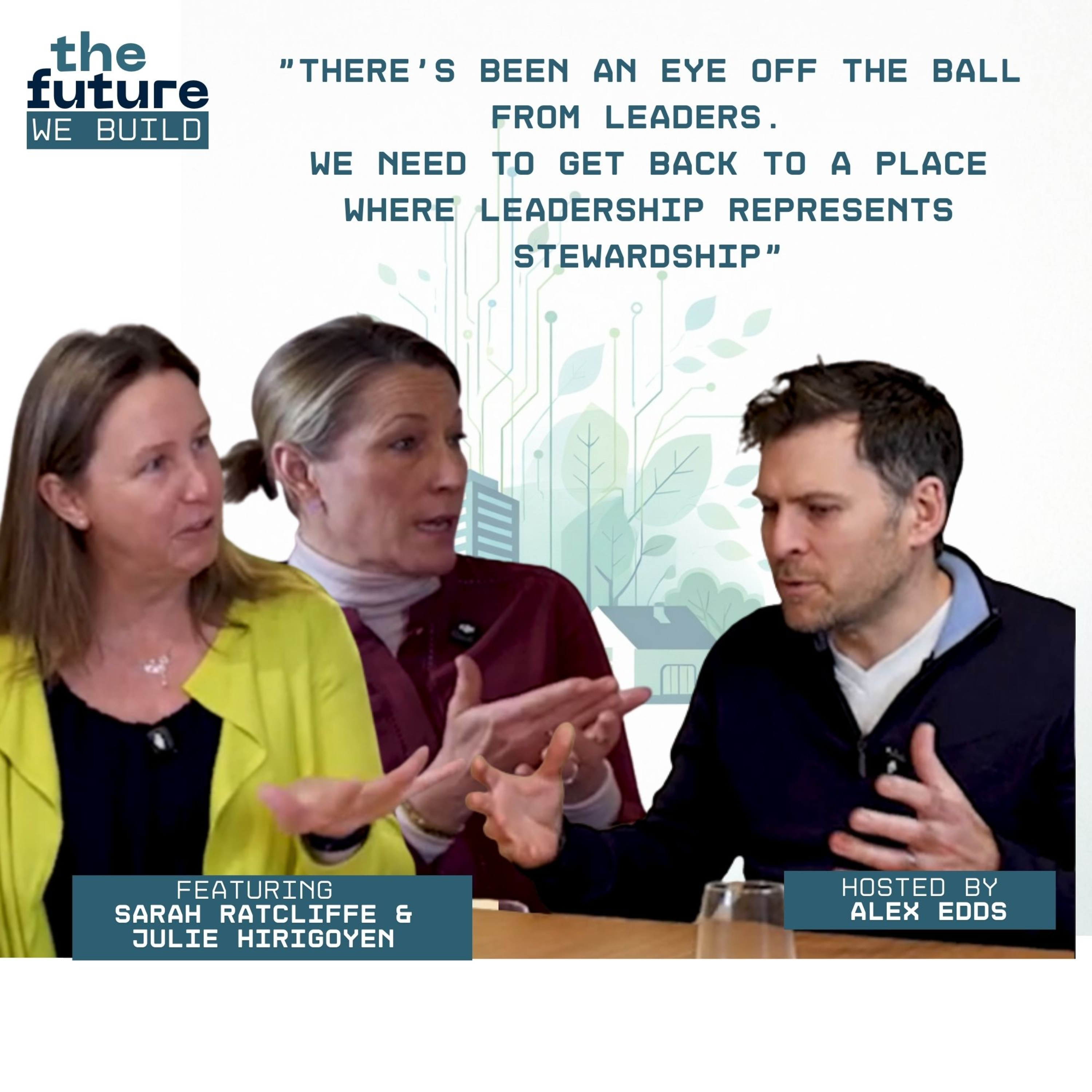
The one with... the godmothers of green buildings. Now is the time for creativity, collaboration and leadership.
46m 50s
The conversation traces the journey of sustainability in the property sector since the late 1990s. Initially, the focus was on raising environmental awareness at the board level, requiring highly creative and bespoke approaches to integrate sustainability into business decisions. Over time, this evolved into systematization through toolkits, certifications, and reporting, which, while embedding sustainability, may have reduced bespoke innovation. A significant current focus is on operational carbon decarbonization, driven by measurability and ROI, but this often overlooks critical whole-life carbon impacts. The speakers note that complex, interconnected challenges like climate adaptation, nature, and community well-being are difficult to address at the scale of individual buildings. They suggest that future advancement depends on making these systemic connections, learning from large-scale regeneration projects that can manage broader inputs and outputs, and fostering greater industry collaboration to tackle geographical and portfolio-wide resilience collectively.
But your presence here and you're really helpful and thank you massively. You might not say that after we said what we've got to say! That's true, yeah. Welcome to this episode of the Future We Build. I'm super excited about this episode. I've got two guests today who were there when it all started for me. Julie Hiragoyan, ex-CEO of UKGBC, now Ned and advisor to a range of investors and property companies, and Sarah Rackliff, CEO of the Better Buildings Partnership. Both Julie and Sarah were the co-directors and leaders of the small consultancy upstream that I joined back in 2006. So this is where it all started for me and it's great to be able to come full circle and discuss with them. What progress we've made as an industry over the past 20 years, where we find ourselves now and looking ahead what's needed. We really pick up on topics such as collaboration and the need for collaboration within the industry, the skills that are needed. And we reflect on actually what we want from our urban spaces and the reliance that we have on nature and our communities. It's a great discussion with two powerhouses in the industry. Let's dive in. Thank you both for joining me here on the future we build. Real privilege for me to have both here with me today. So we've got Julie Hiragoyan and Sarah Rackliff. And why this is really important, probably obvious for you to, obvious for me, but for the listeners. This is where it all began for me, is back in 2006. I think it was when I joined upstream. I think it was 2006. I think it was the eighth person to join that team. And obviously what happens since then and the journey that we've all been on. So I was really keen when I was thinking about this podcast and as I say the stories that I wanted to tell and reflect on was for me anyway going back to the beginning. And actually we had some recorded an episode with Robbie Epson and Emily from Sables. And we were talking about what was and how it's gone and just the journey that we've all been on. And I guess one of the things that came out of that and I'd be good to get your reflection on this is it felt like the first sort of, we were sitting this earlier like the first five to seven, ten years when it was hard. We were challenging. We were all kind of like fighting a good fight. But it felt like we were really creative. We were like really coming up with some interesting solutions. We were getting in at the C-suite level and we felt like certainly from a personal perspective like we were really kind of challenging the status quo and being really creative in the solutions that we were coming up with. And the reflection certainly from the session I had with those was obviously there was a great positive step of a lot of the industry. And I was like, I'm boreding people bringing in house teams, you know a lot of that went in house. But perhaps coupled with regulation and some of the other issues and other drivers that some of that creativity maybe sort of slipped away and a lot of it became a bit more compliance and tick boxy and also the whole reporting. It was a very quick but it was an interesting sort of takeaway from that that you would ironic because you would think perhaps as we progress things would get easier and things would get more creative and things would get more innovative. But actually it felt like perhaps not. So anyway, I'd be good to get your impressions on what your thoughts are about where you started, what you wanted to achieve when you started, how that sort of arc to now has sort of been for you. And where where we are today is is it where you thought we'd be? Julie, do you want to be question? I think it's worth saying that we started sort of almost 10 years before that. In late 1990s was so I started a year before me I think in environmental governance as it was then called and it's probably worth just reflecting back on that. And actually at that point it was really just about the vision and the ambition was just to put environment and environmental risk and management on the map for property kind of investors and developers. By 2006 I think we'd already grown quite significantly. There were 35 people in the upstream team we'd renamed the organisation and it was very much more focused on sustainability not just environment. So even in that decade there was a massive shift and I would agree with you that because of that the early years were really about environmental awareness and kind of board level engagement and we always used to say we were banging on closed doors. We kind of were no one had this on their radar. So in that respect those you know when the monitor is back over that decade there was massive progress because suddenly everyone many of the pop goes many of the listed companies many of the institution investors were starting to recognize it as a mainstream investment risk or business risk and certainly environment and we're starting to embrace sustainability and the wider socio-economic agenda. I think we had to be super creative because we had to make processes up to integrate this into their mainstream decisions. So everything was much more bespoke to the organisations and businesses that we were working with and if you fast forward to kind of like ten years ago maybe even mid you know 2015 kind of era a lot of it had been already kind of turned into toolkits and certification ratings and you know Gwere's systems. So it's become formulaic in a way non creative and tried to be systematised and I think that's lost some of the bespokeness and perhaps also something nuanced what it means to different businesses. I pause there because I carry on but I'd like to give Sarah chance to reflect on that but it is worth I think those first ten years were like awareness raising and then it was kind of you know embedding into key core systems in a bespoke way and then it was systematising and you know hence where we are. Which is pretty worth saying that was I guess always the goal right is how do we embed this how do we get this system twice how do we get investment committees how do we get regulators how do we get so in a way that was always the goal. Yeah those first twenty years I would say achieved a lot took too long. Yeah I mean I think she is described it very well. I don't really think I have a huge amount to add to that you know it's a really eloquent description of the different phases we went through. I think probably you know the significant things to emphasise in terms of those first phases were that we went in a board level so it was trying to put environment and sustainability strategically on the map at a board level. And then once you had done that and it was about the basic building for us to remember where we started very very straightforward things which now you look back and think well there aren't many organisations who don't have these things in place but it was really quite basic. But I think Julie is described it well in terms of saying what she then you know the next kind of decade or so was all about embedding. I agree with Julie that the pace at which that happened was you know it's quite slow when you get into sort of changing processes and systems and you know kind of really embedding things you you have to build the systems and processes but then you have to bring people on board and that takes time. I think from a sustainability perspective we would all like to see have seen that happen a little bit more quickly. I think one of the challenges around that is almost what's got embedded and systemised highs and what got filtered out during those stages as well. So there is that kind of you know that there was inevitable where in terms of kind of governance transparency reporting which then you have to narrow down to what is it possible to report what is possible to measure but also you know in terms of the scope than the capacity of organisations to take on sustainability holistically you know is limited. It was necessarily kind of narrow down to you know sort of a smaller number of challenges if you like that would then systemise. There are still some that are not you know. Essentially in it just reflecting and like thinking like the things happen by accident or by curation but like there's obviously now a huge focus on decarbonisation there's an entire industry energy management of you know energy platforms energy optimisation. It's a huge like stack now of companies trying to solve that problem and it's almost as a direct consequence of that evolution that you've described which is well what can we measure and we can measure energy and there's an ROI to that. Obviously greater one now than there was but and that became then I suppose the language that often was talked about and it's like well this is the one thing that we can actually manage and measure and then actually do something about and it's burned an entire industry. Perhaps bringing us to kind of present day is almost sort of taken over the agendas and what from all of the other issues that we felt were important and sort of as you say sort of got filtered away is this just sort of big machine of like decarbonisation and that's there which is absolutely needed certainly in the sector that we work in. But it's just interesting whether it's what drove what. I mean it is the single biggest impact of this sector. 25% of our carbon emissions in the UK you know directly from.
from buildings, and that's not counting infrastructure and all of that. So I don't necessarily think that's a bad thing. I think we had to focus on the most material things, otherwise we'd have not done anything. The piece of that that frustrates me is that it was single-mindedly and has been for so long about operational energy and carbon and not about the whole life carbon. And so even though those discussions now are, I remember when I first took over the UKGBC role, and body carbon was quite contentious for us to focus on as an organisation and I didn't quite understand why. And when you look at the sort of, you know, that increasingly it's going to be like more than 50% of a building's footprint. So we all know those stats and yet that's still not regulated, it's still pretty difficult to do. We still don't have the, to your point, the kind of solutions and the tech and the, you know, the data that we need to really take that. So it was all indeed the alternatives, right, from the materials point of view and the design point of view. So I think even with the biggest impact and even with, you know, such a singular focus, we're still only looking at less than half of the pie. So it goes to show how complex and, you know, how slowly we're going. I personally think if we'd gone at that pace with everything, all of the different impacts, we'd have got, we'd have got frozen and frozen out and we wouldn't have made any progress. Yeah, that's a fair point. I was at event this morning actually and it was a bit sort of like moment, is this 2015? Yeah. Talking about embodied and it's really important and it's okay. And what struck me was the conversation was around value and it's like, well, you know, tenants demand it or investors want it. But because operational carbon is what they can measure, that's the currency or that's the language that they're speaking to them about. But they're missing the border picture, which is they're picking building A over building B because it's got a good operational footprint. What about the whole life of carbon footprint? And actually building A or building B might look very different if you were to provide that whole picture, but we're not. So it almost decisions are being made based on a small subset of the information, which yeah, it's very difficult, very challenging. I mean, I think in a way, it's totally just to get very specific. I also think that depends on the different players and where they intervene in the process. So with whole life carbon, you know, really critical to understand that as a whole picture, but actually if you're kind of, if you're very transactional in the market and you're transacting existing buildings, then that carbon's already spent. And it's how you account for that, how you then kind of bring that into kind of a forward-looking perspective and think about the risk and an opportunity associated with that. So I think there is a challenge around that. But to come back to this point around kind of, you know, creative thinking, I think, you know, perhaps where some of the creativity now is about beginning to make the connections, you know, that the tentacles that come out from kind of that very specific focus on energy and carbon and realising that actually if you look at that as a single issue, what it does is its tentacles reaches out. So, you know, how, you know, how we address mitigation then leads you onto thinking about how are we going? And I'll fit Legion to the whole question around adaptation and resilience, and it leads you into the whole kind of area of nature and how those kind of different things interact. And you were talking about creative, I think that's where the creative thinking is at the moment. How do all the how are all these things interconnected? I fully agree with you. I guess I struggle to see, and I don't know whether this is human trade, but we almost need, people need examples, or they need to see what does that actually look like. And I think the picture you're painting, which we can all sit around and sort of discuss and understand from a sort of conceptual perspective, but actually seeing what does that actually look like for a building or for an asset or for portfolio? It's, I mean, I can't point to an example where that's, you know, where that's scaled. And I think that's perhaps one of the challenges is we understand what a decarbonised building looks like, or an energy efficient building looks like. There's tech, it looks like this, there's, you know, ways of designing it. But when you start to think about, as you say, that more holistic, I don't know, it's sort of, one that hearing you speak, it's like, can I go and see what that looks like? I think that's give people an idea of that. Yeah, I think that points to like one of the fundamental flaws of a kind of a market like real estate, or an asset class like real estate, is, you know, we're generating income streams from a fixed built kind of real asset that isn't, that is very difficult to change, you know, inherently, very costly and difficult to change, and is very illiquid in some ways, you know, I mean, yeah, we transact them frequently, but it's quite a big deal. So I, you know, and also it's so inherit, inextricably driven by its sustainability is inextricably driven by its context. So we're trading on a kind of, you know, a very singular level, and actually the real physical asset is in a really complex kind of rapidly changing, you know, physical and economic context and social, and that just, the two don't quite meet. So to your point, you know, if we think about something like nature, you know, that's really hard to do something meaningful on one building. We know that, right? But if you've got a huge regeneration site like, you know, a big herb and region site like Kings Cross or something, it's much easier, and in fact, you almost can't not do it because you've got to think about flood risk and you've got to think about overheating and you've got to think about people's quality of life and health and well-being and quality, etc. So it's the same sort of thing. It's like if you're trying to do adaptation on one building, and you really haven't got much chance, whereas you need to look at, you know, what neighborhood is it sitting in and where the local, you know, hydrological or kind of, you know, flows and what wants the drainage like, and we can't think in the way that we think transactionally about some of these very connected systemic problems. So I've thought about this a lot actually, as in terms of the, and we've seen it in London, right? You mentioned Kings Cross, you've got British land, Hills Court, there's these big developments where it makes use, there's infrastructure, and as you say that allows that single entity to think more holistically about inputs and outputs, and whereas you say, you know, I'm transacting a building in the city of London, you know, what can I do? And so, yeah, I guess from a leadership perspective, are we now starting to see those that control, sort of, I guess fundamentally larger footprints and have those different inputs and outputs? Just because of need ultimately, there is actually a need to consider these wider impacts versus, and then I suppose is it therefore unfair to expect the single asset owner, because they just don't have, there isn't that externality that they have, they don't see the externality that they're at risk to, and I guess with that, is there then a role, what is the role of the government or the Ministry of the people, whoever it is, to try and bring up? I don't know, it's just, I think as you're talking, it seems to be the trend, doesn't it? Yeah, I mean, it is really challenging, I think also to kind of just think about it and the wider context, I totally kind of agree with what Gilles said in terms of actually the way we treat buildings as a single entity, which is disconnected from, you know, around that in terms of how investment decisions are made and so on, but I also think there's a context there in terms of, you know, the types of investment vehicles, the types of portfolios, so, you know, equally in the same way, if you have a, if you're investing in an area and a big regeneration project, you can see where all those connections are, if you're also, if you also have long-term patient capital, then, you know, you can actually, the way you approach that prospect is very different to if it's a very short-term highly-transnational, I suppose what I would say is that in terms of sustainability, I'm thinking about the sector as a whole, you know, it's thinking about how, it's kind of a dual thing really about how you challenge that, but also work with it, you know, how those investment vehicles are constructed as kind of outside, if you like, where the sustainability kind of professionals work, but there is a relationship there, challenging those investment vehicles, challenging the investment criteria on which they're based, but then also kind of working well, if you have got this type of, you know, investment vehicle, here's the most material things you can do, if you've got a long-term patient capital, you know, big projects, there are probably other things that you can do, and it's sort of a more nuanced approach, I feel. Yeah, I mean, there's a few things going on in my head around, you know, the resilience of that investment asset, whatever you want to call it, if I was in a capital investor, and I was thinking about over the next 30, 40, 50 years, does that mean that those that control a bigger footprint and can control some of those externalities are in a better position to be more resilient, and therefore is that asset, and that investment going to be more resilient, that's a high-pitched question, but it's an interesting one, but I think it also opens the door to, we talked about this before we started, the role of kind of like industry bodies, and you mentioned the word collaboration of where you do have investors or holders or managers of individual assets, but they're all next to each other. Pick the city of London or the West End, right? We've got lots of
of members of the BPP, they all own this buildings, but they all think about them in very much an isolation. Is there, you know, what is the role, I guess, of the industry body, and is there a role, and is there an ability to think about, or how do we start to think about that geographical location that has support, and can sort of support and contribute to resiliency. - I mean, I think that the construct of place is much more conducive to doing what we need to do, to make the built environment, and it's kind of broader sense, more sustainable, to drive more sustainable outcomes from how we use managed investing, develop urban spaces, which therefore means, because it's fragmented in ownership, and the owners of the different, but, you know, parts of it are not even in the same kind of categories, I might be infrastructures, I might be local authorities, I might be landowners, you know, you need the collaboration, you have to get that collaboration, that's the bit that, you know, way these kind of formulaic tools that have targeted very single kind of users, have, you know, that that's what it, those things are great for them to systematize, sustainable within their processes, but it doesn't deliver the wider change that's required, so it can be a bit tunnel vision, and not necessarily, and have unintended consequences potentially, not to say they're bad, just more to say, we need both and, and so that's why I see the role of industry bodies, is a grouping them together, so that they're at least, there's consistency and commonality in how they're all doing it, so that, you know, not measuring apples and bears, but then also to bring others to the table, and I feel like as an industry, it's still quite siloed and insular, you know, real estate doesn't often connect with energy, I mean, that is, if we want to decarbonize, build environment, we need the two sectors, I literally hadn't, in hand, and there are plenty of other examples, right? So, so I feel like that's the bit we haven't got to yet, and I think there's a big role that we often talk about, radical collaboration, and, you know, that that is where it needs to happen, and it's kind of, you know, genuinely new commercial models of ways of working that knit these different interests together, so that we, you know, we are doing it in tandem and, and together with other sectors, the local authorities would come into that, right? I mean, adaptation of resilience, we've mentioned a few times, you just can't do it, you can't expect the building owner to do it on their own, it's, they've got to connect with other building owners in that place, and with the local authority, in that place, and the public authorities, and the highways, and then you get some meaning for action, and there were some really good examples internationally, of, you know, sponge cities, or, you know, those have all happened from not one body or one organisation, but multiple, like, government-backed initiatives. Yeah. No, I mean, I totally agree with Julian, and I mean, I think this idea of place, you know, and actually kind of getting greater collaboration there is really critical. I think, you know, the other way in which we need to collaborate is all the organisations working together. I mean, there's obviously different cohorts, kind of, there are different, you know, there's a cohort in place, but also there are, you know, there's obviously the private sector, the public sector, but then there's professional institutions, industry, bodies, trade associations, membership organisations, all through the value chain. All through the value chain, and I suppose, I think that in terms of actually moving forward with that collaboration, that then that ecosystem of different organisations needs to work more effectively. And a very symbiotic way. Yeah, it would be kind of rationalised, right? I mean, there's two mentors. I mean, I don't know any other industry where, there's as many as there were, and the construction and property value chain. Well, I'd be interested to know that. I think in our sector, we tend to look at our sector and because we're in it, we know all those different organisations. I'd be interested to see if other sectors had, you know, a similar complexity of complexity. It is mentally just list out anything. The construction sector, then the architecture, and the encounters, and the managers. And they're each talking about their own bit. And rather than thinking, I mean, I asked a question at the end, but we've kind of already answered it. We should be like, what does it we wish for? Clearly, collaboration is going to be one of those things. But, you know, okay, I mean, yeah, it's, I guess, in some ways, and thinking internationally, there are obviously countries and cities where they're starting from a blank piece of paper, and this is the master plan, this is what we're going to build. And therefore, I don't know, you could argue both sides, but they can sort of think about all of these different externalities from day one and plan the city, plan the town, plan whatever it is. Whereas in Europe, traditionally, and certainly in the sort of older cities, we're dealing with what we've got. And we've obviously, certainly in Western Europe, we've got a lot of this, you know, just say high value real estate. And so there's going to have to be from government or industry bodies or another thing. There's going to have to be a way of trying to get this sort of geographical piece to sort of knit together and think about, okay, guys, how do we sort of contribute into the resiliency of this place? And that isn't just fabric, right? That's also how do we continue to attract people? How do we get the best people here? There's so many dimensions to that as well as just the sort of traditional way, it's going to be interesting. I also think it's really great to have examples of where those things are working well. This is what we need, 100%. And I think that's really critical. I also think it's really important just to acknowledge that, you know, in terms of all of the buildings exist, all of the communities, all of the locations, you tend to find that those examples are in urban centres or where there's a definite confluence. And I think the secondary, you know, that this kind of what called a bifurcation of the market, where you've got, you know, prime locations, prime assets, bigger than regeneration projects. You can see how that can kind of stack up. I also think as an industry, we have a responsibility to think about how that impacts on, you know, the secondary markets, the secondary locations, and you know, what that means, and actually think about learning from those examples, then how they translate or whether there's a different model needed for those other locations, because, you know, we tend to focus on the big cities. Yeah, I would agree with that. I mean, I'd leadership, but I think we need it all. Yeah, I know, yeah, it's the long tail, right? The current political discourse doesn't help with that, because actually when you think about it, you know, of course, these topics, climate and others have been politicized and I don't blame in a way I'm not surprised by that, because there's an easy narrative to spin that this is going to cost more, and it's going to undermine our standards of living, and go up, there's an equally good and strong argument to be made that actually in places that really, whether the disenfranchised kind of voter is likely to be, you know, they're hollowed out communities with really, you know, tired and ineffective buildings, with very few sort of opportunities for jobs, and you know, whatever one can paint pictures, those are the places where actually revitalizing the urban fabric could provide a huge number of different opportunities, lower billers is an obvious one, but you know, new skills, new jobs, different ascents of pride in the community, you know, quality of life, air quality, you know, it's just multiple kind of benefits on benefits, and so it's deeply frustrating in some ways that actually we're not looking at it in that respect and thinking well, actually the real estate component or urban renewal could drive all of these societal and economic outcomes that we're all craving and environmental, and therefore we need to kind of, you know, incentivise and do whatever it might be through government taxation through, you know, whatever it might be, that over and above many other things that we're incentivising like, you know, all in gas subsidies, because that's going to be at the core of people's experience and daily life and blah, blah, blah, so it's quite perverse 'cause I think a lot of those are the secondary tertiary places where many investors wouldn't touch with a barge ball for good reason, but actually need to be kind of, you know, we thought from the bottom up, and that would actually lead many better outcomes. So it's just, yeah, I find it really frustrating that the kind of politics is really good. - Yeah, it's where that collaboration is key, isn't it, because in order for the private sector to be active in those places, they need the confidence to do that and part of that confidence is through. - There's doesn't take much from the government to give that, right? But it just needs to give certainty in a bit of longevity to like, we're gonna do this, now come and board with us. And I just, yeah, it's actually just how I was gonna ask the question, like, where we find ourselves now, sort of, you know, the last 20 years of progress, and we sort of find ourselves at a point where, I don't know, in some days, I mean, I turn on the news and it's like, oh my god, have we gone back in time or, you know, we seem to get down to different paths to the one that I thought we were on, and obviously, you know, we don't know what's gonna come tomorrow, but there's, you know, there's paths that go into place where I should've done that, I don't wanna go, and maybe we won't go down there, but to your point, the loudest voices around you use, and politicising and using, and I think it's, you know,
energy and carbon has sort of captured the sustainability, you know, sort of taken the sustainability word and made it its own. And it's been, as you say, sort of made a dirty word. But you can, yeah, as you say, where are the voices to say, "Hodong, no, this is a huge opportunity, there's jobs, there's low cost to reduce low cost living." But it's just been just, yeah, it's just the loudest voices of the ones that are saying. I take some hope from the fact that there's an inevitability, both in, I mean, this is where my hope and despair come in and equal measure. But the inevitability of the science, which is becoming so, so obvious and, and frankly, undeniable. And so impact upon impact upon impact, you can't keep denying it, right? It's happening and we are losing, I can't remember the last 120 trillion or something last year in the top 10 climate events globally alone, right? So it's kind of, it's just ridiculous. And that's going to keep happening and the economic impact, you know, the sort of lack of, the sheer speed with which many of these technologies are becoming cheaper, both to install and invest in and to operate. So I think like, yes, there's a huge narrative and a huge, you know, it's a sort of powerful movement against it, but those drivers are going to, you know, any foresighted business and private sector in particular is going to say, well, the music is one thing, but the economics is another and it's going in that direction, whether we like it or not politically. So I'm going to put my chips on that, on that bit of the, you know, of the deck or whatever and invest in that. Yeah, I mean, I think I would certainly reflect that kind of, you know, alongside all noise, alongside all that rhetoric, you know, that because the science and the evidence is there and because it is being acknowledged as based a risk and an opportunity, the work and the ease, you know, underneath all that kind of noise and tuberous, you know, that from a private sector perspective, from an investor perspective, it isn't something which is a judgment call. It's based on kind of evidence and, you know, risk opportunity analysis and that, you know, that work is still going. A fast, fast, is growing bit of the economy. Well, if we had double digit growth in other way, it's like construction. We'd be laughing. I think I was shouting about that. It's bizarre. Exactly. I had Vincent on from Green, the investor network and exactly that, I also think that question is, you know, if thinking about it from an institutional money coming into real estate, he's like, well, yeah, we think long term, these issues are long term. Of course, we're going to continue to invest in it. US is a slightly different story and there's some perhaps illogical decisions being made that are driven by politics, but generally certainly in Europe, we'll follow the money. We follow the risk. We know where the risk is and we're going to, and as you say, the opportunity, and then again, the irony is when you look at countries like China, they're doing some great things. They're not doing some not so great things, but the economic boom, certainly within the clean tech industry, is just phenomenal. Yeah, in Europe and America, we're saying where's the opportunity? Look what they've been doing. So, yeah, it's kind of odd that for whatever reason, the voices of anti voices have become the loudest voices that have sort of muddied the water a bit. Tech, consensual media might have something to do with something. It could well do. It could well do. So I guess, you know, that's where we are challenging times and however long they'll go for, but I guess thinking about both yourselves in terms of, you know, what you want to be doing, what you are doing, what you think you'll be doing in the future. I'm obviously spending a lot of time thinking about that now. I'm just curious to kind of get your thoughts about where both you will be going and what you want to be doing going forward and where you think the market either needs to go should go. I guess what your message is to, you know, the listeners out there, you know, if they're in real estate companies, whether it's heads of sustainability, whether it's CEOs, whether it's service providers, whoever it is, like kind of what's, yeah, just curious to kind of get your thoughts on where do we go from here. I mean, I don't know what time I was in the other thing out, but if I look forward 20 years, I might not be around. So let's be serious. I'm by 2045. I mean, we need to have pretty much eliminated all our emissions. So we've got quite a bit to do in that time. I'm not going to give up on it because that's what's needed. I think we have to keep, I think when we've squeezed the time frame so much that it will be much more painful to do, but I think when some of the sort of, you know, the things that kind of keep me up at night, the things like tipping points and the science. And once some of those which are imminent start kicking in, I do think that we will, you know, human ingenuity will kick in and we'll try and sort it out, but it will be quite late. So I think the window of opportunity to do that is definitely in the painful zone now. It's going to be, it's going to hurt. I, you know, I, it's a server quite rightly pointed out to, you know, reflected back on when we started, we engaged with Chief Executive and C suite. And I feel like that's what's been lost a little bit in the, in the kind of systematisation, which has to happen. There's been an eye off the ball from the real leaders and actually those leaders have changed over time. And now, and I just think we need this to be absolutely baked into and kind of well understood and part of the legacy of those who, you know, are at the very helm of these organisations that are producing the, you know, well, to your point, the future that we build, right? That is there, that is their legacy. So we've got to somehow get back to a place where leadership, genuine leadership, represents stewardship, custodianship and future, you know, safeguarding, safeguarding for the future. And I would, you know, that's where I'm spending my time now because I feel like unless we get it baked in at that level, we can do all this stuff that we want underneath, but there's no real accountability. So board and meds and chairs and CEOs and they have to get that this is their job, not the people who come behind them. That's, you know, non-negotiable, I think. Yeah. Okay. Yeah. And I mean, I guess, I, you know, agree with that. I guess I don't see it in the sort of, um, rules talk about, you know, things in a binary way. Do this, don't do that. Do more of that, do less of this. I don't see it like that. The, the challenges of such magnitude, we need to do it all and we need to do it at a faster pace to, you know, effectively make sure that that very last bit isn't so painful that it, it, it, it is incredibly disruptive. Um, so I think it, in terms of where, you know, that focus is now both sort of, you know, has an individual, but also thinking about where we need to go as a sector. Um, I think it's about being really incisive in those different places, understanding what's needed at board level, understanding what's needed in the implementation, you know, and also the pace that, which, which that needs to go. And I think, um, you know, within that, there's a, where are the opportunities for leadership? What, what, what is going to kind of, as Julie says, kind of bring those boards back on board in terms of actually kind of, you know, making sure that, that leadership is there, spotting those opportunities, but not only for individual leadership, for collectively to ship across the industry. And I think there's that whole point around, you know, not, not just how individual organizations move alone, it's how we move together. So I think probably, you know, I would say that wouldn't I given that the role I'm in as, you know, in terms of better building this partnership and the Green Property Alliance is, you know, let's not think about this individually, let's think about it collectively, how we can demonstrate leadership and, and move forward. So also kind of valuing all of the other stuff that needs to be done, resourcing it, supporting it appropriately to make sure that can move forward as well. So we started at the beginning saying that the last 20 years progress was good, but it went too slow. So everything you'll say, I mean, had a lot to genuinely think when, you know, the people you're meeting with, there's people that you know, the people that lead is that we've got, are you hopeful that because we need to make that change quicker than the last 20 years, right? So, you know, I did, do you feel confident that we have the right skills, the right people, and that's all there, and it's, and it's, and it's, it's poised to deliver that, or are you nervous given what's going on, and perhaps just where we are and who, you know, how it structured. But definitely don't feel like we've got all the right skills and, you know, that we're there now, personally, no. But I am, I have to remain hopeful, otherwise I don't know that there's any point in doing what we do. So I think, I guess, going back to what I just said earlier, that the penny is dropping increasingly fast, and, and, you know, despite all of this sort of political noise and rhetoric and geopolitical, you know, setback, it's almost like some people call it the last thrash of the Dragon's Tale, isn't it? Like, what's coming after that? And I, I mean, my hope comes as much from kind of community, what's happening in communities, and people are taking the initiative and saying, we can't wait for top-down change anymore, but at ground routes, grassroots level, there's a huge amount of stuff going on, there's community interest companies being set up all over the place, you know, schools putting PV on their rooms, you know, streets retrofitting.
together. I mean there's a real grounds well and I think that's really exciting, particularly in the Rotten Barberman, actually because it is a physical kind of, that's on neighborhood in a way. So take huge hope from that and the fact that at pace there is a changing of the guard happening at those upper levels of organizational leadership. I don't think we're there today but I think it's worth going after in terms of, you know, I've got to be comfortable with it. Yeah and I'm a natural optimist and you know like Julie I do sort of believe that the human ingenuity, human ingenuity, creativity that you know is there, it needs to be unleashed and it's been the right place and it's not all doing AI or something else but yeah. I mean I think what could help? Well yeah I think that's the part of that creativity, a part of that engineer is about learning what skills needed in the right places but also how things like you know AI technology can help and assist in the right places. So yeah I mean I'm an on optimist so I naturally remain hopeful and you know when you see the communities of people and I use communities in the wider sense. Of people who are working really hard to make this happen whether this is a board level or you know in you know it's a very local level. That's what brings me hope and kind of going. A question I ask everybody and we've kind of answered it so if we don't need you don't have to answer it. We're not something else if you feel like we've already covered it but I ask all my guests like if you could get one thing change from government business and or individuals and it could be all three or just one of those. What would it be? I mean we've kind of talked about collaboration we've kind of talked about you know the sort of spatial element of it whether there are things there but yeah if there's anything that you would want to say or add in then yeah is there anything. I mean I probably give a bit sort of it could be a magic one one like if you can get them to one thing what would it be. I change their mindset. That's a small one. I mean I really hope that part of that is focusing on outcomes rather than you know input and processes and so really religiously focusing on outcomes and being clear what good looks like and what we're really striving to do and not I've but it's okay because we're measuring and we're doing that. That's just like let's think about what we want to achieve and let's measure what we want to achieve. If we just did that everything else will stop falling into place. I mean that's one example of mindset. I could go slightly more deep and spiritual but I think it also goes to the point we talked about earlier which is I think we need to give people examples of what does that look like. Certainly I'm a visual person and I think we're really a tangible thing we look at it we feel it is like tell me what you know show me what does that actually look like so you know message out as leaders those that are out there that are doing some really cool stuff. Tell me show me we can share it but I think that's that I think a lot of people need to see what that looks like. Anything for me. Yeah I mean I'll maybe start really specific and then go back out again I mean I think underlying some of what we've talked about so I know it's quite specific and incisive is data. Okay. So if I was to do one that you know I think all markets can be creative can be innovative but quite often what they need is data to help support that and I think in the real estate industry we've had so many different attempts to make data available to market and for one reason or another you know we still haven't got whether it's embodied carbon or whether it's operational energy if we could just have that information more freely available to help people informed decision makers does really incisive kind of very specific example of one thing I would like to see I suppose at a deeper level I suppose you know Julie talked about changing mindsets I suppose my kind of more sort of existential thing is about this issue of connection you know so that everybody begins to see how things are connected which is related to your point about changing that mindset is that all of these things are connected. And ultimately the nexus of that is the planetary boundaries within which we operate. Do you know what I mean we talked about it before we started is the I guess the schools from which we came through how we learn that was just built into our DNA is you know we're just how we all survive and how we say and I you sort of worry wonder but the you know the generations that follow and those that didn't go through that schooling I suppose is that there just seems to be a complete disconnect from you know I live in a city this is my job and you know I live in my works online and what's my connection to nature what's my connection to clean water to you know clean air etc and there just seems to be that's lost and I know there's a big movement is happening around like getting people back into nature and that's you know that seems to be happening quite a lot so I'm all for that but it's sort of place at that point right as we almost need to reeducate people certainly those are in positions of authority just understanding how this all kind of nits together because you know you can't yeah it's yeah it's the end of the pendant so that was going to be my deepest spiritual point we've ended on that now thank you so much both of you for your time I pretty appreciate it I've finished on time hopefully for you to make your next thank you so thank you both that's it for this week's episode of the future we build I want to thank you so much for listening to us wherever you are if you're navigating these same challenges from pricing in climate risk decarbonising buildings or if you're scaling a new product or solution join us on LinkedIn search for me Alex Ed's or follow our official page at the future we build that's where we break down these episodes further discuss the topics and discussions and connect you to the leaders engaged in this mission this show and the guest sign by will be influenced by the conversations we have on LinkedIn so if you have ideas or would like to hear the thoughts of an industry leader let me know and I look forward to continuing the conversation with you there you can find the show notes and full transcripts on our website and if you found today's session valuable please hit subscribe on apple Spotify or wherever you find your podcast thank you for listening I'm Alex Ed's and I'll see you next time
Podcast Summary
Key Points:
The discussion reflects on the evolution of sustainability in the real estate industry over the past 20+ years, from early awareness-raising and creative, bespoke solutions to increased systematization and a current heavy focus on operational carbon reduction.
While progress has been made, challenges remain, including the slow integration of whole-life carbon accounting, the difficulty of addressing systemic issues like nature and resilience at a single-asset level, and a potential loss of nuanced, creative problem-solving.
Future progress requires reconnecting systemic issues (e.g., carbon, adaptation, nature), leveraging large-scale regeneration projects for holistic action, and improving collaboration among asset owners and across industry bodies to address geographical and portfolio-wide challenges.
Summary:
The conversation traces the journey of sustainability in the property sector since the late 1990s. Initially, the focus was on raising environmental awareness at the board level, requiring highly creative and bespoke approaches to integrate sustainability into business decisions. Over time, this evolved into systematization through toolkits, certifications, and reporting, which, while embedding sustainability, may have reduced bespoke innovation.
A significant current focus is on operational carbon decarbonization, driven by measurability and ROI, but this often overlooks critical whole-life carbon impacts. The speakers note that complex, interconnected challenges like climate adaptation, nature, and community well-being are difficult to address at the scale of individual buildings. They suggest that future advancement depends on making these systemic connections, learning from large-scale regeneration projects that can manage broader inputs and outputs, and fostering greater industry collaboration to tackle geographical and portfolio-wide resilience collectively.
FAQs
Initially, the focus was on raising awareness about environmental risks and integrating sustainability into board-level strategies, often requiring bespoke, creative solutions for each organization.
It progressed from awareness-raising and bespoke integration to becoming more systematized through toolkits, certifications, and reporting, which sometimes reduced creativity and nuance.
Decarbonization gained prominence because operational energy and carbon are measurable and have a clear ROI, addressing the sector's significant contribution to UK carbon emissions.
Focusing solely on operational carbon overlooks whole-life carbon, including embodied carbon from materials and construction, which can represent over half of a building's total footprint.
Creative thinking is needed to connect issues like carbon mitigation with adaptation, resilience, and nature, often requiring a broader, systemic view beyond individual buildings.
Large regeneration projects, like Kings Cross, enable more holistic approaches by considering flood risk, overheating, and community well-being across a wider footprint, unlike single-asset transactions.
Chat with AI
Loading...
Pro features
Go deeper with this episode
Unlock creator-grade tools that turn any transcript into show notes and subtitle files.
 PodcastTranscript AI