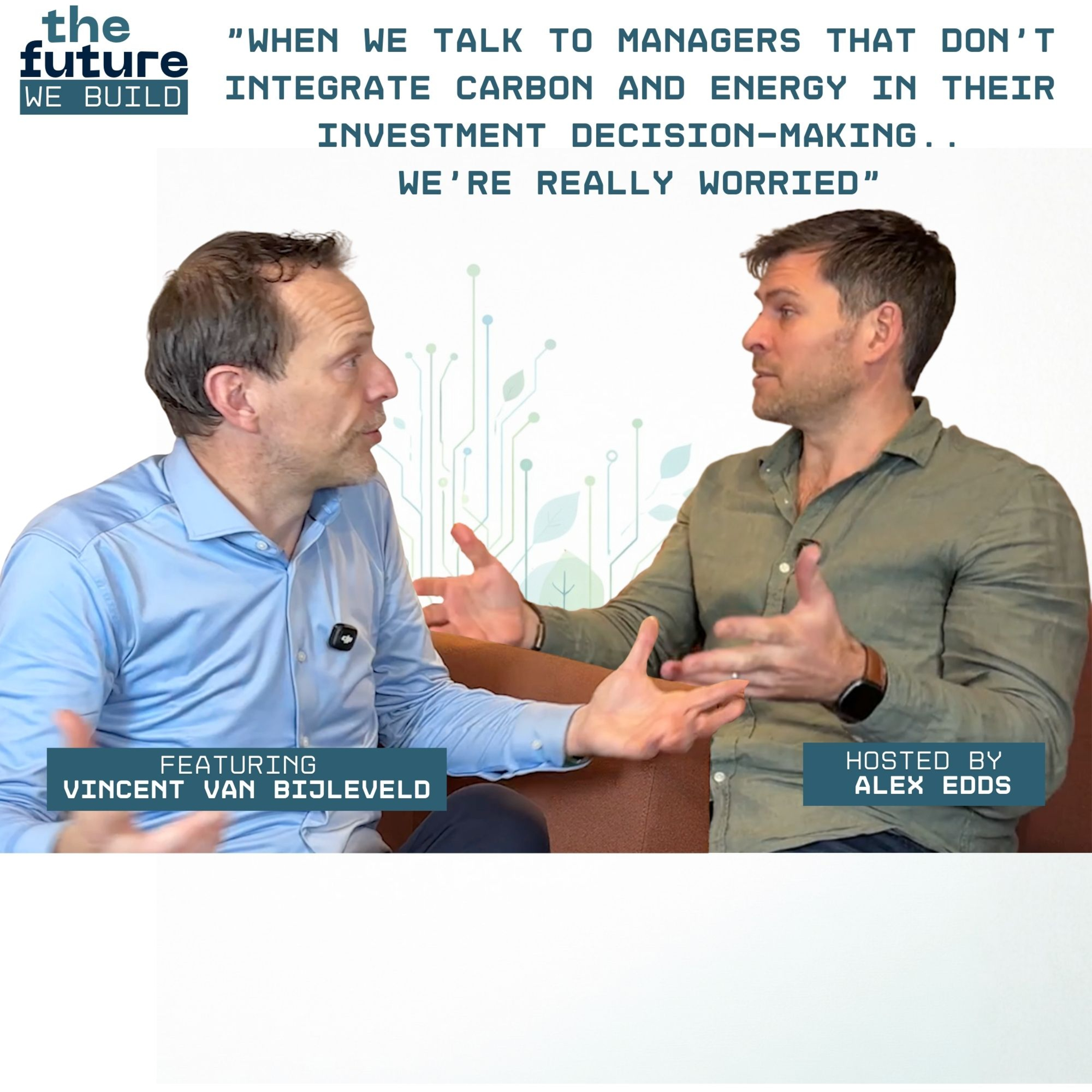
The one with.. the $4tn climate coalition transforming real estate
42m 59s
The discussion features Vincent von Beilerveld, director of the Global Real Estate Engagement Network (Green), which guides institutional investors on sustainable real estate capital allocation. He explains that real estate is relatively easier to decarbonize than sectors like oil and gas, as it doesn’t require overhauling core business models. However, progress is inconsistent due to the industry's fragmentation, with leaders advancing while others lag. A significant concern is the "brown discount/green premium" effect, where selling unsustainable assets may simply transfer problems to private buyers rather than addressing systemic issues. While decarbonization remains central, physical climate risks and adaptation are rising priorities, especially with increasing insurance costs. Regional differences exist: European investors often consider broader sustainability impacts, while U.S. approaches are more financially driven. Ultimately, investment decisions are shaped by fiduciary responsibilities, though some asset owners may tolerate short-term financial trade-offs for long-term portfolio resilience, particularly where regulations or market incentives align.
I was like, we need to have the voice of where the capital is actually coming from, and why is it even investing in this sector? I guess today is Vincent von Beilerveld. He's the director of the Global Real Estate Engagement Network, Green, and Managing Director of Finance Ideas. He leads a powerful coalition representing over two trillion in assets under management and advisors of about 30% of the top Dutch pension funds on how to allocate their capital to force real-world change in real estate. My conversation with Vincent today covers everything from capital allocation into real estate and what criteria comes with that in relation to sustainability. We cover off regulation, whether that's a positive or a negative driver, some of the benchmarks and tools and metrics that investors are using, and stick around until the end where you'll hear what problems Vincent believes need solving in 2026. Vincent, thank you so much for being here on the future we build. Thanks for having me Alex. This is my first one. Yeah really? Yeah, yeah. You're on the first guest. I'm so glad that we managed to make this work. Guinea Pig in English isn't it? That's a good expression. Yeah, you are the guinea pig. What is it then? It's actually a trial remit. It probably sounds even worse. It's not the actual trial rabbit. Guinea Pig trial rabbit. Yeah, it's probably kind of from a pharmaceutical industry. It's not very easy, you're friendly. That's the origin. Yeah, I'm not sure. That's what I would guess. Yeah, true actually. That's probably where Guinea Pig had it from. I guess. Maybe. Anyway, maybe to start with if you could just sort of introduce yourself and a little bit about green and finance ideas. Sure. Well, first of all, thanks for having me in your first podcast. Yeah, Vincent from Baileyveldt. My name, I work for finance ideas and the Global Real Estate Engagement Network. The Global Real Estate Engagement Network in short green is a collaboration of investors in real estate. We started life as a collaboration focused on engagement. So indirect investors in real estate engaging with companies that manage assets real estate. And over the time, we've also included a systemic workstream that works to solve the more systemic issues that a single company can solve on its own. For example, the ensuring that we focus more on the specific measures that are relevant for green premiums, brown discards, et cetera, et cetera. Members are global. They're as donors. They are as managers in direct and they are managers direct that actually, you know, buy buildings. So let's start that. Tell me, why did you start green? Yeah, I think there's a personal motive and a goal of green. From a personal perspective, of course, I'd like to contribute to reaching that zero as a world. I think our generation needs to ensure that the future kind of reaction lives in a livable world. But green is an organization looks at managing financial risks in real estate related to climate change. The starting point from this, like I say, was, you know, where is the capital coming from when we talk about real estate? And I have to say, you know, so many conversations I have. Certainly when you go down the supply chain, the value chain of people who are actually responsible for managing the buildings or, you know, providing solutions for buildings, they actually often don't know what the value is. And value chain is and where and who ultimately is the ultimate kind of beneficiary of why this is even an asset class. And so, like I was saying, when I was thinking about this, I've got, you know, heads of sustainability, I've got advisors, I've got tech people, but I was like, we need to have someone who can kind of speak to why they even invest in this asset class. For listeners, when I was at LaSalle, we obviously were engaged with you through some of our friends as well. And I think, you know, clearly you guys were a voice of that was sort of pushing, you know, certainly our sense was of all the clients we had and all the investors we had. Well, here's a group of investors that not only are pushing probably further and faster than anyone else, but you've actually kind of all pulled together and, you know, rather than every individual client and every individual having its own perspective. Here's a sort of a group that's sort of coordinated. Which is helpful, I suppose, as an investment manager because you're like, okay, well, there's a sort of, you know, we will understand what they're kind of, what they expect. And so I guess, you know, in that regard, what, you know, both in terms of kind of what was, but also what is and what will be, you know, a million dollar question, a billion dollar question, do you think the real estate sector and through the lens by which, you know, I guess you see it through the investments you're made or the members of green, is it moving fast enough? Is it are there signs that it's moving fast enough? Are you happy with that? You know, and if you've got sort of relative comparison to other asset classes, like, you know, where do we sit and kind of how do you lens that as an investor? And obviously this is in the context of, predominantly I guess climate, but also other, you know, sustainability issues as well. Yeah. I think it's a really difficult question to answer because there's different answers and different points of view there. So I think within a real state, it is a relatively easy sector to transform because at the end of the day, we don't have to change our kind of core business, you know, we still own assets and we, you know, we find tenants. I mean, if you're in the oil and gas industry, you need to have to, you have to change your whole kind of business. If you are in the cement industry, you really have, I mean, it's still cement or you really still have to make huge changes to your operational processes, make huge capital investments, infrastructure. Yeah. I mean, if you look at, let's say, the pure energy, I think things are moving faster in wind and solar because it is financially viable to show. In the outer real sector, you know, there's also clear tendency to go to move faster there. I think our sector is not a very concentrated sector. So there's like a zillion real estate managers, which in itself probably makes it a little bit, you know, slower to transform because, well, there's some early movers that are, you know, really ahead of the curve and really making lots of progress, but there's also significant parts of the industry. And even outside in institutional investors, I mean, you know, the majority of assets are absolutely right. Yeah. So it's hard to really give an answer on that. I mean, as a whole, you know, if you look at international energy reports, I mean, legging in many of the sectors, including real estate. So you can't be kind of too happy with, let's say, where we are growing as a as a whole, let's say, globally economy. And I guess, you know, to that point, as you mentioned, like it's an asset which, you know, you can refurbish, you can move, you know, you can reshape, you can transform, and it's still the kind of same bones, which is, you know, attractive in some ways. But it kind of that lends itself perhaps to what's been happening, which is sort of incremental improvements, you know, bit by bit, which, you know, stand back over 30 years. Maybe that's great. Whereas, you know, perhaps in other industries like you're alluding to, there's been transformational change, like it's a new energy source or it's a whole new infrastructure. And I'm just, you know, from your lens or, you know, is there an appetite and you mentioned some of the leaders are, you know, are you interested or is there other things happening that is interesting from an institutional capital that is completely new, a completely new way of doing it? You know, or both, but obviously specifically to real estate, you know, I'm just curious to know, are you seeing any kind of genuine transformational business models? Well, for sure. I mean, but even there, you know, transferring all our assets to newer assets, slash, you know, non-energy efficient towards, I mean, it's all, it's also in a way, a tradition way of doing business. But it's not very transformational. But it is transformational in a sense that, you know, there's, of course, for such organizations, you know, more kind of value-at-opportunistic, you know, they are, you know, not only trying to kind of attract new tenants for, let's say, you know, the shiny new facade, but also because that shiny new facade is more energy efficient. And especially in the office sector, you know, there is a demand from tenants for, let's say, low- and body's low operational energy. So where do you stand on this then? Because this is something I've grappled with. And obviously, I've been in, you know, the institutional, you know, market as it were, in that, you know, you've got all the institutional funds, you know, managing the money on behalf of, you know, your clients and your members. And, you know, we've seen, obviously, a huge amount of movement towards, as you say, that sort of prime asset moving away from Brown or discounted or have you wished to define it. And, you know, looking at moving into, you know, prime and using sustainability as part of that. And, you know, part of my job was, you know, helping to to find ways as part of the acquisition process, like let's screen the asset, let's make sure that we know what we're going to be buying. That does, oh, and then obviously, let's sell the Brown ones. Let's sell, you know, the obsolete buildings. Well, that's fine within the universe of that institutional capital. The problem is that you're selling the building or you're giving away the building to someone else. So the planet, as a whole, to sort of use that, you know, the planet as a stakeholder, they don't really care who owns the building. It's still there. It's still being run. And arguably, if it's not being institutional capital, if it's not being run by institutional capital anymore, it's being now run by, you know, private landlord or something else, they're not going to have the means and to, you know, to transform perhaps, you know, that asset. So there's a bit of a sort of moral conundrum really. I've like, yeah, you're moving kind of institutional capital from Brown to Green and transitioning that. And that all looks great. But what you're leaving behind for other people to deal with,
it is more difficult to see. I don't really know how to square that away. It's a difficult one. I think there's two points to that. First of all, the financial sector isn't, let's say, more than the biggest aspect. So I think we just have to live with that. So of course, it would be great if we can change, let's say, the whole world, but I don't think that's realistic. It's a matter of fact that we are, as it owners hire, as it managers to get returns. So it's-- - Play with the norm. - But I also don't think it's really a big problem. Because at the end of the day, we need a bigger green premium slash brown discount. So whenever institutional investors are selling, let's say, they are lower quality assets, at some point in time, that brown discount will come bigger. I mean, when we engage, we sometimes engage with companies that are not already integrating, especially in Europe. I mean, there's, of course, the whole brown discount green premium, difference per geography, et cetera, et cetera. Especially in Europe, when we talk to an asset manager that doesn't integrate carbon and energy in the investment decision-making process, we are really worried because we're saying, well, you will probably buy the kind of the product for the assets. And as an investor, that's not what I want. So we are pushing them purely for financial reasons, at least that will resonate more with them in general than why don't you save the world. So they will start looking at those aspects as well, which at the end of the day will decrease the value of those assets, which will make it easier for those kind of value at opportunistic strategies to buy and retrofit. So I mean, this is an argument from a residential manager. What the residential manager would say, well, at the end of the day, a private owner of a house doesn't really care about the financial viability of an investment. So if you look at many sustainability, I mean, many sustainability investments will make return, but they might not make a 10% required for a financial manager. If let's say, transform it to a heat pump, delivers a 2% return, but also increases all other kind of things, better place. I mean, as an individual, you might think, well, someday I have to change anyway. Let's do it right now. So it's a little bit less focus on, and again, it's of course, it's an argument that's that's favorable for them. But I also believe that at the end of the day, especially what is already institutional, I don't think that will be kind of sold off to somebody who counts of fort. Any of those kind of-- Yeah, essentially. I mean, that is the game that's being played at the moment, right? Is the institutional player is a really trying to get-- and this is where data comes in, but trying to get really sophisticated on the-- particularly the acquisition point of digging deep into the technical due diligence of building to really understand, is this a building that we can-- and we can sort of underwrite the capex to ensure that we can deliver that, whether it's Grezbo, whether it's a rating system, or whether it's SFDR allocations, whatever is driving that sort of dial. And there's that sort of arbitrage at the moment of, well, there's a market opportunity to sell the asset. Yeah, and at the end of the day, I mean, it's still real estate location location. So most of the men's who would say, well, yes, it plays a role in my evaluation. But does it play a huge role in whether I'm going to hold or sell that building, not necessarily? You've got that right, I think. So of course, if you have two assets next to each other, I'm going to favor the one with lower capex, which is a good thing, because it increases brown and green premium. But if it's a prime location, it's still a prime location. I still want to have that asset. Whether it's efficient or not. Yeah, of course. And when you touched on that, I was going to curious, because the focus, let's be honest, of the last four, five, seven years even, has been decarbonisation. Carbon energy has been the main topic. I mean, when I was at the South, I'd say 80% of the effort of the team, the structure of the team, the expertise we brought in and the focus was 70%, 80% focused on decarbonisation. From your lens and the lens of your clients, when they're thinking about kind of long-term risk and resilience and definition, I suppose, of sustainability, is that the number one? Is that still the number one? Do you see that changing? Are there any other metrics or KPIs or areas of focus that you and your clients will be looking at? I don't think I'm going to suppress you if I tell that physical risks, that they should become much higher on the agenda for several reasons. So first of all, we're seeing those risks now and then while maybe a few years ago, we were likely to know, it's like 20, 70, 20, 80 when those risks are actually hitting us. I mean, insurance costs are going up, especially in the United States. So there's a reason from a financial perspective that adaptation becomes more important. And by the way, also, if we're not meeting those pairs of goals, the risks of physical risks are going to be maybe become bigger and bigger over time. Then there's, of course, the situation in the United States when we are engaging with the United States, reads, I mean, the transition risk has become smaller, at least on the shorter. Because during the current administration, we don't expect a lot of energy. So you see, it makes us to be taken even on the state level. Where the states might lean towards more progressive policies. But don't necessarily want to implement those policies right now, given all the-- They might not call them energy policies, or they might not call them state. But it's interesting because obviously, cost of living energy prices in a crisis, and in the US, right, there's a real drive to cut costs and energy is a key driver of that. So the measures are still taking place. So I would say, and that is a big difference between, let's say, the US and especially continental Europe-- you're getting a little bit in the middle, I would say-- this, again, single materiality versus double materiality. I think many, both on the other side, but also on the manager side, there is more willingness to-- and also more conviction that at the end of the day, it will be confirmation material. Obviously, if there's legislation coming into place, then it is financial material already. Whether you like it or not. So I think in Europe, investments are being made that are not necessarily per today. They're 8% return, but they're just like making it per for you more resilient. And to a certain extent, also simply becoming a good citizen as an organization. I think in the US, it's almost always. Yes, we want to kind of reach the zero. However, of course, within the boundary of sustainable financial return, slash optimal. So we're seeing less activity in general in terms of retrofits in the states than in-- let's say, then in Europe or in the-- So I guess question would be, if an investment manager or an asset manager comes to you and says, that we've modeled our entire portfolio, we've modeled the capex to get us to, whether it's Paris, two degrees, whatever the metric is, that you want to align with. It's going to cost us X. That's going to drag on performance in the short term, but it's going to get us by 2030, 2040, whatever. And it depends. I mean, it really depends also the projector in the office space, London, Paris, Amsterdam. I mean, there is this green premium in rent. So you can't even-- so you need even to be at that level. So it's not always a drag on a return, I would say. 100%. But if I guess over a portfolio of a whole, let's say, with mixed portfolio with different asset classes, if the snarling, if there is projector drag on performance, would you say that your clients or a section of your clients, are there any clients out there that would be willing to say, OK, we're willing to take a short term hit, but make sure that the portfolio is positioned in a resilient way by 2030, 2035, whatever it is. That's their view. Or is it still very much-- no, look, you have to achieve-- within the fiduciary responsibility of the short term margins, but we also expect you to be delivering. Because in the practical reality of what that means, and having been in that seat, it's, well, that means we can only do these retrofits now, and we'll have to put off the next retrofits until the next time in the hope that technology gets cheaper, policies are there, whatever it is. And so I'm just curious to know whether or not from your lens and the clients that you work with, is that conversation happening? Is there an acceptance or tolerance there? So I have to come back to the discussion on who is the asset owner. So if the asset owner is somebody who is responsible for the returns of a portfolio, not really. So I mean, there's the focus is-- so there might be a goal from a board that we want to be more sustainable-- It doesn't translate through. --but it translates to the level that it is financially acceptable. I think if you go to the pension fund board level, and as I said before, my main experience there is in the Dutch market. Now within Green, we mostly work with the asset owner being the real estate department of-- which are the kind of the investors. But in the Dutch market, that's the kind of part of my work, as well. We work with, let's say, making-- in all asset classes, by the way, in making responsible investment policies. And there we see that many pension fund board members, and even more so, by the way, the participants behind those pension funds, because the pension funds actually ask their members, like, what should we do? What is it? What you want to do in terms of risk return, impact stations, and ability? So on the board level, I think there is a willingness to accept without-- Without writing. --more really saying it, exactly. So I'm on shaky ground now. But like, it was like 10 basis points.
Do you really notice that at the end of the day in the pension results, given also the fact that the members are willing to spend or invest in? And I think also they are at the end of the day an investment belief and it's not the truth. So if you are strongly convinced that the legislature will come there anyway and it is indeed investing in resilience, then that 10 basis point is that you might go in terms of net return this specific year will come to you on the longer run. And from a purely technical view, I mean a heat pump is much more efficient than gas boilers. So it should be more, you know, should lead to better returns which is of course a great tillwind for those changes. Current pricing between energy and gas is not necessarily always helpful and also legislation, taxation etc. Now it's interesting, I mean it's the asset test right is if you're setting up a policy or an objective as a business and you're saying look we stand by this is a risk to our business over the long term. But then you don't factor that into the way that you allocate and judge your invest those two things are not compatible. And what I have seen changing I think from I mean the stability people might have in the past be very much like okay, you know, net zero net zero that's what we want to achieve. I think you know really really kicks in in that kind of in that part of the industry as well like okay we can push for something but it's if it's not financially viable, we won't get there. This is actually one of the reasons why within green we have started a systemic work stream where we not only engage with the companies. So it's of course relatively easy as an asset owner to tell you as a manager and your previous capacity like you need to do you know net zero and by the way also still make great returns. But there are hurdles you know if that green premium brown discount isn't big enough then you can't do that. So within our systemic work stream we are now working both with the indirect investors and shareholders if you will and the real set companies themselves to tackle some of those hurdles. One of them being that in many of the kind of rating systems like green lead or grass on the portfolio level those are holistic ratings and tenants and investors tends to be not always too sophisticated to the sustainability. So they think well if it's a great rest score or a great room score this is an edge of building which is definitely not the case. So we are working with the industry to ensure that you know we are measuring the right metrics if you're looking at that I mean all those other metrics are right as well but if you look at the climate then you should look at you know subset of those metrics those should be clear to the markets which should at the end of the day lead in that kind of brown discount green premium difference being bigger and therefore you know better pricing in the markets. I was going to ask you about Grez because it's from within the industry the real estate investment manager is not going to make it any easier for me today. Well I'm just curious because you know from our perspective as the collective I guess of you know within the investment manager and the REITs obviously you know having to complete that it's such a big exercise every year and you know the listens out there that have been involved and it will know exactly. It's a huge amount of effort but on the flip side you know when I sit down with our portfolio managers or fund managers at the beginning of the year what's the need you have to hit five stars it's the only way we're going to go and raise capital you know and I guess you know that so it's proving it I suppose it's own worth in the fact that you're putting all this effort in but it is actually material and I guess from you know so they're from your lens is it because there's an absence of anything else. Like how valuable is that as a tool is it is it is it now become too big and too kind of ubiquitous that it's you know what this is this is now the problem of so I'll start with some positive notes then some criticism and I'll hopefully also end with some change of the last for sure that's probably the last part as well so obviously Greshp has been kind of you know the reason why our industry has kind of you know started to focus on sustainability so I think that compliment to the grads organization you know should always be acknowledged you know without you know there wouldn't be any data which is also per today still very relevant there wouldn't be any attention so I think that that's kind of a lot of agree with that. So then I mean the way Greshp works I think any rating works that you know at the end of the day and sustainability people think that everything is important so so this is important that is important and they don't necessarily care about financial maturity because they are kind of prime yeah topic is you know the better roads yeah so I think and I know that even internally within grass you know they talked about let's say debiaged it has grown and grown over time in terms of metrics metrics and I think the honest answer is that sustainability people might look at all those even that is probably not true but they might look at all those data points but then the actual investment decision is not happening so either they're looking at the overall score like the five stars which is mostly for the less sophisticated investors I mean even the Dutch Centre Bank you know when they when they kind of prepare the draft proposal on how you should manage climate risk they said well a good example is this pension fund is only investing in grass five star funds which I mean as an expert you know we even I know doesn't say a lot about how climate resilient that is either on adaptation or transition so and and then the more sophisticated investors they dive into kind of the more specific data points mostly on the climate size carbon energy etc etc and it's of course really hard to change this system so to be honest I think they have been late in accepting that the technology doesn't work anymore it doesn't differentiate the true leaders you know from let's say and so yeah and then in the positive notice they are now going through kind of tremendous changes so yeah they have been relatively slow as an organization but let's not sure whether if I would have you know I would have been the leader of the company faster because it is hard to change the organization yeah yeah I mean I think you're right and I think they've obviously done that I was just you know looking in the news recently there's some changes coming out big change is coming out so let's see I think you know that now coupled with SFDR certainly from the unlisted side you know SFDR I think in terms of a needle mover that was another one that in the last couple years was really kind of the non-sustainability professions if you like so you know the again having you know a bit on the inside of the fun teams the investment relations teams you know everyone was or we need to be articulate we need you know we should be able to go nine to be able to go so I think that again you know looking back really positive in terms of and you know marker did they get it right first time no are they re adapting it yes looks like the new version coming out will address some of those key challenges around like you know where does my portfolio actually sit and you know is it transition so hopefully it will become a marker to the investors but I think you know those to well certainly SFDR it to me it's like if you could get you know regulations often thought about in this a dirty word or it's you know they're not fast enough but actually get right it can actually be a real kind of mover and it can really kind of want to to then to your market is it can direct capital flows right no for sure and and I mean also here we see a difference in geography it will it won't happen in the state so you need other yeah kind of incentives all though again and local 97 is probably one of the most agents regulations in the world and local 97 has you know in Boston and other regions kind of similar arrangements but yeah of course the legislation does push the industry yeah now I thought for me that was you know there was a real kind of moment when I was because it happened whilst I was in place at the salon it was suddenly the conversation with people in the business around like I think you've seen performance of the building director is probably the more relevant legislation yeah I mean SFDR top down I think FDR is I would say that let's say as we are up till now for a real state fund specific given the fact that that you know the the actual impact in real state is much more in the transformational site than owning yeah great buildings I think thus far and maybe it's because I am the more kind of sophisticated investor in its space I mean you know whether it was a six or eight or nine yeah you say anything to me yeah so most of the money right yeah yeah and the lines weren't really nine because they simply really really you know what new what folios maybe well let's hope that the new the new version addresses that and it does start to allocate yeah yeah I guess maybe rethinking it is you're absolutely right is that the first version it wasn't that helpful in distinguishing you know laggards and leaders but what it was good as it was it sort of it gave it gave I guess a lens through which and a conversation and a language that's probably the best word a language between the investor and you know the investment manager around okay what are you aiming for and is this actually you know how you're going to define your fund or define your portfolio and that was the conversation that we would then have with our portfolio team so that was a positive but I think you're right the way that they designed it. Yeah and I think we under or overestimated but I mean the level of knowledge of let's say because at the end of the day a financial investor doesn't really care about any of those labels so it should be the board and the kind of the you know the people that are our member of pension fund or client of an insurance company or whatever you know that shoots the year that
There are money. Sure. And I think we should not overestimate the knowledge that board members and even more of course individuals have in terms of is it sustainable or is it not? So it is really, really complicated I think to kind of get it right in terms of that demand signal. So I think therefore I said that the building directive is probably more effective even as it simply has to comply with certain energy or carbon performance standards then you know. It will happen. It will become financially material and even the ones that don't care at all about sustainability will have to make the change. I guess you know, I sort of think about this, the EPD, the European directive is almost like it's sort of bottom up right. It's tangible things that you have to deliver within the built environment. You know, SFDR or it's okay well if we can align those two things here are the metrics that we want to use or here are the things that the goalposts that you have to hit and the money coming in is going to be directed to the things that are better versus the things that are not. Actually those two things working together could you know, should. I am not too positive about let's say the you know how you can steer the world with capital. I think in truly impact spaces. Yes. Right. But I think at the end of the day real estate is such a big sector. And so important and the portfolio that and I don't think that let's say a majority of the investors in the world will start to kind of you know, warm glow that's tried to make impact. So I think you know the impact side or the change side should become financial material in order to truly scale. And it helps. I mean any you know drop counts. So of course if SFDR helps you know to kind of steer but I don't expect lots of investors to really really make that change if return wise. Yeah. There would become a difference. So if I'm an investment manager in 2026, 2027 and I want to raise capital from you know your members. You know what other than the sort of normal what would you expect what are you expecting what are you looking for. Is there anything new different that they should be doing what's table stakes like what you're going to say our members because that membership basis. That's pretty broad. And of course members are both pension funds and indirect managers and with the new works I'm also the direct ones. So you can't really say about let's say the whole population at all. What I'm seeing and again this is a little bit of a sidestep from green within the organization that I work for that runs green but also other niches. We're now doing a research on sustainable investment in general. And there we see that let's say a portion of the asset owners are you know willing to kind of dedicate money to words kind of more impactful. And really make changes in strategic education for kind of you know reaching the goal which could be financially driven up. I'm a strong believer in the fact of universal ownership. At the end of the day we all have financial benefits in preventing climate change to become bigger because at the end of the day it will cost us money. But so there's a group of pension funds that is willing to kind of commit capital to more impactful kind of article nine where it starts at that truly well and then you could discuss whether article nine eight seven seven and then there's also a very significant part and I think on the global or more European even level the majority of the investors are thinking the Netherlands is a little bit more impact oriented double maturity than the others. It's my general. You got your head. Yeah not really sure why. But anyway but there's a big group that you know is willing to kind of you know let's say if you want to go into infrastructure and within infrastructure renewable energy is kind of similar risk return than the rest of the sectors then you know why not allocate to new energy. And at the end of the day you probably need both groups because you need part of the capital you know that that you know is willing to make that you know a little bit more effort a little bit more risk maybe a little bit more governance budgets compared to let's say you know simply investing in I don't know what brought stock based passive index. Yeah no it's interesting because I you know hearing you one of the things I've been thinking and actually you know both in my previous role but but also senses this concept of like impact funds what does that mean for real estate traditionally or typically that's mainly kind of social impact indicators that are used and actually environmental impacts it's more difficult and obviously decarbonisation is now becoming almost. So I think it'd be interesting to see as you say if the capital starts to allocate more towards what we want to see non financial KPIs associated with our you know investment what does that look like and how robust and that comes back to data and you know how does this actually get verified so yeah that's okay that's interesting I mean you know a question I have which I'm going to ask all my guess is like right you know 2026 let's say what's have you you know what is there a challenge or a problem that you're trying to solve right now or you know you will be trying to solve this year that you're looking for a kind of solution for or you'd like to see solved. That I like to be solved within our organization that we will solve or that that will ask for you but I'm just yeah is there something that's like this just this problem doesn't go away or I can see this this is a challenge that we need to confront. So I think a big problem it maybe comes back to SFDR kind of topics as well so the devil is in the detail and to really understand whether something is either impactful or green or whatever you really need to understand the details and you know naturally we people are kind of lazy yeah I mean if not necessary then we tend not to dive deep yeah or dive deep in only the things that we care about. So investors in real states there are very few investors that have dedicated teams and that truly understand you know okay which metrics are relevant in terms of risk return impact etc etc so from the let's say the the outsides my outside wish is that let's say board members start to focus more on real states in as a sector it's responsible for 30 to 40 percent of global emissions so without transforming real states you know we'll never get anywhere near to net zero whether it's 2050 2060 2070 or 2018 we need to transform real states but in as it on your portfolios you know it might be maybe 5 to 10 percent so it's already a little smaller and then the sector is very fragmented so we're in oil and gas you have shell and total and an ex on you know really large players where you know people tend to focus on you know looking at my portfolio these are the big emitters I have to focus on those companies within the real state you know there's there's like the listed space 200 players maybe non-listed you know there's there's more dedicated allocations from pension funds and so I think my wish would be that that you know pension boards you know okay take more are looking more at real state and understand the importance of the sector so the second yeah okay I mean yeah again sort of sat on the other side of it when we would engage with pension funds or you know any any crime but certainly pension funds I think the journey I went on was it is improving I think their knowledge they're equipping they're equipping themselves but you weren't talking with board members I think no probably not all members no yeah so so it it really starts you know at the top of the pyramid so you know if my bonus as a manager in a pension fund you know I'm the real state manager of a pension to ex wise that you know and of course if I would be that manager I would also spend 90 percent of my time on other topics and sustainability so it's only fair yeah I mean if you if incentivize on you know make from the red return you know those teams are generally smaller than the equity teams or a huge teams don't really well that was that was my point it was actually there was very few if any real estate experts they didn't actually really weren't knowledgeable about the sector and they were sort of transposing their policies or you know objectives from other asset classes and we would get RFIs or RFPs and it was like really the amount of times we'd have to be like that's not really relevant to our asset class and we'd have to kind of figure out a way of translating it so I mean you've kind of asked my second question which starts everyone is if there's one thing you could ask from government business or or individuals what would it be I mean you've kind of answered the business one is if you're a pension fund board member focus on real estate yeah but I'm curious in terms of government maybe legislation regulation or indeed individuals is there something that you would wish for if you could say do that one thing and everybody would do it and I mean the answer would be kind of too obvious so so I'm trying to think of a more kind of you know you kind of answer I mean at the end of the day you know we are the government I mean we vote sometimes we forget that and yeah they make us forget that yeah so and I don't really know obviously you know net zero is an important thing both from a kind of financial materiality yeah in terms of you know if we I live in Amsterdam in Netherlands I mean I live kind of at sea level personally I live in a floating house so I mean you're okay
I can't see if you use my house in Germany. But, and I'll be a refugee, which is probably difficult to have anything in Germany. Anyway, so those are the overview answers. So I'm thinking about what is-- It is probably we probably need more shifts. And to be honest, if I look back when I started my career and sustainable investing like seven years ago. So I am, of course, being in this industry always a bit disappointed about what we're not going fast enough. And that's always the thing. If you look at change, the one year change is always too small. You're always disappointing. You want to go faster. If you look back 10 or in your case, even 20 years, I mean, change has been tremendous. So am I positive that we're going to reach in a 0 by 2050? No. But I mean, I don't see any other route than towards net zero at some point in time. And it's really said that we will not be able to make it most likely by 2050. But we are making significant progress. Energy is becoming cheaper. If electricity is becoming cheaper, then even more cheaper, compared to gas, then heat pump will become much more-- Well, the drivers become more right? The drivers are there. So we will get there someday. And it's probably financially viable to do it sooner and invest in making the change because then you are ahead of the curve. Yeah, I fully agree with that. I mean, I remember reading a quote somewhere, and it was probably going to miss 1.5. Well, it's the next one's two. No, the next one is 1.555. Exactly. I was about to say it's going to be-- No, it's not. So we can still aim for that. But I think as you say, the drivers are becoming more tangible, for everybody. Everybody's feeling it. The cost of things is just going up. So if you can find ways to give people cheaper energy, cheaper way of living, then they're going to do it. Thank you. Really appreciate it. Yeah, really interesting to get your insights. It's inviting me. Yeah, no, absolutely. Yeah, thank you very much for your time. That's it for this week's episode of The Future We Build. I want to thank you so much for listening to us wherever you are. If you're navigating these same challenges, and pricing in climate risk, decarbonizing buildings, or if you're scaling a new product or solution, join us on LinkedIn. Search for me, Alex Eds, or follow our official page at The Future We Build. That's where we break down these episodes further, discuss the topics and discussions, and connect you to the leaders engaged in this mission. This show and the guest sign by will be influenced by the conversations we have on LinkedIn. So if you have ideas or would like to hear the thoughts of an industry leader, let me know. And I look forward to continuing the conversation with you there. You can find the show notes and full transcripts on our website. And if you found today's session valuable, please hit subscribe on Apple, Spotify, or wherever you find the podcasts. Thank you for listening. I'm Alex Eds, and I'll see you next time.
Podcast Summary
Key Points:
Vincent von Beilerveld leads the Global Real Estate Engagement Network (Green), a coalition representing over two trillion in assets, focusing on aligning real estate investments with sustainability goals.
The real estate sector is seen as relatively easier to transform compared to industries like oil and gas, but progress is uneven due to its fragmented nature, with early movers advancing while many lag behind.
A key challenge is the "brown discount/green premium" dynamic, where institutional investors may sell less sustainable assets, potentially shifting environmental burdens to private owners rather than solving them systemically.
While decarbonization remains a primary focus, physical climate risks and adaptation are gaining importance, especially with rising insurance costs and regional differences in regulatory drivers between Europe and the U.S.
Investment decisions are often constrained by fiduciary duties, prioritizing financial returns, though some asset owners may accept short-term trade-offs for long-term resilience, particularly in markets with strong sustainability incentives.
Summary:
The discussion features Vincent von Beilerveld, director of the Global Real Estate Engagement Network (Green), which guides institutional investors on sustainable real estate capital allocation. He explains that real estate is relatively easier to decarbonize than sectors like oil and gas, as it doesn’t require overhauling core business models. However, progress is inconsistent due to the industry's fragmentation, with leaders advancing while others lag.
A significant concern is the "brown discount/green premium" effect, where selling unsustainable assets may simply transfer problems to private buyers rather than addressing systemic issues. While decarbonization remains central, physical climate risks and adaptation are rising priorities, especially with increasing insurance costs. S.
approaches are more financially driven. Ultimately, investment decisions are shaped by fiduciary responsibilities, though some asset owners may tolerate short-term financial trade-offs for long-term portfolio resilience, particularly where regulations or market incentives align.
FAQs
GREEN is a collaboration of real estate investors focused on engagement and systemic issues. It works to manage financial risks related to climate change in real estate and helps allocate capital for real-world change.
GREEN was started to contribute to reaching net-zero goals and manage financial risks in real estate from climate change. It aims to ensure the voice of capital is heard in why investments are made in this asset class.
The sector is lagging globally, with progress varying. While some early movers advance quickly, the industry's fragmentation and many less active players slow overall transformation.
Selling brown assets shifts them to other owners who may lack means to improve sustainability, leaving environmental problems unresolved. However, a growing brown discount may incentivize retrofits by new buyers over time.
Typically, investors prioritize financial returns within fiduciary duties, so sustainability measures must align with acceptable returns. However, some asset owners at the board level may support sustainability if financially viable.
Physical risks are becoming more critical due to rising insurance costs and immediate climate impacts. Adaptation is gaining importance alongside decarbonization for long-term resilience.
Chat with AI
Loading...
Pro features
Go deeper with this episode
Unlock creator-grade tools that turn any transcript into show notes and subtitle files.
 PodcastTranscript AI