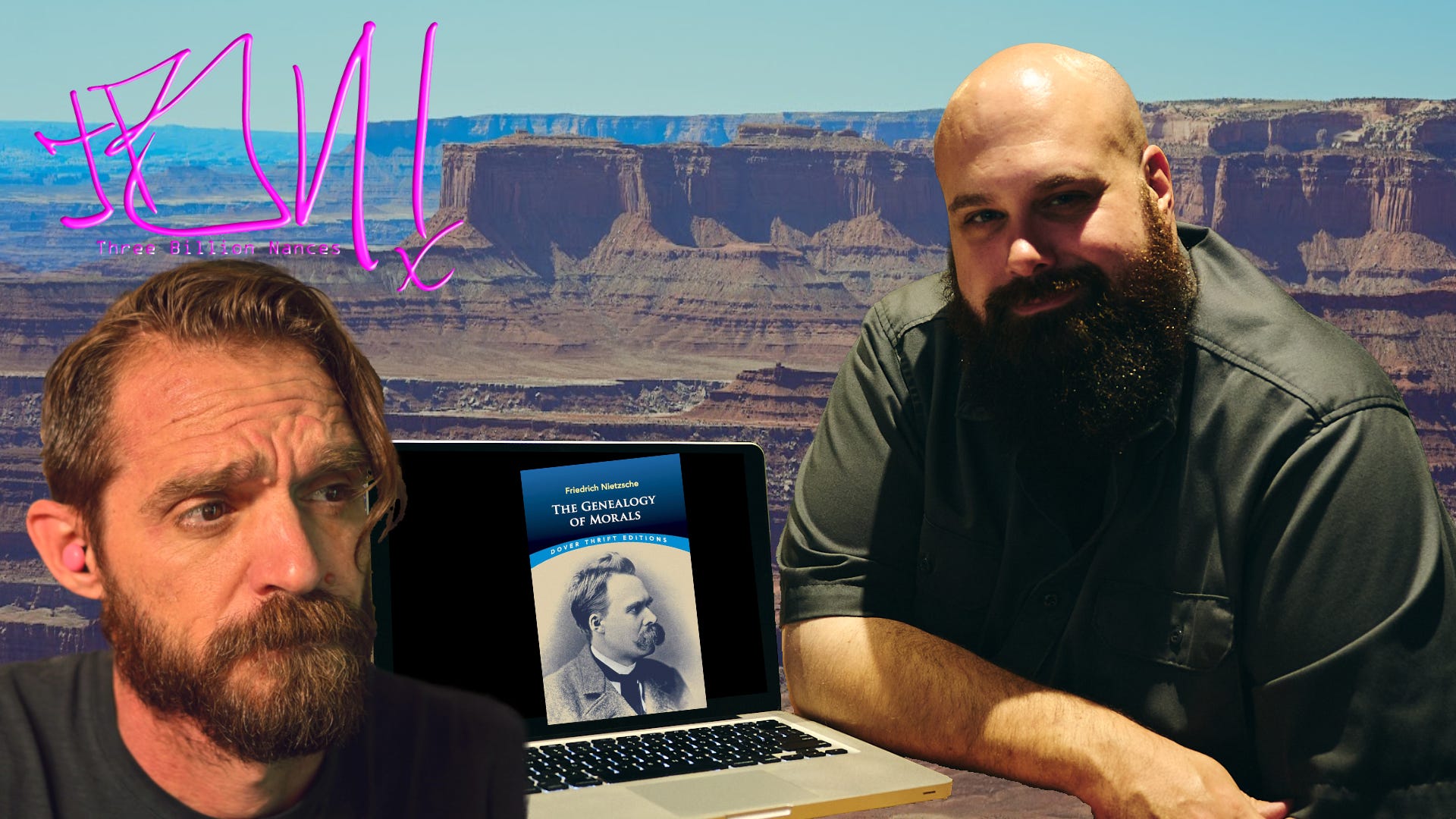
The Nietzsche Episode! | Reading a bit from Nietzsche's Genealogy of Morals
130m 28s
In this podcast episode, the hosts explore Nietzsche’s *On the Genealogy of Morality*, specifically Section 24, which they find unexpectedly powerful despite their usual dismissal of Nietzsche as overrated. They frame Nietzsche as a nihilist in a nuanced sense—not as someone who rejects all values, but as a thinker who understands that values are historical, contingent, and can be reconfigured. The discussion centers on Nietzsche’s assertion that erecting new ideals demands the destruction of old ones, which comes at a great cost. The hosts link this to Lacanian and Žižekian ideas about master signifiers and the symbolic order, arguing that installing a new ideal disrupts everyday life and provokes resentment and nostalgia. They stress that activists and "world engineers" must recognize that the cost of change is borne by everyone, not just themselves, and that they should avoid certainty and credulity about the outcomes. The episode also reflects on recent conversations with Nick Land, who revealed his early philosophical influences, including Nietzsche and Sartre, and with Todd McGowan, whose deep Nietzsche scholarship inspired this reading. Ultimately, the hosts appreciate Nietzsche’s insights here—particularly his emphasis on the price of value creation—while maintaining their broader critique of his philosophy. They conclude that radical change requires compassion, empathy, and a sober awareness of its sacrifices.
I want to read what my translation has, because he's talking about this figure, this younger figure. Here, it says, "Heavier with future." Now, what happens to those of us living in the futuristness that Mark Fisher was talking about? Can this figure emerge when the future itself has been canceled? Or is this what defines this figure? Is to resuscitate the future in the shadow of its already certain demise? Where no, I'm going to fight for values that will, even though I have no future, I'm not "Heavier with future." I'm only "Heavier with future" because I'm demanding a future. I'm going to fight for values that are not the same as the other ones. of the, what's up, what's happening? What's up, everybody? Welcome back to another fantastic episode of Let me see if I have my button we're fucked, we're fucked, we're fucked, we're fucked, we're fucked. The nance cast, what's up? What's happening? There we go. We are here, dearly beloved Mikey and I are gathered here today to do something. Well, I don't know, I don't know if it's surprising, but it's definitely I think probably a little bit unexpected, Mikey, what we're about to read, what we're about to get into. A little bit. Yeah, it's just not the standard fare for what we're normally getting into. Redrick Nietzsche. Redrick Nietzsche or Nietzsche as the French would say, but yeah, we are reading or Nietzsche. We are reading some Nietzsche on the genealogy of morality, the genealogy of morals, specifically this section in the second essay section 24. And yeah, I mean, I think we've, I've definitely like made off handed comments before where, you know, Nietzsche might be the most overrated, overhiped thinker in. Oh, I'm fine. Yeah. But also, maybe he's overrated and overhiped because he actually sometimes has bars and he actually sometimes puts it down. It's just the overwhelming majority of the time he's not at the top of his game. I mean, he's certainly a wordsmith. I can give him that. Totally. Is he the systematic, like, grand philosopher that a lot of people make him to be, I've never found that Nietzsche, not even through Heidegger's Nietzsche or Delusus Nietzsche. I've just always gone, okay, cool. But Nietzsche's never been one of my guys as we put it. Yep. And yet, there are certain things he wrote that did resonate with me that, you know, I at least earlier on in my life, I would think in terms of. And genealogy of morals is probably at the top of the list. I mean, maybe the anti-Christ, but that's just because it's such an amazing rant against Christianity. And when I was having my issues with the faith, that one really kind of expressed a lot of what I was feeling. But as far as lasting influence, it would probably be genealogy of morals more than anything I can think of. There's stuff in Twilight of idols that I like. There's some stuff beyond good and evil, which is kind of a companion to this book, Genealogy of morals. But stuff like Zara Thrustrin never resonated with me. I know it does for a lot of people, but it just never could hold. There's stuff in will the power that I like. But as you can hear, it's a, but it's not like the way I, G. Jack did something for me, or Bojryard, or Land, or Fisher, right, or Heidegger, or Marks, or Lecon, or Delus, right? And so I've always struggled with this, where I'm like this guy who so has had so much influence on so many philosophers that I love. And yet, he didn't really do that for me. So, you and I both want to, I mean, I think a lot of what we've discussed about Nietzsche has been behind the scenes. Yeah. But what's your, I guess, even though we've constantly had our discussions about Nietzsche, what's your history with Nietzsche? I don't think you've ever told me that. Yeah. I mean, I think probably like most American guys who were into a theory or philosophy or whatever I had my phase, my teenage phase, going through nihilism and existentialism and all that stuff. So Nietzsche definitely, and he's also probably one of the first philosophers I heard about. I think for a lot of people that's true, just because he's quoted all over the place and he has like trickled down into all corners of society and culture because he was so influential on so many thinkers and so many artists and so many creators and producers. So Nietzsche is like one of the first guys you hear about. And like I said before we started recording a day, like it's been, it's probably been close to two decades since I've actually sat down and really read Nietzsche. I've gone back to Nietzsche when people like DNG reference, batai or when we're, you know, doing high-digger, like people make references to Nietzsche a lot. So I've gone back to, but never actually like really sat down and seriously read because it, for me, it was very much a face. It has always felt like, oh, it was very much a face. And even though all these guys that are my guys seem to hold him up high, yeah, I've never, nothing stuck with me from reading him and going deep on him. Whereas, you know, Pradhan and Mark's, I was reading them at the same time frame. I was reading Nietzsche and they have stuck with me. You know, I'm constantly finding myself thinking like, oh, well, Pradhan already said that. Rousseau already said that. Mark's already said that. Like these core guys, I'm constantly finding that I haven't really departed as much as maybe one might think. But Nietzsche, I don't know. And maybe it's because, yeah, it just didn't resonate with me. It was a stylistic thing or, or what I don't know. But I'm not a Nietzsche guy. Let me ask you this. Okay, because you and I, I mean, we both have said this so much. I don't even know who said it first or who do it. I just attribute it to both of us at this point. Do it by like Nietzsche's the most overrated philosopher in the history of philosophy. This thing that we always say to each other, right? Okay. I almost want to, since we're talking publicly about it, here's what I would say. I think there's probably, I mean, even what we're reading tonight, I think is excellent. That's why I've been kind of bugging you to read this thing. Okay. And I'll tell you why we're reading this in a second audience. But here's what I would say. He's the most overrated in the sense of the people who hype him
up have never been able to convey to me why they put him so high. That's what I mean by overrated. Now, whether or not him at the level of his text is overrated, that's another story because a lot of the people who hype him up so much, they have, I mean, they have some textual familiarity with him, but not a whole lot. But it's almost like if somebody's like, give me the Giac Spiel, give me the land, like, give me the, the, the, the, the selling point, right? Elevator pitch. Right. Give me the elevator pitch, right? I've never seen a Nietzsche pitch where I'm like, oh, right. And I think that's it. I just think that like, like the big other or Doss Maun, hype him up as a philosopher. And I'm like, this dude can't begin to touch Kant. Come on. Like, it's not even close or like what marks pulled off in capital, like, are we really going to say Nietzsche did anything? I don't think so, dude. I don't know. But I know there's people watching who are going to, like those are fighting words. But guys, I always can just say is like, we're being honest. And maybe there will be some big Nietzsche turn in one of our lives or both of our lives. But maybe it, maybe. But I guess because we've never really talked about Nietzsche, I was like, well, this thing that we're going to read tonight because it's Todd McGowan and I, we were talking on the phone. We started talking about Nietzsche. And I didn't know this, but like, Todd has a really extensive vast knowledge of Nietzsche. Like he read Nietzsche very, very closely for a long time. And I didn't know this about Todd because he never talks about Nietzsche barely, right? And I think he told me the story where his wife, Hillary, he had written essay where he quote Nietzsche so many times. This is like early on when they first met her whatever. And she basically told him like, you need to like never do this again. Let me look at more seriously than I think Hillary probably intended. And so we just stopped talking about Nietzsche. But God damn does. I mean, Todd is really a treasure trove of Nietzsche scholarship. Yeah. And so we were talking. And I was telling him, I'm like, you know, there's stuff in Nietzsche about, I was like, I like Nietzsche as a nihilist in the sense that I interpret him to be a nihilist, which is he understands that values are not absolute and they can be reconfigured and restructured and reestablished, right? He's not a nihilist in the fucking Big Lebowski sense of those three guys who are nihilists, which is, you know, people always call him a nihilist. He's not a nihilist in that sense. He's a nihilist in the sense that he understands that values are historical and contingent. And there can be better values in others because some values are more life affirming than others. But this whole thing of how values can rise and fall is this Nietzschean motif that I think is really important, right? And for me, it's important because this is where I want to connect Nietzsche to Lacan and G-Jek on subjective destitution. So that's how Todd and I got to talking about this. And he started quoting parts of this section, section 24 of SA2. And I was like, I mean, I've read that before, but am like, it never lit up like that before for me. So I went and read it and was like, man, this is this is fire. Okay. This is really good. And I was like, damn, I want to read this with Nancy. And so Nancy is known for like a few weeks now. I reference this section. So that's that. And then guys, we we recorded so much with Nick Land last weekend. It was it's close to nine hours. We recorded with him. And I, you know, so much of the, okay, so there's the, we recorded the discussion with him and John Michael Greer. You guys have seen that, right? And it's entirety. But we talked with Nick a couple hours before that, just the three of us. And then he's video accessible right now, which means like he can, he can do this kind of stuff. And we were like, well, you know, we talked about doing talking on Sunday too, since you're available. And he was like, I, I, maybe he's like, let me check and see. And then late Saturday night, he was like, yeah, actually, that works. Let's do it. Fuck it. And so we talked to him for another like four or five hours on Sunday. I say that to say, we got to talk to him about a lot of stuff that we've just always wanted to ask him. But usually when we talked to him, we have some agenda, some project, we have a time. Yeah, it's more directed, more focused on accomplishing a goal. This was, this was like hanging out on the couch, shooting the shit. Yeah, hanging out on the couch with Nick or at the coffee shop. And we, yeah, dude, we, I mean, we went through the tie, fiction, numbers, the like the occult versus ontological status of Nugger's book, Bogna's book. Yeah, like we, we touched on, on so much stuff. Dialectics, which was, yeah. Like we, we, we, we had a fun talk about dialectics where, and he, I was explaining the Gieckian, McGallian, twist on dialectics and he was following along. And then he was like, oh, but they, every dialect titions just the communists. And so when we went down that path and then he kind of backed me into a corner. And then I tried my best to kind of get out of it, but he backed you into a semantic corner. And if you are committed to the semantics, and at that point, it, it, it stops being semantic and it becomes syntactic because he really is an argument over a particular word, not an idea, concept or complex of ideas, but it was that particular word itself. So yes, he backed you into a corner, but also I think, I think what really happened. I'm trying to get him to loosen up on the meaning of dialectics and he doesn't want a budge on that. He doesn't want a budge, which I think is excellent. I think let, so let's, let's not use that word. But the idea, the, the chain of thought, he was like, yeah, dope. Awesome. Heck yeah. Until it gets to that word. And it's like, no, no, no, no, that's the no, no word. So it's like, okay, let's call it a communist as a word so long as it means free time. Yeah. With Dam J. Who, which is interesting. Like if we pivot to this idea of communism is free time, it's the one thing where he's like, yeah, I'm cool with that. Yeah, totally. Yeah. But yeah, the, of course, I want to go, well, can't we switch to a different meaning of dialectics if we're doing, but I mean, hey, dude, sometimes you can't teach an old dog new tricks. Sometimes you can mix seasons and go, fuck you guys. But no, but, but, and I, I, I get where he's coming from. Like, I for many, many people, the word dialectics is vomit inducing because it is this kind of synthetic thing that like the, the very small brained one, two, three version of, of what people take as dialectics. What are the linearist dialectics? Then this dialectics, which is this whole thing of like, make it worse so we can get to the desired point we want to arrive at. Something like, yeah. And so I don't know what Chris Coutrone, you think he would go for that? I mean, I don't, I don't think so. And in fact, in conversations with Chris, I think we've, we've come very close to that. And I think he's said, no, of course not. However, when it's unavoidable, that, you know, there's no sense in sitting around trying to moralize about what's what's going to happen tomorrow. Let's try to figure out a plan to survive tomorrow. I, one of the little highlights from day two with Nick was him telling us how much he loves that Chris, Chris Coutrone, quote, that I posted. Yeah. That was, that was surprising, but I'm like, oh, that's, that's cool. But okay. So one of the other highlights, and this is why I started talking about this in the first place is that Nick humored me. I asked him something that he typically is not going to talk about, but I don't know is his birthday weekend. And I was like, just, just indulge me here. He's like, what? I'm like, I want to know about how you got into philosophy. You never talk about your childhood. You never talk about your teenage years. Who were the
first philosophers you really got into and he actually told us and it was it was really interesting and so of course Nietzsche was one of his early on influences surprisingly sart. Yeah. He said he was reading a whole lot of sart as a teenager that sart had a huge impact on him early on. Um, but no, this thing like, you can't tell people that Nick Lann was influenced by sart. You can't you can't let that catch out of the bag. Uh, but no, I guess like so we know that Nick, Nietzsche is one of his main thinkers because of libidinal materialism and he's always returned to Nietzsche on some level. But considering how much influence Nick sat on us and then finding out how much Todd was actually reading Nietzsche, it just both of those made me go, okay, let's actually do some Nietzsche. That's read some Nietzsche. The thing that Todd had me a guy or got me reading, I'm like this is the best way to open up a conversation about Nietzsche between the two of us. Let's do it, man. Let's uh, let's get into it. So again, section 24 on the genealogy of morality. Can I say just real quick, this first paragraph is kind of you don't know the context and we'd have to go back. And so we'll read it. But guys like it's really the second paragraph where this section takes off. I am concluding with three question marks as is playing to see is an ideal being erected here or is one being broken down one might ask. But have you ever asked yourself sufficiently how dearly the erecting of every ideal on earth had to be purchased? How much reality always had to be slandered and denied how much lying sanctified how much conscious disturbed how much God sacrificed each time in order for a temple to be erected a temple must be destroyed. That is the law. Show me the case where this is not fulfilled. Okay. So whenever a new value whenever a new ideal takes hold in a society, it comes at great cost. Now of course we could say whenever a new master signifier is installed. And it's because not only does an old ideal or old ideals or old master signifiers have to be destroyed. The installation of a new ideal, a new master signifier reconfigures the symbolic order, which means there is a disturbance in the everyday going about of ones being in the world. And so the idea of just oh we're going to tear down old ideals and install new ones. I think you see a lot of, I mean this is true of young people like there's a hastiness to do this. And they don't understand that the I don't know they don't I don't think they understand the cost of this. Not to say there aren't costs with keeping old ideals propped up. Yeah. But there needs to be a greater reflection on hey, we want to change the world. We see those problems with it. But what is the actual cost of doing this? It costs more than standing on a corner, chanting a people united will never be divided. Yeah, cost a little bit more than that. So if somebody is trying to be, I don't know what we call it, a world engineer. They have to understand the sacrifices involved in erecting new ideals. And people are going to be resentful. They're going to be nostalgic. And are you prepared for that? What's the blowback to some sort of reactionary impulse? Are you sure you've thought through all the various consequences of a new master signifier, a new ideal taking center stage in a society? Okay, all of that thinking about that, that's why I'm already sitting here going, yeah, this is important stuff to think about. Oh, yeah. Well, I mean, there's like you said, there's cost to creating a new world. There's also costs to keeping the world as is. We would like to think that we would be willing to pay the costs to bring about a new world. However, we are not the only ones who are going to have to pay that. So while I, I want a better world, I want to topple the old masters and install new ones. Like you also have to understand like from someone's perspective, you're destroying their life. That's it. Yeah. So in, and it's not to say, let's, let's not do it. Let's don't do it. I'm, I hate traditionalism. I hate the idea of conservation for the sake of conservation. Like just do it to do it. Be like, I hate it. Like I, I want radical future. I want radical new things. I want to radiate to not everybody does. And that's, that's the, that's the point. Like I, me, and bad people because they're, they don't, they're not as future happy as you as you and I are. Well, and you know, the conversation we had around xenophimism, like it's like, yeah, I 100% endorse these ideas. However, they get delicate when you're talking to people who don't already understand. You want, yeah, you, you very much are destroying someone's life, someone's world, someone's universe. And there is a cost to pay. Like the, the radical isn't the only one paying the cost. And I think for the radical, for the world engineer, for the, for the activist, like you have to understand the, the cost isn't just a you problem. The cost isn't everybody problem. And so you have to be compassionate and empathetic enough to understand. Even though we're moving into something that we imagine will be better because we can never really know if it will be better. That's another thing activists need to be aware of. Don't, don't fall prey to certainty and credulity. Which leads us into. It's one thing, like I respect the idea of somebody wanting to be a world engineer. Some part of me kind of wants that to be one too. I mean, I don't know how to go about implementing it concretely. But theoretically, I mean, with, with whatever visions of the future, you and I both have, right? There's part of that. What I think this right here, what Nietzsche gives us is an opportunity to go, wait, one thing to want to make the world better by having new ideals and new values. But you better not be a pervert about it. Yeah. You better not be operating from this perspective of, I know better what's best for you than you yourself know. So for example, right? For you and I, the idea of, hey, automation abolishes all jobs, you get UBI, we're sitting there going. Yeah. Sign me up. Sign me up. What we also have to factor in, you and I already have our existential projects figured out. And somehow we were able to do it working and, okay, most people don't. So even though most people hate their jobs, there's also a stability, a stabilizing dimension of the job where the one thing that organizes their life and grants them stability and even grants them meaning. I'm sorry, but there were some of it. Yes. Do there were days when my sole source of meaning was how clean I got that toilet like in like legitimately like when you're going through it and when the world sucks and the world stacked up against you and nothing else is happening for you at the moment. Yeah. When everything sucks, sometimes all you have is that pride in your ability to do something. Well, and it's and it yeah, like I legitimately, it's it's not hyperbolic. Like there were periods of my life where the only source of meaning was well, at least I can go to work and at least I can have integrity while I'm at work and do a good job and do the right thing. I have nothing else. But at least I can do that. And that's what work represents as well as all this other stuff like a labor and wage and like it's also meaning for a lot of people and you have to be compassionate and consider it when you're talking about. And aware of what the existential crisis would be for somebody who first of all,
they have no theory, they have no, I'm manzo, you know, I'm manzo, patient oriented, imaginary, no visions of that, like, even though they dislike the structure of their life based on wage labor, but they know it makes sense to them, even if it's begrudgingly it makes sense. It makes sense to them. And like you're saying, it gives them a sense of fulfillment or purpose. Like I did a good job. And if somebody like, okay, so I know what my passion is. So whatever happens at work means nothing to me. Because this is what means something to me. But it's like you got it, like, not everybody has been lucky enough to find their passion. Now we would sit there and say we want institutions built. So human beings can find this purpose in their life. They can find the thing that they want to get out of bed and repeat spontaneously, not because they're goaded, not because there's economic necessity involved in it. It's just what they love to do. Great. That's not even a living possibility for most working class people. Yeah. And so yeah, I'm just saying, if if you want to change the world and set up new ideals, having the end again, for those of you who are here and stumbled upon this and you don't know the vocabulary we're employing, I know the word pervert probably caught your your like, wait, what? It is a technical definition that we get from like Lecanean psychoanalysis. And yes, what you think of as perversion is tied up with this definition. But what it means for us at least in this context is somebody who believes that they're the pure instrument of authority, that they know what the best thing is for everybody. What I know better than anybody, what the collective good is. So everybody, I'm going to do the thing and you better just fall in line because I know it's best because I know it's because I've tapped into this knowledge. Yeah, I mean, I also like just this opening paragraph, I think that's a great description of the human. Like we we are this thing that is constantly destroying ourselves to make ourselves a new. So here's the cool thing, right? Is he not getting at creative destruction? Absolutely. And this is what I one of the reasons why it resonates with me is for us, I mean, death drive involves a creative destruction. It's you create you. Whatever you create comes out of this enjoyment you get in destroying yourself in various ways. And anybody who's a true artist knows this to be the case. And so this line is just an amazing line. If a temple, a temple, something sacred, something sublime, something above and beyond the rest, right? If a temple is to be erected, a temple must be destroyed. I mean, something sacred has to be sacrificed. And that is where we're saying people do not understand. Like the whole just, you know, young adult activists, oh, just tear it down. Fuck it. It doesn't matter. It's all fucking bad. Anyway, you don't get what it means to other people. And that's why nobody trusts you is because you're not understanding why this thing problematic as it is has a sacred status for most people. And you're wanting to destroy this sacred thing, really nilly. Why? And why people are like, I don't like these people. Yeah. No, and that's like I'm all for it, man. I tear it all down. But also be there's people talking about Trump talking about all this all this stuff right now. And it's crazy. And I try to avoid it for the most part I do. But I think one of the things that's often repeated is Trump talking about how he's willing to pay the cost of American lives. And I don't know if he said, I don't know exactly what he said. I don't put it past him saying something like that. But basically he's, you know, well, we're going to lose thousands and tens of thousands of young American service members. But that's a price I'm willing to pay. Like I can imagine him saying something like that. But you're, you're not actually the one paying it. Yeah, that's not that's not a price you can pay. That's a price that the people who go give their lives would have to pay. And the activists cannot fall in their families. Yeah. And and friends. Yeah. And all the things down stream of that. And that's, that's the activist can't fall into that same thinking of like, oh, well, that's a price I'm willing to pay. It's like you may be willing to pay it. But the, you know, the families that are in the same situation as you and just don't have the same understanding or don't see things the same way, they are probably not willing to pay. And they also don't understand it. So you can't demand things of someone because another thing activists often say is it's not my job to educate you. And it's like, I'm sorry, homie, but if you want to change the world, if you want a better world, it kind of is your job to educate people. Like that, that, that, that is a you problem. And this trumpet is most Stalinist. And what I mean is, you know, Stalin and the Stalinist, this idea of we know the true trajectory of history, history with a capital H. Yeah. We are its mere instruments. It springs us back to perversion. And what, you know, whatever the cost, whenever somebody does like whatever the cost, they usually don't have to suffer the cost. Yeah. They're not in danger when they, yeah. And the people who are most in danger, they often, yeah, they, they get wrapped up and, and taking advantage of and screwed over ideologically, socially, socially, politically, materially. So yeah, I mean, I like it. We, in order to create a better world, you must destroy the, the world that exists. And that's not something that, that can, or should be taken lightly or should, or can be taken lightly. You're destroying lives. Pain trauma, yeah, suffering, sacrifices are all things that are the actual costs of this. And it is. It's not to say things shouldn't change. But you gotta, you gotta be tapped in. So as to navigate. So as to understand when to compromise or when to, you know, and not just have this straight up, I know better than you. So therefore all the means are justified. Yeah, man. Yeah. The, the, the end, the end has to be justified by the means. I, I don't go in for this. Oh, the means are always justified by the ends. Like the end, justify the means. Like, no, I don't think so. Like I think, I think the process is what's important. And the outcome is, you know, because we'll never know. So you can't sit here and tell me that you know what the outcome is and that the, the outcome will justify all the, the things we're going to have to go through. That's the point. It's an outcome. We don't know what it is yet. It's the end of a process. And guess what? It's not even the end of a process. It's just the, it's always another, exactly process. It's, it's the end of your foresight. Like your projected outcome is the end of your foresight. It's the 50 yard line on an infinite football field. Like that's so it's the process has to be justifiable in and buy and for itself in order for it to actually be one worth doing. There's a way where it's like when do things actually ever end? It's Christianity over. Some people could say it is. Well, it would say it isn't like I don't know, depending on what you mean. Well, I mean, everything is depending on what you mean by that. But no, Chris, we'll never be over. Zoroastrianism is never over. Myths. It also is. It's it's this whole thing of like how do we define it? Okay. Is anybody truly practicing, you know, the, the old Greek religion? Like are there, like, mixing like, yeah, the zoo's worshipper. I'm sure there's a small, small group, somewhere. Okay. But are they a force in the world, the way that Muslims and Christians and Buddhists are? No. No, because they died so that Abraham and Yahweh and Jehovah and Yeshua
and Muhammad like Zeus and Thor died. Maybe not Thor, but like Zeus and Hera and Jupiter and Kronos, they all died when Jesus and Yahweh came to town. And Jesus and Yahweh will die when our descendants 2000 years from now come up with their own new myths. - A lot of it was incorporated into Christianity too. - Right. - Yeah. - He's like, "Have your keg and eat it too." So I mean, the point is, there's, when we talk about the beginning and ending of a value, what you actually find is the value has a ontology. That it's related, it's positioned within the symbolic, it's own valuation among other values, it's in flux and it can vary. Typically it remains some kind of value, but I think the way to say it is, is it the central organizing principle, the master signifier of a symbolic order? And somebody could say Christianity isn't that now, sure America. - I don't think it ever was for America. I think it was always a skin suit, but. - And see then you get into this whole other. - Right. - Yeah, right. So, this is, but, look how far we got off one paragraph. - Yeah. Cheekily, I mean, this is directly related to what we were talking about when we were talking with Nick about dialectics. Like this is the thing, like these values persist, they've been re-quilted, they've been recast, they've been re-situated, but they're still there. And it's not a unity. Like there is attention, there is a real contradiction, but it is a dialectical process to use the word. And yeah, it's an ongoing unfolding thing where things are constantly sublated into new things, but that doesn't mean they're resolved, that doesn't mean they're not. - Diagonally? - Yeah, it remains a thing, it persists, it's not like it's synthesized into this new thing. Like no, it's there and there's tension, but yeah. Also, you don't have to use that word dialectics. I think I think I said that. - I think a new word isn't an order actually. I think it just, I never know what the fuck we're talking about because we're all over the place. And like, it's like if I read a passage where Heidegger mentions dialectics, I'm like, I don't know what the fuck he has in mind here. - Yeah, yeah. - I don't know. Are we talking Hagle marks some variation on it? Like I, I don't know. And so I remember reading a book on Hagle and I'm forgetting the name of it, but each chapter had like some famous Hagellians, it's summarizing a famous Hagellians interpretation of Hagle. And you start to see how varied the understandings of what dialectics is. And you go, well, all these fucking Hagellians can't figure it out. I've fucked Jesus. Like, I feel like I know what Jesus Jacque and McGowan are doing with it, but, and that's what resonates with it. Like their idea resonates with me and with you. But yeah, it's a word that's so overly saturated with meaning that it becomes meaningless. - Yep. - You know, all right, should we do the next one? - Let's do it. All right. We modern human beings. We are the heirs of thousands of years of conscience, vivisection, and self-animal cruelty. In this, we have our longest practice. Perhaps our artistry, in any case, our subtlety, our pampered taste. Humans have all too long regarded their natural inclinations with an evil eye, so that in them, they have finally become wedded to bad conscience. A reverse attempt would be possible in itself, but who is strong enough for it? Namely to wed to bad conscience, the unnatural inclinations, all those aspirations to the beyond, to what is counter to the senses, instincts, nature, animal, in short, the previous ideals, all of which are ideals hostile to life, ideals that slander the world. To whom should we turn today with such hopes and demands? For this, what? No, I think the next one helped. Like, for this, we would have precisely the good people against us. Additionally, as is only fair, the comfortable, the reconciled, the vain, the fanatical, the weary. Okay, so look. Okay, I do like this trans, so what, Nancy and I are going off to different translations. Yep. I've got the old Kaufman translation. Okay. So he begins, we modern men are the errors of the conscience, the intersection, and self-torture of millennia. So what comprises the West ever since the quote, "slavery vault" in morality, which would be Judeo-Christian morals taking hold, is that when Judeo-Christian morals could hold, all of a sudden we are, we have a sense of guilt, we're constantly turning inwards, we're evaluating our desires, we're evaluating our motivations and all of this. And those who had master morality and there's various ways to define what that is, you could even say, maybe it's virtue ethics, I've seen people go in that direction, but the old masters, the aristocrats, did not have this kind of existential gravity inward. This is something that happens with Judeo-Christian values. And the self-reflection, this vivisection of our conscience, tearing ourselves apart because of, oh, I desired this and that's wrong and blah, blah, blah. That was brought on by new ideals, taking the focal point of the symbolic order. And these Christian ideals and values being new master signifiers, new quilting points in a society. And so Nietzsche's here, he's getting at this thing. He knows that these values are dying something else is gonna have to be put in their place. He understands that this will come at great suffering and costs, but he also is up to the challenge. I mean, the uber-minch would be this image of this human from the future who is the one who helps establish new ideals and values, but you're in for a fight because a lot of people are not willing to let these values go. And so this whole thing, of course here, it's this older translation, it says, "Man has all too long had an evil eye for his natural inclinations, so that they have finally become inseparable from his bad conscience." Okay, so whenever you have a naturalistic impulse, say lust or whatever, right? It's immediately connected, you feel guilty, feel bad about yourself, oh, I shouldn't have thought that. And Nietzsche wants these naturalistic inclinations to be liberated, be a new ideals taking hold. But he knows that this is gonna entail a fight, right? To pry naturalistic inclinations from bad conscience, right? But it's not impossible for him. I mean, anything here resonating with you in this paragraph or two paragraphs? - I mean, I, so we recently had J.M.G and Nick on the dangerous maybe, talk to them. I think for me, one thing that really stands out that John Michael Greer has talked about is the way he talks about politics, I think is excellent. And in the king and orange, he talks about how 100 years ago sex was deplorable. Like in this kind of like Victorian, fanciful, withering heights type world or whatever, sex was this like being promiscuous, was the deplorable thing. And now the deplorable is a new category, well, not a new category, but to be a deplorer.
horrible, has kind of always existed. You know, we have, we have ideas of untouchables and unclean and stuff like that. And that's always constantly shifting. So what's in in polite society versus what's out, that's always been a thing. What's in and what's out. But that shifts over time. And I really like the way he, he compares hate to sensuality, particularly erotic sensuality. He's like, he's, he's talking about how silly it is to a modern thinker to think back on the era when sex was seen as deplorable. And he's comparing that to, to maybe hate like all these performative liberals and all these progressives and, and all these people who are very much in the in crowd, they're very compassionate. And they're, they're very performative with their compassion and they're like, how could you be angry? How could you hate? I mean, I've had shit you and I were just talking the other day about people say we look angry. Like when we're just looking, we're, we've taken a nice photo and someone will say, no, I showed my best friend a photo you took of me the last time you were in town. And I was like, look, like this is the one of the only professional photos I have of myself. She was like, the photo is great. Why do you look so mad? Why do you look angry? Like I'm just not smiling. I think it's a great photo. I think you look great in it. Like I was like, damn, you look good. But it's yeah, like I've had people accuse me of having toxic moods and being toxically angry. And it's like, yeah, no, I'm definitely aware of the fact that I can be a very tempered person. I can be very angry. I can be very violent. I absolutely can when I was younger. I was less aware of it and it would get out of hand. I like to think that now I am aware of it. That's not to say it doesn't get out of hand sometimes. Sometimes I absolutely do have violent, abulliant anger and it explodes. But I think I manage it fairly well. All things considered. But it is the case that like that type of anger is looked down upon. Like there is very much there is a value in the, I don't even know what to call it. The question of it is, is what's Haboo? Yeah, yeah, yeah, yeah. You can have it, but you have to bottle it up and not show it. You have to hide it. So it eats away at me. I can't let it out. Yeah. So, and here's the deal, man. Like maybe if you, if you are upper middle class and you have all your needs met and everything is fine, maybe you can afford to go to therapy and work through that shit. And you know, you don't have to outwardly express it in your daily life. But if you're an average everyday person, I'm sorry, dude. Sometimes you just got to let it fucking roll. Sometimes you got to have an angry look on your face. Sometimes you have to cuss. Sometimes you have to raise your voice. You can't afford therapy, but you also can't afford to have an explosion where you go out and do some violent shit and you ruin your life or you ruin someone else's life. But it should that be tied to bad conscience or not. Right. But it's where, yeah, it's tied to class. And it was, I don't want to call it PMC because I have major problems with the PMC discourse and the PMC analytic. However, it tracks with the professionals and the mainstream liberals and progressives. They tend to have a socioeconomic status that is above the average everyday worker, which gives them different default moods by and large. Yeah. They don't have to be angry because they're not cleaning toilets all day and they don't have poop under their fingernails. I mean, wouldn't wouldn't that make you angry? Yeah. So this, there's a value around anger in the same way that there was a value around chastity and promiscuity in the past and how Jmg talks about it in the king and orange. There's very much a value around anger today. And I think, yeah, when we have our better world, we should probably maybe not just accuse someone of being an absolute deplorable. If they get a little bit angry, but we have to masculinity. Sure. And look, toxic masculinity is a very real thing. It, I mean, I wrote a fucking, I wrote a piece, a, a, a, with strange exiles, he's doing a series about masculinity and they make it broader where it's like even the expression of anger and frustration. They turn, it's like masculinity into toxicity. And that's not the point. Like when we're talking about toxic masculinity, we're not talking about masculinity as such. Like masculinity is okay. We're talking about a mode. Yeah. But, uh, but no, yeah, I, I, I would love it if we could shift our social values or our cultural values away from, uh, performative affect because I, I, and I, and it's other things too. And I think bottling up these effects can, can do serious harm and not everybody can afford to go to therapy and also not everybody wants to and also not everybody needs to go to therapy. Also, like, therapist. Should we allow, should we allow young men to get into this fight without ruining their lives? I mean, I'm just saying I, I, I've been in a lot of this fights. Yeah, but now you're getting one now the school calls the police, you get arrested. It's just like you catch a fucking charge. Yeah. Yeah. No, I, I, I, the way we have dealt with that the last 40 years, I'm sorry, they had it better figured out earlier on. I mean, mate, I wouldn't even say they had it figured out better in the past. It wasn't, uh, it wasn't a problem in the same way that it's a problem now. And I was thinking if you don't let the minor expression of anger and frustration happen, doesn't it boil and exponentially increase and increase and then you get Columbine? Like, yeah, no, 100%. Let it, let it be expressed at the, the much smaller scale. Yeah. And that's why I think Columbine signaled, uh, this massive shift. Like when people talk about the world we live in today, everyone always ties it to, to 9/11. Uh, no, I think Columbine was it because for this reason, because I think that was a, a problem that came from repression. I think if those young men had had different lives, things probably would have happened differently, but playing the counterfactuals game is outlets. Yeah, but, but yeah, I mean, I just think like we should probably allow kids to argue, we should allow them to fight. We should allow them to develop problem solving skills because, because like that's all a problem. Terry with the negative, Terry concrete, yeah, real emotional way. Yeah. And that's all like learning and problem solving. But we have, but no, fairism is toxic positive toxic affirmation. Absolutely, man. And that's far more, I think far more dangerous than toxic masculinity, although toxic masculinity is real and it's a serious thing and you should, uh, not, not all masculinity is toxic. In fact, I think the overwhelming majority of masculinity is not toxic, but some can be toxic blah, blah, blah, blah. But, uh, anger. Hold on. Yeah. Here's where the, okay, but this point, this is, okay, this is where it gets even more interesting to me. And that, okay, what do you think here where he says an attempt at the reverse, a reverse of the connection between naturalistic inclinations and bad conscience. He'll, right? An attempt at the reverse would in itself be possible, but who is strong enough for it? That is to wed the bad conscience to all the unnatural inclinations, all those aspirations to the beyond to that which runs counter to sense instinct, nature, animal, in short, all ideals, hitherto, which are one and all hostile to life and ideals that slander the world, which is to say, what if instead of connecting our sexual impulses, our aggressive impulses, all of these things to bad conscience, what if the desire for immortality, the desire to have connection with God, the desire to live in a transcendent state? What if these were connected in our minds in such a way as to invoke guilt? We feel guilty for wanting to have a soul. We feel guilty for wanting to pursue God. Yeah, that's what's, he's saying there. I mean, I think, I think for the average, well, I mean, I think for the average everyday person, we are made to feel guilty for wanting more.
And it increasingly more so now as we move into our super egoic AI techno capital world where if if you're not enjoying you are doing something wrong, you should feel bad. You should fucking feel bad. You should feel guilty or not enjoying. But you should also feel guilty for wanting to read a book of philosophy or read a book of poetry to get in touch with something maybe spiritual or get in touch with your soul or something. Cosmetic God. That doesn't build your resume. That doesn't build your portfolio. Yeah. I mean, I think we that all of that is connected to guilt in the world we live in today. No, and that's that's what's interesting here is because this thing with super ego that you and I are on about all the time. I don't think Nietzsche could see what was on the horizon. And I mean, sure, of course, he didn't. But yeah, this is a this is a different dynamic where we feel guilty for not enjoying ourselves. But the point is he didn't seem to understand like he would just tie naturalistic inclinations to like our spontaneous drives. Whereas we are our enjoyment. Like it's very hard for us to actually live lives that enable us to thrive and pursue our spontaneous drives. No, we have commanded forms of enjoyment. Enjoy your job, enjoy watching Netflix, enjoy, you know, going to Starbucks, blah, blah, blah, blah, all of these program forms of enjoyment. And if if you're not happy in those, you should feel bad about yourself. Yeah. But yeah, he's talking about a major major world transformation and value, revaluation of all value, right? Which is you imagine like you feel guilty because you wish you had a soul or you wish you live forever. But that's what he's talking about because he wants our values to be tied to life affirming world affirming ideals and not have us chasing transcendence, have us chasing God, which for him are all life denying ideals because the point is, well, if God's the ideal of the soul, if heaven, then this world is shit in comparison. And for him, that's where Christianity is nihilism. Like this is where a lot of people I think don't get it. Like no, for him, Christianity is nihilism because when you set the standard at that level, yeah, you turn this world into a world of shit that is to be denied out of obligation to God. Because in in that Christian world, the ends justify the means or like in the Christian world, the ends are the only thing that matter. The means don't matter because fuck this world, fuck this mortal plane, everything sucks. I just want to get to heaven. I just want, I mean, it's the same, the same shit with Pascal's, like Pascal's logic living in Pascal's world. It's like, yeah, nothing, nothing here is real, nothing here matters. All that matters is my cosmic reward. And it's, it's like, no, this world is real. Dude, the world we're living in right now, this rich world that's full of meaning, that's full of events, phenomena, things, people. This is real. What may or may not come after. That's out of it. Yeah, but favoring what may or may not come after in, in place of the world that's right in front of you. I think I agree. I think that is extremely nihilistic. We were just watching True Detective. Season one, Russ Cole says something, I mean, this might not be verbatim, but if the only thing keeping a person decent is the expectation of divine reward, then that person is a piece of shit. Yeah, dude. Now, people will probably, I mean, even people who want divine reward, they're going to try to find a way around this, but I don't, I don't, I don't think, I don't know. I mean, I, that's very true. Like if you don't actually care about the world and the people in it and all you care about is your divine reward, then you suck. Aren't you just a divine capitalist? Yeah. Yeah. We're just, and that's what this boils down to. We're all just everything just to the end. Like it, like it, people become instrumentalized, people become, I'm doing this so I can have all five of those crowns to throw at Jesus' feet. And it's like, yeah, that sucks, dude. That really sucks. That's why you're doing it. I like to think that if there is a heaven, then the dude who made it and the dude who lets people in would care more about like, were you actually good in life in the world that you lived in? Like, were you actually good and ethical? Or did you just perform it? And did you just pretend? Hey, look, you know, me, like I grew up so amissed in this Christian fundamentalism, you know, the independent Baptist, King James, onlyist, and I had these conversations with, you know, my aunt was a Bible believer born again, walked in the blood Christian. And this was our constant conflict, even though I, you know, I was a Christian at various points in my life. But no, like the whole thing of like one of my childhood best friends, his mom is a knitter and Buddhist. And I mean, she, she had a rough life and her Buddhism always was this center of gravity for her. She had, you know, kept her anchored and got her through. And early on, I had these discussions. I'm like, she's like one of the best human beings I've ever met. And, you know, the Baptist would say, yeah, but she hasn't accepted Jesus Christ as a personal Lord and Savior. Am I okay? So I'm like, so what does that mean? Well, she'll go to hell. I'm like, she'll go to hell, even though she's one of the kindness, most generous, selfless human beings. That doesn't matter. I'm like, so being good doesn't matter. No, because you can't ever be good enough for God. So you, all you can do is accept his goodness on faith, faith alone and have it apply to your account. So it, and this whole thing like the blood of Christ is like, it gets you out of your sin debt because he paid the price for you and like, so you just do a, well, I accept this. And then he gets applied to your account. And so you get a clean slate. So no matter what sin you fall into the rest of your life, you are get you have eternal salvation and it's guaranteed. You can't lose your salvation. Yeah, that faith alone position is insane. And you know, people who argue like works based Christianity, like people who do that are only doing it because they're interested. And I know a lot of, I know a lot of, you know, Christian people who are good people and who do good things. And I, I believe that they are good people and do good things because they recognize it's good. Not because they're trying to ensure their, their seat at God's dinner party in the afterlife or whatever. I don't know. So you, I mean, you can problematize works based Christianity in the same way that you can problematize faith based Christianity. But the faith alone mentality is just, it's fucking nihilistic and it's fucking disgusting. So okay, random pivot. So this whole thing that Nietzsche's talking about, this, this transvaluation of all values, right? This, this new revolution. We're gonna, we're gonna build a new temple on the ashes of an old one. The ashes of the old one being Judeo Christian morality, which again connects naturalistic inclinations to bad conscience, to guilt. And we're gonna do this by severing that connection and forging a new connection between unnaturalistic inclinations, spiritual inclinations, and guilt, bad conscience. And so then he says, well, before I go into that, I should just say, is this not kind of what Nick in his own way has done in his work, where typically anything that was thoughts of the inhuman getting beyond our humanity was tied to bad conscience. And that Nick is like, no, let's, let's flip it around. Anything that that wants to preserve.
of the human that keep us as is to not become should be tied to go. What do you think you like that? I do like it. And I think, you know, I, uh, I like it. And I, I like the inhuman, um, as it gets used by other by Brasie and, uh, this is, read as much in. Yeah, but yeah, it's, uh, on one hand, there's a very, like, oh, yeah, the humans, the human sucks and we deserve to die. But then on the other hand, there's like this, no, does he miss the, what the, the kernel of the human that should be preserved? Well, and that's the thing, like it's, it's this ongoing self-improving, self-revising thing. That's what we are. Like all these other things that we've been, uh, classified as and, and, and this is why philogeny is just ontology for cowards. Brought that up with him too. Yeah, you gotta write something on this. I know, but, but no, it like the, the thing that resists classification, that can only be sought if you are affirming that which has been classified, or if you are affirming the destruction of that which has been classified already. So if we want to be writing the shockwave, if we want to be out ahead of it, we have to affirm that position. And so I, I actually do think the only way to have a universal humanism at the core of your view is, is to say everything that the human is and has been needs to be destroyed. Because the true human, what is truly human is that which resists classification. Yeah, that which has yet to be language, qualified, classified, all this stuff. So no, I mean, and I don't know, maybe Nick would argue with us if we tried to make a humanism out of his position, or maybe he wouldn't. I, yeah, I don't know. I don't know either. Okay, so hold on though, this, this thing Nietzsche's talking about, where he's like, okay, I want to connect unnaturalistic inclinations to bad conscience, right? He says, to whom should one turn today with such hopes and demands? One would have precisely the good men against one. And of course, the comfortable, the reconciled, the vain, the sentimental, the weary. You're saying if you try to, try to make people feel guilty about God, the soul, heaven, afterlife, you're going to have a lot of good people. Oh yeah. Really, you know, attack you. And so he's he's well aware of what he's up against, right? The battles to come. Okay, I mean, that kind of, you want to read the next one? Because what do you want me to read it or whatever? What offends more deeply, what distinguishes as thoroughly as letting as letting show something of the rigor and loftiness with which we treat ourselves. And in turn, how accommodating, how kindly everyone behaves toward us as soon as we do things like everyone else and let ourselves go like everyone else. What's he saying there? When in Rome, act as the Romans, when you are, what offends more deeply, what distinguishes as thoroughly as letting show something of the rigor and loftiness with which we treat ourselves. I mean, I've written in the past about how how letting your effort shows is offensive. And not even offensive, but like in in skateboarding, a trick, there's something called steese in skateboarding. The more relaxed, the more comfortable you look while performing a trick, the more people like it. And they say, oh, that guy's got steese. And it's a play on style. And I think unintentionally ease. So you have style and it looks easy. You have steese. It's offensive to show your effort to people. People get if I'm hitting something with a hammer, if I'm on a construction site and I'm hitting something with a sledgehammer. And I'm grunting and I take my shirt off because I'm so hot and I'm sweating and I'm swinging my damn hammer. I'm showing something of the rigor. Now the loftiness also like if you think of yourself as, I don't know, people can also get offended if you like to read books. Well, what are you? Some kind of smarty pants, like that whole shit. What you think you're some kind of genius. You think you're better than us. This and that. I mean, I think it's just true. Like showing effort and pursuing excellence is offensive. But if you just win in Rome, if you just do as the Romans, if you just get with DOSMON, if you get with the program and you be an unoffensive, an inoffensive little producer consumer, yes, I will, I will do my job. Yes, I will enjoy. Yes, I will do this. Right. See, here's the thing. I think the way he starts this paragraph is a bit vague. And you're like, wait, what? What's the like? Okay. What gives greater offense? What separates one more fundamentally than to reveal something of the severity and respect with which one treats oneself? If you're sitting there going, I care about what I think. I care about ideals. I care about values. And I'm not relying on what you tell me about them. That's where the issue starts to come in. Because you're saying, I'm not just accepting your values at face value. I'm an individual. And in this sense, individual means I take responsibility for myself and for my values. And I'm not going to just accept hand me down values. I'm going to be very critical of the values that I hold myself to account to. And that means I'm going to be very critical of what you motherfuckers are telling me is good. That's the problem for most the world. Like, no, we've got the good figured out. Yeah. Just let yourself go. You're rocking the world already. Has it? You're rocking the boat. Well, and it also like this does come into like enjoyment and consumption. Like if you like like style people who are trendsetters, people who are adventurous and they explore and they experiment and they try new things. I think most of the time it doesn't work. And most of the time it doesn't work because people have stupid ideas in general. And we tend to do stupid shit. But sometimes it does work. And sometimes you are a trendsetter and you are out ahead of style and you are actually out discovering what is actually good because you didn't take someone else's word for it. That takes effort. That takes courage. That takes risk. That like, you know, like, for oneself. Right. And so you're like, you're going out and often people are ostracized for not not fitting in and not going with the flow. And yeah, people don't like to see distinguishing characteristics, distinguishing features. We all want to look like the same airbrushed Instagram photos, all this stuff. And even more so now that we're hyper connected on the internet. And we have images images are ruling the day like it is at the level of appearances. Want me my most niche in the sense of what we're reading right here. I will not accept the Protestant work ethic as a value as an ideal. And I say that out of respect for myself. I say that out of respect for the life of passion. I say that for what I would say is a meaningful life. These are ideals I hold. And the Protestant work ethic is an ideal that runs counter to those ideals. And I will not respect it. And I will not bow to it. And even if I'm forced to, even if I'm forced to sell myself in wage labor, I'm never going to praise it. I'm never going to never going to be happy about it. No, and I'm not going to accept it. I'll do it if I have to do it out in necessity. Okay, but I will never accept it as the way it is or the way it ought to be fuck that value. And whatever I can do, hurt that value to destroy that value, I'll do it. And this is one where there's a level of individual discernment where there's other values where
I go, okay, it's funny. I would even separate the job from the Protestant work ethic. You can have a job and you can get some sense out of getting some meaning out of your job without holding it up as, no, the ideal is not just the job itself. It's work before all else. Somebody could respect their job and still not think the job should be the center of their life, right? They could say, I think the job is important, but we can roll back the work week. The Protestant work ethic says, put your fucking job at the center of your life and everything else is the temptation of the devil. Well, then I'd rather be Luciferian. Yeah, I'd rather go worst of the devil. Fuck that ideal. So that's one that I feel very strongly about as anybody watching can tell. But yeah, I have no respect for the Protestant work ethic. None. And so, no, this, but that's up this personal thing, right? That is this moment. There's a lot of people if we have, if we were in a crowded room with 200 Americans, a lot of people are going to feel a lot of ways about what I just said, right? And some would like what I said, but others are going to have big problems. Because a lot of them are going to want to tell me to shut up and get back to work. Yep. I should know my place. And if we're talking about the Protestant work ethic, that's tied to a concept of God. So God put me where I'm supposed to be. And me saying, no, I reject this life of wage labor. Now I'm defying God's will. Then good, I'm defying God's will. Yep. Well, and I think like, I mean, I can't help it. Like I, the, the Protestant work ethic runs strong and deep to man, because like, there's still a part of me that I, I derive a sense of self worth from the work ethic. And I honestly think that'll be with me forever. Like that's just, even with us with how much we're on the same page. This is where I think this is a great example, though, right? Of where actually how we feel about all of these various ideals is incredibly idiosyncratic and nuanced. Yeah. No, I mean, I, I think it is garbage. I, I, yeah, however, I also know that that had a stronger hold on you than maybe like, there's some part of you that like, it's not like I, I, I'm choosing it. Like I know it's not a good thing, but it is also like a part of the way my subjectivity has been structured. Like there's like, I can't help, but, but derives some sense of self worth from this. Okay. Now here's here, because I want to, I want to make myself guilty in a similar sense, guilty in them. I think the sense that Nietzsche would appreciate not like this. Yeah. You know, forced guilt from the authority, but Christianity has a much greater weight on me than it does you. Oh, yeah. I don't care about it. Right. Right. Let's see, I'm that way with Protestant work ethic. And so this is where even, you know, we're so similar theoretically and philosophically, but when it comes to our real lives, when it comes to dealing with these different ideals, there's a lot of nuance that people are dealing with. And so if you're going to be a world engineer, that's another thing. Yeah. Like this is highly idiosyncratic shit you're dealing with when it comes to people. And you can't blame people for the way they grew up and relate to the world. Like you can't hold these ideals resonating in the unconscious. Yeah. Like you can't, you can't hold it against people. You have to be able to work with it. You have to be able to find some kind of way to create a universal position that doesn't exclude anybody at that level. And I think the bulk of that work of engineering comes down to educating people and a large part of educating people is giving them this space to learn for themselves. So you can't just sit on the street corner and hand out pamphlets and get a bullhorn and shout lectures into the crowd and say, I am telling you this, this is the truth that I am telling you like you can't do that. You can't whack people over the head with the truth because you don't even have the truth. But like a large part of the change that needs to happen will only happen if we are graceful. Like if we give everyone grace to learn and understand because again, dude, at the end of the day, people don't have time or desire to think about stuff. They're like, I'm beat from work. I just want to go home and eat a burrito and watch arrested development on Netflix and go to bed. Dan, so I don't know if I've told you, but there is always money in the banana state. Yeah, I've heard rumors. I don't know yet, but I'm thinking to start trying to get. Yeah, I'm pure pressuring, man, so fully commit to watching arrested development because it is for me, arguably my favorite comedy series of all time. And I just, it's one of those things where it's like you wanting to share Max headroom. Yeah, where it's like, all right, this is special, right? And I'm so glad that you pure pressure me on that. So I'm returning the favor. This is one. I need you to get the references, especially because I'm always fucking singing the final countdown. And he does it guys. He doesn't know the thing. Yeah, I've never seen the show. So, all right, we're almost done. We got two paragraphs left. It's the final countdown. It is indeed. Dun, dun, dun, dun, dun, dun, dun. Mm, guys, you don't know how the time when we're editing videos, Nancy just out of nowhere. Oh, shit. All right. For that goal, a different kind of spirit would be needed than is probable in this age of ours. Spirits strengthened by wars and victories for whom conquest, adventure, danger and pain have become have even become a need. For this, people would need to be acclimatized to sharp high air, to winter journeys, to ice and mountains and every sense of the word. What would be needed for this is a kind of sublime malice itself, a final superlatively self-confident mischief of knowledge that belongs to great health in brief and bad enough, precisely this great health would be needed. Okay, so are we talking literal wars or are we talking metaphors here? Existential metaphors. Yeah. That's where you get into this paragraph, you get a lot of people to say no thanks and it's the opinion if we read it literally. I mean, look, as somebody who's been to war yourself is war this thing that necessarily produces heightened existentiality in a person or I think in the world we live in today, absolutely not because it's and especially today, you know, 18 years ago when I was in Iraq, warfare was different, but it was already modernized it was already fairly modernized, but it's changed again. We've gone through another revolution in how wars fought. Now we're fighting with drones. Now we're fighting with satellites. People are, you know, in trailers with PlayStation controllers killing civilians and stuff like that. So war today, it's so abstracted. It's it's so far away. And I bowed to yard was keen on this, dude, bowed to yard on on war on PlayStation war. Yeah. But where that where that where it was going to that. Yes. Yeah. But no, I mean, I think even there are a few moments that are still real. And actually the story about barge bowed to yard that I just wrote or the story about the reality principle that I just wrote references. I rack and it like it was I was thinking about how he like I'll be driving and I'm transported from Phoenix, Arizona to Baghdad, Iraq. Like that's that's the thing that still happens from time to time. So there are a few moments that were just absolute existential adrenaline like yeah.
Yeah, but I think it's not the case for everybody that goes to war. And I also think that price is not worth paying just ever, like just hands down across the board. I think war is the one, the most tragic fucking thing. I don't think Neatjust being literal. I think Neatjust being metaphorical here. I also think it's probably true that a hundred plus years ago war was different. War was fought with swords and muskets and it was close range and it was very in your face. And so yeah, the existential stakes were probably heightened for people who went off to war. So maybe the metaphor you had to feel through risk. Yeah. So the metaphor probably rang truer, a hundred plus years ago. I mean, the metaphor ring truer, 30 years ago, 20 years ago. And it's owned as war continues to be more and more abstracted away from, from actually from the violence that's actually taking place. It's the stakes are lowered for the people pressing the button on the playstage. And controller, however, not for the people that are being blown up in the fucking, in the village in the, in the hut, those stakes are just as high as they've ever been. So here's the question. Then what concrete existential experiences does he have in mind? What wars and victories are we talking about? I mean, I, I think if you have the conviction, if you hold yourself with severe respect, and if you truly believe in the things that you believe in and you're not just doing it to do it, but you're actually chasing your passion, your job for what you believe. Yeah. Yeah. Which, that's happened to me. For facing homelessness for what you believe. Yeah. And like if, if using friendships, if you're able to do that, and I understand maybe even the majority of people aren't able to do that because they don't know they've, they've never had the chance to explore and discover what they actually believe. But that is what it would take. It would take the being able to answer the call. Now, I think most people, I think a lot of people, they may hear their conscious calling sometimes, but they don't know what it is. It's just this nagging thing that's going on in the background while they spend the majority of their time working and mindlessly consuming because they've never really had the ability to just sit down and interrogate that. What is that? What is that thing that's at the back of my mind that keeps calling out to me? Or what is it when, you know, when I think about this, when I think about something in particular, it gets me feeling in a certain kind of way. A lot of people are going to retreat from that. They're going to retreat into security rather than safety because in the world we live in today, security has supplanted safety. And so it's, it's already this simulation. That people are trapped in a scarcity mindset. And so like we are already locked in a struggle, but the stakes have been occluded and we can't see the stakes. And we're just like slowly chipping away at our own souls for the sake of capital. And what we need is the inverse of that. We need to actually be chasing our true beliefs, chasing our passion, really standing on business like and not standing on business like, oh, you talk shit about my home here. Oh, you're, oh, you're from Kansas City. Well, I'm from Phoenix. We have to be for each other, not that kind of standing on business, but like really being really about that shit for real. What does it mean to really be about that shit? What is it like that type of shit? Those are the existential stakes, but those have been abstracted away from us and they've been replaced by Netflix and jobs at the, at the fucking job factory. And I mean, he says spirits strengthened by war and victory for whom conquest, adventure, danger and even pain have become needs. Yeah. Not have these not become needs for the narrator and fight club for that kind of guy or even the guy who the guy who is, is not willing to compromise like I'm not willing to turn off my brain. I'm not willing to give up on theory and philosophy. I'm not willing to put this down, even though it can cause me pain and it could cause discord and disharmony in my life. I'm not going to stop doing it so that I can be a better factor. Go ahead. Raise your hand. Right, right. Like, oh no, the AI's turned off. The damn AI camera turned on again. Trying to make a point in it. Damn it. Stupid fucking proto robo cthulhu fucker. Yep. But no, it's the ability to chase that to really stand on your, your true belief. You're going to risk. Fuck you. Fire me. Okay. Yeah. And, you know, the, it would require a bituation. The keen air of the heights to winter journeys, the ice and mountains in every sense. Is this the coldness of having to stand on your own and what you believe in in your conviction? Uh, yeah, you don't have a war. You don't have a ready made army of people who already agree with you. So you're kind of out there in the wilderness on your own or the warmth of validation. Yeah. I mean, this is, I do believe this is where slaughter dyke is coming from. Like when he, like, we've talked a little bit about slaughter dyke. We can't figure him out. We can't pin him down. And I think that's probably a good thing. He does kind of talk about challenging things and climbing mountains and, and all this stuff. And I think that's what he's talking about. He's talking about this kind of like conviction. And, you know, we would need that if, if we were, what's the, what's the fucking real talk about? That's a hard thing to do. Like that's a monumental task. That's not saying, oh, I'm going to take the, I'm going to take the adkins diet. I'm going to get a peloton and watch hot chicks in yoga pants ride bikes and scream at me while I ride my little fucking exercise bike. I'm not going to sign up to LA fitness, like no, changing your life is fucking hard. But you must. And then he says to do this, it would require even a kind of sublime wickedness and ultimate supremely self confident mischievousness in knowledge that goes with great health. So we're talking about a kind of, if you're, if you're going to defy the herd, if you're going to defy the default setting, the status quo, is that going to entail some sort of personal existential version of Mac Avellian, hunting virtue? Because how are you going to survive if you're going to fight the fundamental values of society? If you can't be mischievous or evil in this sense that he's talking about. I mean, golem from the Lord of the Rings. He's a diminished creature. And he's been diminished because the precious has kind of sucked his life force away. But he used to be a, a ruddy little hobbit and he wasn't a hobbit. Was he a store? I can't remember what he was in the, in the book. He's basically a hobbit, but they call him something else. It's like a proto hobbit. It's been a long time, guys. It's been a long time. Don't, don't get mad for not remembering. That's what they're going to be more mad about that than anything else. I know. I know. But um, smegle, he was basically a healthy little hobbit guy and he was young and he was healthy and hardy and he could go on adventures and hang out and do things. But he spent centuries in thralled to this vampiric ring who was sucking the life force out of him and it diminished him physically, mentally and spiritually.
So he was kind of dumb, like Sam tricked him, Frodo tricked him. Like he just had diminished capacities and he was all like shriveled up and weak. That's what I think it's two sides, right? He had the kind of the child like trusting. Yeah. And then he had the kind of went into. Yeah. But the even golem, like it wasn't cunning so much as, as like desperate. Like he, he was dumb. He was just getting tricked into, into dumb shit because yes, he could be conniving, but he wasn't smart. He was just kind of dumb, dull, diminished. But I don't know. This passage makes, makes me think of that. Like I think, yeah, if you are going to defy the powers that be, if you're going to go stand on your own two feet and it's going to be you against the world, you need your capacities. You cannot be diminished. You cannot be like golem, all fucking shriveled up and, and just dumb and dull. You have to be young and hailed and healthy and strong, strong, strong, but it's also, this is also the existential health, right? It's not just, it's not, yeah. And so we saying, you have to have the health of commitment to your ideals, willingness to sacrifice for them, but also committed to this world. Yeah. I don't think he gets, you can't have being great existential health for him and your ideals be ones that destroy this world. Yeah. And that's why like I, for me, it does conjure smiggle and, and golem because I mean today we are diminished. We in general people, average everyday people, we are not existentially healthy because we haven't had the space or the time or the resources to, to develop into strong, healthy creatures. We're diminished little producer consumer golem creatures and not, not to say, oh, and we're all obsessed with the precious, the commodity is the precious. I think that's a bit lazy. I don't think we're just consumer brained idiots, but I, I do think there's something to being, being trapped in scarcity all the time, being locked in artificial competition all the time, stops us from developing into healthy creatures and physically healthy, but spiritually healthy as well, existentially healthy in, in this way. It's difficult to stand up for possibilities. Yeah. It's very difficult to try to stand up for something when, when you're already so weak. Like if you, if you're legitimately about to be homeless and you're sick and you're hungry and you're tired and you're poor, give us your hungry, you're tired, you're poor, all this stuff like, it's, it's a world kind of beach. Yeah, dude, it's like, I would love to stand up for my beliefs. I would love to stand up for something, but I got to eat, dude, and I'm sorry. I'm tired of being hungry. I'm tired of being sick. I've been hungry, tired sick my whole life. At a certain point, you reach exhaustion, not just that person, like a victory is being able to have a fucking reliable bed to sleep in at night and, yeah, you know, yeah. So, yeah, I mean, we, it's, it's, we need our cunning. We need our wits about us, but we need our existential health as well. We need, because it's taxing, it's taxing to climb mountains. Let's do this last one. Is such health even possible today? All right. But someday in a stronger time than this decaying, self-doubting present, he really must come to us, the redeeming human being of great love and contempt. The creative spirit who time and again is driven away from any aloofness or beyond by his surging strength, whose solitude is misunderstood by the common people as if it were a flight from reality. Whereas it is merely his immersion, burial, absorption in reality. So that someday when he again comes to light, he can bring home with him the redemption of this reality. It's redemption from the curse placed on it by the previous ideal, this human of the future who will redeem us from the previous ideal as much as from what had to grow out of it from the great nausea, from the will to nothingness, from nihilism, the bell chime of noon, and of the great decision that makes the will free, that gives back to the earth its goal and to humanity its hope. This anti-Christian, anti-niallist, this conqueror of God and of nothingness. One day he must come. Okay. I mean, look, number one, this figure he has in mind, anti-Christian or anti-Christ, because my translation has it, anti-niallist. So this is where you get, like, Nietzsche is not a nihilist in this sense that people talk about. They're nihilists, don't you? He's against nihilism. But he's not against the destruction of ideals or values, right? And so this is where we're at, is he wants meaning, he wants values, he wants ideals, but he wants them to be ones that service in this world that can help us live in existential health opposed to the guilt and the turning away from this world that the old Judeo-Christian values assail us with. That shape our sense of guilt and self-hatred. And this is where he says it basically, and he says it elsewhere, but Christianity is nihilism. So, he has this image of this young revolutionary figure who will bring about the future. And I mean, maybe it's worth reading, section 25, it's a couple sentences, but he kind of quilts what he just said. But what am I saying here? Enough, enough, at this point only one thing befits me to be silent. Otherwise I would profane what only a younger man is at liberty to do. A more future one, a stronger one than I am. What Zerathustra alone is at liberty to do. Zerathustra, the godless. So, UberMinch, Zerathustra, but I want to read what my translation has, because he's talking about this figure, this younger figure. Here it says, "Heavier with future." Now, what happens to those of us living in the future listness that Mark Fisher was talking about? Then this figure emerge when the future itself has been canceled. Where no, I'm going to fight for values that will, even though I have no future, I'm not heavier with future. I'm only heavier with future because I'm demanding a future. He's trying to paint this description of this situation where all is not lost because some sort of radical youth will re-valueate all values. I really like heavier with future. I like that because we are, today, we are heavy with the present in a weird way. A present that often dresses up as the past with deotraditionalism and conservative movements and this and that. But really, it's a capital, capital's infinite death drive or whatever. Capital is just trying to extend artificially, eternalize the present by way of the commodity. It's always about now, now, now, now, now. So you're always looking forward and like, "Oh, I need to get that next commodity, next commodity because it will represent this gold path." >> I'll be able to have any sense of the future to plan 10 years down the road.
So it's, but like, so it's very much this, this thing, but we're very, very, very heavy. We're being weighed down now with a present that pretends to be anything but the present. And yeah, I would like to be heavy with the future. I would like to imagine that, you know, I carry around a bag full of the future with me. And I'm spreading it around everywhere. I go, I don't know if I did as a kid. I know what this feels like. Yeah. I don't know if I love tying it to youth. And I don't think that Nietzsche is necessarily saying youth, but we're talking existential youth. That's the thing. Youthfulness. I think people have a proclivity to fetishize youth. And as we started talking about the activist who isn't aware of the price that must be paid for changing the world, often youth gets valorized and turned into this radical thing. And it's like, well, we're not talking about that so much as we are youthfulness. How does it valorize immaturity? Exactly. And so this idea of youth that Nietzsche is talking about gets conflated with physical youth and immaturity. It's not about youthfulness. You and I, yeah. We're not, we don't have the heaviness of youthfulness that he's talking about, but the very fact that we will not give up on this thing called philosophy that means so much to us. This is where our youthfulness is at. Oh, yeah. Because we know a lot of guys who gave up on everything that they wanted out of their life or what matters to them. And there's nothing youthful about them. Now, there's moments that people observe me in my day to day life where they would go, there is nothing youthful. This guy, but you put me at a coffee shop with philosophy books and a laptop and I can write where you put me on camera and we're having a discussion. That's where the youthfulness is at for me. And I don't want it just in these tiny little moments that I steal from the rest of my time on this planet or lack thereof. But I have a sense of what he's talking about here because of that. Yeah. He's talking about youthfulness. Well, and, you know, this kind of existential youthfulness presupposes a future, right? Like we are, we are youthful because we're, we are, we believe in the future. We believe in that this hasn't come to pass yet. This of the future, whereas all these people who, who were kind of forced to give up, there is no future for them. They're, it's just more of the same every day day in day out day in day out day in day out. I mean, look, existential de-reppedness, you use the Lord of the Rings reference. Well, I'm going to use another one. He's a prodo after they get back. He's back in the shire. And this wound that he inflicted that will never heal. He went back, but he can never go back. Yeah. You know, the king and queen went back to the green, but you can never go back there again. There, I finally quote a Billy Joel in the screen. Okay. But no, like, Frodo can never go back to the shire again. And he's there, but it has nothing for him. The possibility, the shine again for him, the thrive is the go on this wherever he and Gandalf and them go. The great events. The that's what so many people are living with in their day to day life is their Frodo back in the shire and it's got nothing for him. And so existential youthfulness in a sense is importing oneself towards the world on the basis of it having something left for you, which is to say, driving possibilities. Yep. The not yetness of it all as opposed to the rise in the yeah, as opposed to the same old, same old, same old shit day in day out day in day out. So be youthful in the sense that there's a future for you that the future has something for you. Don't be youthful in the sense that you lack self awareness and you, uh, you're kind of full hearty and you don't respect people's surroundings and all that stuff. You can compromise. Yeah. So that is why I love this section or sections, be accurate. Values and ideals are battles. They can be changed. They can be re quilted, but it comes at a cost and those who are willing to fight for these moments where something occurs in the symbolic space, whether we want to talk about it as a bedouin event. Um, those who have fidelity to this are going to struggle. They're going to feel isolated and they might even have the appearance of somebody who has retreated from the world when they are far closer to it than the rest of us. So the connection to La Conde is this whole thing with subjective destitution where you realize there is no ultimate ground. There is no ultimate ideal or value, right? And the freedom that comes from this is that you can become a shepherd of the symbolic order world engineer, so to speak, um, or what Heidegger called a shepherd of being. But what that means is that you understand that there are not fixed values, ones and for all. And for us to live in a meaningful world is for us to fight for those type of values that can make it as meaningful for us as possible. And we cannot retreat into the fantasies of grounded grounds. These absolute ideals that just are what they are and mean what they mean and have a kind of eternal status in the platonic sense. No, our ultimate values have to be world historical and world contingent. And that's precisely why they're worth fighting for. Indeed. I think, uh, I think that's a great fucking quilting point. Although, uh, I feel like I want to leave the people with, uh, a recommendation, some homework and assignment, something to go read, something to go watch, something to go do. What that is, I don't know. Um, I mean. What about maybe explore some of genealogy of morals as we just did? Huh, I mean, yeah, you could do that. You could do that. I don't know. I don't like recommending people read Nietzsche. I don't, I don't want to be seen as the type of person who recommends people to read Nietzsche. Um, because I just think that's probably been done far, far, far, far far far too many times. Uh, and we'll probably be still be being done when we're dead and gone. There will be people out there saying, read Nietzsche, young man, it'll do you some good. Uh, go read some Emil Kirin. Uh, I think that's, uh, yeah, I got one. Yeah. Want something else? Maybe take a look at Lee Bravers' groundless grounds. Hmm, there we go. That'll, that'll get you thinking, uh, very much in line with this, but also from a very different perspective. What's a good TV show or movie? That is what I'm thinking of. I keep racking my brain right now. And for some reason, I keep coming back to office space. Office space. Dude, it's been so long since I've seen office space. It's where a guy decides, Hey, working in this fucking office is not what I want for my life. There's something else calling me and this is going to require sacrifice. This is going to up end my life as I know it. But I'm not, I'm not going through the motions anymore. And then they beat the facts machine with the baseball dad. Great soundtrack. I might add. And so the thing is, I, I mean, I use this example of Bartle, the office base as an example of Bartleby politics. You can use it as a moment of silence.
objective destitution, but that's in keeping with what Nietzsche is talking about. So yeah, my, my film recommendation would be office space. Hell yeah. I want to recommend like I'm wanting to Silicon Valley. I think Silicon Valley is, is an update to office space. And we do, we have to, we have to watch Silicon Valley and do something about it because it's such a, it's so good. And there's so much like to do with what's going on right now with AI and all that stuff. But no, it also, I don't think it has explicit, as explicit a message as office space, because the guys they keep trying and trying and trying and trying and trying and they eventually just stumble upon kind of the groundlessness of it all, but it's never intentional. Like they never intentionally choose, I'm going to stand up for my own beliefs or whatever. Although it does start kind of like the main protagonist says, I'm not going to go get a job. I'm going to start my own company. And so there is this kind of message of like stand up for what you believe in or whatever. But it's just very good at demonstrating the contingency of everything. Like everything is just an absurdly contingent mistake. Yeah. I mean, look, one third recommendation, Michael Clayton, sorry, George Clooney. Basically a man with a conflict of values and. Yes, I'll just leave it at that. Who? Is Julie Roberts in that? No. What am I thinking of with George Clooney and Julia Roberts? Oceans, oceans 11. That's not the first time they were in something together. Is it? Now we're talking Hollywood trivia. Yeah, we just read Nietzsche. We just talked about. I ever thought George Clooney and Julia Roberts. Yeah. I don't know. All right. Hold on. Just what's the first movie that George Clooney and Julia Roberts were in together? Oceans 11. Wow. Wow. Okay. I must be hallucinating memories then. On that note, everybody. Thanks for hanging out. I hope you enjoyed it. Check out Nietzsche. If this was interesting to you, definitely check out Lee Braver. Check out office space and these ideas of standing up for something. Also be aware that in order to have beliefs to stand up for, you have to discover them. And not everybody has had the opportunity to discover beliefs for themselves or whatever. So don't get on some like a polar than now activist bullshit. Just be cool, be kind, compassionate, and empathetic and understand everything comes at a cost. We always have to pay a price, even if we want to create a better world. And may you find yourself heavier with future? Hmm. Hmm. Hell yeah. Okay. Doki. Howdy-duty everybody. What's going on? I hope you're enjoying this episode or this video or whatever it is that I'm interrupting. I just had to interrupt real quick just to clue you in on some information. Now as you can see it looks hot. I don't know if you can tell but I'm sweating and I'm hot and it's really, really hot and it's still technically winter. But here in Arizona it gets up in the 90s and it's actually potentially going to top 100 so it'll actually be in triple digits while we're still in winter. You know according to the calendar winter is still going for another I think week and a half at time of recording this and it looks like we are going to hit triple digit temperatures before spring rolls in. And now that's fair and high of course the conversion to C it's a bit tricky. What you do is you cut it in half and then you take away like 12% or 18% or something. I can't remember it's been a while because C it's 0C it's 32F and 100C is 212F so you cut it in half and then you subtract. Is it 16%? I can't remember. I'll do the conversion and I'll put it up on the screen so my civilized audience so you can get an idea of how hot it is outside. But yes it is indeed up in the 90s and it will break triple digit temperatures this winter. So that's awesome and the cool thing about that is while that's what we deal with here in Arizona. I'm pretty confident that that's going to be spreading around to many many many cities around the globe here in the near future in the coming years. So if you want to know what it feels like to be sweating your ass off in winter sit tight it'll arrive before you know it. But yeah look I'm just sweating. But I just like I said I wanted to interrupt wanted to jump in here real quick and let you know that you can go to www.patrion.com/nance with 2E's that's in ANC E2E's that'll take you to the 3 billion Nances Patreon page where there is already some bonus stuff up and there will be more bonus stuff in the future some of the stuff that's too hot for TV some of the stuff that we can't put up publicly it goes there on the Patreon and some you know some other stuff as well there's some other benefits as well one of the benefits is you know being able to send messages on the platform. I know sometimes it can be tricky to try to track me down. I'm not really on a bunch of platforms and I'm also not the most communicative guy in the world in the first place but that is a benefit of Patreon and also if you're just following if you're a free follower over there there's still you know bonus content that's available as well you don't have to pay and of course everything on sub stack YouTube that is free for the public. I wanted to clue you in let you know you can go to patreon.com/inance and check out the 3 billion Nances bonus content while you're on Patreon make sure to head over to the dangerous maybe check out what is going on over there the bonus stuff also being able to drop a line ask questions and comments and stuff like that people can be a bit tricky to get a hold of sometimes but that is a benefit of being a supporter on patreon so check out patreon.com/inance ee patreon.com/thedangerous maybe and there's also tons of stuff as well if you look at my Patreon page I've recommended a few few people who I think you should follow that'll be continually updated and stuff like that definitely want to make sure you get on over to philosophy portal.online check out what's going on over there there's always something exciting and awesome and worthwhile happening at the portal and and yeah check out all the stuff do all the things like share subscribe blah blah blah blah blah do all those things and yeah thanks we'll go ahead and get back to our regularly scheduled programming. [Music] (upbeat music)
[Music]
Podcast Summary
Key Points:
The speakers discuss Nietzsche’s *On the Genealogy of Morality*, specifically Section 24 of the Second Essay, which they find compelling despite their general skepticism of Nietzsche.
They critique Nietzsche as overrated, noting that while he is influential on thinkers they admire (e.g., Lacan, Žižek, Land), his work hasn’t personally resonated with them as strongly.
The conversation touches on Nietzsche’s idea that erecting new ideals or values requires destroying old ones, which entails significant costs—both for those who champion change and those who suffer from it.
They connect this to concepts like master signifiers, symbolic order, and the need for activists to consider the consequences of world-building, including blowback and nostalgia.
The speakers reference recent discussions with Nick Land, who shared his early philosophical influences (including Nietzsche and Sartre), and Todd McGowan’s deep knowledge of Nietzsche, which inspired this reading.
They emphasize that changing the world is costly and requires compassion, empathy, and humility, rather than naive certainty.
Summary:
In this podcast episode, the hosts explore Nietzsche’s *On the Genealogy of Morality*, specifically Section 24, which they find unexpectedly powerful despite their usual dismissal of Nietzsche as overrated. They frame Nietzsche as a nihilist in a nuanced sense—not as someone who rejects all values, but as a thinker who understands that values are historical, contingent, and can be reconfigured. The discussion centers on Nietzsche’s assertion that erecting new ideals demands the destruction of old ones, which comes at a great cost.
The hosts link this to Lacanian and Žižekian ideas about master signifiers and the symbolic order, arguing that installing a new ideal disrupts everyday life and provokes resentment and nostalgia. They stress that activists and "world engineers" must recognize that the cost of change is borne by everyone, not just themselves, and that they should avoid certainty and credulity about the outcomes. The episode also reflects on recent conversations with Nick Land, who revealed his early philosophical influences, including Nietzsche and Sartre, and with Todd McGowan, whose deep Nietzsche scholarship inspired this reading.
Ultimately, the hosts appreciate Nietzsche’s insights here—particularly his emphasis on the price of value creation—while maintaining their broader critique of his philosophy. They conclude that radical change requires compassion, empathy, and a sober awareness of its sacrifices.
FAQs
The hosts discuss Friedrich Nietzsche's 'On the Genealogy of Morality', specifically section 24 of the second essay, and explore themes like values, ideals, and the cost of societal change.
They feel Nietzsche is overhyped because fans rarely provide a compelling elevator pitch for his philosophy, and they find his work less systematic or impactful compared to thinkers like Kant, Marx, or Lacan.
It means that erecting a new ideal or value requires destroying old ones, which comes at a great cost, including slandering reality and disturbing consciousness.
They link the cost of new ideals to installing a new 'master signifier' in the symbolic order, which reconfigures society and causes disturbance, similar to Lacanian theory.
They hate traditionalism and conservation for its own sake, but they emphasize that radicals must understand the cost of change affects everyone, not just themselves.
Nick Land's recent discussions with the hosts, including his early philosophical influences like Nietzsche and Sartre, prompted them to revisit and read Nietzsche more seriously.
Chat with AI
Loading...
Pro features
Go deeper with this episode
Unlock creator-grade tools that turn any transcript into show notes and subtitle files.
 PodcastTranscript AI