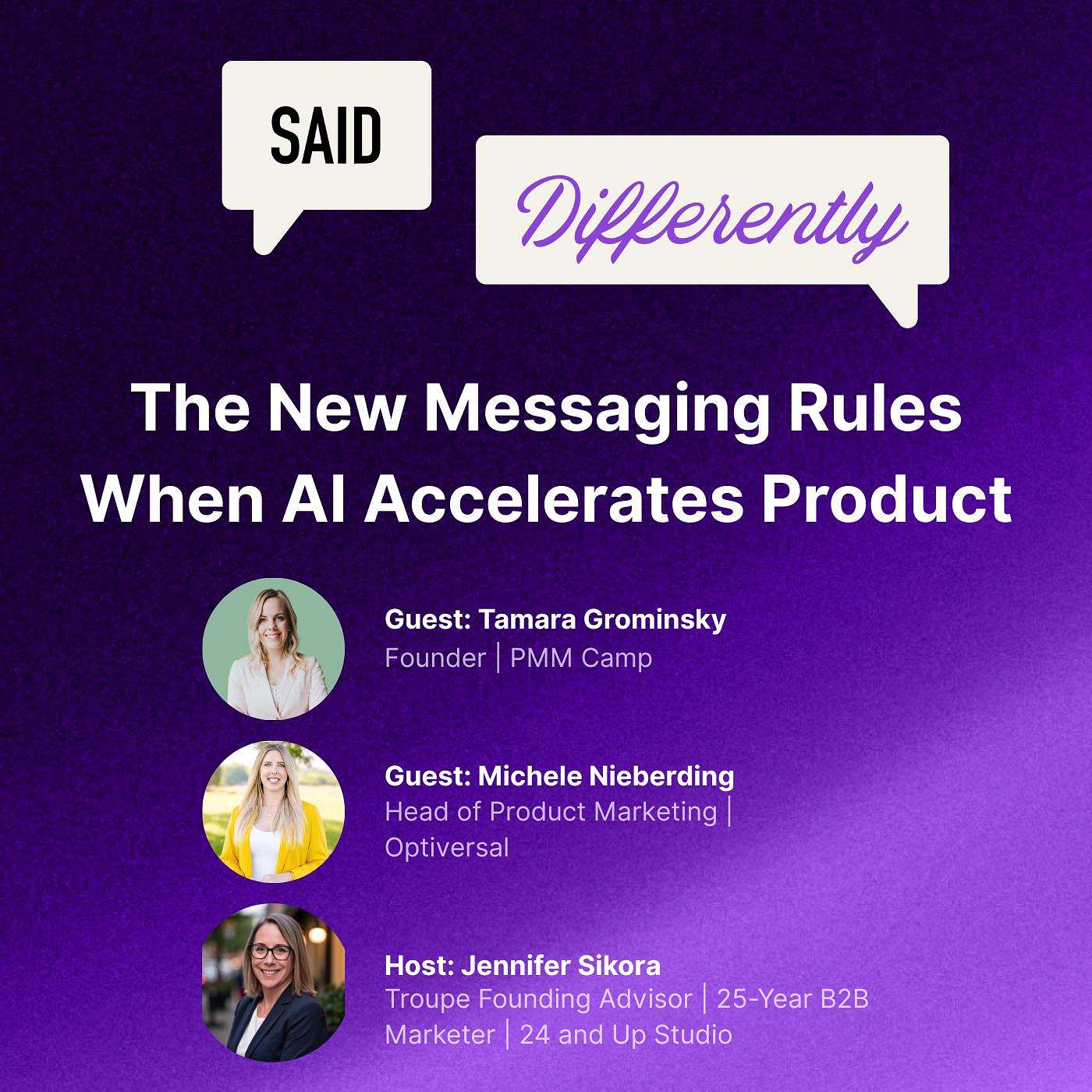
The New Messaging Rules When AI Accelerates Product
38m 59s
In this episode of "Said Differently," host Jennifer Sacora discusses how AI is speeding up feature development and releases, creating challenges for product marketers in managing a consistent story. Panelists Tamara Grominski and Michelle Niebreding share insights from their experiences. Michelle notes that constant updates overwhelm customers, likening it to daily spoilers for a favorite TV show. She emphasizes the need for strong storytelling and stakeholder management to avoid launching every minor feature. Tamara adds that while some teams struggle with rapid cycles, others feel FOMO when their companies don't ship as fast. She advocates for letting customers self-serve information based on their preferences. The conversation shifts to redefining launch plans, with Michelle suggesting that product marketers should focus on customer value and narrative progression, packaging features into meaningful "chapters" rather than overwhelming customers with constant updates. Tamara introduces the idea of product marketers as editors who influence the order of feature releases to tell a compelling story. Both agree that shifting left—being involved early in product planning—enables product marketers to be proactive rather than reactive, helping align development with strategic messaging. The episode underscores the growing importance of product marketing in managing rapid innovation and maintaining customer trust.
[Music] Hi everybody, welcome to today's episode of "Said differently." I am your host Jennifer Sacora on behalf of Troop who brings you this program focused on the art and the science of bringing your go-to-market story to life, all things messaging, all things positioning, and the topic today is a really great one because this has come up a lot in our recent episodes with other guests, which is how AI is making it faster and easier to build and launch new features faster and easier in the market, which is making it challenging for product marketers and marketing leaders to manage a coherent story. Sales is off chasing the last new feature and trying to figure out messaging around it, so we're going to really be focused on that topic today. And I have two amazing panelists as far as today's episode, Tamara Grominski, I hope I did not push your name tomorrow and Michelle, and Niebreding both who we've met through the product marketing alliance. I'm really excited to have them both here lending their perspective on this topic that they both equally feel pretty passionately about. So I'll let you introduce yourself, Tamara, please start. Yeah, no problem. So I currently run a company called PMMCAMP, which is a community and education company for product marketing leaders, where we talk about topics just like this. You know, I found that at one point in your kind of stage as a product marketer, it's really about learning from each other rather than learning about a particular individual. And so that's what I do. But before that, I was a product marketing leader for 15 years, mostly in the PLG space. So I think we'll have an interesting discussion today about even some of the nuances between sales led versus POG and how that impacts today's topic. I love that. That's a great, great way to, yeah, I didn't even, that didn't even occur to me. So I'm glad that we're going to be bringing that Michelle. Yeah, I love it. I'm not part of the PLG world. So I think like you said, that'll be really interesting to try to about, but I am a part of PMMCAMP and I can't say I let I love it. So big fan, but yes, I'm Michelle Niebring. I'm the head of product marketing at a startup called OptaVersal. And we do AI search for retail companies to get them found with all the craziness that's happening with how search is changing, which is super fun and interesting and scary at the same time. Maybe I'll talk about it. I'm sure I'm like, I just don't want an agent buying everything on my behalf, but you know, there we go. Yeah, that's going to be wild if that day comes. I've got the heavens knows what they'll end up ordering for me. But the two of you know each other as well, right? Yeah, we're besties. And we didn't I didn't really plan it that way. It just kind of worked out that way for this episode. I love it. Some Pataco. I think you asked us both what we wanted to talk about. We set the same topic. We're like, please, let's just all get on a call. You absolutely did. I'm like, well, let's just consolidate this. This is great. Okay, so great. We're going to have three voices on this conversation. So let me just kind of kick this off here. So we've all lived in the pre AI world. You know, and now AI with, you know, cursor, cloud code, all the co-pilotting tools. It is now accelerating product development and releases. I experience it every day as an active advisor for troop. I'm on the Slack channel. I see what engineering is posting with their PRs and they're like, here we go. This is shipped. This is shipped. And it's like multiple times a week. And some of it is little small stuff that doesn't warrant messaging. But other things are like, wow, you ship that already. That's amazing. So how have you guys experienced this first hand in your roles? Maybe give some specific examples of where you're seeing this. How does this come up in your work or with the interactions you have with other peers? Michelle, start with me. I mean, like you said, it happens all the time. And it's so cool. And it's like, you want to show off like your new born child and how great the, I don't know, it is. And you're like, wait a second. Like, what are we doing here? It's funny because I tried to explain to my mom like, what I do. And I was talking to her about this topic. And my mom doesn't know what I do. She's like, it's AI, whatever. That's about the extent of her knowledge. Yeah. And like imagine, pick, pick like your favorite TV show. Say it, I don't know, great British baking show. One of my favorites. Imagine you know a new episode is coming out every single week. And so you're planning to see it on that day of that week. And that's like where your headspace goes. Now imagine every single day you had a new update. Oh, this contestant made this or did that or there was a spate like updates every single day. And you're like, no, I'm mentally prepared for the next episode. Next week, I'm not trying to hear, you know, new little updates happening every day about my favorite TV show or spoilers or whatever. And it's kind of what it feels like right now. Like it's too much noise for customers to understand what is actually happening or what's impactful or the prospects to even know what you're doing. So I think what's happening now is like, yes, it's really cool that we can ship things more quickly. In fact, that part of it is probably a dream because we lived in the world where we're like waiting, waiting, waiting for the things that we've been promised from a product marketing perspective actually felt. So like, yeah, pendulum swinging back. But this is also when I think two things become truly important. One is the story, which has always been the case, but even more so now and then to a stakeholder management when the team gets so excited about building these things. And of course, they want to show it off. And we do too. But we have to manage the expectations with them just because we built it. It doesn't mean we're going to do a whole big launch around it at this point. I'm in that kind of pressure of, okay, we'll we're building more and more and more in the next couple of weeks has become stronger. So I think product marketing, the role is becoming even more important again to tolerate stories really pulling on what that stakeholder management looks like. Couldn't agree more and we, you know, a troop of course we embrace that because that's where we're solidly playing in. But Tom, what are you seeing with the camps that you run and hearing from other people? First of all, I love the metaphor Michelle. I feel like we're living in like a love island style where, you know, there's new episodes every night. Yeah, just to keep the metaphor going. But so I love the female voices, by the way, our choices of reference point. Right. So I think that I talked to at least 10 PMM leaders one on one a week. And so what the value I have is I can actually see breadth in addition to my own consulting work that I do within companies. And so I think maybe highlighting some of that breadth might be helpful here. I'll also add, I kind of see two ends of this spectrum. So I think what we're talking about today is the reality for a lot of product marketers. But what I'm also hearing is that it's not the reality for a lot of other product marketers where, you know, they would expect their teams to be moving faster. They're seeing on LinkedIn and in private chats that other people are seeing this and they almost have some phomo of like, oh, well, why isn't my team moving faster? Why aren't we shipping? And so I just want to recognize for anyone who's listening, like if that is you, you are not alone. Both scenarios can be equally true and everyone's kind of living in different realities right now. But with that said, I completely agree with everything that Michelle just said. And I think for me, I've been speaking or thinking a lot and speaking to PMM's a lot about how does this change our relationship with our customers? So Michelle, you kind of tease it a little bit. Like as humans, we cannot absorb this much information. And I think we have been used to in the past us pushing information out to our customers, whether that's for like monthly release notes or big launches. And I think the conversation needs to start to shift into how do we let customers self serve the information they need at the time that they need it? Because some people do want to binge love island every single night. And other people just want to watch a 12-episode show once per week and get that like higher quality content. And it's almost like how do we create both of those experiences? And then let customers choose the experience that is right for that. That's awesome. And we're definitely going to dig in on the planned questions I have for this episode. We have a focused question around how the users or the end consumers of those updates are going to absorb all of that. But you brought up a really great point, which is the other end of the spectrum, Toma, which is, okay, you have the people who are handling rapid release cycles. But then you have those who are not only getting the FOMO feeling, but also like how do they message in the absence of that pace when their competitors or other players in their space might be doing that. So there's that tension as well. Like, it's one thing to feel the FOMO internally, but it's another to try to figure out how to position that in the market if your company's not shipping or and maybe they're deliberately not shipping. Maybe they're moving code quickly, but they're still holding it back before they're pushing it live, right? And so there's a lot going on. One thing I would also add is that we're product marketers who work at tech companies. We are a part of a bubble where we are talking about things and experiencing things that the average consumer, even a business consumer is not. So I'll give an example of QuickBooks, which is an accounting software. I use QuickBooks and my dad uses QuickBooks. He has a small business. I have a small business. My dad is not sitting around thinking, wow, why with AI is QuickBooks and not shipping features faster? Oh, I'm starting to lose trust in QuickBooks. They're not innovative enough. He's not thinking that at all. Meanwhile, it could be me.
as a product marketer, I'm like, "Oh, it QuickBooks does feel a little outdated, you know?" And so I think we have to, as product marketers, also try to be as responsible as possible of thinking about who are actual customers, what are their expectations, and then to your point, Michelle, how do we manage those expectations accordingly? That's really great. I love it. Okay, so let's dive into the first kind of more planned question. So product launches, we've all been through it, right? There's this sort of, we build these frameworks, these structures, these plans, and so that's been around forever. You know, and we've always kind of thought about how to grade a product launch, or like, is this a major, is it medium, is it low? Like, because then that helps determine how big of a splash you make, what resources you pull in, how big of the scope is the launch plan that you need to manage and to end. But now with all of this stuff shipping more frequently, you know, how are we redefining what we consider a launch plan? Michelle, let's start with-- Yeah, I mean, it's not just like, "should be more stuff," it's like, there's more places to ship it if that makes sense. Like, the number, a click-up, stuff, a great job. I'm like, TikTok, you know, from a corporate perspective, like, there's just so many, or, you know, who's immune to like, to actually-- Yes, yeah, to talk about the things that we're shipping. So there's, again, in my world, which is, you know, interesting to think about, because Tim, whatever you're so right, like, the past company I was at, my CEO is literally building things, shipping things, being like, okay, product marketing, go enable. I'm like, I don't even know what you built. And this kept, you know, more like companies that are rebranding to whatever company name AI, and they're like, "Well, that's our launch." It's just, we rebranded to something AI, and that's going to fix all of our problems. It's so-- It's not even my product, right? It's just like fully rebrand, because everyone else is doing it. So there's all these things going on. There's all these new ways to communicate it, channels to communicate it on. But I think what changes is, it's not just waiting three months to launch something, right? I feel like historically, product marketing was, okay, you know, you build that three-month plan. You get three months to build your product. We have three months to get all the things together to talk about it. Last week, I was building landing pages unlovable, because, you know, my CEO broke his arm and can't build all the website right now. You know, things like that. There's ways to ship things faster, but I think the way we need to think about launches differently is not just like, to be ship something or rebuild something. It's like, how does this change? How like the buyer, the customer, the market should think about it, right? Because when everything is-- This is my new favorite word, "sloft-amized." AI slopped-- I know, right? It's like kind of fun. Unfortunately, not take credit for it. I saw it in some LinkedIn post. I'm like, "That's a genius." It's a good portmanteau, for sure. I need a t-shirt. But that's kind of-- If you're not doing it right, if you're like using AI ready, and like all these buzzwords, and you're just like literally slapping AI on something, I mean, it doesn't mean anything. And so when we're thinking about how we're redefining launches, you have to keep like, I think the criteria of what, like, why are you launching it? What is the narrative? The story becomes, like I said, 10 times more important because, like, you'll have cases where you're telling a really, really strong story, and you have a set of features that tell that story really well. And then someone launches something that they think is like tier one, like, the coolest thing in the world, and you're like, but that does not fit into the narrative that we're about to tell, and why we're telling it. So even though it's calming the chaos, you just have a couple more cuts to herd than what you're doing, I think. Yeah. I think it's so interesting because we think that how, like, we've traditionally tiered launches. There's many different ways of doing it, but oftentimes the conversation comes back to what is the level of customer value that we're delivering with the launch, and what is the level of business value? If we have high customer value and high business value, we're going to make it a tier one. I think we need to start over indexing on the customer value right now, right? Because when we feel like we're costly shipping things that could be valuable, often as we are doing those things for us, we're like, oh, well, we're getting a lot of churn because of this thing. We want to ship this. Right? And it's like, well, maybe that is valuable to the customer, but like, is it or are we building up ourselves? And so it's like, what is the customer narrative that we want to tell over the next three, six, nine, 12 months? Maybe that narrative is now a bit tighter than it used to be. We're not thinking in three-year increments, but we certainly should still be thinking about the next 12 months. And are we shipping something that allows us to actually move that story forward for the customer? And when is it enough? I think one little thing could be valuable and it could help move the story forward, but to go back to like the serialized kind of TV show example, I often like to think of like serialized novels as well. It's like, okay, some novels came out chapter by chapter, but they didn't come out sentence by sentence. You know what I mean? They waited until there was enough sentences to move the story forward to package it into a chapter, but they had the plot to it, right? Oh my God, I love it. I just envisioned a teaser for this episode here and so. That's amazing. And so I've been thinking a lot about that. I'm like a big reader. I did my masters in publishing and so I go back to books a lot and it's like, how do we start packaging chapters rather than sentences and paragraphs? But also, we don't want to wait till the end of the novel either. So I think that's a fun metaphor we can maybe play with. It really is. I also had a recent episode of said differently with Tom Chris. Do you guys know him? He's with Fluvio Marketing. He's a big part of the product marketing alliance. He hosts a lot of their events. He and the Fluvio team they published a report about how product marketing can close the revenue gap. And they were, he was, he made a really good point that I think actually fits in well with this theme, which is that product marketers need to shift left. And sometimes that's been really hard, but if product marketers can get ahead and get more strategic visibility and have a greater voice in actually what is being planned, even with that accelerant of AI poured on top of it, then, then you can anticipate what's coming down the road with the plot line, right? So now you can read, you can be proactive about thinking about your communication as opposed to reactive, which unfortunately, I think a lot of product marketers find themselves in a reactive state, right? Somebody else makes the decision about what is getting developed in the product and now it's product marketing is job to carry that water to the market. But his argument is shifting left. What do you both think of that? Do you see an opportunity in opening here from product marketing to get more strategic? Yeah, so I call that inbound. So there's like inbound product marketing and outbound. I think I've always advocated for people to build that inbound muscle. But I'll also add to, typically historically when we talk about inbound product marketing, we say, oh, we should bring insights to the product team to help that influence what they built. But to bring us back to the book metaphor, what if product marketers were not the authors, but the editors, right? The product managers responsible for figuring out what are we building? It is our responsibility to make sure, yes, we're helping them build the right things, but more importantly, build them in the right order so we can tell the right story. So if you think about an editor, we're looking at the raw ingredients that are on the page and we're saying, would it be really great if we moved these couple paragraphs up into chapter two instead of chapter five? That creates more tension, that creates more excitement, that, you know, satisfies the reader, whatever it might be. I really think that that is our role within the inbound part of the product marketing world. I don't know which all, what do you think? I mean, I think to build on that and I've actually had to use the story recently for a similar situation where there was pressure to push things too quickly and you're right, like where is it being into the story? The analogy I used, so I guess I'll ask you both what pick what's your favorite animated movie? Pick anything. Oh gosh, I'm gonna go old school here and go with the OG Aladdin. Yeah, gosh, I can't say I've watched a lot of animated movies. I'm like, I'm just exposed to you. Okay, he focuses the-- Yeah, I know. Okay, yeah, yeah, book, book server movies. I also like, beevus and butt head do America, but I don't know what that says about me, so I guess I just admitted that, but that's okay. Okay, so Aladdin, whatever, beevus and butt head, whatever. It all animated movies have this in common, right? Where they get the story right before they build out the animations and because of that, it takes less time to build. It's cheaper to build versus say something like a live action show is a mission impossible where they record hundreds and hundreds and hundreds of hours of footage and pay so much money to the actors to do this and then they slim it down to like an hour and a half that you're watching in a movie theater. For hours and hours of content that's been built. So what I, to Tamera's point, like you want to start like an animated movie, you have to get the story right first and then build everything after that to make a good movie. There's really no bad animated movie this way. They got the plot right first. They got the story right first. They knew to Tamera to your point, like what fit where, what chapters they were building and where to put things in, which is why it's been so powerful and so impressive, like what it is.
animated movies have been able to do. What are the new ones about like emotions or what like there's all really good new ones that have taken off? And then you see, I don't know, maybe some live action films that either are the best or you like, I don't know, scary movie six came out, I'm a millennial, I can't help it. And they were like, all you're talking about all these parts of the movie that were cut. And you're like, ah, you know, what a waste of money and time for things that are just getting cut out of a movie. And so I think, you know, that goes back to the point is like, you've got, be an animated movie, right? Get the story right first and then ship it and tell that good story. Because otherwise it won't stick, it won't make sense. Back to the customer like, again, yeah, reshipping things to ship things. That's really the question. - Great. No, all right. So let's stick with the customer lens on this. So how are they going to absorb, you gave the analogy to Tamara already about the quick books between you and your dad, but I mean, the communication strategy to your prospects. I think we're all on the receiving end. We all use many different tools to do our jobs, right? And we're constantly getting fed different updates or you go in and there's something changed, there's something different. Most of it I think we can absorb, but if it's at such a high pace or it's a jarring change and that's happening fairly often, that gets really difficult for users to absorb. So users are one group, but then there's the non-users who you hope one day will be users and how do you get them? So I feel like that you can almost even segment it further, there's the people who are already on in your product who are using it and they have to absorb the change. That's more of a customer success, customer training kind of issue, but there's a story there too. And then there's the prospects who are like, well, how am I making sense of, hmm, maybe I should just wait two more months before buying your product, right? Because if you're shipping so much, then why don't I wait 'til there's some more good stuff in there, right? So you don't want to also give them cause to delay a decision. How do you guys, how do we get our arms around this, the customer comms part or the prospect comms part? - Yeah, I think there's, obviously there has to be some consistency. So if we go back to the TV show analogy, right? People that don't watch Love Island, I didn't watch it for a while. How do you get, cause we're all fighting for the same dollars, the same attention, right? So how do you get someone who, I don't know, prefers watching the bachelor over Love Island or whatever, like to get them to watch Love Island, right? It's like that similar concept and you have to keep that consistency of like, what do you stand for? What is your true narrative from a high level? Like what are you doing to solve people's problems? Now you might be doing something a little differently yourself, maybe it's a slightly different problem, but from like a umbrella narrative that should be consistent and remain the same. I joked with my husband, like durability is so important. Like if you can compliment somebody, durability is actually up there with one of those top, you know, things that people maybe don't think about. And I think when you're, the idea of like message durability is so important, it takes a step beyond consistency. Are you saying the same thing, sure? But does that message continue to resonate as the market changes, as things change as customer, ways of buying changes, tamer into your point? Like does that message still remain the same? And you think of brands that have done this really well? I don't know, Slack for example. Didn't, I think it started as like a way to interact for video gamers or something. Like Slack was not always meant to be a corporate messaging platform, but it was so good at what they did. This idea of like we're good at communicating, you know, helping people communicate and message each other that they were able to build upon that core durable narrative in a way that really expanded them into like corporate necessity everyone most times, Slack, right? So that message remains the same. You're really good at the core of what you do and everyone knows that too, then eventually say, okay, when I'm looking for a tool to do X, I think of Y. And that's really what I think we're working towards. - Yeah. - Yeah. - That's okay. - Yeah, I have a few thoughts here. Not sure where to take this first. I think there was a couple questions. It was like how do we message to, both prospects and then also existing customers, equally how do we message an innovative, fast-changing product when maybe people want stability? I'll take that last one first. So I do think that being honest with the prospect and the market about like where you are in your journey as a product is the best course of action. How I see a lot of people handle this well is something like a manifesto that paints, you know, the picture of what you believe in. To your point of thought, it was like durable values that direction that's probably not going to change. The thing that you believe needs to be different and managing the expectation that this is not gonna happen overnight, but if you believe in this too and you want this better different world, come along with us for the journey and here's some of the benefits of being along for the journey. You get to help shape it, you get an inside track, whatever it might be. But then on the homepage being really clear about like this is what we do today. Here's the use cases we saw for the people whom we saw them. So I think that topic, we're going back to the first topic which is like how does the messaging actually change between messaging to a prospect versus messaging to a customer or a user now that we have, you know, things coming out faster and faster. I think that's where like a messaging hierarchy comes in which we often talk about messaging and positioning is like a very flat thing. We have messages and we have positioning. But I like to think of positioning as like the anchor or the foundation and we can kind of go up or down. As we go up we're going to more kind of cooler audiences, right, so people who are maybe, you know, yes, prospects, mid funnel, prospects, top of funnel, people who've never heard of us before. I mean, which is went out, we can use QuickBooks as an example again, like at the very top of the funnel, what are we talking about? We're probably talking about financial independence. We're talking about the power of entrepreneurship, about building something for yourself. They're not talking about profit and loss sheets, right? But then when they're below kind of the middle of the funnel and they're at the bottom of the triangle and the messaging hierarchy, that's where they're going to talk about, you know, all of the little features that are being shipped that are leveling up to specific story lines that they want to tell to their existing customers. So it's worth literally building one of those little, you know, messaging triangles at the top is like the prospect, it's like what's your big, both message. And at the bottom is like literally the use cases under each of your products. And then in the middle, it kind of gets filled up from there. That's a really great way to look at it, I think. And you know, it kind of said ways, what you were both were talking about is this concept of a North Star and the messaging durability as you phrased it, Michelle, is, and how the hierarchy unfolds underneath that North Star. I know, like just as an example, you know, it true, we've been working with some of our early customers here on helping them understand how their messages are performing against their pipeline. So they all have messaging plans and we get that loaded up. And then they start tracking how those messages are actually getting articulated in the real world, which is an interesting analysis in and of itself. And then how they're performing. And we have one customer will not reveal who they are, but they have three core pillars to their messaging hierarchy. So they're like these three primary themes. And oddly, those themes are underperforming, compared to their average conversion rate and their average wind rate. So when those messages are present, they're actually seeing a decrease in those rates. So that's where you have to really kind of have the metrics to also challenge this, which is, okay, let's not just assume that our North Star story are big hierarchy actually is correct either because as we are articulating these messages in the market, we want to kind of use those inputs to reshape it, not just simply the product velocity that's happening, like how do we come up and iterate and refresh the story, not just simply based on what's shipping now, but also what's working. So what do you guys think of that aspect to this, Tamara? - I think it's like an ongoing work. And I think it also depends on who your customer set is. So again, going back to the end of the call, I mostly have worked in PLG and when I work with clients now, it's often in the PLG space. And we have the luxury of having data and very fast sales cycles or buying cycles. And so for me, that's always meant like, before we are ready for a tier one launch, we're testing every part of a landing page before we even get there. So we're testing on like our beta landing pages, different versions of headlines, subheads, order of those stories, all of those things so that we can see, well, we know this one is going to perform better than this one. So I would say we have more of an advantage there, but I think if we just take like a more philosophical perspective on this, regardless of your go-to-market motion, what actually causes this? Half the time, it's because we have a set of executives who sit in a room, who want to tell a story. And then we have another group of people who are actually building the work, shipping the work, talking to customers, getting real-time feedback. And there isn't enough trust between the two groups for the executives to be willing to hear the feedback of the people on the ground, but also people on the ground, sometimes they're not taking that initiative to make it impactful enough for the executives to find a way to communicate. And so I think it's about just having more of a spirit of innovation. It's like, okay, if you're as open to shipping new product this quickly, why can't we iterate on our story that quickly as well?
And then just setting up the right like rituals and rhythms of business to have that so the same way we have product meetings Why can't we have story in narrative meeting? That's right. Yeah, yeah something like that. I mean, it's nice You know, we didn't really have metrics to test messaging before right? I mean to your point like Executive had an opinion and that that was that didn't matter if we had tested it with customers or now there's like AI persona testing which is a whole whole another can of worms. I wanted we go down that path But it's this idea of You like you have to keep that North Star and yes We have to test what these pillars are but in a world where I come from where it's like very sales lead very enterprise Takes a really long time and if you mess up that story as you're working at enterprise deal that takes 12 or more months That can get confused and almost scary to the process. I feel like oh you said you were this and now you're this I mean again my last company We really focused on like IT and engineering and almost overnight We updated the whole website launched a new product went just after marketers and our customers were like Are you still like selling that thing you sold me? Are you still investing in the product that I have? Really like that whiplash was very real and it came it did come from the top down Which is a lot of pressure for product marketers to keep that North Star store star story and then even the idea of testing pillars like You can't even do that in that moment which is almost scary because to your point like You have you have to have that hierarchy now within that hierarchy how often those layers change is an interesting idea Right because if you have that top down pressure You know what do you do in that situation? How do you communicate you do your best to say here? We're not changing our identity or expanding on it, right? I used to tell people like if you think of the depths of the ocean You don't necessarily know everything that lives down there and just because a new species and the deep ocean pops up It doesn't mean everything else in the ocean goes away, right? That's a whole lot to tell And scary when everyone there's so many tools out there I mean there's hundreds of AI tools popping up overnight to solve like the same problem, right? So it's like I feel for our customers and you know sometimes I'm a customer of our customers Because they're dealing with so much noise and like there's oh this tool can do this now and this tool can do that now So you really have to have some level of consistency and think goodness now that we do have tech to test the messaging because previously as product marketers It was kind of like also is my best guess I talked to customers. I'm getting feedback from sales But I don't have the numbers to take up to the exactatives to say hey Here's what's working and not working even if they have a strong opinion. It was kind of like You can only do so much to share your feedback because you didn't have hard metrics other than you know Yeah, our turn is up or our conversion rate is lower whatever that might the direct correlation wasn't there so Yeah, definitely and I think those metrics and that kind of data cannot just help with this sort of stagnation around messaging But also mercurialness around messaging, right? And I think there's a risk here that with the amount of AI Velocity for shipping more features is that we are Refreshing too often So you guys have both brought up really good arguments about how to strike that balance Just kind of closing out with the last question. I did ask one of my many LLMs that I subscribe to It's thoughts on this and it gave a good reminder on how a long-standing framework still applies So I'd like to get your thoughts its answer was before communicating any launch ask yourself who needs to care? Is it for customer prospects technical debt or a full market moment? Why does it matter now? So giving that release context and how does this fit our larger story? I feel like the three of you hit on all of those during this discussion, but like looking ahead what kind of Practical advice would you give product marketers or marketing leaders to ground themselves and kind of just you know Get some stability right now. Tomura Yeah, you know one thing I've been thinking a lot about recently is this idea of trust I think that you know pre-AI we went into most relationships with products and companies with trust right until they broke it And I think what AI has exposed is that now we actually enter most relationships with a lack of trust And we then expect someone to build up that trust It's like I immediately assume that you've written this all with AI I immediately assume you haven't given any thought It's gonna change all the time all of those things right that's the mindset that a lot of people are going into so I think how do you Make sure that you are building on trust with your customer with everything that you release and so the I think the extra question I would add to that framework is is this building trust with our customers or is this you know breaking trust with our customers and just What would that look like? Well if we've been talking about our narrative a storyline maybe a value proposition for the last six months And now we're adding a supporting feature that's part of that story that they can tell this part of that story That's adding trust But if all of a sudden we're talking about something out of the blue that we've never talked about before we're not giving any Contacts the why it matters to them or the story then that's going to start breaking trust and so just using that filter To kind of just see is this the right thing to do? Yeah, and Michelle would it what do you recommend what practical advice are you maybe even practicing yourself or would you give to others? Yeah, I mean, I do agree trust is so important. It's interesting because we see so many competitors doing like free audits I call it a closet because they're basically putting a prompt in cloud to get some sort of audit out And it's not even accurate, you know, it's saying things about a brand no one's even looking at it that isn't even true And it's so I see that because again You have to like you said you have to be honest you have to like build that trust Everyone says it can do all these things but it's it's hard to dig through and so I think it comes back to also just People connecting with people the more that you can have conversations like this or like talk to your customer get them on camera Get them like just chatting like just informal conversations about like what is the reality that they're living in? And what are the words that they're using what you know that it's been true forever, but what keeps them up at night like that story is so powerful still I mean there's things that like yeah back to quick books that my husband also was an entrepreneur and you know There were things that kept him up at night that he would actually you know message quick books about so that's also still very true And I think the questions that you had are pretty Spot on I think one I might add would be like what should someone do differently because this exists because If the answer is nothing then like maybe it's not a launch like maybe it's not A priority and that's what you put in your you know monthly updates somewhere like if they're not Doing anything differently or is truly not going to change their lives. It doesn't matter I think the biggest thing in product marketing kind of why I got into it I mean truly if I can get someone promoted if someone Personally like to me personally can come back and say this product this tool this tip whatever it is helped me do better in my job Like personally that's what makes me happy and I think that builds trust too So despite all this AI like humans matter build trust Last story I'll share because I thought this one was funny my and like kind of embarrassing My CEO we were doing like a closed loss outreach right like reach out to account Lost and we've actually sent proposals to in the past just write them an email series So haven't a long day decided to put in cloud and be like hey right this you know three email series for prospects that we Lost and sent proposals to And I'm looking at the output. I was like I didn't think about it. Send it to my CEO. He goes like what? I'm like You know what I mean? I didn't totally read it like that spare He's like you know what take out your notebook Which I always have he's like hand right and know that you would like write to a friend about this like literally Write it down just don't look at your computer write it down on paper and it was So much better. It was so much more compelling and so yes, AI is there to help us but that human factor just like cannot Be you know emphasized enough so Yeah, that's a great note to end this episode on I think um Thank you both so very much for participating in this discussion This is going to be a very special episode um because we're on summer break right now But this is a topic that I feel can't wait so um thank you both so much any kind of final comments or words or plugs No, thanks for having us. This is great conversation All right, thank you both so much. Bye
Podcast Summary
Key Points:
AI accelerates product development and releases, making it challenging for product marketers to maintain a coherent story.
Frequent shipping creates noise for customers, requiring careful stakeholder management and emphasis on narrative over individual features.
Product marketers must redefine launch tiers, prioritizing customer value and story progression over business value alone.
Shifting left—getting involved earlier in planning—allows product marketers to be proactive editors of the story, not just reactive messengers.
Customers need self-serve options to absorb information at their own pace, balancing binge-style updates with curated releases.
Summary:
In this episode of "Said Differently," host Jennifer Sacora discusses how AI is speeding up feature development and releases, creating challenges for product marketers in managing a consistent story. Panelists Tamara Grominski and Michelle Niebreding share insights from their experiences. Michelle notes that constant updates overwhelm customers, likening it to daily spoilers for a favorite TV show.
She emphasizes the need for strong storytelling and stakeholder management to avoid launching every minor feature. Tamara adds that while some teams struggle with rapid cycles, others feel FOMO when their companies don't ship as fast. She advocates for letting customers self-serve information based on their preferences.
The conversation shifts to redefining launch plans, with Michelle suggesting that product marketers should focus on customer value and narrative progression, packaging features into meaningful "chapters" rather than overwhelming customers with constant updates. Tamara introduces the idea of product marketers as editors who influence the order of feature releases to tell a compelling story. Both agree that shifting left—being involved early in product planning—enables product marketers to be proactive rather than reactive, helping align development with strategic messaging.
The episode underscores the growing importance of product marketing in managing rapid innovation and maintaining customer trust.
FAQs
AI tools like Cursor and Copilot enable engineering teams to ship features multiple times a week, ranging from small tweaks to significant updates, which creates pressure on product marketers to manage messaging and launches.
It creates noise for customers, making it hard to highlight impactful updates, and requires careful stakeholder management to avoid over-communicating minor changes while still celebrating innovation.
Focus on customer value over business value, and think of launches as 'chapters' in a larger story rather than individual sentences, packaging features into meaningful updates that move the narrative forward.
With constant updates, a strong narrative helps customers understand what truly matters and avoids diluting the message with 'AI-slopfamized' buzzwords, ensuring each launch has clear value.
Set clear expectations that not every built feature warrants a big launch, and use tiered criteria based on customer impact to decide which updates to highlight and which to include in regular release notes.
It means getting involved early in product planning to influence what gets built and in what order, acting as 'editors' to ensure features align with a cohesive story rather than reacting to shipped features.
Chat with AI
Loading...
Pro features
Go deeper with this episode
Unlock creator-grade tools that turn any transcript into show notes and subtitle files.
 PodcastTranscript AI