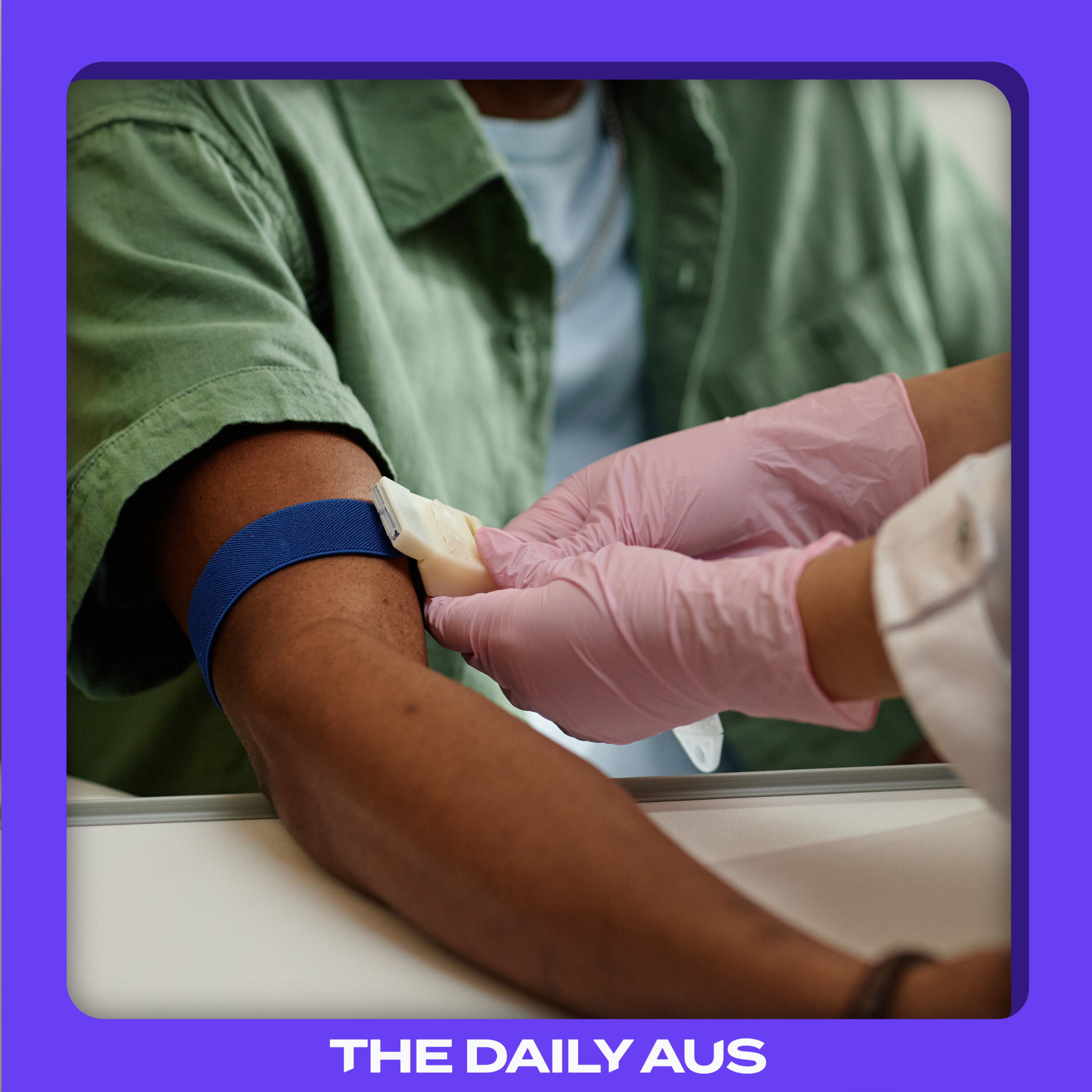
The new Alzheimer’s test that will help young people
24m 33s
This podcast episode discusses a groundbreaking Australian-first blood test for Alzheimer's disease, approved by the Therapeutic Goods Administration. The test can detect the condition up to 20 years before symptoms emerge and delivers results within 18 minutes, marking a major medical advancement. The hosts, Billy and Zara, clarify the distinction between Alzheimer's, a specific brain disease caused by abnormal protein clumps killing nerve cells, and dementia, an umbrella term for cognitive decline symptoms. Alzheimer's accounts for 60-70% of dementia cases, and dementia is Australia's leading cause of death, affecting nearly 500,000 people, with numbers expected to rise due to an aging population. The test measures biomarkers like p-tau 181 and APOE-e4, offering a less invasive alternative to current diagnostics. While there is no cure, medications can slow decline, and up to 45% of dementia cases are preventable through lifestyle changes. The disease can silently develop in the 20s or 30s, making early detection valuable. The rollout begins in 6-9 months, initially for symptomatic patients, with plans for Medicare coverage. Challenges include clinician education and sensitive communication of results. The episode also touches on a lighter story about BTS boycotting the Grammys over a new Asian pop category, which they see as marginalizing. Overall, the test is celebrated as a significant leap forward, though ethical questions about knowing one's future risk remain.
Today's episode was made possible by our friends over at NBN. Ready? And good morning! This is the Daily Oz. Oh! Now it makes sense. Good morning and welcome to the Daily Oz. It is Friday the 31st of July. I'm Billifant Simons. I'm Zara Siedler. This week the therapeutic goods administration approved an Australian first blood test for Alzheimer's disease that can detect the condition 20 years before symptoms emerge. The blood test will also deliver results within 18 minutes. And while the disease does largely appear in older populations, it can silently develop in the brain much earlier. And we know there are a number of factors that can prevent the buildup, slow dying the buildup and those are modifiable and that we can do something. On today's podcast we'll share what you need to know. Billy, I am very excited to talk about this. I think firstly it's huge news when it's an Australian first. But also this is just something that touches so many people's lives and is so significant to so many people. Before we get into the discussion though, I do just want to alert listeners to the fact that we have Abigail in the room with us. So, hello. Abigail is what we call a slashy. She does 100 million things in this organisation and one of the things that she has done in the last week is done a lot of research into this topic. And I've spoke to experts who you'll hear from in this podcast. So, Abigail is producing this pod today and you're going to hear from her along the way. And she will give us some of her expert opinion on this Australian first. She also has a science background which is why we get her to work on all of our science stories because she's the absolute expert. I don't know, can you be an expert on all things science? That's how I see you. You know, she's not at all. I'm like always like trying to look over all the lecture notes. When I was like, did you study at university? Yeah. So, there is a backing there. There's a backing there. I've got my old lecture notes. Back of my pocket. Well, that is about 10 steps ahead of Billy and I and 10 steps ahead of where we'll ever be. So, very helpful. So, welcome, Av. Thank you. Now, Billy, I want to start with, I guess, just a distinction that makes the foundation of this story make a bit more sense, which is the difference between Alzheimer's and dementia because I know that they can be used interchangeably, but they don't actually mean the same thing. Yes. This is something that Av and I have discussed at length in looking at this story. So essentially, dementia is a list of symptoms. It is a category of symptoms and that includes things like memory loss, fatigue, confusion, your brain not being able to process more complex tasks. That is a group of symptoms that is all under the umbrella term of dementia. Alzheimer's, which is what we are talking about today, is one specific brain disease that falls under the umbrella term of dementia because it is a disease that causes symptoms that fall under dementia. Does that make sense? Yeah, yeah, I understand. So, it's one of those symptoms of cognitive decline. Exactly. Yeah. And what it is specifically is, it is this disease where abnormal protein clumps, which sounds a little bit jargony, but say with me, those protein clumps, the abnormal protein clumps, build up between nerve cells, causing those nerve cells to die. And those nerve cells are the things that connect our brain to do certain things. And that is what is dying and causing the symptoms that fall under dementia. Following? Av is nodding along. Yeah. So I think you're exploring. I think it's satisfactory according to her. And Alzheimer's disease is the most common form of dementia. Yeah. So it accounts for around 60 to 70% of cases of dementia, which is why it's one of the things that we hear the most about when we talk about dementia. Yeah. And I mean, I don't think that I necessarily even need to ask because I think everyone has been touched by this disease in some way, whether it's, you know, someone in their family or a friend, whoever it is, but it is an extremely deadly disease, right? It's the leading cause of death in Australia. Wow. So that's dementia is the leading cause of death in Australia. And then Alzheimer's, like we said, that makes up most cases of dementia. Yeah. One thing that I learned from this piece is that nearly 500,000 Australians are living with dementia. And that is expected to double by the late 2050s. I'm curious about that because I feel like anytime we're talking about a trajectory of a disease, I mean, hopefully that trajectory is going in the way of diminishing and decreasing, but you're suggesting here that the episode is happening. Yes. Well, one thing to know is that we don't have a cure, which is something that we can get into later, but the other main two reasons that Alzheimer's is expected to increase, the number of cases of Alzheimer's is expected to increase is because one, we have a growing population and two and probably more importantly, we have an aging population. And to kind of tease that out, this might be a bit oversimplified, but just for the purposes of a short podcast, I'm going to do my best. India has this aging population because one, we are living longer, but also we have a lower fertility rate, which is something that we have spoken about on the podcast so many times. And there are so many reasons why Australia has a falling fertility rate, but it does cause issues. For example, the fact that we have an aging population that puts more stress on healthcare systems and it does mean that the share of people old versus young is changing, it's skewing older. And that means that for a disease like Alzheimer's that does impact older populations more, it is going to become more common. Yeah, understood. That is so interesting. And I guess all the conversations we've had about the fertility rate and the replacement rate and all of those sorts of topics, I haven't actually heard about this specific angle in any of those discussions, but it is certainly interesting. Nabilia, I want to ask you about the announcement and the reason that we're talking about this today, but first let's go to a quick message from today's sponsor. This episode is brought to you by NBN. Simple changes to your setup like where your Wi-Fi router is placed can make a real difference to your internet experience. Find simple practical tips and check your setup at nbn.com.au/optimise. All right, so you let this podcast by setting out that we have had a major announcement this week. I genuinely don't think it can be underplayed how significant it is. Talk us through what it actually is. So Australia, as of this week, as of Thursday yesterday, we are launching, I say we as though I had anything to do with it, billion the labs. Australia, the country. It's massive. I'm just going to keep going with weight. We are launching Australian first blood tests, which can predict Alzheimer's disease up to 20 years before symptoms appear. Now I'm sure many people who are listening to this podcast can think of someone potentially in their life who has Alzheimer's disease or who has dementia. And often you don't know until those symptoms that I talked about earlier start to appear. And that can be really concerning and confronting when those symptoms do start to appear. So this news that there can now be a blood test which can predict the symptoms appearing 20 years before they actually appear is huge. Yeah, I mean, it should be said that I don't even know if you'd frame it as an ethical debate, but perhaps just a personal one, that there is a lot of discussion about whether people want to know this information because I think it's one thing to learn a piece of information when there is a cure available and we need to be really clear that this blood test is not at all a cure. There is still no cure. And I was reading through some of the comments on our post and there was some people who were suggesting they don't want that piece of information if there's nothing that you can do with it. Yeah. Well, I think I would and maybe you'll be helpful here as well. I would say there is no cure, but there is medication that can slow cognitive decline. So it's not right to say that there's nothing that can be done. Right, Ev? Yes, that's correct. And even when I spoke to the associate professor Emma Devani, who was overseeing the sense of excellence leading the launch of this new test, she was mentioning that there are emerging treatments that are soon to surface and there is ongoing research behind finding a cure. So there is no like lost hope in that. Yeah, that is interesting because I guess we're talking about quite a long lead time here. Yeah. If it's suggesting that it can find something that might only materialize 20 years down the road, obviously we know how fast science is.
and medical research in particular is advancing. I am curious, I mean, I'll just put you on the spot here to both of you. Would you want to know this piece of information? I think I would want to know, because I would live in hope that I could do things. I mean, like I said, there is medication that can slow down cognitive decline. And I would want to do as much as possible to prevent that, but I completely understand why so many people in our audience are saying that they wouldn't want to know. If I would want to know and I'm looking up something right now, because associate professor Devani also mentioned that it is scary, like knowing 20 years in advance, but it's good to know that most cases within dimension out-sim is armotifiable, which means that you can change your lifestyle behaviors. You can do a lot of things within those 20 years that could possibly change the outcomes. And if we want more grounding in that, in the 2024 Lancet Commission report, which was looking into dementia, up to 45% of dementia cases worldwide can be prevented by modifiable lifestyle changes. That's a huge decision. It's a huge number. So there can be things done that can change the outcomes. On that, before we came into the studio, I was looking up, I had always presumed that it was genetic and that it was mostly genetic, but that's not completely true. It is a lot about lifestyle choices and there's a whole range of complex reasons why someone can develop Alzheimer's and it's not completely known the exact causes. Am I right, Ev? Yeah, so I think that's a really, really important point. Yeah, fascinating. Well, I guess I mean, in that vein, trying to understand how this blood test actually works, because the other thing, sorry, I keep adding preambles to my questions, but the other thing is that I feel like sometimes we talk about huge medical breakthroughs that there won't be available for years and years and years or decades even. That's not the case here. This is going to be available very soon for Australians, which is why it's so massive. Maybe I don't know. Not just the three, one, to the bus, Philly. Take it away. Explain. How does it work? Yes. How does the blood test work? So it's as simple as like a normal blood test you. Go into the GPA, your doctor, and they'll take a blood sample. And it's all in the processing and the lab work, which is where it all comes in. Yeah. So what this test is measuring are specific biomarkers that are linked to Alzheimer's. So little like characteristic signatures in the blood sample that will show that there is a presence of Alzheimer's. So the higher concentration in these like specific biomarkers that they're looking for will like help clarify or identify that there is Alzheimer's present in someone's blood. And if anyone is interested in what they are looking at specifically who's more across in like biomarkers and all of that stuff, they're looking at p-tow, 1-8-1, p-tow, 2-1-7, and apoe-e-4. So that's a link to Alzheimer's and those abnormal protein clumps that Billy referenced. Yeah. Well, I'm sure that if there are listeners who again have a family history here, they would be familiar and would be, yeah, that piece of information would be so helpful. Yeah. The other thing I found amazing about this news is that they said that the results of the blood test could be returned in 18 minutes. Yes. Crazy. I'm sure all of us here have had blood tests. I didn't get my results within 18 minutes. No. It usually takes 24 or 28 hours. I wake at the moment and take ages to come back. Yeah. So it's such an amazing thing that they can deliver those results so quickly. But, in your piece, I did see that there was a recognition that, you know, if you are getting a blood test like that, it taking 18 minutes to get the results. And then there are healthcare professionals who will have to communicate those results. I know that that was flagged as maybe a concern. Yeah. Like anytime when there's a new form of testing, a new method, like getting that across the board nationwide is such a difficult thing. Like doctors are already overburdened with like doing so many things, especially GPs or general practitioners who have to do so much as well. Being able to be fully on board with how to carry out the testing correctly, making sure that you won't get any false positives or anything like that. Like there's so much things that you have to take into consideration when you're doing these tests. So the professor I talked to Emma D'Ampany, she said like educating clinicians properly across Australia is a big large-scale thing to do. So that is one of the challenges. And how to communicate it sensitively. Like, you, I mean, that piece of news will alter the course of somebody's life, like irreparably. And so, you know, just like an oncologist works on their bedside manner, how to deliver news about cancer. Like this is going to be something similar. And I imagine it will be told to younger cohorts than perhaps we've seen in the past. That's a good point about once you tell someone and then what? Yeah. Because like we were talking about before, what do you do to modify your life? Yeah. Or what is the course of action once you do know? So I think that's a really good point. I've for someone who might be listening to this and be wondering why or how is this relevant to young people. One thing that I found really interesting is that this disease can silently develop in the brain as early as your 20s and 30s. That's not to say that in every case it develops that early is just to say that in some cases it does. And I know in your conversation with Professor Devaney, she spoke about that as well. That was a big surprise to me when I asked her that question like why should young people be interested? And she said that those little protein clumps that form in the brain can silently develop in the brain. So that doesn't mean that symptoms will present in your 20s or 30s, but it can. And exactly like it doesn't happen to everyone. But that's also to consider that the main age group who are affected by dementia is within the 60s to 80s. So if you reel back that mathematics, that kind of falls into your 50s and 40s. But yes, Professor Emma Devaney did mention that it can develop in your late 20s and 30s and that was, yeah, that was a big surprise to me. And I'll play a bit of that interview right now. You know, when you're in your 20s and your 30s and your 40s, in fact, we know that the abnormal proteins that are deposited in the brain and Alzheimer's disease, they're called amyloid and tau. We know that they start to build up in your brain 20 to 30 years before people develop symptoms. So that's in your late 20s, your 30s. And so that's the time that you need to start thinking about brain health right? It is really interesting. Obviously, we have a focus on young people and so trying to understand why and how this news might pertain to them is something that we always try to do. Billy, I am curious now on what happens next. I think I just mentioned that this is fairly imminent. How imminent is it and what are people expected to do now? So it will start to be introduced in the next six to nine months. That's when the rollout is going to start. Initially, it is going to be focused on patients who are presenting early signs of dementia. Makes sense. Very quickly, one thing that we haven't spoken about is the existing diagnostic tool is quite an invasive process. And like we've gone through, there are kind of two benefits to this breakthrough. One is that it can show you symptoms 20 years in advance, but also that it can show results very quickly and it's much less invasive than the existing diagnostic tool. So that is why the initial launch will be focused on patients who are already showing the symptoms. However, the goal is to ultimately have the test available to all Australians via Medicare. And basically from what I understand of this is they want it to be part of regular GP check-ins, health checks. They want it to become a common part of going to your doctor for a general health check. So ultimately, that is where it will get to, but it won't get there straight away. Just on that, obviously, in order for something to be rolled out nationwide, certainly for Medicare to be covering it. So we need some form of government intervention there. Has the government said anything about this? Have we heard from them? They're very much involved in the rollout of this, the health minister, Mark Butler, he told of that the test is an important step forward in the diagnosis and treatment of this heartbreaking disease. They're very much involved in the rollout of this. Like you said, it will be through Medicare. So yes. So interesting, Av, thank you for joining us on this pod. My pleasure. This was fun. It is just really monumental. I would love to hear from our listeners about that question of would you want to do this test, whether or not you do have a family history or someone you love has been taught?
by this, I think that it is a really interesting discussion and certainly represents quite a leap forward in terms of our medical research here in Australia. So, very interesting stuff. Thank you, Billy, and thank you out. Thank you. Thank you. Do we have time for a quick tip bit? Do we do? You are both familiar with BTS? Yes. Not to be confused with behind the scenes. If anyone's not familiar, though, they are. One of the world's biggest bands. Probably the biggest boy band in the world. Yeah, definitely. There is pop. Yeah. South Korean band. And this week, they have announced that they won't enter themselves into the Grammys. Now, they issued a. I call it a vague statement on Instagram, but people have inferred from that statement as to why they are not putting themselves forward for these Grammys. And that is because the Grammys have announced the edition of a new award for Best Asian Pop Music Performance. And BTS have essentially said they don't think that awards should be divided by region or language. And that what is happening here is ring fencing, South Korean music or Asian music from the mainstream awards, the big awards that we all know that happen every single year. There is an award for Latin music and now an award for Asian pop music. And as we kind of just said, BTS is the biggest boy band in the world. And fans are theirs, and certainly what we're understanding is that they think that they should be up for the mainstream awards, not shafted to the side in some other category of music. I haven't even taken a breath. Do you have anything to say? I was going to say, I'm pretty sure that Grammys responded. Yeah, they did. Yes. Do you have it there? I do. Sorry, I actually have when the Asian pop award was announced, I have their rationale for that. Because they said it was a new, they were wanting to make space for new forms of music. Yeah. And they wanted to celebrate new genres and that that was feedback they'd received from the music community that there needed to be more opportunities to celebrate what they called different and new genres of music. But, you know, that's certainly one side of the coin, the other being, why can't they all be celebrated in a single category and why are we breaking out these different genres? And I've also seen criticism of the Grammys from people who have said that Asian pop music is not new. Yeah, and certainly Nora's Latin music. Yeah. I guess just the Grammys trying to acknowledge the growing influence of these different genres globally. But, very interested to see what happens if, you know, one of one of the biggest bands in the world isn't competing for these awards. And it is, yeah, really certainly for that award in particular, very curious to see what happens there. I feel like over the years, I've heard a lot of artists criticizing different things about the Grammys, but I haven't heard that much about artists actually boycoding. Like this is quite a significant step from them. Yeah, well, this might sound really stupid, but I was surprised. So they've withdrawn. They said that they have decided not to enter the Grammys this year. I didn't know that it was like a self-nomination thing. Yeah. Like does that. Wait, is that. Is that yeah, like you're being stupid or yeah, duh. Well, they're the same thing. I'm sure. They're the same thing. Like any two options to call me dumb and you chose by the same thing. I chose by the same thing. Um, no, I think I only learned that I like two or three years ago. Okay, and now I'm acting like it's common knowledge, but if you think about awards and journalism, we have always had to enter our cell phone. Yes, and yeah, to take one home. Oh, go ball ball. We, one, I'm not going to ball out, audience. We have a one-of-walkly, but we're going to. On our way. Yeah, suddenly this podcast might be it. You're on ticket. Obviously, never. All right, well, on that note, we will leave it there. Thank you so much, both of you, for that explainer. And thank you, listeners, for tuning in today. We'll be back later with the headlines, but until then, have a fabulous day. My name is Lily Madden, and I'm a proud Arranda Bungalong Calcutty and woman from Gadigal Country. The Daily Os acknowledges that this podcast is recorded on the lands of the Gadigal people and pays respect to all Aboriginal and Torres Strait Islander nations. We pay our respects to the first peoples of these countries, both past and present. Shout out to NBN for supporting today's episode. Okay, real talk. Most of us haven't thought about our internet since we moved in, but with NBN full fiber rolling out to more homes, it may be worth checking your address to see what's available to you. Faster, more reliable internet can help you do more of what you need and love to do, whether that's streaming, gaming, working, or everyday browsing. Head to nbn.com.au to find out more.
Podcast Summary
Key Points:
The Therapeutic Goods Administration approved an Australian-first blood test for Alzheimer's disease that can detect the condition up to 20 years before symptoms appear, with results available in 18 minutes.
Alzheimer's is a specific brain disease causing abnormal protein clumps to build up and kill nerve cells, while dementia is an umbrella term for symptoms like memory loss and confusion; Alzheimer's accounts for 60-70% of dementia cases.
Dementia is the leading cause of death in Australia, with nearly 500,000 Australians affected, a number expected to double by the late 2050s due to an aging population and lower fertility rates.
The blood test measures specific biomarkers (p-tau 181, p-tau 217, and APOE-e4) linked to Alzheimer's, and it is less invasive than existing diagnostic tools.
There is no cure for Alzheimer's, but medications can slow cognitive decline, and up to 45% of dementia cases worldwide can be prevented through modifiable lifestyle changes.
The disease can silently develop in the brain as early as a person's 20s or 30s, though symptoms typically appear in the 60s to 80s.
The test will be rolled out in the next 6-9 months, initially for patients with early dementia signs, with plans to eventually make it available to all Australians via Medicare.
Health Minister Mark Butler supports the test as a significant step forward, but challenges include educating clinicians and communicating results sensitively.
A secondary story
Summary:
This podcast episode discusses a groundbreaking Australian-first blood test for Alzheimer's disease, approved by the Therapeutic Goods Administration. The test can detect the condition up to 20 years before symptoms emerge and delivers results within 18 minutes, marking a major medical advancement. The hosts, Billy and Zara, clarify the distinction between Alzheimer's, a specific brain disease caused by abnormal protein clumps killing nerve cells, and dementia, an umbrella term for cognitive decline symptoms.
Alzheimer's accounts for 60-70% of dementia cases, and dementia is Australia's leading cause of death, affecting nearly 500,000 people, with numbers expected to rise due to an aging population. The test measures biomarkers like p-tau 181 and APOE-e4, offering a less invasive alternative to current diagnostics. While there is no cure, medications can slow decline, and up to 45% of dementia cases are preventable through lifestyle changes.
The disease can silently develop in the 20s or 30s, making early detection valuable. The rollout begins in 6-9 months, initially for symptomatic patients, with plans for Medicare coverage. Challenges include clinician education and sensitive communication of results.
The episode also touches on a lighter story about BTS boycotting the Grammys over a new Asian pop category, which they see as marginalizing. Overall, the test is celebrated as a significant leap forward, though ethical questions about knowing one's future risk remain.
FAQs
Dementia is a category of symptoms like memory loss and confusion, while Alzheimer's is a specific brain disease that causes those symptoms. Alzheimer's is the most common form of dementia, accounting for 60-70% of cases.
It's a blood test approved by the Therapeutic Goods Administration that can detect Alzheimer's disease up to 20 years before symptoms emerge. The test delivers results within 18 minutes.
The test measures specific biomarkers linked to Alzheimer's, such as p-tau181, p-tau217, and APOE-e4, in a blood sample. Higher concentrations of these biomarkers indicate the presence of Alzheimer's.
The test will start to be introduced in the next six to nine months, initially focusing on patients with early signs of dementia. The goal is to eventually make it available to all Australians via Medicare.
There is no cure, but medication can slow cognitive decline. Up to 45% of dementia cases worldwide can be prevented through modifiable lifestyle changes, according to the 2024 Lancet Commission report.
Alzheimer's can silently develop in the brain as early as your 20s and 30s, even though symptoms usually appear later. This means young people can take preventive lifestyle actions early.
Chat with AI
Loading...
Pro features
Go deeper with this episode
Unlock creator-grade tools that turn any transcript into show notes and subtitle files.
 PodcastTranscript AI