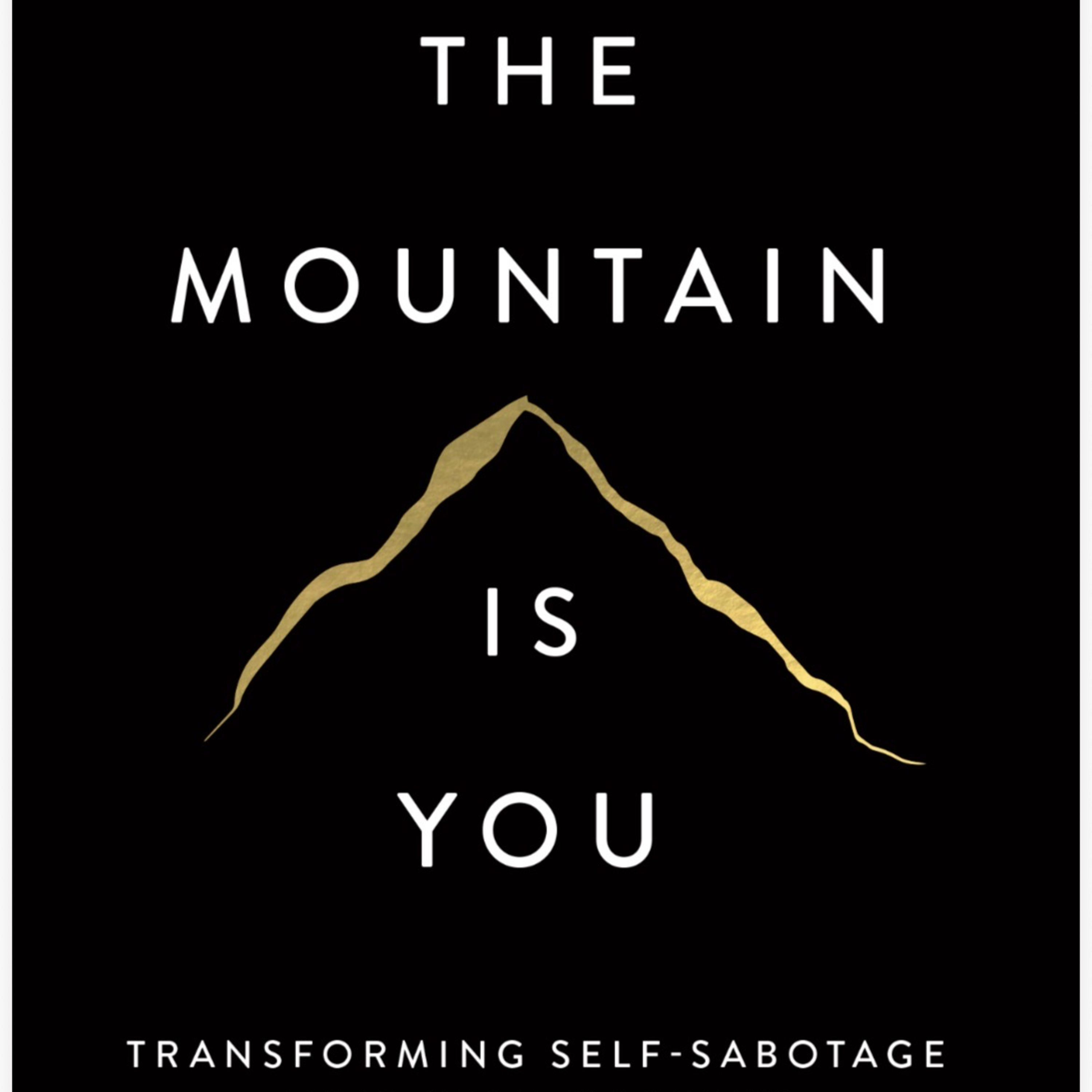
This discussion explores Brianna Wiest’s book *The Mountain Is You*, focusing on transforming self-sabotage into self-mastery. The central metaphor reframes the mountain as an internal obstacle—built from conflicting needs between the conscious self, which desires growth, and the unconscious self, which prioritizes safety and familiarity. The book argues that personal crises, or "positive disintegration," are not failures but necessary breakdowns that allow for rebuilding higher-level psychological structures. These crises occur at "edge states," where old coping mechanisms stop working, forcing a rethink. The mountain itself is an accumulation of tiny defenses and unexamined traumas, not a single event, and its persistence signals a chronic problem of the self rather than a circumstantial hardship. Crucially, imperfection is seen as a condition for growth, making the mountain a compass pointing toward potential. The path to reinvention follows a clear sequence: a trigger reveals a wound, the wound reveals the path, and the path leads to destiny. This journey requires letting go of the old self—mourning it respectfully—and adopting new skills like agility and resilience. The ultimate takeaway is that the mountain is not a curse but a calling, and mastering yourself, not the external goal, is the true reward. Practical advice includes practicing small habits of the future, mastered self today, even before reaching the summit.
Welcome back to the Deep Dive. Today we're going to be diving deep into a really powerful book
by Brianna Waste, The Mountain Is You, transforming self-sabotage into self-mastery.
And we've all been there, right? It's that that deeply frustrating feeling. You have a clear
vision for your life. You know what you want. But somehow you find yourself being the main person
putting up these huge roadblocks. You're the one in your own way. Exactly. So our mission today is
to really unpack this core metaphor that Waste uses to talk about self-sabotage and more importantly,
how to shift our thinking to create some real lasting change. And that shift in thinking is,
well, it's everything. You know, we're taught to see the mountain as something external.
Right. Like the bad economy, my difficult boss. The job market, not enough time. It's a big thing
in front of us. But what this book argues so powerfully is that the mountain isn't really an external
barrier at all. Okay. The mountain is a problem inside of us. It's the physical result of an
unstable internal foundation that we've built up over years. That one idea, the mountain is you.
That is such a game changer. It is. It completely shifts the focus from, you know,
fighting the world to mastering yourself. So if we accept that, if the problem is internal,
where do we even begin? How does that transformation start? Well, it starts by changing your whole
relationship with adversity. Yeah. The core premise here is that life, a lot like nature,
is always, always pushing towards growth. Always. So even when things feel chaotic or uncomfortable
or like they're just completely falling apart, the underlying process is actually moving you
towards something better. That breakdown. It's a necessary ingredient. I get that on an
intellectual level, but let's be real. When you're in the middle of a breakdown, it doesn't feel
necessary. It feels awful. It feels devastating. It absolutely does. And that's why the book uses
these metaphors from nature sort of validate that feeling. Think about a forest fire. Okay. Our first
instinct is to see destruction, right? Laws. But for the ecosystem, fires are essential. The
intense heat is the only thing that can crack open certain types of seeds. Ah, so they need the
fire to grow. Exactly. The destruction literally makes way for the rebuilding of the whole forest.
That's a great metaphor. It's necessary heat. And it's the same in space, right? The book mentions
that stars have to implode the collapse inward before they can explode into a supernova. Right.
The destructive end is just the setup for the most brilliant beginning. And we as humans, we follow
that same natural law. The book calls our big personal crises positive disintegration. Positive
disintegration. That sounds like a contradiction. It does, but it's this fascinating idea that our,
you know, our lower-level psychological structures are coping mechanisms. They have to become unstable
and break down first. They have to fall apart. They have to completely disintegrate before we can
build higher, more complex, more resilient structures in their place. It's not about patching up
the old you. It's about a controlled burn to make room for the new you. So we need that disintegration
for any positive growth to happen. And this connects to another idea in the book, edge states.
Where does this all happen? It happens on the edge. You know, in nature, the most fertile,
most dynamic places are the parameters where the ocean meets the land or where two climates collide.
For us, we transform when we reach these edge states in our own lives. It's that point where
our usual ways of coping of, you know, avoiding the truth, they just stop working.
What does that look like for someone listening? How do you know you're at an edge state?
It's that rock bottom feeling. It's a moment you realize that the thing you used to rely on for comfort,
maybe it was a relationship, a drink scrolling on your phone. It just doesn't soothe you anymore.
The old way isn't working. It fails you. And that failure creates this intense
pressure that forces you out of your comfort zone. It forces you to rethink everything. That moment
isn't you failing. It's the awakening. It's the start of the breakthrough.
Okay, so once we get why the breakdown is necessary, we have to look at how we built
the thing that's breaking down in the first place. Let's get into the anatomy of the mountain.
Yes. So, geologically speaking, a mountain is formed by a collision. It's what happens when
two massive, tectonic plates are forced against one another. Creating this huge upheaval.
A huge upheaval. Yeah. And our personal mountain, well, it comes from the exact same thing.
It rises from these coexisting but deeply conflicting needs inside of us. Internal civil war.
Yeah. So, who are the two sides fighting this war? That's the crucial question.
The first part is your conscious self. This is the part of you that knows exactly what you want.
The promotion, the healthy relationship, the creative project. All of it. The life you dream about.
But the other side is your unconscious self. Yeah. And that's the part that is
actively, if unknowingly, holding you back. The mountain is the physical proof of that fight.
Why? Why would a part of ourselves, especially the part that's supposed to protect us,
sabotage our own happiness? Because the unconscious mind has one primary job.
Yeah. Keep you safe. And the unconscious safe means familiar.
It truly believes that if you stay small, if you stay in your current situation,
even if it's miserable, you're safe. Big success, real love, vulnerability.
That's all scary, unknown territory. That's a conflict between your desire for growth
and your deep, deep need for safety. Precisely. Your unconscious would rather you have a
predictable familiar misery than take a risk on unpredictable joy.
So this mountain of self sabotage is basically a fortress we build out of our old fears.
And I imagine that fortress can look very different from person to person.
Oh, absolutely. For some people, the mountain is obvious. It's a chronic money problem,
an addiction, a pattern of bad relationships. But for a lot of us, it's way more subtle.
Like what? Like a constant little level anxiety or just a vague feeling that you're not happy,
but you can't put your finger on why. A fear of commitment, low self-esteem.
It just sort of bleeds into everything. But no matter what it looks like on the surface,
the source is the same, that internal pressure. But this raises a kind of philosophical question for me.
If the whole point of being human is to grow, why is the system of self sabotage even there?
Well, the book argues that growth is the universal law. I mean, we see it everywhere.
DNA evolves, species reproduce, the universe is expanding outward. Your problems aren't a mistake
in the system. They are the system. They're the catalyst. They are the system. If we are always
comfortable, we'd never change. Our mountains are the mechanism that forces us to expand inward,
to deepen our ability to feel and understand. So our problems aren't stop signs. They're actually
giant flashing arrows pointing to where we need to grow next. Exactly. But to know which arrow to follow,
you have to make a really important distinction. And that brings us to our next section,
knowing the difference between a hardship of life and a problem of the self.
This is such a powerful tool. So how can you tell the difference? Is this a circumstantial issue
or a chronic one? It really comes down to one word, persistence. If a problem is circumstantial,
you're just dealing with the reality of life. Stuff happens. Stuff happens. A pandemic,
a layoff, a storm. Things outside of your control, they're tough, but they're usually finite.
You adapt, you cope, you move on. But when a problem is chronic, when a problem is chronic,
the book argues you're facing the reality of yourself. This is when the same pattern shows up
over and over again, just in a different close. A new job, but the same fear of speaking up,
a new relationship, but the same fear of getting too close. Exactly. When you see that recurring cycle,
that's the signal. The mountain is inside you, not in your circumstances.
And that chronic mountain isn't from one big event, is it? It's more of an accumulation.
That is so critical. The mountain didn't just pop up yesterday. It's almost always the result
of years and years of accumulating these tiny, unexamined defenses, little traumas,
small adaptations you made, coping mechanisms you learned to avoid feeling hurt.
And they all just compound over time. They compound into this massive internal block,
this unstable foundation that now feels completely immovable.
The image of a mountain being built from tiny little pebbles of avoidance, that's really powerful.
But doesn't facing that feel, I don't know, a little overwhelming, like it's saying you're
fundamentally broken. It could, but the source offers this amazing reassurance about imperfection.
It argues that having a mountain doesn't mean you're broken. It means you're human.
Nothing in nature is perfect. In fact, if the universe were perfectly smooth and uniform,
gravity itself wouldn't work. Growth wouldn't exist.
So imperfection is actually the requirement for growth.
It's the condition for growth. The very fact that you have a fault line, a break, a gap,
your mountain, that is a sign of your potential. It's not a flaw. It's the empty space where the
biggest expansion of your life is going to happen. I love that. I love that reframe. It takes
all the shame out of it. It tells you your struggle isn't a sign of deficiency. It's a compass
pointing toward your highest self, which is the perfect lead in to the final section, the path to
reinvention. The hero's journey. Right. So we figured out the why and how the mountain. Now,
how do we actually start to climb this thing? You start at the breaking point. That moment of
necessary heat we talked about, the rock bottom that finally wakes you up, that moment is the doorway.
Why? What is it signal? It signals to your entire system that your old self, your old ways of coping
can no longer sustain the life you're trying to build. The old structure is officially condemned.
This sounds less like making a few small changes and more like a complete personal revolution.
It's a rebirth. And the book outlines this really clear path. First, a trigger shows you to your wound.
Your big emotional reaction, the anger, the anxiety, that's not the problem. It's just a trigger
pointing to an old unhealed wound. So once you see the wound, what's next? Your wound will then
show you to your path. Once you understand where you're
your self-sabotage comes from, say, a deep fear of being seen, then you know exactly what
your work is.
Your path is to practice being seen.
And then your path will show you to your destiny.
Correct.
But that journey from path to destiny, it requires some serious emotional heavy lifting.
You can't carry your old self up the mountain with you.
What does letting go of that old self really mean?
That sounds painful.
It is, because it's a real loss.
Reinventure means you have to be willing to let your old self go into the fire of your
future vision.
You literally have to mourn the person who got you this far.
mourn them.
Yes.
The one who built all those defenses to keep you safe.
That younger self deserves your respect, your gratitude, even.
But they are not equipped to guide you to the summit.
They have to be left at base camp.
So you're making space emotionally to become this future master self, the one who's
already at the top.
You're becoming one with them.
The climb requires you to learn new skills, agility, resilience, and a deep, honest,
self-understanding.
The book says, "The silent internal climb is the most important work of your entire
life."
Okay, let's bring this all together.
The core message of this deep dive is that the mountain, whatever it is for you, is
the block between you and the life you want to live, and facing it, climbing it, is the
only path to your actual freedom.
And the ultimate takeaway is that the mountain in front of you, that chronic fear, that repeating
pattern, it isn't your curse, it's actually the calling of your life, it's your path finally
being made clear.
Wow, the source really leaves us with this one definitive truth.
In the end, it is not the mountain that you must master, but yourself.
And that's the real prize.
Because who you become in the process of getting over that mountain, that stays with you forever.
That self-mastery is the lasting reward, and it's so much bigger than whatever goal
was waiting at the top.
So we'll leave you, our listener, with a final thought to mull over.
If that self-mastery is the true, lasting reward.
What's one small habit of that future, mastered self, the hero who's already at the summit,
that you can start practicing today.
Even before you take the first step like the mountain, you don't have to wait for the
summit to start becoming the person you're destined to be.
Think about that as you face your week.
Podcast Summary
Key Points:
The mountain metaphor represents self-sabotage as an internal problem, not an external barrier like the economy or a difficult boss.
Growth requires "positive disintegration"—a breakdown of old coping mechanisms that is necessary for rebuilding a stronger self.
"Edge states" are moments of crisis where old strategies fail, signaling the start of transformation.
The mountain forms from a conflict between the conscious self (desiring growth) and the unconscious self (seeking safety and familiarity).
Problems of the self are chronic and recurring, unlike circumstantial hardships, which are finite and external.
Imperfection is essential for growth; the mountain is a sign of potential, not a flaw.
The path to reinvention follows a sequence
Self-mastery, not the summit goal, is the lasting reward; practicing future-self habits today is key.
Summary:
This discussion explores Brianna Wiest’s book *The Mountain Is You*, focusing on transforming self-sabotage into self-mastery. The central metaphor reframes the mountain as an internal obstacle—built from conflicting needs between the conscious self, which desires growth, and the unconscious self, which prioritizes safety and familiarity. The book argues that personal crises, or "positive disintegration," are not failures but necessary breakdowns that allow for rebuilding higher-level psychological structures.
These crises occur at "edge states," where old coping mechanisms stop working, forcing a rethink. The mountain itself is an accumulation of tiny defenses and unexamined traumas, not a single event, and its persistence signals a chronic problem of the self rather than a circumstantial hardship. Crucially, imperfection is seen as a condition for growth, making the mountain a compass pointing toward potential.
The path to reinvention follows a clear sequence: a trigger reveals a wound, the wound reveals the path, and the path leads to destiny. This journey requires letting go of the old self—mourning it respectfully—and adopting new skills like agility and resilience. The ultimate takeaway is that the mountain is not a curse but a calling, and mastering yourself, not the external goal, is the true reward.
Practical advice includes practicing small habits of the future, mastered self today, even before reaching the summit.
FAQs
The mountain represents self-sabotage, which is an internal problem built from conflicting needs within you, not an external barrier.
Crises are seen as 'positive disintegration,' where old coping mechanisms must break down to allow for growth, similar to a forest fire enabling new life.
An edge state is a point where your usual coping methods stop working, often feeling like rock bottom, signaling the start of a breakthrough.
The unconscious prioritizes safety and familiarity, so it resists change and keeps you in predictable misery rather than risking unknown joy.
Circumstantial problems are finite and external, while chronic problems recur in patterns across different situations, indicating the issue is within you.
No, it means you're human; imperfection is a condition for growth, and your struggles point to where you need to expand.
Chat with AI
Loading...
Pro features
Go deeper with this episode
Unlock creator-grade tools that turn any transcript into show notes and subtitle files.
 PodcastTranscript AI