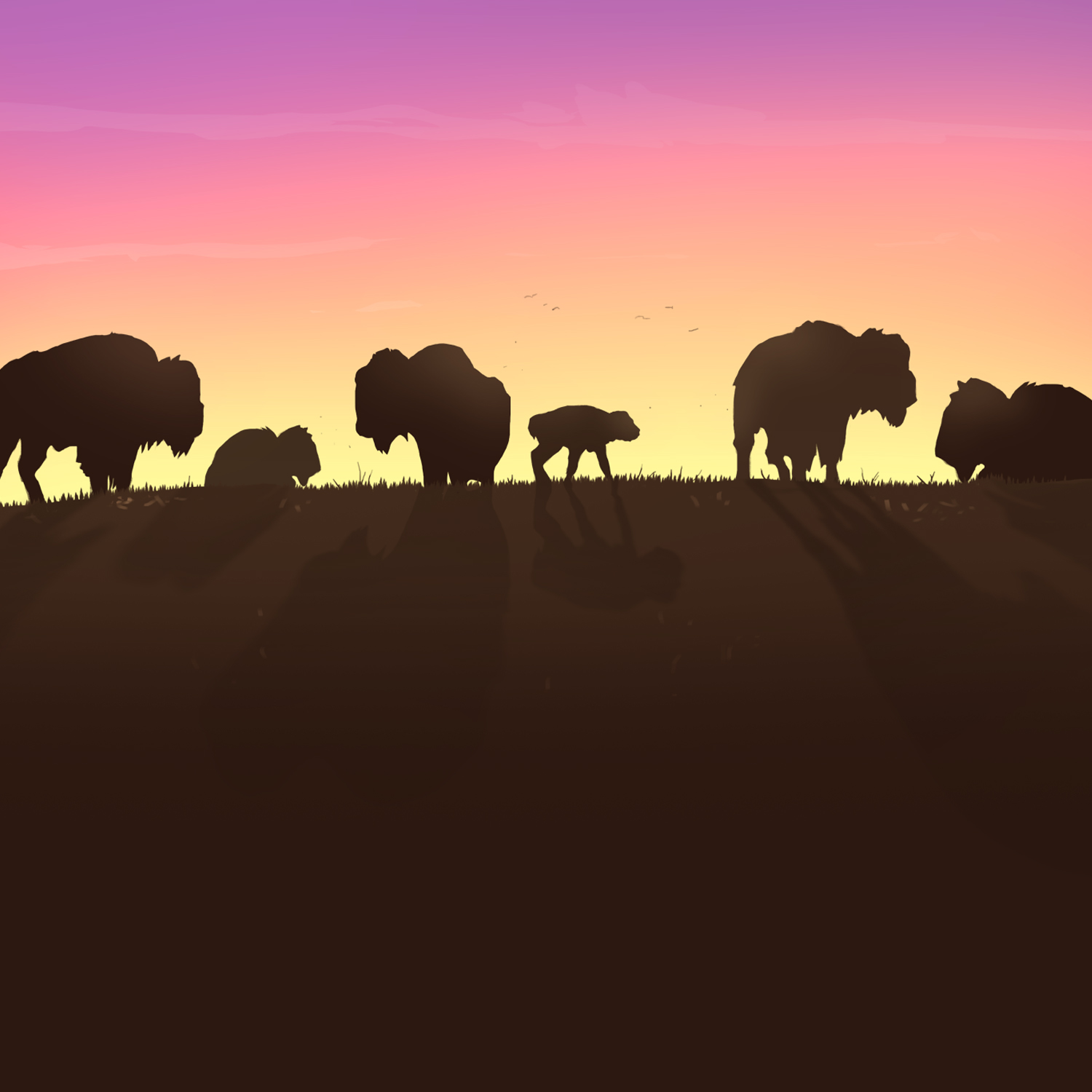
(upbeat music) This is Side Door, a podcast from the Smithsonian with support from PRX and Lizzy Peabody. (upbeat music) A couple of years ago, Kirk Johnson sat down in his couch, put up his feet, and turned on the newest Ken Burns documentary. Native peoples co-exist with the Buffalo for 10,000, 12,000 years. This one was about American Buffalo, or as they're also called, Bison. In this topic, this animal, not exactly foreign to him. As Kirk puts it, I've always been Ken of Bison adjacent in my life. Kirk is director of the Smithsonian's National Museum of Natural History. He's a huge wildlife enthusiast, but Bison hold a special place adjacent to his heart. I grew up in the American West, so there's always Bison iconography around, and it's hard to avoid Bison, they're everywhere. And as Kirk is watching this documentary, an old black and white photograph of a wildlife display pops up on the screen. It shows six stuffed Bison in a gigantic glass case like a diorama on steroids. There's some grass and some sagebrush. There's the big bowl looking to his left. Kirk learned this Bison display was created in the 1880s by a taxidermist on a mission. His name was William Temple Horneday, and he'd arranged the six stuffed Bison to look like a family. There was even a cute little baby bison sideling up to its mother. His name was Sandy. And the way that he positioned Sandy almost embraced in a semi arc of his mother's body, kind of curving around Sandy, it was very compelling. Shavon Starrs is a senior project manager and exhibition developer, also at the Smithsonian's National Museum of Natural History. And she says back in the 1800s, when Horneday created this display, there were no movie theaters, no virtual reality. Horneday's diorama brought Bison to life in a way nothing else could. It was something that people could connect with. And he imported real Montana dirt and real Montana grasses to transport you west, even if you'd never been there before. His rendering was so true to life. In some of the planes Indians that came back and visited the diorama were stunned by how realistic it was and thought that they might just walk off the platform. The diorama gave Americans a chance to see an animal they'd probably read about, but never seen in person. And it might have seemed like their only chance because this hulking, majestic animal in front of them was about to vanish. In the span of roughly a decade, from the 1870s to the 1880s, the Bison had gone from millions and millions, roaming the planes, munching on grass, rolling in wallows, to just a few hundred. It was William Horneday's hope back then that when you saw this diorama, you saw these huge creatures up close and personal. You'd care that they were disappearing. Because they're just so amazing and the concept of having that many on the landscape and then none would be heartbreaking. Back on his couch watching the documentary, Kirk Johnson learned how significant the diorama had been, how powerful these stuffed bison must have been in the effort to save their living counterparts. And there was something else that snagged his attention. The location, they had been on display at the National Museum, or as it's known today, the Smithsonian's National Museum of Natural History, the very same museum that Kirk runs. - So I was like, wow, that's a cool story. Those bison must be in my museum somewhere. And I called up Darren Lundy, who was one of my collection managers. I said, Darren, where are the Horneday bison? He said, I got bad news for you. It's like, what's the news? He said, we gave them away. I'm like, what do you mean you gave them away? - That's right, the Horneday bison had vanished, a little like their ancestors. This time on Side Door, the case of the disappearing bison, both real and stuffed. Kirk takes a trip down one of life's dusty little side roads to find the sixth bison that brought attention to the near extinction of their species and helped ignite the early conservation movement. We'll follow their hoof prints across the continent and see if they can be lured back to DC, just in time for the nation's 250th birthday. That's coming up after the break. (upbeat music) (soft music) - Every story from shortwave and peer science podcast starts with a question. Like, why do we have nightmares? How does AI affect my energy bill? At NPR, we are here for your right to be curious about the world around you. Follow shortwave wherever you get your podcast because the more you ask, the more interesting the world gets. - If you were to hop into time machine and go back 200,000 years to America long before it was called America. - Yeah, you would see the America's version of an African serengeti, full of incredible wildlife, the sounds, the smells, but also importantly, full of those grasses. They're so tall, they create their own sound effects. They create their own kind of smell of vision. You might see camels or camel-like animals. You might see cheetahs or cheetah-like animals mastered on mammoth sloth. And then, starting about 100,000 years ago, the last ice age sets in. And the mammoth animals grazing on the plains are wiped out, except the bison's predecessors. They are hearty. They make it through. In fact, the bison don't just survive. They thrive. - We think at one point, all the way into the early 1700s, maybe even late 1700s, there were at least 35 million bison in North America. - 35 million or more. For context, there's estimated to be about that many squirrels in North America today. So imagine if each squirrel was the size of a Volkswagen Beetle. We're talking about a massive amount of wildlife. And it wouldn't just be those mammals. It would also be Native Americans who survived with, stewarded, and were stewarded by the life on this continent, particularly bison, which were so central to Native American culture and stay central today. - We were so into a woven in our religion, in our daily life, in our ceremonies and our customs, in our spirituality, almost everything that defined and shaped us. - Donnie Bearcubb's Diffarm volunteers with the Fort Peck Tribal Bison program in Montana. She's a member of the Asinaboy Nation and a former Buffalo program administrator at the World Wildlife Fund. - Different people today you talk to them, they'll say the Buffalo was our Walmart. It provided us everything. It provided us household goods. It provided us shelter. It provided us food. It provided us weapons. They taught us how to take care of our children. They taught us how to survive in the winter. And they sacrificed themselves to feed us and take care of us. - But in the late 15th century, something began to disrupt this symbiotic relationship. Europeans. European explorers started landing in America in 1492, when Columbus sailed the ocean blue. And they bumped into Bison far and wide in Canada, along the Potomac in Northern Florida. And they weren't really sure what they were seeing. - They talk about seeing strange-backed oxen or large woolly cows in the 1800s, when Lewis and Clark were on their expedition to the West Coast. They ran into these large woolly cows. And lucky for us, they took good notes. (upbeat music) In one account, they document being held up at a river for days, waiting for the massive herd of Bison to cross the river before they could move forward. They document a herd so large that it literally darken the landscape all the way to the horizon. And they could no longer see the horizon line. (upbeat music) They commented traveling four miles, and all they heard were the sounds of Bison, and all they smelled was Bison wherever they went for miles. The landscape truly must have been covered with Bison. - But this was about to change, because just a few decades later, in the mid 1800s, the East Coast is already getting crowded. And people need room, and they're looking at you.
for jobs, for new family opportunities, and they are looking west. The growing United States sprawls westward across North America, driven by a sense of manifest destiny. The number of states doubles, with more being added all the time. And also this is a time of the planes Indian Wars where the US Army free-dreamers to the United States and the United States. There was also a financial incentive. Tough buffalo hide could be tanned into leather for industrial belts for machinery. So hunters hopped on the new Transcontinental Railroad and spread out across the planes to track and kill as many bison as they could. And they had the perfect weapon, a brand new large caliber long-range rifle. It got a nickname, the Buffalo Gun. And people would go out with these amazing rifles and sit on a hilltop and shoot literally from one position, one person shooting several hundred bison in a day. And then teams of skimmers would go out and skin the bison and take the hides and stack them up and ship them back. And that period, from 1869 for the next ten or twelve years, was just massive bison slaughter. They were slaughtered to near extinction. And all the landscape contained was death. There would be skulls and bones and bison wasting away. And then you contrast that to the Native American relationship with bison, where they were so central to many cultures, often viewed as relatives, as kin, as part of each other. And nothing was ever wasted. It was too precious to waste. So it's just such a contrast when you compare those two practices. Up until this moment, extinction, this idea of eliminating an entire species, was a relatively new idea. Like the passenger pigeon, there were so many people couldn't imagine them going away. But the passenger pigeon did go away. The species went extinct around the turn of the twentieth century. And the bison looked like they might be next. And the bison were decimated, and we as tribes were placed on reservations. We still carried with us all of the ceremonies, all of the rituals, all of the stories, and all of the songs that were related to bison. Johnny says, even when the bison were slaughtered, Native Americans still kept them close. Do you remember as rituals performed with part of an old cracked bison hide, or a skull that was more than a hundred years old? We were almost driven to extinction ourselves. But our connection with them was never ever lost. By 1883, the situation was dire. If you'd round it up every last bison, you could fit all of them on a football field. Extinction seemed nearly inevitable. So when a taxidermist at the Smithsonian National Museum named William Temple Horniday read about this, he said, "Huh, we better make sure to get some bison in the collection while there's still some bison left to collect." And so Horniday asked the secretary of the Smithsonian if he could go west and try and find some bison for the collection. The secretary said, "Sure, go for it. Head out there." So Horniday headed for Montana in the spring of 1886. Most of the locals thought he was crazy for being there. Said, "There's no bison left here." And he describes first searching one place and then another, and then another, and then another, and no one had seen a bison for days, for weeks, for months. Horniday was surprised to find the landscape so empty. Actually, surprise is an understatement. He was shocked. He later wrote, "I received a severe shock as if by a blow on the head by a well-directed mallet, but at long last." He found two scraggly bison. Then he found this live calf bison, which he brought back to Washington live. A live calf who he named Sandy. Horniday brought Sandy and those two straggly bison back to DC. He wanted to study them and observe them and understand their biology and their behavior. And so he put them right on the mall. That is the national mall. He plunked Sandy down to a munch on grass somewhere between the Washington Monument and Capitol Hill. People started flocking, and there's some iconic photos of young children in Victoria and Garb peering through what looks like fencing at these bison. There are live bison on the mall. So what happened to Sandy? I mean, we know Horniday put this baby bison in his taxidermy diorama, so I'm assuming it didn't really go great for him on the mall. Unfortunately, they didn't understand the importance of native vegetation to the biology and digestion. And so Sandy was consuming east coast kind of clover, you know, typical grass. And I compared it to basically like a horse or a cow getting collic. So Sandy got very ill and eventually passed because of that. Sandy was taxidermied for the museum's collections. But around that time, something seemed to change in Horniday. Maybe he'd grown a little attached to the baby bison he'd brought back from the plains. But whatever the reason, just collecting the bison specimens was not cutting it for him anymore. Horniday wanted to save the species. He became an activist taxidermist, an act of taxidermist, an act of taxidermist. I don't know, you guys workshop that. Anyway, a couple months later, he went back to Montana. He saddled up once more. And he did find, after much hunting, he did find 22 bison that he killed. Yeah, you heard that right. His approach to saving the bison meant killing 22 of them. But to Horniday, it was a means to an end. He figured if he didn't kill them, some cowboy would come along and shoot them anyway. At least if he taxidermied some, people could see them up close and personal. So he took aim. And the last day on December 6th of 1886, he shot a giant bull bison. And when he brought that bull back, it was sort of the animal that represented the very last bull bison on the plains. Horniday brought the bison back to DC and created the diorama that Kirk saw in the documentary. It featured the giant bull, four other bison, and the calf, Sandy. Horniday's hope was that this display would shock the country into action. They're so fantastical sounding that they don't seem real. And so he made them real and not in any static kind of way, but in a dynamic living kind of way. You would get a sense of their massive size, but also look them in the eye. And they're looking at you. And what is my responsibility to this animal gazing at me? And it worked. The diorama went on display at the Smithsonian in 1888, and people stampeded to see it. In awe of these burly bovines. The bison were no longer this fantastical animal, no one had ever actually seen like a unicorn. They were real. The diorama was such a hit. It remained on display for decades. The bull in particular became a very famous icon. It became the image that was on the 1901 $10 bill. It was in the 1923 stamp. It became the 1937 seal of the Department of the Interior. So it was a particularly famous animal. Horniday made it his life's mission to save the bison. He wrote a book, reached out to newspapers. Even Teddy Roosevelt got involved. Now, we should note here that not all Horniday's ideas were good. These views on early conservation were deeply infused with racism and white supremacy. In fact, many early conservationists helped these views. Horniday even blamed Native Americans for the near extinction of the bison. That said, Horniday did play a key role in helping bring back the bison. Slowly, over the course of the 1900s, the bison campaign paid off. Their numbers began to rebound from just a few hundred to roughly half a million. Today, most of them are roaming branches, not the open prairie. But Kirk says it's still quite a feeling to see a bison in person. I've been now a couple of bison branches where I get out in the field with the bison. It's primordial. I mean, to actually experience being in the herd of bison is like time travel because you go back to a world 120 years ago or 130 years ago. They're really beautiful. They're a vocative of the West. Still to come, how the Horniday bison roamed right out of the Smithsonian. Where did they roam to? We'll figure that out after the break. [Music]
(dramatic music) (bell ringing) In 2016, the American bison got a promotion. It joined the bald eagle as the official symbol of American strength and resilience. It became the national mammal. But Kirk Johnson at the Smithsonian's National Museum of Natural History had a problem. (bell ringing) So here we were, the ostensible owners of the national mammal and it was gone. (upbeat music) Hornet A's iconic diorama, featuring the very bison bull that adorned coins and stamps and it come to represent America's rugged frontier spirit. That diorama had disappeared. And Kirk was determined to find it. (upbeat music) He got lucky when he stumbled across a book written by a man named Douglas Kaufman. Kaufman had traced the entire journey of the stuffed bison. - What had happened was in 1957, the National Museum was quite crowded and the place was just jammed to the rafteries with specimens. And that old bison exhibit was sort of seeming long on the tooth and they said, "Hey, why don't we send that back to Montana and let them take care of it?" - Kirk went to his collections manager. Was there any record of this? - And he said, "No look." And he brought me in the catalog and there in the catalog reference was a little note that said, May 27, 1957, gift to the University of Montana, Mozilla. - Kirk had zeroed in on the location of the bison. They had migrated back home to Montana. He'd also stumbled upon another interesting piece of information. When workers were dismantling the diorama in 1957 to ship out the bison, they found a mysterious metal box under the bull. Inside the box was a note written by William Horniday himself. It read, - My illustrious successor, when I am dust and ashes, I beg you to protect these specimens from deterioration and destruction. - There was no destruction, but Kirk learned there had been some dissolution. A few years after they arrived in Montana, the bison family was broken up. A couple of bison's stay in Mozilla, a couple go to Boseman, the bull goes to Helena, and nobody has any recollection. - So they're spread out all over Montana. Nobody's really keeping track of them, but Kaufman, the author of the book Kirk discovered, he made it his mission to track down each and every bison. He wanted to get the fam back together. - And he started driving around. He went into the museum in Fort Ben and there was the bull. - One by one, Kaufman tracked the bison down. And with all of them herded back together, he convinced Fort Benton's museum of the Northern Great Plains to raise the money to rebuild the Hornet Day display. And that's exactly what they did. In 1996, 40 years after they were split up, the Hornet Day bison were back. - They made enough money to build a building and to actually take them and get the taxi to be done to bring them up to snuff. - They were reunited in all their former glory. Kirk could hardly believe it. - The six Hornet Day bison, I'm like, you've got to be kidding me. - He was on the next plane to Montana. - And I had originally thought that maybe I could talk the museum into letting me borrow the bull and bring him back to Washington DC for the 250th year. - In August of 2024, Kirk walked into the museum of the Northern Great Plains and finally be held up close and personal the Hornet Day bison. He saw their power, their dignity, their timelessness and their togetherness. Suddenly the idea of borrowing the big bull for the country's 250th birthday party flew right out the window. - It was like, this is not right. I mean, like the bull is embedded in the whole diorama of six of them. So it's like pretty clear to me that's like, I'm not gonna borrow this thing. I can't bring it back. But I was kind of sad and as you were driving out of town, my wife looked over and she said, you know what you had to do is just make bronze, and then they found the facts, similarly to these things and put them in the front steps of the museum. And I was like, that is a good idea. - Kirk was all in. What better sculptures to greet visitors at the National Museum of Natural History than the National Mammal? And these particular sculptures would be derived from the same bison that were in the Smithsonian for decades. So Kirk got to work. He raised some money, found an artist to make the sculptures, a man named Gary Stob, everything started to come together. - Okay, figure it out a little bit. Down. - The bison began their trip back to DC. This time, cast in bronze. A team from the museum went to Loveland, Colorado to collect them, including Jim Wood. - They're about to load the magnificent sculptures onto the back of a 72 foot long trailer. - Jim is describing the scene as these larger than life sculptures are hoisted by a crane and loaded onto a long, flatbed trailer. - Moving the trucks forward, give a little bit better placement for the bull, behind the cow and the calf. - One of the bronzes was inspired by the dioramas iconic bull. The other was a female bison. And nestled up against her leg, the little baby calf that once graced on the National Mammal, Sandy. - And we're about to give the way off to the bison as they make their trek across America. Very good crowd here. We've got some amazing. (horn honking) - Once they were loaded, the bison began their triumphant return to DC. Kirk and Javan and everyone else jumped in their cars and made a road trip of it. From Colorado, the bison traveled through Nebraska and Illinois through a snowstorm in Iowa. They stopped for gas. Kirk says people got emotional when they saw the bison statues. - I mean, I watch a lot of people cry when they saw the bison. So many stories, little kids are coming up and you know, we had a Ogolala Lakota chief wave us off in Denver. - One day, you decided to bring up Mother Earth to take the shoes off. You could go to the vibration, stand on the grass, or wherever you are, and tell the vibration. - He gave us a great prayer for the bison. ♪ I'm the other bison ♪ ♪ What do we know of ♪ ♪ Checking out ♪ - It was just a phenomenal thing. He had the entire group of maybe 100 people and had his face north and east and south. ♪ I'm the other bison ♪ ♪ Checking out ♪ - On March 18th, 2026, the bison finally arrived in DC. The next night, they were bolted down on either side of the main mall entrance to the Smithsonian's National Museum of Natural History. They're permanent new home. So I feel like we've come full circle in 2026. A calf that lived on the national mall in the nation's capital is coming back in bronze form to the steps of the nation's natural history museum on the mall. So it's just, I think it's a wonderful story that connects past and present and hopefully future. (gentle music) The bison have returned to the mall. Yes, they're bronze, not living, but the American bison has made an impressive recovery over the past century. Even if they aren't roaming the wild in the millions like Lewis and Clark described, they now live in all 50 states, even Hawaii. For native people like Johnny Bearcub's stiff farm, even a modest herd of bison can have a big impact. Her reservation in Fort Peck has welcomed some 400 bison over the past decade. Or as she says, they came home. When I moved back here to the rez and was able to take the children out to actually see the buffalo that had come back and to know that soon they would open the gates and these buffalo could roam all over on the prairie. This is such a great gift from the creator to be able to rejoin us with our brothers and sisters, the buffalo. She remembers those rituals from decades past that were performed with part of an old cracked hide or skull that was more than 100 years old. Today, her community has fresh hides. And when ceremonies are held, there's fresh buffalo skulls stuffed with sage sitting on the altars of where our prayers and how they're going to be said. Johnny says this is just a start. There's a lot of work to do, but she says returning the bison to the land is an opportunity to heal. The buffalo took really good care of us. Now it's our turn to take really good care of them. (gentle music) You've been listening to SideDore, a podcast from the Smithsonian with support from PRX. The Smithsonian's National Museum of Natural History opened a whole new exhibition about the American bison and their ecological resilience in May. It's called,
standing strong. It features fossil skulls and native stories and more. So if you're in DC, come check it out. It'll run through May, 2029. And we'll be sure to share some of these amazing photos of the Bison bronzes on their road trip to DC. You can find those on our social media. We're at Sidedoor Pod. A nod to the scientists of the Smithsonian Conservation Biology Institute. They're working with native communities and ranchers to understand how Bison impact their ecosystem and how they can help the prairie system to heal. For help with this episode, we want to thank Sarah Johnson, Darren Lundy, Missy Hawkins, Olivia Cosby, Kristen Vanderveen, Leslie Overstreet, Andy Boyce, Jesse T. Bollaries, Irvin Carlson, and Wyatt Capletti. And thank you to Douglas Kaufman, author of Reflecting the Sublime, the rebirth of an American icon, whose book led Kirk Johnson to the Horniday's Bison and supported our research for this episode. The Bison bronzes were a gift from Naomi Tate and the family of Hal Tate. This episode received support from Smithsonian's R-Shared Future, 250, a Smithsonian-wide initiative commemorating the nation's 250. Signature support for Smithsonian's R-Shared Future, 250, has been provided by Lily and Daumen Inc. Additional support has been made by Target. Our podcast is produced by James Morrison and me, Lizzie Peabody, Ruth Morris, produced this episode. Executive producer is Ann Kananan, our editorial team is just static and Sharon Bryant, fact checking by Natalie Boyd. Episode artwork is by Dave Leonard. Transcripts are done by Russell Grag. Extra support comes from PRX. Our show is Mixed by Tarak Fuda. Our theme song and episode music are by Break Master Cylinder. If you have a pitch for us, send us an email at
[email protected]. If you want to sponsor our show, please email
[email protected]. I'm your host, Lizzie Peabody. Thanks for listening. So, Kirk, I've been told that you took a page out of Hornet Day's book and you actually installed your own time capsule underneath the bull bronze. Is that right? Did you leave a letter for your illustrious successor? I put it this way. I was a little bit liberal in how we allowed the time capsule to come together. I wrote my letter literally hours before it went in. But meanwhile, my staff were busily filling the time capsule up with stuff. And we've included in there some 1000 year discs that have information about the museum. There's a photograph printed in platinum palladium of the bison on the truck. I believe there's some cookies. Wait, sorry. Did you say cookies? Well, there's a little bit of a joke that because on my 10th anniversary here, my staff made a Kirk Johnson cookie, which had like a picture of me on it. And you know, there's one of those things where they have little memorial cookies to know and eight. Some of them so they've already been like, they're already four years old. And they're kind of really hard. So we're like, maybe this thing will last 200 years. We'll see. From PRX.
 PodcastTranscript AI