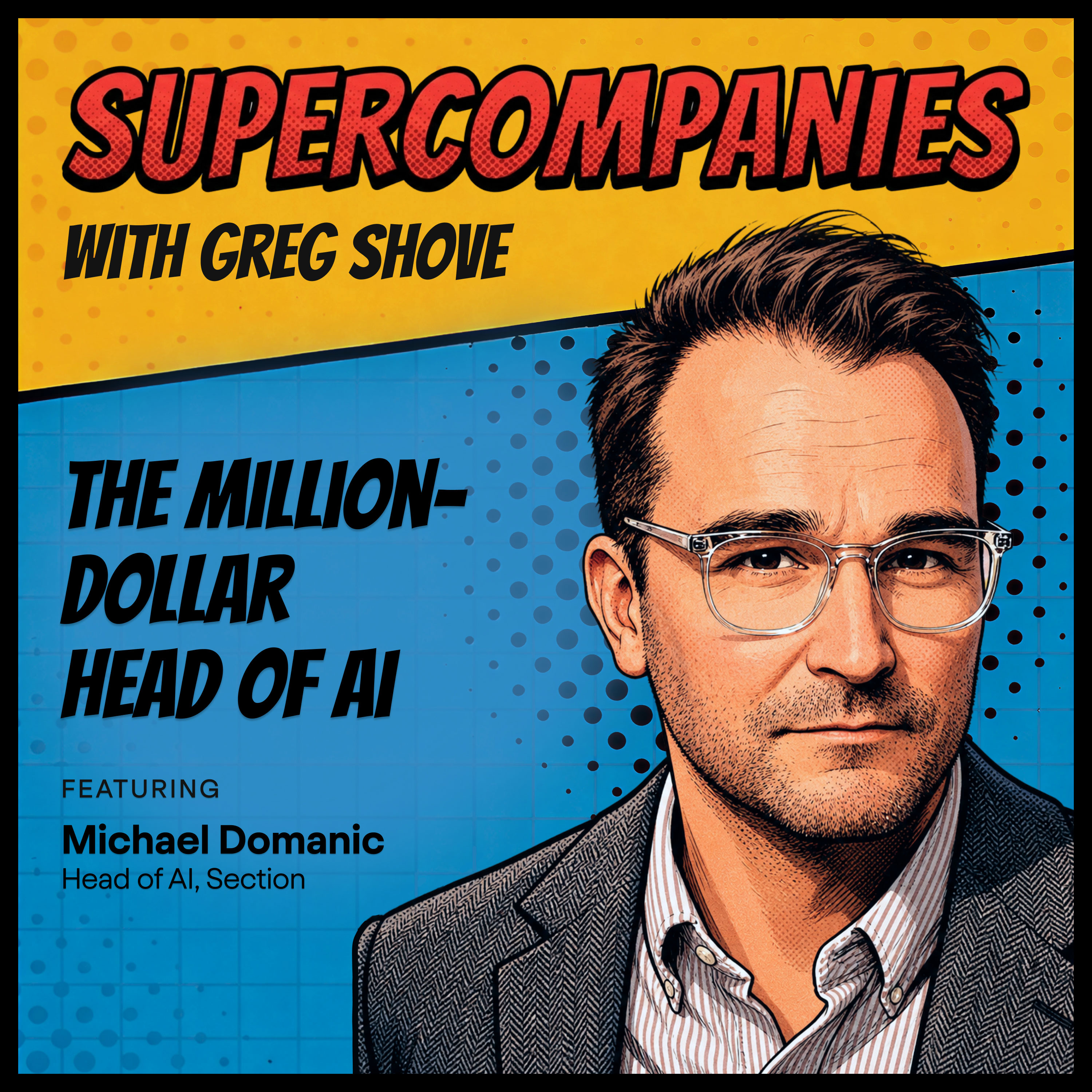
The Million-Dollar Head of AI with Michael Domanic
38m 45s
In this podcast, Greg Shove, CEO of Section, interviews Michael Dominick, the company's new Head of AI, about AI transformation and the role of a Head of AI. Michael defines a "super company" as one that continuously rethinks its operations with AI, adapting to rapid changes that are more intense than past shifts like the internet. He argues that companies need a Head of AI for two reasons: to seize opportunities by formalizing AI transformation, and to fulfill responsibilities in governance and workforce leadership. At Section, a 40-person startup, governance should be minimal ("small g") to foster experimentation, unlike in regulated industries. Michael shares his experience at UserTesting, where he built a formal AI program using enterprise tools, hackathons, and ambassador programs, leading to even adoption across teams. He notes that while measuring AI ROI is challenging, it's possible through methods like before/after comparisons and control groups, especially in sales. However, he advises CEOs and CFOs to have faith over multiple years to see the full advantage. The conversation underscores the need for a centralized owner to drive AI transformation, even in AI-native companies as they scale.
I want people to be attractive for the right reasons and not get too many surprises. Maybe the only big surprise was that my first one on one with my boss would be in a podcast. That's fair. What's your take on our Supercom is the only company is it with? A company that has not transformed around AI that has not rethought its workflows, its processes. It's hard for me to imagine that company even existing in five to ten years. Welcome to Supercom companies. My quest to understand how the smartest and most viable companies will be built in the age of AI. I'm your host Greg Shove, seven time founder and CEO of Section AI. This episode we're speaking with Michael Dominick, head of AI at Section. Yes, Michael joined a week ago. In fact, this is the first time I've seen him. So what we're going to do is first one on a podcast. I hired Michael as our head of AI because I wanted to accelerate our own use of AI at Section. Everyone here is busy, really busy. And Michael was head of AI at user testing and 800 person software companies selling to large enterprise. And he led their AI initiatives and really understands how to launch a transformation, manage it and measure it. To keep the CFO off your back and to really accelerate the use of AI both internally and externally in your products and services. So I'm a Gladys Joint Section and I'm Gladys joining us today on this podcast. As I said, it's going to be his first one on one live on a podcast. He joined Section a week ago as our head of AI. Here we are talking for the first time on a podcast. So welcome. Thank you Greg. It's great to be here. It's also great to be at Section. I got to ask, what have you learned so far? Five days. Any insights? Tell me what's going on. So Monday of last week was my first day. Tuesday morning, I'm telling my wife, the big mindset shift for me is coming from a place where I am constantly thinking within the boundaries of limitations. Now here at Section, I'm constantly thinking about possibilities, right? And I think that's been the biggest mindset shift for me after day one. And after days two, three, four, and five now in day six, I think that observation holds true. Good. Great. We'll go back and talk about that because I think it's relevant to others as well. When you think about AI transformations, I have to ask though, you knew us, Section quite well. As a customer and you had worked with us before you had done some events with us. We talked a lot in the interview process. In the first five days, when you think about your impressions of Section before joining and everything that we told you, your five days in and does it square out? No big surprises. I think my expectation coming in here was that this was obviously a smaller workforce than where I come from, but a workforce that was deeply engaged in using AI tools, experimenting, already turned the corner on the big mindset shift that this is the most critical thing for us to be engaging with at the moment. No big surprises. I always ask just because I think you want the interview process to be consistent with how the company is. I want that for the candidate, I want that for myself, meaning I want people to be attractive for the right reasons and not get too many surprises. The only big surprise was that my first one on one with my boss would be in a podcast. That's fair. That's not typical. I want to be a super company. And that's why I wanted ahead of AI. And that's obviously why we asked you to join. It was to really accelerate our ability to build our company with AI at the core and build AI into every product or service that we offer our clients. That's why you're here and you're right. The team is small, relatively, we're just 40 people. We'll probably be 70 or 80 by the end of the year. I'd expect a section to get to a hundred million dollars in revenue with 30 or 40 percent of the head count of my last enterprise software company. Tell me what you think a super company is. I want to hear your definition first. To me as super company is a company that I think really at this stage is rethinking the possibilities of what it can do. The most important part of a company to become a super company is to accept the fact that you need to rethink pretty much everything that you're doing across the organization. And think about that in the context of what's possible with AI. And to be continuously engaged on that too, the capabilities are proliferating every day. Let's think about that strategy today and revisit it every single day as these capabilities continue to grow. Which would you think about as kind of insanely hard? I don't think we've had a change that is this significant impacts the whole organization, but to your point is not standing still. So I think it's the combination of the scope of the change, the fact that it's relentless and it can't settle or at least not for long. It just strikes me as really hard for most organizations. I think our best proxy is the proliferation of the internet in the late 90s and early 2000s. Companies had to go through a similar transformation in terms of scope, but that happened much slower than this transformation has happened a year in that era is basically a week in the era that we're in today. Is that what it feels like to you? I like that. 365 days, rest of seven days. So by the way, good segue. So when I tell other CEOs they need a head of AI, what I often hear back is I don't have a head of internet. Make the case for a head of AI, Michael, since you're in that role and you were in your previous gig from user testing and 800 person software company, section customer. So I hope they're not too pissed that you left and joined section. Make the case to any executive listening that they need a head of AI. I think the question is why does a company need to formalize transformation around AI? I think that there's two reasons for this. And so may I talk about quite a lot. Reason number one is opportunity. Reason number two is responsibility. So reason number one drilling into opportunity for anyone listening to this podcast and anyone paying attention to the last couple of years, it should be pretty obvious to you at this point what the opportunity is here. We see this transformation happening in organizations. We see organizations that are growing at a scale that was never possible before that opportunity exists for all of us because these capabilities are available to all. But the problem with that is companies that have not rolled out a formal transformation program are not the companies that we're reading about that are scaling beyond what we thought was possible. So you need someone to centrally own all of that. I think that's been the common link to any organization that has had significant progress in their transformation, has a central owner. It's someone who's thinking about how this impacts the entire organization and someone who's making that happen within the company. That's the opportunity side. Now the responsibility side I think has two different components to it. The first component is what I basically would refer to as governance. So we need to be able to provide our employees with pathways to use AI responsibly and ethically. And that's going to look different for every organization. I say the word governance with a little bit of hesitation because I think some companies have gone a little bit too far down the road with governance. Certainly if you're in healthcare, if you're in financial services, your governance is going to look a little different from a 40-50% SaaS company. But you need to figure out what your version of that is and be able to give your employees pathways to use AI responsibly. Use sensitive data responsibly. Part two of responsibility, I think is the most important reason for all of this. And that's the responsibility that we have to our workforce. We're going through one of the most transformational moments. I believe in human history and it's a bold statement, but I believe it. And I do believe it is the responsibility of any company that considers themselves and advertises themselves as a good employer to lead their workforce through the transformation. Because I don't think that leadership is coming from anywhere else right now. Sure, you can jump online and you can jump on YouTube and learn a little bit about AI here and there, but your company needs to completely wrap its arms around the transformation and lead the workforce through it. And lead them in so they can thrive. And I guess that also means if their roles change, if the roles are eliminated, that's also part of responsible leadership. Yeah, I think it's those who don't turn this corner on this transformation are going to be considerably worse off than those who do. For many of us who have a significantly high level of trepidation about all this, I do and I'm sure that you do it to some degree as well, but the gene needs out of the bottle. This transformation is happening, whether we like it or not. And we all need to wrap our arms around that and figure out how are we going to maintain relevancy as this transformation continues well into the future. Okay, I want to go back to governance real quick. Section, I'm hoping that's a small g, not a big g. I don't feel like we need too much governance. I agree. I agree. But in general, I'd say smaller teams and or smaller companies, we want the governance to be muted such that the exploration, experimentation, the growth can happen, right? Yeah, look, that's what I said earlier, after day one, I'm recognizing that the biggest mindset shift for me is coming from a place of where I'm constantly thinking about limitations to a place where I'm constantly thinking about opportunity. Companies can go too far on the government's piece right now. And I think that's a big mistake. And it will look different for every company. If we were a healthcare company, that small g would probably be a big g. We're not a healthcare company. We're a 40-50 person startup that's trying to help other companies become super companies. So I want to go back to something you said around when we see these companies growing it on herd-of rates before. And I think you're referring to AI companies. We know the big ones. They're also probably referring to the gammas and the open evidence, smaller AI native startups with AI products that are growing very quickly. And it seems so far in a very capital-efficient, if not capital-efficient, certainly head-count-efficient way. I don't think they have heads of AI though. So I'm questioning, why did I need a head of AI? Actually, it's one of questioning. Do you think they do or you think they should? Like if you're the CEO, gamma, or
any one of these AI-native startups? Should they get ahead of AI? - Yeah, look, I mean, Gama has made very interesting progress based on relatively small number of employees. I guess maybe the answer to that question is in a different question, will that always remain the case? AI is going to continue to proliferate where we can't probably even think of the ways that we're gonna be using AI in 18 months or now today. But I think that's where those companies want somebody that's completely dedicated to that mission. The answer to the question is yes. I think it would be wise for all companies to have someone who centrally owns that. And Gama's gonna grow. Their employees are gonna grow. They're gonna bring in new people into the organization that haven't been a part of their journey maybe over the last few months. And those employees are gonna come in with different levels of experience using AI. You need somebody that's gonna help the entire workforce turn that part. - Yeah, let's talk about the head of AI then, persona a little more in terms of who should fill the role. So why don't we start with you describing your background in terms of where your careers come from. And then I would like to hear about when you look at that role, what do you think about in terms of what's the right kind of person to occupy that seat. But let's talk about your background a little bit. The last three years in terms of what you were doing before you came to section. - Just the broad stroke over the last 10 years for several years I was a startup guy. 10 years ago I was actually involved in Hypes Like a 1.0 for AI, which is when every company felt like they needed a Facebook messenger chatbot and Alexa to go Google Assistant Action. Conversational interface was a big thing 10 years ago and a lot of people don't remember that era. I remember it very well because I was the guy designing a lot of those experience. They were all terrible because they were all based on NLP. Here we are 10 years later, this is a real thing. Most recently I was at user testing for seven years. I've had a lot of different roles in the organization. Was a customer of user testing before joining when I was building NLP AI solutions and came into the company. As a more of a product guy or a software engineer or business process guy. - Every 18 months my job basically changed. That user testing, so my first tour of duty was in customer success. Then it moved into professional services. I led our pro-serve partner program for a bit moved into solutions consulting. And when I was in that role, that is when the current hype cycle of AI was born in November of 2022. At that point it was a handful of people in the organization started thinking really seriously about how is this going to impact the company. Our first focus was on how that will impact the product. My involvement got very deep in November of 2023. That's when we really started to sew the seeds of what real transformation would look like in the organization. - AI on the inside versus AI on the outside in terms of the product. And did you raise your hand to do this or were you tapped on the shoulder or a mix? It was a little bit of a wolf. At that point, I was pretty involved with executive leadership on thinking about how this is going to impact everything that we're doing as a company, both our product and inside the organization. Mostly I was partnering with our CTO at the time and having these conversations. I would say early 2024 when I did a presentation for most of executive leadership. And I said, here's why this really matters for us. We're not going to realize any of this opportunity unless there's someone who essentially focused on the challenge. By the way, I know a guy. - So you're about a year after a chat TBT+ was unleashed onto the public and you're getting this role as head of AI. What happens next? - So we started the work of formalizing the transformation. At that point, we carved out an innovation group, purchased licenses for chat TBT enterprise, rolled that out to the organization and just slowly started to build a formal transformation program with real structure to it. So at that point, our goal was to make sure that everyone at least had a starting point for our center of gravity AI tool, which was chat TBT enterprise. I've always been super excited about custom GPTs since they were launched in November of 2023. So we started to build a culture around that. We did some hackathons early in those days. We went to open AI headquarters in San Francisco. They helped facilitate a lot of those hackathons for us. Built an internal ambassadors program around AI cross functional group, all the things that we talk about that real transformation needs to do. So we did those in the early days and we saw a really fast spike in regular adoption of those tools. When you talk about this fast spike of adoption, was that across the org or in certain pockets of the org? - It was mostly across the entire organization. Adoption actually looked very even in the company. Finance lagged a little bit behind HR at that point, was lagging a little bit behind. But that was something that we were paying very close attention to is where are the uneven spikes of adoption and zeroing in on those specific functions and teams and making sure that we were providing the right level of support and enablement for those folks? - And the expectation here was efficiency or growth. And you talked a little bit early around this opportunity, how to harness it. Do you think the opportunity is about efficiency productivity or is it about sort of new products, new revenue or both? And how did you guys think about it in the first year or two at user testing? - The first year in those early days, it was really experimentation was the focus, right? And the thesis was that yes, we will be able to do more ad rigor and efficiency across the organization. It was both. Rigor and efficiency have always been true north to why we actually have the program and why are we doing this in the first place. The level or where one is gonna have higher impact than the other will probably change from company to company. And I think for us, the far more interesting component to this was doing more with adding rigor to everything that we were doing. So when you say rigor, that means being more productive, more efficient, more, you're using that word rigor and I'm not sure what it means. - So I think a rigor is exceeding the possibilities, right? So you look at our product team, we're gonna build more products, we're gonna build it better, we're gonna connect to the value that our customers are expecting without AI. Now we're using AI, so we exceed our expectations of what we think is possible. - Three years in before you left, what was the level of business case analysis rigor that we see if ho is demanding? When you think about these investments? - I don't know that there were hard demands on what we were expecting of ROI and not even sure that the right approach at this stage, you and I have talked about the sloth. I think ROI is a pretty critical thing to measure and to pay attention to. It's impossible to come up with any kind of real equation on holistic ROI, but you can look at very meaningful implementations of AI in the business and determine how much value is this adding. You can measure time, that's an interesting thing to measure, but the far more interesting thing is the impact, the outcome that you're achieving by bringing AI in. - But yeah, I agree, but that's stuff so isolated that attribute back to AI or anything else. You make a Salesforce more productive with AI, are we shirts the AI, or is it just the fact that the best salespeople are the best salespeople and they sell more? Is it this gonna be a challenge for a while? This idea of really attributable ROI tracking to AI? And we should just get over it, tell CEOs and CFOs and boards. You're gonna have to have a lot of faith here, probably over multiple years, in order to really see the advantage. - I think both of those things are true. I think it's more possible than maybe what you're leading on to to actually measure the impacts of ROI 'cause there's different ways that we can do that. So you mentioned sales, sales is probably the easiest place to do this because we're already measuring the impact of everything that we're doing. So what you can do is bring in an AI solution that adds rigor and efficiency into a specific workflow. One of the things you can start to do is measure the before and after impact of bringing that solution in. But then every company has a control group, and that is the group of people who are not using the AI solution for whatever reason. So that's one of the things that we were looking at as well is, okay, this population of individuals that we built this AI solution for, here are the people who are using this now, and here are the people who aren't. And here's the impact that is made on these specific individuals. And I would say that every time we did those measurements, the conclusion was very clear. The AI solution had a meaningful impact on the outcomes that those individuals were achieving. And by the way, some of the best sales people weren't using those solutions, and didn't see a meaningful bump in outcomes for achieving. So I think you just need to get a little granular. It's not always easy to do, but you just need to look at the data, look at it showing you, think about it in interesting ways. And I think that you can get at least a directional indication. What were those measurements, Michael? I know before we've talked about surveys as one way to do it, although a lot of organizations worry about survey fatigue and all that stuff. What were those measurements? We did surveys, and I think that surveys are just generally just more directional. What I tried to do is get very specific on what problem are we trying to solve by bringing an AI solution in, and are we achieving a better outcome? So an example that you and I have talked about a lot is at a SaaS company, a discovery call is a pretty important part of the sales process. Generally, the more discovery calls that you do, the better those discovery calls are, the greater you're going to convert. We got very focused on that part of the sales process very early on, and we built solutions that brought higher, better qualified leads into our funnel. We built solutions that helped us conduct better discovery on a discovery call and also a better follow-up. And again, for those individuals who adopted those solutions, we started to see about six to maybe eight months later, a meaningful impact on the outcomes that they were achieving. In the meantime, if you're trying to get to some kind of actual couch.
on the ROI and you haven't fully completed that circuit. We know what the average value is of a discovery call. We know our average conversion rate is on the discovery call. So we start to get some directional indication of how much the AS solution is impacting that workflow. - I described that, or I think about that, so these moments that matter in the business, or these levers that matter, or these KPIs that matter. I'd like to tell you said six to eight months. A CEO asked me recently for some advice as he was about to kick off their AI transformation. He said, "Give me one last parting advice." And I said, "Listen, lower your near-term expectations "and raise your medium-term expectations." And you just, I think, confirm that for me, which is, don't measure this in 30 or 60 days. That's not enough time. Pick these levers, or KPIs, or metrics, and then really give yourself some time. And that feels like to me, it's more like six, eight, 12, 18 months, and large organizations could be longer, obviously. - Although I do think that there are some implementations where you're going to see immediate impacts, and we didn't see that as well. So I'm going back to just that sales funnel. The very top of the funnel, we have BDRs that are trying to capture more leads for us to talk to. And in bringing some solutions into that part of the funnel, we saw immediate impacts within 30 days. What we saw was a higher discovery call booking, higher response rate. I think those are all the things that we saw a 30-day impact on post-implementation. Let's just spend another moment here than just on sales, whether it's tech sales, B2B sales. After software engineering, which I think we all know, really since Thanksgiving of last year, will be dramatically improved, accelerated in terms of roadmap development, software engineer productivity going through the roof. In addition to that, is sales next in your mind, particularly if you're a B2B company, and that it's crazy to think about a sales organization that's not AI augmented or AI powered or AI enabled in 12, 18 months. Is that your mindset today? - You and I both come from SaaS, and yes, in a SaaS business, I think this is probably the lowest hanging fruit outside of actually building the product. The possibilities that AI brings to augment sales pretty wild, it's pretty abstract. I think that we are going to see big meaningful changes to how a SaaS company sells their solutions to the world. - Presumably your CRO, your last company was on board with all this, meaning anything that drives sales efficiency, drives sales productivity is a good thing, I presume. - A very big way, yes, he was very supportive of this. - So I want to go back to this idea of measurement. If you thought about a head of AI, Michael, in terms of doing the job, you got five days a week, how much of that time, what percent, or how many hours or days, should a head of AI allocate to measurement? Because it seems like they're not going to get more resources, more AI technologies without really making these business cases improving them out. So when you think about how you were spending your time, let's say the last three years, head of AI user testing, how much of your time was allocated to the measuring part? - So what we were doing is on a quarterly basis, we were trying to identify the 10 most meaningful implementations of AI over the past three months. And then I would probably spend most of the final week or the first week of the following quarter in that exercise of, okay, let's measure this out. I would say that I probably spent a solid week per quarter on that. - More than 1% less than 10%. - I think this also helps you determine where you need to focus more of your time and effort and resources to bringing AI solutions into other parts of the organization or where you walk away from things that you may have spent too much time on. I think this really helps you get fine tuned on where you devote the resources to the transformation. - Let's go back to this head of AI. In your mind, besides you being the perfect head of AI, but what is the profile of the head of AI in your mind? What kind of person should a CEO or board be looking for to play this role? At least for the next couple three years, meaning in these early years of transformation. - So I think about a year ago, I identified four characteristics that I was noticing across all of the companies who have been making meaningful progress on their transformation and had ahead of AI. The first one's gonna be very obvious, which is a fluency in AI tools. These are individuals who are just obsessed with this and reading about it every day, experimenting with different things every day. That's obvious. Number two is someone obvious. It's someone who knows enough to be dangerous around all functions of the business. You haven't been in marketing, but you have a pretty good sense of what marketing does and what your HR team is doing, what your product team is doing. So someone who has a pretty keen understanding of whatever your function is doing in the business. Number three is this is zero to one transformation. So it has to be someone who's comfortable operating in that environment and maybe has had some experience in the past. I think having been a startup guy for a little bit, like that helped me out a little bit. I think the fourth one is the most important one, probably the least talked about, and that is just a deep level of creativity. This is a very abstract thing that we're trying to do. Again, it's zero to one transformation. So I think the people who are leading their organizations through AI transformation doing that really effectively are very creative people. I think a lot about brush chalmo. I think a lot about Eric Porra's Logitech. These are individuals who approach this with a deep level of creativity. They're able to translate very abstract concepts of AI to the rest of their organization. Those are four characteristics that I've been talking about I think for the past year or I identified a year ago. As I continue to look at the companies who have made progress on their transformation journeys, they're all being led by individuals who embody those four. I'd also add this characteristic of relentlessness. Now, even thinking of Bryce and Eric, and others, I know lots of heads of AI. Maybe it's the combination of relentless impatience. They're willing to sit with people, executives, managers, anyone really, and do one-on-one coaching or a small team coaching or really doing this transformation, I guess, is a level of hand-to-hand combat, I think, about it. Were you doing some of that at user testing? What was your level of hands-on guidance and support to teams? Yeah, a lot of that would come through more formal and predictable channels, monthly luncheon learn, weekly office hours. I think one of the things I noticed maybe about six to 12 months into maybe stage one of our transformation is that the teams that were making the most progress were being led by a manager who was so deeply involved in this. And then I looked at other teams where maybe managers were less engaged. And that's when I started to get really focused on identifying who those folks were, setting up predictable one-on-ones, maybe every other week, joining their team calls or weekly team calls. And that's where we started to see a lot of progress. I know you talk about all talk down bottom up. Some of it's middle out too. Yeah, for sure. I always say that middle management is where transformation goes to die. That seems to be what you're saying. So you had ambassadors or champions, but you also then sounds like you really tuned into those managers that were already on board and driving it, and then those that weren't helping them to hopefully get on board. Do you think that this should be in the job or performance reviews of managers or individuals? How do you think about that whole question of what level accountability and how explicit do we have to make it in performance? I honestly, at this stage, I think that it should be. I think that this should be built into your company's OCRs. This should be built into OCRs at every level of the organization. I do think that people leaders should be held accountable to how the rest of their team is navigating through the transformation and progressing through it. Yeah, for sure. And let's talk a little bit more about super companies. Are they the only winners in 10 years or 15 years? When we look back, most tech errors last about 20 years, plus or minus, right? When you think about previous sort of errors of technology or disruption or computing, whenever you want to call them, right? When we look back, are super companies the only winners? Meaning are they the companies that attract the best talent? Are they the companies that frankly attract the cheapest capital? Because all capital has a cost. And basically, as a CEO, one access to the cheapest, most favorable terms capital. And of course, you want the most valuable customers, the customers that will spend the most and be the most loyal. Over time, what's your take on are super companies, the only companies that win? It's hard for me to imagine a company that in five to 10 years, that's not a super company that has not transformed around AI, that has not rethought its workflows, its processes. It's hard for me to imagine that company even existing in five to 10 years, let alone not being a leader in its-- OK, that sounds dramatic. I think this connects to something I said earlier, which is I think we're living through one of the most transformational moments in history. That's how big this is. OK, but what about legacy firms that have all the distribution, have the brand, have the presumably loyal customers, have lots of revenues? Your point of view in the knowledge economy-- I'm assuming we're talking about the knowledge economy, obviously-- that those advantages look at eroded that quickly by AI native firms, by super companies. How quickly is probably the biggest denominator here? That's the ground truth. We've never been in an environment where disruption is just so right at our heels. OK, so why are we CEOs then seeing this? We have 150 enterprise customers at section, so we see a lot of this. Today is that most CEOs are underfunding their AI efforts. They're certainly underfunding the transformation. I do feel like they're provisioning enough AI, but I see them basically underfunding and/or being undercommitted. It's not just the money or the resources. It's also a level of conviction or commitment, ambition, lack of and/or urgency to really make this transformation happen anytime soon. So what is that? That's just blindness of being an incumbent, denial. I think a lot of it is a mixture of things. So there is no roadmap to this right now. And it's a lot easier to make a transformation happen when someone just hands a roadmap in your lap and says, here's what you need to do. That doesn't quite exist today. I think a lot of it is innovators dilemma. Here's the way that we're working. This has worked for us really well. And if we do these things, that disrupts the thing that works really well right now. We don't want to do that. We've seen that play out many, many times. Yeah, for sure. and it's easier to do.
do nothing. It's not the right thing to do, right? But it's easier to be like, let's wait this out a little bit and see a lot of this feels like hype. Let's see if that's true. And some of it is hype, right? So let's talk about that a little bit more than I'm ahead of AI. Feels like one of the things you need to do pretty quickly is get the executive team, C-suite, the level above to really understand the possibilities, the opportunity and the responsibilities. You said that two part challenge here. How do you get them to really get it? Okay, this is so significant. It is this crazy moment. So what would you do today for the head of AI? And you had 10, 12, 20 people above you, some sort of leadership exact team to get them to really appreciate this moment in a more significant way and come to the table with more conviction, effort and resources. Look, I think I would fall back to how did we start this journey at user testing circle years ago? What I started to do was build out some AI solutions that connected to different parts of the business. And what I'm doing is showing the value of bringing AI solutions into different parts of the business. And this is where I started this whole ROI calculation thing because I knew that I can't just show you look at much easier it is to do this thing now, right? You have to show why it matters to the business. And I think that's where executives typically really tend to index is if you can show me a strong business case that shows why we're going to be selling more products, why we're going to be achieving goals faster again with greater rigor and efficiency. If you can show that to me, then that's probably where you can connect that group in that mindset. I mean, this is where I start up, I have such huge advantage because if you've got capital, it's assuming you do have capital as a startup, which means someone else has already decided to make the bet. I think the gap between a startup today and a incumbent is actually widening. Meaning, incumbents aren't moving as fast as they need to and the startups are moving faster. That's my sense. Would you agree? I think that's what we would expect. I think startups generally just move faster on everything for the reasons that you described. But just going back to how do you convince a large legacy company, talked about possibility. I think equally you need to talk about what happens when you don't. I think one of the things that HR teams should be doing is we all launch annual buy annual surveys that capture qualitative measures about how people feel about working in the business. You need to layer in AI questions into that too. So that's again, something that we were doing is, okay, how do you feel about AI? Do you want to use AI? Are we giving you the right tools? What happens when we take those tools away from you? And I've seen this at user testing. I've talked to other heads of AI. We all see the same signals is that people want this transformation and they're willing to leave organizations and aren't offering it. So you're going to lose your best talent. You're just not going to accomplish as much as an organization. And this is against just something that we all need to grapple with. But how do you square that with this other research, including research from section that says, there's a level of anxiety about AI. It's potentially impact on obviously people's livelihoods their jobs. I'm training my replacement if I'm working with AI. Did you face that at user testing and get through it? Or do you think it's a mindset that some have but others don't? Yeah, a lot of the anxiety comes from the chaotic environment that we're in right now. I don't think that anxiety goes away for a company that says, we're not going to adopt AI. It's okay for you not to adopt it. I actually think that anxiety would increase in that circumstance. I think everyone wants a way to remain relevant, employable, a way to add value well into the future. Most of us have come to the realization that if that's going to be very challenging to do, unless you turn this big transformation corner. And again, it's the responsibility of companies to help lead their organization and give them pathways to do that. My sense, Michael, there's probably at least half a dozen, maybe 10 tough questions. And I think impact on jobs, impact on energy, how these AI models were trained, open source AI, the safety of AI. Those kinds of questions, it feels like to me that ahead of AI should have those answers at their fingertips. Just because I think employees are thinking them or asking them CEOs might be asking them, it feels like to me one of the responsibilities of ahead of AI is to have at least thought about those tough questions. In some, if not all cases, have at least a decent answer. Would you agree? I agree with you on that. And I think you should be understanding the nuanced way of what that looks like in your organization. And that comes back to why it's important to survey your employees at some regular basis so that you can capture that level of trepidation, but also drill deeper into what's at the root of trepidation. Makes sense. I would love for you to give some advice to those who might be leading a transformation, might be part of a team, might be thinking about it for themselves even. I would say definitely don't try to boil the ocean. I think there's an inclination that people have that as capable of doing so many different things. Let's make them all happen all at once. I think that's just a recipe for disaster in chaos in your organization. I think specifically for heads of AI that are leading their organization through this, find the three to five things that will matter most in your company and start to develop a strategy around how AI is going to impact those things. What I'm saying is get really hyper focused on the things that will matter most to your company and the things that will move the needle most for your organization. All right. Now I want you to make a prediction. Let's say we have 100 employees sometime next year. How many agents will we have if we have 100 employees? When I say agent, I mean, I'm meaningful automation. It could be a custom GPT or a skill or a quad co-work agent. If we have 100 employees, how many of those agents will we have? Let's do the math on that a little bit. 100 employees, every single one of those employees at least has a chief of staff. That's 100 right there. Then I think you're probably deploying at least five or six broad automations and agents into every function of the business. At that point, I think it's reasonable to say that we'll have around 150 to 200 agents running in the organization. But once you start layering in GPT's, everyone has the ability to create their own personalized versions of these automations agents. 350 to 400. Love it. All right. That's going to be in your MVOs. I'm also hearing that we should all have chief of staff. You've been here a week. When do you commit that everyone at Section will have an AI chief of staff by the end of the day? Really? Should everyone do this? That's every team and every team that could benefit from some sort of chief of staff. Yes. I do think that everyone will benefit from a chief of staff. When will we roll that out to everyone? Everyone should have the framework to have that set up by the end of the month. Awesome. You would give the same advice to every other head of AI in corporate America right now. Roll out a program that builds some sort of personal agent, assistant, chief of staff, whatever you want to call it for most employees. That would be one of your go-to moves I'm assuming. Yes. Assuming that you have the capabilities to do that. Get really focused on that right now because it feels like the lowest hanging fruit. All right. I'm looking forward to it. Great. Great to see you. Thanks for doing your first 101 on the podcast. Happy to do it. Thanks for having me. This conversation with Michael reminds me of something that I often say to CEOs, which is that the head of AI has one of the most exciting and challenging jobs in corporate America right now. High expectations, small teams, and challenging transformations. He's got a great mix of high low, high meaning and ability to build a strategy and a plan that keeps the CFO and the exact team on side. Cordily reviews of business cases and ROI calculations. And then working low meaning hands-on, joining team meetings, hosting luncheon learns, coaching executives, 101 if they need it. So they develop their own conviction, accelerate their own adoption of AI for themselves and their teams. And I think that's what heads of AI need to be doing right now in these early days, months, and years of AI transformations. There's no playbook to build a super company right now. We have to create that playbook together. In 20 years when we look back, it'll be obvious who the super companies are and how they did it. Meanwhile, we've got to figure it out together to make sure that we can not just survive but thrive in that age of AI. Thanks for listening to super companies. So between now and the next episode, you can find me online at greatshow.com where it can sign up for my newsletter, super companies. And if you've got a second, please leave us a rating or review or even subscribe. It will be a big help to the show and we'll help others find it. [Music]
Podcast Summary
Key Points:
Michael Dominick, Section's new Head of AI, emphasizes a mindset shift from limitations to possibilities at a smaller, AI-engaged company.
A "super company" rethinks everything with AI, continuously adapting to rapid changes, which is harder than past transformations like the internet.
Companies need a Head of AI for two reasons
Governance should be minimal ("small g") in startups to encourage experimentation, while larger or regulated firms need more structure.
AI-native startups like Gamma may eventually need a Head of AI as they grow and onboard diverse employees.
Measuring AI ROI is challenging but possible through before/after comparisons and control groups, especially in sales; CEOs and CFOs should have faith over multiple years.
Michael's experience at UserTesting involved building a formal AI program with enterprise tools, hackathons, and an ambassador program to drive adoption across the organization.
Summary:
In this podcast, Greg Shove, CEO of Section, interviews Michael Dominick, the company's new Head of AI, about AI transformation and the role of a Head of AI. Michael defines a "super company" as one that continuously rethinks its operations with AI, adapting to rapid changes that are more intense than past shifts like the internet. He argues that companies need a Head of AI for two reasons: to seize opportunities by formalizing AI transformation, and to fulfill responsibilities in governance and workforce leadership.
At Section, a 40-person startup, governance should be minimal ("small g") to foster experimentation, unlike in regulated industries. Michael shares his experience at UserTesting, where he built a formal AI program using enterprise tools, hackathons, and ambassador programs, leading to even adoption across teams. He notes that while measuring AI ROI is challenging, it's possible through methods like before/after comparisons and control groups, especially in sales.
However, he advises CEOs and CFOs to have faith over multiple years to see the full advantage. The conversation underscores the need for a centralized owner to drive AI transformation, even in AI-native companies as they scale.
FAQs
A super company is one that rethinks its possibilities and accepts the need to rework everything across the organization in the context of AI, continuously updating its strategy as capabilities evolve.
A head of AI is needed for two reasons: opportunity, to centrally drive AI transformation and scale growth, and responsibility, to ensure ethical AI governance and lead the workforce through this transformative moment.
He formalized the transformation by creating an innovation group, rolling out ChatGPT Enterprise, building a culture around custom GPTs, hosting hackathons, and establishing an internal ambassadors program to boost adoption across the organization.
He shifted from constantly thinking within limitations to constantly thinking about possibilities, which he observed from day one and felt held true afterward.
He recommends measuring the before-and-after impact of AI on specific workflows and comparing outcomes between users and non-users as a control group, which has shown clear positive impacts.
He believes governance should be 'small g' for smaller companies to allow exploration and experimentation, while it may be 'big g' for regulated industries like healthcare or financial services.
Chat with AI
Loading...
Pro features
Go deeper with this episode
Unlock creator-grade tools that turn any transcript into show notes and subtitle files.
 PodcastTranscript AI