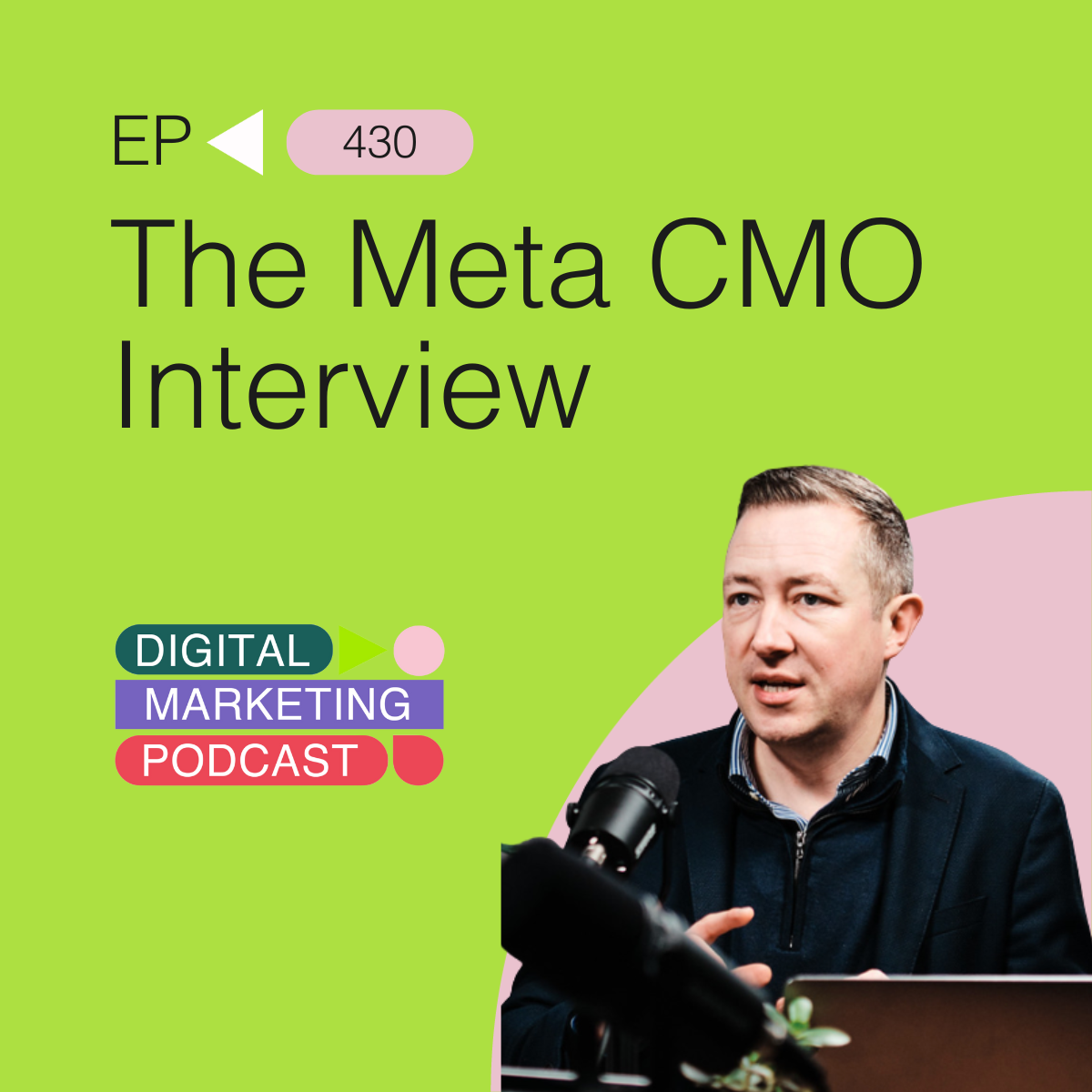
The Meta CMO Interview - Digital Marketing Measurement, AI & Why the Basics Still Matter
35m 3s
In this episode of the Digital Marketing Podcast, an interview with Alex Schultz, the Chief Marketing Officer of Meta, is featured. Topics covered include book recommendations, insights on digital marketing measurement, and the significance of setting clear goals separate from metrics in marketing. The discussion also delves into incrementality in marketing, testing, the importance of the marketing funnel and awareness, and the necessity of a functional conversion flow. Additionally, guidelines for selecting marketing channels based on scale, defensibility, and capabilities are highlighted. The conversation emphasizes the importance of foundational principles in marketing, the impact of awareness on product visibility, and the essentiality of a well-designed conversion flow for successful marketing campaigns.
Transcription
7498 Words, 41611 Characters
Welcome back to the Digital Marketing Podcast
brought to you by TargetInternet.com.
In this episode, we have an interview
with the Chief Marketing Officer of Meta, Alex Schultz.
(gentle music)
So we get at least 20 emails a day
suggesting guests for the podcast.
Some of whom are fantastic, you would have heard them.
Some not so great, but lots of them are authors
who are approaching the launch date of a book.
I wanna share some of their insights.
And more if we can, we take a look at the book,
see if we think they can actually provide some value.
And one of the first things you end up doing
is looking at the book cover
and you have a quick look at recommendations.
And as an author myself,
I know it could be really hard to get these recommendations
'cause you've only just finished the book
and you need someone to read it urgently
so they can give you a quote
so you can kinda hit your publishing deadline.
And therefore you end up asking your close colleagues
and friends, well, quite often for me,
that might be me asking Kieran or something like,
well, this particular author, who did he ask?
Well, he's got quotes from Mark Zuckerberg,
a Facebook fame, Sam Ortman from OpenAI,
and then even Matthew Vaughan,
the director of Layer Cake, one of my favorite movies.
So who on earth was this person?
We were pretty excited.
So Alex Schultz is the long-time CMO of Metta
and VP of their analytics.
And he's all round an amazing guy.
You'll hear more from him in the interview as well.
But he's written what I think is gonna become
the definitive book about digital marketing measurement.
And the book's called Click Here.
There's loads of useful insights in here.
It was a really fun interview, a very open interview as well.
So sit back and enjoy the interview
with Alex Schultz, CMO of Metta.
Okay, I am here with Alex.
Alex, tell us a little bit about the book
and why you decided to write it.
And I should say before we get going as well,
this book is epic.
I mean, we get a lot of invites to speak to authors.
And this is the first one that I'm actually gonna put
onto a course text for my students at Imperial College
'cause listeners will know that I'm senior lecturer there.
So no one else also has Sam Altman, Mark Zuckerberg,
Daniel E.K. from Spotify, and my favorite Matthew Vaughan,
giving recommendations to the book as well.
So I have to say congratulations.
So congratulations to the book, tell us what it's about.
Yeah, that's why you decided to write it.
Matthew Vaughan, he shot our Super Bowl ad.
And I swear he didn't just endorse it 'cause I paid.
He's surprisingly good book, genuinely.
No, he's a great lad.
You know, there's two reasons why I did the book.
And I think like, you're probably,
one of them's like very banal, but it's true,
which is there was a gap in the market.
And I keep being asked for a book on digital marketing
that kind of tells you a high level overview of every area
and gets you started and gets you going.
And I just don't have one.
There's a scattering, like I tell people viral loop,
I tell people scoring points,
the Tesco club card story, but there's no one book.
And so there's this gap and I talked to Hachette's CEO,
he agreed, they actually published Ogilvy
from one of their imprints.
And so went for it and went for the gap in the market
'cause I want a book I can give to people.
So that's the easy answer.
Nice.
The less easy answer is, I really believe in what we do.
And there are so many people pooping on marketing
in general, right?
Like marketing in general,
you're trying to convince people to buy things they don't want
with money they don't have to quote Fight Club.
And the digital marketing realm in particular,
you've got surveillance capital,
you've got everyone kind of going on about this,
you know, and we adhere to all laws that are put out there,
but we get all the laws put in that are not helping it.
And bluntly, I just think they're stopping people
from getting personalized ads that make their lives better,
give them products for free and connect them
to products that they actually like
by showing them slightly more relevant ads for trainers.
And on the other side, create business growth.
So people are employed, so businesses can grow,
so the economy can grow, so there can be taxes,
which funds so much of what we have as institutions in the UK.
And so I also wanted to just be like,
online marketing is good, it grows the economy,
and I'm proud of it.
And someone needs to say something positive,
so I wanted to say something positive.
Love it.
I mean, on that first point as well,
I completely agree there is a massive gap in the market
'cause we spend a whole time, so Kieran might have co-host,
we spend a whole time going,
people need to get back to basics,
they need to get back to fundamentals.
I don't think people know what those fundamentals are.
And I think this book is beautiful at going through
and just giving that kind of right mindset
and going through and saying,
"Look, this is need to think about it,
"get back to those real core kind of pieces as well."
I also think that thing of being proud
of digital marketing is a really key one.
If you look at how the ease of launching new businesses now,
my master's students come into me
and are kind of terrified on two fronts at the moment.
One, constant horror stories, digital is bad,
you know, all this kind of stuff.
There's that side of it.
But there's also their terrifiers of AI,
and we'll get into that later on.
And I keep saying to them,
"Look, and it's a quote that came from you as well,
"was that the tools changed,
"but actually the fundamentals stayed the same."
And I thought that was a really interesting
I picked out from the book as well.
So let's get into some key areas in the book as well.
And I think this is a lovely one to start with,
that difference between goals and metrics
and what that means to people.
'Cause this is kind of fundamental.
- Yeah, I mean, the back to basics thing,
when I was reading my audiobook,
which I know you've gone through that torture as well.
- Exactly.
- I was just going,
"Oh my gosh, I need to go and spend time with my team
"and tell them to do these things."
'Cause like there's all these basics that you just need to do.
And one of the very basic things is,
actually be super clear what your goal is,
and realize that a metric is not a goal.
So, you know, our historic goal was connect the world online,
like people know that through Facebook.
Our metric was monthly active users.
And the thing is, a metric can be gained.
And so many people that turn a metric into a goal,
and then the metric doesn't actually do
what they want as a company,
and they're really upset about it.
And that's because they forgot their goal.
And so the example I use is,
if I get you to click on an email,
and you visit the site for 10 seconds,
have I really connected the world online?
Or did I just get a 10 second session?
So we set the goal, connect the world online.
We then have the metric monthly active users,
and then we have a bunch of guardrails against it.
So percent weekly, percent daily,
all of those kind of things, lifetime value,
to make sure we're not bringing minimally active users,
we're bringing actual monthly active users full stop.
And I got so many examples of it.
The other one's eBay, where we had,
we wanted, for the acquisition team,
the North Star was get everyone to use eBay, right?
I mean, pretty simple.
The goal we used to set was confirmed registered users.
But the thing is, you'd get affiliates out there,
incentive affiliates, incentivizing people
to sign up for eBay and confirm.
You'd get search affiliates,
sending people to the registration page
and not the search landing page,
which got registrations and confirmations.
But none of those users activated
and became long-term active users.
We changed the metric to ACRU.
We kept the goal, get everyone to use eBay,
which is activated confirmed registered users.
All of those incentive affiliates basically went away.
And the search affiliates changed their landing page
to be the search results page,
'cause that's what got someone to bid by activate.
So the goal and the metric have to be separate
because you create metrics
that never perfectly describe the goal.
- I love the fact that when you were going through
and reading your own book out,
you started thinking, oh, we really need to refocus on this.
I mean, reading your book had the same effect on me as well.
Like, we preach this stuff for the time
and we run a business and we, yeah, it was successful,
but you look at it and go, yeah, we're not doing that.
We should be doing more of that.
And there's a gap there when we need to go.
And I always think it's a nice thing
'cause marketing is inherently challenging, right?
- Because I think there's that whole piece that,
if it was just something that you could repeat,
there'd be a guy that you could buy for $99 online
and everyone would buy it
and then it wouldn't work anymore anyway.
So it's an art and it's a science.
And I think there's that kind of key piece.
And that brings me onto this thing
that came out again in the end of the book,
which is that incrementality piece.
So if incrementality is everything,
that's the key principle.
What does that mean in practice for people?
- Yeah, I mean, fundamentally the thing for me is,
I just, I really want what I do in life to matter,
to make a difference.
So actually, the fact I showed up,
things are different because I showed up.
I didn't just collect a paycheck.
That's really just how I think about the world.
And I think too many marketers.
Ogilvy has the useful idiot in his book
of the person who doesn't get modern marketing.
Well, I've got a useful idiot essentially,
which is someone who uses post-click tracking
and never looks at the incrementality.
So what it means to me is you should just do testing.
And depending on the channel, right?
Search doesn't let you do lift studies
and conversion tracking in that way.
So search, you have to do matched market tests.
You have to do pre-post tests.
Like that's kind of what you have to do with search.
Social, most of the social companies
allow you to do holdouts
'cause all their users are logged in,
they've got user IDs and so we offer to lift studies,
but all the other guys offer various different things.
So there you should leverage those
and you should actually see what is the uplift.
So yeah, it's really simple.
It's like, do a test,
see if you've got more results in the test group
than the control group.
And that dates right back to Claude C. Hopkins
a hundred years ago with scientific advertising.
This is not a new principle in marketing.
- I think it's interesting
because the more and more talk there is
about a no-click environment
and there's more challenges
of attribution modeling, all those kind of things.
You kind of getting the basics right
becomes more and more important.
So just let's come back to that and just,
why is it so important to get those basics right?
- I mean, the fraud is one example.
Fraud and waste.
So, you know, from a fraud perspective,
the worst examples I saw back in my day at eBay.
Well, actually, Uber's a really good example, right?
So Kevin Frisch was head of marketing at Uber
and they ended up suing their banner agency,
I had their DSP, I think it was,
because they realized when they turned off
hundreds of millions of spend,
the conversions didn't drop for Uber.
And actually the way they found it,
which, funnily enough, we found something similar,
the way they found it was their ads
were showing up on the wrong sites.
So they were trying to avoid controversy,
they weren't trying to be on bright bar at the time
and their ads kept showing up on bright bar.
And what was actually happening was that they're,
either a subcontractor of their agency or their agency
was putting ads out in places
where they weren't supposed to be put out
so they could get extra impressions.
But the worst thing that was happening
is they were putting them out below the fold
and getting no results and just scattering cookies
and by scattering cookies saying
that they were driving results.
And so when he turned it off,
he saw no drop in top-line growth.
Now, I recently did a similar experiment in India
where I turned off all of our marketing,
Facebook, the app in India.
And during the period I turned it off, Facebook shrank.
It had a top-line impact on Facebook overall
to turn off all of our marketing.
And so that's the difference is like,
if at Uber at that stage,
they could turn off the advertising and nothing changed.
And in India, we turned off the advertising
in Facebook shrank,
that tells you the difference
between actually having incremental impact and not.
For me, that's all you need.
That's like what you need for your job.
But actually that matters for finance,
that matters for the CEO, that matters for the board.
Like that India results only a couple of years old
and it's a legendary result inside the company.
Every time I go to the board, the CEO,
every time I go to the CFO,
I'm able to point to that and say,
I'm not lying to you when I say,
I drive top-line results for the company.
- Right, and I think that that proof of concept
is actually said, let's do it.
Let's do an experiment of some type
to actually prove this is working.
Let's scale from that kind of point of view.
I mean, there's a couple of quotes
I've just put at the book here
that I thought were relevant to the audience,
which is start with a marketing funnel.
And I love the fact that there is no funnel, there is.
And I've always been a big advocate of a funnel
is a great way of thinking about things.
Are enough relevant people
even aware of your product or company exists?
And I'll tell you why I've just pulled this one out.
We did a load of analysis.
And actually upon doing it,
we worked out that about,
it was only a very small percentage of people
that got to our website,
were actually getting to our sales pages.
But when they weren't getting there,
they were converting it at about 12, 15%.
They said, "Oh, the sales page is amazing."
The thing is, there's not enough people
getting here in the first place.
And without taking that step,
we wouldn't have got there.
So that marketing funnel piece came out quite a lot.
And do you mind just talking to us about that a little bit?
- Yeah, I mean, first and foremost,
this is another one of those basics.
I'm going back to what you said at the beginning,
which is a core principle for me of the book.
Like principles are timeless, channels change.
So the marketing funnel has been around
since the 19th century, I think.
Elias St. John, I think is the guy who's attributed with it.
For me, I like to use the old one,
awareness, intention, decision, action.
You can use whatever you like.
The only thing I do is I add virality.
Like there is a huge word of mouth element
that drives awareness.
You know, I look back at our contact importers.
So I'm in a similar place to you.
I don't think I even have this story in the book.
This is an incremental one.
Blake Ross, the guy who founded Firefox,
came to work for Facebook.
He is a genius.
I love him, really amazing guy.
And also made me feel very welcome
with the company as a gay man.
So there's an element of that that makes him very special.
He was tasked with growing the contact importers.
And as a good engineer, what he did
was he ranked the contact importers
on the contact importing page.
He put them in the right order.
Like if you're a young professional,
I'm gonna put LinkedIn first.
If you're like an older person,
I'm gonna put AOL and Earthlink first.
If you're a younger person, I'll put Gmail first.
And he did all of this.
And he got some nice uplift.
And then I came along
and I put a link on the homepage of Facebook
and the thing went up 10-fold.
And he literally wrote a post about this internally.
Like don't over-optimize your thing.
Understand if people even know your thing exists.
And that is the difference.
Like, you know, these glasses,
which I'm holding and you don't have a video,
but these glasses that we're selling,
we did a Super Bowl ad.
And like, I'm a digital marks from a direct response guy.
Why am I doing a Super Bowl ad?
It's 'cause the awareness was low.
We drove awareness in the US to over 50%
of our Ray Van Meta glasses.
I particularly like the Oakley Metas.
That's what I like.
But we drove them to over 50%.
And sales went up a third in the week
following the Super Bowl and stayed up
because people just didn't know they exist.
Like, awareness is a thing.
- Yeah, right. - And you should just do it.
- There's a lovely story from Kieran
that it kind of came in,
and E-commerce brand is working with,
they came in on a Monday morning
and sales were gone up about 2,500%
and they were like, "What's going on?"
They look at the analytics and he says,
"Well, search has gone up, social media's gone up,
"email's gone up, direct's gone up."
And I'm like, "Oh, this is really strange."
And then they go, "Oh, they were mentioned
"in the Times newspaper, two paragraphs."
And that's the thing.
It's like, yeah, let's take a step back.
We're digital marketers,
but actually this is a marketing mix, right?
So I think that was a great insight.
I love this other one as well.
Mediocre marketing with a great conversion flow
is way better than brilliant marketing
with a broken one.
Talk to us about that.
- I mean, the whole way through,
and then you've got to say with a great product
or a bad product, like, that's the next level down.
- Yeah, look, I mean, a classic example of this
was the brilliant Coinbase ad
that they did in the Super Bowl.
They did this ad, which was just a QR code
bouncing around the screen.
Now, I am slightly upset about this
'cause I wanted to put a QR code in that
and wasn't allowed to another time.
- I don't know how they got it done,
but they got it done.
- And that's brilliant.
And they drove so much chocolate funnel to the site
and the site crashed.
And so nobody could convert.
The conversion funnel was gone.
And it really does matter that the basics work,
the flow actually makes you through the flow
and doesn't block you.
There are so many, like, when I started at Facebook,
our, like, signup form was five pages long
'cause we got you to fill out the profile in the signup form.
We reduced it to five fields on the homepage.
Guess what?
All the numbers went up.
So, yeah, you put the wrong conversion funnel
in front of someone.
It doesn't matter how good your marketing is.
People will not get through that conversion funnel.
You have a bad product.
It doesn't matter how good your conversion funnel
in your marketing is.
We do not make up for that with marketing.
Yeah, let's move on flex.
There's another quote, and there's two pieces to it.
So I'll read you the whole quote
and then I'll just go to the two bits.
It says, first of all, channels.
Pick channels by scale, defensibility,
annual capabilities, then work down the list.
Allocate budgets on marginal, not average ROI
and fit the channel to the conversion you want.
So let's just go to the first bit.
Pick channels by scale, defensibility, and capabilities.
Can you just talk to us about that
for our audience a little bit?
- Yeah, so I think the first one's pretty obvious,
which is what are the scale of results
that you can get through the channel.
If you're absolutely brilliant at buying ads
on a paper airplanes website with a thousand visitors a month,
that's great.
You're not gonna get, ah, thank you.
He's held up a paper airplane for the relationship.
- Yeah, we'll get to this in a moment,
but there's some history with this,
but I did that, which was supposed to be
one of your favorite designs.
And I have to say, I am very, very impressed.
And we will put this into show notes.
Tug it into that.
Look on Foresnash podcast.
Let's come back to it.
I interrupted you, please go ahead.
- That's great.
That looks like the Nagatamaka lock or the Knicks Plane.
- It was Knicks Plane.
So I wrote it.
- So yeah, so you can buy it on like some niche website
and that's awesome,
but it's gonna limit your maximum scale you can achieve.
So you need to just have something big enough you buy on
that if you succeeded it, it will matter.
I think one of the things I get a lot
is a statistically significant result
that isn't actually significant for the business.
So you need scale.
So the scale piece I think is actually like,
like really, really interesting and but easy.
The defense ability piece is fascinating.
So when I started doing advertiser growth for Facebook,
we copied all the keywords that Google used,
acquire advertisers for themselves
for our purchases on Google,
which is awesome,
but it shows how non-defensible it is sometimes to have.
Just a bunch of keywords you buy
because someone can go and scrape Google
or buy it from a third party
and basically build a keyword list
and immediately compete with you.
When I was buying on Facebook,
what I did was we actually created custom audiences,
the original custom audiences,
Danny Ferrante in the core data science team
used to put the company.
He built this tool where we could take user IDs
of people who'd entered the checkout flow for ads
or people who had ages.
And we were able to do these really clever data cards
to target people on Facebook with ads for Facebook ads.
And that was completely defensible
'cause nobody could recreate that list.
Nobody could target the same people.
And it put us in a place where,
when we wanted to apply our avatar,
I mean, you look at the numbers we put out,
we have well over 10 million monthly active advertisers,
nobody else is putting out any similar numbers.
We have a superpower in dealing with SMBs.
And a ton of that is our acquisition channels,
whether buying our own ads or in product merchandising,
which obviously no one else can put a link
in the Facebook page asking a Facebook user
or a link in the Instagram app,
asking an Instagram business to buy an ad.
Those things have driven us to be able
to have that huge number of active advertisers
who are all small businesses.
And they're completely defensible channels
that nobody else can get access to,
which puts us in the lead.
So scale and defensibility are really, really important.
And then the last piece of that was capabilities.
And I think that's just,
it is leading intro capabilities as well, right?
- Absolutely, like superpowers for us,
user-based targeting, superpowers for us,
like in product conversion.
Harry Stebbings has this concept of channel market fit
that he talks about for startups.
And I really think it's true.
There is a channel market fit.
You have a channel that is the right channel for you.
Ideally, it's defensible.
But whatever happens, it has to have scale
and it has to lean into your capabilities.
If you can make it defensible too, killer.
- All right, and then the last piece of it is brilliant,
which is allocate budgets on marginal, not average ROI
and fit the channel to the conversion you want.
- Yeah, I mean, this one is an old eBay thing.
I know I keep saying eBay,
but it was an amazing, amazing teaching ground for me.
In Richmond, in Southwest London,
I was based at eBay.
Yeah, so if you're thinking about incrementality
and return on investment,
I think the thing that you need to think about
is marginal incremental returns if you can do it.
Marginal returns are so obvious.
I feel embarrassed on a podcast like this saying it,
but it's that the last $100 you spend
will make you a lot less money
than the first $100 you spend if you're being logical.
Online auctions, so Metta, but Snapchat, YouTube, Google,
all of the places you can buy online,
auctions, second place auctions,
they act very much like perfect economic systems,
which is really cool and really interesting.
And that means you get these diminishing return curves,
which starts with zero, zero, you spend $0, you get zero,
and then you get a beautiful diminishing return curve
where your last dollar, you are getting usually nothing back
for your last dollar as well
in sort of that theoretical model.
And so you have to look at the slope of the curve
at the spend that you have,
rather than the average slope to the spend.
And that means that you'll find,
and then we found this at eBay,
that actually you're spending ROI negative
way before the average goes negative, obviously.
And if you allocate between channels
based on the marginal return
being the same across every channel,
you'll actually find that you massively move up ROI
just by budget allocation.
And within channels, you can subdivide them
so you can have clusters of users
and look at the marginal return for,
let's say British users versus French users, for example.
And then you can optimize for the same marginal return
between each user cluster or keyword cluster,
whichever one you're working at.
So, so yeah, marginal returns,
and if you can get really clever,
you wanna look at marginal incremental returns.
That's pretty hard to do,
even at the scale we operate at.
So I currently separate incrementality and marginality,
but that's where we look at it.
- Love it, I think that's missed us so much.
So let's talk about the capabilities to do these things then.
So how do you think that marketing organizations
should start thinking about the team building,
collaboration, how does that play into all of this as well?
- I mean, there's a load of stuff in this.
Which teams do you wanna collaborate with?
- Let's talk about that,
because let's talk about that marketing engineering thing
that you talk about a lot as well.
I think that's really important.
And I just think that the role of that
in these kind of businesses
that are successful is really important.
The engineering team, when I was at eBay,
this was one of the negatives.
So I said a lot of positive things
about what was happening at eBay.
This is a negative on what we did.
We were in this place where we had a direct mail team,
and what they did was they extracted the data
from the database,
they transferred it to the marketing server at that time,
then they loaded it into their marketing email engine
or on-site merchandising engine,
and then they trafficked it.
That process would take 48 hours, something like that,
'cause the data would be processed overnight,
like extraction, transfer, and loading would take some time,
and then you'd send out the emails the next day,
so it'd be two days.
And then eBay had a notifications team in engineering
who obviously would send the,
you've just been outbid emails, right?
Things like that that were critical for using the product.
Why weren't they one team?
Why weren't we in this place where,
if you had a brilliant marketing email,
it would be able to be delivered
by the massive infrastructure eBay had set up
to send all of their notification emails?
Honestly, the reason was the teams just didn't collaborate.
The teams didn't kind of get excited about each other.
So the marketing folks, and this was changing
towards the time I left, which was 20 years ago,
but the marketing folks didn't really value
how important time is when you are doing database marketing
and how critical it is to do something right at the moment
the actions happen that you're triggering on.
And the engineering teams, they didn't value the marketers,
they didn't value the marketing insights and the ideas
and the clever things that they had.
And so they just didn't work together
and they built completely different email systems,
which gave deliverability problems for marketing,
which gave time lag problems for marketing,
conversion problems for marketing.
But on the other hand, the engineering teams
had lower conversion rates than they would have had
despite the fact they had great deliverability
and great timing because they didn't have great ideas.
So at Metta, we built it differently.
Like I am, my friend Naomi runs the product
and engineering teams.
I run the marketing and analytics teams.
We are very close friends.
We talk all the time, our teams are fully integrated.
In fact, exchange people between our teams
and we operate as a single unit
across engineering and marketing to do growth.
And I think that format has led
to what people call product leg growth at this stage.
And the companies that do that,
I think do a lot better than the ones that use the old model.
- Love it.
And then how do you, we won't get into all the teams,
but how do you think comms fit in with this as well?
'Cause that's always a bit of a challenging one.
- Yeah, I mean, again, so much of this stuff
boils down to interpersonal relationships.
- Right.
I've advised a bunch of companies out on a few boards.
Fundamentally, it boils down to,
can the head of marketing get on with the head of comms?
So something that happened on our side
is a lot of my teams wanted to do the social media for Metta.
It makes sense.
I get why they want to do it.
But Zuck does his social media through comms.
That's where he goes to.
That's who he believes in.
And so I transferred the entire social media apparatus
out of marketing.
It was kind of at that stage,
it was like a third in comms, two thirds in marketing.
And I just moved the whole thing over to comms.
- Proact. - Interesting.
- No one even asked me for it.
I just did it.
And you know what?
That was really important
for building a good relationship with the comms team
because they had a vision
that they were gonna do modern communications.
And of course they would manage,
Metta has a standing press corps,
which is kind of unusual for a company.
- Too much.
- But of course they would manage the press corps.
They would work with our journalists,
but they wanted to talk directly to our,
you know, constituencies themselves.
And for them, that mattered to do social media.
And so that move ended up solidifying the relationship
between our teams and made us way more collaborative
than we would have been otherwise.
So taking these actions to actually be a good partner
is the number one thing to be able to work well with comms
'cause comms is genuinely a fully people driven business.
They aren't doing massive scaled marketing.
It isn't loads of analytics.
It's people, it's relationships, it's communications.
So communicate well with them, be good partners.
- Brilliant.
Let's move on to the subject of the moment.
And does AI sadly or gladly, I don't know either way,
but how do you feel it's changing marketing?
How is it gonna change marketing?
And I was really interested in how you reflected that
on the books and let's talk about that.
- Yeah.
I mean, the quote that's doing the rounds at the moment
that I really love is AI is not gonna take your job
in the near term.
Somebody else using AI is gonna take your job.
- Right.
- The thing people don't understand about us
is that we have been completely disrupted in six years.
Like six years ago, every single ad on,
well, every single piece of content shown
to engage people on Instagram and Facebook were connected.
You've joined a group, you'd like to page,
you'd followed someone on Instagram,
you'd friended someone, everything was connected.
Now, and we just spent a bunch of time
testifying in court on this,
now the majority of the usage of Facebook and Instagram
is unconnected content.
It's mostly these short form videos,
the creators you didn't follow.
And the only reason, the only reason we can do that
is because of the modern AI systems
allowing semantic understanding of content
and also semantic understanding
of the user's intent at that moment.
Like if you come in and you're like,
oh, I want cooking videos today,
you get ton of cooking videos.
If you come in and you want comedy videos,
you get a bunch of comedy videos.
And it's amazing how fast the systems adapt
to your mindset on the day you visit the product.
So we've been totally disrupted.
We are a completely different company now
than we were six years ago.
You layer in app tracking transparency from Apple,
one of the more brilliant and cynical moves
I've seen in the industry.
It is only personalization if it comes
from the Cupertino region.
- Not entirely, it's sparkling personalization.
- Sparkling track tracking.
- Yeah, so we've also had to model a bunch of conversions
and get to the place where we're using AI very heavily
to use less data to make decisions in the service.
And so those two things means both our engagement side
of our business and our ad side of our business
have been utterly transformed by AI in six years
and they will be transformed again.
We're gonna see this and then over 10 years,
10 years ago, I would never use an automated campaign.
Now all of my campaigns are auto optimizing
app install campaigns and similar.
And the clever creative thing I'm doing is the data.
Thinking about what data we're feeding through,
how do we tag it, how do we send it through,
how do we actually optimize the flows,
build the campaign structure and so on and so forth.
Those changes aren't finished.
So the industry is gonna be totally transformed
in the next 10 years.
In my mind in three categories.
One, you're gonna do existing things more efficiently.
The example there is, you know,
you're not gonna create 47 variants of the banner
ad yourself, you're gonna chuck it into an AI
and the AI will produce them.
That will destroy jobs.
That bit is definitely gonna cause there to be work
and that's where someone who uses AI will outsmart you
so you've got to be learning to use AI.
And it's within the capabilities today.
This isn't some future, oh my God,
this is gonna happen, this is today.
Two, we're gonna be in the place where things
that were possible but weren't efficient,
suddenly get done.
So the example I use there is we often customer support
now in the United States, chat support,
if you lose access to your account
on Facebook and Instagram.
That is enabled by AI.
You start by chatting with a chat bar.
It took something that was prohibitive to do
to make it actually viable to do
and we've always wanted to do it and now we can do it.
And that has created jobs 'cause there's still
more people needed than zero to do that
but the AI has meant it's less than the ridiculous number
of people it would have been before.
And then the third category is things that were
utterly impossible before, suddenly become possible
and that's semantic understanding of content
and content based ranking like TikTok,
short form video, YouTube, shorts,
Instagram, Facebook, Reels.
And so those three categories have come along
and they are going to change marketing
but marketing always changes.
Like 20 years ago, you made all your money
from a creative agency.
40 years ago, there was no internet marketing.
You know, 60 years ago, you'd only just had
soap operas come along.
80 years ago, there wasn't TV.
100 years ago, there wasn't radio.
Like every 20 years, marketing is completely
changing itself and that's awesome.
And we're really lucky to be in a field
that's actually very good at changing itself.
So yeah, there's going to be a lot of change.
I think it'll happen in those three categories.
Hopefully those examples give people structure to it.
And a person with AI will take your job.
AI is not going to take your job in the next few years.
- I love it 'cause all my students come to me
in an absolute panic when I show them all the AI stuff
in the first lecture and actually say,
"Look, we're getting this stuff first."
We seem to be getting the tech way in advance
of in many other industries.
And actually there is the opportunity there
to engage with it.
The book's out on the 7th of October.
We'll put everything into the show notes
so you can link through and kind of get
the book from there as well.
I just want to get into one final thing
to explain to people why I was showing you
a paper airplane earlier on.
Do you want to talk to people about that?
A little bit of background on what that was,
a little nice little nugget at the end.
- Yeah, I mean, the way my whole career started
was GeoCities, for those of you old enough
to remember that. - Yeah, yeah.
- Before it was bought by Yahoo.
And I created a website with Formula One,
paper airplanes, fun science experiments,
'cause I was a nerd.
The paper airplane bit started to rank on AltaVista
'cause one company linked to me.
And so I then created using free net name,
who was a web company in the UK. - I remember well.
- Yep, I created my first URL, paperairplanes.co.uk,
and I created a website all about paper airplanes.
And for the next 20 years,
I had the number one paper airplane site on Earth.
And it made me actually a lot of money.
It made me enough money to pay for all my accommodation
at college and my rowing training camps.
I ended up having YouTube videos with it,
which have about 10 million views
of me making paper airplanes.
And they haven't been updated in a decade, genuinely.
And it went really well.
- Yeah, it's a great example, 'cause I went on there
and the first thing I did was make the one that was the top
and it flies better than any airplane I've ever made before.
So thank you for that, if nothing else as well.
- You're welcome.
- The last one as well,
and we can edit this out if you don't want to talk about it,
was that on your LinkedIn profile,
you've got your grades for your degree in your MSc program.
Yes, and I thought this was amazing
because A-level results have just come out.
There'll be lots of young people around the UCAN
around the world stressing about their exam results as well.
And as someone that teaches at Imperial College,
we've got some of the highest grades in the world,
like Oxford, Cambridge, all those kinds of places.
Actually, you put on their luck.
This was going on my life, I got a two-two.
And actually, and I really like that transparency
for the fact to say, look, actually,
this is what was going on, this is where I am now.
So it's kind of irrelevant.
And I just thought that was a,
given the time of where we are,
I thought that was quite a nice thing.
So I thought it was quite a brave thing
to help with your LinkedIn profile,
which I guess doesn't really matter now.
So it's not that brave,
but at the time, I guess it's interesting.
- Yeah, no, I mean, I did well at undergrad.
I, to be honest with you,
I really enjoyed myself at university.
I, at high school, I did, I worked very hard.
I was very nerdy and then I came to university
and I just, I really had a great time.
I got a decent grade, I got two-one at undergrad.
Then when I hit my masters, I was coming out as gay
and I got dumped by my boyfriend
right after I came out to my parents.
And so, like, it kind of felt the world was over
and I totally mucked up my masters.
I got two-two.
- I'm not sure that's totally messing up, if I'm honest.
I mean, you know, I've done a lot worse
than some of the things that I've done.
- That is fair, that is fair.
Maybe that's an unfair way to put it.
I did very, also, I did very bad at theoretical.
I was very good at experimental,
but my theoretical physics was terrible.
So I'm not a brilliant theoretician.
I'm a good experimenter and that's what,
and majority of the grade comes from theory.
Minority comes from experiments.
So, you know, I went into the thing that was good for me,
which was experimentation.
And what I took from that is look at your career
and look at where that experimentation took you.
That's what marketing is.
So I thought that was great.
- Yeah, and look, one of the best people
who's ever worked for me is this chap called Brian Hale.
And he will have no problem with me saying this.
He's currently the head of growth at DoorDash.
- Absolutely genius, like really brilliant guy.
He didn't go to college.
It's one of his LinkedIn too.
Like, some of the best people who worked for me
didn't have the best traditional education
or didn't even go to college.
I mean, Brian genuinely was my right hand for,
I don't know, over a decade.
And he's now the head of growth,
chief growth officer at DoorDash.
Like, credentialism isn't that important.
- Right, that's it.
Okay, then it's a beautiful point to end on.
So, thank you for joining us, Alex.
I really appreciate your time.
I know you're a very, very busy man.
Everything will be in the show notes,
targetinternet.com/podcast.
You can buy the book, please do.
It's phenomenal.
It's really, really worth.
And you'll come back to it again and again and again.
And again, Alex, thank you so much for your time.
- Thank you so much.
- For more episodes, resources, to leave a review
or to get in contact, go to targetinternet.com/podcast.
Podcast Summary
Key Points:
Interview with Chief Marketing Officer of Meta, Alex Schultz.
Discussion on book recommendations and insights.
Importance of digital marketing measurement and book titled "Click Here."
Emphasis on setting clear goals separate from metrics in marketing.
Discussion on incrementality in marketing and conducting tests.
Significance of marketing funnel and awareness.
Importance of a functional conversion flow in marketing.
Guidelines for selecting marketing channels based on scale, defensibility, and capabilities.
Summary:
In this episode of the Digital Marketing Podcast, an interview with Alex Schultz, the Chief Marketing Officer of Meta, is featured. Topics covered include book recommendations, insights on digital marketing measurement, and the significance of setting clear goals separate from metrics in marketing. The discussion also delves into incrementality in marketing, testing, the importance of the marketing funnel and awareness, and the necessity of a functional conversion flow.
Additionally, guidelines for selecting marketing channels based on scale, defensibility, and capabilities are highlighted. The conversation emphasizes the importance of foundational principles in marketing, the impact of awareness on product visibility, and the essentiality of a well-designed conversion flow for successful marketing campaigns.
FAQs
Alex Schultz saw a gap in the market for a digital marketing book that provides a high-level overview and practical insights.
Metrics should support the overall goal, as turning a metric into a goal may not align with the company's objectives.
Incrementality ensures that marketing efforts drive actual results and impact, emphasizing the importance of testing and measuring outcomes.
The marketing funnel helps businesses analyze customer awareness, intention, decision, and action, highlighting the importance of driving awareness for improved conversions.
A great conversion flow is crucial for successful marketing, as even brilliant marketing efforts can fail if the conversion process is broken.
Channels should be chosen based on scale, defensibility, and capabilities, with budget allocations focusing on marginal ROI and aligning the channel with desired conversions.
Chat with AI
Loading...
Pro features
Go deeper with this episode
Unlock creator-grade tools that turn any transcript into show notes and subtitle files.
 PodcastTranscript AI