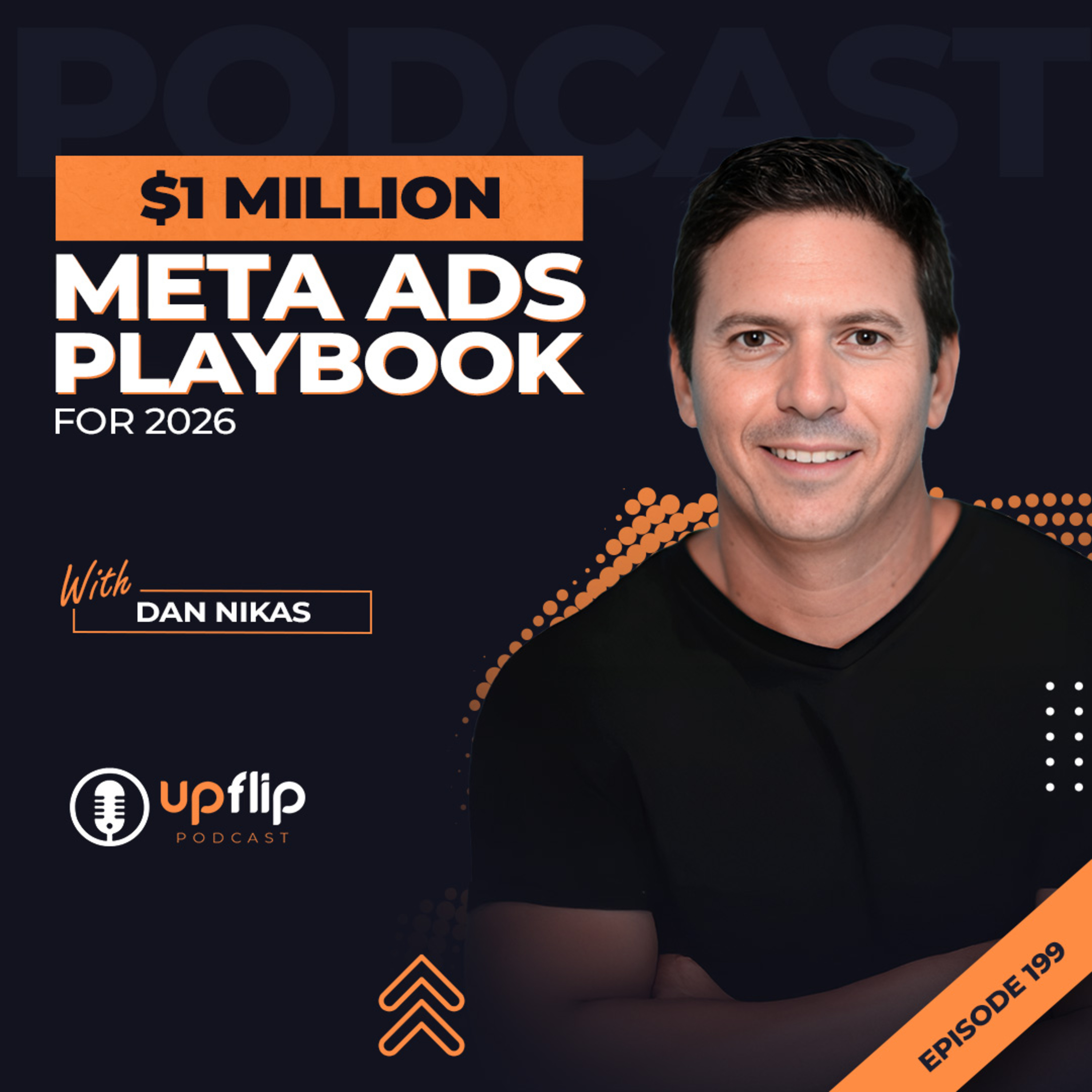
199. The Meta Ads Playbook to Grow from $0 to $1M in 2026
from The UpFlip Podcast
31m 57s
Dan Nikits, a former police detective forced into medical retirement at 36, pivoted to e-commerce with no marketing background. Facing the challenge of supporting his family, he launched GearBunch, a niche apparel brand using print-on-demand. Within a year, he generated over $4 million in revenue primarily through Meta advertising. Dan attributes his success to a relentless work ethic and transferable skills from detective work, such as understanding human behavior and persuasion, which he applied to targeted marketing. His strategy centers on a three-part funnel: creating broad brand awareness, nurturing leads by addressing common objections through varied content (like warranties or brand stories), and finally driving conversions. This approach allows potential customers to self-filter, building trust before a purchase. Dan emphasizes that effective marketing on social media requires nurturing audiences rather than direct selling, similar to a salesperson guiding a customer in a physical store.
Imagine this, you're 36 years old. You spent nearly two decades chasing criminals, solving homicides and leaving investigation as a police detective. It's a high stakes job, intense demanding, meaningful. And then, it's gone. A medical retirement forces you to walk away. No warning, no backup plan, just you, your wife, your three kids. This was the reality for Dan Nikits. But instead of retreating, he pivoted with zero marketing experience Dan drove headfirst into e-commerce. Within a year, he scaled his brand GearBunch to over $4 million in revenue. No funding, no fancy team, just a relentless work ethic, a knack for storytelling, and one marketing strategy that made his brand feel everywhere. I'm Ryan Atkinson, and your listening to Output Podcasts where we uncover the secrets of building and running successful businesses. I am so excited to welcome Dan to the podcast today to talk about all things e-commerce, marketing, mindset, so Dan, thank you so so much for being here. Thank you, family, all right. I cried in stride as well. Hi, I appreciate it. Well, I'm excited to have you on here because your background is amazing. I mean, you were an detective. You're doing homicides, but now you're doing digital marketing, scaling e-commerce brands. I mean, talk to us about what life was like before what you're doing now and did a digital marketing world. Life was pretty good. From a young age, all I wanted to do was join the police. I did manage to do that when I was 19. And never went to university, never got to try, never did a college degree, anything along those lines. When straights, the police Academy had a high school pretty much and I was really good at it. A lot of satisfying parts to it. There's also a lot of hard stuff in there as well, especially dealing with homicides and victims and families of victims. Unfortunately, I did get medically retired when I was 36. And that was really confronting because I'd never known anything else. I'd never lived in any life. It was my identity. As I said, I was good at it. I enjoyed it. And I had no other skill set behind me. So I thought. So in a very down time, I reached out to a friend who had been to a similar journey to me and he got and started into digital marketing and I reached out to him. I said, look, I don't know what to do with my life and no disrespect to some individual jobs. I didn't want to go from the responsibility I had to go and become a cleaner or something that requires no tertiary education or skill set. You can learn on the job how to do those things. And so I reached out to him and I said, look, this is something that I'm interested in. What are you doing? How do you do it? And that's how my journey stopped. I want to really zoom in on 36. I mean, have I put myself in your shoes? I mean, you have family. I mean, this is all you know in your whole life. I mean, what was that feeling like for you that just has to have been such an overwhelming moment to really just hit it at 36 years old with family on your hands? It absolutely was. That was probably the hardest part was it became probably at that stage in my life. And I would still say to this state that the hardest moment in my life, but without it, I wouldn't have got the rebound that I've had now. Sort of eyes that I have now. You know, I had typical middle-class life. I've been in a police officer's pain recently. Well, paid the bills. We had a house. We had a mall. You tried three young, very young kids. My youngest was only nine months old. Married. All the responsibilities that come along with being a dad and all of a sudden, you're told you can't do this job anymore. Not only that, you have this realization that I thought I was going to do this for the rest of my life until I retired. This is who I was. I was now gone. So I thought was all the skills that I'd developed for 17 years becoming a detective and an investigator. I thought, "Well, what else can you do? You're going to replace up a certain amount. There's no other career that you transfer that into or so I thought. And I discovered along the way that components of it could be transferable." I like it. Well, let's talk about those transferable skills and really get into it. You launched your bunch and you guys did over four million in revenue. Listeners are probably like, "Well, man, why would you ever stop doing it?" I mean, that's like amazing. How would you make that transition to gear-bunching? You talked to us about gear-bunch, why I love it, I like that. Yeah. So gear-bunching, it still around to this day, I still run it to this day. It's a to broader summon up, we sell leagues. And we sell really unique designs, very niche down specific designs that target people based on their passions or their hobbies or their personalities. Now, if I don't launch gear-bunch, I'd launch a bit of a fitness website because that's where my passion was and through that, I tried to figure out how to monetize it and got involved in meta-apportizing. But Facebook advertising, as it was at the time, and found that I had this real knack for it. So selling t-shirts and hoodies that were fitness branded, fitness themed around the website that I had, and found that with meta-apportizing, Facebook advertising, it was easy. I could just. The analogies this, I spent 17 years trying to find people that didn't want to be found as a detective. And when I found people, they were never happy that I found them and the only possible outcome of for them more often than not was going to jail, was prison time. So these people, no, no, they didn't want to be found. They weren't happy when I found them. There was a punishment for them at the end of it. And that would do everything they can to avoid being found. They would hide evidence. They would, you know, not bring things to my attention. Everything. So I developed a really good skill set there, finding people that didn't want to be found. And then all of a sudden, I dove into this world of Facebook advertising where people told me everything about themselves. They told me whether they were married, where they lived, what they were interested in, what TV shows they liked, what they had for dinner, what their dogs name was, you know, all of these things. So I would leverage, I found all this information fascinating. So I would pull all that out. And then I would target people specifically based on their interests or their demographics. And when I would put it out in front of them, they're actually happy that it was there. So it was a nice little offset. They weren't disappointed or annoyed that I found them or angry. So there was a sense of satisfaction. And I found that I could repeat this over and over and over again. I started in like fitness and gym, interest. And then I figured out very quickly that, hey, why don't I start a brand where I can target people doing everything still with that sort of active, where fame and mind. And I got approached by a company called Printful who do print on demand. It was a very new thing back in 2016. It was very new print on demand t-shirts and hoodies were a thing. Print on demand leggings was it? And I started to develop a little bit of a name for myself in a print on demand t-shirt and hoody game. That came to me and said, hey, we've got this new product. We love you to test it. I said, right, yeah, I'm going to test it. I launched GearBunch because GearBunch was just going to be a bunch of gear. There was no branding. I'd never run a business myself. I had no branding. I had no concept of what's this going to look like in eight years time. I just launched a website and Shopify called it GearBunch and put on, I think, a dozen pairs of leggings or very hyper focused on passions and niches. And it just took off. And every time I'd launched a new product, it would go. And then eventually it got to a point where we were going from doing our first couple of sales to $10,000 a day within a month. And it was all on the back of Facebook advertising. There was nothing else. Yeah, a lot of questions come to mind there, though. And we're going to definitely talk about your playbook for Facebook ads. So listen or say tune for that. Because I know new entrepreneurs look like I see Facebook ads as a way to grow for you. That had been such a feeling for you to be like, I'm finding something. I'm catching on pretty quick to a new skill that I never thought I would have. And I'm actually making money for it. How was that feeling for you to be so good at something with that? You never thought you'd probably be good at it or doing it. Yeah, well, I didn't actually know that I was so good at it. I thought I was doing whatever else was doing. I had taken a couple little courses here and there. There wasn't a hell of a lot around back then. So we talked and like I sort of cut my teeth on around 2014. And there wasn't a lot of courses around there. And I thought that well, I'm just doing what they have told me to do. But I had actually interpreted it. So what I mean by that is wasn't until I went to a conference and people were like, you're doing so well. What are you doing? I said, I'm still what you guys are doing. They're like, no, you're not like this is different. But we can't do what you're doing. What are you doing? And what I figured out rather quickly was as a police officer, I was not the big intimidating guy. That's not how I operated. I didn't coerce people into doing anything. I just had to talk to people and get them to do what I wanted them to do and make them think it was their idea. Now I realize that's marketing. That is absolutely marketing. And if I fit convinced people when there is no reward for them at the end, the only likely outcome is they're going to go to prison. I found it much easier to convince people where at the end of the day, they're going to be happy about what it is that I do for them. So that was the realization I had. And then I went through some terrible stages of having like an imposter syndrome where it was like, have I just got lucky? Is this a skill set that I've developed? Is this something that I can keep doing? It's still that constant fear of how I'm going to support my family, like things are good now, but ones if they're not. And then kind of the whole range of complexities of actually running a business that I've never experienced before. I had been a government employee and as you paycheck, your taxes taken out, this is the range structure, these are the rules, this is the system, the whole policing culture and being around as an organization for over 100 years before I even joined. I didn't have to invent anything. I decided to fit into all of a sudden on the business owner and I was lost. Most people spend months, sometimes years just thinking about starting a business. But what if you could do it in just 10 days? That's exactly what the 10 day business launch plan is designed for. It's a step by step roadmap that takes you from idea to real operational business in just 10 days. Click the link in the description below and get ready with your business. Well, we're going to talk about like putting the systems in place here, but I want to give a drum roll because I know the listeners are maybe like, okay, Dan, you have to give us like some meta tips, some meta secrets. Like I'm trying to scale my brand here. So let's go back to that as well. What you know currently today with scaling through ads using meta ads.
ads, any type of ads. I mean, what are like three things that someone needs to get rated through just launching like a meta campaign? The thing you need to realize to start with is that people don't come to social media to solve their problems or satisfy a wanderer need. People come to social media to social, but they are still acutely aware of problems that they have neatly solving or wants or needs that they have. So you can't just approach meta as unless you're selling an impulse by product. Like I mean a $20 widget something. I don't know. There's just cool and people don't care and they'll buy it first on their set. You need to nurture them. So you need to, you can't just launch it out and say buy this. Be no different to someone walking into a bricks and mortar store. Very first time they'd walk in never sending in your products and you go, "Hey, go and buy this." They'd be like, "No, I don't even know what it is. I don't know what it's about. I don't know who you are. I don't know who I should trust you. I don't even know if it's a good price. I don't know." What's the warranty? Who else has bought it? How does it work? All of these kinds of things we need to address. Just as a salesperson would talk to someone through it in a store, in real life, we need to use social media to do that. So we do it in three stages and we can broadly call them top, middle and bottom of funnel. That funnel structure's been around for a while. People understand it. It's all up to digest. It's not typically a top, middle and bottom funnel, but if we look at that type of your cold prospects, we need to create awareness that your brand, product or service is a possible solution to the problem that the person on social media is having. As I said, they don't come there to solve their problems, but they can be made aware of a solution to their problem there. You can do that very, very, very cheaply. This is quite often missed by a lot of market. They go straight for a purchase or straight for a lead. What I do is I go in there and I do it so that we create awareness. Once that person has engaged with us, we talk about AI and algorithms. There's two, over 20 million people in the US alone on meta. How much money do I need to spend to find those people that want to buy my product or want to take up my service or become a lead? So what I do is instead of spending a lot of money, I get them to self-filter themselves. So at the top of funnel, if they become engaged with my content, for the brand's content, I'll put them in a custom audience. That custom audience is then my engaged audience. So that means they've either visited the website. They might have signed up for our email list, they've engaged with us on our social accounts. Whatever action they took there, they've shown some indication that they're interested in what it is that we're offering. The other people that have taken no action, we don't need to try and convince them any further about our product being the solution to the problem because they've already given us a very clear indication that they're not engaged with us. So they've self-filter themselves out. The middle of funnel stage is we then run a lot of frequency to create numerous touch points talking about brand pillars, what the product actually does, what the service, what we're doing the service, warranties, guarantees, social proof, materials, products made out of how it works, brand back story. You know, the story we're telling here, like how to dang it into doing e-commerce marketing, digital marketing. It's all these stories that we can tell people, we tell it that middle of funnel stage. It's only then once they've been, we can track that they've had all these different touch points and they've seen all these variations of messaging that we can give to them through various creatives or copy that we then go to them and say, would you like to become a customer? Would you like to become a client? Question that I'm going to ask here. So what is that top of the funnel content look like? What are you seeing? Is it a blog post or something? You touch on the middle funnel, then the bottom of the funnel is it like book a call as a creative ad or talk to us about what's at each stage there then? It's very brand specific, but that top of funnel that messaging needs to be really broad about what it is you actually do. You're not getting down to the minutiae of like my Facebook ad strategy or Facebook ad results. You're talking about at that top of funnel, so you use myself as an example, who we are and what we do and who we service. Very broad. We want to make sure that we're talking to the person. We don't want to just tell them how good we are. We want to tell them about how we help people, what services we can actually provide, whether we can save you time, whether we can make you more money, whatever it is that we're actually doing, but it's very broad. We don't go into any details about the how. We're just talking about what it is that we can do. We just want to make them aware that we are a potential solution to the problem that they have. And that solution could be for a lot of e-commerce brands or a lot of service based brands, it could just be that the founders just got no time to do any more than what they're doing. So we're there with a few time or they're finding that they're wasting money on ad spend or we're here to save you money. We can't get consistency, which is we have these big peaks and trials in our revenue or leads coming in. We can help you get consistency. We don't go in some of those solutions, but we don't tell them the how. The how it comes in that middle of funnel. Once they've already indicated to us that they want to do it. So an example of a good top of funnel strategy at Creative is a very broad video about what it is that you do or information that lands monoblog posts of this, what you do. Middle of funnel, that is very, very independent. That can be a brand back story. That can be if you sell a physical product, it could be UGC content of someone going through how to use the product. It could talk about warranties. It could talk about reviews on trust pilot or Google or whatever review system you've got on your platform. It can talk about past results. So what we're trying to do is that whilst everyone broadly has these same problems that we're trying to solve. In the middle of funnel, we find that there are different triggers which motivate people. So we need to pull multiple levers and show them a range of different things in the hope that it will overcome any objection that they have to take up the service. So for me, it could be, I don't want to invest in this because I don't know if other people are getting results. Well, one of the ads that you get shown is about results. Another one might be, I'm not sure if I want to work with them because I don't know much about them. Well, here's the brand back story. So you can see that we're very reliable. I don't want to buy this if it doesn't have a warranty. Here's a warranty. I don't want to buy this if it's produced in China. We pull these different levers based on objections. And a lot of those objections, we go to brand journalism. We say, what are the common questions or support tickets that come through to you? So good. That's really good. Listen, take note of that. That is super good right there. That's the answer. It's like, oh, how do I come up with 12 angles that say in the middle of funnel about what it is that I need to talk to them about? Well, what question do you get asked the most? Where's it made? All right. Well, let's create an animal talk about where the manufacturing process will get some behind the scenes shots. We'll talk about being made in the US or wherever it's made. What about, you know, people are asking what is the warranty? Well, we can put an ad up and talk about a warranty or a guarantee. People ask, you know, who else have you worked with? That's a common one you get as a service provider. Who else have you worked with? We can showcase studies, then, can't we? We can show more than mine. But these are the different leagues we pull because there's very common questions. There's very common objections. And brand known as no, what they are, but they don't go out and actually proactively solve that provider solutions that objection before it becomes an objection. So people might be subconsciously thinking he is, but by the time he put this out in front of them after they've already shown an interest in what it is you do, he already answered that question before they ask it. Listen, I literally take note of that because that's one of my favorite things in for like my own video marketing and see when we're doing like a customer testimony, one thing that we always advise clients is like, okay, we'll do a customer testimonial with your clients. Like what's the story arc that we want to do? Well, what are prospects like saying as an objection to you and how can we get that in a customer testimonial? It is such a great social proof to directly answer prospects questions for you. Though once you get to that bottom of the funnel content, then like, is it truly like buyer products, books are services? And also what are these creatives looking like? Are they all videos? Are you doing images, blog posts? Absolutely. Make sure of everything. And that's the other thing never fall in love with the creative that you're putting out there. You've got to let the data tell you what's going on. So, and there's numerous different metrics we can look at depending on the brand. Top of funnel, we've got engagement, middle of funnel. We want to see some further action down the funnel. So we want to see them go into the website. We want to see them engage near and commenting. We want to see them becoming a lead. Yeah, they're not quite at that point yet where they've crossed the line, but you need to test a range of images and videos. And there's no one solution fits all for a couple of reasons. The first is it depends on the person on the other end of the device, like what it is they engage with. Did they like looking at images or did that prefer videos? Then we've got to look at the placements. Images can't go over a video's go and videos can't go everywhere that images go. It's just the system's not set up for that as much as they've got like these advantage plus creatives and they'll modify them and I'm pushing here and everywhere. The reality is is that you need to make sure that your ads can be seen in as many possible placements as possible because you don't know where the person's going to see you. You don't know whether they're going to be playing candy crush on their phone and they get a video from you because they don't have the paid version or you don't know whether they're going to be reading a news article and it pops up as an in stream video for them or just a image placement as a banner out in there. You just don't know where they're going to be. So your might as well give the system as many opportunities as Kent to find those prospects. Don't fall in love with the crowd. You can make the best video creator you like and sometimes it just doesn't work and it sucks because you fall in love with it but people are telling you it's not working. The client results will always be true and that's actually the next segment I want to talk about is results here. Obviously there's so much that goes into a successful campaign. So what are some of the metrics that you care about the most in touch about any art and what you're measuring for an effective campaign. So for an effective campaign in marketing efficiency ratio is what we need to focus on and the reason we focus on this is because we need to approach from this only channel perspective. And what I mean by that is that
So you'd be foolish to think that raising awareness and creating engagement on the socials will only lead to a conversion on the socials. That will more than likely also lead to intent on Google when people are searching as well. So they could be introduced and warmed up to your brand or product or service offering on the socials, but then go to Google to find you, do a little bit more research and then convert there. Does that mean that the meta-adged strategy, because it didn't result in a purchase conversion or a lead, did it not work there? No, it meant that it converted over here on Google. The same as email marketing strategy is the email might be converting people into purchases or into clients or however, without that awareness and engagement or in turn people looking on Google and Googling you with that intent and becoming a lead, the email marketing will be in effect. No one just all of a sudden Google's here becomes a lead and then never has a touch point anywhere else. It just doesn't work like that. So that's where MIR comes in. That's where we need to take a combined of all of our media efforts and costs and layer that against the gross revenue that's coming in. And that is our marketing efficiency ratio. So if we spend $100 on advertising and we sell $500 worth of products, that's a marketing efficiency ratio of $5. That means for every dollar that goes in, $5 comes out the back end. How that works for each brand? We've got some brands that run on the MIR of two and they're profitable because they're a service-based offering. There's no cost of goods. There's very low running costs. There's no warehousing. They could just get digital product. And MIR or two is great and you'll do it every day of the week for a dollar and you get $2 worth out. But $100,000 in get $200,000 out. Skylobal. Other brands, heavy machinery, some of the brands that we work with, they've got various slim margins and super combination. So two questions here. If you could answer real quick one, what's the best way to track this? Is it through a spreadsheet or using a tool for that? You route a metrics spreadsheet, put all your marketing costs in one column, whether you track it weekly, fortnightly, monthly. I'd suggest doing it weekly to start with just seeing you in the habit. And you can automate those processes. We've got a calculator that we use which is nice and simple for people to use. Punching the numbers, you're gravitating costs and gross revenue and the other income is MIR. Is that similar to your customer acquisition costs? Could you clarify that as well? Okay. So some people will call it CAC which is CAC. So customer acquisition costs. How much you've spent to acquire that customer? So let's say I spend $100 to acquire a customer. That might be nice if I was selling them something for $200. But if I'm spending $100 to acquire a customer and the average order value for my brand is $80 while I'm losing money. So I can't have a customer acquisition cost the tie that my mate. And what you need to do is you need to work out in turn what your break even customer acquisition cost is. So how much does the product cost you or the service cost you to offer? What are all your fixed costs? Your running costs. All right. So if I sell this $100 product, I know $50 off of this going to go in costs out. Whether that's team members wages, cost of goods, warehousing, distribution, whatever it might be. I know I've only got $50 profit in a $100 product. Therefore my maximum, my break even cost per acquisition. So CAC is going to be $50. Because if it's costing me $50 and I spend $50 and I sell for $100, there's nothing left. So that's your break even and that gives us a good jump off point. So I brought when he'd optimize to be better than a $50 cost per acquisition because otherwise there's no profit. And for all the listeners here, I hope you guys are like taking notes. This is like such a great breakdown into like a world class mind when it comes to this. So thank you for that. Let's talk about another important part where it comes to marketing. That's organic. I mean, what's your organic strategy? If someone's a solar per newer wanting to start their first company, how should organic play under their overall content marketing strategy? Organic can become touch points. Organic is taking a big hit over the last seven or eight years. Seven or eight years ago you could go, you can blow up your following, you can blow up everything. It's not like that anymore. Sometimes you feel like when you're starting out the yelling into an empty room, what is just no one's listening and you look at it, the reach is terrible and organic is back consistency though. The algorithm rewards consistency. The content needs to be good, but consistency is the key. You can't just do one organic post once a month, really add, I can expect that the algorithm is going to go, well, this is good content. We're going to push this further and just hope that you get lucky. Sometimes people put viral content out, but you know, we're running service based businesses, we're selling products. The viral it is just not there. It needs to be something shocking like your cold play case can for it to go viral. No one's got a brand that's going to do that. Otherwise, you're saying how many searches there's been on that actual company since that happened? It's for no. I imagine it's super high down. I'll tell you real quick. One thing that we did for our video marketing, C was last. I think this came out like last Thursday. I want to say the cold play concert, we launched a campaign, an email marketing campaign, last Thursday and Friday all around the cold play concert and our open rates are great. Our click through rates were great. So it was identified a viral moment kind of latching on and throw like an offer. So I love that. We've just done it as well. And this is part of it organically latch on to what you see organically working. We've got a surveillance and security product based company in the US that we work with. And one of their product offerings is GPS tracking and micro tag tracking. It's around more sort of fleet management of cars and putting tags on your pets and your bikes. But we read it a landing page about infidelity and basically the ads are GPS is greater than trust me. It's nothing. It's just using copy like find out the truth before the next cold play concert or don't wait for the next concert to find out the truth and still you really want to get it back to the organic strategy consistency to keep. So it's just about being consistent with your messaging consistent with the frequency that you put things out testing different things as well. Organic sports they won't go viral. We do use organics is our jump off point for ads. The reason is it's the same algorithm in the socials that determines if something organically is a good performer that determines if an ads going to be a good performer as well. If Facebook, Instagram, threads, all those things they're all a user first platform. The user is the commodity. The platform's ready to use so you're the commodity as a personal user. What they need to do is try and keep users on the platform so they want to reward content creators that are producing good content with further exposure. So if you are frequently and consistently putting out content and let's say you have to post three or four times a day I'm saying if you're a brand you want to post two to three times a week do that but do it consistently. Have a look at the metrics and the insights for those organic posts and see which ones getting better reach and better engagement because the algorithm is rewarding the better content. Take that organic post and put it into a stage of your funnel depending on where it fits in there. Because if it's getting good reach organically it will be rewarded with good CPMs so cost per thousand impressions. It can tend to get better engagement and better click through rates. The organic algorithm has already told you people are interested in this. They're engaging with it. They're showing it to more and more people and you'll see it at some time. Sometimes you put something up and order to reach a handful of people and other times it will reach thousands. Not viral and it's not going to be business changing for you. It's not going to change the trajectory of your company but it's enough to indicate to you, hey if I put a bit of pay media behind this it should perform better than the one that I just got a little bit of a handful of reach because organically my idea of audience is telling me they're not overly interested in this but they're really interested in this one. That's a great tidbit there. Test your organic and then throw it into Peter if it's working well. One thing I want to ask I mean you're saying do it consistently yes yes I hear that but like Dan what the heck do I write about like how do I find ideas to write about I mean how do you go about like SEO content or organic content to actually create. So organic content again go back to what objections people throw at you most of the time or talk about what is that's really excited you or a successful case study that you had. People don't mind helping you out if you've done a great job for them or if you've got a good product they don't mind shooting a testimonial for you. You can offer incentives in exchange for testimonials. You can go to platforms live. If you've got products where you just see a creation platform like social cat you can go there in an exchange for products people will give you videos unboxing videos how to videos product in use videos. Then the other thing to keep in mind is that you don't need to create new content every time because the algorithm restricts how many people see it organically you can go back to the well. So if you've had something you've posted a few months ago that worked well you can repurpose that maybe change the thumbnail maybe change the copy fractionally maybe put some of latex on a video doesn't have to be brand new every time. Yeah super good stuff there. Dan as we wind this out let's jump over to our fanbless questions so far in this podcast I mean this was a master class of like the funnel I love talking about that measuring and then we talked about organic so phenomenal episode so thank you so much let's jump into our fanbless questions and these are questions submitted from our community listeners if you want to join in on real class marketers entrepreneurs founders go to www.youtube.com/upflip and submit your questions there. Dan ready for our last five here. Sure. Number one what's the first thing you do when an ad campaign flops? Tired it off simple enough. Number two biggest myth you hear about Facebook ads that you should not be optimized for purchase conversions. I like it. One daily habit that's non-negotiable for your success. I've got a calendar and I have time trackers from personal point of view I try and every day exercise every day. Really good I like that. What's more important Greek product or Greek marketing great product you'll get found out if you product shit and eventually
the way they know about it with the marketing ease. I like it. Last one for you. If you had to start from zero dollars again tomorrow, what's the very first move you'd make? Really build my YouTube channel. That would be, yeah, create that audience, that authority, and then start again. Then go from there with the audience, the authority that you've got built there. Well, speaking of YouTube videos, Dan, thank you so much for being on here. Someone's like, I need more, Dan, I need to learn more about him. Where can they do so and connect with you at? Look, just go to our website, elitebrands.org, l-i-t-e-b-r-o-n-d-s.org. Nothing to sell, nothing to push onto you. Just go there, have a look around. You'll see all the things that we talked about in this call, who knows you might even end up in one of our funnels because you've been to the website more than likely you will. But it talks you a bit about who we are, who our team is, brands that we've worked with, what it is that we actually do, and yeah, no pitch, nothing along those lines. Just jump in there if you're a shipment message, if I'm able to send you emails in there, right, Jeff? Listeners, that was an amazing episode with Dan. That was a great playbook on meta ads and how to run them in 2026. Three quick takeaways. Number one, create content around questions, customers, are asking that's a great way to get your organic strategy up and running, especially as a solo per new or early stage founder. Number two, marketing efficiency ratio. Go back and play that tidbit on what you should be tracking for your marketing to know if it's working or not. And number three, before you start running, paid ad campaigns test organic. We talked about the end of the episode on that. That is how you are going to get the best results with your paid campaigns. Does it perform well in organic? It'll perform well for you in paid campaigns. Great playbook, ton of actual tips in here. Appreciate Dan come on the show. If you guys are looking for more great advice on world class entrepreneurs and marketers, make sure to like and subscribe with episodes coming out every Monday. Dan, thank you so much for the masterclass today. You're amazing. - No, Ari, is it all thank you for having me on? (upbeat music) [Music]
Podcast Summary
Key Points:
Dan Nikits transitioned from a 17-year career as a police detective to e-commerce after a medical retirement at age 36, with no prior marketing experience.
He successfully scaled his brand, GearBunch, to over $4 million in revenue within a year using Facebook (Meta) advertising and a print-on-demand model.
His marketing strategy involves a three-stage funnel
Summary:
Dan Nikits, a former police detective forced into medical retirement at 36, pivoted to e-commerce with no marketing background. Facing the challenge of supporting his family, he launched GearBunch, a niche apparel brand using print-on-demand. Within a year, he generated over $4 million in revenue primarily through Meta advertising.
Dan attributes his success to a relentless work ethic and transferable skills from detective work, such as understanding human behavior and persuasion, which he applied to targeted marketing. His strategy centers on a three-part funnel: creating broad brand awareness, nurturing leads by addressing common objections through varied content (like warranties or brand stories), and finally driving conversions. This approach allows potential customers to self-filter, building trust before a purchase.
Dan emphasizes that effective marketing on social media requires nurturing audiences rather than direct selling, similar to a salesperson guiding a customer in a physical store.
FAQs
Dan Nikits was a police detective for 17 years, specializing in homicide investigations, before a medical retirement at age 36 forced him to leave the force.
After retiring, Dan reached out to a friend in digital marketing, learned about Facebook advertising, and applied his investigative skills to target audiences effectively, eventually launching his brand GearBunch.
GearBunch is an e-commerce brand that sells t-shirts, hoodies, and leggings with unique, niche designs targeting specific passions, hobbies, and personalities.
He scaled GearBunch to over $4 million in revenue within a year primarily through Facebook advertising, leveraging his detective skills to target audiences based on their interests and demographics.
He recommends a three-stage funnel approach: top of funnel for broad awareness, middle of funnel for addressing objections and building trust, and bottom of funnel for conversion, using tailored content at each stage.
The stages are: top of funnel (creating broad awareness), middle of funnel (addressing objections with detailed content like brand stories and warranties), and bottom of funnel (driving conversions with direct calls-to-action).
Chat with AI
Loading...
Pro features
Go deeper with this episode
Unlock creator-grade tools that turn any transcript into show notes and subtitle files.
 PodcastTranscript AI