Hello and welcome to F1 Explains, the official F1 podcast which answers your questions about
the sport.
I'm Katie Osbourn and with me is Christian Hugo.
Yeah, you send us your questions to
[email protected] and we find the best people in the sport
to answer them.
We tend to run up and down the paddock and find answers to your questions.
We're in the paddock right now and you might just be able to hear only just some cars in
the background and this time we're answering your questions about a car.
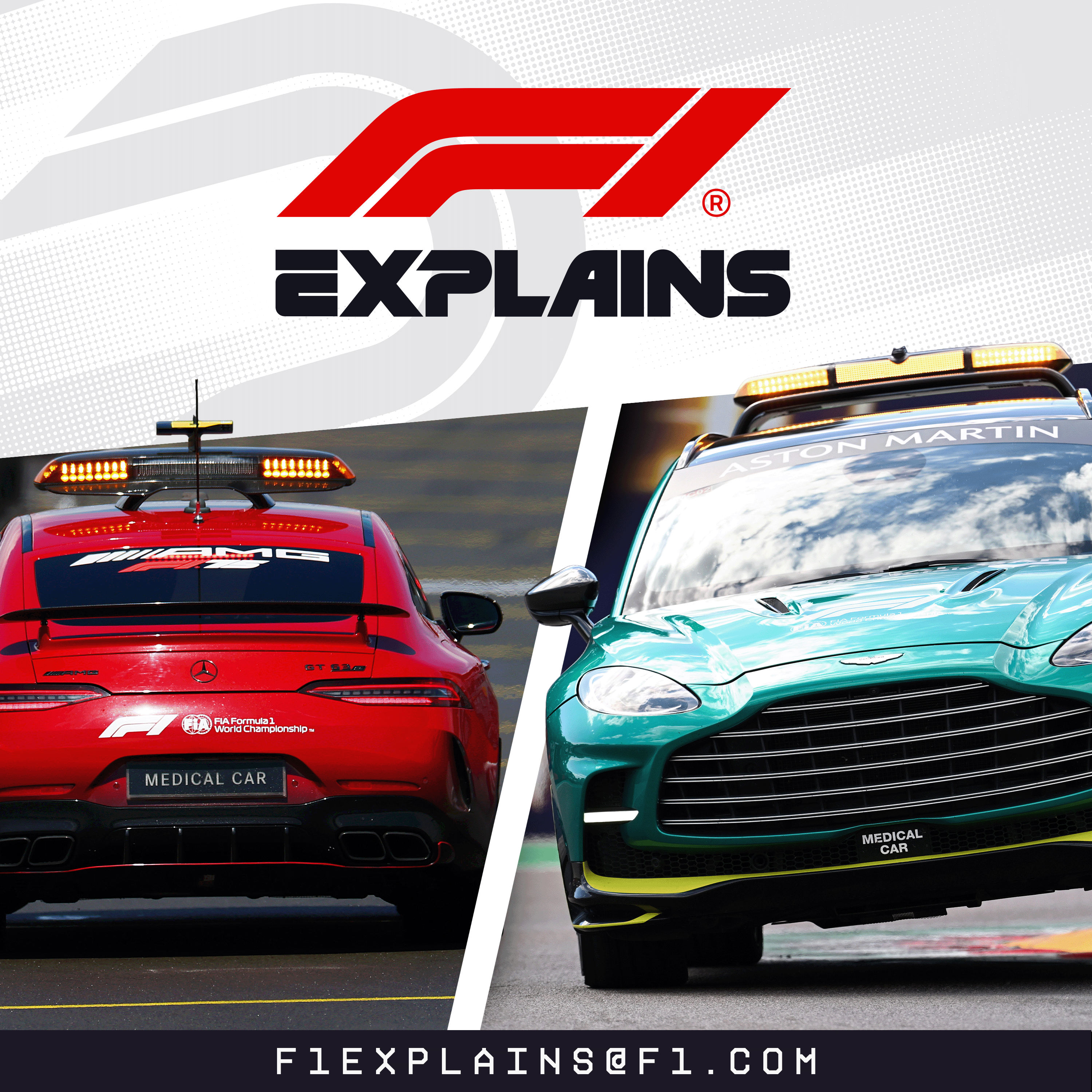
The medical car to be precise, the people who drive it, the doctors who ride in it and
what they do when a crash happens and a driver needs help.
That's right, now one thing to point out, the medical car is not the same as the safety
car which we did talk about on our previous episode.
They are sometimes untracked together but they have very different roles.
Very different.
While the safety car keeps all the cars driving at a slower, safer speed in the event of a
crash or heavy rain, the medical car goes straight to the scene of the crash to help
the driver.
It's run by the FIA, F1's rule maker, so to find out all about it we spoke to the FIA
medical delicate Dr. Ian Roberts and medical car driver Bruno Correa.
Thank you, it's great to be here.
My pleasure.
It's a pleasure to be here with you guys.
Katie, we've got a voice note to start, haven't we?
You do like a voice note.
Do love a good voice note.
Hi, Katie and Christian.
My name is Grace and I'm listening from Durham, North Carolina.
I love the show.
Thank you for doing what you do.
As we all know, F1 has greatly increased its safety measures since its inception, but it's
still quite a dangerous sport.
So, in that vein, I wanted to know who staffs the medical car, what it contains, and what
automatic parameters trigger its release.
Additionally, is each medical center standardized or does it differ from track to track?
And are drivers going through frequent medical checkups or is it just there and in case of
emergency?
Thanks so much.
So who staffs the medical car?
Ian, your role is the FIA Medical Delegate.
I'm struggling to think of a better person to answer Grace's question.
Take it away.
Well, thank you.
Thank you for the question.
The medical car is staffed by a professional driver who is my colleague just here.
Sat to your left.
Indeed.
Myself.
As usual.
Exactly.
This is how we configure it on the track.
Always.
So, myself in the right-hand seat, without the steering wheel, and we also have a local
doctor with us, and one spare seat, and that would be used to transport a driver, should
it be appropriate to do so following an incident on track.
Real quick.
Why a local doctor?
What's the importance of that?
There are liaison with the local team.
The local doctor understands the track much better than we would, and works with the chief
medical officer to make sure that all of the appropriate medical resources are sent for
from their side of things.
We have our own method of requesting resources as well.
We're going to go back to Grace's question in a moment.
I just want to pick up, though, and say we are recording this episode in the paddock,
which on a Thursday morning, like it is now, is often being set up, and as soon as we started
recording this podcast, incredibly helpfully, a man with a staple gun started spotting up
a sign.
So, if you can hear that in the background, it's not somebody being hurt, it is something
being stapled to a wall.
But the sign does look very nice.
The sign looks wonderful.
He's doing a fabulous job.
He's clearly a master of his craft, and at the top of his game, like everyone in Formula
1.
Bruno, what does the car have on board?
What are you looking at?
So, a part of us three, we have our trunk on the back full of equipment, emergency equipment
that normally it's bring by Ian and the doctor around.
I just need to check where they are in each position, everything is placed on the back
of the car.
So, in case we need to use it, I can help them to bring it to the scene.
A part of that, the car is fully equipped with all the safety requirements from FIA,
so we have harness, racing seats, light system, radios, there is a lot of things actually
going on inside the medical car that obviously it's a production car, but it's prepared
to be ready to race on the racing tracks.
Yeah, that's interesting.
By the way, Bruno did race with some quotes in there, because as a race car driver, you're
the one who needs to be ready.
You need to be ready to go at any moment, correct?
Yes, correct.
Since the weekend starts Friday, we are on standby on every session that's going on
the track, and to set that, the car is running, we are fully geared, fireproof equipment,
helmets, radios on, everything is ready, the engine is running, and if there is something
happening, we need to be at the scene as quick as possible.
Normally, I say that we are actually the fastest ambulance in the world.
That's actually probably true.
It's probably true.
Ian, Bruno's just touched upon it there, but in what situations is the medical car used
in Formula One?
We're on standby for every session, whether that be practice qualifying or the race.
You will always see us at the back of the grid, we're always the last at the back of
the grid.
We never finish the race, unfortunately.
That is a TNF right there, that's the sad one.
We chase the first lap, and then we come to the standby position, which is normally at
the end of the pit lane, and that's where we stay, hopefully, for the rest of the race
and do absolutely nothing else, and that's the ideal.
We're then, as Bruno said, engine on, ready to go, and should anything happen on track,
then we're dispatched by the race director or his deputy, and then we go directly to
the incident, and it's my job then to coordinate the response to that incident, whatever that
might be.
Now, you mentioned kind of where your standby is at.
Is that actually like the Circuit Medical Center?
Is that where you typically reside for the whole weekend, and do drivers go there for
regular checkups this medical center?
Our standby position is normally for most races at the end of the pit lane, so on the coverage
you will see us there, the engine is running and ready to go.
There are some tracks that we go to that it's impossible for us to access the track properly
from the end of the pit lane.
Interesting.
So, for example, we're going to go to Brazil in a couple of races time.
The pit lane actually exits at turn two, so we can't get into turn one, and so for Brazil,
for example, we sit at turn one behind the barriers there.
You choose the best location in the entire road.
Absolutely.
We look out on Sao Paulo, and there are other places that we have to be in a slightly different
location.
The medical center that you've mentioned, the medical center is there to take the driver
as soon as they're brought from the incident.
If the medical center is involved, normally the driver will arrive by ambulance.
The driver is stabilized there and then transported out to hospital.
Are you looking from the same thing from a medical center venue to venue?
I presume it's not like a team motor home that comes across all the European races.
I'm presuming you use a facility at each circuit.
That's right.
The FIA's regulations, PENDIX H, gives all of the various requirements for the facilities
that are housed in the medical center.
The vast majority of them are permanent buildings, but some are temporary, and that said, they
still have the same basic requirements.
I'd have to say that they're all to an excellent standard and far and away surpass the minimum
standards for PENDIX H.
That was going to be my question as some of these tracks a little further away than others
from a public center, right?
The resources, that might be, but it sounds like they're pretty stuck.
The medical center is equipped to look after a minimum of two drivers in an extreme medical
emergency, and then we have access to the local hospitals, which have to be trauma centers.
We then stabilize the driver, and the driver is then transported out to the hospital either
via a land ambulance or via a helicopter.
We normally have a helicopter or two at each venue, unless of course the hospital is so
close that it's crazy to use a helicopter, it's just not sensible.
Did the drivers use that medical center for regular check-ups over the course of a weekend,
or will they only visit that medical center in the case of emergency?
They would normally only visit in a case of emergencies.
Their normal care, their day-to-day care, is normally under their own medical teams.
So they will have a physiotherapist, they may have a team doctor who will look after
their general welfare.
The medical center only really comes into its own if there's an issue on track.
One of the things we've found about F1 Explains is a lot of people want to know how you guys
got into the seat, whether it be the driver's seat, passenger's seat or the like.
Listener, your ghost from Greece says, "We know a bird mainlander drives a safety car."
So right, that's a known.
Does the medical car have its own burn, which we've kind of talked a little bit about?
It does, but there are two burns.
Bruno and Carl share the year as the medical car driver.
Carl Reidler, who is a medical car driver, I was about to say number two, making out
like there's a number one or number two driver.
I'm imagining you guys are level pegging in terms of your teammates.
Yes, well it's funny because I've been doing the medical car in F1 I think now for three
seasons, and well, splitting also with Carl, and I met him the first time in Baku.
Because you've never seen him in the same place, of course, that's interesting.
If it's him, I'm not there, or the opposite, or the other way.
But as you ask, yeah, I've been performing the safety car and the medical car ready for
many years on the road.
So I started with the World Touring Car back in 2008, 2009, and FIA World Championship.
Then I moved to Formula E, I did F3, F2, I mean all the championships around the world,
FIA championships with the safety car.
And this opportunity came up, and yeah, it's a totally different role, but I would say
we had the same responsibility.
Once a driver, always a driver.
And this is something that really surprises people in Formula One.
We saw this when we recorded an episode on the safety car, where we were saying that
Burn Mylander is a phenomenal racing driver, and likewise with yourself, Bruno, you guys
have to be highly skilled drivers at the top of your game to go out onto a live Formula
One circuit.
And potentially, sometimes, it's not all about speed, it's about safety, but sometimes
you have to get where you need to be fast, that takes a driver at the top of that game,
doesn't it?
Yes, correct.
I mean, I even compare sometimes, because I've been a racing driver as well, so I would
say that our responsibility is much higher performing these roles, either safety car
or medical car.
Normally, I say we don't have margin for mistakes in our roles.
It's different from being a racing car.
You crash your car, next session the car is fixed and you are out again.
That can't happen with us.
No, you guys are the ones who would have to go out to help you guys, and that would
be a big problem.
Christian and I are going to have to go in and try and do something, that's going to
be terrible.
Okay, let's get their precision, it's so key.
Yes, and again, in this case, in this scenario, with the medical car, I'm taking two doctors
inside, the car is full of gear, so I would say that you don't push the boundaries, you
don't go over the limit ever, because you have that responsibility on your shoulders.
But there are too many variables, when you are doing a chasing lap behind a F1 or a F2,
these cars are ultra fast, the fastest in the world, and we just need to keep up.
And as I mentioned, there are too many variables, when you go behind a group of 20 cars, the
level of concentration and focus, I would say it's 100%, or 110% if that exists.
I think as a racing driver, 110% is your 100% for us normal people.
Exactly, but then the limit of the car, you have to be conscious, the way you drive it.
As a follow-up to that, have you, Bruno, learned anything about the medical industry, or do
you stay in your lane?
Is this at least interesting to you?
It's fun that you have that, because I've been, through all these years working with
FIA, I've been always performing some medical tests, helping the medical team in such extraction
exercises, playing the driver, so I could give good feedback to the doctors and the medical
delegates.
Yeah, I'm involved, I don't have a course, I did some first aid courses back in the past,
but I'm not a doctor or a nurse or whatever, but yeah, I do understand how the things works
on the bed scenario, and obviously I don't have any inputs, I live it with the good hands
of Ian and the rest of our good medical team.
Haftis from Iceland has emailed
[email protected], and Haftis says "I'm a medical student and
would love to hear how the people on the FIA medical team got into the roles, and what
kind of special knowledge they need to have.
Dr Ian Roberts, this sounds like one for you.
The most important thing is to have an enthusiasm and an interest in motorsport, and then want
to apply your skills to it.
We don't really have a particular set of requirements other than an interest in the
sport.
We have had in the past, and when I was working in Silveston, a number of doctors who came
from a huge variety of specialties, but they were all able to apply their skills to the
motorsport environment, and I would say that that's the key thing.
I guess certain specialties are more geared up to motorsport work, such as anesthesia,
surgery, emergency medicine, those sort of things, but I've worked with obstetricians,
with dermatologists, they do the ATLS or similar types of courses, and just really get involved
because they all have something to offer.
Ian, it's known that you've worked in the ICU, that was some of the background.
You also mentioned working in Silveston.
What has been your trajectory to kind of sit here now at these race weekends and be in
the passenger seat?
I was a relatively junior doctor at the time.
I used to be a spectator, but then decided I'd quite like to get involved, and I turned
up at Silveston.
The CMO at the time was a guy called David Cranston, Chief Medical Officer, a super
guy, and I just got involved from there on in, and spent lots and lots of weekends at
Silveston, just either trackside in the medical car, and progressed that way, and I eventually
worked my way up into the medical team.
I became David's deputy, and then subsequently I became the Chief Medical Officer for both
Silveston and for the British Grand Prix.
It was whilst I was there that the FIA came along and said was I interested in joining
them in the medical car, and that's sort of where I ended up.
It was a hobby that became something much, much bigger, and you're quite right.
My background professionally is in intensive care and anaesthesia, I'm a consultant in
those, but motorsport, as I say, went from a hobby to my main occupation.
The passion sucks you in.
You just mentioned the car Ian, Bruno, very much your department now, talk to us a little
bit about the medical car, what is it?
Well, it's a rocket, we have two rockets actually.
In Formula One we have the Aston Martin DBX, so it's an SUV, 707 brake horsepower, it has
some tweaks on it as well, especially on the suspension and brakes, but it's like a production
car.
On the hand we have a day swap between races, we have the Mercedes GT S63 AMG, which is
also a rocket, all both cars with four doors, five doors actually, and yeah, I mean very
good for the role.
We have always to have a space free on the back of the car in case we need to bring a
minor injury or a driver that stopped on the incident on the track.
The car is prepared, it's very safe, and as I mentioned, two good rockets too.
Do you prefer one to another?
To be honest with you, a lot of people ask me that, they are quite different, I like
the colors.
That makes sense to me too, behind the wheel, so which color do you prefer then now?
I'm Portuguese, so we have red and green, it's perfect.
Florence in South Florida is another who's emailed
[email protected], Florence asks,
why does the medical car follow the grid on the first lap of a race?
Now you often, when you watch the start of the race, you guys mentioned it earlier, you
see the medical car on the track behind all the F1 cars, and then it follows on the first
lap.
Why is that, Dr Ian?
There's a much higher chance of an incident, a sort of coming together on that first lap.
So once the cars start to separate as they're getting going, it becomes less of an issue,
not completely out of the woods yet, but it's that first lap that is the most important
for us to make sure that all those little battles that they're having in those first
few corners, they're still much closer together and the chances are that they are going to
come together.
When the cars do come together, who deploys the car, who gives the order, and why is it
that you guys don't go to every single one of the crashes?
We're always and only deployed by the race director, and that's a safety issue.
They want to make sure that if they deploy any other cars onto the track, then it's safe
for us and it's safe for the competitors.
The medical cars are two tonne of solid metal and we really don't want to be involved with
any coming together with us in a competition car.
The race director must be assured that he has, to his satisfaction, neutralise the race
to a certain extent, whether that be with Burn Mylander going out in the safety car or it's
a red flag and everybody's stopped.
Not all the impacts are necessarily for us.
There is a degree of experience needed just to assess, is that going to cause an issue?
But some of the least dramatic ones can be the most problematic.
And if we have a collision, we want to be able to see that the drivers moving, the drivers
talking, and I get their feedback patched through to me in the medical car so I can
hear them cursing to their engineers, which is great medical information.
Producer, can we get any of that for this as a little, just a thought?
A driver cursing his engineer means that he's got an airway, he's breathing and talking
and there's brain activity, so that's all good information.
And even some of the most dramatic crashes can be not a problem for us and yet others,
some of the complex spins, may not be great G-forces but the very nature of the dynamics
mean that the driver could be in serious trouble.
Well Daniel Ricciardo hit the wall in Zanvoort 2023, didn't look at all like it was going
to be a problem.
It's a really low drama incident and injured Daniel and he missed several races, an example
of what he's saying.
Yeah, exactly.
And you know, it was a fairly simple injury for Daniel that took him out for a long time
and that was a hand injury because he didn't let go of the steering wheel.
Yeah.
And then Bruno, I guess do you give your insight as a driver at that point to say, "Hey look,
that could have been a little bit more gnarly than what we expected to be?"
In that case, obviously, the experience that I have as a driver can help a little bit but
it has always to be checked by Ian.
We had some similar incidents, or I had some similar incidents the same year.
And then normally those incidents were actually a really low speed.
The ones that, like Christian mentioned, it doesn't seem anything and at the end, because
he didn't let go the steering wheel on the right because he's slow, so the brain doesn't
process the information as it should and then there is this snap and it can happen, yeah.
Just on this subject, Shana in Alabama has asked what parameters make a trip to the medical
centre required and does a doctor have to clear the drivers to race after they've been
injured?
This goes back to what you were saying a minute ago Ian about different crashes because you
do sometimes hear the commentators say it's hit a certain level, am I right?
That's right.
We have a level of g-force which is detected by the accident data recorder but that data
recorder, the ADR, really shows the energy or g-forces that have been experienced by
the car and those are extrapolated to the driver.
So we have a minimum of 15g in the horizontal or 25g in the vertical and that takes into
account the curbs.
Above those levels we would normally have a routine examination of the driver.
So it annoys the drivers a lot, you know, they have a problem, they see you coming and they're
like, okay.
Oh yeah, yeah.
And then the number of arguments that I've had in the past and it's, you know, it's not
me guys, it's the rules that the threshold has been surpassed and you are required to
have a medical assessment before you continue.
And that's why we then, we pick them up, we take them to the medical centre, they get
a thorough examination by the local medical team, any imaging or other investigations
as required, they're retained in the medical centre for a minimum amount of time, which
again annoys them tremendously but you know, it's for their well-being and then they're
released back to their team to explain why they destroyed the car.
And you leave that up to them.
And follow up to all of this, Eugene Washington D.C., similar kind of question and again,
Dr. Ian, actually both of you might have a perspective on this, how much do F1 crashes
actually hurt, right?
So we're talking about, we talk about the Daniel Ricardo incident and it doesn't look
like it, right?
But then it is.
The drivers seem to routinely crash into a wall well over 100 miles an hour, going back
to the G forces and the speed, half the car is destroyed and then they just gather the
car and walk away.
We never really see a driver limping, at least that may be the ones that are limping are
going into a car of sorts or an ambulance and it seems like the ego takes a bigger hit.
So how would you describe drivers in a crash and is that easy to do?
It's an interesting question in that do F1 crashes hurt and yes they do but a lot of
that hurt, whether that be literally hurt as in pain or hurt as in physically damaged.
He's not talking about the psychology, there's a, there is a degree of or potentially of
course a degree of hurt that the drivers suffer but over the years, the safety mechanisms
or safety innovation, etc. that has gone on for single-seater cars has reduced that hurt
as it were considerably, you know, right from basic use of seat belts, helmet, hands, hands
has reduced the chance of basal skull and neck fractures absolutely considerably, the
foam heads around but they still can be hurt physically, you know, organs decelerate within
the body so all the drivers have to be assessed to make sure that those sort of things are
fine.
So yeah, they do undergo a degree of hurt but certainly as you would understand in your
car if you didn't have airbags and you didn't have seat belts, they would hurt considerably
more if those things weren't in place.
On top of that I think one of the major steps through FIA has been actually the safety on
track, it's definitely when you look back 20 years ago to now the improvements on safety
and the comfort of the driver inside the car that I think was one of the major big steps
on the safety that we see in all the races nowadays with the FIA flags, yeah.
I think over to like Joe's crash, was it Silverstone or something, were they Halo?
Yeah, it was 22 I think.
Yeah, it was 22 and it just, it was one of those dynamic ones where that did not look
like one of the ones where he gets out of the car and hard limping, right?
Yeah, exactly, exactly.
It looked hard, it looked like a hard hit.
It was hard, yeah.
But you look and, you know, you're a little hurt.
If you see that 20 years ago or 25 years ago, probably you would have serious damage
or even a fatality, yeah.
Well on that guys, you know Formula One has had a long history going back to the days
of driver pioneers who pushed for increased safety like Sir Jackie Stewart and the likes
of Professor Sid Watkins who worked for the FIA for many years and it is a legendary name
in Formula One for the work he did, one of your predecessors in in terms of bringing
safety standards.
So we thank you as Formula One fans for the work you guys do, your role is incredibly
important.
Without you guys, without experts like yourselves, we wouldn't be able to watch people go racing.
So thank you for keeping our heroes safe and sound and in the nicest possible way, we
hope we don't see you in action very often at all, one of the unusual jobs in Formula
One.
We hope we see very little of you over the course of a Formula One weekend.
The ideal Formula One weekend for us is to do absolutely nothing and to be completely
an utterly bored and that's fine, you know, we come along, we do all the preparation and
we sit and do nothing and we go home and that is the best weekend.
That's like a true driver there.
You mentioned the physiological or the mental part of these crashes, Bruno can you speak
to that a little bit?
Yeah, definitely.
I mean when you come up to pick up a driver on track, I think the biggest injury is his
feelings.
To the ego.
Yes, I mean as a racing driver there have been as well in the past, it's never a nice
thing when you break a car, especially when it's your fault or something.
So yeah, they have the ego completely hurt and the feelings mostly more than actually
physical.
On the physical side, there is a lot of pressure on this game as you know and yeah, to cope
with all that, sometimes it's difficult.
And Ian, is there a typical sort of routine that happens when you get to a scene?
Yes, the most important is to maintain the safety of the medical car and the occupants.
So once we are at the scene, my task is to make sure that whatever we do we don't make
anything worse, it's to assess the scene and then to assess the driver.
So once the driver is assessed and we then know what resources are required, they are
then further deployed by race control.
They will arrive, will manage the scene in terms of the arrival of each of the resources.
The local team will then take charge of the clinical management of the driver and then
we'll make sure that then, again, appropriate resources like ambulances have arrived, extrication
teams, for example, the driver is put into the ambulance and then the ambulance is able
to then leave the scene and off to the medical centre and we will then follow that ambulance
to the medical centre.
If the driver just gets out, needs an assessment, then we'll pop him in the medical car and
we'll get him there because it just keeps everything flowing and makes sure that the
driver gets to the medical centre in good time.
Do you guys like say hi, how are you doing when he climbs in, like what's the gestalt
in the car?
It very much depends because some of the drivers are very chatty, others don't want to speak
at all, they've just put their car into the tech pro, for example, they've ruined their
qualifying and they are angry, mostly angry with themselves.
Of course, and we won't ask you to drop them in it, that's not fair, but who's one of the
chatty ones, that you can say, who likes a bit of a chat in the medical car?
These guys, they're professionals, they get upset because they've not done a good job
and some really don't want to talk and some are very grumpy.
Understandably.
But not exclusively, you know, sometimes they'll be a little bit more chatty and other times
they'll be a bit glum, you know, I get it, I understand, but you know, they don't want
to go to the medical centre, but guys, sorry, you know, we're there for you.
Bruno's driving you to the medical centre.
So they're blokes and not all blokes like going to the doctors, that's the typical thing.
And you can understand being grumpy when you've just thrown a car into the walk, and if there's
one time to excuse a driver being grumpy, it's there, isn't it?
It is.
I imagine it's like an awkward elevator ride.
Great analogy.
You know what I mean, just like, awkward elevator ride, you're just having to go all the way
up to the 35th floor and you're just like, yeah, anyways, we've all been there.
Well, Dr. Ian Roberts, Bruno Correa, thank you so much for joining us on that F1 explain
things.
It's something as you've heard, our listeners have had a lot of curiosity about, so thank
you so much for the work you do, and for taking the time on a hopefully not too busy weekend
to answer our listeners' questions, loved having you on.
Thank you, both of you.
It was a pleasure.
Another big thanks to Dr. Ian Roberts and Bruno Correa, that was fascinating, Christian.
It's so fascinating because it's such an important part of Formula One, and it's one of those
things that probably we all take for granted a little bit, that when crashes happen, which
in, you know, the most intense motorsport series in the world, that is going to happen.
And those guys we know are on hand, absolute experts, top of their game to look after the
drivers, make sure they get the very best care.
It's such an important part of what the FIA do, and we're lucky to have them in F1.
So just hearing their insight and their explanation was fascinating.
And also, thanks to our listeners as well, some brilliant questions have come in on this
one, and even as after Ian left, Ian said, "Oh, those questions were great."
So well done, F1 Explains Gang.
Thank you again to Dr. Ian, to Bruno, and it puts another perspective on what these
people quote-unquote behind the black curtain do.
Exactly.
And if you want to go even further behind the black curtain of Formula One, there are two
other official Formula One podcasts that is beyond the grid for in-depth interviews with
the people in and around the sport, and there is F1 Nation for Race Reviews, Previews and
the latest news.
Tom Clarkson has both of those.
And if you're new to F1 Explains, welcome.
Please hit subscribe.
Leave us a nice review, and we have new episodes every Friday.
And Katie, we always want people to send in their questions, don't we?
We do, and you guys heard them in this episode.
We had a voice note.
We have a couple of questions.
You can send them in via email.
Producer Chris reads each and every single one of these emails to
[email protected].
Make sure you send it in.
We love hearing from you, and we love your questions.
You read each and every one, don't you, Producer Chris?
Every single one.
And if you believe it or not, I asked him earlier how he kind of manages us.
He categorizes them, because he's literally the most organized person I've ever met.
He's an incredibly organized man.
You are.
You have a very, very organized gentleman, and you send them any time.
If you send us an email on Christmas Day or Thanksgiving, Producer Chris will read it.
That's not necessarily true.
That is true.
We'll be having words about that after this recording.
Right, that is it from me and Katie for this week.
We're back next Friday.
Thank you so much for listening.
Have a great week.
Bye for now.
Bye-bye.
 PodcastTranscript AI