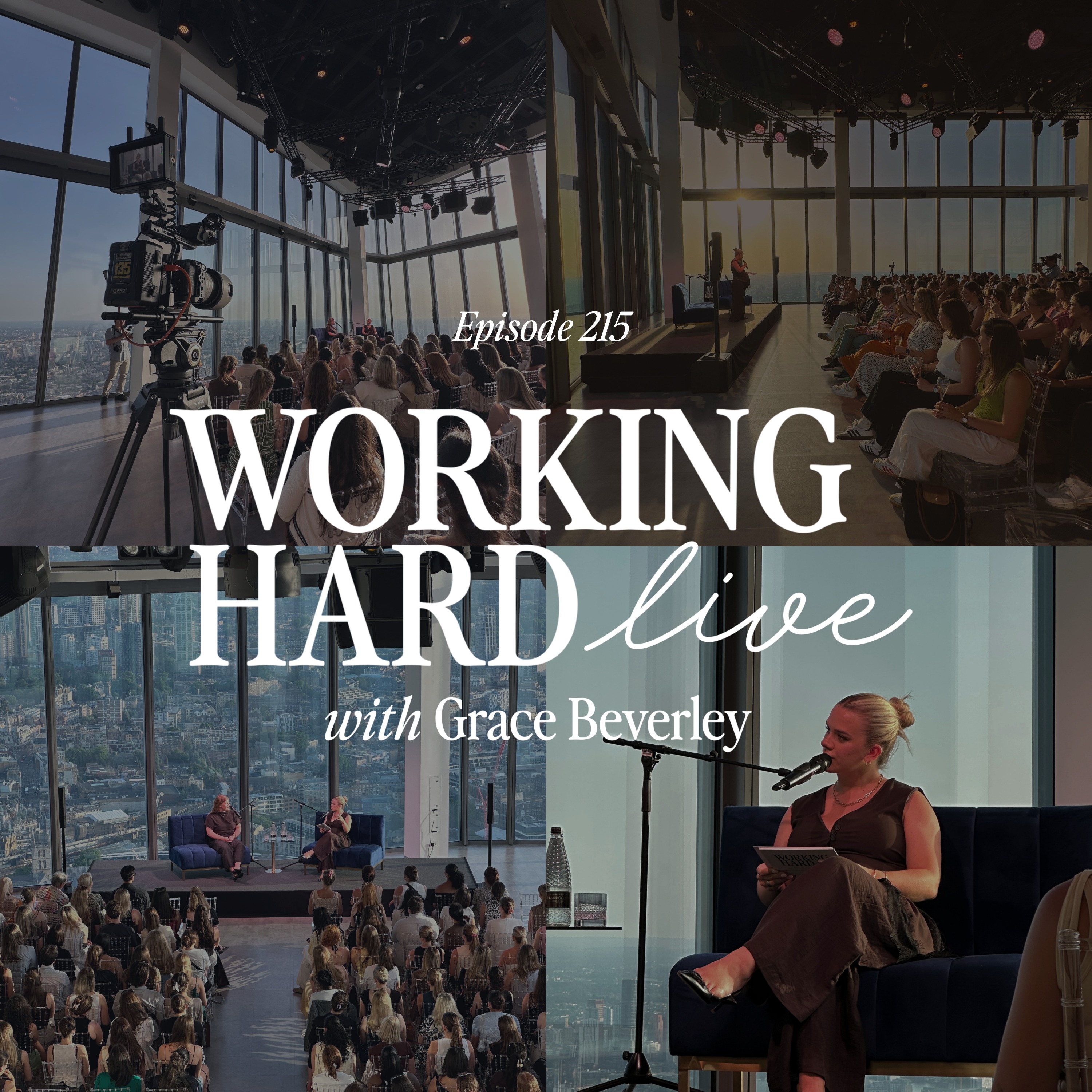
The lies we all tell ourselves about our careers with Jemma Sbeg (LIVE)
48m 1s
Grace and Gemma Speg host their first live podcast, sharing insights on ambition, career risk, and personal growth. Gemma, who built her psychology podcast while working grueling hours in consulting, emphasizes that relentless effort is unsustainable and that true career success requires balance, self-awareness, and strategic risk-taking. She highlights how modern career paths—shaped by gig economies and shifting values—demand greater agility and willingness to abandon traditional models of loyalty and stability. Central to her advice is the idea of momentum over perfection: small, consistent actions—like sending a simple email or attending a networking event—create a "surface area for luck" that increases the chance of unexpected opportunities. The conversation explores concepts like "Golden Child Syndrome," where early achievement leads to identity crises in adulthood due to over-reliance on external validation. Perfectionism is reframed not as a strength but as a liability that drains energy, blocks creativity, and prevents personal fulfillment. Instead, the 80/20 rule—doing 80% of what matters and accepting that 20% is just the cost—is recommended to reduce pressure. Ultimately, the key to progress is action, not planning: setting small, achievable goals, building self-trust through consistent effort, and embracing discomfort to expand one’s network and exposure to opportunity. Gemma concludes with powerful advice—like the quote “An idiot in motion is better than a genius standing still”—and encourages listeners to take bold, even ridiculous, steps weekly to build momentum, trust, and ultimately, a life aligned with their true desires. The episode ends with a playful nod to the healing power of the ocean, a metaphor for the restorative potential of stepping outside comfort zones.
[Music]
What is up, I'm Grace Beverly and welcome back to Working Hard,
the podcast ship guidebook on how to improve your own life
and achieve what you actually dreamed of doing,
because life's too short for boring podcasts and bad advice.
[Music]
What is up and welcome back to Working Hard?
Today is quite a fun episode because it is something a little bit different for us.
You are going to be listening to our first ever live podcast recording.
We held it back in the summer and we have just got the live recording back through.
I loved it so much and I always get major FOMO when my favorite podcasts do live recordings
and then never release them, so I just thought we'd pop it live.
For context, we held this in the most unbelievable skyscraper,
which was at 22 Bishop's Gate and I spoke to the incredible gemmer's bag
who is the host of the Psychology or 20s podcast,
who you will know from our episode in 2024.
If you've been around these parts for a little while,
we got into perfectionism, career planning, ambition,
just a good old girly chat around all of those areas,
so I hope you really enjoy it.
And if you were into these types of live events, please let us know.
That was the first we ever did and I loved being able to do it.
We did 20-pound tickets, but there was food and drink
and it just felt like such a nice evening.
But I don't really know how much people go to live events and things like that,
so if it's something you're interested in, please just show.
Anyway, let's get into it.
Welcome to our very first live podcast ever.
Obviously, you guys snapped up tickets incredibly fast last week,
which made us very, very happy.
And we just thought when the opportunity came up,
really, like, what else should you be doing at nearly eight months pregnant in a heatwave
than trying new, stressful, in person event?
So here we are, and I hope you will really enjoy the evening.
We are here for a little bit more context at Horizon 22,
one of the most incredible views in London.
And I genuinely cannot think of a better backdrop for this conversation,
particularly because this room has aircon.
But tonight, we have a very, very exciting and special conversation for you.
I am joined by Gemma Speg.
She is the host of the psychology of your twenties podcast,
which is one of the most listened to podcasts in the entire world.
In fact, it recently ranked in the global top 20
and was launched on Netflix last year.
But what makes Gemma even more interesting,
and a person who I have had so many incredible index conversations
with who I feel you will really enjoy kind of what we get into,
is that she started the podcast as a side project
while she was working 80 plus hour weeks in a corporate job.
She built it episode by episode using her background in psychology
to break down the things that make ambitious people feel stuck,
anxious and like they're falling behind.
And what I particularly love about Gemma
is that she doesn't deal in platitudes.
She goes straight to the research.
So tonight, we are going to get into the psychology of ambition,
the traps that high performance fall into all too often,
and how to achieve your goals without losing yourself in the process.
And so all that is left for me to do is to welcome the wonderful Gemma's bag.
You know the question I always start with.
But it's been a while since I've asked you.
So are you currently more working hard or hardly working?
Grace, I'm right down the middle.
I'm, I'm telling the line.
Yeah, it's been great.
I just moved to London this year.
So it's like, this is kind of an insane experience
to have been London, like in your first year of living here.
And I'm really taking advantage of Ryanair.
And I don't even know how many pound flights to like Italy and other places.
As you should.
I've been to Italy so.
As you should.
And obviously we've talked about your podcast here.
But I have to obviously say for the room that I find it so
incredibly impressive that in the early days
you built it working a full-time corporate job
in consulting whilst doing, you know, 80 hour plus weeks.
And they'll obviously be a lot of people in this room who look at you now saying,
oh, it's a balance.
Like I'm doing halfway down the middle.
Balancing kind of with looking at the fact that you were balancing the way you did before.
What did that kind of time teach you about the idea
of, dare I say, work, life balance, like to say split between working hard or hard
by working?
Definitely was just working hard back then.
Any management consultant in the room?
Because you know, it's a made-up job.
That's literally what it is.
People pay you to solve problems.
They could only solve themselves.
That is literally what it is.
If anybody wanted to know what a management consultant was,
I, yeah, like you said, I worked as a,
I'm going to say consultant for the seventh time in a row.
But I worked as a consultant and I would work these
crazy hours.
I would be there at seven,
home at like eight or nine.
And sometimes what I would do is I want to be seen as a really diligent worker.
So I would actually finish it like six.
And then I would stay behind and like work on scripts
and work on the podcast on the side using like,
their account and the free Wi-Fi of my of my firm.
And I think it taught me really hard work is great for a small period of time.
But it does not sustain you.
And so I think it's like a, it's a, it's a burst.
It's such a great like, I don't, I don't know how to explain it.
It's just such a great like, okay, I'm in a speed for a little bit.
But you can't go 120 kilometers now or miles now.
Miles, like all the time.
So yeah, I think that was the biggest lesson.
Yeah. And I guess being able then to operate
in more in like seasons where you're able to
know that maybe this is a time where you're doing 90% work, 10% personal.
But it can't be that the whole time.
Like that's just not maintainable.
Oh my god, absolutely not.
I'm sure you've had seasons like that as well.
Probably right now where you're like, oh, I got so much to do before.
Kind of feels like all the poor baby comes.
And at one point to do realize that you wanted to kind of take a turn in your career.
Okay, can I tell you a funny story?
Please.
Okay, so my firm had this like website as firms do.
And I had to have a meeting with HR one day because they were like,
we need to know if you have been involved in an out of work scandal.
Because your profile on the website is getting thousands of clicks a day.
And our CEO is a bit annoyed about it.
Because we have to give them the metrics of like how many people view his profile.
And Gemma Speg, the consultant is getting more.
Because I didn't have any like social media or anything.
And the podcast was kind of blowing up.
And I think that was the first sign of like,
oh, maybe I shouldn't be in this environment anymore.
Like maybe I've kind of outgrown it.
And maybe it's probably not wise to like keep pretending that I am actually still kind of doing
my job when I'm more in love with this other thing.
So that's kind of what I knew.
And also when it was just like, I just can't do both.
And I love this one too much.
Yeah, yeah.
How do you feel like are kind of ability to or desire to take risks in our careers?
Have maybe changed based on the fact that a career used to be maybe doing 10,
20 years in one job, then 10, 20 years in another.
And that would kind of be the trajectory versus now where people are having a lot more
bitty or kind of whether it's a gig economy, whether it is a journey from one thing to another,
whether it is kind of multi-hyphenate.
A lot of people are exploring many different things over the kind of course of their career.
How do you think that's made people feel about the risks that we take?
When trying to build that career over time?
You know, it's really interesting because I think it's harder to get career advice from our
parents in one way, the same way that they got career advice from their parents.
Now it's kind of difficult.
I also think that we kind of started to realize that loyalty doesn't really matter anymore.
And I think our parents generation, our grandparents generation, that was the most important factor.
It was like, who are you going to work your entire life for?
And that counts, like putting in hours, working hard accounts, and now it's like, actually it's
about being very, very strategic and it's about not necessarily making friends anymore,
but making smart choices.
But I think we're in this middle bit where we see all these people who have done it really
well and they're super successful.
But there is still this old-school mentality of like, no, just stick it out and no just like
progress and this is safe and this is risky and now we're starting to realize,
well, a job can fire me at any moment.
I'm sure heaps of you guys have experienced redundancies in the last couple of years or people
you know, like your friends or the people that firms near you have like, experiences made
a redundancy and it's like, oh, so loyalty doesn't take me the same.
And working purely working hard doesn't take me to the same places as taking risks does.
And I also think there's an element of that that is part of that social construct that we
used to know, which was that if you worked a job and earned an average salary,
then you could buy a house, you could have children, you could have child care and you could,
you know, essentially be very comfortable.
And obviously that social construct breaking down pretty much completely, particularly in
major cities. I mean, actually in a lot of the world, I think kind of that breaking down
also means that it's like, well, if me doing ABC that I've always been told to do and I'm
following the perfect path doesn't necessarily equal what I thought it would do or equal safety
or equal security, then it's like,
the kind of opportunity cost changes.
And it feels like the risk is maybe more worth taking,
or maybe that it's the main option
to be able to get to a level of financial security
that unfortunately is no longer guaranteed
with an average salary.
- I literally love this.
It's like somebody said to me the other day,
it's like, "Why do I have to keep playing the game
when the game just plays me?"
Like, and that's exactly what you're saying,
where it's like, "Wait, this whole promised life,
and I don't get it."
But you're telling me, it just doesn't really make sense
for a lot of people anymore.
- And so what does that genuine kind of strategic career
thinking then look like for you?
Because say we throw the rule book out,
we still need to be able to follow a direction.
We still want to be able to build the type of career
that we want.
So what should we be looking at when we are trying to plan
a certain type of career or a certain type of life
for ourselves?
- Yeah, I think about this all the time,
as somebody who's kind of done lived in both worlds,
and I have a couple things to say.
My first thing is a food metaphor,
'cause I found those works the best.
And I literally just made a post about this the other day,
which is this, throw this spaghetti at the wall theory,
which I came up with because I'm half Italian,
so throw this spaghetti at the wall,
which is basically, it is a strategy to just try shit.
Like, that is actually a strategy.
Just being like, I have a vague sense of interest in this,
and I'm gonna do this in whatever way possible,
even if it's at a 0.005% of what I think is available to me,
I'm just gonna try, and I'm just gonna throw this at the wall.
And if it doesn't stick, I leave it.
The spaghetti isn't ready.
But if it does stick, oh my God, thank God, thank God I've tried.
And so I think people need to start seeing strategy
doesn't just have to be spontaneous,
and it doesn't just have to be risky,
but you need to have a strategy that has forward momentum.
And I think one of those strategies is making the five-year plan,
and being like, I'm gonna stick it out here,
and I know that there are certain places,
like I'm sure, in the NHS, or like, in public service,
where you kind of move up routinely, and you kind of know,
that is progress, but if that progress isn't the kind
that you want, like, you can make your own
by being strategic about when you take risks,
how often you take risks, and what spaghetti you're throwing,
I guess, around it out.
Yeah, I get it.
But I think that's such a good point,
because I think really what you've said there
is the fact that, actually, okay,
so we can get overwhelmed by the fact that,
A, there is so much choice.
Well, it feels like there's so much choice.
You're particularly on social media.
You're seeing all of these people
with all these different careers,
and all these different lifestyles,
and everything looks very exciting.
And so it feels like, you know,
you're choosing one life when you're in this job,
and you're forgoing the one life
where you were traveling around the world,
or you were self-employed,
or you were starting a business,
or whatever, that it constantly feels like a choice
that you're making,
which has its positives and negatives.
I guess what you're saying is,
as long as there is momentum,
and as long as you are trying things,
then that is a strategy,
rather than necessarily trying to be like,
okay, well, in 20 years,
I want to get to this point,
so I'm gonna do everything step-by-step
to actually get that assuming
that absolutely everything falls into place.
Yeah, and I think that's the thing
as people are kind of realizing,
I always talk about the myth of the five-year plan,
and how, like, who's five-year plan is of a world?
Very myth. I thought somebody was about to put up their head.
I was like, oh, see it.
Can I say this other strategy I have?
If you struggle with this thing,
if I want to do everything, so I do nothing,
I like to think about my 20s or every decade of my life,
as if it's like a TV series,
and every TV series,
or every season lasts for two years,
which is a long period of time,
and in that season,
I'm gonna meet all these other characters,
but the big thing I need to do is I need to have
a major plot line and a minor plot line.
I need to have something big that I'm working towards,
something smaller and personal that I'm working towards,
and after two years,
once that major plot line is done,
I can choose to continue it if it's still fulfilling me,
but it's had its time.
I've done it for two years.
I've really given it a go.
I can move onto something else,
and it really helps with that paradox of choice.
Yeah, I love that, and I think particularly
that maintenance of agility,
when so many people feel,
and I've definitely fallen into this a few times before,
where you feel that sunk cost fallacy of,
okay, well, I've been working on this,
and so I better continue it,
because I've been working on it for two years,
and actually, at the point that that stopped serving you,
that stopped serving you,
it's like what's the saying about,
if you're on the wrong train,
it's always gonna be better to get off at the next stop.
You don't ride the train to the end of the line
in order to be able to know whether you should have got there.
It's about being able to identify and saying,
"Well, this still taught me things.
"This still taught me whatever it might be.
"It's not just, you know,
"I don't need to always get to extend goal
"in order to be able to have seen this as a version of success."
I love that.
And one thing I love that you've talked about before,
well, I don't love the thing,
but I love when you've talked about it,
is the idea or the concept of Golden Child Syndrome,
which is the fact that people who achieved highly,
particularly in school and in their younger years,
find it a lot harder to settle in their careers
and to feel like they're in the right place
and to feel like they are on the right trajectory.
I have a feeling that knowing the kind of podcast demographic
in our audience that a lot of people in this room
will recognize that feeling,
can you explain what's actually happening there?
- Yes, okay, so you actually explain it really well.
- Oh, thanks.
- Everybody go ahead and just move on there.
- Very good.
- But Golden Child's Syndrome Theory,
it's not a, I'm gonna say this,
it's a mental health diagnosis.
So please don't go to your therapist
and say Gemma and Grace said I might have this
because they'll probably be like,
don't have that in the DSM.
But it is this idea that when you were a child,
when you were a teenager,
you learnt that the best way that you could get love
and praise and acceptance was by being
this amazing, perfect version of you who did everything
your parents wanted, everything your teachers wanted,
everything that put you in the top 5%,
probably top 1% for a lot of people in this room, right?
So you get good grades, be really good at maybe a sport
or an extracurricular, always be very nice, self-sacrificing.
The thing is is that that requires a lot of self-abandonment.
So you're making choices that look great for other people,
that impress other people, that make other people happy,
and then you get to a point of like,
so what do I have left of only ever done the things
that I think will impress or make others like me
and maybe even love me if it's apparent?
And so you get to this point, probably I would say around,
like in your early 20s, where something shifts
and something goes wrong and the external validation
that you're used to receiving through being golden and good
is no longer available to you or you fail or something happens
and you get sick and you're like, look around
and there is like nothing else that makes up your identity.
Nothing else other than achievement.
And I don't really know, you can see where that goes.
Like it's a bit of a crisis.
It's like, it's more than a quarter-life crisis
as an identity crisis really.
And I guess what feeds into that is the idea of perfectionism
and I think a lot of us feel like maybe we have
different degrees of it or it kind of comes up
in different things.
When you think about perfectionism,
do you think of it as a career strength or a liability?
- This is, oh, this journalist, that is a hard question.
I think the thing about perfectionism is that
it is very easy to think that it is like this amazing thing.
It's like the best relationship you've ever had.
It's great 'cause perfectionism does get you stuff
and then you're like, but I don't have any friends
and I don't have anything else other than this relationship.
It's like a really, it's a great boyfriend
who actually just like isolates you from everything else.
It's what perfectionism is.
And it's also rooted in fear.
People think that perfectionism is rooted in motivation
and it's rooted in success.
Now you are so afraid of like what happens
if I am not exactly who I've always said I am
and not exactly at the top of my game
that you don't even give yourself the option
to explore what that would look like.
And so I would say like perfectionism,
gold and charge syndrome, anxiety,
a bit of like existential fears around my worth
or go hand in hand.
I think you rarely see perfectionism
in someone who also isn't quite insecure
and I'm saying that as somebody who is that, you know,
that's me.
Yeah, no, absolutely and I think that it's one of those things
again that, you know, I've had this over and over
where if something's rewarded you for a long time,
it's very hard to step away from it in a kind of,
okay, well, this doesn't serve me
because even if it's maybe making you stressed
or burnt out or not have a great balance around things,
it's also always served you well in a specific way,
usually when it comes to work, usually when it comes to,
I don't know, it might be your career trajectory
or your job title or whatever it might be.
And it's really hard to unlearn those things
that actually have supported you for so long.
So how can we kind of start to, you know,
look at those things when actually you're saying,
well, I still want to achieve great things.
I still want to build this type of life.
I still want to get to this level of my career.
How can you do that whilst also maybe being aware
of the things like perfectionism that might even be holding you back
or might be holding you back from creating a wider level
of enjoyable life that kind of ties in.
and with your success without your whole life being about it.
- Yeah, I always, I actually said this to my sister the other day.
I was like, well, maybe I shouldn't have said it to my sister
'cause it reveals pasta who she is, but she's an athlete.
And I said to her, you know, like perfectionism actually
isn't enough, which is like such an oxymoron,
but perfectionism like gives you, like you said,
all these rewards, perfectionism also stops you
from acting on your instincts.
It stops you from taking chances.
It stops you from acting before you're ready.
And like anybody who is successful will tell you
the number one secret to success is like just do,
just do shit before you're ready.
Because if you have a good idea, like somebody else
has probably had the same idea
and the only thing that distinguishes you from them
is who's gonna go first.
Like who's gonna move the first chest piece.
And so you have to realize, like flip the table.
Perfectionism has given you so much.
We're very grateful to perfectionism.
Thank you for helping us.
What does it cost you?
It's cost you the ability to like move rapidly.
It's cost you the ability to try.
And then it's also cost you all these other personal things
which is probably time with your friends.
Which is probably like unconditional self-regard.
Love for yourself.
It's probably cost you probably a little bit of your relationship
with your family or with people around you
who you think have put all this pressure on you.
So making a pro-consist of like,
what am I gonna get by choosing not to be perfect?
And how is that actually maybe worth more these days?
Yeah, and I want to really move on to that
because I feel like as much as all of this is important,
it's also not the most kind of like,
doesn't make us feel best about ourselves
to be talking about.
I think it's very important to be, you know,
bearing in mind and being very aware
of these types of things that hold us back.
How if we know that we are maybe a little bit perfectionist
and we still want to achieve really highly
and we still want to build a second type of life?
How can we just start to get that momentum moving forward?
Like removing the perfectionism, removing the idea
that, oh, I need to do XYZ every day
or I always need to appear this way.
How do we start to build that momentum
without necessarily fixating
on each tiny little thing we're doing?
I feel like the 80/20 rule is just like the best.
I actually learned the other day
that the 80/20 rule is like, it's like a diet rule,
but I've always thought of it as like,
it's not what we're talking about.
- Yeah, well, yeah, I've always thought about it as like,
you know, 80% great, 20% just done,
and just letting yourself realize like 80% is still,
I actually, I don't know the university system here,
but in Australia, it's still a HD.
It's still an A plus.
Like 80% is still really, really good.
And the 20% is like the price that you pay
in order to get to the 80% like to have gotten stuff done.
So I think when you're doing anything in life,
be like 80/20, 80/20, like, is it at 80%?
What is this extra stuff gonna help me with?
Probably not much, let's move on.
I also think make your to-do list shorter.
And that is a way that I've really helped
with my perfectionism as being like,
I cannot do everything that life has given me in a day.
So why is it all my to-do list?
Like I was looking at mine today and it was like,
figure out IRS, and that's like American taxes.
And I was like, I'm not gonna do that today.
And like, figure out how investing works.
And then makes you do this three social media posts.
And then this Netflix thing, you have to do that today.
And it's like, the perfectionism looks at that
and goes, well, I can't do all of that perfectly in today.
So I'm just gonna do the easy things and tick them off.
And it's like, no, if you had just concentrated your to-do list
to have like, I always call it like two little tasks,
one big task and like sandwich them,
you would get so much more done.
So there's some practical things to try.
Yeah, no, I think there's a great piece of advice.
And I wanna talk about now like really getting out
of our own way.
I think a lot of people, particularly who listen
to podcasts like this, are very happy to spend a lot of time
on self-improvement and happy to spend a lot of time
on working out, okay, what do I need to do next
to be able to get to where I want to get to?
I think that you can get stuck in that almost planning stage,
almost like, okay, what is the theory behind it?
And as we said, like momentum is so important.
I wanna talk a little bit about the confidence
to be able to actually move forward.
And you've spoken before about the fact that kind of self-doubt
isn't actually the opposite of confidence.
What did you mean by that when you've spoken about that?
So confidence isn't the opposite of self-doubt.
The opposite of self-doubt is self-trust,
which is basically being like, you cannot be confident
100% of the time, but you can trust
that you're going to be okay.
And I think the thing with self-doubt is it's like,
every single belief that you have,
it goes, no, no, no, no, no, no, no.
None of these can be true.
And it kind of creates this like paradox,
when I was like, well, one of them has to be true.
Something has to be true.
And self-trust is like the belief that like,
if I have a positive thought about myself,
like I can trust that.
I can say that might work.
If I have an idea, like that's, it might be a good idea.
And being able to like put faith,
it's also the thing of like the opposite of anxiety
isn't confidence as well.
Like again, it's all self-trust.
It all comes down to this intrinsic sense
that like I'm going to be okay.
Even if everything goes poorly, I will be fine.
And self-doubt says, you will only be fine
in this like tiny little zone that we have defined.
And of course, like nothing gets done there.
Yeah, and what I really love about
the self-trust conversation as well,
is that I think confidence is something that we so think of
as an attribute that you are born with naturally
or maybe kind of develop in your earlier years.
And I actually think that the reality is
that so many of us have it a lot more in our early years
and particularly as women, it's almost like dragged out
of us as we go through our schooling,
go through our career trajectory, et cetera, et cetera.
And reframing that as self-trust
rather than confidence, all that requires
is just doing the things you say you're going to do.
Like you can really easily build up self-trust over time.
It's not about always getting the job you want.
It's not about always kind of ticking that next box.
It's about saying, I'm going to do this thing
or like I want to get here within five years.
And so within the next year,
I'm going to take five big opportunities
that might get me there.
And it's not about whether you actually
get those opportunities.
It's about the fact that you ticked off those five things
within that year.
It's about the fact that in that time you said,
okay, great, I'm going to do this one thing
and I'm going to apply for this one job
and I'm going to go to this one event or whatever it might be.
It's not necessarily that kind of,
I need to do these things, as you said,
in almost like to do list or kind of achievement list,
it is just that momentum.
And I think that that has really helped me
to be able to develop, I guess, what would be confidence,
actually just by setting goals that aren't necessarily too big,
they're not these kind of massive things in five years.
They are, what am I going to do in the next three months
that aligns with my one-year plan or my five-year plan
or whatever it might be?
And for someone who's here tonight
who knows that they maybe want to make a change,
it might be a kind of new role, a big move in some way,
generally something different,
but keeps finding reasons to wait.
What would you say is the way through that?
Oh my gosh.
Well, I think I've done that before.
Like right now, there's something I know I really want to do
and I'm like, I'm just gonna wait, I'm just gonna wait,
I'm gonna wait.
And so I'm gonna give you the advice
that I probably should take, which I guess is,
well, I kind of already gave this advice
so I want to give you something original.
I think I'll give you something really practical
that I've been doing, which is like,
when you see the big thing on your list
and it's like, I want to be a business or not.
I want to make, I want to have 100,000 in chairs or stocks.
I want to be a, I want to do this big thing.
You look at that goal and it's like,
but that's like 7,000 things that I have to do to get there.
So just do three of them at a time.
And this is something that I'm kind of training myself
to do right now, like towards this goal I have,
where I'm like, let's just do three things.
And once those three things are done,
then we move forward.
And then once those three things are done,
then we move forward and it's just chunking basically.
It's just the mental exercise of being like,
when you look at like a massive mountain,
it's just like completely unfathomable
that you'll ever be at the top
when you look at the next three steps.
Like your brain works better
by viewing and having progress,
that is tangible, small, and specific.
This is progress or a task that is just so large
that it can't actually compute and put together a plan.
So chunk it, break it down.
And also just like, oh, you want to say take risks.
But just think about like, what is,
what's something that you could do tomorrow
that would cost you zero dollars?
Like registering a business name,
like you don't have to do anything else,
just register it, cost you like zero dollars,
starting an Instagram account with the name of your business
so that somebody else doesn't take it.
Like zero dollars, just telling your friends about it,
zero dollars, also accountability.
I have this friend who is launching something really cool.
I'll give her a shout out.
She's launching this like, women in sports network.
So jobs serve, anybody wants to do sport?
Sporting?
(laughing)
- You certainly don't.
- I don't want to work in athletics, I don't know,
worse in sports, I'm not giving her a good pitch,
but yeah, she's so cool and she works.
She does all this really cool stuff.
And we went for this run the other day, 'cause you know me.
And we are afterwards, we were like, okay,
we both have this big thing we want to do.
At the end of the week, we're going to go for another run.
three things, we're going to write each other's to-do list.
three things like in collaboration but we're going to write it and we're going to say I think
that you can achieve this this week and whoever comes back and hasn't done it like rounds on them
and we both done it and I was like oh I'm really proud of us. I really love that and I feel like
there's something about the world in which the world in the way it is now and the way that we consume
other people's careers and trajectories that makes the end goal always seem both so far off
and also like you're kind of one day away from it and what I mean by that is the fact that you
feel like you can almost like reach it and you feel like you could be there and you could also be
at this point in your career or earning this much or having this title or having this business
or whatever it might be and yet it also feels like there is so much that you need to do to get there
and I feel like one of the best things that we can do to actually break that down and make it
something that is actually achievable and something that has that momentum coming back to that point
again and again is just breaking it down every whether that's every week whether that's every month
as you're saying kind of being able to just take action I think that as you say it's so easy
particularly with the kind of what we're feeling like of a paradox of choice of careers out there
or trajectories out there that it feels like you constantly need to be doing the big thing
whereas in reality you probably just need to be doing as you say three fours three small things
every week or three small things every month I'll also say this that a lot of people don't try
for longer than six months and anything so if you just try for six months of the thing that you
really want to do when you get to the other side you'll realize there's not many people who make
it that far right there's not many people on the other side and there are so many more opportunities
and I think that all the time it is sometimes just a waiting game sometimes it's just about putting
even the smallest thing and doing it for as long as you possibly can and I think a lot of people would
see you know see your businesses and see Tyler and see Shreddy and see working hard or see
you know the psychology of your 20s on Netflix and be like that's so cool I want that it's like
there was there was so much work and there was so many times when nothing got done and nobody
listened like for my podcast nobody listened for two years I could literally see my like when
my grandma listened she would show up in my in my listener daughter it would be like one peasant
over 60 and I was like grandma foul and and I think a lot of people like see the end go it's like
yeah but sometimes it's just like just the years and the years are going to pass anyways and I was
like two years of like nothing happened and then probably more and more and more and sure it was
you and the same with you and then it's like I just think that life and the universe or just
fortune favors people who just are like I want this and I'm standing my ground and I'm gonna prove
every single day that I want to be here and something will move no I think that's such good advice
and I think so much of it is really outlasting like it is not just momentum it is about being
able to maintain and just being able to put one foot in front of the other exactly as you were
saying like when I started my podcast it was by far the most embarrassing thing I did because every
single time I posted about it on Instagram not to out you guys but no one did anything every time
I'd kind of post for it and I'd be like oh I really care about this and I really want to do this
and I really love the conversations I'm having and it just the algorithm whoever was not having it
and I just knew that this was something I wanted to do and felt quite strongly about and so it's
literally been like or a tradition over this time just to be like actually know this is something
I want to do and it doesn't need to take all of my boxes it doesn't need to be the thing that I'm
doing that is you know whether it's a side hustle it might be not the thing that you're doing that's
making you the most money you're making more money from your main job or whatever it might be
but it is adding to your life in some way that I think is the really crucial thing I don't think
enough of us are doing extra things on top of our work that add to our life in some way and I'm
not just talking about monetizable things I'm talking all different sorts like if you want to have
a life that looks like XYZ you have to have things in your every day but look like that it feels like
a no-brainer but obviously we're also exhausted every day that it is hard to constantly add on I think
one of my favorite things in kind of terms of theories on top of that as well is that when you're
thinking and people here might be thinking is sitting and kind of saying okay well I've got this
career and I know I want to make partner in X amount of years or I know I want to start a
business in in this amount of time again as you as we've kind of spoken about it feels like
there are many big things that need to happen to make that happen I think even outside of thinking
about the small things that you can do to make that happen every day I think the idea of increasing
your surface area for luck is something that I come back to again and again and again if you
want to get to a certain place in your life you need to put yourself in the position to be able
to get that and I don't necessarily mean in terms of manifestation or visualization or any of
these things you can obviously do whatever works for you but I think actually it's really easy
to sit somewhere and think okay I want this job title in five years and are you going to the events
where the people with that job title are there are you reaching out to them are you finding out about
what their job actually entails are you asking to spend a day shadowing them or just have a conversation
or speaking to the people who are lower down than them who you whose roles you would have to have
in the meantime same with starting a business it's not just about doing the big things it's not
even necessarily about the conceptualizing it's like putting yourself in the position where maybe
you want to start a business but you don't know what it's what the business would be on yet like
going to events where you might find a co-founder like going to spaces where you might learn more about
branding or finances or whatever it might be I think we often think of those things as secondary
and kind of support acts rather than the main thing and actually if you're putting yourself in
those environments then the lucky opportunities are never going to find you there's kind of we were
doing an episode the other day on exactly that and the fact that we always think of the fact that
you're the some total of the five people you're closest to whereas in reality yes of course you
know you get a lot of their traits and their mannerisms and all of that but your career trajectory
and your life trajectory is much more down to your acquaintances and the people you hold conversations
with the people you put yourself in rooms with over and over and over that is what it comes back
to again and again because that is where the opportunities that you weren't even expecting to get
come from and I think that if we can all focus a little bit more on essentially building a surface
area for luck like being closer to those things being closer to those people spending more time
reading around those things just like immersing yourself in some way that feels like such a massive
unlock that actually really isn't that hard to do it's like what are you doing every single week that
puts you in the position that the person who has the career you want in five ten years is in
and I think that's really like when I come back to it again again it makes it feel less daunting too
see you're one of those people for me no genuinely I just to give you a shout out even though
these people all know you and not me but should listen to my podcast um no genuinely and I when you
were saying that I was like yeah I like I just feel like you need to have expanders and you need to have
people who are around you and I count you as one of them who you're like I fucking love what she's
doing and I love her life and I like her principles and like that is not that that is just like
the best thing you can do for yourself is to genuinely have pure admiration and have
heroes or people that you think are great who you are around or with or see to just inspire you
like one of the best things like to have I think yeah and I think on top of that one of the things
that I also want to point out is the fact that it's easy to do the easy parts of that like it's
easy to be like okay well of course I want to get into a room with that person or of course I want
to be there and I think particularly at a time where so much of our lives are optimised around
convenience like we can do most things to a pretty convenient level you can maybe work from home
or you can deliver a meal instead of making it or you can whatever and loads of these things
are great in lots of ways and to democratise lots of lots of areas and kind of activities and
accessibility but I do think there is always a risk when there's a more convenient option you're
not going to put yourself into the option where maybe it's a little bit more annoying like I hate
mingling for example it's just I do not I will check whether an event is a mingling event or a
kind of sit down event and actually that is terrible for my surface area for luck like that is not
going to I'm going to be sat next to you know one person versus being able to actually have like
conversations with multiple people and doing the and it's not just about like that in terms of the
quantity of people I think it's actually breaking down what do you what could you do this week that's
probably a little bit inconvenient and a little bit annoying and definitely harder than sitting at
home and not going to that networking event or not going to that career thing or what going to
that talk or extra education at work or whatever it might be like what could I do that would put
myself in that position and just make me uncomfortable for half an hour or an hour because
those are the things that will change everything I think you know I think of the retrograde the talent
agency company that I started
I remember them kind of emailing and saying, "Would you like to go for dinner?"
I remember I was already aware of the conference and I was like, "Really?"
When I get to the end of this conference, what I actually want to do is go back to my hotel
room and have some time with TV, which is like one of the best thoughts of being at the
conference, because you get to the end of the day and you actually get some alone time.
I just remember being like, "Oh God, I really should go to that."
Two years later, he popped back up and said, "I've sold my previous company.
I want to start this, this opportunity's there."
Of course, it's not always going to fall into your lap like that, but a lot of the time
it does.
Every time I've spoken about this, the amount of people who have been in my DM's or in
my comments saying, "Actually, no, you're completely right.
The job I've got now that's in another country that I've always wanted to move to is because
I had this conversation with someone at a friend's birthday party who I thought wasn't that
interesting at the beginning, and it's about giving yourself those opportunities."
Can I say something on this?
I'm just so, this is just what I think about all the time at the moment, and I want to
tell people about this thing I've been doing that is literally what sounds like what you've
been doing as well, which is this thing called Shoot Your Shot Wednesdays, where I, every
Wednesday, have two hours in my calendar where I just send the most ridiculous emails.
I love that.
Yeah, I sent one to Simone Balsie the other day.
I was like, "Do you want to come on the podcast?"
She said, "No."
But she never went out with me.
And now I have her email, so she'll be getting one email every month, and no, I won't do
that.
But like, as an example, and I just want to prove that everything Grace is saying works.
I really wanted to work with this company called Impact, and you guys have seen, you would
have seen their stuff on Instagram, obsessed.
Every time I'd see their stuff, I was like, "It'd be so cool if I did something with them.
Be so cool."
And then I was like, "Okay, I'm just going to email them.
I'm going to email them and I'm going to write them this pitch."
And they didn't respond.
And so then I followed up.
They didn't respond.
I followed up again.
And then they were like, "Okay.
Let's do something."
And I was like, "That was embarrassing to follow up for free twice."
But I was like, "Now I get to do what I wanted to do with them."
And I get to have this piece of content come out, and that's probably not going to be
a huge thing for my crib, but it's important to me.
And you just have to be so ridiculous about the things that you ask for.
And 95% of the time, nobody gets back to 2% of the time, Simone Biles says no.
And then 3% of the time, people are like, "Maybe not right now," or like, "Yeah, let's do
it."
And I just think, again, surface area for luck, just, how do you expect to get what you
want if you're just hoping that it's going to find you and you're not actually just expanding
the target?
I love that.
And I think that that is really the overarching message of this evening is kind of
what are you doing every single week that puts yourself in the position to get the life
you want?
Whatever that might be, it is not about the kind of progress in a very linear direction.
It is about momentum, and it is about taking action time and time again.
And I love the fact that you've blocked that into your calendar.
I'm a big fan of that.
Anyone who loves me knows I love a calendar block.
And I think that it really is that.
Like what are those tiny little things?
Are some of them crazy than others?
Some of them simpler than others?
Some of them are more uncomfortable than others.
But it's really just about narrowing in and just making that momentum, like getting the
ball rolling.
And what is an email?
Well, exactly.
The email is two minutes.
Yeah.
It's in five at the time minutes.
And now there's five emails out there just doing their work for you.
We only have a few minutes left before we move on to questions.
So I'm just going to do a few quick fires to end.
What is one thing that you would tell your 20 year old self?
Oh.
Um, this is, it's about love.
I would say like heartbreak is the best thing that is going to happen to you.
Oh, I love that.
Like 100%.
I genuinely think I owe my ex-boyfriends a check.
Oh, don't do that.
No.
No.
My current boyfriend, well, my boyfriend, not my girlfriend.
As an ex, it's a big fancy lawyer now.
So don't worry.
He'll protect me from those claims I just made on your podcasting.
But genuinely, my first boyfriend breaking up with me was the best thing that has ever
happened to me.
I would not have the podcast.
It would not have anything.
And then I almost quit.
And then I found another guy who wasn't going to be very nice to me.
And I got that second wave.
And I was like, this is amazing.
I need to do this more often.
But luckily, I didn't have to.
I really love that.
I really love that.
Not because you had to go through that.
But I do think that it is such a good lesson.
It's one of those things where it's kind of like, okay, in our 20s in particular, if we
can learn as much as people as much as possible from as many people as possible, we are always
moving in the right direction, like whether that is about love, whether that is about friendship,
whether that is about career, all of these different things.
Like, if you can just learn and like be a sponge in all of these different life areas,
I feel like some of the biggest, like the, as you said, the worst things that have happened
in my 20s have definitely taught me the most and also been the most surprising and also
ended up with kind of the trajectory that I'm on now.
And I think that it's always, you can only look back and realize that, but the only way
of making that happen is by using these things as momentum, 100% great summary, you know.
And what is your favorite quote that keeps you going?
Oh, I don't know if I said this earlier, so I'll just say it again.
An idiot in motion is better than a genius standing still.
I like it.
I like it a lot.
Yeah.
And I'm just going to leave it there.
Yeah.
I'm not going to explain, I feel like it's pretty self explanatory.
Yeah.
And what's one non-negotiable that gets you through difficult weeks?
Oh, I do this.
I really like to suffer when I exercise.
Like if I really want to be like on death's door and I do this class every weekend, if
I can't do what I genuinely am like, what am I doing?
It's the sauna class.
If anybody wants to come, I get five free guest passes online.
So it's great.
And I actually, it's in a heated sauna and they make you lift these crazy weights.
And they actually put up my friend and she had to leave because she was having a panic
attack.
And then the guy, oh, I'm sorry, I'm not laughing.
It was funny because what happened afterwards and the guy followed us out and I could just
see him being like, they can't take the heat.
And then like the tagline is sweat doesn't discriminate.
And I'm sorry.
Anyway.
I'm so full.
I'm so good.
I love her.
I'm so bad.
Because I was laughing.
I was like, everybody come.
But the last time I brought somebody, it didn't go very well.
Yeah.
I wouldn't recommend.
Yeah.
I'm up for legal reasons.
This is not a recommendation from guy.
And finally, as we always close with on this podcast, what is the best piece of advice that
you've ever been given?
Oh.
Oh.
Oh.
Okay.
I'm from Australia.
Can you tell?
I totally don't have an annoying accent.
But the best cure for anything is the ocean.
Oh.
Yeah.
And he called the Thames, but he was interested.
This is why I'm suffering in London right now.
So he was like, we have a Lido.
What is a Lido?
A pool?
What does that mean?
Oh, we can go to Hampstead heat.
No.
It's dirty there.
I don't want to go.
I'm like really struggling with it right now.
But yeah, the best cure for anything is to be any of the ocean.
And if that's not a good ad for Ryanair, then I don't know what it is.
Yeah.
What a close ad.
Yeah.
But thank you so, so much.
I have had such a lovely time.
Thank you so much to Gemma who has been absolutely incredible.
And yeah, I'll see you on the podcast.
[BLANK_AUDIO]
Podcast Summary
Key Points:
Gemma Speg built her highly successful podcast while working 80+ hour weeks in corporate consulting, teaching that sustained success requires balance and awareness of the limits of "working hard" as a long-term strategy.
The shift in career trajectories—from lifelong jobs to flexible, multi-hyphenate paths—has made risk-taking more essential, as traditional notions of loyalty, security, and linear progress no longer apply.
A practical, flexible approach to career planning—such as the "spaghetti at the wall" theory and chunking large goals into small, actionable steps—creates momentum, reduces overwhelm, and allows for the ability to pivot without guilt or fear.
Summary:
Grace and Gemma Speg host their first live podcast, sharing insights on ambition, career risk, and personal growth. Gemma, who built her psychology podcast while working grueling hours in consulting, emphasizes that relentless effort is unsustainable and that true career success requires balance, self-awareness, and strategic risk-taking. She highlights how modern career paths—shaped by gig economies and shifting values—demand greater agility and willingness to abandon traditional models of loyalty and stability.
Central to her advice is the idea of momentum over perfection: small, consistent actions—like sending a simple email or attending a networking event—create a "surface area for luck" that increases the chance of unexpected opportunities. The conversation explores concepts like "Golden Child Syndrome," where early achievement leads to identity crises in adulthood due to over-reliance on external validation. Perfectionism is reframed not as a strength but as a liability that drains energy, blocks creativity, and prevents personal fulfillment.
Instead, the 80/20 rule—doing 80% of what matters and accepting that 20% is just the cost—is recommended to reduce pressure. Ultimately, the key to progress is action, not planning: setting small, achievable goals, building self-trust through consistent effort, and embracing discomfort to expand one’s network and exposure to opportunity. Gemma concludes with powerful advice—like the quote “An idiot in motion is better than a genius standing still”—and encourages listeners to take bold, even ridiculous, steps weekly to build momentum, trust, and ultimately, a life aligned with their true desires.
The episode ends with a playful nod to the healing power of the ocean, a metaphor for the restorative potential of stepping outside comfort zones.
FAQs
Working hard for long periods is unsustainable and can lead to burnout. The key insight is that life should have seasons of high effort and rest, and it's important to recognize when to shift focus and reduce work intensity to maintain well-being.
She emphasizes that career risks are now essential due to the collapse of traditional job security and the rise of the gig economy. Loyalty to one job is no longer a guarantee of stability, and strategic, flexible career paths are more effective than rigid, long-term plans.
It's a strategy of trying small, low-effort ventures with no expectation of success—like throwing spaghetti against a wall. If it sticks, you've found something viable; if not, you learn and try again. It promotes experimentation over rigid planning.
It's a mental state where people, especially those who excelled in school, lose their sense of identity after their achievements no longer bring external validation. This leads to anxiety and difficulty settling into a fulfilling career path.
Perfectionism is a double-edged sword—it can drive success in the short term but often leads to burnout, isolation, and a lack of personal growth. It stops people from acting on instincts and taking risks, which are key to innovation and progress.
She recommends breaking large goals into tiny, manageable actions—like doing just three things each week—and using a calendar to block time for these actions. This builds consistent momentum and reduces overwhelm.
Chat with AI
Loading...
Pro features
Go deeper with this episode
Unlock creator-grade tools that turn any transcript into show notes and subtitle files.
 PodcastTranscript AI