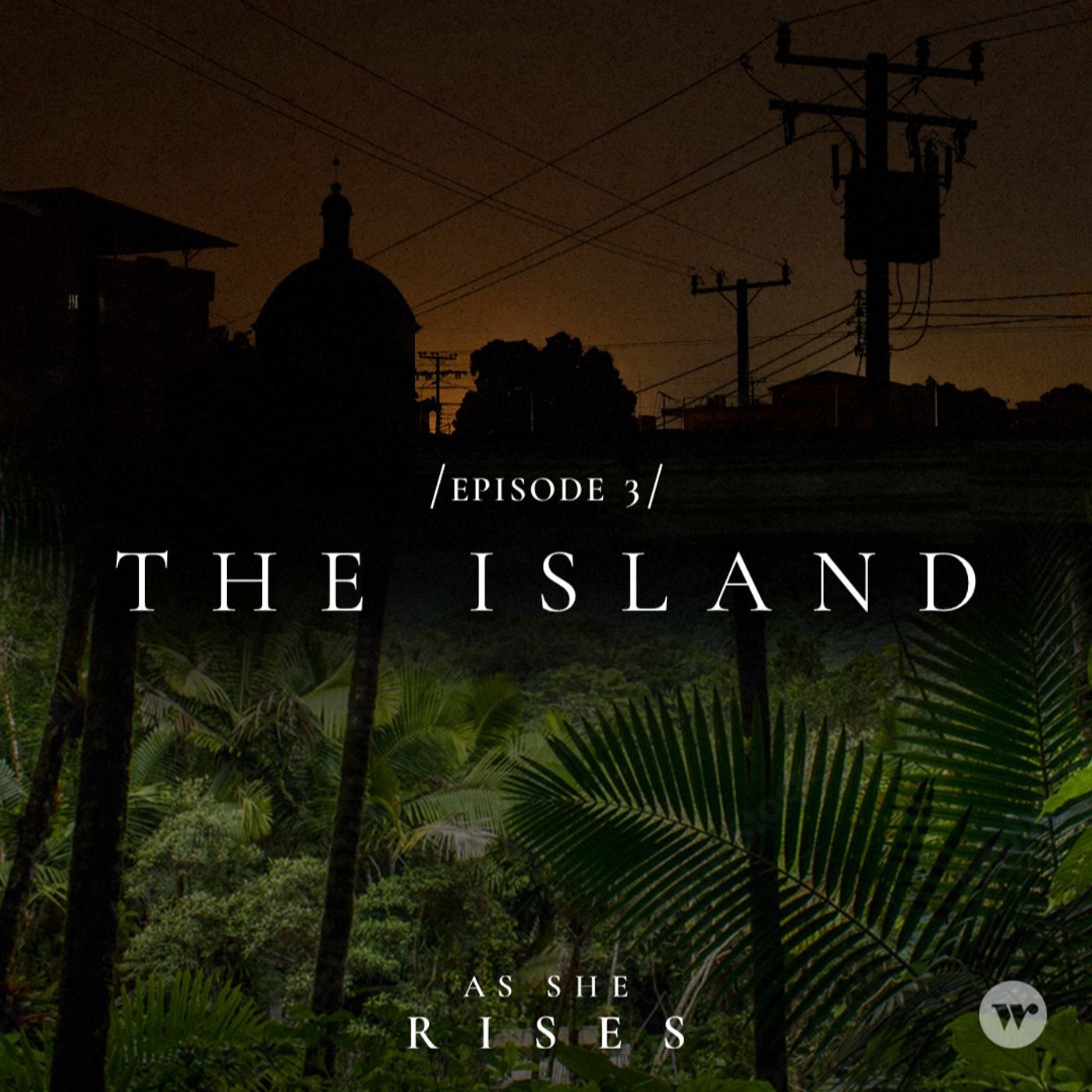
This transcript explores Puerto Rico's environmental and colonial challenges, focusing on the aftermath of Hurricane Maria in 2017. The storm left 3.4 million people without power—the largest blackout in U.S. history—and destroyed 80% of crops, causing long-term trauma. Poet Raquel Salas Rivera shares a poem addressing the suicide of friends after the hurricane, emphasizing the unquantifiable human cost and the collective realization of Puerto Rico's colonial status. Climate activist Amira Ode describes living through Maria, witnessing deforestation and the loss of coral reefs, and now leads reforestation projects with food trees to boost food security. The transcript highlights how U.S. colonialism results in slow, inadequate disaster relief—Puerto Rico received only 5,000 tents compared to Florida's 100,000—and perpetuates dependency. Climate change accelerates threats like rising sea levels, which may flood 140 cultural sites by century's end, and alters the coquí frog's calls due to deforestation. Despite these crises, community efforts persist, with activists pooling resources and dreaming of a sustainable future. The episode concludes with Rivera's poem, which balances despair with hope, rejecting capitalist sacrifice and affirming the value of collective care and resilience.
[Birds chirping] [Birds chirping] [Birds chirping] 1,000 miles off the southern tip of Florida in the northeast region of the Caribbean Sea sits the island of Puerto Rico. At just 100 miles long and 35 miles wide, it's one of the smallest islands in the Caribbean. Yet it's home to a vibrant array of plants and animals, partly thanks to dual environments, a tropical rainforest to the north, and a dry region to the south. If you're at all familiar with Puerto Rico, you know it's weathered one of the most severe hurricanes in recent history. A storm that brought America's history of colonization on the island to the forefront of many people's minds for the very first time. Climate change and the lingering traces of colonialism threaten almost every part of Puerto Rico, and along with it, the island's way of life. From Wonder Media Network, I'm Grace Lynch, and this is As She Rises. [Birds chirping] [Birds chirping] Today, we're in Puerto Rico. The poet you heard from at the top of the show is Raquel Salas Rivera. First of all, for those non-Spanish speakers, like myself, as I'm sure you can already tell, you'll hear the poem again in English at the end of the show. The poem is called "Notapara Una Amiga, que desse ya suirse darse, dispuiz, daruracán" or "Noteprofriend who wants to commit suicide after the hurricane." What struck me about Raquel's poem was how it touched on one of the aspects we hardly see covered in pamphlets about climate change. The human cost, the trauma that comes after the storm has passed. [Birds chirping] My name is Raquel Salas Rivera. I'm a poet, translator and editor, and I currently live in San Juan, Puerto Rico. I originally wrote this poem in response to various friends that had expressed, you know, the desire to end their lives after the hurricane. I began writing it as a way to cope, kind of with the trauma of what was occurring at the time. I was overwhelmed. I was doing a great deal of work. And of course, you know, the people who did end their lives and did kill themselves after the hurricane aren't counted as casualties of the hurricane or of the government, but I consider them casualties of Madia as well. [Music] There's a fissure, there's a fault line before and after Madia's sort of fault line. That's very real, it feels very real. Some of the things we lost right were things we had to lose. Like, I think there was a collectively a shift in which we knew we were a cause we knew we were a colony, but it became all the more accentuated and obvious that we were a colony. And I think that that was something that had to happen for us collectively in order for us to come together. But of course, there were other things that we lost, which are just unquantifiable in terms of what they meant, landmarks, you know. Historical landmarks, but also landmarks in our memory, in our affective collective memory. And, you know, I think it will be hard to describe to a new generation what life was like before the hurricane. And good morning everyone, 631 on the east coast. We're coming on the air right now because Hurricane Maria has made landfall on Puerto Rico. And this is the scene in. Maria was a catastrophic storm. So huge in fact, that it's one of the top 10 most intense Atlanta hurricanes on record. It was the first category 4 cyclone to hit the island in 85 years. Its total rainfall was higher than each of the 128 storms on record before it. And it was a lot of rain. For reference, in an average year, Puerto Rico's rainiest area gets more than 150 inches of rain, which is a lot. My notoriously rainy home in the Pacific Northwest sees about a third of that on average. Seattle sees even less. When Maria hit, that rainy area got more than a quarter of its annual rainfall in a single day. That's like a year's worth of Olympia rain in a single day. And we actually don't know how fast its wind gusts were since the storm damaged the island's main radar. And those are supposed to withstand up to 133 mile per hour gusts. When it made landfall, Maria left 3.4 million people without electricity. Some regions of Puerto Rico would remain in darkness for 11 months. It was the largest blackout in US history, and the second largest in the world on record. And Maria wasn't the beginning or the end of a devastating hurricane season for Puerto Rico. Maria hit just two weeks after Hurricane Irma left 1 million people on the island without power. Extreme storms are five times more likely to hit Puerto Rico today than in the 1950s. Raquel tells me disaster relief hasn't kept up. Puerto Ricans who are pooling their resources to help other Puerto Ricans, which is beautiful but also very sad and devastating because it means that the government isn't using the resources that are available to save people's lives. It just never really ends. So it's sort of like a hurricane followed by governmental inefficiency that had been there before but was accentuated and deepened, followed by earthquakes, followed by coronavirus. There's there's not a moment to breathe or recover. And so it's natural disaster after natural disaster, crisis after crisis and people have become sort of equipped to try and pool sources and find a way of surviving, which of course requires money and it requires resources that most Puerto Ricans don't have. So yes, unpredictable natural disasters are making it even harder to recover from the last storm. But the history of colonization underlies each recovery effort and each attempt at relief. Puerto Rico remains an unincorporated territory of the United States. People born on the island are U.S. citizens but there might no means treated equally to those born in California, Kansas or Connecticut. Puerto Rico doesn't have a vote in national elections. It doesn't have a voting member of Congress. It's in a sort of purgatory existence. That is an embarrassing vestige of colonialism. This second class status was felt in the feeble government led recovery. Following Maria, Puerto Ricans were largely left to defend and look after themselves. The help that was offered often missed the moment.
Mark. Part of me is very grateful that people wanted to help, but I think for me, the response is one that has to last beyond the gestural, right, and the momentaneous. What I mean by that is if you didn't know what the Riko existed before Maria, if you didn't understand anything about Puerto Rico before Maria, and you came into awareness about what Puerto Rico was and its colonial relation to the US as a result of what happened with Maria. That's, I think, not bad, but the problem is if you're only using it as an instant to make a quip about Trump, then you're re-centering the US rather than to displace your understanding on Puerto Rico and its particularity as a place with its own history. And so what often happened was that after the hurricane, it just became about Trump and the paper towels. And many of the same people who remember Maria have no idea that we went through an earthquake swarm in January that led to almost 3,000 people being homeless. So our lives continued beyond this event, right? We continue to deal with the after-effects of Maria and the after-effects of these earthquakes and the after-effects of all of these years of colonialism. Puerto Rico is changing. It doesn't look like it did before. For starters, from 2001 to 2020, Puerto Rico lost nearly 18.5,000 acres of trees that's nearly twice the size of Manhattan. Nearly three-quarters of that loss happened in 2017. Maria toppled maybe up to a third of all of the trees that were in Puerto Rico at the time. In the northeast region of the island, El Yunque Forest, home to hundreds of animals in plant species, was nearly defoliated. In 2021, parts of it are still closed off to visitors. Experts say the highest areas of the forest, which are the most difficult to regrow, might take up to a century to recover. And along the coastline, rising sea levels are the threat. Right now, more than half of Puerto Rico's population resides in coastal towns. Within the next 100 years, they're likely to be underwater entirely. At high tide, 27 cultural sites are flooded. By the end of the century, that number will be up to 140 sites. But despite this concerning progadosis, people haven't given up on their island. Raquel, for one, moved back. Part of the reason why I moved back is because I feel like I don't know how long of the world as we know it will continue to exist if we continue down this path. And I wanted to live and die on my island, so I came back. And of course, you know, what my island's going to look like, I don't know. The beaches are receding. The land is being sold off. The natural reserves are being sold off to investors that are planning on cutting down the forests and exploiting every piece of land they can get their hands on. So it's, you know, all of this is going to impact what Puerto Rico looks like. While I was learning about Puerto Rico, I got to know Amira Ode. She's a climate activist organizing community efforts to create sustainable practices for the future of Puerto Rico. She works with the CYEN, the Caribbean Youth Environment Network. She told me a little about the difficulty of balancing hope for the future with the facts of the present. I'm not sure when I first became an environmentalist because it's something that has always been around me. I've been noticing all my life how the same coral reefs that I used to snorkel as a child, I go there anymore and you can even see a trace of it. It's entirely gone. Amira also lived through Maria. She was in Puerto Rico with her family when the storm hit and she lived through the aftermath. It's not the same knowing the theory of the climate disaster than actually living through it. But you always think in some way, deep in your heart that it's something that's going to happen later and you can delay it somehow. But it wasn't later. It wasn't there. It was now. The storm was over. I just remember hearing silence. Outside, everything was just unrecognizable. If I hadn't lived there for more than 20 years, I wouldn't have known where I was because it's this strange feeling that I can't explain it well, but it's like feeling like you're in a sci-fi or a disaster movie and you're living it and looking to find where the camera is. This can be real because it just was too much to see all the destruction and all the places that you love. They just weren't there anymore. Everyone was just in the same state of tension and thinking, "Okay, what's going to happen now? How do we start over?" After the storm, Amira remembers waiting in line for five hours for supplies like food and water. Her family even had to travel to the US for a period of time to make sure her grandmother got the care she needed. Puerto Rico saw little government support in rebuilding. Compared to recovery efforts on the mainland, it took the US three times longer to deploy staff to Puerto Rico than to Texas after Hurricane Harvey and 30 times longer than to Florida after Hurricane Irma. Immediate aid was nearly nonexistent. Maria left almost half a million homes damaged or destroyed. And yet Puerto Rico received just 5,000 relief tents. By comparison, Florida received nearly 100,000. Nearly a year later, 80 percent of the islands residents rated the US government response to the disaster negatively. Over half said rebuilding Puerto Rico clearly wasn't a priority to the United States. Recovery efforts were sporadic to say the least. A majority of households still couldn't get enough water to drink. Three quarters continued to lose power for hours at a time. And more than 90 percent of those surveyed said their area didn't have the resources it needed to build back their infrastructure. Amira told me that even if and when Puerto Rico rebuilds, that won't solve its climate problem, nor will it solve the structural issues in danger the way residents live their lives. After the hurricane, a lot of people realized that Puerto Rico is a colony of the US. Not many people know about this. And the US didn't ever talk about Puerto Rico before. And if they did, it was just a complaint about how bad the current economy is, that same situation that the US government caused by making Puerto Rico so dependent on the US. And a lot of people feel like Puerto Rico needs urgent help and that we need to act on climate because they say the phrase that Puerto Ricans are American citizens too and we need to protect them. And even though that is technically correct, it doesn't matter if we're American citizens or not. We'll return to Amira and Raquel in just a second. As we've mentioned, we're counting down to the United Nations COP26 climate conference, which is now only four weeks away. In the lead up to the conference, I want to point you to another podcast and resource you might enjoy. The economist just launched to a lesser degree where over the course of eight episodes, they're asking tough questions about the climate crisis and getting the answers we need. Each week, the economist's global energy and climate innovation editor presses experts on everything from farming to finance about the high stakes questions we all have, like we will pay the price for a hotter planet. Can people adapt to climate change? Can we slow the pace of global warming? This series will reimagine industry, technology,
politics and show us what actually needs to change to slow the pace of warming. That's, to a lesser degree, a new weekly podcast on climate change from the economist. You can subscribe and listen for free wherever you're listening to this podcast. The trajectory of agriculture is another lasting change of Maria. Prior to 2017, the island was sustaining a growing farm to table movement, growing about 3-5% each year. This was a significant step for the island, for a lot of reasons. Puerto Rico imports about 80% of its consumed food, and thanks to an over 100-year-old law called the Jones Act, it costs far more to ship foreign products to Puerto Rico than to the mainland United States. Self-promoted farming cut down on that reliance and revitalized local agriculture and crops. And then Maria hit and wiped out 80% of that year's crops in a matter of hours. Today, that movement is picking up steam yet again. Puerto Ricans are fostering food security while also rebalancing an ecosystem still recovering from massive tree loss. Trees protect crops from strong winds, help maintain watersheds, and prevent droughts. Reforestation is exactly where Amira is focusing her efforts. We live in tropical island with wonderful soil and the perfect climate to grow food all year round. And it's sad that the economy that was created made us so dependent on imports when we could be feeding a lot of what we need for our own population. After the hurricane, I noticed how badly our lush green vegetation was hit from it looking green and tropical and beautiful to everything looking brown and gray the next day. So, reinforcing our watersheds is key to making sure that we're going to have enough water in the future and that we're going to be more prepared for one the next drought happens. And after noticing that, me and our couple of friends decided to start a project to reforest with food trees so that way we can help the watershed and also put in a little bit of our efforts towards food security so that people can start building a country that is food secure. If you want to help, you can support Amira's work with the Caribbean Youth Environment Network Puerto Rico chapter or C-Y-E-N-P-R. They organize events to create new green spaces on the island, fundraise for food security, and they equip young people with the skills to lead their own environmental campaigns. You can donate to these fundraisers or participate yourself in person or in online workshops. The rate of climate change in Puerto Rico means the loss of certain patterns, certain ways of life and health day-to-day has traditionally been, but it also means losing a sense of home. I'd now like to turn our attention to a sound we've heard throughout the episode. The cookie frog. Here's Rukhel. You know, I know I'm in the diaspora when I notice the cookies, which is the tiny frogs that sing at night. When I notice them in the background, I know I'm in the diaspora. When I don't notice them and people tell me, oh, what's that sound, right? That's when I notice them when I'm living in Puerto Rico because they're here, their background noise to me, right? They're, I mean, they're not background noise, but they're certainly like part of the sounds of Puerto Rico and the regular on the nightly. Every night in Puerto Rico, cookie frogs come out from dusk to dawn. Their chirps are the soundtrack to the island, a sound associated with night time. But this sound might soon change. Cookies call the El Junque Rainforest Home, the same national park that lost so much greenery in 2017, and since the environment influences a cookie's chirp, deforestation and rising temperatures are changing their signature sound. Scientists think their chirps might be getting shorter and higher pitched. In the next century, the island's symphony could sound very different. To close, let's revisit the poem you heard at the top of the show. You can find more of Raquel's poetry at RaquelSalasRevera.net. Now, despite its themes of suicide, Raquel is adamant that there is an optimistic message in their poem too. Obviously, the poem I read for you today just have hope in it. You know, writing specifically about the future was very hard for me, but I refuse to give up because I feel that on a level, I'm so angry that Capulists are asking us to sacrifice our lives to save the system that never cared about us. I'm so angry at that that I think out of spite. I just want to dream of a future because I think that we are more than our productivity and we are more than our ability to produce for capitalism and I refuse to let my life be summarized in that way. And so, yeah, I kind of feel like that gesture, even if it feels right now small or simple or maybe all I can give, is a good enough start for me and whatever future comes out of that. Note for a friend who wants to commit suicide after the hurricane. No one teaches us to accept death because death that can death stays empty inside. The great hole that wants to devour us, no one explains how we can be a part of the impossible new world that is tomorrow or how we are supposed to avoid falling into the perfect and permanent under eyes circle we call facing the day. Manna, how not to understand? That is the question I avoid with the organizational fervor of a rescue team that never arrives, but I'll tell you this, desire isn't always followed by death. Sometimes I run into you on the street and you shine like an orb or solar lamp, but you're still worth more than all the generators in case you haven't been told a thousand times. In other times without delay, other times your words reach me. Like a fundraiser that explodes and temporalizes truth like an epaturral squashed, flattened, spread, I walk out down the sidewalk, green ray from so much loving. We first have to find better answers in these automatic things. I don't say this to add responsibilities, but rather so that you know sister that the attempted murder comes from within. Like the last refuge of a cowardly colonialism. Come here and I'll give you food and shelter while I have it. Get da nyonya, will cuddle, spoil, hold and rock and sing you, and will duplicate the hugs. I can't heal the phantomless, but will kind of world with this be without you. What kind of world is this that harasses you? Without rescue, let's speak of the future. Not as realists, not as visionaries, let's speak of the future, because we will find it in a mothy and rug, in the tea of the drunken tree, in the Buenos diaspora's coffee of a confused and sincere embrace. We have a bed and we remember yours forever again. [Music] As she rises is a wonder media network production. It's created by myself Grace Lynch. Our executive producer is Jenny Kaplan. The show is produced by myself and Liz Smith. Emily Rudder is our Managing Producer. Editorial support from Alay Taheda and Carmen Boca-Carrillo. Until next time. Hello. From wonder media network, I'm Jenny Kaplan. Thinking back to our history classes growing up, we had one question. Where are the ladies at? Enter encyclopedia oamanica. In just five minutes a day, learn about the trauma.
trials, tragedies, and triumphs of groundbreaking women for antiquity to modernity. Every weekday, we're highlighting a different woman who you may or may not know about, but definitely should. Tune into Encyclopedia Womanica for a daily dose of stories, human moments, and historical breakthroughs. Subscribe wherever you listen to podcasts.
Podcast Summary
Key Points:
Hurricane Maria devastated Puerto Rico in 2017, causing massive destruction, a historic blackout, and long-term trauma that is often overlooked in climate discussions.
Puerto Rico's status as a U.S. colony exacerbates recovery challenges, with inadequate federal aid, slow relief efforts, and ongoing systemic neglect.
Climate change intensifies threats like deforestation, rising sea levels, and altered ecosystems, including changes to the iconic coquí frog's calls.
Local activists like poet Raquel Salas Rivera and climate organizer Amira Ode focus on community-led reforestation, food security, and sustainable practices to build resilience.
The poem "Note for a Friend Who Wants to Commit Suicide After the Hurricane" highlights the human cost of disaster and colonialism, while also expressing hope and defiance.
Summary:
This transcript explores Puerto Rico's environmental and colonial challenges, focusing on the aftermath of Hurricane Maria in 2017. S. history—and destroyed 80% of crops, causing long-term trauma.
Poet Raquel Salas Rivera shares a poem addressing the suicide of friends after the hurricane, emphasizing the unquantifiable human cost and the collective realization of Puerto Rico's colonial status. Climate activist Amira Ode describes living through Maria, witnessing deforestation and the loss of coral reefs, and now leads reforestation projects with food trees to boost food security. S.
colonialism results in slow, inadequate disaster relief—Puerto Rico received only 5,000 tents compared to Florida's 100,000—and perpetuates dependency. Climate change accelerates threats like rising sea levels, which may flood 140 cultural sites by century's end, and alters the coquí frog's calls due to deforestation. Despite these crises, community efforts persist, with activists pooling resources and dreaming of a sustainable future.
The episode concludes with Rivera's poem, which balances despair with hope, rejecting capitalist sacrifice and affirming the value of collective care and resilience.
FAQs
Puerto Rico is located 1,000 miles off the southern tip of Florida in the northeast Caribbean Sea. It is 100 miles long and 35 miles wide, making it one of the smallest Caribbean islands.
Hurricane Maria left 3.4 million people without electricity, causing the largest blackout in US history and the second largest globally. It destroyed up to a third of trees and wiped out 80% of that year's crops.
Puerto Rico is a US territory without voting representation, leading to slower and weaker government aid. For example, it took 30 times longer to deploy staff to Puerto Rico than to Florida after Hurricane Irma.
The coquí is a small frog native to Puerto Rico whose nightly chirps are iconic. Due to deforestation and climate change, its chirps may become shorter and higher pitched.
Puerto Rico faces rising sea levels threatening coastal towns, reforestation needs after tree loss, and earthquakes that have left thousands homeless.
Efforts include reforesting with food trees and promoting local agriculture to reduce reliance on imports, which account for 80% of consumed food.
Chat with AI
Loading...
Pro features
Go deeper with this episode
Unlock creator-grade tools that turn any transcript into show notes and subtitle files.
 PodcastTranscript AI