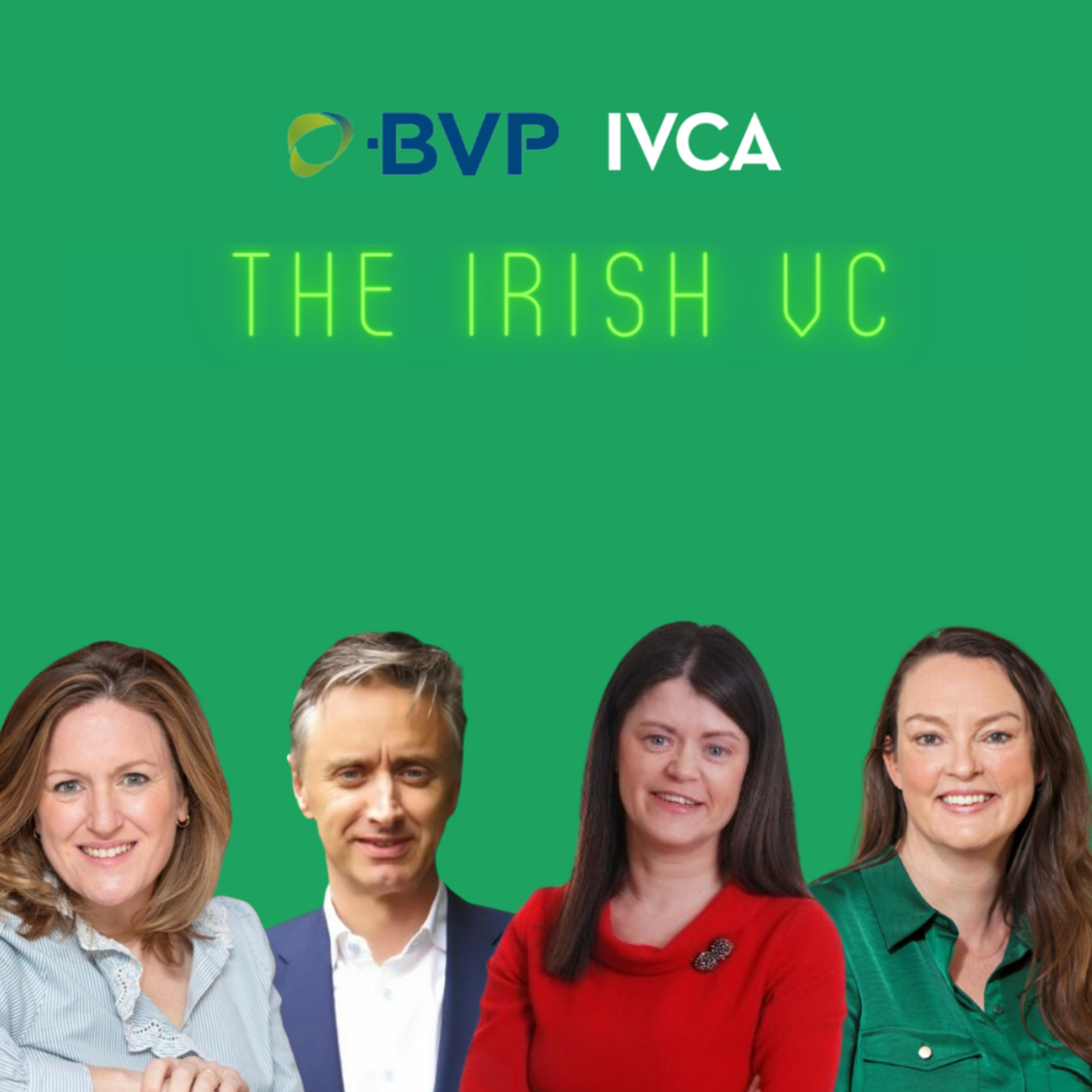
The Irish VC ep34: State of Venture Capital in 2026
from The Irish VC
42m 47s
In this podcast episode, Irish VC leaders discuss the state of venture capital in early 2026. Globally, the market is navigating ongoing economic turbulence and a shift towards investing in company fundamentals rather than hype. The panel notes a sense of being "battle-hardened" from successive crises. In Ireland, the ecosystem has matured over the past five years with more experienced fund managers and strong government support via Enterprise Ireland. However, a critical, unresolved challenge is the lack of deep domestic capital pools, particularly from institutional investors like pension funds, to sustain indigenous high-growth companies. The conversation highlights AI as the dominant theme, creating excitement and new opportunities in enterprise adoption tools and vertical solutions. Ireland is seen as well-positioned to foster entrepreneurs leveraging AI, especially those with deep industry expertise, though it must compete with global tech giants. The discussion concludes by emphasizing the need for continued policy work to attract private investment and the importance of publicizing startup successes to build broader investor appetite.
[Music] Hello and you are very welcome to this episode of the Irish VC podcast. This is our first episode of 2026 and my name is Sarah Jane Larkin and I'm the director general of the Irish Venture Capital Association. And as we are recording this at the start of 2026 in what is a pretty turbulent time globally and in the macro economic environment, we thought that it would be a really good opportunity to take stock and have a little bit of a discussion around the state of the nation in Venture Capital globally and here in Ireland. So I'm delighted to be joined today by Elias Griffin who is the managing director of BVP by Jillian Buckley who is the head of investment at the Western Investment Fund and Amy Neal, the general partner at Delta Partners. So you're all very welcome here today. So I think we've had a chat beforehand about what we wanted to talk about. So I think what we really want to do is zoom out and take stock of where VC really stands both in Ireland and internationally and what we think where it might be heading in the next 12 months or so. So I might start with you, Elias, because as I see you, you're first on the screen. If you were to zoom out and look globally at the big picture for venture capital in 2026, so the view from the US from Europe and Ireland, how would you describe the state of the market right now? Hi, sorry, Jane, thanks. Thanks for that. I suppose I feel that there's a state of nervousness about the state of the global economy. I suppose, but what I would have to say is that like what we're quite accustomed to crises at this stage in all the lack of almost permacrisis. Yeah, for the last five to six years, I think we've, you know, anyone who's been around the block in this industry for quite a while, we've been coping with crises and, you know, going back just five to six years, obviously it was covert. And it's been, you know, different, although, you know, wars and dramas that have been out there as well. And they all have an influence on the flow of capital on people's attitudes and, and it's both in terms of the exit horizon as well for companies where maybe they can't or investors can't exit is quickly as they would like in the usual kind of time frame. I guess that's all made us somewhat a little bit more, deraise battle hardened on what's going on for so many years. And I suppose like I'm in the industry, you know, nearly 20 years. I mean, I suppose I can think back to to other crises as well, you know, in the dot com era and the telecoms crash and so forth as well. I think what you're saying is, you know, don't join venture capital or private equity if you, if you, you know, don't want to fix the kind of roller coaster cycles. And Amy, you know, would you have any similar views or do you have a different take? Yeah, I know, I mean, I think I completely concur with Elliot there and maybe just to build on that a little bit, you know, the last couple of years have been fairly wild, I would say, you know, 2022 was a stark turn around from the previous couple of years in terms of the tide going out somewhat from a, from a, from a readiness of capital availability of capital point of view. And people may be rethinking how to deploy venture capital and we've seen that over the past couple of years, you know, that there was a very stark fork in the road and the last couple of years have been, there's been a lot of hibernation, it's been harder to raise capital for companies and for funds. I suppose if we think about being at the beginning of 2026 in that regard, you know, I had somebody say what a year last week was, but, but, but, but, but, like, I think there's some hope that what we're seeing is a slight normalization of looking for fundamentals in companies as opposed to investing in hype. And if that normalization continues, I think that we, you know, our early stage companies in particular are trying to build with solid foundations because they know that that's what investors through the stack of capital that they're likely to be chasing will be, will be looking for. So I think that that's one thing. You know, the other thing is that clearly at the global level, there's this bifurcation between AI and everything else and I'm sure that we'll probably get into that as we chat a little bit further through the conversation. I don't think we could have a conversation and a podcast about venture capital in 2026 without mentioning it. And Julian, you know, for those who don't know you obviously occupy a fairly unique space in that all of your investments are in what is considered maybe slightly economically deprived region all across the western seaboard. So do you see something different given that lens or your views pretty consistent with with Amy and Elliott. Well, the global macro environments is extraordinarily challenging and the turbulence is the new norm and I don't think 2026 is going to see it any easier. Just seen that the dollar is gone to nearly on 20, which is almost a five year high, which has huge ramifications is so much noise and they have been marketplace about the tariffs, but the currency exchange rate has really, really hit companies very, very hard. And the flight to gold, so there is flight to safe havens. For capital, which means as best for the climate into productive investment, which is a challenge. So our region, as you said, is is somewhat. It's a small region, very small urban centers and we would feel the effects as they say, you know, everybody else get the coal and we get the flu. So we feel the faster and we recover slower. That is a challenge and the challenge that the capsule out there is so hard to get the companies are struggling at this stage to keep going. And I think to Amy's point, we as venture capitalists need to be looking at a very long term lens of any investment opportunities that we're going in because our experiences that we're having to stay at multiple rounds at the very, very early stage because there's been such a challenge in the next stage of capital. Everybody's mining their existing portfolio, but that happening on multiple occasions over the last few years. So it's very challenging, especially for new companies coming to the market. Yeah, and you know, I think you were talking about the big picture, you know, I think it'd be useful for for people who are listening. If we kind of cast our lens on the state of venture capital in Ireland today, because you know, you guys are really at the call face in both in terms of raising funds and then deploying that capital. And if you were to think about Ireland today, you know, maybe with a five year time horizon and to look back to five years ago, what do you think? And I might start with you, Amy, what really hasn't proved and then what problems really still haven't been being solved. Yeah, so it's a, it is a different market to five years ago on a number of fronts. You know, there was much more free flowing capital. It five, five years ago than there is today, but I think that over that period, the market here has matured somewhat. So, you know, the investors that are here in deploying in the market today are often investors that have had, you know, multiple funds under management, have that maturity in the practices that they're deploying. We have seen new entrance as well, which is good for the market. And of course, we have fantastic work going on in enterprise Ireland and I said, and so on and so forth to support the market here. I think the international funds focus on Ireland has sort of shifted over the last five years. So, there's a lot of interest and excitement. There may be a little less of that right now. So, you know, sourcing funds for a company is tough. And then in terms of the challenges that remain, you know, speaking from a VC fund point of view, the challenges that remain for us are access to the capital to fuel indigenous companies. So, we haven't moved forward as much as we would like to have done on that front over the last five years in terms of diversifying sources of capital. We don't have that kind of bedrock of institutional capital available. Obviously, Sarah Jane, the work that you've been doing around pension funds. But also we don't have that kind of mature lens of private capital. It's a constant concern for local indigenous venture capital. Yeah, absolutely. And I don't know that we'll find anybody here in this group.
who will disagree with that piece around access to capital and it has been a longstanding issue. I mean, I am pleased to say there are some movements, but it will still take time and, you know, it's not going to be a magic wand where the attack gets turned on, you know, as soon as a policy decision is made, but it is certainly there's a train on the tracks and it is moving in the right direction and once it is solved, hopefully it will solve it for the long term. And Julian, maybe I'll take that question to you. I mean, I'm sure you would agree with everything that Amy said there. And it's five years is almost too short to lens to be looking back on to see where we've come as a country and as an industry is quite phenomenal. I mean, we're only a population of five, just over five million people, not even a large city in the UK or the US. So Ireland really does punch us above its weight, but more absolutely can be done and again to Amy's point. The sports, the government has given the industry through Enterprise Ireland a nice, to be very, very welcome and hugely supportive, but more can be done and we've discussed this, I'm sure you're going to have many podcasts to revert out the private investment. I mean, the VC industry needs generally limited partners to fuel them in order for them to onward invest into the startups and the scale of so whatever we can do at a policy level to encourage more private capital to go in to the funds that has to be kind of a policy direction. I think the government that we can't be reliant just on Enterprise Ireland and I said going forward, we need to really drive out that private money. Absolutely. And Elliot, obviously you occupy a slightly different position because some of your funds are EIS, funds and back companies that have that have achieved EIS status and do you have a similar view or you know, particularly when that private capital because you're sourcing it's slightly different. Yeah, absolutely. Yeah, what we kind of sit in between, what's my call, private capital and adventure capital in terms of our fund and what we invest, what capital we have to invest. So yeah, like in the last five years, I suppose we've seen, certainly we believe we've seen a shift towards more fund, from an EIS point of view, more fund based investments rather than direct investments where companies would raise money directly. And we think that's a good move. I suppose we'd have a certain view on private investor investing in a kind of a largely unstructured way, it doesn't help companies, it tends to distort the cap table and for future raises as well, it can sometimes require some tidy ups as well. So like we would certainly, but in terms of the actual flow of capital from private investors, we say it's, we saw a great spike there post-COVID, a lot of interest from private investors investing and we've seen, you know, that probably came down from that high, but we've seen a tickle in the last, we just closed the phone in December and we definitely saw a very sizable uptick, about 25% uptick from the previous year in terms of our investor interest as well. And interestingly actually as well, that was direct in investors coming directly to us rather than coming through other channels or brokers as well. So that was big. And I think, you know, just to explore that point because, you know, we always talk about, you know, institutional money and a lot of cases that's pension money, but if you break that down, that is pension savings of individuals in the state. And I certainly think, you know, to your point there about an increase in interest, we see a little bit with crowdfunding, the appetite of citizens in the state to, you know, to invest in these companies is actually, you know, quite strong and getting stronger. And, you know, demographically, I think, you know, just the age for a population and thankfully the wealth and growth that the economy has had means that more people are in a position to do that. So there's maybe, it's like disconnect between some of the institutional mindset around investing in these companies and the individual mindset. Yeah. I think, I think, and we all have a kind of a duty on that to to publicize the successes. I mean, for, you know, and I think that's probably that that profile has raised in recent years as to companies that are actually, you know, funded by venture capital funded by private investors and getting that out there. Certainly we've seen it actually, Jiren and I were just just before we jumped on here, we were just saying that we have a one company in common. So it's no harm to mention the name of the company. It's a called N Pro, but like they they it helps that they have a product that consumers buy for its protection gear for for for rugby players and other players as well and any kind of context work. But we can see a huge uptake of our interest from individuals as to oh yeah, so that's a product we can understand. We can see the global market and they can see the value of investing in a sick holiday based company that you know has has got a really strong team and so forth. I mean, but it just that sort of profile is that that's my point really is is that we it's our duty to try and increase that profile. Yeah, and I think, you know, as the the association, it's certainly our duty to you know, to to ensure the policymakers understand that you know, there is a risk appetite amongst the the population and a desire to you know, to invest in these companies. That could be the you know, the the the superstars of the future and you know, touching on Amy, you brought up AI earlier and as I said, we probably can't have this podcast or those without mentioning it, you know, it has dominated it has dominated venture capital conversations, but really it's dominated a lot of conversations even outside of of our sector for the last number of years and and particularly I think in the last two, you know, sitting here in 2026, what's your view on AI and I might start with you on this one, Jillian, you know, what has proven real value and you know, what has turned out to be hype and where do you do you kind of see maybe the the future of AI in in 2026 and in an Irish context and are we well positioned are we playing catch up? I suppose I just want to have a bit of a conversation about all things AI so over to you Jillian. I'm probably the worst person to talk about this because some of it goes into the whole science fiction star track mode and I think this pace of what's happening and even having chats with friends, the pace of what's happening is quite extraordinary and have we taught long term the implications. I don't think we have where we're going with the seat for a pance. Going back to the regional perspective, we wouldn't have a lot of AI native companies that they're called. Our tech sector is a bit more undercooked and therefore the next generation is going to be even more undercooked so I do see is a gap for us. Application of AI, absolutely I think that's a huge opportunity across all our portfolios. The my tech and been particular. It can unlock efficiencies but be a pure AI play. AI play I should say we haven't seen a lot but we had a huge milestone during the week and I think I should flag this because of the co-investment with ourselves and Delta into a small company. In 2015 I think it was called Outta Cloud. Barrier Sullivan and Joe Smith would have founded it and they were acquired by Genesis and Genesis now have their global agentic AI headquarters in Galway in the west of Ireland as a result and they've just hit 500 or 500 employees. So to have both global headquarters in a very small west of Ireland city and then to have hit 500 seconds that happened because of venture capital investment by the Irish and the Irish we see so that's a huge success story from us and that will grow and we saw that with our Metek sector. Thoughts, guys who come in get that experience they'll hopefully spin out and they'll set up the next generation but in the regions I think we need to encourage that a little bit more but don't really really well in Metek we need to do as an AI on it as well. And Amy and that leads me nicely to you to maybe give us your perspective on AI. Yeah look it's to echo Gillian's point like it is unbelievable the speed of change even all of us know in our own lives right our habits have shifted almost over the night. Sometimes we call AI our third employee in the OPCA because we're literally we're adopting it at the speed of light which is incredible and as a venture capital investor that's extremely exciting right because our job is to take risk on technology and to provide the necessary you know one of the necessary legs of the stool to enable new technologies to get into people's hands that's the whole purpose of why we do the job that we do so it's extremely exciting but it's also really challenging to kind of chart the path through everything and to pattern match back to other platform shifts and try to anticipate where the opportunity might be for young Irish indigenous community.
companies in this new world versus the emerging new incumbents who are definitely not located here, right? So, you know, when we look at companies that are coming through our door right now, there are a few things that are exciting for us that sort of raise our attention and where we think that Ireland has the opportunity to make a play. The first of those is, you know, enterprises are adopting AI, they will be adopting AI, maybe they haven't jumped fully in, yet they've been testing and playing and maybe not going to full deployments, but that will shift and change. And I think that that does create a new kind of ecosystem of opportunity around the tooling for some of that. We've a great company called Disect that we've invested in that supporting enterprises with the responsible use of AI. So that whole kind of tooling and orchestration of AI, I think creates opportunities alongside the kind of the foundational models. And then, you know, the other area is definitely for Ireland in particular when I think about what could we expect? I think that we can expect that there are fantastic opportunities for the vertical AI solutions where we have folks that are maybe jumping out of an industry that they've got deep expertise and they have proprietary access to data sets and so on and so forth and can take advantage of all of those efficiencies in AI that Julian spoke to for companies. Like, I think that that genuinely is really exciting for us. And I also think that that is going to spawn a new type of entrepreneur in Ireland. I think that definitely, last year was a really funny year. The first year was very, very quiet from a deal for a point of view. And then the second half of the year was crazy. And I think that we are sort of seeing this new and bold and entrepreneur who's maybe been kind of sitting back and wanting to do something for years who now, because they've got tools that fingertips feels like the time is now. I kind of liken it to when we were first looking at smart phones reaching the market and the app economy and so on. Anyway, so that's interesting because it is, you know, it's like the barriers to entry to some types of entrepreneurship have been lowered by the capability of AI. Yeah. And also, if you're sitting inside a very large company and feeling frustrated that that company is not moving as fast as you would like it to to capture this opportunity, like the time is now. So that in itself is really, really exciting. I think that the challenge is knowing what the long term looks like and being able to predict who the buyers for our companies are going to be, you know, that piece of art utilitions is extraordinarily hard. And so, you know, I think we have to lean on our job is to take those risks and not try to kind of crystal ball gaze, but rather back credible strong teams who really know how to access markets in this environment as we would for any company, AI or otherwise. Yeah. And I think we might come back to that point actually a little bit later. So I'll kind of flag it and you can you can be kind of considering it. But, you know, I think when we want to we want to talk a little bit about advice to to founders in 2026. And I think, you know, that that point is, you know, is the capability of the team slightly upweat it in that kind of uncertain environment over technology. And we might we might pick that up in a moment. But Elliot, I'd love to get your views on AI and, you know, how that's shaping, you know, yeah, the decisions that you guys are making in terms of investment. Yeah, thanks. Yeah, I mean, it's it's I was just thinking about it. And for some very ancient comments there from Amy and Jillian, but just just I mean, on, on, you know, even trying to be to have an original original thought around AI because so much has been said about us already. But I mean, one of the great things, I mean, we're here, you know, we're running as a venture capital firm. I mean, we're running a business. I mean, and we have to make decisions every day. So AI is a great tool for that. I mean, and it's not something that we're going to base our decisions on, but it's certainly an amazing place. There's nowhere to hide. I mean, like, it really does help, help our research. And we're even seeing dropping some databases that we we use to in, you know, because of the of the what we think is the value of of the research. And just in relation to obviously software software, I mean, probably the big one of the big questions really is, is how much is software under threat from AI? And, and again, it's about a lot of commentary about, you know, large companies, are they going to continue buying software from specialists when they can replicate that, you know, their internal teams can really code code up stuff very, very quickly. So there's plenty of that to be considered, I suppose. But maybe just the kind of the two points I'd probably make in terms of our only interest level. And firstly, we see that there's, we would invest a reasonable amount in the energy sector. And we're definitely seeing some some value there in terms of both from an infrastructure point of view. Obviously, some very large projects, even kicking off in Ireland in relation to data centers or the equipment for data centers. So even debt fund, which is involved in that in that area. And then maybe and just on the only on companies that come to us, clearly for us, the priority is how they've gone and monetize AI. That's really the priority. It's not what we're not seeing as a deep tech from a point of view of taking a risk on like a pre-revenue company that just claims that they have something great on that front. Really, we need to see what is the benefit of AI to to to, you know, reducing costs, making more money or making money quicker, you know, because of because of being able to get to market quicker. So that's really the priority for us. Yeah, brilliant. And I think that that there are two other topics that I want to cover in our time today. And one, I think that that kind of leads us nicely into it, which is advice to founders. You know, I don't think we can have three very active investors in the Irish ecosystem here today without maybe, you know, giving some advice to anybody who's thinking of fundraising in 2026. And, you know, I might start back with you, Elliott, you know, what would you tell founders to focus on? And, you know, I think you've touched on some of it there in the conversation about AI and what should they maybe, you know, downwish and worry, worry less about it. And, you know, are the things they still misunderstand about venture capital in our industry. So, thinking of that piece of advice to founders, you know, what are your top tips for for 2026? Yeah. And look, I suppose it always, it has to always start with the team, doesn't it? I mean, like, like the quality of the team and the founders and, obviously, like my advice, I suppose, on that front, like it's important to me nimble at the start, but as you develop your business and when we see businesses coming to us that are looking to raise our next, for a second round of funneling maybe, you know, they really need to start prioritising how to build their team and bringing in, you know, actually having, you know, people in us as opposed to, I would tell you, so that would be a very, we think a very long, you're visiting for the long term by doing that. And I have to say, you know, I really just a challenging place in many respects because as some of the other speakers have said is that there's not a huge number of venture funds out there. So, really, it's important to have abroad shoulders. So, having maybe more than one investor on your, within a round, is a benefit for the next to follow on round as well. So, you really need to consider that this is a funding journey. It's not a one-solve event. So then, when you think about that that way then, I suppose I might have heard point would be, is to be realistic about your value. You know, I'm sure that other speakers will have plenty to say about that as well, but really, I mean, the point to really is that if there's a sure of the Gels funders, and then sometimes the funders will be, they'll obviously be fighting over the, over the, and through that, the devaluation can can slip up and arise, what I mean. And that can cause damage down the road then for follow on funding as well. So, really being practical and realistic, you know, experience is all about when to stop negotiating. I went to get the price that actually will help you in the future rather than the adherence in the future. So, probably brilliant advice. And Amy, anything to add to that or to pick up on that point about the importance of team versus product in a time of uncertainty? Well, I guess the bit that I'd like to build on at your point about this being a funding journey, I think is so important for founders to be thinking about right now. And the key point in that is discipline for me. It's a really, really hard environment to raise first capital and then to raise your next rounds of capital, discipline about the metrics that you're chasing, discipline around cash preservation, discipline about understanding, you know, understanding when it might be the time to actually put the brakes on rather than
than to aggressively increase the birth. Like that is absolutely paramount right now. And I think also having an awareness that even if you're raising early capital seed funds, you do need to be thinking about when revenues are going to start flowing. This shift from what investors are looking for as you go up the stack, it's changed dramatically in terms of where not what you're raising for today, but what you will be raising for, what you need to be able to prove has changed dramatically. And so therefore, yeah, Elliot, your points are really well made around choosing well in terms of who your first investors are and maybe diversifying there as well. So you know, you've got good partners for the journey forward because you just don't know what that's going to look like. But also, I think it is that it's still very much an environment of cash discipline, focus on revenue and a path to profitability, unfortunately, because I don't actually think that's what seed funding should be for. But I think that's the environment that we're in today. Yeah, and Jillian, I know you have certainly some experience of having to make those seed funding runs go go further. So you might talk about that and give your best advice to founders in 2026. Sure. So my first advice is absolutely do it. Go with your goals and be very focused and resilient, but willing to listen to advice. People have experience and take that onboard, but you have to be yourself as the entrepreneur, very focused and confident in yourself, take on that advice. The other thing I would say to people is if you can find a champion who will lend you their credibility, somebody who has been there, you know, bought the t-shirt and will do those warm introductions, that has been hugely successful for our portfolio companies. They open it or dorset you to the other investors and funders and then build that network and use their network. And I think Irish people are extraordinarily good at that. And that's not just locally, that's internationally because we amazing thing about Ireland is that we do operate in an aglow environment very very early on. For the founders themselves, it is challenging. They have to have so many skillsets. We demand so much of them, which is like correct because we're giving them millions, it's not 10s of millions of money. So they have to perform at a very high level, but it is tough and can be a very lonely space to use their own peer network. And that unlocks other insights and experiences. And again, people will have heard about maybe there's the how do you get to the exe grant accelerator. They'll share that experience with each other. So and there is some great networks to use those. Use your networks, both if they can get that early champion onboard and buy into their vision, that I think unlocks a huge amount of funding from the likes of ourselves and the PCs and the syndicates and the likes of the I.S. phones that BDP do. What else? Again, understand that you know, don't get too focused on the R&D side. And this is one of my book bears. The commercialisation is more important with something again. And this is not nearly for the founders. This is more again a policy thing. We've become and you've heard me say this before, Sergei, and we've become extraordinarily strong. I think we're probably maybe I'm overselling it, but I think R&D capability of this country has in the in a very short spiss time, just been most enormously. We need to do the same with commercialisation skills. A lot of our teams, I kind of joke, the only thing they'll ever sell is themselves. That is no longer the reality. That has changed. That's the biggest change we've seen in the last three to four years. The companies are actually having to go into that commercialisation route. And that requires different skill sets. The founders need to know that. They need to be seen identifying that early and bringing that onboard with them. And they're very expensive. So if we as a country can start focusing on that, I think that will unlock huge opportunities. And we will really, really then scale indigenous Irish companies. And they won't be sold to the multinationalists to go into the selling and the commercialisation. Brilliant. Thanks for that, Julian. And I think it probably we can't, you know, as a group of venture capitalists talk about the state of the nation without talking about one of the things that's very close to our heart, which is the exit environment. Because as we all know, an investment in a company is a kind of a marriage with a planned divorce and that divorce is ideally everybody making back some money. And you know, parting ways in a very positive way. And that exit environment has been has been challenging in the last while, you know, in terms of, and we have very strange things going on, you know, you referenced the dollar earlier, the S&P, the stock market is really high, but there haven't been that many IPOs. There's certainly a dirt. You know, there's some fears, I think, around about a correction in all of that. And meanwhile, you know, we have companies that, you know, need to achieve value through an exit. So, you know, what do you think the exit environment looks like right now for your portfolio companies? And, you know, will IPOs be realistic again in 2026? Should founders be planning for them? Or is that M&A activity, which we see a lot of now, the new default path? And I might, I might come back to you, Elliot, first on this one. I mean, I think you're, you know, said about our own portfolio. So yeah, I mean, it's, there's probably a general comment on that is probably a specific tutorial. And I mean, I, was we, we, for us actually, we, we found 2024 was a drier year for, for much drier year for exit. That just was our situation with, with timing of some of our companies. 2025 was much better in the second half. Thankfully, we had three, three exits happened. Well, two and one is closing up a moment. So, so yeah, like we're, so it's active, just a little bit of a bounce, a bit of optimism that there is. But at the same time, there has to be a realism as well as to when's the right time to jump off as well. And that's, that's supposed to be, maybe to a fault. You know, we, we, we have, you know, we, we, as well as our mandate for our investors is, you know, to get in and to get out, to get out into a reasonable period of time. So if there's enough opportunity to come along, that would take it. So that's probably our attitude to, to, to, to, to exiting. But I think there's definitely, as Julian mentioned earlier, we need to be aware of the need to stay in and to, to see value coming back into companies, if they've had a difficult year or two or whatever. So that sense of pragmatism is, is, is very important in trying to manage. But you have to work with the companies as well. And that we, we try to do that. And, and it's was get the, get the item on the agenda. And, and then, you know, see that maybe it could be a year away for an exit. So it's planning ahead and planning what maybe will, will attract a potential that choir or an, and as we all know, it could be somebody from internal interns of a partner or a, a, a, such, a state, some stakeholder that already is familiar with the, with the company, which will make the, the actual conversation easier to, to, to, to, roach. So, but, but things like just a, what, when I asked point, I mean, really is, is, you know, focusing as, as, as someone else said as well, is, you know, the, the selling, the commercialization of the business is so fundamental and really not just about winning your first one or two sales, but actually building your sales organization as well. And that's where we've seen some, some pretty quick impact, even maybe conscious what I said earlier, bringing somebody and even a senior person part time to help build that sales organization challenge what we're actually doing, because typically founders aren't the people that will understand building that sales organization internally. So bring in some outside expertise. We found recently, um, we'll, we'll, uh, improve the chances that this would be more of an attractive proposition for, for the choirs. Bring it. And Jillian, how about you? The, what is your talking there? I was thinking it's a bit like bosses, you know, we wait and brages and the few coming up together. Exits have always been lumpy. Um, I think at the last few years, there was quite an overwhelming, we would have expected to have got away at a certain infection point, um, because the market changed around them that moved. And we had to adjust all our strategies around that. There will be exit opportunities, but sometimes, um, one of the other panelists have had this experience. We've had a few instances in the recent times where a bit of tire kicking going on, which can be a huge distraction for founders. Yeah. Takes an awful lot of time. And so you need to be sure, no more than when you're checking on board new investors, you need to be sure that the potential acquires are serious. That before you dedicate a lot of time and effort into that process as well. It, for us, M&A was the only exit opportunity. So that's already for, I'll tell you always, I would love to see other opportunities.
And when I retire, I'm going to do something. - I'm so sorry to study paper. Go be with the days when you invested in order to get dividend. There has to be other ways than just an early exit, which is why we're, but I think that's the phase we're at as an island ink at this stage. And we're already seeing the fruits of those early exits. There's the next generation of non-executurements and angels and investors and venture capitalists themselves because venture capital markets would often get those very experienced and successful entrepreneurs to become the partners as well. So that those all see the industry. I just think we could have more options for exit opportunities. - Absolutely. And Amy, what about you? - Yeah, I mean, I couldn't agree more. Obviously M&A is overwhelmingly the default for Irish companies and perhaps more over, whereas as much an export economy for exits as we are for FDI. So it's overseas acquisitions as well, right? And I wish it was otherwise. But that's the way it is and that's the reality. I suppose the only other kind of angle that I would bring to this conversation is, you know, trying to encourage our, the founders of our companies to stay the course and build the biggest companies that they possibly can and not actually be tempted to sell a little early. I guess that's something I'm mindful of in the current environment that there may be sort of like, there's a, there's a, there's a dearth of talent for this new technology environment that we're moving into. And I would love to ensure that we build robust entrepreneurs who can grow into the individuals that lead very large companies into very large exit scenarios, I guess. That would be my only other kind of angle to put onto that point. - Brilliant. Thank you. Well, listen guys, I actually think we could talk on, but I am conscious that for anybody listening to the podcast where we're, we're, we've probably maxed out the time that most people have available, but I just really want to thank you all for your amazing insights. I think it's, it's been a great kick off to the 2026 season of the Irish VC podcast. So thank you to my participants today, Elliot Griffin, Gillian Buckley and Amy Neill. Thank you all very much. Thanks, Eridane. - Thank you. (upbeat music)
Podcast Summary
Key Points:
The global venture capital (VC) market in early 2026 is characterized by economic turbulence, a "permacrisis" mindset, and a cautious, fundamentals-driven investment approach, moving away from hype.
In Ireland, the VC ecosystem has matured with more experienced investors, but faces a persistent challenge in accessing sufficient domestic institutional and private capital to fuel indigenous startups.
AI dominates the investment landscape, creating opportunities in enterprise tooling, vertical applications, and lowering barriers for new entrepreneurs, though Ireland must strategically position itself against global incumbents.
Summary:
In this podcast episode, Irish VC leaders discuss the state of venture capital in early 2026. Globally, the market is navigating ongoing economic turbulence and a shift towards investing in company fundamentals rather than hype. The panel notes a sense of being "battle-hardened" from successive crises.
In Ireland, the ecosystem has matured over the past five years with more experienced fund managers and strong government support via Enterprise Ireland. However, a critical, unresolved challenge is the lack of deep domestic capital pools, particularly from institutional investors like pension funds, to sustain indigenous high-growth companies. The conversation highlights AI as the dominant theme, creating excitement and new opportunities in enterprise adoption tools and vertical solutions.
Ireland is seen as well-positioned to foster entrepreneurs leveraging AI, especially those with deep industry expertise, though it must compete with global tech giants. The discussion concludes by emphasizing the need for continued policy work to attract private investment and the importance of publicizing startup successes to build broader investor appetite.
FAQs
The market is characterized by nervousness and turbulence, with ongoing global crises affecting capital flow and exit horizons. However, the industry has become more resilient and accustomed to such cyclical challenges.
The market has matured with more experienced investors and new entrants, but access to capital remains a challenge. There is a need for greater diversification of funding sources, including more institutional and private capital.
Private investment is crucial for fueling venture capital funds and startups. While there has been increased interest from individual investors, more policy support is needed to encourage greater private capital flow into the sector.
AI is driving rapid change and creating opportunities, especially in enterprise adoption, tooling, and vertical AI solutions. It is lowering barriers to entrepreneurship and attracting new, bold founders to the market.
Key challenges include limited access to diverse capital sources, reliance on government support like Enterprise Ireland, and the need for more private and institutional investment to sustain growth.
Regions, especially outside major urban centers, feel economic impacts faster and recover slower. They face challenges in attracting capital and developing tech sectors, including AI-native companies.
Chat with AI
Loading...
Pro features
Go deeper with this episode
Unlock creator-grade tools that turn any transcript into show notes and subtitle files.
 PodcastTranscript AI