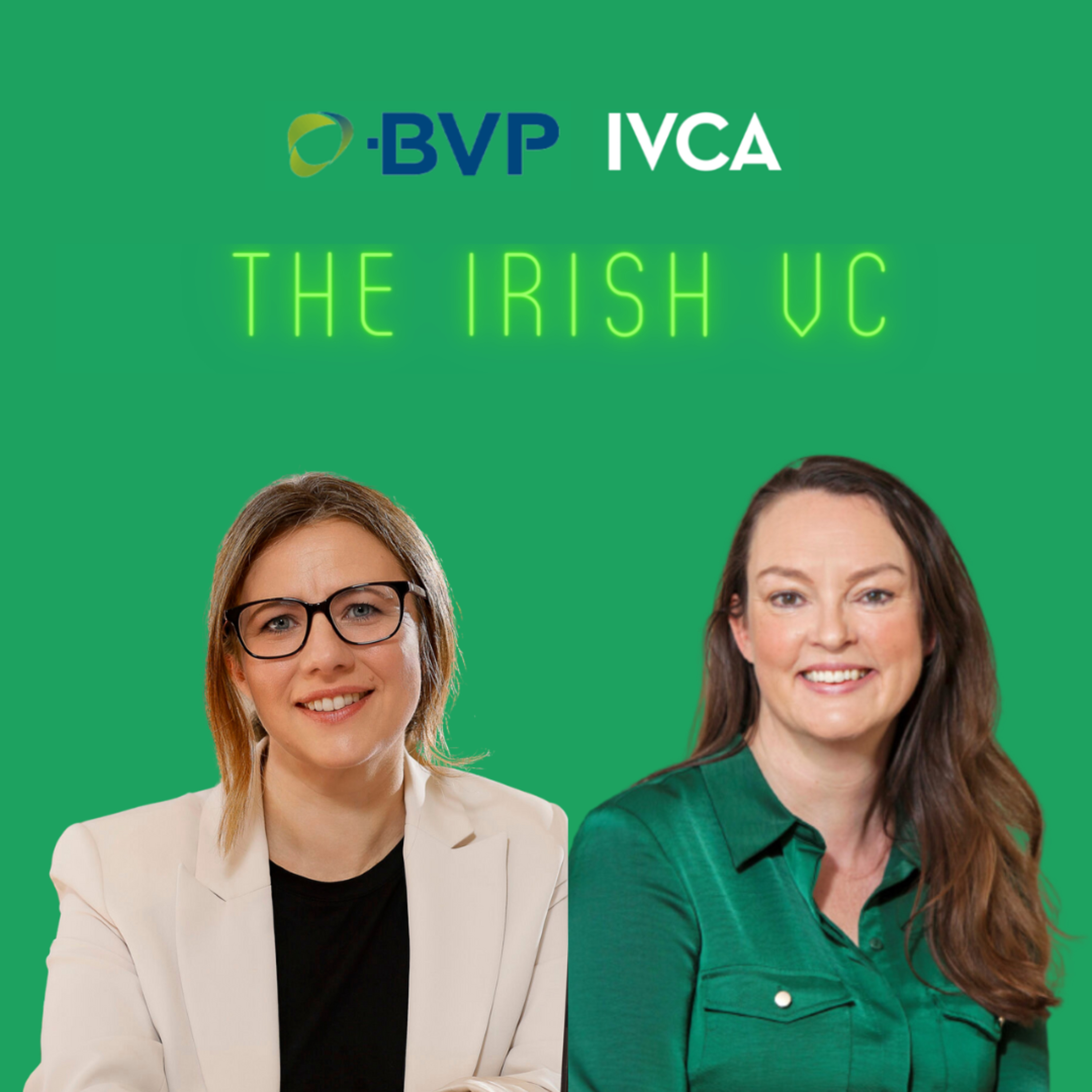
The Irish VC ep32: From Pharma to VC - Insights with Caroline Gaynor of Lightstone VC
from The Irish VC
32m 46s
Caroline Gainer, partner at Lightstone VC and chair of the Irish Venture Capital Association, shared her unconventional career path from pharmacist to venture capitalist. Her journey included roles in pharmaceutical policy, product management, and market access before entering the startup world via the BioInnovate Fellowship. This experience exposed her to the dynamics of financing and innovation, leading her to venture capital.
Regarding the Irish venture landscape, she notes a vibrant medtech sector supported by international investors, but highlights a gap in local, large-scale funds, particularly in biotech and AI. Challenges for founders include funding uncertainty and early-stage capital shortages, with many companies eventually moving to the US for growth due to European regulatory and market limitations. Gainer advocates for a balanced approach to AI regulation, emphasizing protection without stifling innovation. She calls for systemic European reforms—such as streamlined regulations, faster clinical trial processes, and better reimbursement models—to foster a more cohesive innovation economy and retain companies locally.
[Music] Hello everybody and welcome to this episode of the Irish VC podcast. I'm delighted to be joined today by Caroline Gainer, who is a partner at Lightstone VC. But more importantly, the current chair of the Irish venture capital association, well more importantly for us. So Caroline, you're very, very welcome today and thank you for taking the time out to talk to us and to our listeners. I'm Sarah Dindelispe here. So your background and your kind of route into this industry is probably a little different to most peoples. I would say maybe you just tell us a little bit about your journey here and how somebody who's a qualified pharmacist has ended up building a career in venture capital. Sure, happy to. And actually the more I've been in venture, the more I realize there's a number of pharmacists who end up here. I grew very disparate pathways, but yes, so to go right back after working as a pharmacist for number of years and actually continue to work as a pharmacist through my 12 years in Pharma at the weekends. So it happens friends and space. But yes, started off in the IPHA actually as the Irish Pharmaceutical Healthcare Association. And at the time we were implementing the kind of cultural directives. So I guess got a taste of policy and tied to implement various directives at an early age. That was in the context of regulatory affairs. But it was huge learning curve there and just being exposed to the various policy makers, both you know at a national level and indeed European level. And then obviously all the CEOs of the big pharma in the country at the time and just getting a real key non-understanding for what they were thinking of how they were making decisions was important to them in the context of their place in this market. So it was a great experience. And then after that to move back into pharma. So what moved into product management I did a great boss at the time he was always pushing me to do new things. Things I never have thought of honestly so you know most pharmacists do end up in clinical regulatory affairs of some description or or indeed. But no he saw that I maybe had a good strategic mind and so it suggested that I try the business and things so started originally as a product manager and female healthcare. But that was good but as unfortunately we all know there hasn't been much innovation and female healthcare. 20 years ago so after I just needed something a little more scientifically taxing and so that's when I moved over to the oncology site where I got that in abundance. So again product management was involved in the pipeline strategy group which was a lot of fun. I had a lot of time in Berlin with my great colleagues over there and so after it must have been seven years doing that job. I guess the German entity asked if I might set up and run the market access reimbursement division for Bayer ice fire and so. It was double jobbing for a while which was great fun but really the way in big companies you know you get a new rule but then there's this lag where you're still doing the old one. Unfortunately I'm a big gas person so that's been a lot of trouble but anyway so we did that and that was that was really great fun. I actually really love that job you know pricing negotiations the HTA's run and all the studies finding all the gaps getting the data. You know working with the NCP was great fun too and I just really enjoyed it. I was due to actually moved to the US with that rule and just for circumstances that the time chose not to and so that's when I started looking around to see what I could do locally. For a period of time that was sort of scratch that innovation it's and constantly seeking something new I suppose that that is a feeling that exists deep inside. So find the bioinnovated fellowship was actually an ad in the Irish medical times that I had been looking at that day and it just sounded fascinating I hadn't seen anything like us in Ireland before. Certainly not in the biotech side and so you know where I was a little I guess concerned that you know what's this farmer girl doing going off to triac for you know a med tech. I just really love the sign of a show of the opportunities that I couldn't visit it might develop so off I went to what was a very grueling interview I think I need by one of a fellow test to honestly didn't think you know I get in just give them my background but sure enough I got the call and you know decided all very quickly in the end that I was just going to go and do this and give it a go. I was just a bit of a white nerve rocking you know you're stepping away from a career it's going very well just something completely new. But you know 10 months in I have not regretted at all that was really it was really good fun it was really really hard but it was really good fun and just expose me to a whole network in a world that frankly I never thought about it. Big firma such you're very focused on commercial aspects you have a drug it's all strategic it's it's just different you're not worried about where the money's coming from other than internally right always yeah you like that. And having to prove your case but you never have to go out. No, there are deep packets there if you can make the right case yeah exactly. So it was just very different in a different set of players and I just loved the energy of it all and and just the speed and movement and the way you can just make things happen which I think we can all agree. It is not necessarily the case in not always the case. So kind of got hooked and then after that decided I try my hand a few startups myself so took some IP out of me clinic at the time post by invade you know applied for comfort got that had another couple companies running alongside at the same time and you know I can honestly say hand on heart and we we killed that project that may be a clinic one probably a year in when you know fundamentally didn't work but it running come from projects and being involved doing that is just simply the best for you're going to have it's terrifying and nerve wracking all of that but it it's just so energizing and so really really love that it was set you up for that high wire act of big VC. So equally you can make strategic decisions and work on them and see them come to fruition which I think is really really really nice to be able to be in that position so it was through that I got to know the Vantry initially through Mark and Hansen who at that point likes to set up their office here in 2013. So I lost some of the members of us at the various meetings where we'd be at you know doing our pitching and then through Mark and Hansen I just wanted me to work on some projects with them just trying to ideate around different ideas. And so it felt good relationship with them and then through that got to know the light stone team so I have to make came as a bit of a surprise I was not going out seeking a career venture. contemplated. I hadn't at the time and I wasn't very sure. I was really enjoying operating a lot. But I think the other thing you come to realize when you're suddenly in the startup mode is that there is so much about financing, the structure. What matters to be seized that didn't necessarily come second-atured to me. It was not something I could immediately understand. And so when they did offer the opportunity, common as an entrepreneur in residence initially, I thought, well, this could be brilliant. I got a better understanding of how it works, what's important, what's not. And so I did that fully with the intention of jumping back out into one of the companies. But ultimately, you know- You are. I have eight years later. So yes, so stayed with us and you know started rich me as VP and I've moved up to partner now. So working in the European office, cross-bought sectors by a tech and a tech and still enjoying it. So yeah, it's clear from all of that that you're really energized by certain aspects of the roles that you have done. And certainly at the moment in our world and in venture, there's a lot of energy around certain areas and maybe less energy around other areas. If you had to kind of describe the current state of the Irish venture landscape, what would be your feelings? Because I can tell from the answer to the the last question that energy and kind of seeing that and harnessing it is something that you're clearly very good at. Yeah, well, I mean, I think I'm probably quite focused on the life science sector per se. So, of course, general sense. I find right now the meta-exectors, incredibly vibrant. It's really exciting to see all these companies that start in bioinnovate. So I'm not necessarily all bioinnovate, but a lot of them really coming of age. And it just feels like a really great community. They're all managing to raise money and it just seems quite vibrant. We have a lot of international VC coming over interested. And also what's interesting to me is how surprised they are right when they come here and they're just like these companies are really, really good. So, you know, Kudas, I guess, our friends at ISF and NEI are really supporting all of these different funds and investment vehicles that have got us to this position. Yeah.
you know, if we look at biotech, a little behind, certainly with the archipelago and different strategies, I'm hoping some of that now will change in the next 10 years, but it's a long cycle. Might say it's taken 30 years in a sense to get the matuk where it is now. And then just the Irish venture capital landscape. I mean, I think there's probably two stories there. Certainly, there's so much international funding interest here, which is fantastic. They tend to write big checks. They're interested. They want to do stuff at the same time. We simply don't have enough of our own homegrown VCs and the checks they can write are not big enough. So there still remains that gap that we're at IVCA actively trying to figure out solutions to fill. But if we could have bigger funds locally, I think that would even make it more stable, more attractive and just solidify all the good work that's been done today. But yeah, so you know, in the text side, I hear that maybe we're falling a little behind in the AI, I think maybe, you know, we can catch up some or come with a different approach. But certainly, there seems to still be plenty of activity on this sort of site too. Yeah. And I think because from conversations we've had before, you have kind of an interesting perspective on AI and we hear a lot that kind of Europe is so slow and it's regulation, and there's burden and the US is able to do stuff really quickly. But I know you kind of a slightly contrary view on that topic. Well, I do because, you know, I think AI has incredible potential to do great. The reverse is also true. And if you think of any other industry where there's immense ability to do harm, it often did and that often led to incredibly strict regulations and things getting a lot and off lot worse and we can look at all sorts of industries where that happens. So I think, you know, Europe are doing the right thing trying to get ahead of that and trying to be sensible and put in the right protections that said when you have the other forces out there not doing that, it does put us in a tricky position for the next few years. But a lot can happen and a lot can go wrong. And, you know, if you look at the markets now with the least diverse marketplace we've had since I ever remember at least where everything's controlled essentially by tech companies. So if they fall, it can get messy, messy quick. So yeah, I think it will remain to be seen right now. I understand the frustration. It's slow, it's unpredictable, it's all of that. But I still do down hope that at the end when everybody realizes that, you know, there's there's a reason to be a little cautious here that maybe then Europe can step up and have that solution in hand. So we'll keep the things fresh and ready to go. And then continuing on, you know, that idea maybe of, you know, challenges and things that are tricky in the market right now, you know, from your perspective, what are you seeing as some of the biggest challenges facing Irish founders, you know, when they're raising capital and, you know, obviously your perspective is kind of more on the the meta space where the checks need to be bigger. And the return on investment typically is longer. So what are you seeing as the biggest challenges there? Yeah, the biggest challenges are simply, I mean, there's a one, it's uncertainty. And one investor say more than anything is uncertainty because that makes it very challenging to develop any sort of model with any sort of predictability in terms of what your like the X and might be, a value might be. And so when that happens, things tend to slow down. Now, you know, nothing's changed. And what I feel right now is that there's maybe a coming to the realization that maybe we just have to get used to uncertainty and what are on. So certainly, you've sort of had perm a uncertainty in, you know, since 2019, you know, and maybe people are just developing a new ability to just accept that. But I'm certainly seeing more activity, more deal flow. So people, because fundamentally, you need to spend on it. You need to invest. You need to make up work. So we are starting to see the raising get a little easier. You know, that work while it's uncertainty there too, it goes our way as well in terms of our LPs. If they're not getting returns because the markets aren't working because the M&A's aren't happening, well, then, you know, their ability to be able to double die on VCs next one to next one is also limited. So I just think there's been a stagnation across the board of flow of capital. And look, there's, you know, every time we see a little blip of hope and things getting better, maybe it stalls again. But right now it feels like there's a little bit of momentum coming back into things we're seeing deals getting done. We're seeing, you know, big rions being raised. So so look hopefully it gets better. I still think it's hard in the early early phases though. So I'm not sure that the challenges faced by early stage companies are any easier right now. Certainly when I look at where the money's been put, it's more de-risked assets, bigger raises, people crombing large checks into companies where the downside is fairly protected. So having quite seen the early stage investing scene get back to where it was, but you know, at least there's a start of something that's nice. Absolutely. And you know, as you know, and probably anybody who's a regular listener into this podcast knows, you know, we do a lot of work trying to smooth out some of that uncertainty by having, you know, more funds of scale in Ireland that can, you know, can can ride out those times of uncertainty and ride out those cycles. And, you know, I think we're seeing some progress there, which, you know, which is is great. But certainly necessary on the life science side, you know, where the companies are there and that the quality is excellent. Yeah, and it's so important to be able to continue to support them, continue to have the reserves. And I mean, that's the challenge when it's a smaller fund. It's just a smaller, ultimate amount you can put in to play in any one company and bridge rains. And if you're having to keep extending funding, you know, it starts to dry up. And then the winners are the bigger funds to come in at the end and take all the glory. It's not just kind of that. Yeah. So, it's not going to be more cash. Can we be very helpful in these times? And, you know, given the life science, the sector in Ireland, you know, we always hear about it. Like it's one of the biggest, the multinational FDI based sector is one of the biggest contributors to the Irish economy and everybody is really familiar with that. So, you know, logically people would think, well, you know, if you were a startup in the Medtech space in Ireland, you must have, you know, masses of pools of talent to draw from and, you know, must be, all of that stuff must be easy. But aside from capital, is there anything that is particularly challenging for Irish companies in the Medtech space? Or is it, you know, because the sector is booming at every level that that's a benefit? No, I mean, there's always challenges. I mean, what we want to do from an Irish perspective is try and keep the companies here longer. You know, have Ireland as a really viable option for a company to stay and grow in and maybe have that early market opportunity. Now, that's not necessarily the case while we're phenomenal. Medtech size to grow in these companies can be very lean. They're really well connected. Great people. I mean, for the most part, most trials don't happen here and certainly products are not launched here. So, you know, ultimately the companies grow but not necessarily in this jurisdiction. Now, that's not necessarily an Irish specific problem. It's probably European problem. I mean, just, you know, the Europe as a destination for innovation is just on the decline and has been for easily, well, probably more than a decade and it's something we need to do something about. But, you know, those are some of the challenges. I guess they still face it's, it's, you can grow to a point, but then ultimately for the next phase, for that scaling phase, not only Ireland, but Europe isn't an obvious choice of the place to put your focus on. And so, you know, we see them all moving to the US or at least start, you know, the next phase of company growth turns to happen out there. Yeah. And, you know, you have a great perspective on this because you work for US fund, but you are boots on the ground across Europe. If you were, you know, the European Commissioner or the president of the commission or you had, there are so many institutions in Europe that's hard to know who has the power and I think that's part of the problem. But if for one day you were the European overlord and could do anything you wanted, you know, what do you think on a European level is like the game changer to really drive that innovation and have, you know, a more similar innovation economy to those that we see elsewhere. Yeah. Like the reality is I don't think it's one thing. When it's incredibly complex, right? When you think about early science all the way through to a blockbuster, it's hugely complex path. I think what you need to do and what I hope and wish everyone is doing is sitting around a table understanding the full pathway and what are the different main levers or blocks in that road and rather than doing it in a piecemeal fashion and seeing each problem as, you know, a solution in its own right. Yeah. You know, from the very beginning in terms of how long it takes our regulatory process, the fact we can't be joined up even to, you know, set up a company that we can't just have worn European register for that. The IP is the way it is that it can't have the better European patent strategy. Even back then there's things we can do all the way up through clinical trials having, you know, a much better solution.
system for that again in terms of the regulatory piece, but also the electronic data records having systems just joined up. And then obviously on the payment side, the reality is because there's 27 member states, it just takes so long. I know there's moves to try and make that a little more simple, but at the end of the day, if people aren't willing to reward innovation as such, the reality is that still the thing's 70% of the cost of the goods, well, two thirds at least of the cost of getting a drug to market is privately funded. And that's not to take into account all the figures along the way. So yeah, they're the successful ones. Yes, I agree with it needs to be fair price, but it has to be a rewarding price too. And I just think you have to look at the full pathway all in the round and not just think, well, if we fix this one piece, the rest will slip into place. I mean, at the end of the day, if there's no market place here, people won't be here. So probably if there's one thing that has to be fixed, it's surprising. I simply, regulation and pricing has to be fast, it has to be predictable. And then you've got to get paid for it. Because otherwise, you know, unfortunately, I just think every North Sea Europe is as a use of cash, not a source of cash. And as long as that remains the case, we're going to struggle. Yeah, absolutely. And lots of our listeners are interested there. They're kind of on the startup side. You have vast experience in companies and evaluating companies and making investment decisions. If you could give one piece of advice to somebody who's an ambitious founder who's listening today, what is your absolute top tip? And then we might kind of take that on and say, and what is the one thing you just should never do? Or the top tip. Yeah, the top tip, the thing we like to more surround yourself as a founder of people, ideally, who are smarter than you, but certainly can really help you. You know, really people with great experience because, you know, the hardest thing you're going to face if your first time founder is your lack of track record. And that goes for everybody. Right? So to the extent that you can find people to be your support network or that can help you see some of the roadblocks that might be coming away. That shows a degree of maturity and awareness that I think goes down well. The other thing, those who know me will probably sick of me saying this, but, you know, one thing I didn't do in my early days and I still do not believe most do is focus on your fundraising strategy. You know, you spend so much time in a regulatory strategy on a rational strategy, on any strategy can think of, but nobody sits down and looks at the funding landscape, truly understands the funds that play with what stage they are in their life cycle. Yeah. You know, what's the background of those partners who might have their ear. And so what you see is this kind of blanket approach coming to everybody and then surprise when maybe, you know, you're, it's not a fish. And I think it's simply that they haven't done the homework and they could probably save themselves a lot of pain and misery by taking a bit of time out to understand the funds who are active in the market, what their place in the world is, what they do and where in their life cycle there because, yeah, as people will know that massively will determine the maths, our side and what sort of companies we might invest in at a given time. So yeah, they're probably. And, you know, certainly it is something that even, you know, we commonly see on our side is, you know, people not understanding if a fund has dispersed all, you know, that funds need fund raised to and there will be a certain point, you know, in a, in a time span of a couple of years where that will be their focus rather than investing. And part of that goes back to the, you know, to the depth of private capital in Ireland that, you know, sometimes Irish funds that can take longer and be harder and consume more time and, you know, but certainly you want to know where in their investing cycle. Yeah. They are the point when you are, you know, when you're, you're interested in, in seeking capital. Yeah, because that will determine how quick we need to get our cash back to our funders. So you're absolutely right. You know, you come early, you might have eight years to do that. You come in eight, then you've two years. So I think just realizing that, understanding that and this is all information you can mostly find online. So it's not tickly difficult. It's just, I just simply don't think people think to do it. Yes, I think there's some time wasting that can happen. Yeah. You're needed for. And I think there was not something we had thought about in those early days was the fun cycle. And where people are not too jerky. Yeah. And certainly I think, you know, people often when they are fundraising, you know, they waste till they think they're, you know, they've got the perfect picture. They're at this certain point. And now is the time. But, you know, that time may not align with, you know, where the fund is at. You also just mentioned that concept of fish. And it's something I think, you know, that might be useful for you just to kind of expand on a little bit. And, you know, for anybody listening, you know, in terms of that, you know, what is a fit for certain funds and why they would make a decision, you know, based around that. Yeah. I mean, for the most part, it has to do with fund size. I was thinking, I threw the Thomas assume most funds have to go to aiming for three acts at least. So, obviously, if you're approaching a hundred million fund, they have to make a very sizable return off that money. And so, you know, that's going to dictate where they go, what they want to do, the sorts of investments they might do. So if you're coming with your, you know, 50 million exit value, it's probably not going to be exciting to them. That said, it could be very exciting to a smaller fund. So again, just in your head, imagining, you know, when you, when you consider the attrition ratio of any given VC in the fact 50% will go nowhere, you know, 25% might get your money back and you're relying on the final percentage to really drive that return. So we need to believe if it's a big fund, you need to believe it's a big idea with a big potential return. It's not say it's not a great idea, not a free business. And I think sometimes that's the mismatch that happens, you know, but yeah, that's sort of when you talk of fish, equally unfish, we all have our own preferences for what we view as companies we like to do could be a single asset, could be multi asset, might be early late stage, might be a mix of both depending on where you are in your fund cycle. So again, the only way you'll get to know that is probably trying to meet up with the folks involved in that fund, have a look at their website, see what other sorts of companies they've done and see if you can spot some trends there in terms of what they like, therapeutic areas they like, you know, some may or may not do diagnostics tools. So very specific. So it's certainly not one is as good as the other. Yeah, and certainly, you know, as you mentioned, that information is, you know, is available, you know, the obviously publishes a guide to venture capital, which details some of this, we publish it regularly. So that's a good starting point. And then, you know, a lot of the information is there for people who, you know, who are interested and I think it is good advice. You know, I would agree that often people don't think about fundraising until it's, you know, it's too late and they're kind of running out of road. And then that makes it a very stressful situation, rather than having a strategy from day one. And then, and if you, like, if you know you want to be out to years tying at a point where it might be a fifth for somebody, it's always great just to keep them updated in a very non-saly way, you know, as enjoy conversations. I think most venture folks are genuinely really interested in new innovation because we're nosy. One thing better. So, you know, it's always worthwhile. I think it's a different conversation when you're not actively pitching as well and we can get to know the person. As everybody knows, relationships are hugely important in this industry, especially if you are considering investing so many need to, you know, know and trust to respect the person involved. So being able to develop that relationship before you're in active pitch mode can be helpful as well. And kind of on the, I suppose, this like flip side, you know, what is the worst, like, what would you advise anybody listening, like to never do or what, can you give us an example of like a moment where you were just head and hands going, no, no, no, when you're having conversation or somebody was pitching to you or may not. Well, one thing I probably say done too is, you know, tell the venture person they're going, sorry, I'm late. She doesn't go down. So to say the approach to customers always right. Look, they may or it may not be, but I think sometimes the comments come from places of deep experience. You may not agree with it, but having it, you know, an active local disagreement on a pitch probably won't get you anywhere because it's a defensiveness thing, right? And I think what we want to see are people are open to taking on board different comments. If there's a different opinion, there's a way to put that across. Or just, you know, not accepting that it's not a fish. Interestingly, and I don't know why it is, but sometimes, you know, you'll pass for reasons of the lack of being in your strategic focus or whatever it might be. And you'll get an argument back as to why it definitely is. Now, yeah, I'm not sure why people do that. Maybe they've heard persistence as king and that makes the pace when you're on strategy. But, you know, if someone comes back and says, "Oh, I'm going to be a big fan of you."
tells you that it's simply not within your realize they're not going to change their minds. So you can spend more time trying to convince people to do what they fundamentally are not set up by doing or you move on. So it's more just, you know, yeah, a bit of a view, I suppose. Yeah, yeah, and the day. But there are probably the big ones. Another one can be straight out the gate being super focused on your valuation. You know, valuation will be decided by the market. There's a very pretty straightforward way people get to that. It's going to be based on how much you can exit after, you know, and some assumptions will be made around how much money, you know, we feel you will need to get to that point. So that's what determines valuation. It's, I feel like maybe some founders think it's all about VCs trying to grab as much control as they can and as it's, it's, it's not really actually driven primarily bit by what do you think the exit value is and what makes sense for the stage around now in light of how much money is going to be needed. So again, some folks don't necessarily contemplate that. So maybe just always think about what's the exit value, how much money you need to get there and how do you keep everyone who's investing along the way, you know, at a decent return. So that's what it will come down to. Brilliant. Well, listen, that is super helpful. And I think we're kind of coming to the close of our time together today. And before we finish, you know, based on kind of the chat, is there anything else that you have a burning desire to share? No, look, I'm excited for the next year. Hopefully try and advocate for Irish venture. Some more and via different channels. I'm obviously particularly focused, given my background on making the biotech ecosystem better, but it's unequally the meta can just trying to see what Ireland and can do alongside Europe to be fair, just to make Europe a place that's, you know, seen as a good location to keep your business, grow your business and market, access the market off. So it's a long journey, but excited to start on it now. Brilliant. Well, I have to say we're delighted to have you this year as chair of the IVCA and very excited about what we can do together to, you know, to really develop the Irish economy in this space and the indigenous sector. So thank you so much Caroline for your time and your insights today. That was our great stop too.
Podcast Summary
Key Points:
Caroline Gainer transitioned from a pharmacy and pharmaceutical industry background into venture capital via the BioInnovate Fellowship, gaining exposure to startups and financing.
The Irish venture landscape is vibrant in medtech with strong international VC interest, but lacks sufficient local, large-scale funds, especially in biotech and AI.
Challenges for Irish founders include funding uncertainty, early-stage capital shortages, and the tendency for companies to relocate to the US for scaling due to European regulatory and market barriers.
Europe’s cautious regulatory approach to AI is seen as a necessary protection, though it may slow innovation compared to the US.
Systemic European issues—like fragmented regulations, slow clinical trials, and inadequate reimbursement—hinder innovation retention, requiring coordinated, cross-border solutions.
Summary:
Caroline Gainer, partner at Lightstone VC and chair of the Irish Venture Capital Association, shared her unconventional career path from pharmacist to venture capitalist. Her journey included roles in pharmaceutical policy, product management, and market access before entering the startup world via the BioInnovate Fellowship. This experience exposed her to the dynamics of financing and innovation, leading her to venture capital.
Regarding the Irish venture landscape, she notes a vibrant medtech sector supported by international investors, but highlights a gap in local, large-scale funds, particularly in biotech and AI. Challenges for founders include funding uncertainty and early-stage capital shortages, with many companies eventually moving to the US for growth due to European regulatory and market limitations. Gainer advocates for a balanced approach to AI regulation, emphasizing protection without stifling innovation. She calls for systemic European reforms—such as streamlined regulations, faster clinical trial processes, and better reimbursement models—to foster a more cohesive innovation economy and retain companies locally.
FAQs
She started in regulatory affairs and policy at the Irish Pharmaceutical Healthcare Association, then moved into product management in pharma, and later joined a bioinnovate fellowship, which exposed her to startups and led to roles in venture capital.
The life sciences sector, especially medtech, is vibrant with growing companies and international VC interest, but there is a gap in local, larger-scale VC funds to support stability and growth.
Uncertainty in the market makes it difficult to predict valuations and secure funding, particularly for early-stage companies, though there is some momentum returning with more deals being done.
While Ireland has strong talent and connections, companies often move to the US for scaling, as Europe faces challenges in clinical trials, product launches, and being a competitive destination for innovation.
She believes Europe's cautious approach to AI regulation is sensible to prevent harm, and it may position Europe to offer balanced solutions in the long term, despite current frustrations over speed.
A coordinated, holistic approach across the entire innovation pathway—from regulatory processes and IP strategies to clinical trials and pricing—is needed, rather than piecemeal solutions.
Chat with AI
Loading...
Pro features
Go deeper with this episode
Unlock creator-grade tools that turn any transcript into show notes and subtitle files.
 PodcastTranscript AI