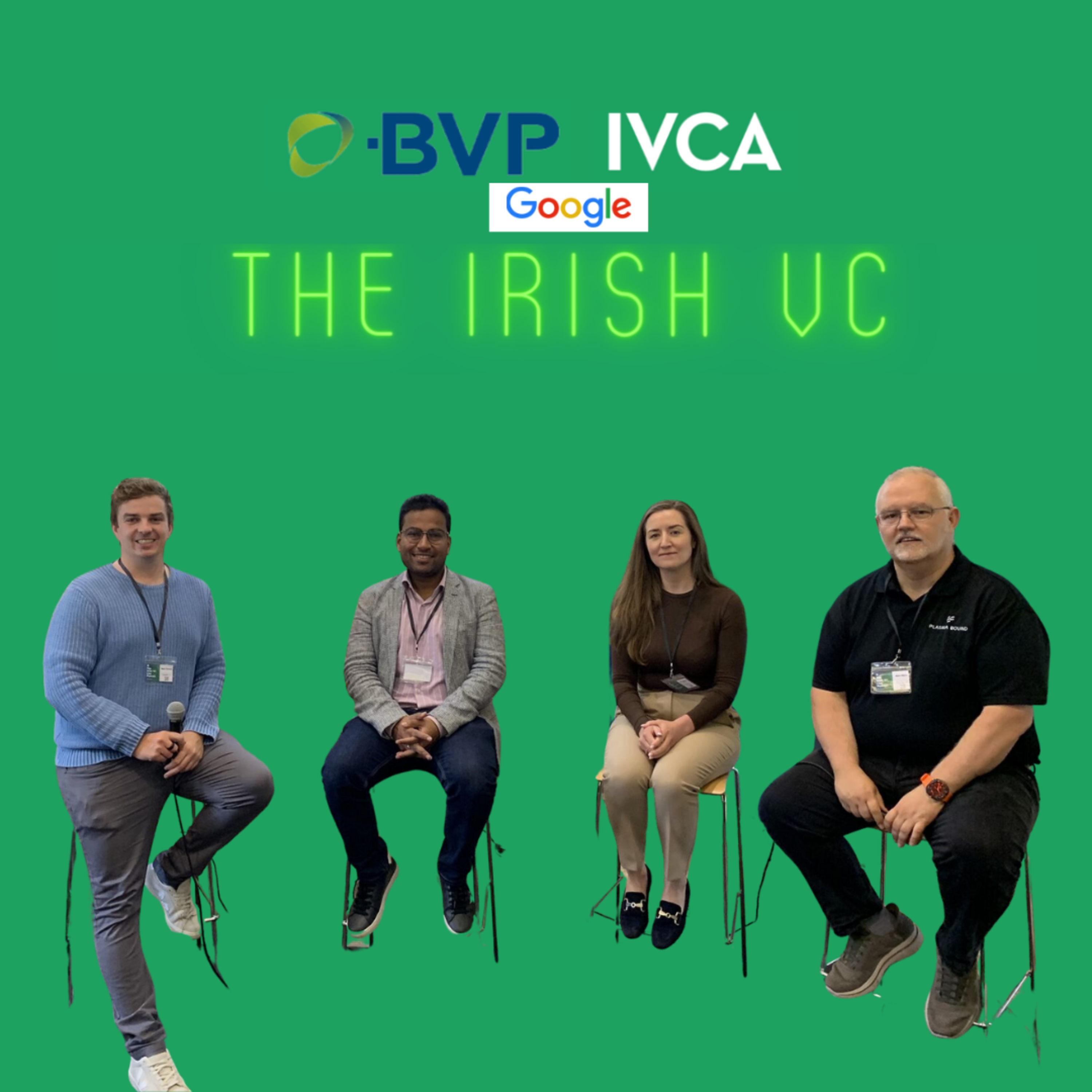
The Irish VC ep28: Ireland as a launchpad @NovaUCD
from The Irish VC
61m 35s
This IVCA podcast episode, hosted by Mark Farley at NovaUCD, explores the journeys of three Irish founders innovating in health tech, AI, and advanced materials. Alan Barry’s startup uses automated plasma technology to treat engineering plastics 900% faster than manual methods, with integrated quality control for regulated industries like aerospace. Dr. Harriet Tracy’s Beyond BMI addresses obesity through a digital platform offering multidisciplinary medical care, emphasizing ethical, sustainable health gains supported by AI. Apur Kumar’s SPAC AI enables enterprises to responsibly deploy AI by ensuring applications meet standards for fairness and accuracy, operating in a new "responsible AI ops" category. The discussion highlights Ireland’s role as a startup hub, noting its strengths in medtech, aerospace networks, and AI software development, facilitated by organizations like Enterprise Ireland and ESA. Founders shared how Irish programs (e.g., commercialization funds, ESA incubators) and geographic positioning—bridging Europe, the UK, and the US—provide critical support for testing, scaling, and competing globally.
Welcome to this special edition of the IVCA podcast sponsored by BVP and recorded here at NovaUCD. The NovaUCD is the hope of innovation and startup activities at UCD where, and it was earlier this year, was ranked by the Financial Times as one of Europe's leading startup hub. So it's a pretty impressive place to be and I know everyone here has some connections to it. So just for those of you who don't know, I'm Mark Farley, I'm the Associate Director with HBAN, the Halo Business Angel Network in Ireland. And I'm joined today by three incredible founders, and they're all working at the frontiers of new technologies in health tech, in AI, and then in advanced materials. So we'll explore their journeys a little bit, the challenges they've overcome and what the future holds kind of for Irish innovation. And Ireland is a bit of a launch pad for startups and how we can compete on a global scale. So before I go into it, I'm just going to go down the line here and pass it on to each guest. But I just want to start by saying, tell us a little bit about yourself, your background, and before founding the company. And then if you had to explain what your startup does at a dinner party, in the simplest terms that even a tech-aloudite could understand, how would you describe it? And Alan, you've got the mic, so I'll let you start first. Thank you. So I'm Alan Barry. I'm a process engineer by training. As you can see, unfortunately, I've quite a lot of experience. And about 25 of those years were spent in positions of quite a lot of trust, delivering highly complex capital projects for heavily regulated industries like Farmer and Medtech. A few years ago, I pivoted out of that into other regulated industries, though I didn't know it at the time, including aerospace and automotive, to deliver on plasma loans, decarbonization promise to industry where we propose to accelerate the adoption of advanced engineering plastics to decalibreize their products and the use of their products in terms of range extension and fuel use for the lifetime. So what do we do? We do something very complicated, very simply. And in effect, what we do is we treat those advanced engineering plastics for bonding and for painting, 900% faster than current best practice, which is essentially hand sanding. We do that in a fully automated and autonomous way. And if that's not enough to really clever bit, is that the system can detect from the surface, not just machine telemetry. This is one hell of a dinner party, but sorry, it's a material science. I'm sorry. It can detect that the process ran well and got the result expected. So it can feed forward into the customer's quality system and enable automated parametric release, which is absolutely transformational for anybody, for whom weight matters and they are regulated. Perfect. You can put that in two sentences, please. I won't challenge myself to that on this today, but what I would say is, is a pity this is in audio only channel because I know I've seen the demo of what your product can do and how quickly you can do it. It's pretty impressive. We'll go on now to Dr. Harriet if that's okay. Very impressive to follow from that. So yeah, my name is Harriet Tracy. I am a medical doctor by background. So about 10 plus years working across various countries, the UK, Australia, Ireland. About six years ago, got really interested in how healthcare was changing and the digital impact that we were seeing and I just wanted to really be part of that. At the same time, as an emergency medicine doctor, I was seeing an increasing number of patients coming in with unmanage chronic disease, things like heart attacks, strokes, and peas. What was really demoralising about it was the fact that there was nowhere I could really send them to get proper care for one of the main drivers of these diseases and that was obesity. So I was telling them to eat less and move more. I was telling them to go back to what weight watchers are slimming world, knowing deep down that none of that actually works scientifically or medically. And at the same time, there was a massive macro-environmental change. There was the emergence of all these new pharmacological therapies that were groundbreaking and industry-defining, things like GLP ones, a Zem Pick, a Govi, you've heard of all of them. And I just knew there was an opportunity there to do that but to do it well and to make sure that we did it in an ethical and a safe way and that really became the origins of Beyond BMI. So Beyond BMI is essentially an online platform that helps people who are living with the disease of obesity to access a full range of doctors, dieticians, health coaches, psychologists, clinical nurse specialists, all with the view to helping them to lose weight and gain health. And I suppose what we do differently is that we're not just interested in people losing weight, we're interested in people gaining health and really looking after them along the continuum of their disease. So there's so much opportunity to turn what we have, which is essentially a tech-enabled service, into a really powerful product-wise platform, you know, supported by, not led by AI, but certainly supported by AI. Brilliant. Yeah, I mean, we're obviously seeing such a boom in that industry. I've noticed it when someone described Zem Pick to me and said, "Oh yeah, she's on Aussie P." I was like, "Well, we really have adapted to this new one because obviously it's been around a while, but to see it and just fascinating to see it done in a sustainable way, because that seems to be the biggest problem, you know, making it a change for life." A part of it will go on to you last but not least, so you can tell us a little bit about what you've done and how you got here so far. Sure. First of all, good afternoon, everyone, and thank you BVP and NOAA UCD in Mark for this opportunity, delighted to be here. My name is Apur Kumar, I'm co-founder CEO of SPAC AI, and Adam SPAC our mission is to help organizations and empower them to responsibly harness AI. My background is product and business, so before co-founding this company in Q4 of 2023, I was working at Microsoft, I've seen a major product for OneDrive and SharePoint, which is one of the cash cow products. I launched their AI capabilities and I also worked at AWS, it's the ProcMajor for AWS Lambda in Europe. Fast-forwarded to November, 2023 when we were starting the business, what we were realizing was that AI was getting insanely common with the rise of chat GBT and other tools, but it was also getting insanely unpopular because it was continuously going wrong, right? And anyone who was trying to use chat GBT or Bilko Pilots or bots, they were finding it extremely difficult to rely on them, right? And the trust factor was so less that enterprises, they were really not adopting AI and they were having a lot of budget to do POCs, but were not able to move into production. So that's how SPAC was born out of Docpatch Labs in the city center, and we are venture-backed business, we help in pre-production testing, monitoring and auditability of your eGente AI and GENI applications focused on responsible AI parameters like fairness, bias, accuracy, etc. So that's why we are trying to define a new category called as responsible AI ops, which is embedding responsibility AI by design in your applications. We are very fortunate that we have some good traction in terms of enterprise customers, and potentially one of my ex-employers, I can't name it here, is also going to be one of our end customers, which is a very proud moment for me and my team. We move to NOVA UCD, it's a brilliant location, from a research perspective, from an innovation perspective, it's great to be surrounded by some fellow founders, and we also launched our subsidiary in India in Bangalore earlier this year. Fantastic, and I think we might share that your new customer might be an old employer of mine as well, but I won't give it away, but you can check my LinkedIn. Before we go on, we're going to talk a little bit about Ireland's position globally, and how we're viewed within each of your industries. I meant to mention this at the top, though, not to put pressure on the three of yous, and when you're explaining your company, but the last time BVP invited me on to this podcast, an angel investor heard it and invested, quite a sliceable chunk of money into a company that was mentioned. So BVP and the IVCA do have a great reach on that. So do talk yourself up here, we're not all going to be humble on this one here today. Harriet, we might start with you if that's okay. We are renowned in Ireland for Medtech, right? The shout out for ourselves, the HBAN Medtech Syndicate is amazing. It's actually phenomenal. I'm a professional at the group there, Ivan and the team, but in the health tech side of things, where are we globally? Has being positioned in Ireland helped or been a hindrance in the health tech side of things rather than the pure Medtech? Talk us a little bit about Ireland's position, I suppose, globally. Yeah, I think that's
That's a really accurate reflection. Certainly, kind of an opinion, I would share. I think Medtech is, as you said, very well-renowned in Ireland. We have bioinnovate and go away. We have networks dedicated to investing, purely in Medtech. And I think sometimes we can conflate Medtech with health tech. And I kind of see them slightly, slightly differently in so far as the way the funding cycles work. For example, in Medtech, often you'd raise quite a substantial amount of capital before you even get to revenue. In health tech, you can maybe show product market a little bit earlier. Certainly, in the case of Beyond Be My, we've been selling from day one. To really answer your question, what is the health tech seen like in Ireland? I think it's reflective of the size of Ireland. So I would say it's not as strong or as big as a larger market. What does that mean for us, in a starting in Ireland? Well, I think what it does allow us to do is it allows us to have a really good test bed. So we're very lucky in Ireland in that we have a mix of both private and public pain. So you can test out our people willing to pay for this publicly. And could you get that privately? And could you get this into the public system? And I suppose you can also leverage network as well because it's so small. So you can kind of get out there and start testing your idea pretty rapidly. But really, when you're looking for the network effect, you find yourself on a plane over to the UK to build up those networks and maybe even down the line the states. And the UK was being the first protocol for you then rather than continental Europe or West out to the US? Yeah, I trained in the NHS. So we got a bit of a network then anyway, so it felt natural just to kind of extend into that. But yeah, there'd be a very, very strong health tech network in the UK. And I look, I suppose we're very lucky that in Ireland because we are so geographically close to the UK. So it's not that big of a deal to jump on a plane. Yeah, well, I know we spoke about this earlier, but I did a little bit of research into it in the amount. The obesity levels in Ireland are crazy. It's epidemic level, according to who, so hopefully when we're talking in 18, 24 months time, you have made a dent into that number, so the 60% number. So, yeah, I mean, just to add to that, I mean, when it comes to obesity, we're actually quite innovative in Ireland. So yes, we are in the top three in Europe in terms of our obesity levels. But also, we are one of the first European countries to have adapted clinical guidelines. So that happened back in 2022. We adapted the Canadian clinical guidelines for obesity. So we're quite forward thinking from that perspective. Okay, fast and fascinating. Alan, we might move on there and I know we're kind of jumping from topic to topic here, but overall kind of one thread through it. So obviously Ireland is well known for the aircraft leasing and 50% of the planes in the world, I think, are owned here, are domiciled here. Does the fact that the money flows in and out of here make a difference for you when you're trying to obviously aircraft and the aerospace is such a big part of your industry in one of your key customers? Does it help? Does it hinder or just does it not matter? Okay, so the aircraft leasing part doesn't really make a direct difference to us. We have, it's mainly in supporting manufacturing and supporting aerospace to move from what is essentially a non-scalable manual process, like over 50% of a modern white body aircraft is plastic and that is every single one of those parts is manually treated prior to assembly and they need to double production within the next 10 years. So it's nuts. So but with leasing not a whole lot of influence, but where it has been useful is Enterprise Ireland because of that have very, very deep networks within the aerospace industry. And ESA, because space and aerospace, they're very kind of adjacent, right? They are more embedded than you to believe in Ireland. They're actually one of the Bix is here in Nova, the Tendell Institute in Manuthan and Cork also are Bix and we enjoyed early support from ESA in that regard. And Enterprise Ireland's Pathfinder programs, Country Office programs and people like Sean Long and David Lucy and others couldn't have helped us more in getting meetings that American MNCs would have been delighted to have. We got those through Enterprise Ireland because of the network we have. So not directly but indirectly it helped tremendously. Yeah, no, I know everyone sings the praises of the overseas offices and again. It's unreal. Yeah, again, you can check my LinkedIn to see where it previously works as well. Maybe in one of those overseas offices. Pervo, we might move on to yourself then. Look, AI, the centre of the AI world realistically, in my opinion, Silicon Valley, tell me if I'm wrong, but how have you leveraged your position here? We're on the kind of the Western front of Europe, the little island, little rock in the middle of the Atlantic in between the tech giants in the US and then I suppose the growing, everything we're seeing coming out of China and India as well, the growing of industry in the East. So how do you fit in to people of view us at Ireland as a whole by AI or are we kind of tech underdogs that punch above our weight? Yeah, it's a great question Mark. I think whether it is big tech or startups, Ireland has always been an important centre for software businesses. And when I worked at Microsoft and Amazon, I do not believe a lot of product development of some of the top products of Microsoft and Amazon happens over here in Dublin, in Bal's Pradesh and in Leipzig town and is the same story with the likes of Google and the next set of companies. In terms of startups, there's a lot of innovation definitely happening in Silicon Valley, but I think for software businesses Ireland has a strategic advantage and I'll give you my own experience over here that I can connect with my office and my team in Bangalore in the morning. I can work with my team over here in New Way, U.C.D. during the daytime and 4 PM onwards I can also connect with my customers who are in the west coast. So it gives me a significant advantage. In software businesses, especially after COVID, what we have seen is that things have become mature, like there are more and more collaboration tools and softwares which can help you connect with your remote workforce, any part of the world. I don't think it makes a lot of difference in the type of business we are. And at the same time, I think Dr. Harry mentioned the same time zone with U.K. Yesterday I came back from London after a day trip around half 12 in the midnight and two weeks back I was in India and before that I was in the US. So it's like I can take a play into any part of the world and still it's not that challenging in terms of the geographical advantage that I have. In terms of the research rigor, I think we have universities like U.C.D. we have programs like New Way U.C.D. which has given birth to a lot of AI research startups. We have a thriving ecosystem over here which comprises of VCs and a prize island in platforms like Docpatch, which really help in creating new businesses. So I think there is a lot which is happening. Support from government is great over here in terms of different grants and firms. I think if someone leverages it to their advantage, I think definitely we can build like a unicorn out of Ireland. I firmly and my team firmly believes that. A few days back I was also part of a forum where Minister Clara Chappas from France was there and they were talking about how European Union can combine because there is insane amount of wealth which can be put into businesses. I think the entire European Union including Ireland is working with other countries in EU to see how they can give birth to new and new businesses over there. So I think there is a lot of advantage and especially in the type of businesses we are, it is not sentric to Silicon Valley. Ultimately it is all about how you commercialize because you can have some fantastic innovations going on but you also need to think about your distribution and a global distribution to ensure that it is a viable business. Just touching on that, I might actually ask both Alan and Dr. Hyde to talk about the programs that you have gone into as well in Ireland and what you have found most beneficial which ones you have found most beneficial and for any other entrepreneurs in the room here or listening so that they can go, okay I need a clue into that program. So Alan I think I know there is one or two that you like every one of these. My suppose the first one was the first I guess so to get it from being a very interesting experimental result and to actually being a business or at least a spin-out we used the commercialization fund. This was critical to the existence of farm. It is probably fair to say it wouldn't had that not occurred. I think it is a great use of funds and it is really really good to get academic people who might be used and very capable and competent within the environment.
academic environment. It's like a mini MBA, if you will, out of the research environment into business environments. It takes you through the rigors of setting up the business, the financials. But it also allows you to do some primary market research and develop a prototype, which is often that's kind of the hilly a dial when you're a new idea. You just don't have the funding to get to a place where you can show somebody something. The equivalent then would be the European Space Agency Incubator. Really, really good. I have often said to many startups, I don't care if you grow in mushrooms, find a space angle. Because ESA have an active policy of finding non-agent companies that even if it's an only a very abstract hypothetical use in space, they'll fund you because they want to enrich the ecosystem, which is very kind of homogeneous in space. They want new techs, new companies, new thinking. And as part of that, the ESA big program is still worth 50K, is it? Half and half from European Space Agency and ESA, administered by European Space Agency, but very interestingly, then, two or three times a year, they'll do what's called a TTD, was that give you around 40K, to demonstrate your technology to a non-space industry. I remember being in the offices in Tindling Court, kind of going, not for space, no, specifically not for space. And that was the money we used to develop the six-axis robot that we were able to then subsequently demonstrate to an automotive manufacturer that actually, this isn't just something on a flat plate, we can treat that shape in your car. That unlocked everything. And so ESA, we're willing to give that money, even though it hasn't, because actually, it's supposed to be a little cynical, they know they need that company to have a lifeline in a non-space environment, because they're never going to give it enough. So there are a lot of supports. And the final one I'll finish, because I'm probably going on too long, is get into the Leo, get into EI, get a development advisor or a client advisor, or anything they're called now. Because that unlocks an untold amount of vouchers. Development vouchers, innovation vouchers, pathway vouchers, market innovations, discovery vouchers, key hire vouchers. There's so much Nandaloo to money out there, as long as you know it's there, and you can justify why you need it. It's unbelievable how much. Almost, we've almost half of the money we've raised so far has been Nandaloo. That's such a bonus then as well. And I know from our investors, they're always looking to see how you maximize everything a little bit of Nandaloo to grant you can get. I think there's probably a whole industry could go up around consulting to-- I'm actually part of that. Yeah. We showed-- Oh, sorry, yeah, I'll take a break. We showed our own DA, a map of the voucher network. Yeah. Available in EI, and he was amazed. He was a half-- I didn't even know about something. And so yeah, I know there actually is a business there, I think. But yeah, and then DTIF, of course, as well as a can finish without saying to you, you know, DTIF and EIC, you have to have a plan of-- Again, right? To raise funds, if you're not actually in those programs, you've got to have a plan to be in those programs. They want to see that you've got that in your plan. And it is a great source of enabling capital. Not the easiest thing to apply for. Don't underestimate it. And I'm more than happy if someone wants to ask questions about those programs. But yeah, this non-delute of funding is very available here, if you ask. No, absolutely. And I know you're not just joking about that mushrooms. I know Owen Tuy from Sports Impact Technology. I was told-- It was told. I told him, yeah, I said, listen, hey, I don't care. Maybe the astronaut will bump his head or something. You know, put it up there. So yeah, absolutely. Fantastic. Is there any programs that are your-- or a program you'd like to talk about or shout out just before me, Varner? I mean, all I'm thinking about now is, how can I treat obesity in space? [LAUGHTER] Yeah. Two-thirds of the fuel in a rocket upon launch is to lift the fuel that will lift the rocket into space. Two-thirds of the fuel on board a rocket upon launch is to lift the fuel that will lift the rocket into space. That sounds like a paradox. [LAUGHTER] So I think making sure astronauts are at their optimal body mass. Yes. Key for space. [LAUGHTER] And that they stay there while they're on the station. We are going to have the wildest space product coming out of Ireland in the next few years after this podcast, I think. Yes, are you, Pervy, even? Just one small thing. I want to add-- and I think Ireland is very well covered, like all the different types of funding and probably you can do a crash course as well for people who are looking out for it. It's great. But apart from that, I think what I really found very useful was, again, going back to the ecosystem, because as people who are starting for the first time, they need a lot of mentoring and support in terms of how to think about it in the right way. And Ireland has been blessed with accelerator programs as well, like NDRC, for example. A lot of great companies have spun from their-- there are mentors from Enterprise Island who can help you out with different types of business needs that you may have around GTM or around your technology, et cetera. I think it's also important to leverage that. And with NOAA UCD, for example, if you're looking out for researchers or research in terms of business in terms who can join an early stage company, if you're trying to spin it up, then that's also amazing. So it's also mentoring coaching as well as talent that you can track. And it's easy without selling a lot of money on that. It just wants to do that to what I learned. Absolutely. And we might move on a little bit in terms of into the Irish fundraising side of things, though. And how has that been for all of you? And is there-- I suppose from an early stage company, is there anything that you would give-- what was the first piece of advice you would give back to? We've already talked about making sure you get all your non-delute of stuff. But what would be the next kind of key piece of advice you can give? Do you want to take that first? Wow. I think you just have to start somewhere. And that might sound like a very vague point. But I think it's almost like the approach you take to product market fish. You have to make contact with the market to really learn. And so I think really big and really wide when you first start thinking about funding. I wouldn't hone in on any one particular area. I would just think very broadly whether it's non-delutia funding from accelerators, whether it's your own family and friends network, whether it's angels, whether it's feces. I think it's keeping a really open mind. Like Alan, we actually came from the calm fund as well. And I can't give you a really logical reason why we started there. We just heard about it, and we went for it. And it was as simple as that. We didn't really overthink it. We were very, very fortunate that we got kind of an open-minded-- I'm going to call him innovation as well. Commercialization lead in Tom Bannon in Enterprise Ireland who really kind of made us the exception to the rule. So we weren't these fancy PhD students who had dedicated our lives work to-- Sorry, you were just a doctor. Just a medical doctor. So we didn't have very strong IP. But he saw something in us, and he saw something in the idea, and he really backed us. And so I think on paper you would have looked at that and said, God, they're not the right candidates for the calm fund. But we ultimately and subsequently did get it. And so I think, yeah, I think you can be very prescriptive with these things. And then something else comes along. But yeah. Yeah. Getting that balance right of getting out there, but also making sure you're ready when you go. Yeah. I couldn't actually agree more with Harry. I think I'd add to it a little bit, right? So don't go out for money when you need it. Be in the market, build the relationships, build trust, and get a few California knows for several months before you need the money. It's key. I was going to give you money just because you walked in the door. That only happens in the movies. The other thing as well is, depending on what quarter you speak to, you'll have people who think, oh, don't go near VCs. Don't take on EWIAS money. I stay away from angels. I ask too many questions. That's all rubbish. Each source of money is valuable. And while you take it on, it has to be a decision as best for you. And the roadmap you've planned out, ideally to your exit, but certainly to commercialization.
And you should have one. You shouldn't just be going from milestone to milestone, because you could make big decisions that would be very regrettably at Iran. That's one thing. Just there's a kind of a prejudice depending on who you're talking to about that source of funds or that sort of funds. And they're all wrong. Each source is good. The one thing I would say is that maybe it's a cultural hangover in Ireland, but sometimes the attitude you get, particularly from certain mentors, is you're going for a bank loan nearly when you're trying to raise funds. And that's not the mindset. You are bringing an opportunity to these people who need to deploy capital. You're not there to cap in your hand asking for a few Bob to build a wall. It's a big difference. And how you get on actually will be dictated by where you sit in that mindset to a large degree. And I do think as well the Irish ecosystem, I can't speak for the very early stage anymore, because I'm not there anymore. But when we were exiting Confund, to be honest, which a lot of the messaging was, even as a precede, you kind of needed to have stuff that was actually more series A. And while it is important for early founders to understand this is the level of rigor you are actually eventually going to have to get to, I thought the message was last step. When you're a precede, it's idea team. Particularly with academics, they'll get lost for six weeks in God's own financial model that's completely made up. It's idea team and the rest of the stuff. And I think that's not emphasized enough for preceding companies. At least it wasn't in my day. No, absolutely. We see it the whole time, the angels. It's very hard not to make a decision, especially when it's finger in the air financial stuff, not to make a decision based on the charisma and the confidence and the ability of that team and the pitchers and how they're going to get on. Verba? Yeah, no, just adding on to what Alan and Dr. Harry said. I think that mindset is really important that whether you're just raising your first round, you should think about it, that the investor will be perceiving it from a very different perspective. And probably your preparation should be off the next stage or the next two stage. So 100% agree that you should have your MVP in place, your proof points in place, because what they're looking out for is definitely insights. Fantastic team and at precede, probably it would work, but ultimately, it's all about the proof points and insights which you'll have to project in position the right way to your investors. At least that's what worked for us when we were raising a last round. And I think, yeah, just as Alan said, every money, whether you're getting from angels or VCs or enterprise islands, important. So just be very intentional about how much money you're raising, whether you want dilution, don't want dilution, you want what kind of instrument you are looking out for. So it's very nuanced as well. It depends on the kind of businesses. Sometimes, say for example, the AI business, timing is very important because there's so much happening all over the world, like every day, some model, some agent is coming up in some part of the world. So the timing is also very important. So it's an amalgamation of all these things which can help in securing good funding. - Absolutely. And is there a red flag? Is there any red flags that you see common that you're going, okay, if an investor asks me that? And it could just be for you because it's like, oh, if they're thinking this, they don't get more than what I'm doing. Or is there anything that you look out for and how do you vet your potential investors? - Yeah, I mean, I think I can talk about my business. So the market is really important. Like you'll find investors who have a very high degree of conviction in the market, you'll find, you know, generally, investors who may not have the same degree of conviction. And it's all about how you tell your story, the dinner conversation thing, like, you know, in two simple lines about what you are doing along with some good proof points. I think the uncertainty of the market could be like one of the red flags, or, you know, if there aren't adequate proof points of what you're building. So that will never help in building good conviction from any investor, whether it is Angel OEC or, you know, anyone, right? So I think telling about the market opportunity, along with some good proof points, which can be extrapolated with that opportunity and can be turned into a, you know, viable business. I think that's the work I would urge all the founders to tell this to my team as well. - I'm sorry. You guys, is there any, then I suppose, red flag, or even just if I was doing it again, I wouldn't have done this. Any potential portal or traps, I suppose, that the other investors or founders in the room may fall into and how to avoid them. - I think everything in business is a relationship and taking money from somebody is a relationship. I heard somebody say before, never marry somebody that you wouldn't be willing to divorce. And I think there's something in that, what when it comes to where you take money from. Because how are they going to be in the bad times? How are they going to be when things aren't going well? How do they manage conflict challenges? I think it's worth just having that in the back of your mind. It's a somebody I'd like to be in a bad situation with. I was quite lucky in that I had a very supportive chair and access to his network as a result. And so some of that vashing was kind of done for me in some respects. So I think leading on your network as well is really important. Again, I'm kind of full of quotes today, but I watched a really great podcast between Steve Bartlett and Reid Hoffman and he said, they were talking about hiring people and they were saying, if you're going to hire somebody, what is the most important thing you should look out for? And they said, Reid said, if you're hard to pick between an interview and a reference, I'd pick a reference a hundred times every day. And I think that applies probably to investment as well. It's like, do your homework, talk to people who've taken money from these people before everybody is a salesperson. Everybody's able to put on a really good face, but repetitions that little bit more pervasive. And I think just looking beyond what is said to you, I think is probably where I would start. - I'm stealing that quote, that's brilliant. The margin divorce one. - Is that what you're trying to work it out? - Yeah. (laughing) That one's definitely, although I don't know if I want to tell my misses, no, I could see myself divorcing. (laughing) Don't worry, that's all going to be good. Alan, I'll let you go on there and hopefully my misses doesn't listen to this. But I'll let you go on and experience this. - It's mostly guys' career in this. - The bottom line as well as to put us in, the first thing is if you need to understand what to a poor person's point, you need to understand what kind of money you're trying to raise and what your raise world map is. Do you want to bring on board people who are just gonna give you money and then they're gonna sit in behind a nominee for the next X years? Or do you need people who are actually gonna actively participate in the funding lifecycle of the firm? That's a different person and it's a different conversation. So, and one of the ways to identify that obviously is the nature of the funding entity. The other one is, and then this is often, this is after you, it applies to everyone, but the smaller the ticket, the more it is supplies in a way. It's the level of apparent risk tolerance of the person who's giving you the money. Particularly with angels, you gotta fill it that one out very quickly. You spend a lot of time doing due diligence that is appropriate for a VC and then in the end, they kinda, no, yeah. Like, we did a lot of that at the start. So, identify the person or entities risk tolerance quickly. How patient do you need the capital to be? That will tell you, you know, you get that very quickly from speaking to people. And that's one definite red flag. The other one then is, I've seen a lot of startups put all their eggs in one basket. And not getting into a funding bake off. And sometimes there's no problem, but it can be very problematic if you get into difficulty even the leagals and stuff. You're kinda caught now. If you can create, if you can create a bump funding bake off as a very early firm, that's ideal. Easier said than done. The main one is watch out for the risk tolerance of the entity or target.
- Yeah. - No, you and me both know that when you go through the data legends process, if there's someone asking 50 million questions, they're like, "I don't think this is for you." - So you seem to understand what he's doing, yeah. - Yeah, sometimes it can be tired, gikers. And I think Harry, it just gone back to what you said about the relationship, I think, who ran the divorcing. I think one thing that's really, and this is just my two cents for founders, but for all the deals that we've seen in the last 24 months, the communication and understanding up front, what the communication is actually going to be. You know, agree, are you going to speak every month? Are you going to send out a letter every quarter? What is it? But like, I've only been in the angel investing world now for 24 months, and the people are most happy. The investors come back to me that are most happy. No one has got an exit yet. Some people have got enough lift on round, but the thing is, when they say, they're brilliant communicators. They're telling me what's wrong. And that's for angels. Like all these angels are usually fantastic business people themselves. Tell them what's wrong. They're going to help you. They'll give you advice. They'll know someone who can help you with sales. They'll know someone. Yeah, so that's just my two cents on that. So I don't know, did you guys set out strict communication guidelines? Or what was the plan so that you knew, okay, yeah, these are people that I can pick up the phone to. Yeah, I think when I reflect on my communication with some of the investors, I think we've gone through a number of different ways of communication. I think there's been, at one stage, monthly updates, then two monthly, then quarsely. But for the most part, most of them I can pick the phone up to you. And I think that feels like a really nice relationship, because it gives them the context that you don't always get in the written update. But I think actually, sorry, I'm going to go back to something we were talking about. One thing that hasn't been mentioned when we come to fundraising is the customers' funds. So I would kind of argue, and it's very dependent on the type of business you have. Medtech probably doesn't lend itself as well to this. But the best money you're ever going to get is from the customer. And we've experienced that and beyond, be it my for sure. We were revenue generation from the start. We, most recently in the last year, got to cash flow positive, break even net profit positive. And we have cash in the bank. And yes, we are going to fundraise again, but we're in a nice position. And to your point, you're not going out kind of with your hands begging. And that comes from the fact that we have people who are willing to pay for what we do. So I would say never, ever underestimate getting customers' money. Because it means so much. It's not just about the money. It's about the validation of what you're doing. And the fact that people are actually willing to pay for it. Yeah, no, absolutely. Especially see that indirect consumer, like products like squid. I think if you have investors that come in, they're evangelists. Even if they've invested via crowdfunding or whatever, they're going to tell not just one friend but ten friends. It just makes a big difference. So look, we've been talking about the good things. Ireland Inc. is brilliant and amazing and we do everything right. What do we do wrong? What if you had a legislative pen and you said, I can change, a magic pen that can change whatever legislation you want? What is the biggest downfall or thing that we could do better? That especially if there's any easy fixes. Culturally or legislatively. That's a great question. I think there was a magic pen. Two things I would definitely say. One is we should market ourselves more from a global perspective. I think sometimes people don't even get to know the brilliant work which is going on. They're again going back to inciting the examples of AI companies. Ireland has seen some great companies born from here and it's not just Stripe or Workday but talk about companies like Pointy, recently Product Say I raised a large round. Things are changing but it has to be marketed well so that there is awareness. The second thing is education in terms of, is completely okay to leave your FDI jobs and start something. I moved to Ireland ten years back when the family worked in some other top companies. They were very fortunate on that. I started off. It was a relatively new thing. The West where it was more like revolving doors where people were coming out of corporate jobs starting something going back as a result of acquisition or whatever. That whole cycle was going on pretty efficiently but when we started it was one of those rare events where somebody from Microsoft has left and starting. This is an outlier in any perspective. It should be more common. Just uniting that universe of startups and corporate, I think that has to be an educational element over there and there should be some good case studies like any other business that it's completely okay. It should be celebrated and it should be encouraged. I think this is where likes of the OUCD with the CEDA program and Lockpatch, NDRC, etc. has a big role to play to just get this whole cycle moving over here and then with right marketing, it will put us on the global map in terms of how we can do this. I think we're actually, I remember statistics, I think we could be last in, definitely in Europe in terms of the per capita amount of people that leave big tech corporates and to start their own things. It's definitely something we should be addressing and 100% agree. Yeah, Dr. Harried. Yeah, I think you've covered a lot there. I think certainly you need to market ourselves and back to your point Mark, you know, punching up with our weight and actually being proud of that and showcasing that a little bit more. I think we need to make it easier for people to invest and we could get into the whole rigmarole of the tax incentives in this country and things like that. But, you know, this whole country is built off the back of innovation. The state's been won and we're seeing now with the terrorists and all that kind of stuff how vulnerable we are if we're not innovation. So it should be a priority of the government to stimulate risk taking, stimulate innovation and proudly advertise that. It's a very good use of taxpayers' money. You know, and I think it's often sold to the taxpayers, all your taxes are being spent on that and so and so go off and run a business. It's not. They are the future of innovation in the country and we need to showcase and actually maybe, you know, to your point, market that. Yeah. So that's probably where I feel we could probably have most impact. Yeah. No, absolutely. I'd love to see that the CGT from a nice return or a nice exit that that's just white if once you invest right back into Irish companies. If you can do some mechanism for that, I think Martina Fitzgerald put it brilliantly like our tax incentives and our tax systems in Ireland have been written to have been written so that they are not inappropriately used rather than written to be appropriately used. You know, they're rather than encouraging use, they're discouraging misuse and that's frustrating. Well, yeah, I was literally going to say one of the final things would be for me entrepreneurial incentives should be more practical. I think there's a deep seated cultural bias in the country, the echoes of which continue today, silly stuff like, you know, or if you forgot to say something in your business plan or you don't qualify for that, what the hell is that even me? But that's a rule and it's a big rule. Like, why? And so there's a lot of concepts, you know, there's a lot of moral, jeopardy stuff which is not really, you know, I'd put it slightly differently to how you put it. That needs to be weeded out. It's not appropriate and they're really just trying to save themselves some time, money and effort in invigulating the process and possibly there's a touch of ideology in there as well. I think we could clean that up, make it much simpler and reward people appropriately and try and remove some of the silly trip wires. Like, it's much more evolved now, but five or six years ago, the general sense and the rule underground was don't touch either, yes? Yeah. Silly, they'll find a way to catch you out. Like, that's nuts. No, it's gone now, you know, and you can see that in the volumes and everything. But there's still, you know, the still stuff that we can do to make it far more attractive to people to leave their job and that the upside even in a moderate exit is still sufficient for the entrepreneur, you know, because an education and cultural shift, it'll come with time. I mean, look at the kids, the average age in my company is six, as I like to joke, you know, all the guys up in the office. And they're so full of ideas. There's a whiteboard up in the office of ideas to do after we see it.
plasma bound. So we need to encourage that at a cultural level and the way to do that is lead it with getting rid of these silly little conditions that are quite impactful. They drive the culture. Absolutely. A hundred percent agree on that one. We might finish up, do we have time for one or two more questions. I've got some quick fire questions that we're just going to pass along for you guys. Some of these you'll have seen, some of you won't have seen. What's a pet peeve in your industry or in Ireland that just straights you so much? I think it's like, again, talking in context of the AI business, it's like planet Mercury which is like a moving target. So I think the frustration is not on the industry or the country. It's more around this whole trend. It's very fast moving. So you could be chasing a moving target. I think that is one thing which is peculiar about AI businesses. Again, just going back to some of the things we should discuss. I think getting those initial paying customers, I think that is really important because that really helps you in building some defensibility. I think that is really important. One thing if I would have to say from industry perspective, especially the kind of business I'm in, it's sort of how you can stop chasing a moving target by building some defensibility pretty quickly. Our investors are starting to come to terms with it. They're kind of going, so there's no moat anymore because anyone can build anything within a week with all the, you know. Customers are your only moats. That's the most important thing because someone can build something in some part of the world and claim that this is the most unique way of making hamburgers. Then ultimately it's all about like if you're half paying customers. And then congratulations Dr Harry for cash flow positive. I think that's what we should like all strive for. Yeah, absolutely. I think we've glamorised moving fast and breaking things and we have underplayed the value of survival. Surviving in our businesses no mean feat. When I think back to when we first got fundraising, it was this idea that you would burn through your cash as quickly as you could and go out and fundraise again except no one forgot to tell me or remember to tell me that actually when we went back out that the market would have collapsed, there was no money to get. So had we behaved in accordance with, you know, like you said, chasing that target we probably wouldn't be here. So I think it's having the foresight to recognise a trend from a passion. And you know, the trends come and go. You know, woman, it's trendy to spend money next minute, it's trendy not to. And I think it's about you understanding yourself, your own appetite for risk and also, you know, where you see, you know, the genuine length of time you think it's going to take to build the business. Yeah. Oh yeah, absolutely. Almost overnight it went from, you're not spending enough. You need to be more ambitious too. Oh, could you cut down on that burn right there for me please, you know. I'll, Alan, either Ireland industry in general. I suppose one of the things is just in general to stick with the investment and non-delutive side of things is I think the level of documentation for applications and reporting and the level of rigor for reporting, whether it's a 15 million project or a 500,000 euro project, you know, in other words, we need a small project escape opportunity or option for the smaller funds because it's an enormous amount of paperwork and I would worry even for the application of the Com fund and the like, I would worry about how many really good ideas die on the vine because people are intimidated out of applying because this is just, this is crazy. I'm going to need an account, a higher an account and just fill this thing out, you know, that's one area that I think it could be easily enough solved and would make a huge difference because I worry I really do, how much of an innovation just doesn't go any further because people look at it in the go. And like they say, if this is a sign of what it's going to be like, I'm out. And it isn't. So it's kind of, that's one area that I think could be fixed. I think if you get plasma bands all out, I'm in on you. I'm in with you to create a consultancy just to get through everything in Ireland. I think Alan just proposed a brilliant business idea for you and the audience because you can have an AI agent doing all these things for you. Yeah, 100%. And you know, the other one is reporting. Monthly and quarterly reports. If you have six, seven different VCs, you have six or seven different, slightly different, but it takes as much time to do it again reports. I would pay money for a platform where I could just give all my metadata to it. And that platform, the VC would be able to say, I want to see that, that, that, that, that, that, that, I'd pay for that. There you go. And even in the audience, that's the next product. And we, oh no, you're going to wrap it up. So I will not go on to further questions. I will leave it if Alan, if you just want to say like one last thing that you are excited about in 60 seconds about what you're doing, your next steps and your plan, just opportunity to promote everything. Yeah. So I'm really excited about where the product is going because in the long run, what we do right now is we take in materials for an automotive or an aerospace company and we do a trial in about a week where it takes them nine months to do the same thing. And we've a fully optimized process going back out the door to them. Only thing left is robotics at the end of the first week. At the end of the second week, the robotics is also done. To the point, we spend half our time explaining to them that it's legit. Where this is really going to, we're very, with the AI tool that we're building, the AI tool is going to basically be able to tell the customer that this part was perfectly treated and give them a map of where it was treated and how, which is critical to aerospace. As I mentioned earlier, that's going to feed forward into their quality release systems, which is also critical. But we've realized now for rapid prototyping that customer will now be able to present a new shape for a different car, our airplane. The system will be able to analyze the shape, do a few demo treatments with an AI tool, we have a really machine learning and completely reboot the process independently at the customer facility as many times a day as they want to. We've only realized that's a thing in the last three or four months and it's extremely exciting. Fantastic. Doug, Doug, right. What's next for Beyond BMI and what are you most excited of it? I'm most excited about our opportunity to impact the single biggest epidemic of our time, which is obesity. Beyond the numbers, beyond the percentage weight loss or the number of kilos lost, what really excites me is the stories of people having a huge improvement to the quality of their life. It's been able to walk on family holidays without any pain, be able to pick up their children and run around the garden with them. The ability for them to advocate for themselves, one of the biggest things that we do in Beyond BMI is we give people a toolbox of language that allows them to speak and advocate for themselves. They never had before. So they no longer have to be at the mercy of people, shaming them and stigmatizing them. And the power that gives people is something that I never expected going into this. So, you know, for me, I just think there's so much opportunity for us to continue to impact people's lives. And yeah, it's very exciting. Fantastic. And I'm aware it's in spec. What's the plans? What's the next steps? I'm very excited about like, you know, the recent engagements that we are having with different customers. And our goal is to convert all our ex-employers, not just me, but all our team's ex-employers into our customers. Because essentially what we are solving is an AI problem. I love that use case, Alan, which you called out. Because this really excites me that, you know, there's so much of power in the technology, especially AI technology, to disrupt like different types of industries. And seeing this with a live, you know, use case, which Alan talked about, but the trust associated with that whole automation is quintessential. So, I'm excited about like, you know, how this spans out in different industry verticals, with different use cases, with, you know, different types of models, not just text, but vision models, and with different types of, you know, multi-models in terms of images, videos, etc. Because, you know, probably like in two, three years time, if not, you know, more, we may be having this podcast with all of us talking to each other, right? You you know, it will be essentially agents. So I think the trust--
factor is really important. So I'm just excited about the overall opportunity that we have ahead of us. And I'm also excited about this sort of awareness about starting more and more companies in different spaces, which is the whole goal of this particular podcast. And if as an ecosystem, we can help people come out of their golden handcuffs and jump with, as Ellen said, some kind of incentive. So they don't have to worry about the kitchen, right? And they can focus on building something impactful. I think it will really put us in front of the world stage. So amazing. Thank you, everyone, for joining today. Really appreciate it. Thank you to Nova UCD for hosting us here in this fabulous campus. And I know all of you guys have connections to Nova UCD and so many other wonderful companies we mentioned due to. And then, of course, thank you to BVP, who are the sponsors of the IVCA Irish VC podcast for organizing and everything that you guys do as well. We'll wrap it up there. And hopefully we will-- you'll hear from us all again soon. So thank you very much. Thank you. [APPLAUSE] [MUSIC PLAYING]
Podcast Summary
Key Points:
The podcast, recorded at NovaUCD, features three founders from health tech, AI, and advanced materials discussing their startups and Ireland's innovation ecosystem.
Alan Barry's company automates and accelerates surface treatment for advanced engineering plastics, enabling faster bonding/painting and quality verification for industries like aerospace and automotive.
Dr. Harriet Tracy founded Beyond BMI, an online platform providing comprehensive, medically-supported care for obesity, combining human expertise with AI to promote sustainable health.
Apur Kumar's startup, SPAC AI, focuses on responsible AI operations, helping enterprises test, monitor, and audit AI applications for fairness, accuracy, and reliability.
Ireland serves as a strategic launchpad for startups due to strong support networks (e.g., Enterprise Ireland, ESA), access to both EU and UK markets, and a collaborative, time-zone-advantaged location for global business.
Summary:
This IVCA podcast episode, hosted by Mark Farley at NovaUCD, explores the journeys of three Irish founders innovating in health tech, AI, and advanced materials. Alan Barry’s startup uses automated plasma technology to treat engineering plastics 900% faster than manual methods, with integrated quality control for regulated industries like aerospace. Dr.
Harriet Tracy’s Beyond BMI addresses obesity through a digital platform offering multidisciplinary medical care, emphasizing ethical, sustainable health gains supported by AI. Apur Kumar’s SPAC AI enables enterprises to responsibly deploy AI by ensuring applications meet standards for fairness and accuracy, operating in a new "responsible AI ops" category. The discussion highlights Ireland’s role as a startup hub, noting its strengths in medtech, aerospace networks, and AI software development, facilitated by organizations like Enterprise Ireland and ESA.
, commercialization funds, ESA incubators) and geographic positioning—bridging Europe, the UK, and the US—provide critical support for testing, scaling, and competing globally.
FAQs
NovaUCD is the hub of innovation and startup activities at University College Dublin, recently ranked by the Financial Times as one of Europe's leading startup hubs, making it an impressive center for entrepreneurial activity.
Alan's startup treats advanced engineering plastics for bonding and painting 900% faster than current methods, using an automated system that also verifies quality, which is transformative for weight-sensitive regulated industries like aerospace and automotive.
Beyond BMI is an online platform that helps individuals with obesity access a full range of healthcare professionals, focusing on sustainable weight loss and overall health improvement through a tech-enabled service supported by AI.
SPAC AI helps organizations responsibly harness AI by providing pre-production testing, monitoring, and auditability for AI applications, focusing on responsible AI parameters like fairness, bias, and accuracy to build trust and enable production deployment.
Ireland offers a good test bed with a mix of private and public healthcare systems, allowing startups to validate their ideas quickly, though they often expand to larger markets like the UK for network effects and scale.
Enterprise Ireland provides deep networks and programs like Pathfinder, helping startups secure meetings with multinational corporations and access funding, which is crucial for entering industries like aerospace and leveraging Ireland's strategic connections.
Chat with AI
Loading...
Pro features
Go deeper with this episode
Unlock creator-grade tools that turn any transcript into show notes and subtitle files.
 PodcastTranscript AI