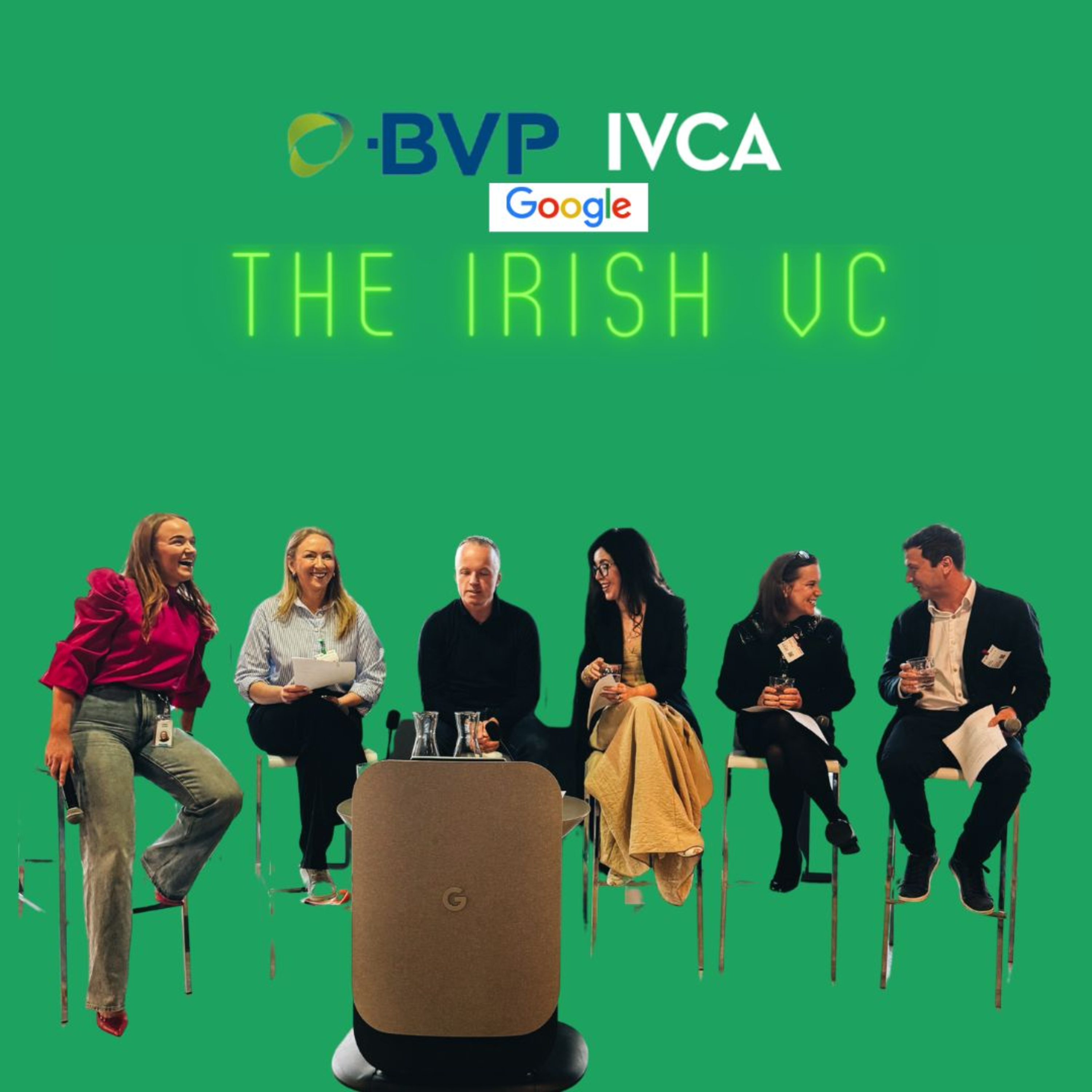
The Irish VC ep25: The Funding Landscape in Ireland - Live Audience Recording at Google HQ Dublin!
from The Irish VC
71m 29s
The panel discussion, hosted by Kina Jordan at Google's Dublin offices, featured investors and a founder exploring Ireland's current startup funding environment. Experts noted a global venture capital reset following a boom period, making Series A funding particularly challenging while seed investment remains active. This has led startups to pursue larger seed rounds and alternative financing like venture debt to extend their runways. Investors emphasized prioritizing market opportunity and a deeply expert team over product or metrics when evaluating startups. Despite the tougher climate, Ireland's ecosystem was praised as vibrant and open, benefiting from strong governmental and institutional support that builds entrepreneurial talent. The discussion also highlighted a significant opportunity for female founders, with progress being made but a substantial funding gap still existing compared to male-led ventures.
Hello everyone, good evening and thank you so much for joining us in our fabulous fabulous Google offices here. This is by far one of my favorite offices. This is where I actually worked for the first time in Google. So it holds a very, very special place in my heart and I'm just honored and privileged to welcome you all here this evening for an incredible lineup of panelists and then after join us for a mixer with some delicious food and drink afterwards. Quick introduction to myself. My name is Kina Jordan. I am leading our early stage startup team here in Ireland and then also working in the UK with about 20,000 accounts who are on the unassigned accounts and looking for those gems in the market of which we have loads. I am delighted to welcome on stage our fabulous, fabulous guests. We'll go in this order if that's okay. Nived you want to start us off with a quick introduction. Hi everybody. My name is Nived Sterling. I am the online director of HBAN. I'm also on the board of BVP. My background is I started my first company when I was 26, which was not yesterday. So that's a bit vast. Nounons in 2021 and I was on the board of our family tier one engineering company. Leah Lynch is in that was acquired by Texan Private Equity E-Verm in 2022. Hi everyone. My name is John O'Sullivan. I'm a general partner with a firm here that's based in Dublin, Act Venture Capital. So what do we do? We're a technology investor. We invest tickets from 500k up to about 20 million. What do the companies look like? We invest from two people, up to about 300 revenues, zero, up to about 50 million run rates. So in that window, tech-based companies out of Ireland is generally what we do. Hi folks. I'm Chupie. I'm a founder of Chupie Jewelry. We're Ireland's most love jewelry brand based here in Dublin. We sell into 70 countries around the world. We've about 300,000 people in our community. I am the token founder. We are a BVP client and I'm going to be ready for questions afterwards. Thanks Chupie. I'm Eleanor. I'm the co-founder of Blue Immacuity. We are a climate tech growth stage fund investing across Europe, including into Ireland. In terms of stage, what we in by growth is businesses with a proven business model, attractive unit economics where we can support on the scale up journey. That's typically kind of serious B onwards and we invest tickets of between five and 50 million euro. Thanks, Eleanor. Hi guys. My name is Andrew McGreill. I'm an investment director with BVP. We were here this time last year for the first podcast. A lot of you might already know who we are. But for those that we don't, we're early to growth stage investor. We're actually a multi asset investor. So what do we mean? But not as we do both equity investments on debt. I'm an investment director for the equity size. Focus most of my conversation on that today. But in terms of what we look at, we typically focus on three teams. So climate, health and technology. Investments kind of range between 500K up to three million. And yeah, that's that's really it. Brilliant. Thank you folks so much for that. We're going to go straight into it. It wasn't too long ago where I had no idea about this world. So I definitely want to start off with a quick overview of the current funding landscape here in Ireland. So, Neve, I'll come straight to you. What are some of the current trends that you were seeing in the angel investors landscape at the moment? Yeah. So, H1 is sector agnostic. So we invest in everything from, you know, patented dog toys, medical devices and everything else in between. A lot of software, some hardware wearables. We just finished 18 months of investment. We invested 25 million in that in that time frame. Out of that, about 60% of that went into medical life science, diagnostic space. And in terms of trends, one of the kind of emerging trends that we're seeing is sports tech. So again, that would be everything kind of from software and maybe, you know, payments in the software in the sports space all the way up to wearables. So the network of deployed 1.75 million over the last 18 months in sports tech. And that looks like that trend is following this quarter. We just deployed another million euro in this quarter alone. So yeah. Brilliant. Thank you so much. Now, John, onto you. So we heard from the angel source. I hopefully I'll mix it up at some point, but at the moment it's going this way. In terms of current trends in the VC landscape, what are you seeing at the moment? So the best way to describe this. So you've had an extraordinary reset in VC in the last two years, maybe two and a half. After a phenomenal boom period that really ran from about 2017 to 2016 to the end of 2021 in the States, it went a bit longer in Europe. And if you care to study VC, I wouldn't recommend it, but I'll get to the bit where it impacts companies in a minute because it does impact companies. The graphs underlying that boom are quite extraordinary. Level of capital deployed, level of capital raised, a number of new people hired into VC. These, these their extraordinary slopes on those graphs, never been seen before. In an industry that have been gradually expanding for 50 years, it had this very large kink. And it is resetting. It's resetting the number of headcounts going down. It's very difficult for funds to raise fresh capital. And outside of the elite group, let's leave them and I'll get back to them in a second if you want to, but how that's cascaded back into the market place after this very intensive period is for companies who are starting out. Would you like it or not? Whiplash effect shows up. So what does lots of money in the market? There is. It feels quite schizophrenic to be a startup. And this is so you've got to get a whole two ideas in your head. So what's happening? How that's been plays out in Ireland is no different. This isn't an Irish thing, right? The Irish market is the most open venture capital market in Europe and possibly the world. Our economy is very open and our venture capital market is exactly the same and it's always been like this. It's a wonderful feature of this marketplace. So what we experience here is not that different. So the way it's playing out at the moment is you're seeing extraordinary high levels relatively speaking given the shark and VC. The shark and VC is because it's been shark and outputs from companies. Just that they're directly connected is you're seeing still very active levels of seed investment. That one level are quite you're kind of taken aback by this consistency of that level. Now what type of seed investment is going on? You're seeing actually lots of teams relatively speaking and I'm dumb into describe this as being easy, right? I'm not saying it's easy, which you are seeing a regular pattern of teams being able to raise one to four million as their seed rounds. So bizarrely the better teams are able to raise more at seed than they were before and they want to raise more at seed. Now why is that because you're arguing the dilution question, why would you do this? And the investors want them to take more. Why? Because series A has become impossible to define and predict. That next level like a capital that seemed quite available has stalled. And as soon as people define what the metrics are to get to series A, guess what? The VC's move the cheese and it's not because they're being you know philosophical about it. Is they're seeing live and their portfolios, their own companies inability to hit series A marks and series B marks. They're from the VC's program to invest the money, but they can't live in a world where the portfolio they're in can't raise large tickets. So the only way of dealing with that if you want to stay in the market places, you do seed investing, giving them long or runways and hopefully series A might still don't keep running out. So you just get to freeing you series A series B is becoming incredibly difficult. B is actually nearly easier, but series A is where everyone is queued up has become incredibly difficult, but supersede has got easier. And the bridge is to cope with the series A gap. Sorry, that was probably more than you expected. Sorry. Yeah, no, it's very. And is that you're saying it's not just knowledge problem is that pan Europa is that global? Oh, it's global. It's it's global. In fact, in you'd nearly say in the US reset has been harder. Really? Yeah. So when you look at the numbers on it, generations are also difficult to always find the outliers, but the US started its reset in literally you can see it does a month in July 2021. And you'd nearly think there was no such thing as the internet. The way Europe carried on until the war. You can see it in the day, do you think people forgot how to read newspapers and we were lying on transatlantic pigeons to get the information back. The US hit a hard stop. It is quite incredible when we now see in the graphs and hindsight. We could kind of feel it going on, but when you see the graphs and they haven't stopped going down. And so, so some extent European founders have actually been a little bit more protected from it today. But the implication might be that it's got it's going to unwind further, whereas the US is now we it's probably true its recent like resetting. Yeah. Sorry. That was great. No, Andrew, any points. Echo, John, sentiment, we've actually seen it. We've we've over 35 companies in our portfolio. And we're definitely seeing that impact. And so a lot of our--
companies are now looking at alternative sources of finances. So we've seen a big, big increase of companies using things like venture debt or revenue-based finance to hopefully help to make stand run away to try and get to this series A. Another big thing that we've seen which probably linked is not just bloggers or talent, but actually adapting to the market is actually pushing more on the fundamentals and more towards profitability. I don't see that as a bad thing if you look at again on the graphs. The larger, if you looked at the companies in the public markets that have been growing, putting growth as a priority put to the detriment of profitability. Hopefully that will come in a later stage. Their evaluations have come right down from peaks to 20X down to 5X times. Whereas you look at companies that are prioritizing capital efficiency, have gold cash shows got got go profitability and their evaluations have largely remains somewhat stable in comparison. And you be I suppose come to you as our founder of the evening. So everything these guys say I'm just going to reel back to the GPNC. In terms of someone who's been able to bring their company from that seed round to series A, what are your thoughts on that and some of the opportunities? I think you know what John is saying is really interesting and Andrew in that the world has changed. We're seeing that huge shift. Obviously at 2P we've done that first piece in terms of seed but haven't progressed to series A yet and are waiting to do it. And then I see it. I sit on a program called Going for Growth. It's a female entrepreneurship program. It's backed by KPMG and enterprise Ireland. It's the big co funded piece. We've got a huge gap in female entrepreneurship. So 10 years ago for every one female founder wanted to start a business at scale. Scale being 10 employees, a million in revenue and exporting. There was nine and a half men. It's a huge opportunity gap in terms of what we're seeing. That data has come back now to one woman for an a half men. It's great. Halfed in 10 years so it's good progress. And so I sit on the program and lead an amazing table of female founders. And so whilst right now we're not out there looking for series A. I'm working with founders who are out raising seed and I think John is seeing exactly what you're seeing bigger rounds coming in. But I think what's interesting is there's incredible potential. What Ireland has right now, what makes it so incredibly unique is the brand sitting in market waiting. So the likes of sisterly supplement brand health, it's health and med all over just launched into Harrods in the UK, Riley and other Femtec piece. So fertility, fertility, or fertility, amazing all going for growth companies actually. But amazing to see the ecosystem. I think that's the question of what's the opportunity. And what's out there and who, it's why we've such an active market because there is such an opportunity, particularly obviously my interest is on the female founder side. Less than 2% of venture capital goes to female founders. So you and your brother start a business in the same day, he's 49 times more likely to get funded than you are. And so there's a real opportunity there and you can see it happening. Those 2% figures don't apply to Ireland. Yeah, no sisterly is an amazing brand. I actually use some of the supplements so quick about sisterly. But I think definitely in that testament can come back to what John was saying there about the openness of the Irish market as well. And I learned over to you, I know you work in Google and in the UK as well. They're sorry on Google, there's me on an auto bar like there in Ireland and over in the UK. I'm curious what are, what is the current, like the Irish capital landscape compared to a lot of the European countries. Yeah. Yeah, I think it's in a really good place, not withstanding, I think totally agree with what John and Andrew said about the general backdrop and it being a very challenging backdrop for founders looking to raise and quite a frustrating one where I think often companies have grown, they've grown well and the valuation hasn't had an uplift over the last couple of years. And that can be a hard thing to understand if you're not in the market all the time. Yeah, so back to the Irish market, I think it's in a good place. You know, it's different to, I'd say the large VC ecosystems of Europe, so the Germany France UK where there is just, I think inevitably more depth of capital, more companies, they're just bigger places with more people. But when I compare it to countries of a similar scale, so maybe Denmark, Norway, Finland, I think the Irish ecosystem is very vibrant. If you look at pitch book and you look at the number of VC deals done, it stacks up very well compared to these countries. And I think the Irish government has done a great job of ecosystem building over the last 15, 20 years. I first started investing into Ireland in 2009 and it was a very different world then. I saw fewer funds, kind of, just kind of less entrepreneurship, I would say. I mean, there are some great funds that have been around for a long time. But it feels so much richer now. And I think both in terms of seeding funds like NTA, kind of Icif have done for us and many other funds. Seeding companies through into Pryzaland with the sport they provide to companies both financially but all in terms of skill building, aspiration, international growth and having a kind of regulatory legal tax framework which encourages people like you who come and locate her. I think it's just brilliant what they've done. Yeah. And even to second that, I think the ecosystem that we're currently building, that has been built over the past maybe 10, 20 years, especially in the support of from the ground up. So everything from your TY mini company, then on to dog patch, onto the accelerators, the incredible incubators they have there, then on to the kind of semi-says like Enterprise Ireland, really set up a great pipeline of incredible founders that are coming down the line. And therefore there's kind of market for funding to support on that side. So thank you very, very much for that kind of overview of the landscape. We got right into the net ingredient, the detail. So I appreciate it. Coming now more from the founders point of view, John, come into what are some of the green flags you look at for and someone that is coming to you for funding. I saw what else first. So the difficulty with this answer is a confedery generic. Okay. It's not intended to be that way. And if you ask lots of ECs, you get, you get hopefully kind of similar answers. And some of this might upset some of the kind of standard narrative that's out there as well. So any meeting you're having with the VC, they are only thinking about pretty four things. They're thinking market people, product numbers. And they're probably thinking about them in that order, regardless of stage. So not really thinking about people first, thinking about market opportunity first. Now that sounds easy to hold on. You have these four things. You may be asked 10,000 questions, the 10,000 questions. And you may be asked, what are the two things that you can do to make a difference between those four things? Most of the questions don't have those headings on them because they don't need to put them in boxes, but they're recalibrating and calibrating again, again, those four things. Now, which VC's like a project or don't is a function of their risk profile against those four items, how much they index against one or another and you get all that variability. And then the VC's team trumps everything. The VC's actually hunting for the best market opportunity and then the team in that market. Which is why in the US, you see a much more aggressive phenomenon changing the team. Very uncomfortable to listen to this now for you guys, even uncomfortable for us on our side. If they believe the market opportunity and they have the capital, they will endlessly change the team. That's the sign to you that they deeply believe market opportunities above teams. Now, that feels quite tough. The real beauty of it is if you know that in advance and you know what the questions are, you have long time periods to prepare to have the best answers. You have an unfair advantage, but just so when people who are over indexed on one, then realize late in the process they're light on the others. And it can feel a bit unfair. But if you've been thinking and a lot of the interesting enough for startups in particular, a lot of this is thinking time. And I don't mean that lightly in just a bit of it. I mean, it's deep thinking time is how am I solving for these four things? What do I look like? What can I what can I affect? And actually in meetings with VCs, that behavior comes across. Because the VC is trying to invest in someone who can repeat that behavior when they're not there. You don't want to meet. The VC doesn't want to meet you every day of the week after they've been given you the money. They've assumed you have some kind of ability to scale and have deep knowledge in your marketplace. So if they're not sensing that at the start, well, guess what? You'll have some very nice meetings, but you're not getting traction. And that's why. And how can a company show that they're really putting importance on the market? Like, is that something you'd look at in the data room? Like, where is that coming up? Oh, yeah. And so again, like I said, it's starting to set it is like it's very easy to describe very hard to do. So. So you think the logic of it answers you have a really good section on the market and the deck. Right. A really good section, gardener. The best decks in the world have no market section. It is dripping from every slide that you are dealing with experts.
And I don't mean recent experts who studied it last week. I mean experts under their fingernails. They in their DNA, they are experts in whatever areas or chosen field. You may decide not to invest in them for whatever set of reasons. But what the VC wants to believe is these people know this better. And I could be dealing with some of the people who may know better than anybody else. And that's what you're trying to put across in the dialogue across the four headings. Now, you can have nice slides and nice slides help and control the narrative and nice storyboards and all of that. But don't mistake, they're looking for that tell. And the divvity you have in the environment at the moment. And maybe this has been uncomfortable for everybody, but you're all on the same journey. Is the ecosystem is narrowing to a standard definition of what good looks like. So all the companies look the same as all the companies coming out of the programs. Unfortunately, have become products of the program because the program needs income there. For you're in a pipeline and the pipeline is going to be delivered. So the companies are starting to look and sound the same to the extent that I think I could change the CEOs, give them a bit of a script and they don't. So are they experts? And it's a real dilemma. It's a real dilemma when you stand back from it. And because everyone's got very good presenting, everyone's got good, very good PowerPoint and everyone kind of has good answers for 20 minutes. And actually, well, the VC is testing for expertise. For a while, it's a big gray. The two subjects are gray, but they're actually trying to get behind expertise. So a lot of people feel very frustrated about their financing process and they have a whole range of initial good meetings because they're really good at the first meetings, but actually they can't get gravel afterwards. And that's generally why. Do you want to say? Just because they can't get it. That varies a little bit with with the angel investment. Typically in, and you know, because people talk about the difference between angel investment and venture and typically in an angel world, actually people are investing in people. And for sure, they're looking for a domain expertise, but there is. They are also, they nearly start with that because the return doesn't need to be the same. You know. So anyone talking to John after knows that his green, green flag is market, market, market. And they're over to you with some red flags. Yeah, and I think it kind of, it's the counterpoint to what John was saying in many ways. But before I say that, I just would say, as you get later stage, the data becomes more important. So it becomes less about the pretty deck and more about the actual delivery of what you've scheduled to as you build a business. And we're kind of at that stage. But I thought what I could do here is go through pet peeves of mine. I would love that. Yes. In a red flag. So I think pet peeves might sound interesting. So if I go through the process, I think the first is, it's really obvious, but a founder or a management team that can't explain well what their business does and why it has the right to exist and to win. And you'd be surprised how often that can happen. And if you can't explain the business, it may be a complex business, but if you can't explain your business in a proper way, I don't think you're very backable because you have to be able to sell to customers, you have to be able to sell to people providing finance. And you know, if you're an expert part of being an expert, I think it's being able to simplify the complex. So that I think a really good team will be able to tell you what they do in a really compelling simple, clear way. I think the second thing that can be quite grating is when you have a really bombastic business plan, you know, and maybe this is a kind of hangover from early stage venture, but by the time you're getting to the stage where at whether a number is seeing that you're going to be doing an ex billion of revenue in two years time, it is just not credible and kind of undermines your belief in the team, the judgment of the team. So I think maybe there's behavioral change that happens as you go later stage to later stage investors, but certainly that's something to consider. You know, you want to believe to your point, John, that the team have good judgment, good business acumen, can say, look, you know, this is how much we need to raise now because this is where we want to get to and it kind of all kind of stacks together, kind of moving through the investment process. I think another thing would be the company not having good data. And if you're going out to raise capital, you want to make sure that when you've had that first meeting, there's then a data room which has got accurate relevant data in it. And sometimes it isn't and sometimes it's not well organised, that's kind of a hygiene thing, but it's really important. And I think goes to how well the businesses run because you need to have insights into the business to be able to operate it. And then clearly, you need to see trading deliver during the process, during the process of fundraising. That's always difficult. You want to have a business plan that you present, that is one that you think you can deliver because that's often how processes unravel and that's not good for anybody. And then I guess the last thing is back to people, right? I mean, market is hugely important, but you're working with the team for a number of years. So just feeling the team is one that you can work with where you can kind of share the good times and the bad times and you can solve things together and that you can be open with each other. And Andrew, finally coming to you. Thank you so much, I know, I know, Tupi was one of your investments, so I want to come to you and see if there's anything else other than what we previously touched on that you'd be looking for in, yeah. I think I said back to that we're kind of a broad focus on what we look at, what we classify maybe as a generalist. So what we look for, we might actually have a, it's like different lens depending on the business. So a SaaS business will have a different lens to say, medical device business that does the same to a consumer brand like Tupi's. There is some commonalities and they all point to exactly what John said, product market and numbers and team, team being the most important. So yeah, maybe just one area, not so much in the pitch deck, but it is something that we look at from purely from a risk mitigation point of view is ESG factors. And I don't know if it's talked about enough from generalist fund managers as opposed to, I don't know, who's a pure impact fund. So we see companies approach the ESG as a way to mitigate risk and to operate more sustainably and give you just a really basic example to that might be say, if you take DS in ESG social. If you, if we look at companies and see what their policies are around culture or say employee well being, that for us is a big indicator of something like employee retention and something that's something that's really important for early growth stage businesses. You want to keep your best staff and that's just one slide element put to the mirror in a way is a look and others and it's just something I think any company should consider. Amazing, now to be coming to you from my founders view on things between all of those green flags, red flags. And what do you call it again? I'll know pet peeves. I love that. I'm going to start bringing that in a bit more. In terms of flipping the script and bringing it back to what you're looking for in an investor. Did you give us some insight into that? I think it's so interesting and look echoing what everyone says. There's brilliant points. I think we sometimes forget as founders that we are out raising raising money but we're also essentially getting married. It's a huge partnership bringing in a serious investor, HBAN, whatever stage you're at. If you've built and scaled your company and you're bringing someone in, it's so important that you're looking for a match. I shook a lot of hands. I met a lot of brilliant people and I always think we ended up BVP or an incredible partner with Abbey Finance and some some great HANET worths. They were the most challenging interviews I walked out of. They were the most difficult meeting. Some of them walking out going, "Oh, that was a tough one." But with brilliant people. We forget about that. What does your business actually do? How do you want to be remembered? We talk a lot about today, but what about legacy and what about impact and how that partnership, you are going to have good days. You're going to have bad days and you need to make sure the people in the room believe in what you believe. Look at their portfolio, look at who they're working with and be mindful that if you're going out to pitch, if you are sitting at a tube, because of huge sustainability play, it's really important to us. We weren't going out and meeting funds that didn't care about it. BVPs, ESGPs, hugely powerful. I think that we get obsessed with just get a check. It's not about a check. It's about a partnership. This is going to be a five-year partnership. Make sure you really like the people in the room and make sure they like you and make sure you're going to go on a journey together. That's a great, great point. And, Neeve, come into you in terms of understanding that it is such an important partnership, but also understanding that you do need to go out there and you do need to speak to loads of different people and understanding, well, that startup time is very, very valuable and rare commodity. What is the best way to kind of curate a list of investors that are aligned to you? Yeah, I've heard you described us, I I married with a bland divorce actually. So, um,
Yeah, your time is precious and capital raising is quite a time sink for founders. It is part of the job. So trying to be as efficient as possible as he's at. Doing your homework in terms of who the investors are in your space, actually going and looking to see who are their portfolio companies. Sorry, their portfolio companies look like-- and John would answer this better than I can in terms of-- are they going to invest in a company when they already have a company at potential competitor in their portfolio? You don't necessarily know how well or not that's doing. But you want to be comfortable about what even their investment thesis is. So for us, as Andrew said, it's regeneralist. So we will be looking at everything from F&B. This is my H1 and H1 and F&B and Armadical or whatever. But if I'm a HR company, I'm likely to be wanting to be looking at companies that are comfortable investing in, that they'll specifically look at companies that invest in in SaaS. And you also want to look and see, who do they can invest with other next rent? What are they going to be able to do for you? Because as Chupy said, it's never just about the check. It's about what happens next. Where can this investor take you to? So who are the other companies within their portfolio that they have co-invested in? Are you looking at expanding into Europe? Have they co-invested with European B.C.? Are they particularly focused on America? Is that where you're going to want to raise your next capital? Because that's your next market. So there are all things that you need to factor in. So there is a bit of homework due to, in terms of-- or it might be that they're an impact investment fund. So therefore you're going to want to make sure that you get in front of Alan or in that you're spending your time talking to them, that you're not wasting your time looking at somebody who doesn't invest. I get a lot of inbound requests. And you're going, "Would my HBAN hat on?" You're going, "Look, you haven't done your homework. This is not what we invest in." So try and be focused and try and be efficient about it. And go and talk to the right people. Talk to other founders who either got investment through the VCs or how spoken to them and certainly try and get introductions. If you can get an opportunity to get a cup of coffee with John and Andy, that's a great opportunity. And Alan, that's what you want to be able to go and really maximize those first conversations with them. I was going to talk to him on that. Is this-- what do you see the most of? Is it coffee chats, is it emails, is it at events like this? Yeah, so because of the volume that we do in HBAN and because of sector agnostic, right? So we would always say to companies it's never too early to come and talk to us. And we manage quite a large pipeline. So we will try and get out and come to events like this, meet founders. We are talking to the DAs and Enterprise Ireland and making sure we are going to events. We're going to Nova UCD. We're going to Tindle. So we will try and make sure that we get out there. And so that when people think of wanting that, they think of HBAN. So that's kind of a two-a-street to make sure that we get visibility of the best companies out there because that's why our angels are in our network. Because they want to make sure-- well, they're reliant on us to curate that deal flow and make sure that they get visibility of-- so yeah. Amazing. I want to touch quickly on valuations. Because they are very much the anchor when it comes to funding. So Andrew, you're going to pass this one over to yourself. And in terms of what should have been looking at in terms of-- I know getting a really high valuation can always be great for the ego. But what does that actually mean? And can it be a double-edged sword? Yeah. Yeah. It's an old topic. And when I am petized with founders, and no founders want to give up delusion, especially when in early stage, they don't know how far. They've left in their journey. So I do ampetized with it. I think the point on being a double-edged sword, completely true. Obviously, on the upside, if you get a strong valuation, it sets really good signals for future investors. It might actually help-- in your Pior, it might help you attract talent, thinking you're onto a winner. And the double-edged other side to that is if you go really high in the beginning, you're setting off a really high expectation to perform. And I put your pressure on the business, when ultimately, if you don't perform, you're going to end up having a down-round, a lot of negativity, a lot of morale. Early investors taking a hit, you're really having an impact on the business. Even that, if you go too high, and you get it into an understage with business, and you're starting to think about exits, you might price out certain buyers. And that might be on the extreme side, but it probably is true. So from a recommendation perspective, I'd really don't focus on hype, just trying to just get the fundamentals right. I'd look at it as a tool, as opposed to a trophy. And really, if you're ultimately focused on getting an execution right, a good valuation will follow. And then, Neve, we touched a bit on data rooms and the judiligence process. So I really want to empathize with founders who say, may have gone, got their presider seed, and then they're in that waiting period. What does that judiligence process look like on your side? So kind of under the lid of funding. [INAUDIBLE] I'm certainly coming to you, John DeWay. [LAUGHTER] [INAUDIBLE] Do you want to do something to say? I thought I was going to have to rest. Acting gone down. He was like, he was a big grudge. I didn't want to give the-- A question. To the witch question. He's joined out to the GD. Oh, we'll pass it on to him. We'll go need first, and then we'll come to you. Do you want to have a quick comment on us? The only thing we've got the value. Go on, go on, go on. Because it really is what people's minds. Yeah, there it is. Be fairer. Fairer. No, you're not going to get off the hook either one or so like so. Don't be just-- Don't be next, Al, they don't worry. So be collective fun. Don't worry, I'm chaining. So yeah, the valuation-- so I was a bit tricky. Why is it tricky? You're trying to divide a future that hasn't happened yet. Just think about that now. It's not a share price. It's reflected in a share price. It's reflected in percentages, but you're trying to divide a future that hasn't happened yet. That's what you do. And of course, everyone has a different view of the future. So now we're having a bigger arm rest about the future that hasn't happened yet. We're expressing it through numbers, but that's actually what's going on. Do you think it's the valuations that kind of popped the bubble say that you were talking about in the fall that we've been seeing in the past? Yeah. So what you've had is a period, you know, that the economists would describe it. It's an helper description. So uncomfortable for the industry is that you've had a massive mispricing of risk for an extended period. So that's the blunt summary of what I described earlier on in the economists would say. That's what you've had. Now go deal with it. And where does that risk show up? Well, you can argue that all the VCs are very foolish. Very foolish industry. What were they thinking? And there's been an hour ago to go through some of that, because it's a bit of fun. It's a bit of fun. Very serious, but it's a bit of fun. The real reason that all the staff does know exits. The valuations are fine. If you can deliver exits, lots of those prices. We paid those prices all day if you can get the exits. So does the VC problem or a founder problem? Just to be just to be adult, to better. Or does everyone play and pass the parcel? Got a bit of money off the VCs. It paid a super high price. It's a bit of a crack. It's never going to be worth that. I'll show you with that later. And that's OK too. It's an adult contact sport. So people can mind themselves. But there are implications. But as an industry, startups in general and VCs have collectively misprice risk for an extended period of time. And where that's showing up is the companies can get to exit windows at anything approaching the prices. And what's that going to mean for the next generation of startups, the ones that haven't met these people? If life gets tougher for them, because risk now is to be reprised as to what happened. So it's kind of-- it's really an unfair sharing of the burden. And it's like an intergenerational sharing of the burden of the failure of a whole go-art of startups to hit the valuation numbers for the exits. So if VCs felt they could get the exits of these trajectories, they'd have kept going. Now you can argue it's like, oh, it's like nearly like the stock market, when were valuations too high? Well, actually, when we decided they were too high, for the last day, they were grand. So the predictability of this is really difficult. So the valuation discussion-- and this goes back to the CREASA problem. CREASA problem is a performance problem. One of the rate metrics, that's moving. But it's actually captured as a valuation problem. If I get involved in this, maybe a little bit of how VCs works, because we're running a business. Believe it or not, the VCs are actually running a business. It isn't a cocktail party on steroids. We've actually got to deliver the returns, pay the wages, raise money, keep going. So we've got business plans too. So the VCs aren't raising any money. They're going out of business. Oh, sorry. And the reason they raise money is they make returns. I know this is-- and Adam, now this gets very uncomfortable, because you're only worried about your company. So the VCE has to drive-- what returns they have to drive? They've kind of got to look like they can two or three extra fund.
So if they get 100 million from the investors, they got to give them back 300 million in cash. You can argue with IRRs and it's not about that at all. It's about can you ship back 300 million including all the failures? So the price of putting on the money is five to ten times. So the price of the money now telecopics back to the DD process going, if you want money at a 20 million valuation, depending on what the returns profile is to the VC you're talking with, if you're back to screening your VCs, is this a two X-Fone Shop, three X-Fone Shop, four X-Fone Shop, five X-Fone Shop? You need to understand that going into the meeting because that's setting the bar, if your ambition for valuation, which you're right to have, is setting the bar of the magnifying glass they're going to use to say, can this person with this team, with their unfair advantage, deliver a 150 million exit? And whatever it is that I have to believe that's on, other than some polyannish feeling that this sounds like a great idea, which does happen by the way. That's the beauty of EC, you get very randomized decision making. So the higher you, and I'm just touching, how are you turn that up or we want to turn that up? You are turning the magnifying glass up on the execution or what has to be believed on the other side of the table. And guess what that question is, that's a market question. Can you build a company in a market for the market will deliver an exit at that level, for that level of execution? So you've got control over that magnifying glass. Not yourself out. But the other person inside of the table is actually running a business. They've got to figure out, can I make money with these people sustainably, so that I can stay in business? And that's for the two collide in the so-called valuation question. Sorry, that was longer again. Any points on that in terms of the latest stage? I think it's all been answered very well. What else can I add? But I think there's a disconnect at the moment in pricing between what management teams you aren't in the market all the time, think the value of their business should be, and what funds think the value should be. And that's an issue when it comes to raising. And I think it's one reason you're seeing more internal rounds. And you're seeing more kind of unpriced internal rounds because nobody knows the valuation. And that's a way to kind of solve, as you say, for a future that isn't known, and deferring the price conversation until hopefully the market picks up a bit. But I think our view as a fund is that the last few years have been an aberration in terms of pricing. And this is the more normal environment that we're in. And I totally echo what you say about thinking about the exit. We're always, we're a real later stage. We're always thinking about the exit. And I think for European businesses, you have to be really mindful about what the exit EV is that you're likely to get off to, and you'll be selling to a strategic. You know, it's not quite as likely to be an IPO as it would be in the US. And I think that's just the reality of things if you're a European operating based business. And strategic generally have bans of EV that they will pay. And if you go beyond certain thresholds either it becomes a really big sea level decision or board decision, or it's just not an option at all. So, you know, with that in mind, you kind of do get to a point where you potentially cap out exit options for the most likely exit route. So it's just something to be aware of. And it does then impact what funds will value a business at today. Amazing. Thank you so much. If I might loop it back to you on that deal-room question of that. Oh God, in terms of the two, the two-delaydancy out. And so two things to think about. So we would get a lot of companies who will come in and potentially will do programs, investor ready programs or accelerators. And they come out of it thinking that they are genuinely investor ready. Whereas actually they're probably possibly not. But the more, if you think about it in terms of keeping momentum on the run. So a lot of this, you know, how much you're raising is going to matter how quickly you get in and get funding from a HBAN perspective. So if you're raising two, three million euro, you've got a lead VC in there. They would, you know, the terms and conditions are set by them. There may be a DD report that they're happy for us to share. So you're going to put in 250, 500 into the deal, maybe a million euro. You know, then that deal is going to, the momentum on that round, it's going to close faster. If you're not investor ready, you don't have a data room. That's in good shape. You know, your financials are going to lower the place. You're raising two million euro, but you've no commitment to the round. Or you're still at that really early stage of having kind of soft commits. It's going to be slower, you know. Our angels are going to wait until you've got those terms and conditions set by somebody else. And, you know, so I think, I think there are things to think about in terms of, you know, velocity of the raise and the momentum on getting that, getting that. And the more investor ready you are, the more, you know, you come in, you've got, we talked about the, you know, robust business model. And your data room in good shape. And, you know, we're only looking at doing talking to your customers. And we're going to be looking at, you know, stress testing your business. So, you need to be ready for that. And, no, that may different, that may different for venture, but that definitely is kind of what we're looking, our angels are going to be looking for. So, investor ready can, and we talked about the fact that they can be look productized when they're coming out. They say that they're raising and whatever, what actually when you lift the lead on the business, that's what we're going to be doing. You know, we're going to be lifting the lead on the business. We're going to be really looking at the unit economics of this. And then, a 2p again, coming to the van, news lands. In terms of practically doing that, what does that look like on the Fender site? Being able to provide that type of data for say, VCs through. I think it's, I so agree, so we didn't raise until the business was nine years old. So, 2p was really established. And I always, I did that very much on purpose. I think so often, Fender's have this idea that they're going to raise in year one or two. And it's not always necessary at that exact point in time, particularly obviously consumers, where we set diamonds. And being really sure that you're going out to raise at the right point for the business, that you're not just raising, because everyone else is raising. And, like, you know, there's some brilliant programs, some brilliant schemes that take some brilliant incubators. But you are heart-housing. And there's some great people who come through them. But they come out with a very sat idea. If this is what I'm going to do and I'm going to go do it, are you actually ready? Are you, have you built a business that's actually going to succeed? Do you understand your numbers? Do you understand your market? Do you understand your people? And I think for us, because we raised at a very different point, we knew exactly what we were doing. Yes, we've still made mistakes. But we were, we are, we are very sure of who and what we were doing. And our data was obsessive. We are absolute data nerds. So, you've got to be, you know, I always think, hey, everyone was asked, what's the secret to a good deck? I'm like, it's not the deck. It's you, you should be obsessed. You should know every single thing on that slide. You should know everything about it. You should be able to answer it without the deck. I love you. We have a very shiny deck. A shiny deck is wonderful. But actually, it's you knowing everything you and your team, knowing everything about your business and having every answer. I'm being at the right point. Nothing more embarrassing. I always think, you know, you've got to be mindful. You're going to stand in that room and they're going to ask you questions. Don't be standing naked. Be ready and understand your numbers. Amazing. Folks, thank you so, so much. This has just been a wealth of knowledge for this evening. I'm going to do a wrap up of a few closing statements. If there is anything that you want to say before opening up to the floor for a quick Q&A before getting ready into mixer. I was going to say, I just, I might as well just have directed that question. I'm so glad you asked. I was about maybe 100 people here. So about 80, 100. So I'm asking that question. You've got to keep in mind, okay, you've come to this because it's about VC or about fundraising environment ecosystem or raising VC. So, but it's always worth keeping in mind that the number of businesses at any one time on the planet that are right for VC and VC is right for them is about one to three percent of all business. Depending on what economy you live in. Generally speaking, I might be off by one percent, but I'm not off by 10 right. And that's really interesting because our lived evidence is just tons of companies are really successful. And so, you know, I'm not really a person who is leading to your, your journey. When I'm going to VC, in fact, that is clearly the dominant mode of successful companies. However, we want to define success now. We've got to be very careful here. Success is defines in the VC world and in the startup world and in a very monetary way. So, the evidence of one of us is lots and lots of companies are really successful. What I this VC injection at the start and this point in this kind of standardized narrative that's emerged as their journeys. So that that's just a considerable. It's just when you surface it, you go when I first started talking to you think about this, you got to so obvious. We're in this, we live in this really narrow level of defining what we're looking for and what we think will work.
Now, here's the good news of the bad news. Within that bubble, we get it wrong a lot. So how good are the VCs? All right, that's the fact. So in this one or two percent that we back, the subset that it works out for in our definition of working out is a modest subset of that group. So getting VC is not a proxy for success. It reflects a certain type of business model that happens to need capital way ahead of when customers will pay for the products or services before they exist. That's the abstracted nature of what you're looking at. So whether you get VC or not get VC or VCs right for you, it is not a proxy to success. You can do it later. Chippy's example is excellent. You cannot do it at all. And I suspect chip people are business to have that choice. And it's really interesting when people have that choice. They're now behave like an investor. So when entrepreneurs in Chippy's situation come into us who have seven to ten years building a business, they've got a two certain stage. And they say, "I think I want to raise some capital now." And the only question I have, I have lots of questions. But the real question I have for them is why are you doing this? And of course they look at me quite shocked and they go, "No, I really mean why are you doing this." I don't want to raise a major capital. I know that. Yeah, I got that. And it takes me wild to get the question across to them. And I can understand why. I said, "No, why are you doing this? You have something to trade. You have choices that you can make in the morning on your own, or with your current group of confidence or wherever you ask." The minute you take capital for someone else on a professional basis, that changes. It can be generally, it's for good, but it changes. So you have to ask yourself, if you've got value while you're taking that step and clearly the evidence is lots of businesses don't take that step. And many people are quite successful, but I would wish. That a very natural segue. John, thank you. And I think that's such an important one as we look at that wrap up. I hope we haven't scared you all off the idea of raising and you've heard lots of different stories here tonight. I think, you know, you've got to be so sure you want to do it. Like I said, it's a partnership. We built a beautiful business. It was really strong. And we went, actually, we can sit here in our lovely business having built it to the stage, and we're going to need partners, not just investors, partners. And that's the piece that everyone forgets when they're out on that journey. That is about a partnership. It's about, you know, what are you going to do in the future together? What does it look like? Who do you want? You know, we got offers from all over the place. We raised Irish money because I wanted to be was born in Ireland. It'll grow up here. We wanted to bring in partners like BVP who believed in what we believed. So I would say that partnership. Number one thing, that's what you've got to focus on. And when you're ready, choose the right partner. Amazing. Thank you so much. If it's okay, do you want to start? Sorry. Sorry. If it's okay, I might just open it up for the quick Q&A now just for the sake of time. And I know we haven't been speaking for quite a while. But thank you so much. Can I get a quick round of applause for all of our panelists please? Thank you. [APPLAUSE] I think we should have time for about three to four questions. So if anyone does have any questions. Please do. Please do. Please raise your hand and we'll get a mic over to you. Don't be scared. There we go. Brilliant. Perfect. If you could just give your name and if you're start a friend or a your background before thank you. Yes, my name is P.I. and I'm back. I guess came out one of those product incubators. I completed the EFrontiers Phase II program last year in IEDT Delivery and Nova UCD creating a travel platform to make travel safer for female solo travelers. So, similarly stage, pre-MVP. And I guess that's what lead into my question in terms of in order to make the right decision of if I should raise money or when I should raise money. What is your suggestion in terms of really work on building that product market fit? I'm going to you know, you know, a revenue stage or having a really strong business or really have a strong market in order to then make that right decision for investment or if either case comes kind of like yeah, I'm at the very early stage. What should I do? Should I ignore VC for a little while and just focus on building a business or otherwise be great either from John or Steve or anyone's willing to take that. Oh, here. Hiya. Sorry. I think it appears. I would just say. Yeah. Hiya. So I'll answer from an angel perspective and I look, this is a really simple answer, but also it rings true for probably by 70% of the businesses we see. Build something sell something. There is no better proof point for us in terms of in terms of showing product market fit. For most businesses and this comes back to my piece of a team what I what we're definitely looking for are teams that are living and breathing the problem. Are you living in your consumers in your in your customers world and are you obsessed with fixing finding a solution for whatever their problem is. So revenue generation is not always what we're specifically looking for because obviously the breath and death every company that we look at is is looked at in a holistic way. So your market sector are you consumer brand are you a food beverage is a medical device and is it about the FDA approval process. So we look at every company he'llistically and look at it from a view of actually from an investor lens of what are they going to need to see that are the proof points within this particular business in this particular sector. You know that in that particular market. So for a product like that. I don't know whether it's B2B or consumer, but yeah, so so you really you're also looking at for B2C particularly. We're looking at not similar to a bill something something like if you've got users if you're if you deeply understand the habits that you're seeing within the upper platform that you're looking at. They you know we want to know that you're focusing on the right stuff for your particular business that you're tracking. And the right metrics. And again it's going to come down to you in metrics are you having to buy every customer are you where are you making the margins do you understand that we know what kind of auxiliary services might you be providing them with. And what are those margins look like are you working on channel partnerships you building the technology in house to the few things around that. But look you know it really product market fish for any particular company is is going to be really critical. You're going to have chance for us. And question what your ultimate ambition is like if you want to scale and go global and do it fast then VC might be for you. But if you want to take it slower steady pace at your own. I'll complete you on your own and like with your own autonomy and then maybe it's not for you and that's just a bit of a voice I give you. Hello Jenny co-bright from my law the legal services fix price fix price legal services technology platform and my question is around AI and. Is there any nervousness on the part of the investors with regard to investing in tech considering the rate at which things are changing. Or is it the opposite you can't wait to invest in tech considering the rate at which you know things are changing or do you have any comments at all with regard to AI. So Jenny. If I make this too brief it's kind of something that's not going to long either. So AI while you're living in the home of AI in Google here today that's the truth of it. Come back to that in a second. So AI is confronted people with a kind of big question as a question in VC and some of the largest VCs have already declared their hands their out in fundamental AI. So it's a very unusual to see the primary new wave of technology in information technology in the last 50 years to see it captured owned. And the innovation coming from the largest companies because that's what's happening table stakes are massive they're outrageously high for now they look like they're getting higher. So this is not how it would work before. Normally was the it's been the history's been the complete reverse. And it's not just a lowly or large VC sitting the corner going because we don't have a three billion dollar funder don't think we want to play. So let's create let's invent an excuse for to read for us some of the largest VCs in the planet of declare themselves not capable able to they'd like to invest at that foundational level. Now they're not naive to the opportunity because they've got people who are embedded in for a long long time longer. So there we're all looking at this and trying to figure out and your question is really really good. What areas are going to be steamrolled and go to free. If you fast forward application areas and what areas get massively opened up and now.
The phrase that was used 10 years ago was "Soft rates everything" and now it's "Soft for NDI" and "Eat everything". Now it would become a thing that's possible that you can have enough differentiation in that you don't get steamrolled by GROC5, whatever's coming next, as they continue to wrap. And so the VC is a really interesting question. That's where a lot of the brain time is going. At the same time, there are some of the fundamentals for you to access AI at much lower price points, so how do we change the fundamentals of economics? At a really deep mathematical level, there's investing going on there, because that brain power is not compute power yet. They can run the experiments. And at the other end, then you've got areas where they're thinking, "Okay, who owns data that if you had AI, it would work?" And the really interesting thing those ideas is, is who's got data sets that are good enough through their normal business model or true business model you can create that you can actually do a real life results and own the answer. Whole companies are experimenting that internally. They're doing it inside. They're not telling the world. And other people are wondering, "Are we in a business or could we create a business?" Where our natural power with customers is they want to use what we have, because it's instantly, it solves a today problem. But at the same time, they're willing to share with us the power of their data sets to actually get this to work for them. Because the dividend with the AI at the moment, and I say this jokingly, but it's true. It's the problem with AI is the answer to it every time. So when you want to apply to real problems and you talk to real companies and of course, thanks to the economist and the speed of information flow, every board is now talking about AI. So it's been the most rapid adoption of an experimentation technology across enterprise in the history of IT. And of course, all the companies are responding. There's a risk. That's all the massive fall signals. As corporates go, "Well, hang on a sec here now." I'm not really sure about any of this. Because today, the answer is different every time. And when you say that to a corporate for important decisions, this is really exciting. But you do know if you're on the model tomorrow, it might be different. "Oh, hang on a sec. How different?" Well, we're not really sure. It's solving that is really, really interesting. Yeah, I mean, we spend a lot of time thinking about AI both for how we do stuff internally and also how it's going to invest companies that we're looking at. I mean, it's moving so rapidly, but honestly, I don't think we can really understand how the world is going to be different in ten years' time. I think when the internet came in back in the '90s, we didn't envisage that it would be kind of impacting political systems through social media, right? It has like seconds and thirds or fourth order consequences, which I don't think I can't see today. But when we look at companies, you have to think about whether it's going to be a risk or an opportunity. And I think, for some companies that we work with, the fact that coding and product development is going to become much cheaper for certain kinds of tech product, that's going to be a great opportunity. It's going to be a great level of smaller companies. But also the lead to commoditization in other areas. So I think it's super interesting, but I don't have the answer. But I think it is something to think about. And if you are looking to build a business, look to build a business where you've got an answer to what AI will do to it. Hi, my name is Hugh Brennan. It's probably a question for John and Eleanor. The last couple of weeks, there's been like a lot of exit news, the ways acquisition, the AI and IPO. With the sentiment of companies saying private for longer, how has that affected your underwriting decisions? Are you underwriting IPO or do a strategic exit? And how has that changed? It's a good question. I think Exit's a kind of key to unlocking the industry and capital within the industry. So we had an exit about three or four weeks ago to a strategic. It was a very good exit. And I think it's partly that, but also partly environment that makes us, when we're looking at investment cases, like businesses, which we think have a logical trade buyer in the next few years, because that's a very good investment if you can get to an exit more quickly through that route. So those kinds of businesses, where we think there is a particular set of buyers that will have a particular strategic interest in the company, are more highly weighted in values in our pipeline. Oh, the difficulty with generalizations, God. So those two landmark transactions, if they proceed, which is the big if. It's always nice to be able to talk about them. And wouldn't we all have to have one or two of them? Oh my God, that would be great. However, that isn't the market. Their bedwethers, their reminders is possible. Their reminders are what can be done. But they're not your average rodeos. Okay. So most M&A, so lots companies go bust. Everyone tries very hard. They go bust. But here's the real reality. Most M&A happens below 50 million. If you just do the numbers on us and it's a bit, it's a bit chilly. Now we're all looking for better outcomes. But do you do a little triangle of exits at 50, 150, 250, 500 a billion and up, it gets narrow pretty quick. Okay. And now why is that important? It doesn't mean that people aren't ambitious, but they've got to be grounded in what likely looks like and still give you a shot at what's possible. So you want to be able to, the example that you're on, believe there's a trade opportunity that's a natural fit because it gives everyone not just the VCs comfort that this is a worthwhile exercise. But actually, if you're really right, you've choices. You can take that or you can push and you can only push if your market's big enough and the team is good enough and you can, you see a better opportunity that's adjacent, you can access it. You're not being dreamy. And that's what Puyzen Claren, a Puyzen Claren, a picked amazing markets and they executed. Sorry, I keep going back to where I started. That's why they're where they are. They were first to market. They did something. People taught was impossible. Like, that was not doable. They started 10 years ago. So this is the element of cheese. The only thing that was amazing is all this last week. It's incredible. No, they didn't. Plus, the wins guys in particular, all at 30 years of history before they even got into the company. I mean, we won't discuss that today, but they did. Right? So you're dealing with experts. Those days shows what's possible. But the VCs are back, but okay, hang on and say, what are we hunting for and what's to do? Well, the difficulty with the market has now is an increasing, it's a nice narrative, companies can stay private for longer. So it's an amazing phenomenon of the last 10 or 15 years is you can raise billions and billions and stay private and build your business. So that was not possible 10, 15 years ago. Like if you could time travel and say, guess what? You can raise in the private markets at valuations way ahead of your public peers endless capital. People have thought you are on drugs. And where do I sign? But that's kind of what's going on. All right? But at some point that money's got to come out. And what no one can really tell from the outside, although there's enough information, some of the companies that nearly have quasi public markets internally now, what can no one tell us how what are these companies doing and can they get to an IPO window? So the comfortable narrative is they're executing so amazingly that when we finally do the big reveal, it's going to be incredible. Hopefully, and by God, there will be some of them that will we'll all look back and go, they change the world. Right? So stuff coming, that's really quite amazing. Or there's a whole bunch of them can't go public, can't tell the world anything. They haven't figured it out. They spend billions and we need to keep the show on the road here and something happens. Now, which is it? Because the standard to be a public company has gone through the roof. And that's the other thing that changed. So you could go public in the States on 15 million revenues, even less actually when you look at when Microsoft went public in Eastcombs, when public when we looked how small they were then and what they achieved. What you have to be now to go to the public markets and have a successful IPO and that isn't just the event that is successful performance in the following three years. The robustness of the business and their scalability is quite extraordinary. The standards are healthy. So there is, there's a counterpoint to the tension of what you can do in the private markets. What you need to be public has actually become extraordinarily, an extraordinary high standard. And it's not clear that the private people who have all the capital are behaving to the standards at the top end public companies that if they if you scrub them down, what would they look like? And it's the big conundrum at the higher, higher end of the billions of billions of markets that that's going on at the moment. But meanwhile, back at back at base, everyone on the Hennings to have that ambition, but you got to be conscious of, can I create staffing off points for myself and my investors? And in some cases, the investor stuff off and the company goes on. In other cases, everybody stops off. So can I create those opportunities for me to recycle investors in a capital and keep building the business against my ambition? And that's the optionality you're talking about where you call it a public or private. That's the real sign you're building something. Amazing, folks. Thank you so much. Another round of applause, please.
[APPLAUSE] Amazing. And with that, we will wrap up. Please do, loop in and chat with us. I want to say a huge, huge, girl Margaret. And thank you to our fabulous Google team here who are speckled around. So quick round of applause for them as well. Thank you. We also have a very, very special guest, Googler, Dani. DJ Dani, who's going to be on the text in a couple of minutes. So looking forward to starting off the night. And with the gorgeous backdrop of Dublin City behind us, I am very much on our Google Cloud Early Stage startup team, so helping you with everything you need in terms of getting sorted digitally and through your technology stack. I know the guys will actually give you the cold hard cash, but I'm very much here in terms of credits and anything you need in terms of support on that side. So please do, loop in if you want a chat. And with that, we'll get started. Thanks, Malian. [APPLAUSE] [BLANK_AUDIO]
Podcast Summary
Key Points:
The Irish startup funding landscape is experiencing a global reset post-boom, with seed funding remaining active but Series A becoming significantly more difficult to secure, leading companies to seek larger seed rounds or alternative financing like venture debt.
Despite challenges, Ireland's ecosystem is vibrant and open compared to similar-sized European countries, supported by strong government and organizational initiatives that foster entrepreneurship and a pipeline of talent.
Investors prioritize market opportunity, team, product, and metrics (in that order), seeking founders with deep, inherent expertise in their domain who can demonstrate capital efficiency and adaptability in the current climate.
There is a noted and improving opportunity for female founders, though a significant funding gap persists compared to male-led startups.
Summary:
The panel discussion, hosted by Kina Jordan at Google's Dublin offices, featured investors and a founder exploring Ireland's current startup funding environment. Experts noted a global venture capital reset following a boom period, making Series A funding particularly challenging while seed investment remains active. This has led startups to pursue larger seed rounds and alternative financing like venture debt to extend their runways.
Investors emphasized prioritizing market opportunity and a deeply expert team over product or metrics when evaluating startups. Despite the tougher climate, Ireland's ecosystem was praised as vibrant and open, benefiting from strong governmental and institutional support that builds entrepreneurial talent. The discussion also highlighted a significant opportunity for female founders, with progress being made but a substantial funding gap still existing compared to male-led ventures.
FAQs
Angel investors in Ireland are sector-agnostic, with a notable focus on medical life sciences and diagnostics, which received about 60% of investments over the last 18 months. Emerging trends include sports tech, covering software, payments, and wearables, with significant recent deployments in this area.
The VC market has reset after a boom period, making Series A funding difficult while seed investment remains active. Companies are raising larger seed rounds to extend runways, and there's a shift towards prioritizing profitability and capital efficiency over growth alone.
Startups are increasingly turning to venture debt and revenue-based finance to extend their runways and bridge gaps to Series A funding. This helps them focus on fundamentals and profitability in a challenging capital environment.
Female entrepreneurship in Ireland has improved, with the gender gap in scaling businesses halving over the past decade. However, less than 2% of venture capital goes to female founders globally, highlighting a significant opportunity for investment in this underrepresented group.
Ireland's ecosystem is vibrant and competitive with countries of similar size like Denmark or Norway, supported by strong government initiatives, tax frameworks, and pipeline development from education to accelerators. It has more depth than smaller nations but less than larger markets like Germany or the UK.
VCs evaluate startups based on four key areas: market opportunity, team, product, and numbers, often in that order. They seek founders with deep expertise in their market and the ability to scale independently, with the team's capability being crucial after market potential.
Chat with AI
Loading...
Pro features
Go deeper with this episode
Unlock creator-grade tools that turn any transcript into show notes and subtitle files.
 PodcastTranscript AI