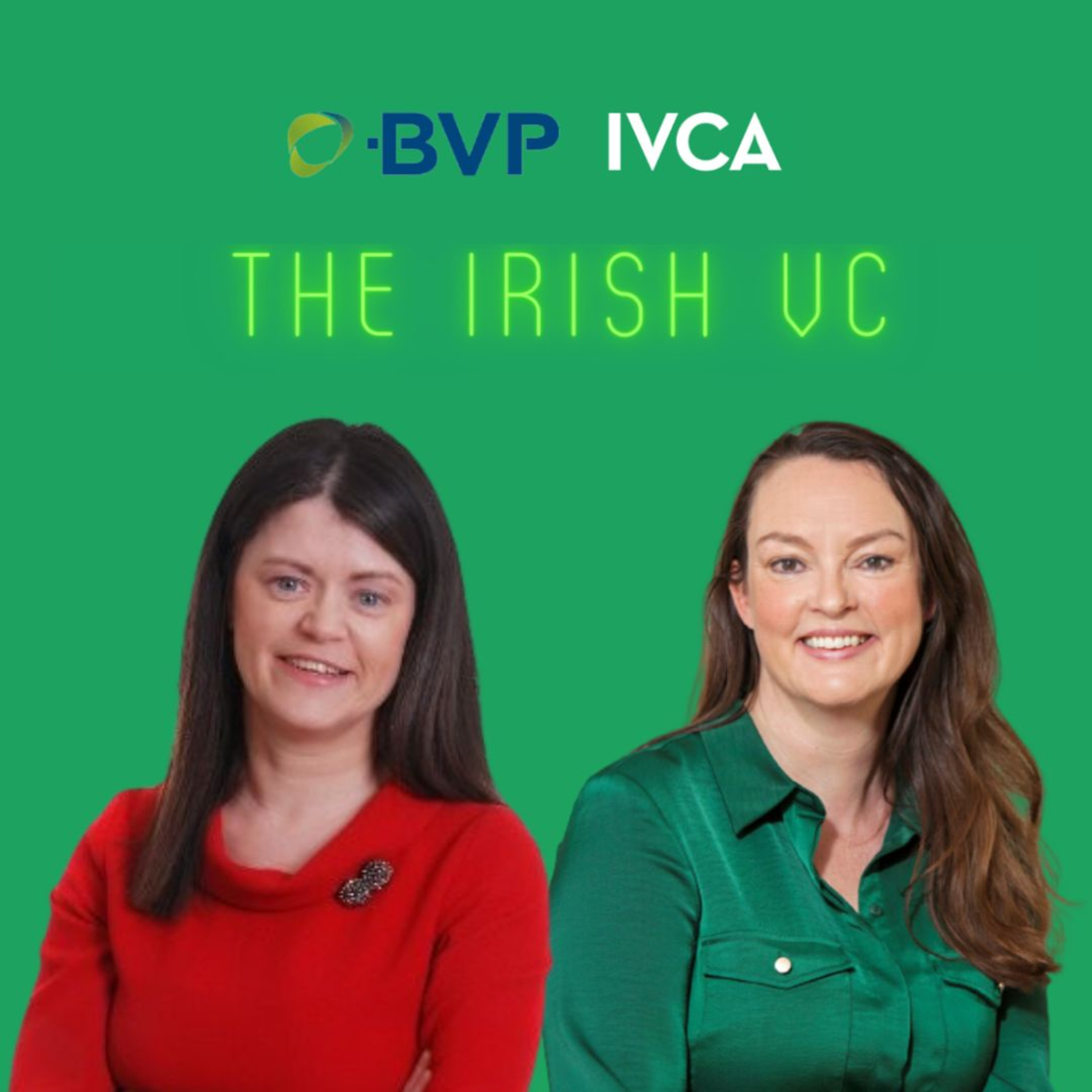
The Irish VC ep24: With Gillian Buckley, 40 Years of the IVCA
from The Irish VC
28m 13s
This conversation between Sarah Jane Larkin of the IVCA and Jynian Buckley of the Western Investment Fund reflects on 40 years of venture capital in Ireland. Buckley recounts Ireland's economic evolution from the 1980s, driven by education and policy, into a technology hub. She details the founding and success of the Western Investment Fund, which, starting with €20 million, has generated thousands of jobs, spurred significant R&D, and leveraged over a billion euros in further investment, showcasing the power of targeted regional development. As the IVCA's first female chair, Buckley advocates for greater female participation in the industry and entrepreneurship. Looking forward, key challenges include mobilizing private capital through tax policy, improving the commercialization of Irish research to create global market leaders, and ensuring venture capital addresses existential threats like climate change. The discussion underscores venture capital's critical role in Ireland's past prosperity and its potential to shape a positive, technology-driven future.
[Music] I'm Sarah Jane Larkin, the Director General of the Irish Renture Capital Association, and I'm delighted today to be joined by Jynian Buckley, Head of Investment at the Western Investment Fund, which is part of the Western Development Commission. And not only is Jynian head of Investment at the Western Investment Fund, she's also the first female chair that the IVCA ever had a number of years ago. So as we this year celebrate 40 years of the IVCA, you are very welcome, Jynian. Thank you very much, Sarah Jane. And Jynian, 40 years of the IVCA, it's a big milestone. Thankfully, we've had a few other female chairs since. And I'm actually struggling now to remember what year you were chair in, but it was pretty recent. It was infamously the COVID year, Sarah Jane. Right, you didn't you didn't get to have a chair's dinner. That's right. You didn't have a chair's dinner. Yeah, I remember that now. Certainly. It was still certainly a very active and challenging year. So I was an important year with no chair's dinner, which has got me off the hook, really. And talked to me about 40 years of the IVCA. I know you haven't been in this industry for 40 years, but I do remember you telling me about being one of the very few females at an IVCA dinner back in the day. Yeah, I'm glad to say I have been around for the 40 years, not far off it. I was just thinking back that the IVCA has just been such an important organisation to represent a critical part of the enterprise ecosystem. And when I think back that it was established in 1985, I was a teenager, a young teenager, but it was a very grim country. You know, my older siblings would have been immigrating. We had mass unemployment at the time and we had mass immigration. This was the year of self aid for some of your listeners might remember that. Larry Goggenwitty's job every day on the radio show, people advertising jobs that they had. So to see that transformation in this country, I think it's quite phenomenal. I think we're a beacon of light to a lot of other developing countries as to what can be done. But the seeds that that got set as was in the 1950s and '60s around free education. And education has been such a pillar of our development as a country and continues to be our transformation. We missed out the industrial revolution, but we got there with the technology revolution and the knowledge revolution. So it has been quite a phenomenal 40 years. And I think as well as the IVCA and the VC industry, we've been enabled by government policy. And I think a lot of times we don't give ourselves enough credit for our achievements as a country. We're a tiny open country in five million population. That has gone up from I think three and a half probably when we were 40 years ago. So it's phenomenal growth, phenomenal prosperity. And a lot of that down is down to hard work and policy framework that the government and the state agencies, enterprise Ireland has been hugely important to the success in the journey that the venture capitalist industry has had as well along the way. Yeah, absolutely. And how did you, for anyone listening, how did you find yourself in this fledgling industry of venture capital back in the day? Back in the day and definitely a lot of your listeners won't even remember this, but there was things called job ads in the Irish Times on Friday. So I applied for a job. I was trying to get back to the west of Ireland and I was about to get married. And husband had followed me down here originally and I left. So I was trying to get back. And I applied for to set up to become the fund development manager for the Western Development Commission. My really didn't have any idea what that was, but any job in the west of Ireland that looked vaguely interesting I was applying for. And it was, you know, it was amazing opportunity to just join an organization at that nasi and to time. I think I was employee number five and we didn't grow to more than that for a number of years. But I had to bring the concept of the Western Investment Fund and initially was a page on a report to reality finding its funding, getting legislation in place, then getting state aid approvals and then finding the deal flow. And that all was a every, every aspect of that was a mountain to climb. So it has been quite phenomenal. And I would have been aware of quite early on about the Irish French capital association and also at the time the European Capital Association. And we were very unusual. We were supposed to be setting up as a commercial fund, but we were a state body. So it was kind of an oxymoron there. So I very much aligned the fund with the Irish venture capital association, became a member and also became a member of the European venture capital association to kind of set our our soul. We were commercial. We were going to be operating this on a return basis. So that's where the journey started. And it's been quite phenomenal. I'm not sure my even then did I expect the kind of success that we have had. And it's amazing to be able to take such an asian concept. We got originally 20,000 euros, 20 million euros apologies for the equity side of the fund. We're involving deals now that are 20 million euros, you know, and one thing the company would get around will get 20 million euros. So at the time, it was still quite a lot of money. They gave it to us in small amounts of three to four million a year. But at the time, we only thought we were getting that money. So I devised what I knew and I found out in hindsight was an evergreen strategy. I didn't even know the terminology at the time. So all our returns, we get to keep and reinvest. So not only have we just revolved the fund, which was my target? If I could revolve the 20 million, I would have been it would have been quite an achievement. But we've grown that fivefold over that period of time. All that money goes back into new enterprises and into follow on investments to generate more jobs and companies in our region. So it's been a very virtual circle and quite an achievement. Yeah, it has been a phenomenal achievement. And I know you did some analysis or end of yourselves a couple of years ago. And I think even you were surprised by, you know, some of the spin-off impacts that had had been generated. Yeah. And again, for policy makers that might be listening, I think it's really important to kind of look at the Western Investment Fund. There's a very targeted intervention for regional development can achieve. So the research was done independently by Indicone Economic Consultants. And they have found that directly there's 5,000 people employed in the portfolio companies, over 10,000 on an economy-wide basis. But phenomenal things like the wider GVA, the revenue generated directly and indirectly is by 4.6 billion. When I start seeing billion associated with our fund, I just really was quite staggering. But even our portfolio companies, they've spent nearly 700 million on R&D. Yeah. When you think of we started out with 20 million, that kind of multiplier is quite exceptional. Between exits, leveraging out public and private monies, both the VCs, angels, but also as very significant European money through Horizon 2020 and the IEC Accelerator, we reckon that there's been about a billion euros leveraged again from our little 20 million pot that we started with. So it really does show you cause an effect. Brilliant. And obviously we touched on earlier. You were the very first female chair of the IVCA. So we can't let this conversation pass without talking about that little. Yeah, sure. And I've been advocating for, I suppose, female entrepreneurs, most of my career, I actually, when I was doing my degree in University of Limerick, I did entrepreneurship. I wanted to do entrepreneurship. I actually thought I was going to be a founder. And I got distracted, but I got, I got, I got, I got to help lots of founders as a result of, of, of that journey. So even back in when I was working in me, that I set up the mid branch of network Ireland, which is for women in business and enterprise. So that's how far back I would have gone and tried to encourage female entrepreneurs. So I'm quite passionate. It's quite a challenge, but it's again, and I'm, I code us to yourself and the IVCA for prioritising females working in the industry as well. And to try and encourage more women through the industry. And I think it was, it was quite high profile that there was a female chair. It made a statement. I, as you know, had to be asked a couple of times in typical female style. I think women tend to have to be asked, well, and we'd have to kind of get over that. But I think there is a huge sea change. I think this is an industry that really suits the female psyche. We get the wider finances and the technologies on the aspect of a deep impact that these companies have. And if they don't have impact they're not going to sell. So we see that.
And the profound change, and I think of what some of our companies have achieved. And the solution to COVID was technology. You know, it was science and technology. Now, behavioral science was important as well. But the real solution came from technology, and I think a lot of the solution. The problems we're facing as a country, and we might, our planet, we'd my touch on laser, we'd come from companies that have been supported by venture capital. Yeah. Absolutely. But it was, you know, your time as the first female chair was definitely has shaped the path of the IVCA, and you know, one of the things that we try to do, and we have managed to successfully do, since your tenure is alternate, a male and a female chair every year since, and, you know, but, but, but breaching that kind of, that barrier was, you know, was, was, was really important. And, you know, we, as I, I'm always struck when we, we speak, and, you know, we, we spoke a lot during your time as chair, and we, you've been on cancel for, and for a long time. So we, we do get to speak, you know, fairly regularly, but I'm always struck about your passion, and, you know, your knowledge of how policy can, you know, can really shape economic impacts in, in communities that are maybe outside of the, the, the urban metropolis that we, we have kind of a left field question that I haven't flagged to you. So apologies in advance. But if you were, if you were T-Shock for, you know, for a month, and you were looking at kind of the Irish economy, and, you know, what you would do for, what would be, what would be your, your top priority or top priorities? From an investment point of view, is to unlock the private sector money. I think the public sector is more than put in its shoulders to the wheel, but we need to unlock the private sector money. And I know the IVCA, and we even, under my two year, I worked with you closely on the chair. We really tried to influence national policy, but there is 156 billion languishing in almost zero presenting deposit bank accounts. All that money could be put to a very productive use. Likewise, the pension funds. And these are the future. That money is for our future. By generating more jobs and more highly paid jobs, we're generating more taxes for the government, we're generating more less burden on the social welfare system and the pensions in the future, because we now have a sovereign wealth fund, and we now have wealthier people as a result of investing productively in productive investment. So using the tax code to me is a huge leverage that the government has to try and unlock that private sector money, or in some way reduce the risk to people to put their monies into that. I mean, crowdfunding and mechanisms, angel investing or mechanisms, but they're quite sophisticated. Is there easier ways for people to put their earned earned money into productive use, where they will get a good return financially to themselves, but also for ironing and for society. And to me, investing in venture capital and early stage angelic investment is an absolute no-brainer on every level, and the more we can do of that, the better. Brilliant. Thanks, Juliet. You know, we're talking kind of work this year, the team of the IVCA and probably the team of this, a lot of the podcasts that we will do is around that 40 years, because 40 years is, you know, it's a big milestone and it's something to be, to be celebrated and reflected on. And as I've said, and I'm a painstaking point out you have not been in this industry for 40 years, but you've been, you know, you're one of probably the, you know, the, one of the veterans of this industry. You're one of the veterans. That's, that's a great way to put it. Yeah, you're one of the veterans. So how have things changed in your time? Phenomenally, in a lot of ways. And it's supposed, again, in other ways, they don't change. To my mind, the biggest change has been the caliber of the startups of the entrepreneurs. They are so much more professional at the time, you know, in our early times, it was, a guy was an idea. Yeah, but now the, the, the market research, the business planning, the decks, they're all so much professional and the teams, it's no teams and it should all, before an entrepreneur was considered the lone wolf, lone wolves, they're the outlier. Yeah, companies are built by teams. Great companies are built by teams. Now, you have to have a leader within that teams and a range of skill sets. That's one of the biggest transformations I've seen, the caliber of the, of the companies that come looking for funding. It's still very challenging. An area that, again, from a policy point of view, and I would have shared this with yourselves and the likes of Enterprise Ireland and politicians that we would engage with, is I think there's a weakness within the commercialization aspect. I think we've got really, really good in R&D. And again, comes back to when you focus on any show, what you can do to change the move the dial. And I think we as a country have been phenomenal on the R&D side of things. We probably can hold our own with the best in the world. The commercialization is a real challenge. And a lot of our companies would have relatively early exits. They would sell to multi-nationals. And then that's great in the short term. But for Ireland and Dink, that's not ideal. What can we do? And I know Enterprise Ireland, in particular, and I, Seth, are looking more to the scaling side of things. What can we do for our companies to become the acquirers? Not the acquirers. And again, the dragy report was very, very clear in weird lagging behind here in Europe. And one of the things, and it wasn't pointed out in dragy, but one of the things I would have been aware of is we only have, I think, four universities across the EU, across the entire of the EU, only four of our universities hit into the top 15 in the world. Wow. The UK on its own has seven in the top 50 and four of the top 20, I think, even the top 10 in the UK. So we're not, while we have the brains, clearly European brains are as good as your Chinese brains, our American brains. But we need the caliber of university to attract the very best, to drive that innovation that dragy was talking about. We then need to come back with real money to really drive that. And the challenge, and the challenge, particularly for public sector is where you take very high risk, there is likelihood of failure. But failure has to be not necessarily celebrated, but it's part of the journey. Yeah, it's part of the journey. So if we, at a national level, but also at a European level, we really do need to take on board, if the dragy report, and I think what's happening in the last 12 months even makes that even more and more pressing, we need to have, we need to near shore more, we need to have much more self reliance at the European Union level around supply chain, food security, energy security, all those aspects so that we have a stable world that we can thrive in. And speaking of that stable world that we can thrive in, you know, if you, if you, if you had a crystal ball, and you know, if we're taking kind of 40 years as a checkpoint, what do you see over the next 40 years? Yeah, that kind of gives me a fright asking me what was going to be like in 2065. It seems such a long way off, but last 40 years seems to have gone back quickly. I hope we're all still here, Sarah Jane. Yeah. I mean, there is an existential threat to the planet that we very much need to address. I do think technology and the venture capital industry will be a huge part of that solution around risk mitigation. But I think sometimes we as a human race need to be falling off the cliff to realize that we need to solve the problem. We know there is a problem. We need to solve it now before it becomes too damaging. And again, it will be the developing world that will suffer the most. So I do hope we're all still here. I think and the other aspect as well as this coming at us from every direction is the use of artificial intelligence. How will that all manifest itself for good? And again, the VC industry is huge investors in those sectors. How can we make sure that for societies well-being that AI is using? I think it can absolutely be a game changer for the planet and for human kind if it's used in the right way. That's probably there is to the right way. There isn't much risk around that. And a little bit of an aside, I've bought the Stephen Hawkins book from my son recently. He studied theoretical physics. There's a chapter on AI in it. I don't know who in Stephen Hawkins wrote it. I think for Zaird Lear in kind of the mid-Tinis, but he referenced the fact that himself and Elon Musk were on an advisory committee around the regulation and the safe use of AI. I think we need to make sure that that happens. Yeah. Did he have a, I must actually, I must look at that.
that would be an interesting read. And then-- - And then things like that and Steve Jobs, you know, those guys that were just aptly visionary for positivity. That's what we need. We need positive visionaries. - Yeah, I think we can kind of all get behind that. (laughs) And speaking of positivity, let's talk about the positives. What do you think? Because, you know, your fund is unique in terms of its investment mandate along the Western Seaboard. And what is, you know, yet, you've probably managed to have one of the very best investments that our industry in Ireland has ever seen. So would that be the one that would be classified as your best investment or? - And again, it's a bit like some of these that feel like your children are times. They're all my favorite, Sarah Jane. (laughs) The first big exit has to always have because we have gone through numerous cycles in the Western investment fund. We were just barely getting going and dot bomb happened. Then we had the Celtic Tiger and we'd apart blue to patch. And then we had the financial and economic crash for our own funding got cost. And then we were climbing back to sustainability and survival. And we had the Nuravia exit. - Yeah. - But that was a game changer for us from the point of view of having some real cash available for reinvestment. The Nuravia team were extraordinary. And we, they had been successful in previous companies. So there were serial entrepreneurs at the time, John O'Shaapnese was coming in as chair and Aiman Brady and was coming in as the CEO. Even at that, they struggled to raise funds. So the Western investment fund was a seed investor alongside an angel at the time. In 2009, I think it was. As the world was crashing around us, put an extraordinary team with an extraordinary vision and an extraordinary product clearly. But again, it would have gone through ups and downs. It's every investment, I think, is a bit of a roller coaster. We were, we feel a huge, huge part of our role is to leverage out private monies as well. So Delta and Fountain came on board, I think in 2012, that series A and then LSP, which is now EQT, I think they're called, came on board as series B round. And that in itself was quite phenomenal for us in the Western investment fund to have a company that was attracting the biggest players in Ireland from VC and then the European biggest players. That was the most, it was an extraordinary exit. Again, can't deny the multiple, but it was very, very good. But it was still, I think, classified as largest mech tech deal in Europe. So for a tiny little fund in the West of Ireland to be part of that, it's for most is quite extraordinary. But again, the aspects of us, we get up in the morning because these companies are creating jobs, they're creating wealth for our country and for our region. But they're also, I've mentioned a couple of times, the societal impact. So if Nouravi's technology, they were developing Gen 3 while Gen 1 was in the marketplace. So they were going to, if they got it over the line, they were going to blow the market out of the competitors out of the water, which is why it's for such a good exit. Now, they could have fallen down at any number of hurdles. But now anybody like has treated with Nouravi's technology a stent retriever. They can go back as for ice gimmicks stroke. So they can literally go back within a matter of minutes to normal life or near normal life. It's that much of a profound game general of the treatment. And the healthcare board and cost saving, per patient is $190,000. Imagine. Imagine. So you're talking about-- and stroke is becoming an ever-increasing challenge. For a small company in the West of Ireland to have developed that truly disruptive technology, that is such a game general for patient health. And make a lot of people, including ourselves, an awful lot of money that has been reinvested. Because a lot of those entrepreneurs we've actually gone back in with Damon Brady and his team into Whiteswell, which will even be more profound technology. A lot of the other investors would be serial investors now in the region as well. So again, the virtual circle. I should calculate how much tax the tax man got out of it if he did very well. The Dix-Chequer has done very well between capital gains, tax, and everything else out of that investment as well. So again, the virtual circle, and I know the IPCA is very much in the 40 years looking at success stories. And I think that's the aspect that needs to be highlighted as well. If we all got-- If it's a bigger cake, it's a bigger slice of a bigger cake. So that's the other thing to try and grow it. 100%. And Jelene, given your absolute wealth of experience in this industry, I'm going to finish up and ask you for some tips for anybody who's listening, who's looking for investment. What is the main reason in the past why you haven't invested in a company? And what tips can you give anybody seeking investments? So I'd be a little bit facetious, say, because they're not in our region. That doesn't stop you moving to our region, guys. We are a very supportive benign investor. We go in at a very early stage. So the teams aren't fully formed. They're rarely the product or service that's fully developed. The market opportunity is hope value at that stage. And the finances clearly are flaky, because they're very early stage. So in order to say what we don't do is what we would require-- so you need to be able to have made certain progress. You need to know that you can fill out your team. You need to know that the market opportunity and how you are going to access it. And rather than saying it's a billion-year opportunity, we're going to get 10%. A lot of times you'd hear that we're phenomenal. How are you going to get the 10%? Is that realistic? You really have to get granular. And then the products and service, your pathway, whether it's software, service, clinical registry, and reinforcement to so many more aspects when it's a MedTech Life Science project. But for us and other investors may be different. But for us, a deck is not a business plan. A deck is the calling card to say, would you be interested in seeing my business plan? But the number of projects that do not have a business plan-- and I think at this stage, they shouldn't have to have a business plan. It doesn't have to be 100-page document guys, but you have to know how you're going to build the business. There are too many places that it can fall apart. So the more you can plan, the more you can pivot if you require, because you'll have scenarios of what might work or not work. And so the business planning-- and I think that's a bit that might have been lost along the way. That to me is absolutely fundamental. Brilliant. Well, super advice, super insights, as always. It's always a pleasure to talk to you. And thank you so much for giving up your time to talk to us today. Jillian Buckley, thank you very much. Thank you, Sergei. [Music]
Podcast Summary
Key Points:
The Irish Venture Capital Association (IVCA) celebrates 40 years, highlighting Ireland's transformation from economic hardship to a tech/knowledge-driven economy, supported by education and government policy.
The Western Investment Fund, a regional state-backed commercial fund, demonstrates significant economic impact through job creation, R&D spending, and leveraging substantial private and European investment from a modest initial capital.
Increasing female representation in venture capital and entrepreneurship is emphasized, noting the importance of role models and the industry's suitability for women.
Future priorities include unlocking private sector capital (e.g., deposits, pensions) through tax incentives to fuel productive venture investment and addressing commercialization challenges to build scalable, acquiring companies in Ireland.
The next 40 years will require leveraging technology and venture capital to solve global challenges like climate change and ensuring artificial intelligence is used ethically and for societal benefit.
Summary:
This conversation between Sarah Jane Larkin of the IVCA and Jynian Buckley of the Western Investment Fund reflects on 40 years of venture capital in Ireland. Buckley recounts Ireland's economic evolution from the 1980s, driven by education and policy, into a technology hub. She details the founding and success of the Western Investment Fund, which, starting with €20 million, has generated thousands of jobs, spurred significant R&D, and leveraged over a billion euros in further investment, showcasing the power of targeted regional development.
As the IVCA's first female chair, Buckley advocates for greater female participation in the industry and entrepreneurship. Looking forward, key challenges include mobilizing private capital through tax policy, improving the commercialization of Irish research to create global market leaders, and ensuring venture capital addresses existential threats like climate change. The discussion underscores venture capital's critical role in Ireland's past prosperity and its potential to shape a positive, technology-driven future.
FAQs
The IVCA is an organization representing a critical part of Ireland's enterprise ecosystem, established in 1985. It has played a key role in supporting the country's transformation through venture capital, contributing to economic growth and prosperity over 40 years.
Jynian Buckley began by applying for a job as the fund development manager for the Western Development Commission, aiming to return to the west of Ireland. She helped establish the Western Investment Fund from concept to reality, overcoming challenges like securing funding and legislation.
The Western Investment Fund has generated significant economic impact, including directly employing 5,000 people and contributing to a wider GVA of 4.6 billion euros. It has also leveraged about a billion euros from an initial 20 million euro pot, supporting jobs and companies in the region.
As the first female chair, Jynian Buckley made a high-profile statement that helped encourage more women in the venture capital industry. Her tenure paved the way for alternating male and female chairs annually, promoting diversity and inclusion in the field.
She notes that startups and entrepreneurs are now more professional, with better market research, business planning, and team structures. However, commercialization remains a challenge, as companies often have early exits instead of scaling to become acquirers themselves.
She recommends unlocking private sector money, such as funds in deposit accounts and pension funds, by using tax codes to incentivize productive investments in venture capital and angel investing. This can generate jobs, taxes, and reduce future social welfare burdens.
Chat with AI
Loading...
Pro features
Go deeper with this episode
Unlock creator-grade tools that turn any transcript into show notes and subtitle files.
 PodcastTranscript AI