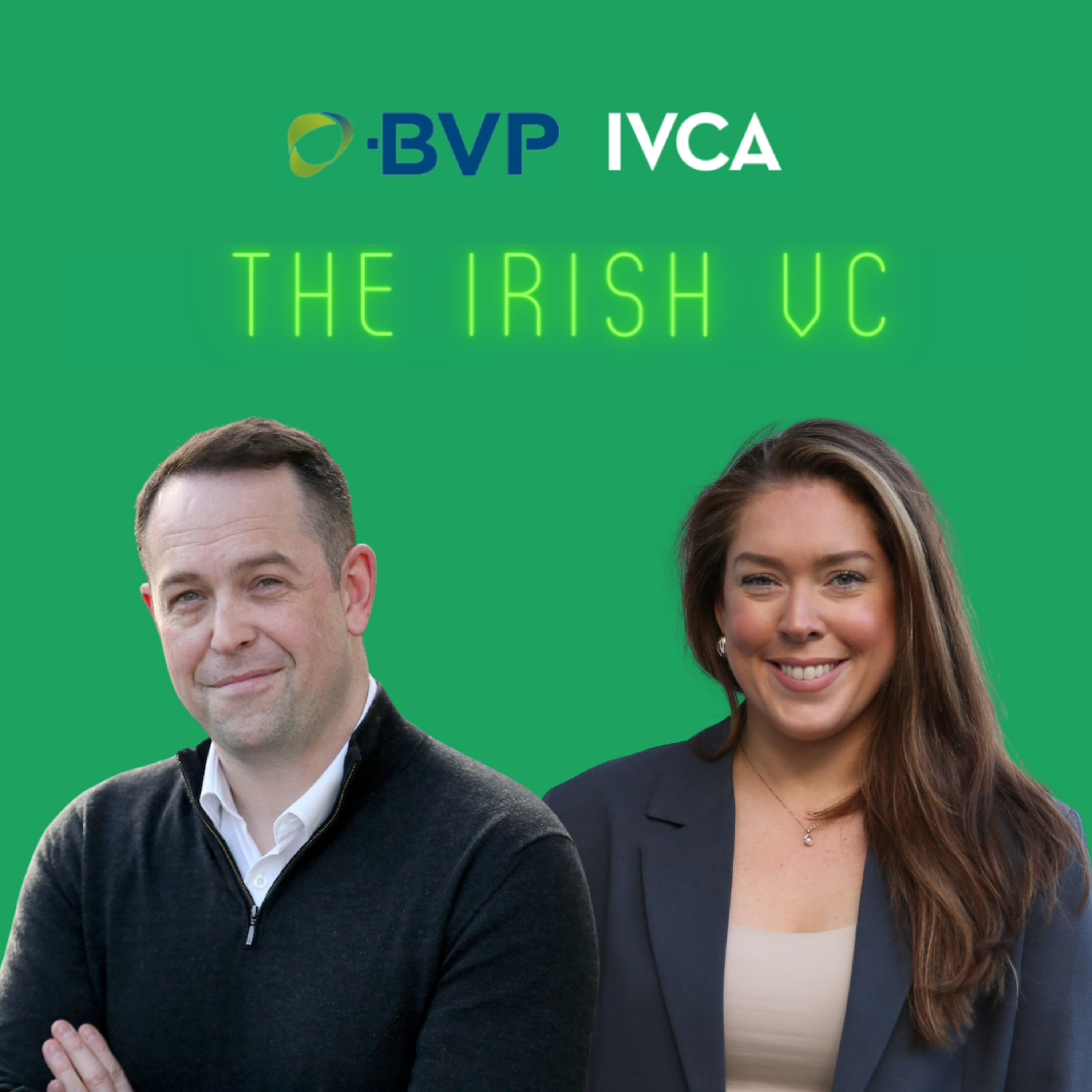
The Irish VC ep:35 The Inside Scoop with BVP Director Stephen Burdock
from The Irish VC
33m 32s
In this podcast interview, Stephen Burdock, Investment Director at BVP Investments, discusses his career journey from traditional banking to venture capital and outlines BVP's multi-asset investment strategy. The firm provides both equity financing through tax-incentivized schemes and a debt fund aimed at supporting companies in green transition and growth sectors. Burdock shares key insights for founders pitching to investors: he prioritizes the strength and alignment of the team, deep market knowledge, and a clear vision for scalable growth over mere financial metrics. He warns against overconfidence without data and emphasizes the importance of preparation and internal consistency during pitches. For founders facing rejection, he advises accepting constructive feedback, staying in touch with investors, and demonstrating progress toward milestones. Burdock stresses that an investment from BVP signifies the beginning of a long-term partnership, typically lasting 4-7 years, where ongoing support and network access are as crucial as the capital itself.
(upbeat music) - Hello and welcome to the RSVC. My name is Marie Nolan and I work with Business Fence for Partners and I am delighted to introduce our guest today. He is the director of BVP Investments, Stephen Burdock, it's great to have you on the podcast. How are you keeping? - Very well Marie, thanks for having me on. It's a pleasure to be here with you. - Yeah, you're not an unfamiliar face now, you know. We do work together, we are colleagues, but we work in different departments. So it will be great to get your insights on the investment side of things, but just before we kick off into it, you might just tell us a bit about yourself and how you got to where you are in BVP today. - Sure, I think my journey to where I am today in BVP is probably slightly less traditional than perhaps in my team. My career from the outset started in frontline banking. So I actually began my career working on cash within AIB, working across foreign exchange, customer service, across the retail instruments, residential mortgages before moving into what was then relationship banking and into corporate banking. And so for me that grounding was really interesting actually because you get to see the fundamentals of how, for example, foreign exchange works in a business, understand forward contracts, it's importance, currency fluctuations, and everything else that goes in between. And so it was a really interesting start to my career before then I moved into a more credit or lending type focused. And at that time, really the economy was going really strongly, things were booming and then suddenly we had the big stop. And so the transition into lending for me again was probably less traditional than normal because suddenly we went from a period of great success into what was recovery and restructure. And it taught me a lot again in relation to various different types of businesses, their stage of development, how the teams managed with adversity in many respects. And what was the bank able to do within those parameters which were limited at times. And so it was really a full spectrum between companies from blood stock farms to hospitality and everything else in between. And as I say, stage of development. So that was my first foray, if you will, into banking. And from there I moved into professional services. I worked and managed to join venture phone between BDO and Davey, which invested into SMEs under equateist instruments. And so that was an extension of what I had been doing within AIB in terms of providing credit and stimulus funding to companies. And we did that for a number of years. And ultimately it led to me moving to BVP as an investment director firstly. And then I've been very lucky and privileged to now sit on the board of directors, alongside my colleagues and lead out our investment team. But I guess in summary, it's that full spectrum from the early days of banking and into credit, then into what was the start of private investment and an equity journey. And now into a full circle moment that lends itself to BVP in relation to our core offerings, which are equity and debt products and stimulus funding for growing companies. Yeah, that's fantastic. And you've obviously been around the block and from your experience in the debt and equity side. So BVP do offer both. So it's obviously a great background to have in the business. Do you want to tell us maybe a bit more about BVP and their offerings before we get into the depths of the podcast? Yeah, of course. And look, I'm happy to talk a lot about BVP. And so as a whole, the firm is a multi-asset investor. And in really simple terms, what that means is we have core products and we've alluded to them so far. So one of our core products is obviously equity funding based around the EWI S scheme, which is a tax relief incentive rather for retail investors. And so every year we will raise a couple of 10 to 15 million and deploy that into SMEs across different sectors, creating a diversified or basket approach for investors. And really the purpose of that vertical is the potential for capital appreciation and obviously underpin it by tax relief for our investors. So it's a really attractive proposition for companies that are looking for funding across different sectors. So it can be to a degree pre-revenue. It can be early stage. It can be somewhat later stage. We're not quite sector-agnostic. And there are core sectors that we will invest in. So really quick example will be renewables, emerging technology, mobility, a small bit in consumer goods and services, medical tech and technology. And we could go on and I do appreciate this 15 subverticals within that space. But that hopefully provides a sense of what we offer under the equity side. I would say our typical approach in terms of investment cycle is somewhere between four and seven years. And our investment amounts are somewhere between 500,000 and maybe upwards to three million. So a broad range in that spectrum of diversification that I mentioned. And then equally when we look to the other part of our business, which is our debt fund, we've been involved in private credit for a number of years and more recently raised institutional support from the SPCI and the European Investment Fund for a 50 million debt product that is fundamentally about supporting companies that are looking to apply green transition. And so what that might at first glance appear very focused on renewable energy. I can assure you it is a broad enough mandate with eligibility criteria that covers a similar spectrum to what I mentioned under the EWIS focus, which is manufacturing businesses right the way through to digitization of services. And so what we're looking to assist funding with is working capital, capital expenditure and a broad spectrum ultimately for various different companies. And that product is a culmination of our own experience across equity and private credit. And it sits at an intersection that's become really, really energized for a lot of companies that we're speaking to because it sits probably or simply between what would be pillar bank lending and perhaps venture debt. And so it's a straightforward product that lends the companies that are growing over a period of time. But where we have the ability to scope for payment profiles is that leap from what is traditional funding instruments bringing our experience to the table as a result. So really, really interesting combination across both sides. And when we say multi asset, that's what we mean, a tech-reality in debt. But I think the most important takeaway, I'd like Annie the listeners to hear from our discussion today is that we really are aligned with partnering with companies that we invest in across different life stages of a business. And that might be early stage equity followed by later stage debt or something in between. But it is that sort of blended approach that we like to offer across BVP. And are you open just for anybody that might be listening that is looking for investment? Are you open to having meetings throughout the year if anybody is looking to arrange something with BVP just to have an initial chat? Or is that something that you're open to all times the year? Yes, of course. At all times the year. I mean, the interesting thing about our business is that it isn't exactly seasonal. And so we raise funds every year. And we have the allocation to deploy those funds typically over the subsequent 12 more period. And so yes, would be the fundamental and short answer to that we always are. And equally in relation to the debt product, it isn't cyclical by any means. So of course, we're very open to have a chat myself and the broader investment team at any stage. Fantastic. So I think we'll just deep dive maybe into the investment mindset and decision making cyber things. Because I think it's really interesting, especially to get your perspective on it because you've probably sat in many rooms, listened to many pitches, and just have a great understanding of the different sectors and what works, what doesn't work. So one of the first questions I have is about that first impression because, as we all know, you only get one. So I'm just curious, is there anything a founder does? It may be in the first 60 seconds of a pitch that makes you lean in to listen that really gets your attention? I think that's really interesting. How I would phrase it is, or how I would look at it is what gets you through the door. And so in that early start or early part of a conversation, what is going to capture the attention rather of somebody like myself or any potential investments partner? I think for me, it's market knowledge. It is something everyone talks about. And one of the things that will stop anyone in their tracks is generalities about large markets. Or it tends to lead to a loss in confidence pretty quickly. So what I really like or what really would capture my attention is telling me something I didn't know as soon as I walk into a meeting. So all founders are very unique.
very specialised in their own areas. And so typically they'll share information in advance. And I'll have a sense of something. But something that captures attention is definitely something I wouldn't know as a founder, unless I was part of the business living and breeding it every day. And so that really quickly helps to capture somebody's attention. That's usually a really good one. And another thing for me that I tend to look at at an early part of a conversation, or as we first meet founders and broader teams, is actually the team versus the idea. And so often people will say it's the idea that captures the attention. That's true. In many cases, but for me, it's the team that actually wins early stage attention. Because business models, financial models, change over time in my experience, less so are the people likely to fundamentally change beyond that point. So that's a really interesting dynamic between those two aspects of market knowledge and team versus the idea itself. That's really interesting, because it is that question. Is it the idea versus the team or the person? And you've just said it there, fundamentally, you're investing in the people. And then maybe the idea comes secondary to that, or a combination. But then also wanting them to be an expert in the field and telling you something that you didn't know. Exactly that. And for me, the sense I like to have after an introduction meeting or getting to know a company for the first time really is that a great team finds a better idea. If you understand, they'll evolve, things move, things change. And so they will look and find a grasp, that idea, or a better iteration, maybe, whereas sometimes if the team is struggling, you can find often leads to under execution rather than having a great idea from the outset. Yeah, it's so true. Even in our own business or in any business you can really think of, they start out with an initial idea. And then, sectors change, maybe AI is a very big influential factor, and it changes the company. And the idea is then roll with that. So that's really interesting. And then just another question I had was, would you have any advice on what an ideal pitch involves? And what investors might be really looking for? I mean, is there a single ideal for a company to pitch to investors? I'm not sure there's a single ideal. I think it's more about having your preparation done before meeting Andy. And what I mean by that is understanding who you're pitching to. So if you're not pitching to a very generic investor or you're impaching to an investor that's specifically focused on an area of expertise, then lean into that. Would be the first sense. And then for me, the idea of pitch is one that leads with trajectory. So really, really highlighting that scalability and growth. And it's trajectory as opposed to absolute figures. That's really what begins to excite me. It shows me a company is focused on growth, revenue retention, improving the key metrics we're all looking at in relation to customer acquisition costs. And what it shows me is the repeatability of motion, even if it's small today for an early stage business. It's how this business can repeat and scale true economies. And that's not often what you get. Often we might hear hardline facts about top line revenue and net profit, et cetera. But for me, it's about the vision for growth and the strategy to deliver upon it. That's probably the ideal pitch for me. And from your perspective, so you just talked about the ideal pitch there. So on the other end of it, what would be a red flag or something that you don't like seeing in pitches? You know, again, it's interesting. I don't think-- certainly, I don't get the opportunity to mention this in terms of red flags. And I don't want it to feel as if it's a complete no-no from my perspective. But I think silent deal killers, if we want to call them that, is probably overconfidence without evidence. And so for me, and it's probably a default behavior and a bias in mind. I think conviction needs data behind it. But another highlight that I think is important to be aware of for any pitch is that often we mention the team at the outset. For me, if you have a CEO and a CFO, if there's inconsistencies between the team, and I've given the example of a CEO and CFO, it signals internal misalignment. And so that's usually a concern from the outset. So it's really important to align back to my point about preparation before you're pitching so that there is a symmetry and a good cadence between the leadership team and any company that alone won that's pitching for investment. And has there been any times that you've seen a good idea and you can see that the people are good, but then at the same time, maybe they are misaligned and they don't have everything that you need at that point in time and you give them a no. Is there any point in time where you would say, come back to us later and then you'd go back and review them at a different stage? And it could be a yes. Is that something that happens? I think so. It happens more often than people probably expect to be honest because there isn't an exact science to a pitch. I think a lot of us will accept that. And wrong, like strong pitches can fail. And it can be for a number of reasons, be it unit economics or different views in relation to how a story should be told. And for me, it's about testing resilience. So I mean, a company could come back or we might reach out to a company having passed on it. And so it's really about trying to understand, look, what was the hardest moment? What did we learn in terms of the real vision rather than the polished one? We're looking for, I guess, analytical honesty, not performance of strength necessarily. And so for me, that sort of speaks to a self-awareness on both sides from the companies or our founders and equally from a potential investor about strengths and weaknesses as opposed to what's rising wrong. And what advice would you give to anybody who have got to know maybe from one VC, numerous VCs? What advice would you give them? Hopefully, if they've got an advice-- and it's something I'm acutely aware of within BVP-- is that when we are giving feedback on why we're not progressing within investment opportunity, we try our absolute best to be constructive in what we say. And so it's too simplistic. Sometimes to say, look, a business is too early stage for our funding. But instead, what I'd prefer to offer is something along the lines of, what KPI might change to dial here? Is it a revenue-run race approaching a couple of hundred thousand, or is it a particular contract that would change the proposition? So I think it's in the first instance to accept and acknowledge that feedback and how it's given. And it's important that it's taken in the good faith that it's offered. But my advice to any founder or any business that's maybe had a tough time or some feedback in that context is to try and keep your investors or potential investors in touch. Stay close to them. Often people have newsletters include BVP on that. And send out your feedback as the company is progressing because investors are watching these things all the time. And so for me, it's trying to keep people informed of progress really is the best thing, acknowledging that the feedback, as I say, was given in good faith. And if you can hit those milestones or at least show an uptick, it's trending towards what the investor is looking to see, I think that its communication for me is the key in that aspect. And that would be my advice. Yeah, fantastic. And maybe just keeping that relationship going, as you say, even if it's a no, just kind of leaving amicably and then seeing how things built in the future and there might be something then that might grow. So I'd love to look on the flip side of things as well. So from a BVP perspective, I'm from your perspective as an investment director. So when it's a yes, and you provide the funding, and the check is gone over, and everyone's happy, what happens then? What does support look like beyond the check? What are we really saying yes to? I hear you. I think when all are said and on, and companies are in receipt of funds, the yes is really about a partnership. And for me, capital is almost secondary. I'm not suggesting it is secondary, but it's a partnership. So you're committing to the network of BVP, an equally BVP are committing to the network of the company and its founding team. And so we're all reliant on each other's experience and credibility alongside the check in essence. And so I always view the funding aspect of it as the beginning of a relationship rather than the fundamental point of it. I do accept it is the nature of an outcome, but it's the beginning of a relationship, and that probably comes back to someone where comments at the outset and perhaps again, biases of mind towards relationship building because I spent a huge part on my career in it. So say if a company comes in,
true EWIS, which is what PVP are really known for. How long can it expect the relationship to carry on? So our typical investment cycle is somewhere between four and seven years. And that's not a hard and fast rule because we have had portfolio companies that have exited earlier than that time frame. And typically they're really important milestones for companies because if a, you know, there comes over the hill with an offer to acquire a company, that's usually positive. And equally the opposite can be true as well, which is maybe something that doesn't work out quite as planned and it goes the wrong way. But typically our investment cycle is somewhere between four and seven years. And so that's really an illustration of my point around the partnership. It is a partnership with a defined exit, but you need to understand that relationship you're getting into with an investor and equally the investor needs to understand the business that's getting involved with. And that's back to our points we discussed in relation to due diligence and trying to understand each other and both sides of that relationship from the outset. And you have to remember someone always takes the other side of what's expected of us. And so working together in those dynamics is really something that BVP provides itself in. And something we try to do, as I say, throughout that investment journey. Fantastic. I feel like you've given us really good advice there already. But I might just move on to maybe the bigger broader picture and looking forward and taking Ireland just as an example, if you were a first time founder in Ireland today, what sector would you be going after and why? There are a few to be honest. And I'm conscious I could probably go into to five or six, but maybe I'm very I'm acutely aware of how topical AI is. And so we could spend the next 20 minutes half an hour talking about AI, but maybe I'll offer a different example because I met a company in the early part of last year and they mentioned something to me that that really struck home and really resonated with me. And it's in the fitness wearables space, right? Which are all moving towards coaching in the market. In all markets to be perfectly honest. But the key aspect to it was that the product need is no longer about just tracking. It's about having a wearable that coaches you in relation to your movements, your health markers can't even be blood biometrics at this point in time. And so I think it's a really interesting space. That intersection between technology and health and fitness and wellness. And I'd add sports into that. And so it's quite a divergence on a number of sectors all in the realm of data. And as I say, coaching as opposed to simply just tracking and offering data. It's the integration of helping people understand how better to improve whatever it is they're doing. Be it a sport in context, health and fitness context, etc. So that's a sector that's really interesting to me. There's obviously topical brands, Foup, Garmin, there's many, many more that I could speak to. But I think it's an interesting sector for anyone to look out. And I'd extend that data play and intersection wear technology across a multitude of orders to be perfectly honest. I don't think there's many sectors that we could talk about that aren't experiencing some sort of convergence on that respect. Now we're not sponsored by Garmin or anything but I will assess to have an agreement and absolutely being obsessed with the data that it gives me. And even this morning I took my watch off last night. And before I was running out the door, I realised it wasn't on my wrist. And I was like, well, I'm going for a run tonight. So I need to have the stats on where my health is at. What my VO2 max is is where my heart rate is. And I feel like that is becoming more than norm. And like that. That's why I see it so much as an intersection across multiple sectors because it's data with technology. And ultimately, if we go back to I mentioned we're involved in the consumer sector to a degree and think about the impact of both of those things on consumers. And I admit the very same thing as yourself. I mean, it's suddenly like leaving your mobile phone at home. You don't have access to data and you feel the absence of it. And so what does that tell us in terms of the emerging play within the data space in a general sense? And that really is what I'm pointing to. The wearable side of it is probably again a default bias of mine. But nonetheless, I think it extends across multiple sectors. And that's really interesting. I think if a founder was looking at in Ireland various different sectors, that's a real sweet spot I think in many respects. Absolutely. And I think it's one of those things that used to be a want. So say, you know, I want the latest garment with the additional stats that it gives me. But then when you get used to it, it almost becomes a need because it's like a part of your body and it's not just the sport and performance, but it is. I feel like it's in relation to my health, which is really important. We're all human and so there's a motive aspect to it. And has goals and ideas personally. And so if you have a piece of the data that allows you to measure, monitor, contribute, understand where you are on whatever stage that you're in is, I think it's just going to become more and more apparent. Hmm. And I think it's really interesting as well. One of the other companies in the portfolio that PVP has is N Pro. And that's another data driven sports kind of tech. And I feel like that's a really interesting one as well because they're doing all these clinical trials in relation to concussions. And it's one of those things that even when you're watching the Six Nations at the moment that you see the, you see the scrim caps and they're really, you know, they're there in your face. And it got my mind thinking when I was watching a match the other day, like I wonder how those clinical trials are going. What's going to be the advancements in these scrim caps that are not traditional scrim caps anymore, but they are trying to mitigate head injuries. And that's just improvements in technology in that space. And illustration of what we've just been discussing. And the thing I'd add about N Pro for me, and it's one of the things that I like about it so much is in the realm where it plays right in the context of sport and safety and protection and data. It's N Pro's transparency that is an on-negotiable. And so really they're trying to fix a very specific problem. That's widely regarded. And they're doing that in a really transparent way, which again, I hope and I believe will elevate it as the business progresses. So I think it's a great illustration. Yeah, yeah, I look forward to seeing what what comes next for them. And then what advice do you find yourself repeating to founders more than anything else? I think is it advice? I'm not so sure, but I find myself discussing perhaps the Irish ecosystem more often than not. And so I think it's definitely dramatically better than perhaps it was even a decade ago. But I think the ecosystem is changing. There is capital for deployment, but I think the landscape has shifted somewhat. And so it could be argued it's more difficult to access capital because a lot of investors now are looking for fundamentals. They're looking for fundamentals to be in place before a process is kicked off by a company. And when I say fundamentals, it's back to what I said earlier about trajectory and scalability and growth and understanding, have either right team, have either right fit, have I a product that commands willingness to pay or compels people to engage. All of these things are factors. And so in many respects, they need to be dealt with in advance of kicking off a funding round. And so if we use the example of AI, which I know is very topical, but it is sometimes hard to distinguish between what is for one for better phrase hype and what is factually available in the market today. And so that's my point is been able to demonstrate and validate a level of traction. It doesn't need to be millions and millions in terms of revenue, but you need to be able to have a validation point that points to an audit trail that helps a funder investor, whoever is witty on the journey, understand what it is you're trying to deliver. In the context of what I've said, the fundraising bar has moved, which I think is an important point for anyone to consider, but hopefully it resonates that from my perspective, that's not necessarily bad news. It really just means it's rewarding strong businesses in its day to development when those fundamentals are in place. So just one of our last questions here is going to be what's a belief that you hold that many of your peers might disagree with? It's a good question. I'm not sure whether they agree or disagree with it, but I laugh from my thoughts in any event. I mean, for me, the best companies build teams that challenge the founders. And so I always have a belief that through travels fast internally. And so it might be cliché, but for me, it's that success, breed success. And so for any founder or any company, I think it's having that challenge network, if you will, that really, really changes the dial in many investors' perspective. And I think that works both sides internally as I said.
for the team and its development and growth and how you pull potential investors in as a result of that. And then again, is it a contrasting view to my peers perhaps, but often I reflect on the ones that got away, you could argue, be that an investment that we did or an investment that we didn't do. And so for me, it's certainly over the years what I've now taken is that every miss is a calibration lesson in how we recognize patterns, what we learned, what we know now that we didn't know then. And so I think that's an evolving process, but it's not the right and wrong of, you know, as I say, a deal that got away or it didn't perform as expected. It's really just recognizing it now as an opportunity to challenge ourselves within the industry of what can we recognize in the pattern, be it good or bad and be able to maybe offer that valuable insight to companies as we're with them on the journey for investment as we do with many of the portfolio companies, but equally if there's companies looking or speaking to us for the first time, it's been able to offer that insight if at all possible based on whatever that pattern recognition might be or learnings may have been over over the years. Well, Stephen, I can say that you have absolutely provided us with some invaluable insights there today, really great advice for any founders listening. We might just tie it up there because I feel like there's been so many golden nuggets in that that we can take a lot away from that, but do you want to leave us with any final words or any bugs? No, I think for me and it's something the investment team will echo is that please do reach out to us would be the first thing I say and then equally we have various different channels that will be involved with so we have an event coming up in the next month or two which I'm sure will be announcing very shortly. We obviously have our podcast channel which has always got interesting guests and then please keep an eye out for our newsletters. You'll see various insights coming out in relation to our product verticals and the solutions we provide. So I think I'd offer all of that and then maybe to finish from my perspective is that if there are companies looking for funding or even some of my peers who might have contrasting views to myself, I'm always available for contact and happy to have a chat at any stage. It's fantastic, Steven. I might just elaborate slightly while we're here and do my own plug for BVP. So we are doing a funder, founder, ecosystem, half-day event on the 9th of April. Look out for it for any funders who would be interested in pitching. We are having a pitching competition so just look out for the invitation slash submission, have look on our socials, our website. You'll find it there very shortly but it will be a great ecosystem network and day and there will be workshops. The Irish VC podcast will also be recording a panel discussion on that. So there's lots going on that day, early April and it will be in the Fantry in the Google offices. So keep that in mind, Steven, it was great to have you on. Thanks so much for all your insights there. My pleasure. Thank you.
Podcast Summary
Key Points:
Stephen Burdock's career transitioned from frontline banking to corporate lending, then to private equity and venture capital, providing a comprehensive background in both debt and equity financing.
BVP Investments is a multi-asset firm offering equity funding (via the EIS scheme) and a dedicated debt fund, focusing on sectors like renewables, technology, and medical tech, with investments typically ranging from €500,000 to €3 million over 4-7 years.
When evaluating pitches, Burdock emphasizes the importance of the team over the idea, market expertise, and demonstrating scalable growth trajectory, while noting red flags like overconfidence without evidence or internal team misalignment.
Post-investment, BVP views funding as the start of a long-term partnership, providing ongoing support and leveraging its network throughout the investment cycle.
Advice for founders includes using investor feedback constructively, maintaining communication even after rejection, and preparing thoroughly by understanding the investor's focus and showcasing unique market insights.
Summary:
In this podcast interview, Stephen Burdock, Investment Director at BVP Investments, discusses his career journey from traditional banking to venture capital and outlines BVP's multi-asset investment strategy. The firm provides both equity financing through tax-incentivized schemes and a debt fund aimed at supporting companies in green transition and growth sectors. Burdock shares key insights for founders pitching to investors: he prioritizes the strength and alignment of the team, deep market knowledge, and a clear vision for scalable growth over mere financial metrics.
He warns against overconfidence without data and emphasizes the importance of preparation and internal consistency during pitches. For founders facing rejection, he advises accepting constructive feedback, staying in touch with investors, and demonstrating progress toward milestones. Burdock stresses that an investment from BVP signifies the beginning of a long-term partnership, typically lasting 4-7 years, where ongoing support and network access are as crucial as the capital itself.
FAQs
BVP offers both equity and debt funding. Their equity product is based on the EIS scheme, investing €500,000 to €3 million in SMEs across sectors like renewables and tech. Their debt fund supports companies in green transition with working capital and capex financing.
BVP is open to meetings year-round. Companies can contact the investment team directly to arrange an initial discussion, as fundraising and deployment are not seasonal.
Founders should demonstrate deep market knowledge by sharing unique insights the investor wouldn't know. Additionally, the strength and alignment of the team often matter more than the initial idea, as great teams can adapt and find better opportunities.
An ideal pitch focuses on growth trajectory and scalability, not just absolute figures. It should highlight repeatable business models, revenue retention, and a clear strategy for scaling, while being tailored to the specific investor's focus areas.
Overconfidence without supporting data is a concern. Inconsistencies or misalignment among founding team members, such as between a CEO and CFO, can signal internal issues that may hinder execution.
Investment marks the start of a partnership, typically lasting 4-7 years. BVP provides ongoing support through its network and expertise, focusing on long-term collaboration beyond just the capital injection.
Chat with AI
Loading...
Pro features
Go deeper with this episode
Unlock creator-grade tools that turn any transcript into show notes and subtitle files.
 PodcastTranscript AI