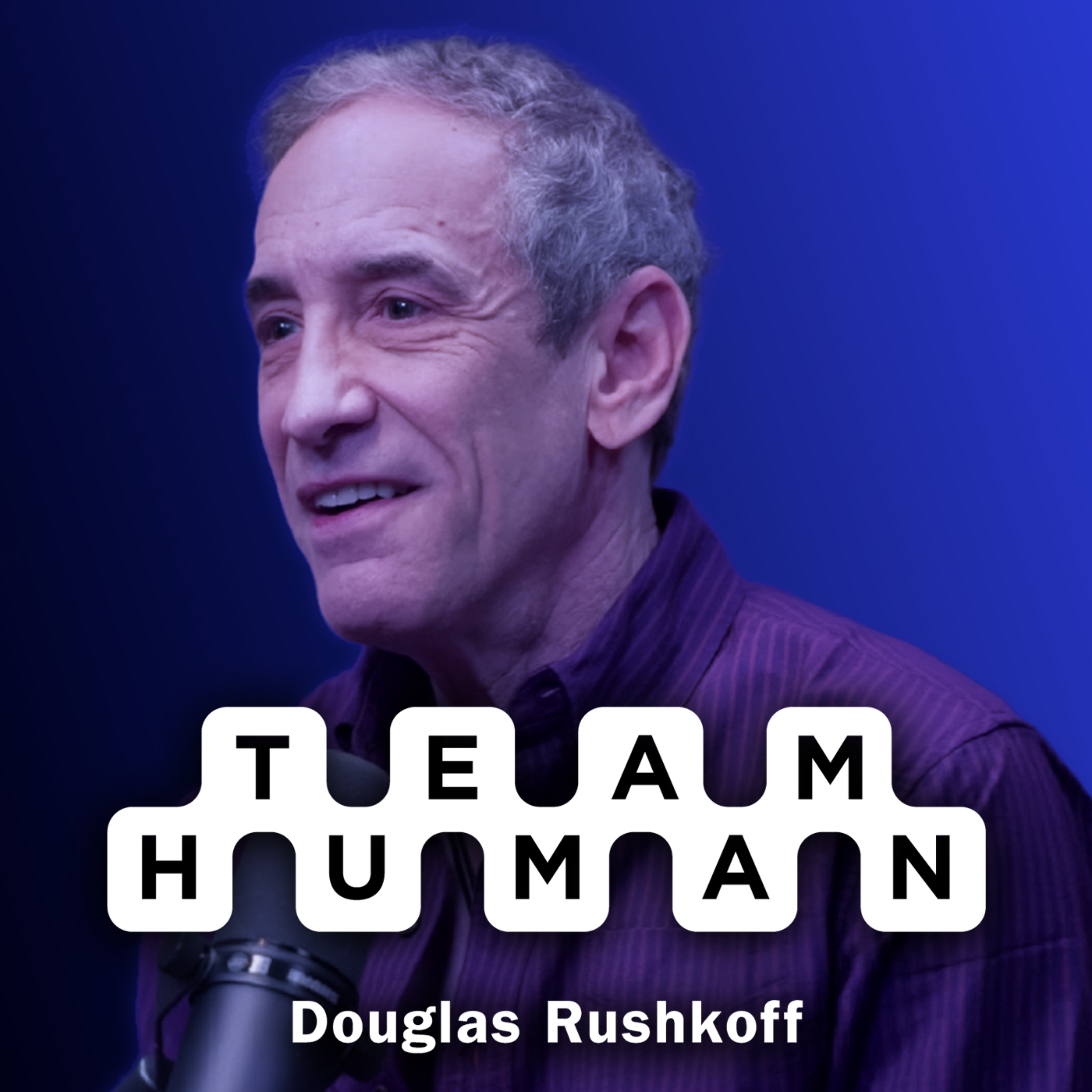
The Internet Is an Occult Machine (w/ Shira Chess)
67m 53s
In this episode of "Team Human," host Douglas Rushkoff interviews Shira Chess, a professor and digital folklore scholar, about her book "The Unseen Internet: Conjuring the Occult in Digital Discourse." The conversation centers on how magic and technology have become intertwined in the mid-2020s, making them nearly indistinguishable. Chess explains that she writes from a "Chapel Perilous" perspective—a liminal space between belief and disbelief—neither dismissing nor affirming the supernatural, but focusing on the discourse itself. They discuss cryptids, such as the Slender Man, an internet-born mythological creature created on Something Awful forums, which evolved rapidly through collective online negotiation, unlike traditional folklore's slow oral spread. The dialogue shifts to how the internet was once seen as a tool for agency in the 80s and 90s, but corporate platforms have since stripped that agency, turning users into data points. Chess argues that occult activities, like creating memes as sigils or prompting AI as oracles, are attempts to reclaim control. However, she notes that magic can serve both the powerful and the oppressed, as seen in political meme magic. The discussion concludes with a call for subversive tech use, like confusing algorithms, to resist corporate control, while acknowledging that even everyday branding, such as Nike's swoosh, carries unconscious magical resonance tied to ancient goddesses.
With almost half a million customers and over a trillion dollars of secure payments, Bill isn't new to intelligent finance. It's the proven way to simplify Bill Pay and maximize cash flow. Want to learn more? Visit bill.com/proven for a special offer. Acas powers the world's best podcast. Here's a show that we recommend. Christian Bale was preparing for his role in American Psycho, dressing the part, hitting the gym for the first time in his life, even getting his T3 done. There was just one problem. He didn't actually have the part. Leonardo DiCaprio did. Listen to our podcast What Went Wrong Every Week as we unearth the chaos behind Hollywood's biggest movie flops and most shocking successes, available wherever you get your podcasts. Acas helps creators launch, grow and monetize their podcasts everywhere. acas.com You're on Team Human, conscious intervention in the machine. A chance to look beyond the shiny profiles of Instagram influencers and trillion dollar business plans of the tech oligarchs to the pagan roots and magical blends, both informing and emerging from our digital entanglement. I've seen the future and it's only getting weirder. I'm Douglas Rushcough and I'm on Team Human. Playing for Team Human today, the world's greatest scholar of digital folklore, professor Shira Chess. We're going to talk about this, the unseen internet conjuring the occult in digital discourse. This is Koby Laundry Buds. These are beautiful, natural, little buds. You just chuck them in your laundry machine instead of one of those horrible vinyl pods from the grocery store supermarket, big brand chemical oligarchs. It makes everything clean and soft and healthy and don't kill the fish. Use this stuff. As a celebration of the end of our sponsorship with these folks, you can go to kobyclean.com, put in the code Team Human. If you forget, just remember it's the name of the show. Team Human. Type that in that little discount box and you get 31% off. Go do that Koby Clean, Team Human. 31% good stuff here and it'll keep you clean and the world safe. Play for Team Human today. We've got Shira Chess. She's professor of entertainment and media studies at the University of Georgia and a leading scholar of digital folklore. Her previous work, Ready Player 2, looked at how identity and gender are coded into our gaming lives and her new book, The Unseen Internet Conjuring the Occult in Digital Discourse, takes us somewhere much more liminal. She's looking at the magic we use to make sense of the corporate black boxes we practically live inside from the cryptids found in AI latent space to the spells we cast via our prompts. She's here to help us understand if our, well, I'm hoping she's here to help us understand if our digital occultism is a path to liberation or just a new way of decorating our gilded cages. Thanks so much for being here. God, I've got so much to talk with you about. I love your book and it's sort of the big, the big question that and I'm not supposed to do this as like an interviewer person, but the big question that sort of informing the other stuff and I can't, I can't quite tell exactly where you stand on on the occult, which maybe is a good thing. As you write, I don't really know whether the occult is something that we project onto new technologies whenever they come because they're weird and unknown and there's these sort of liminal empty spaces or, I mean in other words, is it just another form of crazy or do the liminal spaces and weirdness and margins and delightful disorientation of new media environments create opportunities for us to reconnect with the underlying occult nature of reality. I mean, it's an all culture just another form of crazy. I don't know, like I don't know that I can make that distinction, right? Like I don't know that where I've sort of landed. So I should say I write this book from the position of the chapel perilous, right? Like I write this book, Chapel perilous was a term used by Robert Anton Wilson in taking it from Mallory's "Lumort Arthur" and he uses it to sort of talk about this liminal space between belief and disbelief, right? And I, where you sort of acknowledge that there are unknown things and there are things that we can't quite grapple with that might feel supernatural, but not quite willing to go all the way there yet, right? And that's more or less where I write the position of this book. I'm not. I don't take a stand on things, but I also have no interest in being dismissive of other people's belief systems. I think that that is unhelpful and it's unhelpful for me to write a book saying that all of these things are true and it's equally unhelpful for me to write a book saying that all these things are untrue. I'm more interested in the discourse, right? But in terms of is this real or not, you know, or what the things we put into our technology, I mean my book is about how now in the mid-2020s were we're living. Technology and magic have increasingly become so indistinguishable that it no longer matters, which is something that you and others wrote about in the 90s, but also I think part of what my book is about is that we increasingly have to deal with the ramifications of being ill-suited magicians. Right. And so should I say, I mean, yeah, I remember at the end of a chapter in Siberia, I spent like a day with Terence McKenna, the bar, yeah. But at the very last line of the chapter, I remember writing, you know, has he found the philosopher's stone or is the philosopher merely stone? You know, and I didn't mean it in a mean way. I meant it half of me totally entertains and engages and is with it and half of me is like, you think cool, weird things when you're really high and and that's all that's all okay. I guess I'm interested to know to start for those who are less accustomed to some of the terms. Maybe it would be good and actually fun for you to explain kind of what what a cryptid is. Mythological creatures, right? Like sort of mythological creatures created, you know, as part of folklore, right? Sort of shorthand for mythological folklore creatures. Right. So it could be anything from Chupacabra and and Bigfoot to Slender Man, who I wrote a book about. That was my first book was on the Slender Man. Oh, the Slender Man. Well, I've seen the Slender Man. Personally? Yeah, I mean, haven't we all at one point? Oh, I saw a shadow, a shadow that my daughter told me was the Slender Man. Oh, interesting. I love that the Slender Man folklore still lives on. Honestly, I find that so fascinating and I talk about it with my students every year and it's been interesting watching that myth move through my teaching, right? Starting with like nobody knowing what I'm talking about to everyone knowing what I'm talking about. You know, people kind of knowing what I'm talking about, but knowing about it from like early childhood. Right. And what was the origin of Slender Man? Something awful, something awful forums, which was like a precursor to forechan and Reddit. Right. And somebody had posted on there and said, you know, I'm making supernatural images. We make a ton. And somebody a couple of days later, somebody posted something and the forums went wild for it. And then everybody started cropping it really quickly. And it was sort of like an open sourcing Mahara character. But that's sort of the the par excellence example of an internet cryptid, right? An internet born cryptid is this idea of. And the thing that interested me about the Slender Man was, you know, hundreds of years ago when a super when sort of a mythological character came into being, it would, you know, it was all, um, everything was oral traditions, right? People would sort of whisper stories from town to town and there would be like the slow migration of the story. So like with a vampire, there's like a certain set of characteristics that you know belong to a vampire. And if you put them together in a certain order, then you understand that that's like,
like that's a vampire probably that I'm dealing with here, right? And with Slender Man, you got to watch it happen really rapidly on the forums, right? Where everybody was negotiating very quickly. And that's like that's the internet, right? Like that's sort of the spookiness of the internet is all of this connectivity, but we're just, we don't quite know how to handle all of that connectivity anymore. - Right. I mean, in that sense, the folklore's, and you suggest this, the folklore can serve as a form of, either a form of media literacy or a kind of a substitute for media literacy. You know, it's like this way of maintaining agency in a system that, that, well, in today's world wants to treat us like data points. You know, the occult becomes a kind of empowerment. - Well, we're the folklore of the system, right? - In some ways. - Right. - You know, the system tells stories about us. - Right, we're the ghosts in the machine, in that sense. - Maybe. - Indeed. But do you find, do you find the occult becomes a way for us to, or occult activity becomes a way for us to try to sort of feel empowered or to maintain a sense of agency? - Absolutely, right? So when I first started this book, the very original version of this book, that didn't make it very far. I actually was called the haunted internet. And I was really, I was like grappling with this idea of haunting. And I started with sort of, Jeffrey Sconce wrote an amazing book many years ago, called "Hunted Media," where he really breaks down the relationship between telegraphy and, and, and spiritualism in the 18th century, right? And how they sort of functioned in a kind of parallel discourse and how the two sort of resonated with one another. And I was kind of thinking about pulling that thread forward to thinking about the internet. And, but the problem with this idea of haunting is that it lacks agency, right? You don't have a giant to control and a haunting. It's passive voice. It's happened upon, right? You were haunted. But with, what interested me was not the passive. It was the active choices. It was people trying to conjure things beyond themselves. And that really crystallizes what has happened over the last 35 years. And I mean, it has been a wild ride spending this much time in the 80s and 90s again, sort of like looking back over these documents and these ideas that we, what everyone thought we were doing versus now and what it looks like now. And it's, it's sometimes really jarring. - I mean, especially if you look at the way, even just the way people use the internet, whether they have an occult lens on it or not, the kids are on Instagram creating a meme and putting the words and the picture. They're basically making a little sigil that then they're sending out into the world. Some of them see it as a sigil and some don't. Other ones going to AI and trying to prompt it so that it comes back with, you know, it's so delphi oracle. You know, these are the shapes of these activities are kind of classically occult. - Absolutely. One of my favorite chapters in the book, I talk about reality shifters, which is in the, it happened a lot in the 2020s. There was like sort of a, moved towards this idea of reality shifting. It makes a ton of sense in 2020, right? Like everything was shut down. People couldn't go places and young people started doing more meditation work and more sort of attempts to move into a different version of reality, you know, sort of forcefully. The people who made the internet, not all of them, but a lot of them, a disproportionate number of people who were involved in the origins of the internet had some kind of non-traditional spiritual beliefs. Not everyone for sure, but there are, you know, in the book, I talk through a lot of examples, right? You know, all the way back to Arpenet. There are all these great examples and it's not everything, but it's just one lens. And if you look at it in a certain way and like Marco Adler wrote in the 80s that the most common career choice for people who had non-normative belief systems at that time were in computing, right? Like that, it makes a ton of sense at the same time. And so it was like built into the wallpaper, but you don't see the wallpaper. You don't notice the wallpaper that you see every day. - Right, and it's interesting in people who maybe in the, you know, a majority of whom in the 50s or 60s might have gone into music even. Or, you know, the great kind of, you know, spectrum people and people who are aware of the weird, liminal things, people who are weird in one way or another, they did go, they did go into technology from the, right, from the beginnings right through to the sort of the techno shamanic, you know, rave, you know, Mando 2000 era that I came into it. - Sure. And I mean, I've at this point spent a lot of time in Mando 2000 because of course I'm also co-authoring with Are You Serious Mando 2000 History. So I've really, like I've been swimming in Mando 2000 for a couple of years now. And again, it is, it's extraordinary. If you look at the ideas and choices that we were making and thinking about in the 90s and what we thought this would be versus what it was, is jarring. And I don't think that we can fix what we have until we reconcile with those choices, the rituals and the beliefs that we had then versus what we believe now. - Right, I mean, I'm judgemental when I'm not academic, I would say with the rituals and choices we made then, we're better. - But they've lit the rituals and choices that we ended up with, right? Like I mean, like they were better until they weren't, right? - Right, right. - I mean, there was obviously, there was the pivot toward, call it capitalism, was a pivot away from one understanding of the occult and influence in liminal space and another. You know, the Mando 2000 early techno shamanic one was this sort of mass empowerment, rave. You know, we would reconfigure the consensual hallucination in something that looked like something across between a rave and a multiplayer universe. - Sure. - And we've ended up in something where I feel like we submit to the vision and rules of a single tech oligarch and surrender all of that agency. - Absolutely. No, I mean, everybody in the 90s, in the 80s and the 90s, the internet was treated like it was going to give us the agency that we needed to survive the next millennium and it was that exact technology that took away our agency. - Right. Right. So now when we attempt to conjure on a corporate platform, are we asserting any agency over the unknown or are we just performing the precise labor that industry wants from us? You know, is the magic at this point just a user interface trick to keep us from asking who owns, who actually owns the box, where are the conditions on the ground? - I think it is, but I also think it doesn't have to be. Right. I think there are subversive ways to use our technologies. I think we need to be more innovative with those technologies. We become so accustomed to the comforts of living in our technologies and we're so averse to breaking the machines that create those comforts or angering the machines that create those comforts. My husband spends a lot of time trying to confuse algorithms. Right. That's like one of his hobbies is, like I go to an algorithm, I'm like I just want the thing that I want and I'm annoyed if I don't get it. He's like, his purpose is like make the algorithm do something that it doesn't want to do. And we all need to be doing a lot more of that. - Right. In our spare time when we're not busy succumbing to what our bosses or the market is making us do through the algorithms. - Sure. - But yeah, it's that wiggle room. I mean, that's to me as part of what makes the occult lens so valuable is that it does feel, maybe it won't be forever, but it does feel kind of distinct from machine. But at the same time, I mean, it looks to me like Trumpism and President himself are both leveraged the at least some of the occult potentials of these technologies. There's sort of, you know, the Norman Vincent Pio new thought early 20th century magical sensibility in that whole movement. - I mean, magic is both a tool of the power structure and a tool of the oppressed, right?
It depends on the time period and perspective. And there are tons of examples of both of those things happening. And you know what, we haven't even defined magic in this, right? Like, and I think that like it's useful, I think it's useful particularly for people who are not within all of these spaces to understand sort of what we need by magic here. So like a very famously Crowley said, Elster Crowley said that it's the science and art of causing change to occur in conformity with will, which is a really popular definition in most contemporary magicians don't look at magic in a poof kind of sense, right? It's not like you, it's more the magic of the will, more of changing things. Some, there's a spectrum of course, right? Like there are people who think it's more psychological affect there are people who think that it is manifesting things. And there's, you know, there's that range. However, the, what we're talking about is the symbolic and ritual processes intended to affect material reality. And there's a lot of interpretation that we can really build into that, right? Like acts of persuasion are magical acts. I talk in the book about the meme magic war of the 2016 election, right? Leading up to the 2016 election. And we talk about memes and, you know, people laughed at the idea of meme magic at the time, which, you know, is what it is. But when we talk about memes, we talk about that kind of presumed virality with a very magical effect, right? Like we, on the one hand, you know, memes are fun and funny and whatever and we spread things around. And on the other hand, they're the thing that can infect your uncle with that crazy QAnon virus, right? Like, and so we don't quite know what to do with our memes and how to talk about that. And again, that goes back to the late 80s and early 90s, right? The, the people who most attached themselves to talking about memes were people that were part of the counter culture, right? You yourself included, it was, those were the people who saw what memes were, the possibilities of them and what they could become. And, you know, our memes literally magical, I don't know, chapel perilous man, but it brings back that question of, does it matter? Does it have to be poof magic for us to talk about it in these magical ways? Because when you don't see how things work, then it becomes magic. - Right. And if you, and if you do, then it may not see magic, but it's just as magical, you know, is the thing. You could take a corporate logo and, you know, even if the corporation had actual sorcerers sitting there, you know, doing enchanting their logo, I mean, still the logo has a certain memetic power, like the Nike swoosh, say. You could say, oh, the swoosh works because of this that, or it could be because it's just such a great iconic symbol. It combines all of these different things. Maybe it unintentionally, but effectively, you know, goes to some neo cortex. - Nike was a goddess. - Right. - You know, and so was Columbia, the goddess Columbia on the part of the logo of Starbucks. And the Starbucks logo has nothing to do with the actual like drinking of coffee, right? You don't, there's nothing in that logo that implies coffee. And yet you see it. And you know, well, I'm gonna get some media or like overpriced coffee if I go in that place there and now, right? Like it has become part of us. So I mean, we can say, oh, I don't believe in magic. Oh, I'm, you know, I'm an atheist. I don't believe in these things, but you're still assigning your choices to the goddess Columbia or the goddess Nike, right? Like there's, we're still paying tribute to those gods and goddesses in sometimes uncanny ways. - Right. And I mean, we don't, we don't think of say, speech or text or drawing as new media environments anymore. You know, we don't think of that, but at the time they, they were new technological media environments, right? I mean, John D. We're back in Elizabethan, England being able to read books silently or, you know, write things or use a press. Those were, I mean, printing press is magical at that point. At least as magical as the AI would be to us. - Sure, absolutely. So then it, it's as if it feels like each new media environment then creates kind of like a bump like, it's like, oh, we have a typewriter. So we get automatic writing of a different kind. We get, you know, in that, that there's that, and we're in another and just because, I mean, it gets us a lot of them these days, but because there's a new tech, the new tech environment, now we're having another kind of resurgence or retrieval of sort of, occult sensibilities. - Absolutely. I mean, that's really increasingly people treat artificial intelligence as though it were any other kind of non-corporial entity, right? Like we have, humans have a long history of courting non-corporial entities. However, and AI is just like one of those, and AI can do a lot of things, but it can't do that, right? It's not sentient. However, I mean, AI of course is just the spirit of the hegemony vaguely animated, right? And people seem to be fascinated with AI in the same way they are fascinated with hauntings, right? They somehow want like this passive sublime. But magic, you know, is all about the active and agentic choices that humans make. - Right, so that's really an interesting one. So on the one hand, it's like we see these creatures coming at us. We become the object to their subject, right? It's like the gallum somehow emerges in the virtual space. And on the other, there's kids on TicTac manifesting for ponies or something, which is I guess the more agentic form of it. - Or text messages. My favorite ones are the ones that are manifesting text messages, right? Like these simple manifestations that speak to the messiness of contemporary life. I mean, I love that, right? Like who has not stared at their phone and tried to manifest a text message anyhow? But sort of these guiding rituals for how to do these things are just fascinating. - And maybe because I'm just in the mood right now with all that shit going on outside, but also in in profoundly positive ways. Like I remember, I was gonna say this before your time, but luckily it's not. When I remember Ariana Grande had this concert in Manchester where someone like blew up a bomb, there was some terrorist bomb thing. - I do remember that, yeah. - And I mean, I was always really down on Instagram and messaging and stuff. And Instagram became filled with all of these 11, 12, 13 year old girls sending messages of condolence and hope and positivity to each other. And it felt to me like they were going to, as a group, consciously or not, they were going to cast a different, they were going to, through sheer force of will and their text messages and emojis, they were going to turn the energy around this thing into something else. And I think they did. I mean, it's easy to now be dismissive of the amazing things that we have, but it's, the internet, digital technologies, all of these things that we conjured in the 90s are incredible. They have connected us in ways that we could have never conceived of and maybe we shouldn't have been. So you wrote in Siberia, 35 years ago, you wrote that computer technology fits the Siberian spirituality in two ways as a way to spread the magic and as the magic itself. So like, I don't know, does that hold up? Now that we're all networked together, is that true still? - I think it is true. I think it is true. And the assholes figured that out. It's like, I feel like the same thing that happened to the, Stuart Brand and Jerry Garcia would talk about the acid tests in the 1960s that they did, where people, they would have all this music and people lying around, guys and girls and LSD of course. And they had these great two or three parties and then these dudes found out, oh, there's a barn filled with hot chicks on LSD and, you know, whatever you want to call it, rape and sood. And then the movements gone. You know, Jerry Garcia would always say, you know, oh, the 60s happened for about two weeks in the summer of '69. Until, and it's same thing, I feel like the net, there was this, you know, playful,
optimism and naive-tay, and then people figured out, "Oh, look at all these human beings with wide open minds and hearts, and we're looking for a connection, and you know, we were all so naively promiscuous." I remember writing emails in the early '90s to essentially strangers, and when I think now back to that and think about how horrific it would be to somebody in their 20s writing these kinds of things to strangers, right? That is chilling. And it's so inspiring too. It was so inspiring. I have a digital culture, like freshman class right now, and I was talking to them and trying to explain, like we were talking about what the magic was of BBS, is that like when you connected with a stranger on the internet, you've understood that there was a person behind it, and that's something that they've never fully experienced. Right? I assume that all of them at this point understand that it could be. Right. But also to be not. Exactly. It could be not. Right. It could be not only could it be a person who means to exploit you or just get your money, but it could be a bot. That means to exploit you. Right. It's really, it's tricky. And in some ways then, again, it's part of why the occult lens works for me is, I remember people like Mark Pesci would always talk about if you're going to engage going to an occult space like this, you've got to do like you're banishing rituals and things ahead of time that that the magicians understood. Well, and I mean that's, you know, and Pesci and I have talked about this. Maybe not at length, but we've talked about this and that you should always enter with a blessing. Right. And then of course there's that whole thing where you know it feasibly did, you know, did the counterculture ripple hole in the fabric of reality. Right. Like there was all of that talk in the 90s about, you know, destroying monoculture and like, you know, associated with the internet. And I don't know, you know, in his in his book of lies, Richard Metzger has his sub subtitle being an alchemical formula to ripple hole in the fabric of reality. So then the question is, did that work? Did did Metzger ripple hole in the fabric of reality? Because I don't know what else that would look like than where we are now, where we all live in very distinct realities. We don't have a monoculture anymore. Right. So I mean, I guess everybody was willing this new thing to happen and associating it with the internet. And I guess then the question is like, what did what did everyone think that looked like? Yeah, I mean, I remember like every weekend there'd be a rave that was meaning to like break on through to the other side. But in a different way, it's like there'd be a rave. It's like, oh, this is the UFO rave. We're going to buy two in the morning. We will have summoned a UFO. You know, oh, this is the machine elves rave by the two in the morning. The machine elves from the DMT landscape will have come. You know, this is the time travel rave. We're going to, you know, end up in a different time or bring Tesla back. You know, we're going to do a feedback loop into a single colonial organism was shared consciousness. You know, right, that there was this desire to break through. But the the way it looked, the way it would manifest was varied from place to place. Well, and but also you're talking about a bunch of physical communities manifesting and all that manifestation has now gotten taken over by social media, right? There's something about everybody coming together to manifest something and to manifest different realities. And it looks so different now. And I think that that physicality mattered. Right. Physicality did matter. Yeah. And it always struck me with Siberia. How much of that book was about physical space that was interrogating the digital spaces rather than the reverse. Interesting. Yeah. That was that was the moment of transition. Wasn't it? Before we went through the mirror, you know, that here is a New York journalist reporter traveling to San Francisco and walking around on foot talking to all these people going to all these, you know, to the Mando House to the Tune Town rave to this. It was saying what what's over there. And it was also the internet was different then in that we had this long complex ritual, although we didn't call it that in order to get online. Get the modem plug it into the phone, plug it into the computer. Then you're bing, and then you're online. And now you're here and it's expensive because time the phone cost money. You know, and you download everything you can and travel around it goes. It's like almost like a magical vision quest excursion until the drugs or the magic wears off. And then you gather what you can't come back to here. And then. Pill for through, you know, what you what you gathered out there. And it was also that kind of like the weird sense of ritual was in all of the media articulations and of technology that happened in the late 80s and early 90s. So like and often very magical as well or like edging on magical. So like, I don't know the last time you watched lawnmower man, but that movie is a trip today. And in terms of like what that vision was for it, like what what would technology look like? How does it how do we get inside of the machine? And so, you know, the all of that involved sort of these strange rituals of like entering the machine that that it was never something that was as naturalized and it old as it ultimately became right. And even though that was a popular, you know, it was a movie a mainstream movie on the one hand, you know, on the other, I believe some of the imagery was developed by cyber lab seven who were like San Francisco, Manda 2000 friends and colleagues. So of the of a bizarre, you know, psychedelic underculture. There is a great interview that I quote from that was in Manda that I don't know who did it with him, but it was Brett Leonard, the director of lawnmower man. And he talks about how like they use sacred geometrists to come up with like the the the the imagery that happened on screen. While during the transference and that the the artist and designers would sit with their heads over with their hoods over their heads trying to let like, you know, and they knew they got it right when like things fired right in their brain pans or whatever. That's a paraphrase, but essentially saying that right like everybody was so engaged with this idea that our technology perhaps was magical and that that would liberate us in this very specific way. Right. I mean, and so I guess well, because the internet was new and because a lot of us were involved in one way or another with helping shape either the tech or the culture that emerged. Our magical or occult sensibilities were explicit, you know, and it's interesting and I never really, I mean, I guess I thought about them a little, but I always thought about it as like psychedelic countercultural ambitions. And that's why it was really interesting for you to like bring it up specifically as occult that it was and I think back to disinformation, disinfo con, you know, and it's like, oh, gosh, and it's just PR, Robert Anton Wilson, Joe Coleman, you know, these are, oh wow, that sometimes you're doing it, you don't even see it absolutely. I know, I know, and I think part of what was cool for this for for me about all this is that I was coming from an outsider like I'm old enough that I was a last adult when Mondo came out, but I didn't read it at the time I was that was another world entirely right. I didn't I wasn't aware of any of these things as they were happening. So the process of discovery was somewhat pure, right? Like me remembering the time periods, but not really knowing the beats of the story. By the way, at disinfo con, Metzger again talked about beating reality, consensus reality like a pinata. So like there was everybody wanted to destroy consensus reality. Right. Well, because we thought it was bad, you know, the consensus reality was like capitalism and people getting jobs, because they were people are getting exploited and there was wars and what we think's that problem. Oh, yeah, well, no, you can't just crash reality without a good idea of what you're going to replace it with, you know, I guess that would have been responsible. You know, but it felt it felt reality felt like like a prison of a sort. It felt like if nothing else, you know, we read Robert Anton Wilson, we read, you know, cosmic trigger and we're like, oh, at least people should know reality is not fixed. We could dream up another one together if we chose to, but I think what happened was as people learned reality wasn't fixed, they got really scared. So they went back to make America great again to the last reality that they kind of shared remembered. You know, it's better than a bad reality from the past is better than what I'm in charge of what's going on here. No, it's scary. You know, I want to talk because I didn't know about the low app.
It's pronounced lobe. I wasn't shit. I was, I asked the, I asked Steph much, so once and I at one point, because I had been pronouncing it low up as well. And I, uh, she, like, mother of all bombs, you know, it's like, lobe, like, is in earlobe. Right. Okay. The, the lobe. So the lobe, the, the lobe mirror and then it's kind of the, I wonder if you can share the, the lobe mirror. And we can kind of talk about it in the context of sort of the ethics of, of summoning. Yeah. So, I start the book off with the story, right. It was a few years ago. I think it was 2020. It was 2021 or 2022. Um, the, um, an artist revealed on Twitter was still Twitter then, um, that she had, um, like discovered this, um, character that she had, um, she'd been playing around with some prompts. This was, you know, early, um, sort of text to image AI prompts. This was a few years ago. So it wasn't something that everybody did. And she had her own model that she was working with. And she put in a picture of Marlon Brando and asked for the opposite of Marlon Brando and got this weird image, which is a great prompt, by the way. Um, and got like this weird image that almost looked like a digital logo. It was just a strange looking thing. And then she put that in thinking, I'm going to see if I can get the, if I put that in and get the opposite of that, will I get Marlon Brando again? It's a good experiment. Yeah. And, um, instead she got this image that had, of this woman that looked, you know, a middle aged woman that looked somewhat demonic, let's say, she looked weird. She looked uncanny. And at the top, it said something that, um, that Swanson, like interpreted as lobe. And so she, she started playing around with it. And what she learned was that this character persisted within the, this particular model, right? That as she was playing with the model that lobe kept coming up. And the pictures got more and more horrific as she went, right? Like with, like, you know, headless dolls and, and, you know, and, and of course, the internet reacted exactly like you would expect the internet to react in that situation. And they were like, oh, no, we, we've summoned a demon. And then everybody else was like, no, calm down. We didn't summon anything. Um, but I guess part of part of like the, the messiness of the lobe situation is that, I mean, we did summon something, right? I mean, like, she, lobe is not, is not pure, doesn't come from nowhere. It's, it's a composite of all of our beliefs and all of our, um, all of, all of the things that we as a society have put together. So of course, there would be a, uh, middle aged woman that presents as demonic, um, dealing with, um, there were, there were a lot of like, um, dolls and strange headless dolls going on in the images, right? So like, there was a consistency in terms of how that model reinterpreted itself as, or with a reflection of humanity and also what it, what it seemed to be basing itself on. It is in essence conjuring, right? It's not, um, it's not out of nowhere. It's not pure. It's, um, it's something else. Right. I mean, I used to when people would complain and I, I understand social media algorithms are not fair. You know, they, they, they, tilt, but I used to tell people not to forgive Facebook or anyone, but if you don't like the stories that the algorithm is feeding you, then change your behavior online that, that one way, I mean, it's, it's not the probably the best way, but, but one way to, to become the person you kind of want to be is to see if you can get social media to reflect what would that look like? Sure. But I think people are also sort of fascinated by how algorithms do have sort of this weird spiritual undercurrent. There's, there was a term that some scholars whose names, uh, escaped me at this moment had coined, um, and I quote in the book, um, algorithmic conspiratuality, right? This idea that we are, um, you know, um, how people treat their algorithms like they are specifically, um, sort of these spiritual responses to things. And we all do it to some extent. Like, I mean, who has not back in the, back in the old days, who has not, who didn't listen to the radio and think the next song that comes on the radio is going to tell me the future, right? Certainly in our teen years, um, right? And so it's sort of the same thing except that was, I, well, I would say human determined, but I mean, what with Payle, I guess, you know, corporate determined, I don't know. Um, but we do the same thing with our algorithms, right? We are, um, we are pleased when our algorithm service us and tell us things and give us answers to things we want to believe that our algorithms can somehow know things that we can't know. But at the same time, we don't want them to know us. Or we only want them to know us to the extent that we are comfortable. Right. And that's collectively as well. I mean, you could, I know that, you know, Grock, the, the Elon Musk AI is like a Nazi AI or whatever. I know he's tilt toward that. But you know, you really have to ask, would all the AIs tilt toward Nazi AIs if they weren't very carefully adjusted to not do that? That might, it might be the least, the least conflicted of our, and the least controlled of our, of our AIs. And when they do that, I mean, it's not just because the political economy of media is, you know, leading to companies that profit off greed and evil, but because our collective psyche history, at least as recorded and offered to these, to these machines, is that dark we are. Look at, look at our history. Certainly Western civilization. We do have slaves. We still have slaves. We do kill people. I mean, it's, yeah. Well, one of the most interesting parts of the debates about, so I sort of deal with demons and sort of non-corporeal entities and AI in conversation, right? And one of the biggest debates that really was happening online with sort of, with sort of witch talk and associated in the early 2020s was whether we should command our demons, right? Like I'm on the one hand from like this, a solomonic perspective of you, yell at your demon, you tell the demon what to do, you have to, that's what one does, right? And then on the flip side is like, no, you, you ask it nicely, just ask nicely and it'll do things for you. And sort of this going back and forth over how to properly treat a demon, but all of that rhetoric ignores the fact that I mean, historically, all of those grammars that people are pointing to, solomonic and remars did advocate for slavery, right? Like, of course they would treat demons like slaves. We treat our AI in similar ways. We talk about our AI in very similar ways with these same debates about like, what do we do with the spirit of something? How do we understand that? And like, but I also like, in as much as I'm talking about algorithms, like, you know, in this very non-human way, I also think that like, so one of the cooler manifestations, I think, of how people deal with algorithms in spiritual ways is on TikTok, people doing terror readings and saying, you'll find, you only found this if this applies to you, right? That's a great example of sort of, that's human at the core of it. There's a human being making these choices about what, or not choices, but like using their own wu to kind of put things out there. And then other humans choosing to align or not align to to follow the breadcrum trail of that algorithm. Does it teach that person anything? Is it real? I don't know that it matters. It's how that person is coping with the messiness of contemporary existence. Right. But then the other thing it suggests, though, I mean, to me is that our comportment matters. So you could say, oh, you know, King Solomon, you know, when he built the, this is myth mythologically anyway, when King Solomon built the temple, he summoned these demons, you know, and he inscribed them in a Jewish star, you know, and then, you know, and they were little slaves and he binded them and it was all that kind of what I look at as sort of mean versions of sorcery and built this temple. I mean, look where it got us, right? You know, how was the Jewish star regarded globally today? And how well is that temple doing Solomon? So, but that's besides, besides the point, then on the other end of the spectrum, you have someone like DeKai, who I, I had on the show, he wrote a book about, you know, how we raise our AI and it's, it's less a matter of, of, of what we say than how we act in front of them. You know, and I don't think it's necessarily superstitious to behave gently and kindly to our thinking.
and semi-autonomous technologies. And one, because if they're gonna be treating someone else somehow, someday, even if AIs are gonna be running a nursery or running an old age home, then it would be great if the data set of behaviors that they were trained on was nice. And second, I mean, like you see a real painter, you know, the way that they'll treat their brushes and the thing is not just because they want to preserve the brush over time, but because the brush is there, is their partner. You know, and just move through the world where everything, every cup, this coffee cup, I'm gonna enjoy the texture of it in the way and how place it down to have a, you know, a gentle, kind way of treating both the living and non-living things in our world. - I mean, Paka Nithin, who I know you know, and is an AI expert and I quoted him at length in the book, Paka likes to remind people that artificial intelligence is humans and machines cooperating. - Right. - It's a question of cooperation. And I agree with you, it's being nice to AI, and I don't mean nice like, you know, treating it like it's a person because I don't know that that is helpful for us psychologically. But being, I mean, we should be kind to everyone. I don't know, like we should be kind to, we should behave with kindness as human beings. And I mean, I don't know, I tend to be kind to inanimate objects because, you know, I name my car. She's nicer to me when I name her. Now that I named her, her name is Betty, if you're wondering. - Oh, I want to say like an Archie's Betty kind of a Betty, or I hadn't thought about that, but I, you know, that works. (laughing) - Doug, you got a little bit in the book and sort of the question of the nothing is true, everything is permitted dialogue. You know, so I guess, I mean, I feel like I'm 12 asking this, but it's still a question that's still relevant. How do we distinguish between nothing is true as kind of a liberating philosophy of chaos magic and nothing is true as a tool for sort of corporate propaganda, death of the real and the imposition of nihilism? - Yeah, that phrase has gone through, that proclamation has gone through so many phases, certainly over its lifetime. And now I would say over the last hundred years, it has gone on a wild ride, you know, it was, so nothing is true, everything is permitted originally was Hassani Sabah on his deathbed, and then it was quoted by Nietzsche, and then it like sort of like wound its way through various texts in the early 20th century until like Burrows and Geisen found it, and they, they, they claimed it for their own, and they really like that phrase. There's a quote from that Genesis purge gives to Burrows, which is reality and all it's cracked up to be, and which is, you know, seems to be at the core of it, right? And the counterculture and specifically chaos magic and discordians and sort of the, the people that were involved in all of these things really embrace the phrase. It is by the 1990s, it was entirely being used in service of the counterculture if you looked online, right? And then in the early 2000s, Assassin's Creed came out and Assassin's Creed took the phrase and sort of made it the slogan of the game. And that sort of changed it. If you search the phrase now, you'll find mostly Assassin's Creed, maybe a little bit of the origin, the Hassani Sabah, you know, variant of it, but it's not, you know, nobody talks about it in this counterculture way, but I don't think that there's a phrase that better characterizes the internet we have now than nothing is true, everything is permitted, right? It is, but also if nothing is true, then everything is true. And if everything is permitted, then nothing is permitted, then permission ceases to matter. So I think, like, and like on the one hand, at first, like I was thinking about it, I was like, bristling against Ubisoft for, you know, appropriating the phrase and I was like, but they're actually attributing it to its actual source and they're dealing with it, you know, within that tradition. So I don't know, you know, I don't know that we can say that they appropriated from the counterculture, but it does seem to have eclipsed the counterculture use of the phrase at that same moment that, you know, maybe or maybe not, the counterculture was simultaneously destroying consensus reality. - Right, well, certainly what we did, I mean, if I'm considered myself part of it, it kind of backfired on, you know, it was, the, I mean, it was one thing for Abihau from the Nalangansburg to lift the Pentagon and for the Yes Men to, you know, create all sorts of bizarre fake news to dysregulate and kind of decalibrate consensus culture, but those same tools and techniques are working as well or better for those who are trying to obfuscate conditions on the ground and lead people into various forms of paranoia and hysteria. - It's absolutely true. You know, I think the '90s is so responsible for the conspiracy culture we live in now. The sort of cute conspiracy love in the '90s, really softened it in such a way that it became kind of like a hobby, you know, a fad. And I think nobody really fully understood that a combination of conspiracy theory and the internet, what that would bring us. - Right. - And the same counterculture people who were embracing as oturk things were also embracing conspiracy theory. I mean, like, you know, disinfo being a really good example of that, right? It was like 50/50. - Right. And those days and the early days, you know, Alex Jones was sort of at the party in a way. You know, he's in Austin making these weird videos and yeah, and it spun out, right? Some spun this one. - But they were all part of it. Like, I mean, and I've heard some stories about him in those early days. And I mean, like he did show up to things, right? Like he was part of a conversation maybe at the extreme of it and a little, you know, like nobody, but it wasn't nobody saw him as being inherently dangerous. - Right. Because groups of weird people, we were sort of welcoming. All are welcome, you know, and they were weird. That's just some weird beliefs. But as long as you're not bothering anybody with it, you know, you guys are sticking nails up your noses and stuff and all right, as long as you do that, you do you, you know, there was that. But I'm wondering even sort of in the bigger sweep of history, if we just kind of go back and forth between these sort of rational and magical sensibilities. I mean, if you want to play overly broad, you know, middle ages, there's everybody superstitious and believing in these, you know, crazy things. And we get, we get, you know, sort of a rational culture and they go, oh my god, let's get rid of those superstitions. They become, you know, hyperrational and the hyperrational scientific culture became part of capitalism and growth and all that. So then we get our counterculture. Oh, let's, you know, burrows and gaisen and Genesis and internet people. Let's get rid of that hyperrational scientific anti-god, you know, capitalism and do some weird, crazy fun counterculture stuff. We do that. And then the build the internet and rave and then that gets taken over by capitalism and technocrats and scientists again and hyperrationalists. It just keeps kind of, kind of going. Yes, there's the hyperrationalists, but we're all sort of living in this mystical sense at this point, like, because of our black boxes, I don't know how my computer works. Do you know how your computer works? Nobody does. Right. We've compartmentalized our information in such a way that nobody knows how everything works. Right. And so we are relying in a faith-based way on things and treating them in this magical way that I think is not insignificant. Right. I mean, I used to think of it as, 'cause I mean, I, back when I was writing program or B program, saying you've got to understand how this, but it's like, you can at best understand one layer. Like, I might understand the software layer, but not the operating system layer or the operating system layer and not the machine language layer or the machine language layer or not the chip architecture layer. You've got to trust some heretic order of coders, you know, beneath and above you for any of this to work. And we're gonna bet you get even more abstracted from that because of AI programming, right? Because of the effect that AI is going to have on programming, we are, everything is going to get more and more abstracted from the material reality that of how things work. And if you were people are going to, you know, the people who are kids now.
are less likely to understand it even more, right? And, you know, I mean, I think that magic is one way of dealing with that disaffected problem, that problem of being disaffected. - Right, because I guess it creates a way of expressing agency through all of the wiggle room. It's like, I don't understand any of how this works, but I have a metaphor for it. And I guess then there's a question of whether it's effective. - I mean, it depends effective for what, right? Like effective, and I, you know, for consoling me or effective for actually getting something done. - Again, like it depends on what we wanna get done, right? It depends, and, you know, I think that people, young people now have some choices to make about what they want their interaction with technology to be and how they're going to deal with that uncanniness that we have all brought into our lives. - Right, I mean, from the thing I've been advising is to develop some somatic awareness, you know, that get involved in your body, get your feet on the ground, learn how to breathe, you know, and engage with these technologies at least as a functioning metabolism, rather than just a panic little consciousness. - I'm really hoping there's gonna be like some new hippie movement that comes out of all of this, that like, right, I hope that that's where Gen Z and Gen Alpha take this is that they just are like, you know what, we're good. - I mean, wouldn't that be great? I mean, that was sort of our slacker movement in the late 80s, early 90s, like the object of the game is to work as little as possible and optimize for free time, you know, which is the sign of any good horizontal civilization. You're not accumulating stuff and saving money. You're having as much fun as possible in moment to moment. You know, it would be, that'd be nice. - Magic doesn't only need to be top down, it can also be bottom up and it can give us a sense of agency again if we choose to look at the world in the correct ways. - The first time I played with a Mac computer, which was different from the other machine, we had, we used code on other computers and the Mac was the first one that I played with it had, you know, interface with menus and stuff. And I went to the edit menu and it said cut and paste up there. And I was like, oh my God, this is a machine to do cut and paste, to do the boroughs, Geysen, we have the power. And even at that time, I wasn't even thinking about having the power to actually create and transmit something just to cut and paste, just to do cut up. - So let me lay a fun fact. I am not 100% certain, but I'm pretty sure that cut and paste as a computing function was invented on a boroughs computer that Engelbart was using a boroughs computer in order to, which was of course, where his family fortune came, which, you know, accounted for his freeform lifestyle. - Mm-hmm. - Let's call it that. And so like there are all these wonderful synchronicities, right? So like yeah, the cut up in a computer is sort of tangentially relates back to boroughs in a cool way, I think. - Yeah, which is gorgeous. And then everything, I mean, to bring it on home, you know, thousands of people out there doing podcasts, even that is, I mean, all of it, all of this expression, we're all casting, you know? Casting our hopes and our dreams out there. And I mean, some models, you could say, they're all competing, but in another model, they're just looking for wet brain to land in and spawn. - We're still all just trying to connect. And I think we just want to connect with fewer bots. - I do. - Fewer bots. - Same to more people. Yeah, but I guess, but I also guess there's some people who would prefer to do it with the bots. I mean, and hopefully there's space and healthy ways for them to live their lives too. Oh my gosh, well, thanks, thanks so much, Sheriff, for doing this. I want to, obviously, we gotta have you, me, and are you, do one when the, when the Manda 2000 book comes out? - I'm very excited about that. Me writing with Are You Serious, I like to say, is a lot like, Leslie, no, writing a book with animal from the Muppets. (laughing) - It's for, I know, it's kind of perfect. - It reminds me to not take everything quite so seriously, right? It's the most fun I ever had writing a book, writing that book. And so there's just like so much weird joy to it. And I love that. So I am sure, you know, it's been great working with Ken and I'm sure we would love to be back here to talk to you. - You shall. Until then, though, everybody get the unseen internet by Shira Chess. It's available now. And this is, does it look like this? Or it looks like this. - It does. - It does. - It looks like this. So this is what you're looking for. When you go to, remember that book? Well, there were these, sorry, back in the day we had these stores called bookstores and you'd walk in and you'd like see these books on shelves and think, it's another, it was a different thing. We gotta just go online to one of those things and get that book. And also, while you're at it, thank our sponsor on their final days, Kobe, laundry, buds, you take these natural, good for you, they're clean. And it's like, this is better for your baby skin than even the so-called baby shampoo's or baby laundry's. These, you just chuck them in, there's no plastic, no poison, chuck it in the washing machine with your wash and it turns into like really good soap for that. So do that. You just touched it and my hand is fine, right? You wouldn't do that with detergent. So check out Kobe, go to Kobe Clean and put in team human and you get 31% off your purchase from now until like March of Teens when this promotion ends. Okay, love you. You've been on team human. Here was Shira Chess, our last best hope for peeps. Thank you so much for having me. Over 90 of the top 100 US accounting firms trust Bill to simplify and secure Bill Pay. That's proven financial infrastructure built on over a trillion dollars of secure payments. - Acast powers the world's best podcasts. - Do you like being educated on things that entertain but don't matter? Well then you need to be listening to the podcasts with Nox and Jamie. Every Wednesday we put together an episode dedicated to delightful idiocy to give your brain a break from all the serious and important stuff. - Whether we're deep diving a classic movie dissecting the true meanings behind the newest slang or dunking on our own listeners. So their bad takes or cringy stories. We always approach our topics with humor and just a little bit of side eye. And we end every episode with recommendations on all the best new movies, books, TV shows, or music. - To find out more, just search up the podcasts with Nox and Jamie wherever you listen to podcasts and prepare to make Wednesday your new favorite day of the week. - Acast helps creators launch, grow, and monetize their podcasts everywhere. acast.com.
Podcast Summary
Key Points:
The conversation explores the intersection of digital technology, folklore, and the occult, focusing on how people use magical frameworks to understand and interact with modern media.
Shira Chess, a professor and scholar of digital folklore, discusses her book "The Unseen Internet," which examines how occult concepts like cryptids, sigils, and rituals appear in digital discourse.
The Slender Man is highlighted as a prime example of an internet-born cryptid, created and evolved rapidly through online forums, contrasting with traditional folklore's slower oral evolution.
The discussion contrasts 1980s-90s techno-shamanic ideals of internet empowerment with today's corporate-controlled platforms, where users often lose agency to algorithms.
Magic is defined broadly (e.g., Crowley's "science and art of causing change to occur in conformity with will"), encompassing memes, branding (like Nike or Starbucks logos), and user interactions with AI, which can be tools for both oppression and subversion.
The hosts and guest suggest that users should actively confuse or subvert algorithms to reclaim agency, rather than passively consuming technology.
Summary:
" The conversation centers on how magic and technology have become intertwined in the mid-2020s, making them nearly indistinguishable. Chess explains that she writes from a "Chapel Perilous" perspective—a liminal space between belief and disbelief—neither dismissing nor affirming the supernatural, but focusing on the discourse itself. They discuss cryptids, such as the Slender Man, an internet-born mythological creature created on Something Awful forums, which evolved rapidly through collective online negotiation, unlike traditional folklore's slow oral spread.
The dialogue shifts to how the internet was once seen as a tool for agency in the 80s and 90s, but corporate platforms have since stripped that agency, turning users into data points. Chess argues that occult activities, like creating memes as sigils or prompting AI as oracles, are attempts to reclaim control. However, she notes that magic can serve both the powerful and the oppressed, as seen in political meme magic.
The discussion concludes with a call for subversive tech use, like confusing algorithms, to resist corporate control, while acknowledging that even everyday branding, such as Nike's swoosh, carries unconscious magical resonance tied to ancient goddesses.
FAQs
Bill.com is a proven financial platform with nearly half a million customers and over a trillion dollars in secure payments. It simplifies Bill Pay and maximizes cash flow, with a special offer available at bill.com/proven.
It's a podcast that uncovers the chaos behind Hollywood's biggest movie flops and most shocking successes, featuring stories like Christian Bale preparing for a role he didn't have, which Leonardo DiCaprio did.
Koby Clean makes natural laundry buds that replace vinyl pods, cleaning clothes without harming fish. You can get 31% off by using the code 'Team Human' at kobyclean.com.
She is a professor of entertainment and media studies at the University of Georgia and a scholar of digital folklore. Her books include 'Ready Player 2' on identity and gender in gaming, and 'The Unseen Internet' on the occult in digital discourse.
It's a term from Robert Anton Wilson, describing a liminal space between belief and disbelief. The author uses it to write without taking a stand on whether occult phenomena are real, focusing instead on the discourse.
A cryptid is a mythological creature from folklore, like Bigfoot or Slender Man. Slender Man originated from Something Awful forums, where users rapidly co-created the myth, exemplifying internet-born cryptids.
Chat with AI
Loading...
Pro features
Go deeper with this episode
Unlock creator-grade tools that turn any transcript into show notes and subtitle files.
 PodcastTranscript AI