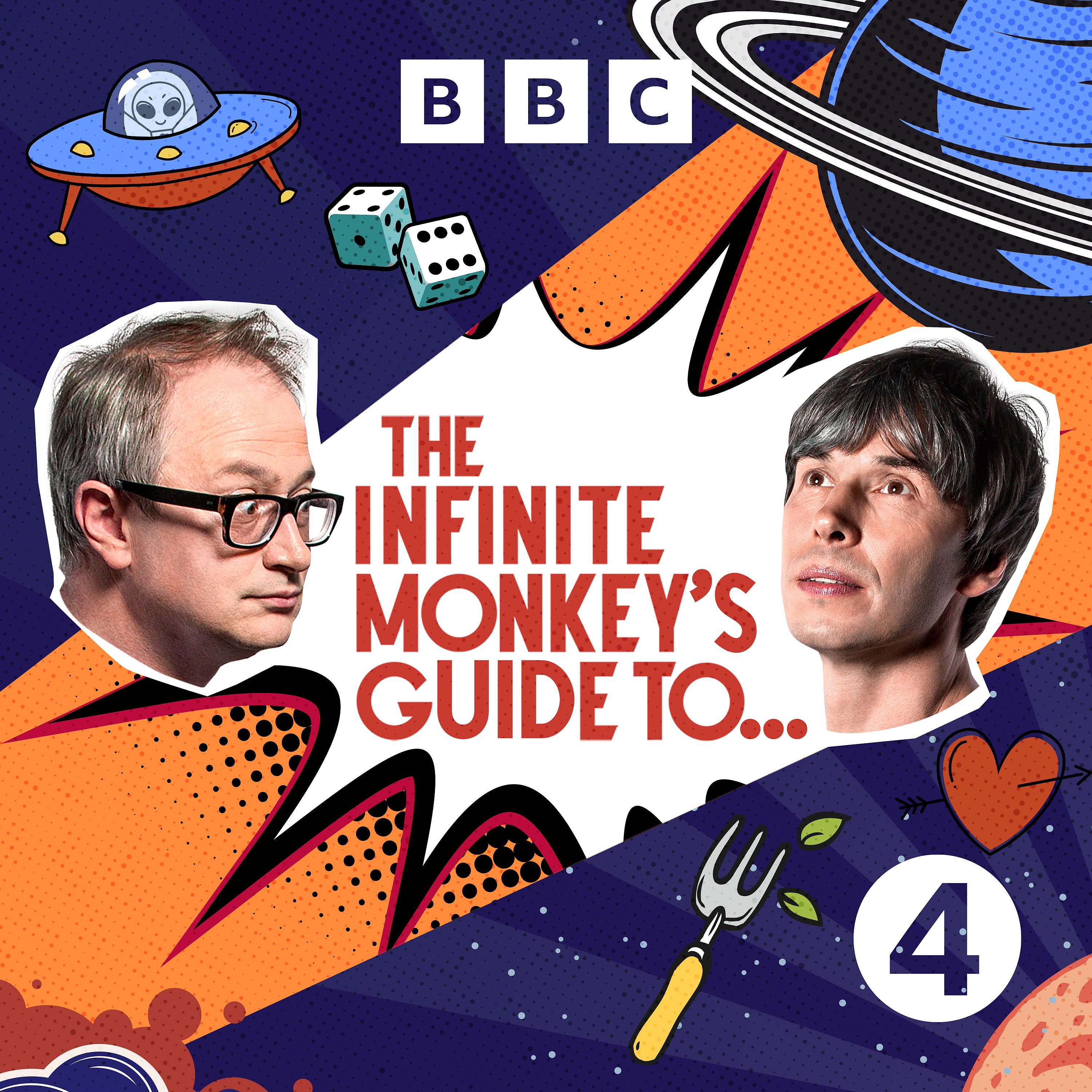
The transcription covers various topics related to science and nature. It delves into scientific jargon, explaining particles like muons, gluons, and quarks. The discussion extends to the tiny nature of particles such as electrons and subatomic particles, highlighting their quantum mechanical behavior. Dark matter is explored, focusing on its properties, elusive nature, and the ongoing mystery surrounding it. Additionally, the importance of microbes in diverse environments is emphasized, showcasing their ubiquity and partnerships with living organisms. Humorous anecdotes and discussions about existentialism, the vastness of the universe, and the insignificance of human existence in the grand scheme of things add a light-hearted touch to the overall exploration of scientific and natural phenomena.
Transcription
4053 Words, 22267 Characters
BBC Sounds Music radio podcasts. Hello, I'm Brian Cox.
I'm Robin Hintz and this is another Infinite Monkeys guide to. Now, scientific jargon can
be tricky. Well, it can be tricky for me. It's not as tricky for Brian. That's his kind of job,
you know, muons and gluons and strange quarks or quarks. Is that jargon that it's just a list
of nouns? Yeah, I know, but it's jargon to a lot of us. Why? Because it's the name of it. It's a particle
is hard and it's strange. Is it quarks or quarks? We've discussed this before. Well, that's a
literary question. Quark for Mr. Mark is where it comes from, James Joyce. But a lot of people say
quarks and a quark for Mr. Mork entirely changes that. I say quark. Well, that's another thing as
well. The charm quark and the strange quark. Why is a strange quark strange? The story which I don't
think is apocryphal is genuinely the particle was discovered that was very strange. It was a
particle. It wasn't the quark that was discovered. We didn't know about quarks at the time, but there
was a particle that was a strange and required the addition of the strange quark to the up and
down quark in order to explain that particular particle. Anyway, how do we go looking for these
really, really tiny things? And it's very hard to imagine, isn't it, Brian? When we think about it,
that enormous things, we kind of take for granted, there is a point where things become so vast that
again, you get that sense of being infinitesimal when you think of the size of the universe. But
sometimes when we talk about the tiny, tiny things, they're almost something that doesn't register,
you know, the tinniness of an atom, let alone subatomic particles. Those are things that are
very hard to picture, especially when we know that they are us. Well, they're hard to picture because
they don't behave like grains of sand. When you say electron, I suppose most people picture it,
it's just a grain of sand, like a little thing. You can bounce them together like little billiuboles,
but they don't behave like that at all. They're quantum mechanical particles. They, in a sense,
expand to fill the space that they're in. So they're not visualisable. We're dealing with the easy
stuff here because we do know electrons exist. But now we're going to move into those other
things as we get to a size, and also something which you certainly wouldn't say was a made-up
story. We're going to talk a little bit about dark matter. Isn't it made up stories? No,
well, it's dark matter is still the strong evidence, but it's quite elusive, isn't it?
So we're pretty sure it's there, but the nature of it remains a mystery. Here is the discussion
about dark matter that we have with planetary scientist Monica Grady and physicist John Butterworth,
who were explaining dark matter to, frankly, a skeptical Eric Heidel. What we've got, really,
are astronomers and cosmologists demanding, not demanding, but suggesting very strongly there is
another particle, which is a subatomic particle the size of an electron. Or they've got gravity
wrong. We shouldn't rule that out. That's an interesting point, actually, isn't it? Because,
as you said, the only way we know or we suspect dark matter exists is because of the way that
gravity behaves. So is it possible that our theory of gravity, which is Einstein's theory of general
relativity, is wrong? So, yeah, when do you stop? When do you stop looking? I mean, I guess we were
all kind of hoping that you guys would have found this particle by now. Sorry. I really feel like
you've let us down. You can't find what's not there. So, all of our observations, and there are
numerous observations that all support this idea of there being this dark matter particle,
all of those observations are taken in a framework which is based on Einstein's theory of general
relativity. And if we're missing something in that theory, then maybe we're misinterpreting
our data. And something that would have got me thrown out of the university a decade ago is now
really gaining momentum and people are really seriously questioning our fundamental knowledge
of physics. I mean, when you don't understand something as gigantic as 95% of the universe,
that's got to point you towards you missing some key piece of the puzzle. Is dark matter
outside our galaxy? No, it surrounds us. A giant clump surrounds us all. In fact,
In the room. It's in the room. Right. So, you know, I was talking about
neutrinos flying through you. There is about between a million and a billion, depends on
your model of the dark matter particle, between a million and a billion dark matter particles flying
through. Let's pick your thumbnail this time per second. But just like the neutrinos, you don't
feel them. Wow. And very, very rarely, maybe once every four hours or so, there'll be a direct
collision between one of those dark matter particles and the stuff that's in your body.
But you don't feel it. They're absolutely tiny, tiny. Can you see that? No, that's just a theory
of what we think. If our numbers are right and what we think the dark matter particle is like,
that's how many would be in this room with us right now. And how do you calculate something
you can't see? You just postulate, they bang into each other. So, there are lots of things that you
can say about the properties of this dark matter particle from our observations of the universe.
So, the first and most important thing is it doesn't interact with the stuff that we're made
up of. Because if it did, then we would have detected it already. You know, these particle
physics charts to my left and right are pretty good at particle physics. They would have found
this particle if it really interacted with the stuff that we're made up of. It doesn't.
So, it's weakly interacting. There are other properties. It has to have quite a small cross
section. So, that means that it hardly ever collides with the particles that we're made up of,
because otherwise, again, we would have detected it. And it has to be moving quite slowly,
quite a slow particle. If it was moving too fast, then the galaxies simply wouldn't form
in our universe. This is the important thing, right? We've just been talking about dark matter.
And I know we've covered this in the past on the show, but it still seems to be such a simple
problem. Why then call it dark energy? Because dark energy and dark matter,
they have nothing in common, do they, apart from using the word dark? What was this, you know,
ridiculous idea in terms of the naming system and physicists? I mean, dark matter, the name
makes sense in that the best theory we have is that it's a kind of particle, a subatomic particle
that doesn't interact with light, for example. So, it's dark. So, you can't see it. It's stuff that
looks like it's there because we feel it's gravitational pull. But you're right. Dark
energy, we don't know what it is. It's the thing that appears to be causing the universe to accelerate
in its expansion. Brian Smith, who's been on the show several times, discovered that the universe
is accelerating. That requires something to make that so. And so, we don't know what it is and
we call it dark energy. I mean, it might be a property of space. We really genuinely, it's one
of the greatest of mysteries. And undoubtedly, solving that mystery will point to a deeper
understanding of the way our universe is. Someone might come up with a wonderful, obvious answer
tomorrow. That's the beauty of science. This is where the beauty of science sometimes gets ugly
for you because we're going to move on to biology. So, these tiny things are very big, tiny things
by the standards of the atomic model, but very tiny by the standards, I suppose, of the biological
model. Because one of the things that I find fascinating, again, I only found this out really
by doing this show over the last 15 years, was the fact that we are also a bacterial multitude.
So, even someone as clean as Brian, and Brian is very clean. He's very, very shiny. But we would
go through your weight of bacteria. We reckon about six pounds of bacteria is Brian Cox.
Six pounds. 2.722 kilograms. When I first heard this, I hadn't quite kind of put it in my head
properly, which is the idea that in terms of numbers, we're more microorganism than human,
because we've got 10 times as many microorganisms as human cells. And then you find out that they're
all very, very small. Because I thought, what if I had a really hot shower and accidentally got rid
of all the bacteria, and then it turns out they were making my knees, and I'm just lying at the
bottom of the thing, being an absolute disaster. But yes, so don't worry so much. It's a lot of
bacteria, but in terms of actual mass, you are mainly human cells. Not a problem. The idea that
it would be your knees. Yeah. Just your knees are made of bacteria. Yeah, they are. I'm so sorry,
bacteria. I hadn't realised this hinge system's all over the shop now. We told you. Anyway,
here is Monica Grady again with marine biologist John Copley and Ed Byrne on the secret
rulers of our world, microbes. What excites me about the microbes here on earth is their ubiquity.
So we find them everywhere from 20 miles, 32 kilometers up in the stratosphere. They can survive
those conditions. We can find them in these things called lignite deposits, which is a sort of
fossilised peat, and that occurs in some places two and a half kilometres below the ocean floor,
and there are microbes living there as well. So now they are everywhere, and they're thriving in
so many different ways. They're like the Brian Cox of life. You're everywhere, man. You're ubiquitous.
In certain circles. When we talk about microbial life, and as we kind of alluded to in the
introduction as well, the idea that there's microbes and there's us, and then actually
we were saying so 50%, is that right? That we are, how much of us is microbial life,
and how true is that of most or even all living things? So yes, we used to think that it was about,
we were outnumbered in terms of cells, sort of 10 to 1 by microbes, but more recent workers said,
no, it's about 1 to 1. So yeah, I mean, plants live in partnership with microbes,
animals live in partnership with microbes. So when we say we're half-microbes, but we're not,
I mean, that's not, we're all human aren't we, but it requires being, how does it divide up?
If I accidentally flush out all my microbes, what's going to happen then? So yes. Why when
Jeff Goldblum got into the teleporter, why did he only fuse with the fly? Why wasn't he genetically
absorbed by the microbes and just a big half-human, half-microbe? Or a fungus. I mean,
but he wouldn't have been as much fun, would he? I suppose he'd have been a mushroom.
It would have been a different show. It would have been a very, very different film.
And you couldn't see what had happened to all the microbes when he went into the transporter,
because they might also have become half of a fly microbe as well as half of a human microbe.
There was a whole other story happening, a million other stories happening.
That film about a man and a fly being transported in a mass transporter may have had scientific
flaws. I don't know if you've got a favourite nanotechnology joke. My favourite nanotechnology
joke is, I work for the biggest nanotechnology company in the world, but not very good,
which is a great nanotechnology joke. Of course, small things have become incredibly
useful to us in lots of ways. But we asked Andy Hamilton, who is himself quite small,
and biomaterials expert, Eleanor Stride, whether size really matters.
As a guest idiot, I would say it depends on what the context is. I mean, if it's out in the sort
of tooth and claw environment and nature, size probably does matter. For instance, if I'm up
against a mammoth, I know that's unlikely. Not with Channel 5's new man versus mammoth, Joe.
Joe, what's really sad is that if that gets broadcast, there'll be someone sitting in a
room at Channel 5 going, "Do you know that might just work? Can they bring back mammoths?"
Yeah, I think it depends entirely on the context. I mean, it's all relative. I mean,
how big you are to start with dictates how big something looks to you. So when you're a child,
everything looks big, doesn't it? And then you go back to places when you're an adult that you
visited as a child, and you think, well, it shrunk. What's happened to it? If you could be three times
the size and a giant to terrorise all of those... I'm still worrying about the nano technology,
because when you're working with stuff that tiny, you must lose a lot of it.
I don't want to go back to the ants, but we actually had a crazy project last year that
someone proposed trying to make ants glow. So I forget mice, this was trying to make ants glow.
And we were doing that by introducing nano gold into the system. And actually, if you go beyond a
certain size, the nano gold does literally go everywhere, and that causes you enormous problems.
So that was worth a fortune? Or is it not? No, no, no, because it's a billionth of a meter's worth of...
Of gold? Yeah. For anyone trying to stick to a diet, anyone's to just not love food as much,
Erica McAllister is one of the best guests, because she's a brilliant ability. So for anyone,
off their tee. Especially when we've had shows that have gone out at 4.30,
and someone's got their fish paste sandwich there, and a fly is then just buzzing around the kitchen,
and I can tell you that more often than not, the fish paste sandwich ends up in the pedal bin.
She loves flies, but she loves the expressions people pull on their faces when she talks about them.
It is some of the horrid stories about flies that Erica shared with comedian David Badeal.
I think I have been bitten by a fly once, but not a lot. You've never been bitten by a fly.
You may have been pierced, shredded, sucked, maimed, but you can't be bitten because they don't have
jaws. What fly was it, you know? You know I didn't ask. Foolish of me. It was on my back,
and it was a fly because I saw it buzz. By the way, I want to ask later why they buzz,
because I would have thought that evolutionary is a bad thing, because it alerts you to the fact
they're there, and you swap them in more easily. I don't think that... Well, in fact,
botflies, because they're so fat and heavy, because they're such loud buzzers,
they will catch a mosquito and lay their eggs on a mosquito. So when the mosquito feeds off you,
the botfly egg then drops off, and the larvae then crawls through the hole.
So not only can you have a botfly maggot, you get dengue at the same time, which is quite fun.
Somebody's going... That must be said that amongst entomologists, rearing a botfly is a great thing.
People want to, you know, they're very happy if they go to the tropics and they get one of these
maggots living underneath them. They then want to rear it and to get the fly coming out.
I've been... No, I say this, I've popped one out my friend's head. So no, no, he's a primatologist,
so he was very like... So we're in Costa Rica, we're in the jungle.
No, I'm sorry, but that... So people are disgusted by, I think, but then you're meant to... People
are not going to be... Oh no, don't worry, he was a primatologist. That doesn't seem to stop the
disgust of you popping a thing out of someone's head, merely due to their their job.
Well, he should have been like, you know, it's a jungle getting used to it, but he looks a
primate, you know, but he was in his head. And what's quite fascinating, because they can't
burrow down at that point, obviously, because of the skull. So it grows across. So I was able
to watch it developing, which was fab. But at night, when it's all quiet, you can hear it eating.
Well done, Erica, by the way. 137 shows, and already we've had
more than we've had in every single one of the other hundred. Because it's this image, though,
of the crawling across like some kind of underskin comb overhappening. Seriously,
that's not the bad thing. It's because it's maggots. Feed one end, defecate the other end.
Obviously, obviously they do. I know they should go "errr" about that, humans do that too.
It's news for you. We all do that. Now, one of the first moments of existential despair that
usually occurs before, well, before we even know what the word existential means, or indeed even
know the word existential, is a strange dizzying horror of realising just how vast the universe
is. I don't know when you first came across it. I think for me it was, there's a great short film
called The Powers of Ten. It starts off with the couple on a picnic blanket, and then it keeps
going out by a factor of 10 across the universe. And then it does reverse. And I think the next day,
I felt so dizzy thinking about the size of the universe that I very nearly fell into the toilet.
For me it was when I first crossed the penines to Halifax.
Well, they told you there was nothing beyond. They told me it was only Oldham,
but it turned out there was Halifax. They said no, they said they'd be Yorkshiremen.
We end with a clip about how tiny we are in the vastness of the universe. And who better to ask
than an astronaut who's experienced this in a very visceral way.
Here's NASA astronaut Chris Hadfield with comedian Katie Brandt.
I suddenly could see with nobody filtering anything that the earth has been here uninterrupted
for four and a half billion years. And there has been life on earth uninterrupted for four of those
four and a half billion years. So the earth is tough as nails and life is so tenacious.
And we can get all wrapped up in the current events, be they good or horrible,
and think that this is the only moment that's ever existed.
But life, we could not eliminate all the life on earth if we tried our damnedest. Life is tough.
And I found that reassuring, this little elephant's length life that we're going,
it's important to us. But in the big scheme of things, it's just a momentary blip.
Katie, I think you alluded to it right at the start. There is a complex set of
emotions that contemplate in our place in the universe raises. Because at one level, as you said,
the sheer time scales, the physical, the physical insignificance of our world
might make us feel just that insignificant and irrelevant. And yet, at the same time,
there's a profound sense of value. What's your feeling of what that complex mix of emotions
signifies? Yeah, I mean, I, as I've said before on this show, and, you know,
my mathematical ability is very low for various reasons, teaching and sort of slightly odd
maths arrangements early in Catholic school, where we just did art and Jesus.
And I was good at art and Jesus. I'm still good at drawing.
It should have just come to you.
Yeah, we were often told how insignificant we were, but for other reasons.
But I think the difference of emotions I've had, especially over the last year or two,
over lockdown, I got into some of this stuff. And what I felt was excited by the idea that
there were ultimate truths out there that people in the world who study these things are really
trying to get at. And they're not afraid of the truths, the underlying truths of existence
and how space works and on a quantum level on a classic level, all of that. But so I sort of
broached it with this incredible fascination for like, wow, this could be really about what is
the true stuff of life. This is incredible. And then I think I glimpsed out of the corner of my eye
for a very brief second, an understanding of what this all meant. And I instantly became
really terrified at the seriousness and the hugeness of it of how, you know, quantum physics
might actually work and how that infects how I perceive my life on earth, and how I perceive
everything, how we all perceive each other is anything real, does anything matter. I went
through all these emotions, you know, sort of in about 20 minutes. And then I carried on reading,
carried on being excited by it, came in and out of understanding. And I did feel thrilled and
uplifted, but also deeply unsettled and worried. And I got quite upset for a bit because I thought
nothing I know is real, nothing I know makes sense anymore. Nothing, you know, nothing matters,
as you say. But then a new thought came to me. I didn't say that. Well, no, I mean,
I was just saying you were directly saying nothing in my life has any value. But I think I
settled on a new idea, which is all of this tells me that we should value every single second of
our own life on earth and that finding pleasure in life is the most important thing, pleasure and
beauty and truth. Obviously, I had to go off and have a quick bounty bar to calm down. And then I
thought, you know what, just have another one. That's what the message is. Next week, it's over
to you, the listeners, as we bring you the infinite monkeys guide to audience favourites.
Just to warn you, we will have the one where you get all scared with those spiders.
People really enjoyed hearing you being scared. I wasn't really scared. He was scared.
Anyway, thanks for listening. Bye bye. Now, all the episodes we took clips from are available
on BBC Sam's and you can find all the details of those in the programme description for this show.
Turned out nice again.
Hi, I want to tell you about my podcast from BBC Radio 4. It's called Fed and it's with me,
Chris Van Telekan. It's about one of the most important things that we all do every single day.
It's about what we eat. And I'm taking a close look at one food in particular, the most commonly
consumed meat in the world. And it comes from a humble, unremarkable little animal that, as I've
been finding out, is actually pretty extraordinary. It's chicken. Wheat, around 74 billion of them per
year. And yet, it turns out, I know almost nothing about where it comes from, how it's raised or
the impact it has on our bodies, our culture and the planet. But I'm going to find out,
in Fed. With me, Chris Van Telekan, listen now on BBC Sam's.
Podcast Summary
Key Points:
Discussion about scientific jargon and particles like muons, gluons, and quarks.
Exploration of tiny particles like electrons and subatomic particles.
Explanation of dark matter, its properties, and the mystery surrounding it.
Insight into the prevalence and importance of microbes in various environments.
Humorous anecdotes and discussions about existentialism and the vastness of the universe.
Summary:
The transcription covers various topics related to science and nature. It delves into scientific jargon, explaining particles like muons, gluons, and quarks. The discussion extends to the tiny nature of particles such as electrons and subatomic particles, highlighting their quantum mechanical behavior.
Dark matter is explored, focusing on its properties, elusive nature, and the ongoing mystery surrounding it. Additionally, the importance of microbes in diverse environments is emphasized, showcasing their ubiquity and partnerships with living organisms. Humorous anecdotes and discussions about existentialism, the vastness of the universe, and the insignificance of human existence in the grand scheme of things add a light-hearted touch to the overall exploration of scientific and natural phenomena.
FAQs
Quarks are subatomic particles that make up protons and neutrons. They are considered jargon because the names and properties of these particles can be complex and unfamiliar to many.
Dark matter is a hypothetical form of matter that does not emit light or energy. It remains a mystery because its exact nature and composition are unknown, despite strong evidence of its existence.
Dark matter is weakly interacting and does not interact with regular matter in a significant way. This is why it has been challenging to detect directly.
Microbes are essential for human health, aiding in digestion, immunity, and overall well-being. They outnumber human cells in the body and are crucial for various bodily functions.
Scientists study subatomic particles using advanced technologies like particle accelerators and detectors. These tools allow them to observe and analyze the behavior of particles at a minuscule scale.
Chat with AI
Loading...
Pro features
Go deeper with this episode
Unlock creator-grade tools that turn any transcript into show notes and subtitle files.
 PodcastTranscript AI