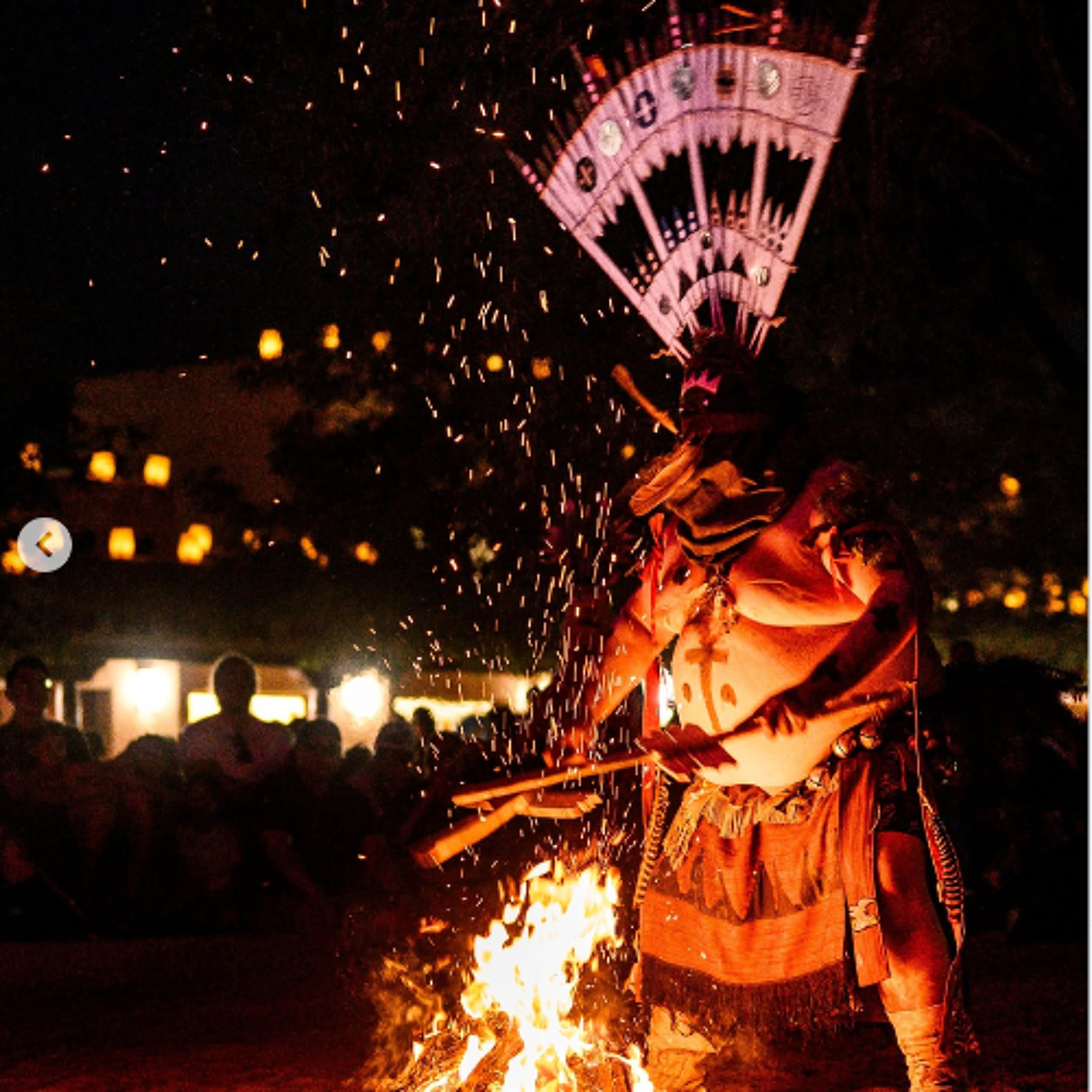
124. The Indian Village of Expo NM with Maurice Crandall
75m 36s
In this podcast episode, hosts Ty Banerman and Mike Smith welcome Dr. Auri’s Crandall, a history professor and author, to discuss his research on two topics. First, Dr. Crandall shares insights from his upcoming book on Yavapai and Apache scouts in the US Army during the conquest of Western indigenous nations. He explains that these scouts were recruited with promises of remaining on ancestral lands, and while their actions included fighting and looting, their later lives were complex—many reintegrated into their communities through purification ceremonies and used their military experience to advocate for tribal rights, though some are still remembered with bitterness. Second, Dr. Crandall delves into the history of the Indian Village at the New Mexico State Fair, inspired by his childhood memories and the lack of written records. He describes the village’s evolution from a dirt area with raised dance platforms to a more manicured space, noting its role as both an authentic community hub for Native peoples and an educational exhibit for fairgoers. Dr. Crandall also traces this tradition back to 19th-century world’s fairs, such as the 1876 Philadelphia Centennial, which featured Native artifacts but excluded living Native people due to contemporary conflicts and racism, highlighting a shift toward more direct representation in later decades.
Well, I guess we kind of have a theme song. Sit on the edge. Sit on the edge. Join us, well, sit on the edge. Sit on the edge. Sit on the edge. Sit on the edge. It's going to be like, it's going to be like you and say, "Sit on the edge." Oh, do I still say "Sit on the edge"? Sit down, you say "Sit on the edge"? Whoa, a new podcast lore. Alright. Sit on the edge. Alright. Welcome back to "City on the edge" with me, Ty Banerman. Joining me is Mike. Mike Smith, what's up? And then we have a special guest today. A special guest. A Ori's Crandall from Arizona, Professor of History over at the State University there. Yeah. Is it Arizona State? A.C. Yeah. And the author of these people have always been a Republic Indigenous electorates on the US-Mexico borderlands by University of North Carolina Press, which won the 2020 Cowie Award? Cowie. Cowie say "Cowie Award" for the most distinguished book on the history of the West, which that's awesome. So cool, man. Congrats. Yeah. Thank you for joining us. You're here from Arizona. We're not your only reason for coming. Right. Right. Yeah. So you were born in Albuquerque? Oh, really? Fossil material? No. I was born at the Southwest Maternity Center. My mom was a natural birth person. Oh, that's nice. I was not good on the hospital. Oh, good natural birth. Yeah. And the family was in Albuquerque because sort of similar years, my grandfather worked for the BIA. Oh, I see. Okay, fellow BIA. So my mom lived in Albuquerque and met my dad. Went to San Diego High School. Okay. And then they got married and had kids. So I was born here, lived here for a good chunk of my childhood and then moved to Arizona back to our tribal. Yeah. Right. Which is where? So my tribe is the Yabba Pipepatchy Nation. The town is Clarkdale, which is like, have you ever been a Jerome? Do you know Jerome? I've been a Jerome. It's a ghost town. Yeah. Mining town. Yeah. It's, I hate to say what it's near. I mean, it's like 20 minutes from Sedona. And when I say Sedona, it was like, oh, Sedona. Yeah, I got through Sedona once. It's on fire right now. So Crecanian is burning and last I heard it was 0% contained, 1500 acres in the canyon, kind of burning towards Sedona. Hopefully they can get that under control. Yeah. So come on. Interdimensional entities that live in the vortexes there. Come out. Those don't exist. Okay. They don't. The vortex was a tourist. Yeah. You heard of your first fox. The vortex is not real. The vortices is that what you would call it? The vortices are there for the vortexes? They're just seven or something. I've heard people say that Santa Fe has a vortex too. And like, yeah, it's a vortex. The woman who came up with the vortex concept in Sedona, if you look, they're all just very conveniently by the main street through town. So they're all like, with distance. Oh, funny. Short distance of the main road for tourists and businesses. Yeah. Yeah, exactly. The vortex plush doll is some sort of spirally plushy. And so you got your doctorate here at UNM. I did. M-A-N-P-H-D. Okay. What were you studying? Western history and Native American history. So that's like your past? Yeah. Yeah. I'm a, I would say I'm primarily an indigenous historian and then more broadly the history of the American West, which in clothes like Northern Mexico. And then US history as well, like I teach US history courses. Oh, that's great. The US history survey. In the fall, I'll be teaching like 101, the first half of the US survey. Right. And you are working on a book as well. Yeah, the book is with my editor right now. So how are you? I'm in the script and excellent. Waiting for edits to come. Can you say anything about that book? Or what? I can. Yeah. So the shortest way to say it is the US Army when it conquered Western indigenous nations, used indigenous scouts from those nations or from neighboring nations to fight against them because like the saying goes, and I'm Apache and Yabapai. So only in Apache can catch an Apache. And so the Army had this sort of way of going about its business where it would, as soon as it had subdued a group, it would then try to recruit scouts from that group to help with the fighting from the point. Right. And so I'm writing about Yabapai and Apache scouts in the US Army who served as enlisted men. They received the same pay as regular soldiers. Oh, yeah. They received the same equipment, but they served shorter enlistments. So they were between like 30 days and three months. And they were traders. They were, I mean, yes, in a sense, I mean, you could say they're race traders. The Army often tried not to use people from one group against that same group. And so like they would use white mountain Apache's against my ancestors, like Dijay Apache. So the initial conquest of the Tonto Basin or Moeon-Rin country was done with scouts from white mountain Apache. And where there's often groups that had like longstanding rivalries? Yeah, they could, but not always. No. And so I look at sort of the motivations. And I mean, the simplest way it would be to say like these were race traders and what they do it was bad, which I agree with to a certain extent. But like with anything historical, if you dig deeper, you kind of find different motivations and it's not always. So there is no single Apache nation. There are many, many Apache and like Geronimo was no ally of my people. You know, Cherkawa's or Southern Apache's or an enemy group. We're like the farthest north western Apache group. And so, you know, there were various enticements that were made. Think about it this way. The main promise that was made to Apache's and Yababai's who were recruited for scout service was, if you help us do this, we'll let you stay. We'll be here on your ancestral lands. All be it in a smaller form, a reservation. But if you help us bring in the so-called renegades, you can stay here. Now that was not a promise that was capped. Right, right. Well, we were removed to San Carlos, which is a couple hundred miles away in Southeast and Arizona. I know that there. And then eventually we filtered back into our home lands at room 1900 after being essentially imprisoned for 25 years on a concentration camp. But I'm interested not just not even primarily in what these guys did. And the overall majority were men, although there were a few female scouts from the majority were men. I'm not so much interested in what they did during the campaigns because that's pretty clear cut. They guided army. They fought. They killed. They looted because they were allowed to take the spoils of war from enemy camps that they helped find. That was sort of one of the rewards. But I'm interested in what they did later on. You know, at a distance of 10, 20, 30 years, who are these guys? Are they hated by their communities for being racers or are they gone? And for the most part, they aren't. Because I think that people at that time understood, it's best to sort of move on. Let's do the ceremonies that heal from, because in indigenous society, like if you kind of, in my community, if you come into contact with the dead, if you're in the community, you're involved in killing, you have to go through purification ceremonies. And so as my uncle, who was an elder in our tribe and had a deep knowledge of this, said, the guys came home, they did the ceremonies, and then they considered it done. They tried to forget about it. But their experience in the knowledge that they had gained is scouts had some utility. Some of them had English proficiency. They knew how bureaucracy worked. They knew how the army functioned and how layers of leaders jantras did it. Who you could go to if you had a problem. They knew how to deal with Indian agents. Some of them go to Washington, DC. They meet with the president with the commissioner of Indian affairs to air grievances. So it's more complicated than these guys did something terrible. They deserve to be hated. And some people do remember them with bitterness, with a sense of, these guys did was bad. We kind of, I don't know, I try to find a fuller picture. And I find that some of what they do is almost sort of like funny or coyote-like, there's one former scouts who is an ancestor of mine who, I don't know that he necessarily started the story, but the story became maybe through a game of like operator that he had personally captured Jeronimo. And so walking around a town like Camp Verde, Arizona in 1920, which is like the most racist place in the United States. Everybody hates the patches. But this guy is like, oh, you're the guy that captured Jeronimo. You're fine. You could shop here. I see. We'll give you a line of credit. And so, you know, I think that these guys realized that there was some currency in their scout service. Even if it was painful, even if it caused damage. And roots in their own communities or other communities. But they could benefit their communities and maybe make amends in some way. So kind of a funny story is the reason that the term scout is on my mind this week is, so I do a show called Let's Talk New Mexico on KUNM. And this week we were talking about.
talking about AI. And we had a fairly pro AI guy on as one of the guests. And but afterward my engineer, who's Navajo's like, that guy's a scout. - And it was like dripping. - Of course. - Yeah, yeah, yeah. - Well, hatred. - You hear it, you hear it for sure. Like when they were talking about the confirmation of the new commissioner of Indian Affairs, was a Navajo guy that was being, it was a congressional hearing. It's through the department of the interior, and all of that is operated, the BIA. And the comments on the Navajo Times Facebook page were like, here's another scout for the cavalry. There's Navajo guy who was gonna work for the Bureau of Indian. - So the fascinating. - The reputation lives on the. - It's still there for sure, for sure. - But that's not why you're here today. You reached out to us to want to pitch some ideas. And what we settled on was something that I've never really thought that much about, which was the New Mexico State Fairgrounds Indian Village right over there at Expo, New Mexico. So how did you decide that that was something that you wanted to find out more about? - Some of my earliest memories are in the Indian Village. - Sure. - And I don't wanna spoil it right. It's part of the story. - Okay, okay. - But let's just say as a child, I grew up in the Indian Village. - Well, that was there as a little kid a lot. - Well, this is gonna be right. - Yeah, yeah. So I have an interest because of that. And truth be told, I haven't been to the Indian Village in several years. So I'm not sure that it retains the same feel. It has changed over time and become a little more, let's say like a little nicer or a little more corporate. - Yeah, and a little more, yeah, kind of manicured. Like there's grassy area. - Exactly. - It's kind of elevated. - When I was there, it was like, shacks with chicken wire, all dirt. And I don't know if you went as a young child. You were born in Albuquerque? - Yeah, but I didn't really start going to the state fair until, what I was linked to in your cell. - Okay, so way back when it had a raised dance platform, the dancing was not done in the open like it is now. There was almost like a wrestling rink. - It's like, raise with, kind of, - Just like a race. - Yeah, it was a raised platform. - 'Cause you got now, it's just right in the middle. - Right, yeah. So I just have memories of being there as a kid. And the VIA Spana was opened in the early 70s and is right next door. So, you know, there was just kind of this energy around the safer Indian village. - Yeah. - And I thought it's an interesting history. I looked into it and there's not a lot that has been written about it. - No, I, I, I, I, I tried to do a little cursory research, you know, just so that I could, could not be fully ignorant and like I found it like three facts. - Yeah. - Like, you know, there's a very, like 64. - 64 is an augurally year, but that's about all you can find. - You know, you're gonna save your website has like nothing. - Yeah, that just, there's no better. - What the schedules are for the state fairs past. - And the dance groups and that's it. - Yeah. - Like at least. - But you have to say it is, I think it's my favorite part of the fair at any given year. It's like the most comfortable feeling place. It feels like the scale of it works for me, you know. - Yeah, yeah, yeah. - Usually has the best food that's, you get the, for sure. - For sure. - For our red Indian tacos. - That's all part of this story. - Yeah, right. - That was very intentional. - All right. - All those aspects. - Yeah. - Okay. - Yeah. - Should we launch in? - Yeah, let's do it. Let's, let's, so like I said, I found out like two facts about it. You have, looks like 25 pages. - I have, let's see. 29, no, 30 pages of written text and, wow, 85 footnotes. - Holy no. - Amazing. - I mean, this is an article. And I'll submit this to a journal. - Oh, I love it. - I have a draft of an article. I need to do a little more research still, but we're getting there. - I feel very, like, rib-loathing. - Rib-loathing. - Rib-loathing. - Rib-loathing. - Rib-loathing. - Rib-loathing. - You know, this is all exclusive. - To me and apparently new to most people. - Yeah. - So it's so, not well covered. - Exactly. - So sure. - Yeah. - All right. - Let's go ahead and jump in there. - Okay. - So I'm going to start with a, with a quote. Okay. The Albuquerque journal published a short piece in September of 1982. And the fair, it's at the Indian village is at the state fair, which takes place in the fall. For listeners who don't know that, the New Mexico state fair. I guess it's ex-pon-expo in New Mexico now. - Well, that's the grounds. - The grounds, okay. - But it's still called the New Mexico state fair. - Okay, okay. So this is in September in the immediate lead up to the fair. And the article was titled Indian Village among top fair exhibits. And it deceptively covered an entire page of the journal, although like three quarters were ads. So it's really only like, you know, just a quarter page. - Just. - And it's in the back page. It's not like a headline, you know, front pages. But anyway, the article highlights the Owinge Village. It was called the Owinge Indian Village. I'm not sure if it's still it. - I don't know if it is either, 'cause I did, that was like my second fact. - Exactly. - And originally spelled O-W-E-N-G-A-Y. Not like Oke Owinge Pueblo, not just O-H-K-A-Y-O-W-E-N-G-H. It's, you know, the Tehwa spelling is different than what they had on those days. - That's okay, that's the Tehwa. - Owinge means village or place. - Okay. - Oke Owinge means place of the strong people. Village or the strong people. - Good to know. - So, in 1982, like I said, this article was published. That was its 19th year of operation. It would be its 19th year. Ned Russell, who was the director of the Indian Village at the State Fair, was quoted in the paper and he said, "What we try to do is present a good cross-section of Indian culture so that people can see what Indians are like." And also for listeners, Indian is one of those terms that is still used in native communities. You will hear it as a self-referent pretty often. When I'm home among my people, Indian is common. I always get, you know, well-meaning white people are like, "You shouldn't say Indian 'cause it's offensive." I'm like, "Well, you don't know native people." - Right. - You have been around them. So if I say Indian, it's not offensive. - Right, right. - Just, well, then you're also like, refer to things that were produced in the '60s. - Yeah, so also. - But the term is still used. It is still used today. - Okay. So he goes on to say, "We would eventually like to grasp most of the village." It was dirt at the time almost entirely. But we don't wanna get so modern that we lose some of the Indian-ness of this place. - Yeah, that makes sense 'cause the grass does seem very at odds to the idea of-- - Yeah, at the time it was almost all dirt. The article goes on to highlight attractions at the Indian village, Pueblo-Even bread, fry bread, dances, arts and crafts. And it referred to the Indian village as a, quote, microcosm of American Indian culture, unquote. It was very positive and unequivocally stated the Indian village was immensely popular. Similarly, that same guy Ned Russell was interviewed two years previous when he was also acting as the director of the Indian village and he spoke about what was called Indian Day. And that is one day a year where the state fair declares this is Indian Day and native peoples are recognized on that day. And there's usually a parade and the crowning of Miss Indian New Mexico at a pageant. - Yeah, do they still do that? - They did up until recent years. I'm not sure if it's still ongoing today. But I would guess that it probably, into the 2000s it was. - Right. - I would imagine there are still New American pageants for Native American women going there. - Sure, I'm familiar with the one of the gathering of nations they usually have - Missed four-year-old, right? - Exactly, exactly. And Miss Indian New Mexico goes to that pageant and is the contestant for New Mexico in the larger pageant. But he also said, for Indian people, Indian Day has to be the most popular aspect of the Indian village. It's a day when most of them come to reestablish old friendships and talk about what has happened to them in the last year. So what you get a sense of here through the Indian village is this like gathering place where food, dance, all of these things are shared. They want to cultivate a sense of community. And also something faithful to Native American community. They don't want it to be too slick. And they also want to have a place where they can sort of showcase native culture to outsiders so that they get a better understanding. And that's kind of it. - And it's authentic in that it's about the community as well as showcase. - Right, exactly. - So what it sounds like. - So that's it, that's the Indian village. We can stop here. - Okay, it's called that. - That's right, next. - Okay. - Okay, so what I'm gonna do now is we're going to turn the clock much further back now. Okay, so you can't understand the Indian village if you don't understand a history of the Indian village at the New Mexico State Fair. That history is tied directly to the history of world's fairs and larger things like the Chicago exhibition because native peoples and Indian villages were parts of those fairs as well. - Yeah, I'll be right back. - Dating right back. - Exploid of way. - Exactly, okay. So let's talk about that. The first fair that took the first world's fair in the United States was 1876. It was the Centennial Fair in Philadelphia. We're having the 250th right now. They had an 1876 fair. And at that fair, there were exhibits at the Philadelphia Centennial that showed.
mostly artifacts. So there were artifacts of weapons, paraphernalia, clothing, ceremonial objects, many of them from southwestern tribes, Hopi, Zuni, Navajo, etc. But they did not have live native peoples. They had mannequins dressed as Indian. And those were not popular. They didn't go over well. People didn't like them. The comments were, we don't like these mannequins dresses. But why do you think there were no Indians at the centennial exhibition in 1876? Were they maybe not allowed because of racism? That's my guess. Sure. You're on the right track. 1876. So the fair ran from May to November of 1876. Custer's last stand was June 26th, 1876. I mean, native peoples were still viewed as dangerous at that time. I mean, there are apaches in the West are in open warfare against the United States. I would think in Philadelphia, where they're like not maybe differentiating between the different groups. Absolutely. Yeah. And native peoples just viewed as dangerous. And so perhaps having live native people there wouldn't have gone over well because people were still afraid of native people. There were still you know, barbers and at war and you know, scalping and all these ideas. But future fair organizers decided we do need to have real native peoples at fairs. And so fast forward a number of years to the Chicago Fair, which is in 1893. It's the official title is the world's Colombian exposition, which was to celebrate 400 years since Columbus's discovery of America. But yet that's funny. Those beset with logistical issues. And so it was a year late. It's actually it's 1893. It should have been 1892. Oh good point. Yeah. Yeah. So it's a year. We all know shouldn't have plenty and on that one. Yeah. But they had an Indian village there. Definitely. And the Smithsonian isn't Smithsonian is involved. The Bureau of Indian Affairs, which is the time is called the Indian Bureau or the US India Service. It's not called the BIA told in 1940s. They're involved. And so they have this, they build what's called the Cliff dwellers village. They make this gigantic cliff dwelling there. They bring in Navajos who live in a Hogan. They bring in a number of Weblo peoples. But they also bring in indigenous peoples from around the world. And they have this. Oh go ahead. Do we do one on the the Philippine? You did mention. I don't know if we did a full episode of the S1. But yeah, you talk about those. Yeah, because they're ultra-alcoholic. They did. Yes. And so they have these comparative displays showing the fairs about progress. It's all about progress. And so Native people are shown as primitive and comparative displays of different indigenous groups from around the world. And then US groups as well. But they also want to show progress and that Native people are progressing. And so they have a model Indian school. By this point, Pratt has opened the Carlisle Indian School. And so they make a fake Indian school there. And they're like to contrast each other. We have the old Indians of the past, the primitive ones who are dying out. And then we have the new Indians who are progressing. And they'll be assimilated into the American mainstream. There are a lot of interesting things happen at the Chicago fair. Native people, a lot of them don't like their treatment. For example, there's a group of Inuit who live in what was called the Eskimo village. They didn't like their treatment and their pay. And so they quit and found jobs elsewhere. Some of them worked in the midway. Some of them started their own exhibit, their own Eskimo village as it was called just off fairgrounds where they charged admission and did their own thing. Yeah, totally. Like with the Igorote, they wound up being basically enslaved for a while. Yeah. I mean, they were there like six months. Yeah. It's a long time. Yeah. To work under these conditions and like, how are you going to get back home if you don't like it? I mean, there's a lot to consider. There were students from the Albuquerque Indian School there. They were brought right at the beginning for the opening. They were at the model Indian School. They're mostly club-low students. But what went on at the same time just off fairgrounds was Buffalo Bills show. How the well went in as it was right there. And fair organizers who were involved with the Indian villages and those displaced, they did not like that because none of the Indian village displays at the Chicago fair showed like battles or recreations of savagery as we would like as they would call it. It's supposed to be sensational. Yes. But Buffalo Bills having like reenactments of Cussard last stand. He's doing, he has 200 native people in his troop and they're, you know, they're having these mock battles. They're doing all this stuff. And so there's this tension going on. And they don't like this. And Frederick Jackson Turner gives his, you know, the Frontier myth speech that year is really an historical society. It's 1893 as well. The Frontier is closed. So there are a lot of currents going on. 1893 is an important year. But the point I'm trying to make is that Indian villages are an essential part of fairs, even pre-dating the Chicago fair. But that was maybe the most well known and railroad makes that possible to bring native communities. I have them construct, you know, villages for the, for people to goch at essentially. And this is at the time of, you know, the vanishing Indian trope where they think native peoples are going to die off and be gone. Yeah. Off into the sunset. And so this is why Curtis is going and taking all these photos because it was salvage anthropology. We've document all this before Indians are gone. They didn't go away. But all these things are intertwined. Then in 1904, they have the St. Louis Fair, which is the Lewis and Clark centennial. And they're celebrating the Louisiana Purchase Exposition there. There's Indian Village there as well. And at this one, they have the building where it houses both the model Indian school on one side and then the Indian arts artisans on the other side. So they're making crafts in the old way while the Indian school students are just across the aisle doing modern things. Yeah. And they're learning classroom like rudimentary education stuff. But then they're also working at trades because they're training them to become carpenter sense and, you know, to make horses for horses. Like they're not training them to become business people or, you know, entrepreneurs or anything. Right. Right. Exactly. Yeah. They want them to be cogs of the man or laborers. Yeah. Yeah. Because that's what ethnic people are supposed to do in the United States during the industrial there. Exactly. But one of the interesting people who was at the St. Louis Fair was Geronimo. They brought him from Fort Silicoloma, whereas people had, they were imprisoned there. They were prisoners of war. Yeah. Once the final surrender of Geronimo in 1886, they were put on a train and sent to St. Augustine, Florida. And then they were brought to Alabama and then eventually to Fort Silicoloma where they stayed. Fort Sil tribe is still there. Patches from that group, some of them went back and lived at Mescalero. But the majority are still there at Fort Silicoloma. Yeah. So Geronimo was a guest. So was he basically like forced to do this exhibition or was he? He wasn't. No, he was not. And none of the native people were forced to. They were recruited. Right. With promises of money and opportunity and you know, it comes to the world, have a new experience. And so Geronimo was brought in and it's really interesting. You can read his, he did an as told to autobiography. I love his autobiography. Yeah. There's a part where he's talking about the St. Louis Fair. And Geronimo is in this sense like this is him at his best in my opinion. He has a hustle. And he says, I sold my photographs for 25 cents and was allowed to keep 10 cents of this for myself. I also wrote my name for 10, 15 or 25 cents as the case might be and kept all of that money. I often made as much as $2 a day. And when I returned, I had plenty of money more than I had ever owned before. So he did well with his, he took advantage of this. But there were complaints at these fairs that they didn't like the Indian villages and the portrayals of native peoples. The white gays was really strong. And if they didn't think the Indians were authentic enough, they would complain. Wow. Which is ridiculous. Because these are native peoples recreating their own long real earth. And they're also modernizing too. Like native peoples. And this is really what's happening. Exactly. By 1900, you know, native peoples, they've found the advantages of certain modern convenience is also. Right. But they didn't like, for example, at the Chicago Fair, they didn't let the Navajos put a stove in their hogon because they were like, why should they have a modern stove? Yeah. That doesn't look authentic. That's all tickets. And so they like froze in this hogon. Right. So anyway, these, these early fairs are very influential to what will happen in New Mexico. The first territorial fair is in 1881, which is, you know, kind of in that same sphere, basically the last 40 or so years of the 18 of the 19th century are like the heyday of the fair. These, these big fairs. And, and New Mexico holds its first territorial fair in 1880. That's the year of new town being founded. 1880, the railroad comes in 1881. They have the fair. And because the roads there, that's why Albuquerque is the logical choice for where to hold the territorial fair. Santa Fe has like three times the population, but Albuquerque because it's by the railroad. Yeah. And the original state fairgrounds are at like Rio Grande Central.
- Yeah, right around the old town. - Yeah, yeah, exactly. From that earliest day, native peoples are part of the territorial fair. They dance, they sell, they are at celebrations. One of the biggest attractions was what were called Indian foot races. Native peoples have a strong running tradition. And so people would come big crowds to watch native peoples race. They had native horse races as well, like relays, where they would run around the track. So native people are involved in the fair. They also are involved in the form of Indian villages. So the territorial fair had Indian villages as well. Not the Indian village that would come later in the 1960s, but there are Indian villages. - Kind of faux pueblos is what I. - They did, yes, yes. And the idea, so the whole purpose behind the territorial fair was, we need to portray New Mexico as modernizing, as whitening and native peoples, and you know, Nuevo Maycanos or Hispanic peoples, they are of the past, but they're harmless. They're docile. - They're a great attraction. - Exactly, yeah, we're the statehood, make a mistake. But they are the ancient past. New Mexico is becoming modern and it's progressing. And it has all these great things going on, like mining and agriculture and tourism. And it's safe. Don't worry, our native peoples are not dangerous. - Yes, that's kind of what's going on there. And the villages are a place where you can showcase native peoples who are not dangerous. They're safe, they're doing their thing. - They only just want to sell you stuff. - Exactly, we'll have them make crafts, et cetera. So like I said, they start constructing villages in various forms. They ranged in size. Some of them were large, some of them were just sort of small, but typically a small group of native peoples would be recruited to come to the fair. So some fair official would go to like Navajo reservation, find a group of people who are willing to come and then bring them there. Sometimes they were on a larger scale though. Like for example, in 1907, the Albuquerque Morning Journal, which was the precursor of the journal. It had a headline, "Zoony Pueblo will be moved here for the fair." - The whole Pueblo. - Apparently. - That was picking up the biggest sound. - Obviously they're exaggerating, but this is what they say. This would be quote, "biggest Indian feature this fair attempted." "Big band of the famous Western Pueblo will invade Albuquerque, bringing their horses and homes." - Yeah. - Just for fun. It's not a scary invasion. - Yeah, yeah. - Exactly. - Fun invasion. - Exactly. They're not dangerous, right? - How the west was fun. - What's funny is in that same article, it goes on to say Navajos, who were hard riders and good dancers when they feel like dancing, which isn't often. - They feel like, "Well, I'm coming on." - They had been the main attraction. - Yeah, exactly. - That's the idea that they're trying to force them to dance. Well, nobody wants to be forced. Come on, it's time. Let's go. - Let's go. - You got to schedule it. - Wow. - That's fine. - But it speaks kind of disparagingly of Navajos who had been at the fair previous. And maybe this has to do with that episode. You referenced where DKB sellers had approved - Right. - Navajos to battle. - And supposedly they stuck in some live ammunition. - Well, so the story is kind of, it's quite a bit to it. Sellers had this group of cowboys and also cavalry from Fort Wingate. And he would ride alone across the rodeo ground. And then the Navajos would run out and attack and then the cowboys would come and help. And eventually the cavalry would rush in and save the day. - Sure. - But an interpreter told sellers that some of the Navajos had loaded live ammunition. They had all been given blanks by the army. And Peshla Kai was the name of the Navajos chief. And basically sellers goes up to him and he's kind of small talking. And then he reaches and grabs his pistol out of his holster, opens it up at real bullets. It's like I'd seen in three amigos when they're having that. - Right. - They're trying, it's supposed to be like fake battle. - It is like the great real bullets. - And so they do the battle, but those Navajos were actually put in jail. And then the ones who remained did the whole thing without weapons. They did the recreation with Nippinger. - Yeah, pew, pew. I don't know what they were doing. But apparently it wasn't like the end of things for that Navajo leader, because a few years later he was at the fair and they had a mock battle. So I guess everything was forgiven. - Your apologies. - Yeah, yeah, yeah. All forgiven, all forgiven. But the whole Indian Village concept runs through the territorial fair. The most significant Indian Village though, during the territorial fair era, do you know where it was? Either do you know where it was? - Let's see. I feel like it might be connected to UNM. Was it connected to UNM at that point? - No, no. But it's connected to something, nope. It's connected to something you guys talking about frequently. The Alvarado. The Alvarado is completely. So when it opened in 1902, it had an Indian building. But it had an Indian Village as well. - I didn't actually realize it at all. - It was called an Indian Industrial Village. And they brought in Navajos. They brought in Pueblo peoples to. - So that was a photo of like a Navajo Hogan that's supposed to be right into. - There was one. There was one right there. And that was. - It was a picture of where that was. - It was off of first street just beyond the tracks. I mean, so it was just next to the Alvarado fairgrounds. - Right, that's the part of that. - Yeah. And so it was started in the construction for the Indian Village at the Alvarado complex, began even before it opened. Because the papers were reporting in 1901 that the Alvarado was gonna have an Indian Village. - Yeah, that was an important part of there. - And so it's there in 1902 when it opens. There's an Indian Village and they had them on. They have Navajo peoples in there. And it's funny the paper reports that that first. It's connected to the territorial fair as well. Like it opens in conjunction with the fair. Because the Alvarado is a big feature of the territorial fair. They bring guests there. They host balls inside the Alvarado at the time. - Yeah. - But that Hogan is reported and then they said, they brought in a stove because the Navajos who were in it were Mutuofrio. - That's what the news they brought it all says. - Yeah, okay. - It's just okay. - Any chance to sort of build a little bit, you know what I mean? - Yeah, yeah. And so what do they do? The native peoples who are there are artisans mainly. They're weavers, they make rugs. Pueblo peoples are brought in, they make pottery, et cetera. And then those are sold at the Curio shop right there at the Alvarado, which is, its whole purpose is making money. And they make a tidy profit for themselves. In 19, oh, I need to find one of these in my notes, sorry. In let's see. 1909, President Taft was meant to visit during the territorial fair that year. And that's when they held the first monosumable, which it still goes on. - Really? - It was monosumable. - Really? - Yeah, that it's still something associated with New Mexico and what the-- - Yeah, okay. And was that hold at the Alvarado? - It was. - I think I heard about that. - And that year, they in 1909, when Taft was supposed to come visit, they moved the Indian village into the lobby of the Alvarado. - Oh, okay. - And the Santa Fe New Mexican reported on it. It said something quite unique under the skillful direction of Herman Schweitzer, that was the guy who ran the Curio shop for the Alvarado. Manager of the Harvey Indian Building, the little placita or inner court of the hotel has been transformed into an Indian village. TPs, the true Indian yellow kind, have been erected. The placita is for the special benefit of the guests at the monosumable. - There's that appeal to authenticity. - Exactly. - We swear it's real. - Yeah, there's never been a TPs in New Mexico. (laughing) - Well, you know, I mean, like planes Apache people. - Oh, really is that true? - They use them? - Yeah, there were some groups who used to, but it's not the common dwelling. They Navajo's live in Hogan's. Most Apache people's live in like Wiki Ups, Goa's, call them in Apache. Yeah, yeah, but he didn't go to the monosumable. - No, he didn't. - No, I think they were disappointed, but they had the ball anyway, and then they had it in succeeding years. So. - One of the stories that I heard about the Alvarado was Jackie Cougan came out and was inducted into some Navajo society is-- - That happens frequently. - They have prominent guests or people, they put a headdress on them, they adopt them into the tribe, et cetera. - Which is exactly what happened with Johnny Depp a few years ago. - That's right. - Yeah. - The charity. - It was being criticized for-- - Yeah, you were trying Native American. - Yeah, I mean, those things, they're for publicity, but always you have to think, you know, Native peoples have their own reasons for doing such things, and maybe they're just like, "Has all right." - I agree with you. - At least you go out of our hair, they'll leave us alone, I've already do this. - Anyway, so the territorial fair runs from 1881 to, the first state fair is actually before statehood, they happen to 1910. - This is the, we're gonna be a state fair. - Exactly, yeah. And like I said, Native peoples are part of those fairs until 1917 when the state fair is furloughed, essentially, until 1938. And in the intervening years, there are some other fairs that happen. There's one called the First American, which happens in Albuquerque. And that one is specifically geared toward Indian exhibitions, dances, selling of crafts, et cetera. And they actually constructed a four-story paper mishap weblo at the corner of Wyoming and center. - That might be what I was talking about. - I have a picture of a Japanese book. - That's incredible. - Yeah, it's enormous. - Right.
They must have been thinking like please don't rain. Yeah, well, it's you know, like, your chance it wasn't once. Oh, where do you say it was at the corner of a central and Wyoming and Wyoming? Yeah. So up there. No, there's a very sad McDonald's. Yeah. Yeah. And no more foxes. Oh, this long goes booze and cruise. Booze and cruise. Why did that business not fail? Why did that fail? I mean, although like, that last. Yeah. So the intervening years, there are other things going on, other celebrations, other fairs. The state fair is picked up again in 1938. And native peoples, once again, are part of the state fair from 1938. But what you sense at that time is like a subtle shift in the nature of participation. You hear more about like fair officials are meeting with representatives from the All Indian Public Council. And they're asking them about what participation will look like during those years. Well, it's good. But it's a subtle shift. I don't want to overstate it because the Bureau of Indian Affairs, the US Indian Service is involved. And they're using Indian students as laborers from the Santa Fe and Albuquerie Indian schools on the construction. And they have an Indian building. They decorate it with arts and crafts. They have native peoples selling again. But what you start having is an annual barbecue where weblo leaders are hosted and honored. All the governors from the 19 Pueblos are there. And then after a few years, Navajo leadership is invited as well to this barbecue. And it's open to all native peoples. So you start having this what's essentially Indian day. And the barbecue hosts native people and their fed. And so like I said, a little bit of a shift. A little bit of a shift. But where things really start to change and what is most influential to the establishment of the Indian village as we will see it in the 1960s is a federal effort at relocating native peoples from reservations to cities. The urbanization of the Native American population. Yeah, how say the dawn stuff? Do you know where the roots of Indian urbanization as a federal program are? Not really. They're right here in New Mexico. Oh really? Yeah. In four corners area. Essentially what happened was there was a terrible blizzard in the winter of 4748. Yeah. Navos and Hopes. Which if you don't know, the Navajo reservation is sort of surrounds the Hopi reservation as an island inside the larger Navajo nation. But it was bad for those people who are a lot of them, and so the federal government moved native, employable native men to cities, to Denver, Salt Lake City. And there I think there was a third city. I'm trying to remember what the third Los Angeles is. How state of dawn has parted to leave about that? Well that's later. Over the same thing. It does become a, but this is the first kind of like pilot program. And it's on a smaller scale. It's on the two tribes. This is after the big sheep culling and all that. Yeah, the second long walk. Yeah. The Navo stock reduction program, the haulier during the 1930s. There really is a need for help at that time. Yeah. The Navajo nation and the Hopi tribe are suffering because of this, these blizzard conditions. Well people are starting to survive. I will have been wrenched up. To diminish significantly. Yeah. After that happens, Truman appoints a guy named Dylan Meyer to be the commissioner of India affairs. That name doesn't ring a bell. Dylan Meyer was in charge of the war relocation authority during the 19, or during World War 2, which moved Japanese and Americans to concentration camps. Some of them on reservations. I mean, if you don't know, yeah, the one of the several of the internment camps were on reservations. There was one at Loop. I never have on reservation. There was one at the Heila River Indian community in Arizona and we're on. And you have the big ones like Lord'sburg. Yeah. Several were on reservation as well. That is one. And so you've got this guy who has experienced moving Japanese and Japanese Americans to concentration camps. And so he and others that follow after him in the Indian Bureau, they think that urbanizing native peoples and relocating them to cities is a great thing because it accomplishes the purpose of assimilation. They want native peoples to just sort of vanish into the American mainstream in cities. How's made of dawn? Same thing. And so they institute this wide scale federal program. It's all voluntary. It's not forced, but they go in and they recruit and they make all these promises. You'll have a better life in the city. We will find you a job. We'll give you job training, et cetera, et cetera. We'll help you find housing. And a lot of those promises are empty. People's, they're lonely, they're cut off from their communities. They fall into addiction. And a lot of bad things happen because of relocation. Some people do, you know, find their footing and a new life. And you have vibrant native communities in cities. You have Indian centers that spring up. Albuquerque has an urban Indian center that sprung up during that time. The major relocation areas were like twin cities, St. Paul Minneapolis, Denver, Los Angeles, Chicago. It was not an official relocation place, but they just sort of happened. But well, they're still encouraging native peoples to move to cities, even if they're not part of the program. And so there are Navajos who moved to Los Angeles. There are people from my tribe who ended up in Chicago, et cetera. And they, they moved them as far away as they could. They wanted them to be at distant locations. And they would basically buy them a one way bus ticket and just cut them loose there. But in the places where these populations of native peoples grow in urban areas, you have a growing pan indigenous community. So in Albuquerque, you know, our indigenous community is mainly Navajo and Pueblo historically. You know, like this is Southern T-Wah homelands. So you have San Dia Pueblo and you have this let up Pueblo right nearby. And then you have Navajo Nation nearby. And so this is those are the end of patches as well. They're sort of here within this area historically. And I've always been and it's across roads. There's a lot of trading and exchange going on. But relocation brings native peoples from other tribes. So from across the country. So you have Lakota's and planes, Indian peoples. You have Apache's from Arizona. You have various groups who moved to Albuquerque for jobs for opportunity. And one of those was this guy that I quoted at the beginning, Ned Russell. There's a spoiler. That was your grandpa. We moved to Albuquerque in the 1950s to work for the BIA. As did a number of people. Another group that ends up in Albuquerque in large numbers is the Laguna colony. There's a Laguna colony in Albuquerque. The railroad arrived at Laguna Pueblo. And instead of just negotiating like a fee for right of way through the reservation, they said you can put the ATS and F can put the track there if they provide jobs to Laguna Pueblo members. Oh, okay. So they brought them to that interest. Interesting. Well, so they went with the railroad west. And so there was a Laguna colony in like Beirosto. There was one in Gallup. There was one in Richmond, California. And those communities of Laguna peoples who worked for the railroad. Some of them stayed and Laguna Pueblo recognized them as official colonies. So it afforded them the same political rights. Oh, really? And they were recognized. And then there was an Albuquerque colony that sprung up as well. Some of them had worked for the railroad, but some of them were Albuquerque Indian school graduates who had stayed. And they were recognized by like-- So they had similar sovereignty and kind of rights? So yes. Like they could vote in elections for the Red Bull. Although they could participate in ceremonial life, they were recognized as members of the community. Because a lot of times at some of the Pueblos, if you moved away, you were sort of cut off culturally and politically from that. I mean, just because you were at a distance, it was hard to maintain that. But these colonies allowed them to maintain an intense connection to Laguna Pueblo. Was that like kind of a geographically centered space? Not necessarily. They were-- I guess what we would call the rough equivalent of indigenous marios or four areas of concentration. But native peoples were dispersed throughout the city. So that's happening. Urbanization is going on in Albuquerque. The urban Indian population has grown considerably in New Mexico by mid-century. And so a group of people start this organization called the New Mexico Council of American Indians. The NMCAI. It started in 1960. It's granted a charter. It's recognized as an organization. And it is a pan-indigenous organization that is established for providing community for urban Indians in Albuquerque. And also providing opportunities for what they would call the betterment, whatever they could do for native peoples. And so this is 1960. They decide, hey, one thing that we can do for native peoples and many of these urban Indians who had relocated are sort of first generation college educated. They believe in the importance of higher education. And so they say, let's start an Indian village at the state fair. And let's have concession stands there. And let's use the money that we raised.
based from the concession stands to fund scholarships for native students. - Love it. - Okay. - And so, the approach state fair officials who agree, and they say, sounds like a great idea. We're not gonna give you any money or resources, and they say, fine, we'll do it all ourselves. So they build the structures. The first few years, the Indian village is like, dirt with arbores and you know, it's logs. It's very rough and sort of, and the people working there live intense, right there on the grounds, and they're cooking out in the open, but they bring in both the people who are part of the New Mexico Council of American Indians, who are urban Indians, both from New Mexico, but also from elsewhere. You know, they're kaya was there in command, cheese, there are planes, Indian peoples, there are people from Arizona who have ended up in Albuquerque. But then there are also pueblo people, like Publite Vellardi from Santa Clara, the famous artist, she's heavily involved in the NMCAI, and my grandpa was the first president. - Okay. - So he's one of the founding members, which is funny. So this is like personal connection. It's so cool. Growing up, my mom was like, your grandpa started the Indian village, and I was like, yeah, okay, whatever. And then I go to this research, and it's like he was the first president of the organization. They start the Indian village. So like, he was involved at the very least. He's part of that group that starts it, which is pretty interesting. - What a great discovery is a historian. - Yeah, exactly. And it's immediately popular. They think that within the first few years, the Indian village is getting 100,000 visitors during the fair time, which is average about nine to 10,000 a day. People are lining up to buy fry bread, Pablo of in bread, Indian tacos, green chili stew, and the native people are doing all the work. They are running the concession stands, they're building the structures. And within a few years, they have built an Adobe structure that has rooms for crafts people who are selling. They're renting out those booths to people who want to sell, to native people who want to sell there. You have to be native. - Yeah. - They are, eventually there's a Kiva type structure where it serves as an information booth. It's not like a brain service. - Oh yeah, it's not an act. - You wouldn't do that, because those are sacred places. - Yeah, you could not fit for the expo. - Yeah, yeah. But it's pretty much immediately popular. And the state fair officials love it because native peoples are doing all the work. - Yeah, right. - They're building everything. And so here's where another family connection comes in. My mom was involved as well. By this time she's an adult, and she's working with the NMCAI as well. - So is this ava dews early? - 70s into the 80s. Yeah, and she works at the concession booth. And the people who work at those booths, they have families, they bring all the kids. And so all of us kids just ran around the Indian. - Oh, that's together. - And I remember that sense of just sort of like freedom and I asked her, we ever worried and she's like, "No, not at all." It was safe. We let you guys run around. It's like, I can't imagine the state fair. - During the 10 days of the state freeze. - That's two weeks. - Two weeks, whatever. I'm just running around like all day. - Amazing. - With other kids. - Yeah, what does that look awesome? - It was awesome. Yeah, yeah. And there were three main concession stands at that time. One was run by the NMCAI. Another was run by the Laguna Calling of Albuquerque. And the third was run by the Navajo Club of Albuquerque. - Another club, that's a-- - Of Albuquerque. - Okay. - And so those three run the concession stands. They're making Fribre, they're selling. And then that money afterwards is used for scholarships. - So it is, yeah. - It's currently really benefiting. - The benefits are almost immediate as well. I have, you know, I found some articles where it talked about it. The, sorry, you're gonna hear my pages flipping. - Oh, yeah. Well, we're a pretty professional outfit. So they're gonna be used to hearing things. - So I use this shuffling in the background or typing. - I can't count the episodes where I'm like, "Tie, cut this part out." - Oh, you don't have to cut this in the broadcast. - Oh, no, we don't solve that. - He leaves it in. - Oh, there's one thing. - I always do. - Okay, here we go. Here we go. - So the Laguna Calling of Albuquerque awarded its first scholarship in 1964. - Wow, so that was absolutely cool. - So immediately after the fair, yeah. A man by the name of Michael Garossbe, who was attending the College of St. Joseph, which later becomes the University of Albuquerque. - Oh, okay. - Yeah, it had a, I'm gonna brief sense with my St. Joseph's, yeah. - Yeah. And the scholarship came from funds that the colony's booth and session stand had raised. NMCAI quickly awarded scholarships as well. Another St. Joseph student received $400 award that was then matched by the College of St. Joseph's owe $800, you know, which at the time, in the mid-60s, that's a pretty decent amount of money. - All right. - So they're doing this right off the bat. It serves its purpose pretty much immediately. - Right. - It's not just the food though, there are dances and the dances are very popular where people come to see them. They have Indian Day, which is wildly popular. There are parades. They hold another important part of the Indian Village was the Miss Indian New Mexico Pageant, which at the beginning, it's called the Indian Princess and then it becomes Miss Owinge Indian Village and then Miss Indian New Mexico. - But it's still held by the same organization. - Yeah, it's hosted by the NMCA throughout that period. For a couple decades. My mom was the director of the pageant for a few years and-- - Miss Owinge, she won the award. - No, no, no, I asked her about that. I was like, why didn't you? And she's like, ah, and I was an interested. - That's okay. - But, you know, she just said, yeah, we would bring these young women in. Basically, the requirements were, you know, to be between a certain age, you couldn't be married, you couldn't have any children. You had to give a cultural demonstration. - Okay. - You also had to talk about your thoughts on the current state of native peoples. - Okay, typical kind of pageant. - Yeah, yeah. - You get talent. - And then you were crowned. And you represented the Indian Village for the year until the next one was crowned and they would go to various functions and et cetera. So the Indian Village really is like a hub. And like I said at the very beginning during that quote, people who hadn't seen each other much during the year, they might meet up at the Indian Village and sort of update what had happened during the year. But there was also a core in the New Mexico Council of American Indians that was working all year long. They were fundraising because if they needed to do repairs or updates, they had to raise the money. And so there were potlucks and my mom would drag us as kids to like bingo nights and the potlucks and fundraisers. And it was a very active organization that had a core of, she told me maybe like, you know, 25 to 35 people. It's not a huge, but then as state fair is approaching, more hundreds of people become involved. But they're not like the officers that are not actively involved throughout the year. Yeah, I just get everything ready. - Yeah, and the Indian Village, you know, it grows. It grows in popularity. There are various guests that come, for example, I'm trying to, there's some funny stuff that happened. Who's this singer? Andy Williams? Is that him? The singer in television star. - Right, right. - Yeah, he went to the Indian Village. He rode in on a motorcycle. So it was this sort of like big spectacle. And then he got honored with the, you know, like they did a social dance around dance. And he's there. There's another time where in 1973 in celebration of the 10th anniversary, it was the 10th installment. The first one is 64. That means, yeah, 73 is the 10th fair. Because account 64, 65, 66, through 73 will be the 10th fair. Even though it's not, you know, we think about the 10th. Yeah. Anyway, they had what was called the American Indian athletic call of fame on Indian day. - Jim Thorpe. - Jim Thorpe was dead already at the time. His daughter Grace was there representing Jim Thorpe. But that organization was started by Billy Mills. You know who Billy Mills is? - No, I don't actually. - He was a Lakota runner who won gold at the 1964 Tokyo games. Very famously, 10,000 meter race. If you watch it, it's one of the greatest calls in Olympic history. Because he's behind and he has to pass like four people before he wins. And the announcer is like, look at Mills. Look at Mills, how am I going? You know, it's like this big deal. And that guy actually got in trouble for yelling during the live broadcast. - Yeah. - Yeah, but Billy Mills becomes a celebrity. He's very famous for when he's gold. And so they bring in a number of people to that event. One of them was, I just think these are interesting. A guy named Ali Reynolds, who was Muscogee Creek. His nickname was Super Chief. He had been an MLB pitcher for the Cleveland Indians of all teams and the Yankees in the 40s and 50s. That guy named Louis Weller, who was Cato. His nickname was Rabbit. He was the football all-American who played for the Boston Redskins at the time of the NFL and the Tulsa Oilers of the AFL before they were the Houston Oilers. Way back in like the 90s. A guy named Wilson Charles, his nickname was Buster. Everybody had an awesome nickname. - Right, that's true. That is a very sports guy. - He was a track and field star who got fourth at the 32 Olympics in the DeCathlon event. And then like I said, Grace Thorpe, the daughter of Jim Thorpe was there. And if you know the story of Jim Thorpe, when he went to the stock market.
comb games in 1912 and one, both the decaflon and pentathlon. And when he got his medal, the king of Sweden said, "You sir are the greatest athlete I've ever seen." - Imagine Thorpe said, "Thanks, King." - That was his response. - And Jim Thorpe, he was a professional athlete in football, basketball, track and field, baseball. They did a real, it was criminal that they took his medals away because he had played essentially like single lay baseball. One summer when he was a Carlisle student during the summer, and he made like almost nothing, but anyway, they were restored, but not during his lifetime, emotionally. - Yeah, I'd sometimes work in Monzano's detention room and they have a giant poster of Jim Thorpe on the wall. - Oh, that's awesome. - He was considered like the greatest athlete of the only century. And also, there's a little lesser known story. He played for the Carlisle Indian school football team and other sports that they had. And Carlisle, we think of those schools as high schools, but they actually had students who were like college aged. And the Carlisle football team was one of the great teams of the early 20th century. And they played against the powerhouse college teams of that day, so they played, it's funny the teams that were great, that time were like Harvard, Princeton, Yale. But they also played West Point, they played Army. And the year that he was, it was actually in 1912, during the football season, they played West Point and Dwight Eisenhower was on the team. He was one of the cadets. And so Thorpe and Eisenhower like face off. And Eisenhower is trying to tackle Jim Thorpe and gets rocked so hard, he like injures his knee. - This is not a matchup, like I never imagined. - Well, it didn't do him in completely, but then like a couple games later, he realized like I can't go on. - Yeah, okay. - And he never played football again. - So Jim Thorpe. - And partly Jim Thorpe ruined the football career at Dwight Eisenhower, who yeah, he goes on to be a war hero in the press. - Right, what do I, it was pretty fun. - Yeah. So yeah, just sort of like moving along, the Indian Village, like I said, is popular. The press is very positive about it. They're highlighting the dances, the quality of the food, the attraction overall. It makes the papers pretty much every year. - Yeah. - And there's not a lot negative said, but there are some naysayers. - I'm wondering if you found the same water that I found. - Oh, letter to the editor? I'm sure you did. Yeah, yeah, this guy, George Markinson of Santa Fe, who brought visitors from Connecticut. Yeah, this guy's terrible. They had quote, "Never seen any Indians perform their native dances or had never seen a real Indian Village." So he takes his friends there to see, you know, real Indians in their native costumes and homes. We expected to see Pueblo Indians living in Pueblo style homes. Instead, we observed Pueblo Indians cooking outdoors and living in regular camping tents. - Oh. - They were quote, very disappointed about the lack of Pueblo authenticity. He was also disappointed by the high price of the crafts that being sold. It's like he wanted to buy them for a pittance. - Right. - And he said, "These are made by experts who spend hours and hours in their craft." Yeah, he wanted basically to pay pennies. - Right, wow. - And that letter, you know, it goes back to those Indian fairs at Chicago and elsewhere, where people, they had ideas of what the authentic Indian was. - Right. - Not realizing that by the 1960s and 70s, native peoples are modernizing too. - Yeah, of course. - We're keeping our traditions alive. We're still dancing, we're still doing our crafts, but we're living in houses too. - Right. - You know, it's like, so this guy, he was totally off his-- - He wanted the fantasy version. He wanted the Little Beaver Town version. - Oh, right. - Which he did. - Yeah. - He did, yeah, that's true. Yeah. - I remember taking a tour of Akama, and there were TV antennas on a lot of the buildings. And the tour guy was like, "If any of you have problems with these TV antennas, just so you know, we're not a museum exhibit." - Yeah. - Through actual people over there. - Well, and he also said, I went on the tour there, he was like, "Yeah, you'll hear the generators running "during like the Super Bowl especially." Because up on the mesa doesn't have electricity. Only when you have generators. - All right, right. - Yeah. - Interesting. - But basically what I'm saying is the Indian Village represented sort of like the multifaceted lives of Native peoples at, at the second half of the 20th century, right? They're not existing in a vacuum. They're not these A historical relics. Native peoples don't want to be that. They want to show a vibrant culture that's evolving and growing, but that is also maintaining traditions. - Yes. - And this goes back to sort of like what my grandpa said when he was interviewed, you know, nearly 20 years after the Indian Village had opened, 101 years after the first territorial fair, he's territorial fair. He said, "We would eventually like to have grass "in most of the village, "but we don't want to get so modern "that we lose some of the Indianness of this place." - Sure. - We want the authenticity, but we want - Yeah. - Convenience as well. - Yeah. - You know, we want both things. So the, this isn't supposed to be sort of like a, you know, booster piece for the New Mexico Council of American Indians, but I think it deserves credit. - Yeah. - It did a pretty significant thing by starting the Indian Village or running it, by organizing the labor. You know, my mom was kind of joking and when I said, you know, like you did all the construction, she said, "Yeah, we did." And it was a big undertaking, but she was like, a lot of the structures were a doby and they had all that stuff at the Pueblos. So they'd bring it in and they knew how to build it. So she kind of laughed when she said that. You know, so they, you know, they used indigenous knowledge. They used kind of structures that were already in place for organizing labor, et cetera. But the organization, you know, it did a good thing by starting the Indian Village. And I think that, you know, over the course of its years, it funded scholarships for numerous people, allowed native peoples to go into higher education, people that were involved. If you look at the newspaper and like sort of 2000 till about today, you'll see the obituaries of people who are from that generation but who are part of the Indian Village and its founding. And they remember it fondly. It's listed as part of, you know, their obit sometimes. There was this one article that I found about a pair of nurses, Navajo nurses, who, you know, spent long careers working in healthcare for native peoples. And one of them, you know, specifically talked about the Indian Village. And she said, you know, like I was there in the, in '64 when it started, we were involved in all of the work and selling things and it funded scholarships. And she was really proud of that. And this is what we're going around the time is a lot of Indian activism too, right? It immediately predates sort of like the red power activism. Yeah, but it's part of that larger phenomenon. And a lot of the people who get involved in red power are involved in relocation. You know, like Russell means the Lakota leader was in the Bay area as a young person growing up. He had been part of controversial. Yeah, yeah, yeah. But a lot of red power activists were urban Indians. Yeah, right. What I think the Indian Village is most successful at doing is that, you know, they all say we want to present an authentic presentation of Native American life. It was authentic. It wasn't fancy in those early decades, you know, for a number of decades. It wasn't fancy, but it was real. And when you went there, you were getting real food. Yeah. You were seeing real dances. These were not people who went to, you know, the craft store and bought an outfit in case these were not. It still has that feeling. It does. As of the most recent times. Absolutely. Yeah, whether or not it has the, you know, it's a little more manicure. It's modernized a little bit more. Yeah, sure. And that's okay. But it feels sure. Yeah. Even like I said, my early memories, one of my earliest is, I was standing next to the dance platform and there were a patchy gondancer, crown dancers. You ever seen crown dancers? No, I don't think so. They have, you know, the bodies are typically painted black and they have these crowns that are decorated with, you know, sacred motifs and they have wands that they kind of, sometimes they beat them together. I would say there's usually four. And then there's what's called the clown who has a bull roar that, right. The clown is actually the sacred one and the four dancers represent the four directions. And anyway, they're really important in our culture. Yeah. But when you first see them as a kid, they can be scary. Sure. Because they have this really strong presence and the dance itself, you know, it makes an impression. But I was standing there and sometimes the clown will take people from the crowd and bring them into the dance. Well, he reached over the edge and grabbed me by the hand and pulled the up onto the platform and they danced around me. And I remember being terrified. But that was like three years old. Three or four years. I just had a little little, I can't, I didn't know what a great, amazing memory. Yeah. And when I, and since even at that time, and since then, whenever that comes up, my mom was like, yeah, they were, they were blessing you. Yeah, they're a benevolent mountain spirit. Right. And so that's, that's what they were doing. What an amazing early memory. Yeah. Oh, wow. I love that. Basically, that's the history of the Indian Village from its inception into, you know, the 1980s and 90s. Yeah. It still goes on. You know, you have to kind of find an end point when you're writing history. Right. Of course. And I figure 1881 is the first territorial fair. Early 80s marks 100 years of fair of various incarnations of Indian villages. And then the actual, the first time I was in the city,
actual Indian village, it's real legacy is that it was by Indians for. Yeah, right. They decided everything and the people that I talked to and the things that I read from those who were involved, they were like, the state fair never told us what to do. They couldn't because we did all the funding ourselves and all the work. You can't trust that with what was happening in Gallup around the same time with the big the inner tribal serenoneal. I think that they've taken control of that more so now. But from '64, when it was it's a inaugural year, the state fair Indian village was an indigenous enterprise. I think that that shows Indian activism as well that we know do our thing. We're not going to be told how to do it. This is not going to be for the benefit of the white gays. Right. We're not going to satisfy George Markinson of Santa Fe in New Mexico. Exactly. Or this is not to enrich the Fred Harvey company. This is for us to fund scholarships for our young people to go to college. What's more noble than that? That's the legacy of the Indian village. That's great. So I don't know if you're aware, but the New Mexico state fairgrounds, Expo, New Mexico, is currently on the cusp of a really radical transformation. Yes. I am aware. They're following that. Well, they're going to be transforming it into a lot of housing. Oh, right. They're talking about building a stadium. State La Rolla. Probably united, frankly. Around there still? I thought they were talking more of a lunch hour. They were, but that did not go through. But now this is the grapey neighbor's real. Yeah. At some point, Tinkley's got to be retired. Yeah. Well, that's pretty damn old for sure. Yeah. I mean, I saw concerts there as a little kid. And even then it was kind of a dump. But it's a highly, highly controversial these different plans. And I don't know if the Indian village is on the chopping block for any of the things I don't know. I looked through and I was trying to determine that. It was, it was pretty vague. I think the most popular plan right now is to preserve a fair amount of the fairgrounds area, which would include the Indian village. Yeah. It's only a couple acres. Yeah. What it encompasses is just a few acres right there on that corner. Right. And then they would still use that area for events and so forth. Yeah. Um, you mean things to change? Gathering in the nations is, I know. I can't believe it. Yeah. Yeah. But that wasn't for Indians by Indians. I was surprised to discover exactly how controversial that was just over the last year. Yeah. I hadn't known before that. Yeah. Yeah. Well, um, so yeah. Um, but I think I wish you'd come prepared. You know, you could have probably really delved into this. Well, can people like purchase your book? Is it so what is called press? It's called just search. These people have always been a republic. Okay. There's a quote from the Franciscan, alongside the Benavides who was in New Mexico. He did sort of like a grand tour of a mission and basically was, there's this common misconception that, oh, well, Spaniards believe that native peoples had no government. And he and he says these people have always been a republic and always had a government. Right. They've always had systems in place. He's referring to the Pueblo is in particular. So the book deals with Pueblo, Autumn and Yaki. So participation in colonial forms of governance and democracy. Yeah. So you can get it directly from UNC Press. You can get it on the booksellers Amazon, whatever. Sure. And as with you guys, by the way, I get a tiny little, yes, royalty each year. With that chapter. Yeah. Exactly. It's deposited. I'm hoping the next one's bigger though. It's with LiveRide, which is a Norton imprint. Okay. So hopefully it'll get bigger distribution. And when are you expecting that to? Hi, Shells. I don't. Yes. Yes. We don't have a publication gate. It is with the editor now, though. Yeah. It exists with my editor. It is a complete manuscript. It will come back to me. I'll have to do whatever significant edits and then maybe late, maybe late this year, early next year. I don't know. I don't know how that's going to go. Well, that's awesome. Well, thank you so much for dropping this huge amount of knowledge on us about something that I'd never even thought that much about before, which is exactly why we have this. Seriously. And we love being surprised like this. And come back anytime, man. If you haven't had other articles like, yeah, or by Zoom, you know. Yeah. It'd be fun. Yeah. Awesome. You don't even have to live here to be part of the march. That's true. Yeah. Well, as Nora has thought of. Good by Nora. Yeah, I'm sorry. All right. Shall we wrap it up? Any thing we want to? Yeah. Thank you. Thank you. Well, thank you again. And that was amazing. Yes. Wonderful. Thanks again. [Music]
Podcast Summary
Key Points:
The podcast "City on the Edge" hosts Ty Banerman and Mike Smith interview Dr. Auri’s Crandall, a history professor from Arizona State University and author of a prize-winning book on Indigenous electorates in the US-Mexico borderlands.
Dr. Crandall discusses his upcoming book on Yavapai and Apache scouts in the US Army, exploring their motivations (e.g., promises of land), their roles in campaigns, and their complex legacies in their communities, including post-service ceremonies and political gains.
The conversation shifts to the history of the Indian Village at the New Mexico State Fair, which Dr. Crandall researched due to personal childhood memories and a lack of existing scholarship.
The Indian Village began in the 1960s, initially as a dirt area with raised dance platforms, aiming to present authentic Native culture without excessive modernization, serving both as a community gathering place and a showcase for outsiders.
Dr. Crandall connects the Indian Village’s origins to earlier world’s fairs, like the 1876 Philadelphia Centennial, which displayed Native artifacts but no living Native people due to ongoing conflicts and racism.
Summary:
In this podcast episode, hosts Ty Banerman and Mike Smith welcome Dr. Auri’s Crandall, a history professor and author, to discuss his research on two topics. First, Dr.
Crandall shares insights from his upcoming book on Yavapai and Apache scouts in the US Army during the conquest of Western indigenous nations. He explains that these scouts were recruited with promises of remaining on ancestral lands, and while their actions included fighting and looting, their later lives were complex—many reintegrated into their communities through purification ceremonies and used their military experience to advocate for tribal rights, though some are still remembered with bitterness. Second, Dr.
Crandall delves into the history of the Indian Village at the New Mexico State Fair, inspired by his childhood memories and the lack of written records. He describes the village’s evolution from a dirt area with raised dance platforms to a more manicured space, noting its role as both an authentic community hub for Native peoples and an educational exhibit for fairgoers. Dr.
Crandall also traces this tradition back to 19th-century world’s fairs, such as the 1876 Philadelphia Centennial, which featured Native artifacts but excluded living Native people due to contemporary conflicts and racism, highlighting a shift toward more direct representation in later decades.
FAQs
The Indian Village is an exhibit at the New Mexico State Fair that showcases Native American culture through dances, arts, crafts, and food like fry bread. It serves as a gathering place for Native communities and a way to educate the public.
The Indian Village began its 19th year of operation in 1982, suggesting it was established around 1964. It has evolved over time from a dirt-floored area with chicken wire shacks to a more manicured space.
Professor Maurice Crandall is a historian from Arizona State University specializing in Indigenous and Western history. He is the author of a book on Indigenous electorates in the US-Mexico borderlands and is working on a new book about Yavapai and Apache scouts in the US Army.
The book examines Yavapai and Apache scouts who served as enlisted men in the US Army, focusing on their motivations, roles in campaigns, and later lives. It explores how they used their experiences to benefit their communities despite the complex legacy of their service.
The 1876 fair featured only mannequins dressed as Native people because actual Native peoples were still viewed as dangerous due to ongoing conflicts like the Apache wars and Custer's Last Stand. Racism and safety concerns prevented their inclusion.
The term 'Indian' is still commonly used as a self-referent within many Native communities, despite some outsiders finding it offensive. It reflects historical usage and is not considered derogatory by many Native people.
Chat with AI
Loading...
Pro features
Go deeper with this episode
Unlock creator-grade tools that turn any transcript into show notes and subtitle files.
 PodcastTranscript AI