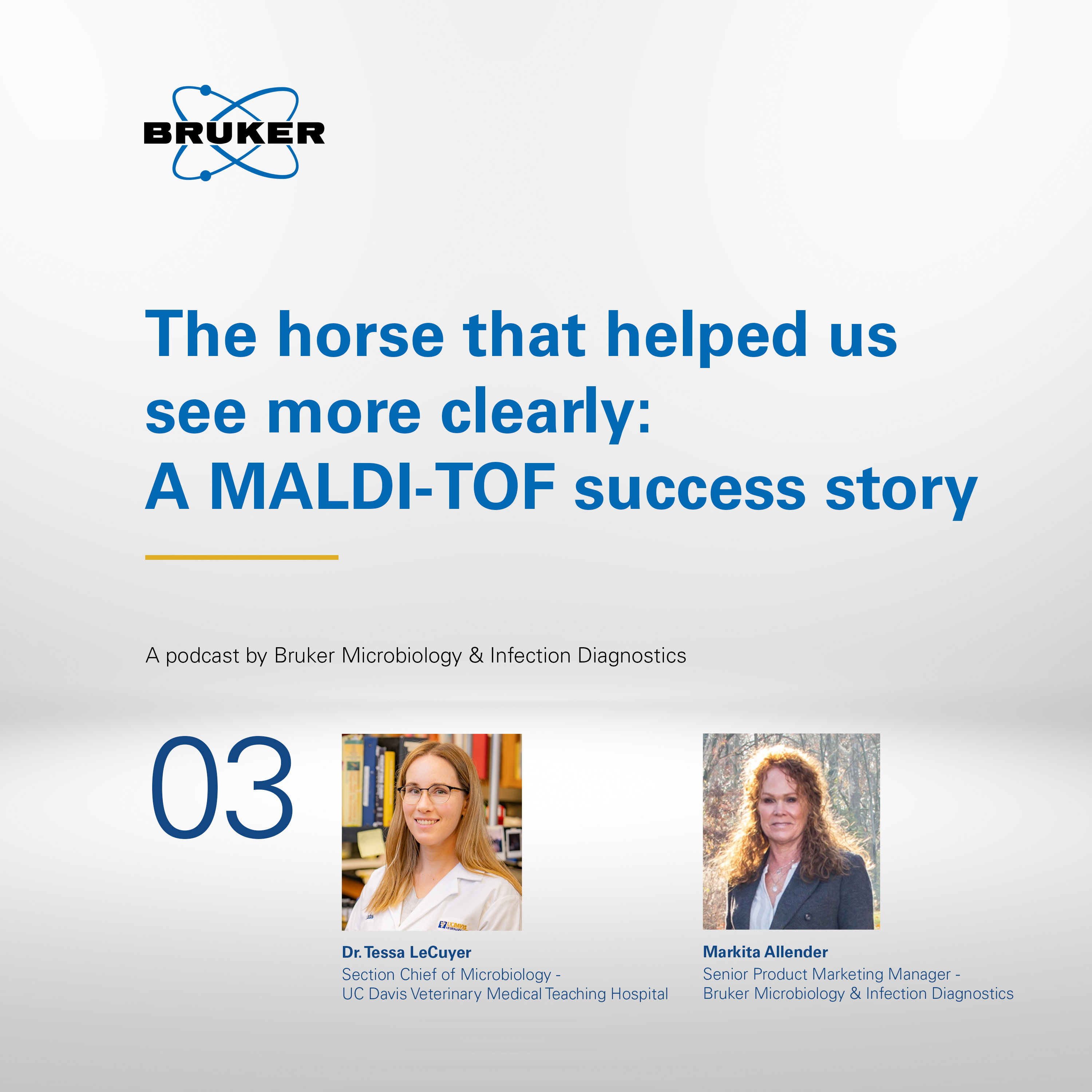
The Horse That Helped Us See More Clearly: A MALDI-TOF Success Story
17m 27s
The podcast episode features Dr. Tessa LaCoya from UC Davis Veterinary Medical Teaching Hospital and Makita Alender discussing the adoption of the Brooker Maldivire type for microbial testing. Dr. LaCoya explains the workflow at UC Davis, focusing on rapid and accurate microbial identification using the Maldivire, particularly beneficial for fungal infections. A case study illustrates the technology's power in identifying a new bacterial species in a horse's infection. The conversation emphasizes collaboration, the One Health Initiative, and ongoing advancements in microbial diagnostics. Additionally, the cost benefits of using the Maldivire type in veterinary medicine are highlighted, showcasing its efficiency compared to traditional methods. The discussion underscores the continuous evolution and importance of accurate microbial identification in veterinary clinical practice, promoting the use of innovative technologies like the Brooker Maldivire type.
Transcription
2513 Words, 14615 Characters
Welcome to this latest episode of our podcast from Brooker Microbiology and Infection Diagnostics. Today we're joined by Dr. Tessa LaCoya from UC Davis Veterinary Medical Teaching Hospital and Makita Alender from Brooker. Dr. Tessa LaCoya is section chief of microbiology at UC Davis in California, it's a veterinary hospital accredited by the American Animal Hospital Association and treats a range of species from family pets to livestock. In her role, Dr. LaCoya has been helping veterinarians at UC Davis diagnose bacterial and fungal infections. And in this episode, we're going to be discussing how UC Davis has introduced the Brooker Maldivire type to bring time and cost savings to microbial testing. So to kick off Makita, can I ask you to give us a quick overview of the methods that are typically used for diagnostic testing in the vet lab? Well, we're talking specifically about the microbiology and infection diagnostics and there's a lot of different applications, platforms that the veterinary laboratories can use. Traditional microbiology was focused on biochemical technologies and technologies that took hours and days and sometimes weeks to, you know, really make an impact on the care and the outcomes of the patients with the advancements in diagnostic technology or focusing on the Brooker Maldivire type which has enabled a very rapid and accurate microbial identification and it has a huge impact on the outcomes of the patients because of the technology itself. Tessa, please tell us about the methods that you use at UC Davis. Sure. So our routine workflow for diagnosing bacterial and fungal infections and animals involves having trained technicians who are looking at everything but then basically all of our clinically relevant isolates will be run through the Malditoff to help us figure out which organisms need to have additional testing performed. We do still perform some adjunctive biochemical tests but really the Malditoff is the workhorse in our lab and helps us guide additional work that may or may not be needed and then we perform antimicrobial susceptibility testing on bacteria and then provide that information to our clinicians as well. Where did you first get to know the Maldivire type and why did you decide to introduce it into your workflow? The first time that I was exposed to working with a Malditoff was during my residency which was at Washington State University and that was a little over a decade ago actually and that was when the Maldivire was first being integrated into the bacteriology workflow at that laboratory so I had the experience of that shift in figuring out how the Maldivire would be integrated into the diagnostic workflow moving from biochemical identification to using the Malditoff and then over time have worked in a variety of labs where we use the Malditoff and have seen the changes over time in terms of improvement in the library and then also just having more ability to identify additional organisms especially recently we've been really pleased by being able to do more fungal identifications especially the molds so that is something that I've seen over time. How has the expensive Maldivire type and library supported your work? Yeah I do think that that's one of the powerful things about that technology is that it is not static it is able to constantly evolve and kind of match the new knowledge that we're acquiring as well. How important is the use of the Maldivire type to identify fungal infections? Has that been a major part of your work that until now you couldn't address? We diagnosed a decent number of fungal infections primarily in dogs but also in some other species of animals as well and you know we were able to previously identify them but it took much longer we had to wait for the fungi to grow these identifying structures that would be evaluated under a microscope so we still do a lot of that but we're now able to get a better idea of a preliminary identification for many of the molds that we're growing in the lab and then that helps the clinicians then direct their therapy quickly for those patients. Taking a step back could you tell us more about the balance of your work at UC Davis? Do you typically treat companion animals or is it more livestock? My laboratory is actually in the veterinary medical teaching hospital so we primarily serve the teaching hospital at UC Davis. The biggest caseload is dogs, cats and horses but we also have some livestock that come through and then we also support external testing as well so we have private practices, wildlife, there are a variety of different people who also submit samples for us but yeah dogs would be our number one species. I'm Mikey too. There's a lot of synergies between human health care and veterinary health care. You talked to us a little bit about the one health initiative. It's an approach to look at the really deep connectedness between human animal and environmental health. The goal is to really prevent, detect, be able to respond to those emerging and existing health threats to all of those different disciplines. A very critical pillar of that is microbiology right and the and the diagnostics involved within this initiative and tools like the Berkermaldi Biotyper really has an impact on that initiative because it enables that very, you know, the rapid, the accurate identification of emerging pathogens. So I think there's a really nice picture of how all of this fits together. Tessa, can you talk us through a recent case where you use the multi-biotype to identify a new bacteria species? I would be happy to. So this is a case that highlights some of the power of the multi-tough technology but also some of the limitations and challenges that we face in veterinary diagnostics in general. This was a horse that had severe infection of its lower jaw that had been affecting it for a little while and was causing issues with the horse being able to eat. So definitely impacting the quality of this horse's life. So samples were submitted to my laboratory and we were unfortunately not able to identify the bacteria that we isolated from this horse's jaw and that happens sometimes. You know, we used our multi-tough. We had no identification that way. We exhausted our other biochemical methods of identification and we ended up with an unknown bacteria. So we ended up recommending to the clinicians that we should do some basically genetic testing on this bacteria to try and identify it. And we found that it was very similar to a bacteria called actinomyces but it was not similar enough to be considered actinomyces. So we actually found that it was a new bacteria but it seemed to behave like actinomyces which is important in this case because actinomyces often require very long-term antibiotic therapy. So it was important that the veterinarian know that in order to design a treatment course that would work for this horse. And so they then started treating the horse and the horse was getting better but still not completely improved. So they took additional samples. We again isolated that strange new bacteria from this horse again and this time I was trying to think of anything that I could to try and help get some more information for these clinicians who were working on the horse and ended up taking the protein spectra that were generated by our multi-tough, downloaded them and then uploaded them to the CDC's microbe net which is basically publicly available database where you can upload multi-tough spectra and compare them to other libraries. And we ended up finding a really good hit when we did that to a bacteria that was in the CDC's unidentified bacteria library. So that matched with what we were seeing that it seemed to be a brand new bacteria but it had been seen before and we would have had no idea about that if we hadn't had this technological tool of being able to take this spectrum that we had in California and upload it compared to what the CDC had seen. So that bacteria had been sent to them by a veterinary laboratory across the country and had been found in a horse in a completely different geographic area. So that let us know that made this really is a problem in other horses. Perhaps it's just not been appreciated or recognized before and all of our the vet labs being able to work together I think is really important. We're a small field in the veterinary diagnostic community and so being able to use these technological tools to kind of work together and figure out these new challenging bacteria is also really important for us. And how is the horse now? And the horse is doing much better now. So at the last at the last reach had to receive long-term antibiotics but at the last reach I was doing much, much better. So yeah I feel like we were able to provide the veterinarians with the information that they needed to make the recommendations that helps the horse improve. Do you think it's likely to be a permanent mutation of the previous bacteria or is it a genuinely different? I think it is genuinely different. The genetic difference was enough that it seems to be that it is actually different and it probably is an organism that maybe does not cause disease very often but we found that in this case it did cause severe diseases as well. So Marquita what happens now? Will you add this previously unknown bacteria to the moldy biotype or library? That is the beauty of this technology and I know that's not a scientific term but the proteins of an organism they're there. If we have the troublesome proteins of the organism and we can compare another unknown to it I mean it's always going to be there. And that's the beauty of moldy top technology is if you have the reference library and like the CDC came through for us it's a huge collaborative initiative that we have with the CDC to have all of these organisms that laboratories can upload spectra of an unorganism and try to identify it within known spectra. And again this is the beauty of moldy top technology and just to remind us a little bit of that when moldy top technology was commercialized in North America in 2010 2011 we commercialized the moldy top technology and the first market that was very interested in our technology was the veterinarian diagnostic laboratories. Interesting. Okay. Yes because they saw possibilities that this technology provided for their patients and so we collaborated with them and because of customers like UC Davis and many others we were able to really expand the organism specific for veterinarian diagnostics in the moldy biotype or reference laboratory because they were seeing we have some gaps in the library. Can you help us fill these gaps and that's what we did we got unknown organisms just like in this case study because we identified them, found them and put them in the library very quickly. Test up to you probably about what you see as the next steps. There's more of this power that we can harness for trying to better characterize some of the more challenging organisms and also moving into additional species as well. We have that consultation with veterinary medicine where we have to know all of the pathogens and a bunch of different species and you know one of the areas that we've had some interest in here at UC Davis is moving more into aquatic animal pathogens. Oh okay. So pathogens of fish and that would be both ornamental fish as well as fish that are being raised for food. They get bacterial infections too and so being able to improve our aquatic animal diagnostics is something that we are interested in and then also working with other laboratories to try to do more of this comparison of spectra that we have generated here at UC Davis and compare to spectra that have been generated at other veterinary laboratories and see if we can either see that there's some regional differences or also using that information to help make our libraries more robust as well. And Marquita, what are Brookers plans for the future in this field? Of course it's all about collaboration. Collaboration with our different market segments. We go back to the One Health Initiative and you know we're looking at the veterinarian, the human environmental farm. All of these different segments we have to really keep a focus. Focus groups to be able to detect existing, emerging health threats within these different segments. And so Berger is keen on that. We want to rekindle the focus that we had with the veterinarian diagnostic laboratories. Back in 2011, microorganisms consistently change and I have a fling we're never going to run out of unknowns to identify. In the back to test is the point. So I can see you're nodding there. You agree, yeah? We have to stay on top of these emerging threats to our human right animals environmental. And that is Berger's focus. As Tessa mentioned, fungi. Berger has taken on an initiative to really focus on fungi diagnostics because they are emerging as an important pathogen within all of these different One Health initiatives. So we will continue that focus and really dive deep into these different health concerns. Now that the Māori Biotyper has replaced more traditional identification methods in some settings, could we talk about how the costs compare? Are there notable cost benefits to using the Māori Biotyper? In veterinary medicine, we are always very cost conscious. So that is something that we definitely have to consider. And the cost of the instrument itself is definitely a financial investment for a veterinary laboratory. That being said, the actual running costs once it is up and running, each identification of a microbe ends up being less expensive than doing a full biochemical workup of a bacterial isolate. And there's also then some cost savings in terms of the time that it takes and the amount of the labor that goes into that process as well. I think overall, once you have the initial outlay, then the individual costs of the testing is more affordable than biochemical testing for most organisms. It's been a really interesting discussion about how the Brooker Māori Biotyper has supported the identification of bacterial and fungal infection in veterinary clinical practice. I'd like to thank Tessa and Marquita for their time today, and for more information on this topic, please visit Brooker.com and search for microbial identification. There, you'll find lots of product information about the Māori Biotyper as well as further materials to continue your learning. For general veterinary use only, not for use with human clinical samples.
Podcast Summary
Key Points:
Introduction to the podcast featuring Dr. Tessa LaCoya and Makita Alender discussing microbial testing.
Discussion on the use of Brooker Maldivire type for rapid and cost-effective microbial identification.
Case study highlighting the power of Maldivire technology in identifying a new bacterial species.
Emphasis on collaboration, One Health Initiative, and continuous evolution of microbial identification methods.
Cost benefits of using the Maldivire type in veterinary diagnostics.
Summary:
The podcast episode features Dr. Tessa LaCoya from UC Davis Veterinary Medical Teaching Hospital and Makita Alender discussing the adoption of the Brooker Maldivire type for microbial testing. Dr.
LaCoya explains the workflow at UC Davis, focusing on rapid and accurate microbial identification using the Maldivire, particularly beneficial for fungal infections. A case study illustrates the technology's power in identifying a new bacterial species in a horse's infection. The conversation emphasizes collaboration, the One Health Initiative, and ongoing advancements in microbial diagnostics.
Additionally, the cost benefits of using the Maldivire type in veterinary medicine are highlighted, showcasing its efficiency compared to traditional methods. The discussion underscores the continuous evolution and importance of accurate microbial identification in veterinary clinical practice, promoting the use of innovative technologies like the Brooker Maldivire type.
FAQs
The Brooker Maldivire type enables rapid and accurate microbial identification, leading to improved patient outcomes due to its advanced diagnostic technology.
The technology constantly evolves to match new knowledge, offering powerful support for diagnosing bacterial and fungal infections in animals.
The technology provides rapid preliminary identification of fungal infections, allowing clinicians to direct therapy promptly for better patient outcomes.
The hospital primarily serves dogs, cats, and horses, with some cases involving livestock and external testing from private practices and wildlife.
The initiative focuses on the interconnectedness of human, animal, and environmental health, aiming to prevent, detect, and respond to health threats using tools like the Brooker Maldivire type for accurate pathogen identification.
While the instrument itself is a financial investment, the running costs are lower compared to full biochemical workups, resulting in cost savings and more affordable testing for most organisms.
Chat with AI
Loading...
Pro features
Go deeper with this episode
Unlock creator-grade tools that turn any transcript into show notes and subtitle files.
 PodcastTranscript AI