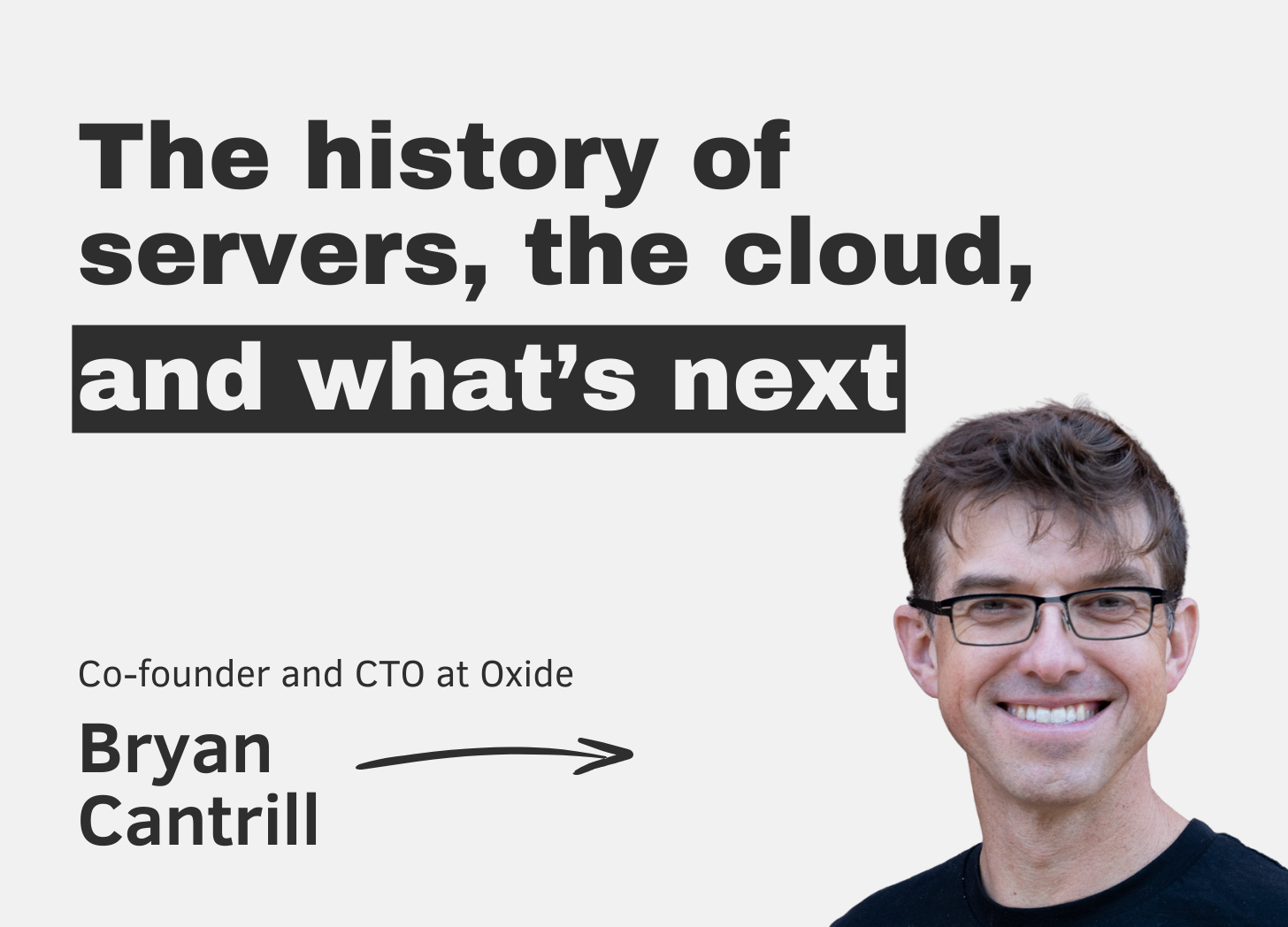
The history of servers, the cloud, and what’s next – with Oxide
99m 17s
Brian Kancho reflects on the dot-com boom and bust, highlighting the significance of innovation during challenging economic periods. He discusses the evolution of servers and cloud infrastructure since the late 1990s, emphasizing the impact of the dot-com bust on driving more focused and creative technical work. Kancho details innovations at Sun Microsystems post-bust, such as ZFS and DTrace, attributing them to the clarity and resource constraints faced during that time. The transition to open source in the early 2000s marked a shift towards Linux, reflecting a broader industry trend. Kancho's insights underscore the importance of adaptability and focus in driving technological advancements, even in the face of economic downturns.
Transcription
20932 Words, 111298 Characters
Can you tell us about the dot-com boom we did? Much more technically interesting work in the bust than we did in the boom. There's a degree to which innovation requires some level of desperation. That good economic times are kind of hard to sum in that desperation. How have AI tools changed? How you're working at Oxide? It's not labor using cloud totabonch and people are doing that. But for a lot of the work that we're doing, it is helpful as maybe a polishing tool, but less as at the epicenter of its creation. Can you tell me what it actually means to design or build a computer? Oh, it's very involved. Yeah, it's very involved. So first of all, how have servers and cloud infrastructure evolved since the late 1990s and what is next? Brian Kancho was a distinguished engineer at some microsystems during the dot-com boom and dot-com bust, built a small competitor to AWS called Joyant and is now the co-founder at Oxide. Today, we go into the history of servers and the cloud from the late 1990s to today. The challenges of building hardware like the Oxide computer from scratch, how the Oxide team uses AI and when they find it practically uses us for hardware engineering challenges. Why Oxide builds everything as open source and how they manage to work remotely as a hardware startup and many more. If you'd like to understand more about how the cloud works and learn how nimble hardware plus software startup operates, this episode is for you. This podcast episode is presented by Statsig, the Unified Platform for Flags, Analytics Experiments and more. Check out the show and let us know below to learn more about them and our other season's sponsor. So Brian, welcome to the podcast. Oh, it's a great to be with you. Thanks for having me. I'd love to jump back in time a lot back in the 1990s because you're someone who's been around the block and back then you worked as some interesting companies, including at Sun. And if you could give us listeners and viewers a sense of what was it like in the 90s in terms of software servers, what was the vibe like? Yeah, it was an interesting inflection point because I was interviewing in 1995. I started in 1996 so I would say that the internet and I mean, HTTP had been developed in like 93, 94 we had kind of the first web browsers. But it was still very, very, very new. And the internet was just kind of prime for takeoff. Java had been, Java had come out in maybe in 1995, Java, we had kind of taken off immediately. So there was a lot of really exciting energy, but it was nowhere near what would become a couple of years, even a couple years later became very frothy, of course, and it was exciting. It was very clear to me, I went to school actually in these coast, but just coming out here to Silicon Valley, the energy was extraordinary and really knew that I wanted to come out here for my career. So at Sun, those next couple of years, I mean, I got very lucky really because Sun was in the right place at the right time with the right technology, which, you know, sometimes you only appreciate an hindsight because it was so explosive. And if you wanted to build a website as part of that.com boom, you were buying Sun servers, you were buying Cisco switches. Now why was this the case? Because again, just taking myself back, just being a bit naive, I would assume that, let's say I'm in the 1995, I want to build a website, could have I not just used a PC and spun up a server. Did it not work like that? Or how did it work? You, I mean, a PC like maybe, but you didn't really have an operating system, right? Because you, Linux is, Linux is very, very new. Linux is not all back down. Oh, yeah, definitely. Linux is, you know, what would be like high coup today, which is an operating system you haven't heard of for a reason. It's kind of like a hobbyist operating system, you know what I mean? You'd be like, what? No, you wouldn't write. And you then you kind of had the BSD's where other free BSD was certainly out there. Also still very much under the shadow though of this lawsuit from AT&T. So the unices are kind, there's not really open source operating system options. There was the, actually, this was kind of funny because so where was the GNU option? It was going to be the herd operating system. So herd was kind of like the Duke Nukem forever of its time. It was the operating system that was constantly coming kind of next year and next year and next year. And it was going to be micro kernel based. And so you know the really, it's kind of amazing, but you really couldn't do it on PCs because of the lack of system software. And actually part of my attraction to Sun was I had used Solaris on Spark, but I never, I knew Solaris existed on X86, but I never used it. So I was excited to use Solaris on X86. And so what did Sun build? He mentioned Solaris. That was the operating system. Solaris the operating system. We built servers. So we built Spark based servers. We built desktop machines. So Sun was a computer company, it was a systems company. So we built desktop machines, built some ill-advised laptops, so basically desktop machines, workstations, but then at that time in the 90s, what was really exploding were everything from those kind of workgroups, file servers up to really getting bigger and bigger servers up to the very large machines. Machines are as physically the same size as what Oxide makes today. And I remember vividly in what would have been like 97, 98, maybe Greg Popp and Opelus than the CTO of Sun, giving a two entire company saying, here are the top three applications for Sun Microsystems, databases, databases, and databases. So that gives you an idea of kind of how it was being used. And this is, again, as that kind of in that kneeup of that.com build out, where if you, again, if you wanted to really build a web presence, you were going to use Java, you were going to use your new Don Solaris, you're going to do it on Sun servers, and you were going to, and it was kind of, it was a wild time, for sure. And can you tell us about the.com boom because right now, I know AI is pretty exciting and it feels like we're in a special time. But what was it like, especially working on something, it sounds like it was the epicenter of it. And you know what was funny is I did, it was frenetic in a way that was not always positive. So one of the things that is that is just a point of fact, and one can take from what one will, I did, we did much more technically interesting work in the bust than we did in the boom. Because I think that when you're in boom times, you know, everyone kind of like secretly believes that this is because of me, like I, that it is because of the thing that I am working on. If I, you know, I once had, you know, one of the, one of the early technologies behind Java, once told me with a straight face, every server that sunsells, they sell because of Java. And I'm like, you know what? You know what's most amazing? I, you believe that is actually the more interesting fact that I mean, it is like obviously false, especially with, you know, databases, databases, databases being the top three applications. But that that kind of reflects the zeitgeist of the time that everyone believes that this is, you know, if I work on the microprocessor, it's because of the, the microprocessor is perfect. If I work on the operating system, it's because, oh, it was the operating system that people are buying the machine for. And it like, that doesn't really lend itself to really, to, to real innovation, I think. I think there's a degree to which like innovation requires some level of desperation that good economic times are, it's kind of hard to some of that desperation sometimes. So I think that during the boom, it, what, and it was just, it was broughty and it felt like there was a period of time where I'm like, this obviously can't go on forever. And you know, the economist is having these very like gloomy covers about how this is all going to end. It's going to be an apocalypse, which I believed. And then I just stopped believing it. I'm like, well, maybe the economist just went on longer and we know one of my early life lessons from the boom and bust is these things go on longer than you think possible. But when they switch the growth in terms of the boom, when you're in frothy times, that boom will go on longer than you think possible. And when it switches, it will collapse faster than you can fathom. And the boom, do I understand correctly that customers were just like wanting to buy your servers. They were flying off the shelves. All these companies were everything. And on a day to day work, what would it mean for you? So I'll tell you, like a day to day, it meant, first of all, it meant that traffic was terrible. That the, you know, there is, you couldn't get housing. You couldn't get, you know, everything was in short supply. You couldn't, uh, it customers are, you know, they are buying out. We had a customer that, you know, but was going to buy 19,000 servers, which is obviously a very big number. And these were these massive big servers, right? Yeah. Well, in that case, those were actually one-use servers to build out a broadband initiative that actually was a company called Enron. You know, I remember vividly, we were at a, a dinner, uh, here in the city at a restaurant called Aqua, which is a very kind of fancy restaurant long since that of business. And I don't think Aqua survived the bust. And we were at Aqua with a, with a bank, who was a customer of sons and they were spending a galactic amount of money every year with son. And we were at a dinner. And I just remember, I mean, it was the kind of like 19th century, gilded age kind of dinner. People are ordering, you know, nine courses. What I remember is at the end of that having Chateau de Kim, which is a so turn. So I don't know very much. I don't know. Very little about wine. I know nothing about so turn. So what I did know is there was someone who knew wine and it's like, we are going to all drink at the 1952, Chateau de Kim, so turn, which is, which is, and I remember being like, I'm like, I'm not much of a drinker, but I was like too drunk at that point to really appreciate it. So I have had this so turn that, you know, that, that enophiles kind of live their life to drink. And I'm sad to inform you that there's one less bottle of this precious vintage because it was poured down the doughnut of a 20 something.com or who really had, and I just remember being back in my apartment, being literally drunk on Chateau de Kim, thinking about it in Patreau Hill. And remember thinking to myself, this can't last. This is not sustainable. And I swear the dot com boom turned to a bust like that night. I, that is, that is September of 2000. So the pets dot com had kind of busted out and the bunch of nasty I could bust out early in 2000. Uh, the traffic got lighter early in 2000. Anyone who's here would be like that, the absolute spookiest thing is it went from like gridlock to like, COVID like traffic in the span of like a month without COVID happening with the only the NASDAQ collapsing. And you're like, okay, that's very odd. And then 2000 kind of muddled along. And then the with that dinner was in September of 2000. And the what really stopped was the telco build out. So that there was a lot of telco build up because people are like the internet is the future. And telco build up meaning the towers, the server, the servers, the infrastructure for and then all the concomitant that the fiber like JDS Uniphase was a huge company. You had these companies that were, you know, global crossing and and MCI world come and all these companies were explosive. And everyone believed that the internet is the future. And this is like an important thing. And they were right. They were right. Brian just said how important lesson of the dot com boom was that people who believe the interim will be the future. They were right today. We're in a similar state with AI. It's pretty likely that AI will be part of the software stack in the future, even if timing is harder to predict. The latest shift is how AI agents are becoming a lot more commonly used for development. And this is a great time to talk about our season sponsor linear and how they think about collaborating with agents linear had taken an interesting approach here instead of building one proprietary AI assistant and locking you into it. They built an open API and SDK that lets any agent plug into your issue tracker. That means you don't need to wait for a linear to build the features that you need. You can connect the best code of gauges on the market like cursor, GitHub, co-pilot, open AI, codex, and devon. Or you can build your own agent for your team's specific workflow. It's a fundamental different approach from most issue tracking and project management tools on the market. You get optionality. And the experience is surprising and natural. You assign an issue to an agent the same way you do sign it to a team mate. Or you can simply mention the agent in an issue thread. Cursor then can pick up a bug, understand the context from the issue, open a PR. Codex connects for a fix while you're focused on something else. Centric and root cause analysis when something breaks. It's pretty powerful what you can get these agents to do. And here's what I like. You the human stays the accountable owner. The agent works for you, not instead of you. You review the work, you decide when it's good and when it shifts. If agents are going to be a part of a tool set of building software, and it feels to me that they increasingly are, you'll want a system that's actually designed for them. Linear is a system like this. To learn more, head to linear.app/agents. And with this, let's get back to the point where Brian was saying how those believing the insurance will be the future back in 2001 were right. This is the other thing it's like they're right. And so like a very famous impact crater from the dot com boom is wet then, right? The van was delivering groceries, which many people today are going to get the groceries delivered, right? Right, right. It's like they weren't wrong. But their timing was off and they lost track of the underlying economics completely. And so when it busted out, so in the fall of 2000, in November of 2000 in particular, there were zero orders from telecoms at Sun. Like it went to zero. Wow. Just to kind of ups and downs, but that's like just like off a cliff. And from that point, we, you know, going to 1000 and then, and then 2001. And it was then very, very grim. I would say that the thing that that happened through the bust and layoff after layoff after layoff and because companies had kind of built themselves and geared themselves around these fat times lasting forever. And now they were gone. And expectations as frothy as expectations were during the boom, they were that much negative in the bust. People are like, everything is, it's, it's the end of days. And were you a software engineer back then? Yeah, a software. Yep. And then so as a software engineer, like both you and also thinking about your, your colleagues back in the time of friends, how did it impact you? Were you kind of just chugging along or I would say that like lots of people left and you had like the statistic of, you know, the U-holes were 10 to 1 out of the Bay Area. So you, they moved away, they moved away. And the thing that I noticed is that the people that had moved out to Silicon Valley because they were, they really had an interest in the technology all were there all stayed. And we're not adversely affected honestly. I mean, I, the, um, yes, we, every one of us, if you had equity in your company, which of course you all did, like you tried not to overthink it, right? You just tried to like, you try to remind yourself like, I never had it to begin with. So like it's hard to, you know, but it's definitely gone and some lost 98% of its value. So it's like definitely gone. And you know, there was some thinking in, I think it also like a boom can get you to care about things that you actually don't care about and a boom can get you to, because in a boom, everyone is so financially driven that it's hard not to become financially driven. But it's like, that's actually not why I got into this. And so during the bust, you know, definitely able to put, you know, put a meal on my table and a roof on my head, um, but the, uh, it was really a reminder about like what's important. And again, because we did, we did do better technical work in the bust than we did in the boom. And I think it's because in the bust, it's like, okay, now like we really, we have to focus. We have fewer resources that that the fewer resources actually force more creativity. So, you know, all of the things that we did, certainly speaking at Sun and system software. So, DFS and detrace and service manageability, all of these things that were really revolutionary for the operating system all happened in the same kind of post bust period of time. So those, all of those things happened from 2001 to say 2005. And so what were these specific innovations? So I'd gone, uh, gone to work at Sun to be, to work with Jeff Bonneweck. And as long as I had known Jeff from the mid 90s, Jeff had wanted to rethink files. And now finally, in the Roy 2000s, he and Matt Aaron's were able to really go take a clean sheet of paper from the file system. And that's ZFS. I had a chip on my shoulder about the way we understand the bug systems, by the way we observe systems. So I, along with two other colleagues, um, did detrace, which allowed us to dynamically instrumentize our systems. And you can kind of go down the line and there were, there were a bunch of things like this where we, and I, I don't know that all of this is related. And to the bust is just that the timing lined up such that it was all happening during the bust. And what we ended up with was a whole bunch of interesting technology coming together actually in a single version of the operating system. And then very, I mean, fortunate for us, and I do think this is a bit of a consequence of the bust because Sun was definitely open to, to new approaches. We opened source to all the operating systems. So that happened in 2005. And that was very important to give these kind of technologies eternal life. But I think, you know, we can never predict the future. But to me, it is pretty positive in the sense that even in the busts, hearing the stories that innovation did not stop sure, you know, sounds like it was probably hard to get jobs and, and they're, they might have been fewer of them. But, you know, industry kept innovating and what you said, I didn't expect to hear that it was a bit easier to innovate. It's just less manic. We were able to focus more. And so not that, you know, I mean, not that one should necessarily pine for a bust because busts are brutal, but there is a clarity that you get to. So I mean, ideally you would like to have just like, can we just be like normal economically, but like, no, apparently in high tech, we've got to be like all in or off. So bust aside, in the early 2000s, leading up this interim boom, the way to, you know, most companies went about buying sun servers with Solaris install that everything was hardware and software came together. It was beautiful. It worked well. Again, I heard from folks who did it. What happened then? When I got into second 2000s, I did not hear about Solaris and that's right. That's right. No, no, no, that's right. What was the shift? So the shift was first of all open source, right? So then, so, you know, we said in the mid 90s, Lennox was kind of still very much the hobby project. Not so by the 2000s, right? So grew up. They grew up. Absolutely. And grew up because you had a bunch of companies that really backed up the truck. And, you know, the things that at first IBM and SGI, data, general, some other companies, those companies were very important because they decided to contribute their technology. So XFS, right? XFS. Many people still use the day on Lennox. That's from SGI. XFS was the SGI on Iraq's. That was happening in kind of those the late 90s. And then in the 2000s, I mean, Google always always built on Lennox, right? And so you had kind of the companies that that became that that next boom were all built on open source indeed needed to be built on open source so that they economically relied on open source to be able to build. So then it became much more practical to certainly run, wrote Lennox and I think that the other BSDs or the I we open source to where so there were a lot of options that were now available. So that shifted. I think the other thing that that shifted is that I mean spark bluntly lost to X86. And you son for and spark is a harbor arc is spark is a market microprocessor. Yeah. And there was because there was a time in the 90s when if you wanted the fastest microprocessor, it was a risk microprocessor. It was it was from it was a spark microprocessor or it was MIPS or it was alpha. And X86 was I was a commodity, but was it was in obviously available with a personal computer, but was not faster than those those risk microprocessors that shifted that shifted in the late 90s and we you know, because we ran the operating system on that was in swear us on both spark and X86, we could see how fast these X86 machines were and could see frankly how like you know you talk to the micro electronics folks, they really did not like the kind of dismissed X86 and dismiss Intel and you shouldn't do that. And in particular, Intel was was very focused and architect the way around what was called the memory wall on and they were able in part because they use speculative execution. They were able to actually make these microprocessors that were it became much faster than the risk microprocessor. So by the time say you are in 2004, 2005, if you want a leading edge microprocessor, it's X86. So that that was a big and important shift. So by the time you're coming up, it's like, okay, yeah, if I want this, if I I'll just like, I don't know, get a like a Dell box or a super micro box, and then I'll put Linux on it or maybe free BSD and way I go, then that the next kind of big and important shift that happened started in 2006, you could argue with with S3, but then especially in those next kind of AWS seven eight nine with the introduction of EC2. And now you have like the cloud that starts to come into play. And now like people were like, well, why would I even like screw out of the server at all? I mean, it was so great to be able to just spin up infrastructure. Yeah. I remember one of my early companies, mid 2000s, we had a server room, we had server administrators, the server room was always hot. And this was a small company mind you. This was not not not a big one. Every company need to do that. It's kind of amazing to think it's like that every single company, no matter if you were a website, you had your own server room. And if you were a dev, you wanted to be friends with the server admin because when you wanted to deploy your stuff, you know, they could do stuff for you. Or that's it totally. And so I think that cloud computing was really important. This is not a deep thought that elastic infrastructure was really important. The ability to have API driven infrastructure. And that so for me personally, so I was I was at Sun and then from in 2006, I started a storage group inside of Sun, which was great, really successful group. And so successful that it actually attracted Oracle as a customer for the first time in a long time. I kind of, this is like a little bit of like residual like a shame that I have that like, did I attract the marine apex predator that ate the company because Oracle, literally required for higher Sun, right? And then they kind of Sun in and in that closed in early 2010, I left shortly thereafter because I could see what Oracle was. Well, I never heard a story of your potential role here. So I, yeah, and Oracle, and I gave something, maybe a year later, I gave a talk on 2011 with some rather unvarnished opinions about Oracle and Larry Ellison. In particular, I caution people about anthropomorphizing Larry Ellison. You have to treat Larry Ellison as a machine, like a lawn mower. You stick your hand in the lawn mower, it'll chop it off. Well, this is, all right. So I, I'm giving this talk up to 2011. And again, this is after I've left, I've left what was then Oracle. And you know, like I was just saying things that I felt were obvious, but people, the audience is kind of gasping. And, you know, it's like, and people are coming up to the talk. Like, do you think there's going to be like, it's going to be retribution from Oracle? Like, no, no, you're misunderstanding. Like, there's no, the lawn mower's not angry at you. It's a machine. It doesn't have, it doesn't have the mirror neurons to be honest. I would almost, I, it would almost show me that I'm wrong for Oracle to resent what I'm saying about the world. Anyway. But all the videos for that conference go up and my video just don't go up. Oh, right. Okay. And so my colleagues were like, this is an Oracle conspiracy. I'm like, this is not an Oracle conspiracy, which it wasn't. It wasn't orchestrated or Oracle. But what I did, I, what I underestimated was the fear of the conference organizers. So they themselves were terrified of offending Oracle. Yes. Even though it probably would have been fine. No. So the talk did finally go up. Before the talk starts, there is a disclaimer. The views in this talk do not represent the views of the U.S. N.X Association. And you're like, all right. I get it. I've never seen this disclaimer before. But fine. Then during the talk, you know, the format of the talk is you got a slide. And then you've got like a little blank strip and then you got this talking head in the little right corner. There's like kind of dead space above the speaker. They took this disclaimer and they re justified it. And they put it above my head the entire time I'm speaking. So if you and I mean, and maybe in this regard, they were prescient because to this day, if Ellison is mentioned on hacker news or Oracle is mentioned on hacker news, someone will immediately cite minute 33 of this talk, which is when I go on this kind of Oracle, again, I don't view it as a rant. I view it as just like me describing what is obviously true that we all know. But anyway, I had left, I left Oracle after they bought some. So we're now around like 2000 China. So cloud has taken off x86 architecture is everywhere Linux is now winning both for small time servers, but also on the cloud. And then what happens? This was an interesting time when Google started to figure out that hey, they could do something interesting on their cloud, right? Yeah, that's right. So this is still a little bit before that. So this is in kind of from I would say from 2010 to about 2014 is when is a period of relentless execution for AWS. AWS is executing so extremely well. There are not really other public on options, there's like kind of Azure is kind of drifting out there. I think people, people forget that, that like GCP on paper has been around from 2009, but up to like 2014, it was like, it was almost like a joke. It was a joke. I would say before, it was like it existed, but it was a joke. And the, and in particular, at every single reinvent, Amazon would announce a new price cut. If you were a competitor to AWS, you are like a dreading reinvent because here comes another price cut. If you are a partner of AWS, you're dreading reinvent because here comes the announcement of a new service that competes with what you're making. I think people have not been around, I forgot, but it really has happened and because it's not been the norm the last like, let's say, five, 10 years or so. Well, and in particular, they did a couple of things are just like, man, you got to tip your hat to just, I mean, Jeff Bezos is the apex predator of capitalism. Like Larry Ellison, maybe the lawnmower, but Bezos is ultimately the apex predator because the thing that was so impressive is they were able to give people the idea that this was a terrible business. So in particular, they did not break out their financials. So everyone's like, oh, my God, what an awful business like they're cutting the price every year. Like you do not want to, like this is a classic red ocean. It's bloody. You don't want to compete. And so we were at joint. We were actually competing head to head with AWS. So you were offering a public club. So we had a public cloud and then unlike AWS, taking the software that we'd used to run the public cloud and making it available for people that wanted to run a cloud on prem on their own hardware. So people that would buy Dell or HP or super micro, they would buy our software and they would run it on there and get a cloud. So we ran a public cloud and we knew what the economics of a public cloud were, namely, pretty good. Margins were good. And so what we knew that Amazon, that Amazon wasn't volunteering, but what we knew is that AWS S3 was underwriting a war on big box retail. S3 was paying for your prime shipping. It was a genius move. And so that also some, some inside of your information that you had because you did your own thing. Well, we don't know that the margins are very good. And then of course, I mean, we did have a, you will be unsurprised to learn that several of joint, most prominent customers were retailers retailers. This was not lost. Retailers are like, gee, I wonder what's happening. Retailers are like, if you think I'm going to take my dollars and spend them on a AWS, so AWS can I, so Amazon can go to war with me like, no, thank you. There was a period of time when I felt like in order to be in the cloud, you have to implement every AWS API. So there's this idea that you had to be API compatible with the EC2. There's a company called Eucalyptus that tried to do this. It was just a disaster. And part of the reason it was thought that GCP and Azure could never compete with AWS because they could never be API compatible. So I am convinced that the, what changes, what changes is like 2015, what starts 2015, Kubernetes. And I think that part of that initial attraction to Kubernetes is that people wanted to get some optionality around their cloud. And they felt locked into AWS and I'm not using all this stuff. I'm not using elastic bean stock. I'm not using green grass. I'm not using kind of these more as I'm not using redshift. What I actually want is this kind of basic infrastructure. And Kubernetes now gives me this layer upon which I can deploy and get some sort of true cloud neutrality. So multi cloud didn't really exist, I would say, before Kubernetes. And I think a lot of that, especially early momentum behind Kubernetes is around this idea of like, I need to get some optionality in here. I want to actually be able to go to GCP. So I think, you know, and I don't, I think it's giving Google slightly too much credit, but only slightly too much credit to say it is masterstroke. On the podcast, I had Kat Kuzgrove, who's released a project manager on Kubernetes. And you know, she's been in the project for a long time and I asked her, she's not, she was never a Google employee, but I asked her, why do you think Google opens for Kubernetes, which, you know, they have board, which is amazing. And they kind of built on as a better version for the, for external and they just released to just like they put a lot of work in it. And to me, it didn't really compute like, why would Google, like, what is the business reason? And she told me that she thought, again, speculation from the outside as she thought that they probably thought that it would help Google cloud. That's right. So to have the, a container, which is now portable and now you can give the promise that if you run this on Azure, especially AWS, you could come over. So it kind of makes sense is this you're thinking, yeah, absolutely. But I think, I think that is definitely the argument that Kubernetes proponents would make inside of Google in terms of like why they did it. Nobody prevented it. You know what I mean? They kind of open sourced it because Google was a pretty cool place in the sense that that was very bottoms up as I understand back then. So, yeah. And then I think part of their, you know, it was Craig McCocky who really pushed for the CNCF, the formation of the CNCF around Kubernetes to give it kind of a foundation home. I did, I do remember one conversation with Craig and I were talking early as he's contemplating the CNCF. And he's like, well, I think this is going to allow Kubernetes to get the marketing dollars that it needs. Mike, don't you work for the most profitable company on earth like, do you really, isn't just like gushing cash over there and you can't get like, you know, a couple million bucks for marketing for this thing. But no, apparently you can't. So, but so I think that the argument that people making internally was about we should be encouraging cloud neutrality because we are the ones that have something to win. And they're right. And they did. And GCP is now not an afterthought. GCP is very important. It's a very big business. And I think that they got is Kubernetes to think solely, no, but I think it's played an important role for sure. And where are we today in terms of the hardware and the software stack running specifically thinking of these big clouds, what's happening inside the likes of metadata, these giants? As I understand, you know, they're no longer just like, you know, ordering servers from Dell or whatever. Never. Never. Never were. Never were. What did they do? They, so it's kind of funny because for all of these folks, they took a somewhat, somewhat path. They never were because in Google's earliest days, they were assembling machines from fries, you know, rip fries, fries, being a local electronic shop that has long since disappeared, but they were kind of famously Velcroing machines together and finding those about like the processor, the, the different car networking switch, whatever. And they had this idea that like, it doesn't matter what junk we run on because, you know, our, our, our software is going to run as a distributed system. It actually doesn't matter. We don't need ECC protected memory because it doesn't matter if your divs fail. And so I think they learned, well, it does matter a little bit. If your dims have rampant data corruption, like dims failing, that's actually not a problem. Dim's your memory returning the wrong thing, like that is a problem. You can actually like, you turn that, like next thing, you know, like your software inserts that into a row into a database and like, yeah, now you got it. That is correct. This is a problem. Yeah. Yeah. Correctness is a problem. Like, yeah. Okay. Overshot the mark. So by the time they're like, okay, we're not going to Velcro machines together. We're not going to, but we'll, by that point in time, you know, the business was established enough that they actually did, they built the machines that were fit for scale. So they have a, a great book that was written in the kind of the mid 2000s, the warehouse size computer, where they talk about all the things they did at DC bus bar, really thinking about power across the entire DC. So they kind of, they went from, from being kind of too cheap for kind of Dell or even Suf micro to then being much better engineered than those systems ever were. So they were never really meaningful customers and did owe for Facebook meta. They were, they were never really meaningful. I mean, they, they kicked them out very early and did their own stuff. Brian just talked about how Facebook built their own servers because off the shelf solution didn't work at their scale. And what's interesting is that companies like meta and Google didn't just build better hardware. They also built incredible internal tools. Tools for save deployments, future flying experimentation, debugging analytics, the whole stack that lets teams shift fast and with confidence. Most companies never get access to this level of infrastructure. You either build it yourself, which takes years and large engineering teams, or you make with scattered tools that don't talk to each other. That's exactly where static comes in. Static is our presenting partner for the season and they give every engineering team access to the kind of tooling that only the biggest tech companies used to have internally. At its core, static is a tool good for safer deployments and experimentation. You ship a new feature to 10% of users behind a feature gate. You validate that it behaves correctly, wash the metrics, and expand to remaining 90% only when you're confident. And if something goes wrong, you can turn it off instantly, along before it affects everyone. And save deployments require visibility. Static includes analytics, both product analytics and infrastructure analytics, so you can actually see what your code is doing in production. Errors, performance changes, funnels, user behavior. Because you cannot ship safely if you can see what's happening. Things like Microsoft and Ocean run hundreds of experiments per quarter were static, velocity that used to require entire platform teams to build and maintain. This used to be infrastructure available to maybe 10 or 15 tech giants. Now startups and mid-sized teams use static to ship quickly without breaking things. If you want to give your engineering team world-class tooling from day one, go to static.com/pregnatic. There's a generous freeze here, a $50,000 starter program, and affordable enterprise plans. And now let's get back to the conversation about the history of computing and what might be coming next. And this was independent. So like, both Google and Matt, both came to the conclusion of like, we should just build our own stuff. Did they? And Microsoft and Amazon all came to the independent conclusion because the scale at which they needed to run was not at all the scale at which SuperMicro and Dow and HP were here. What they were geared to do was to run the servers in your server room where you needed to know the devs. Right? Where it's like, I'm going to have a little rack. I'm going to have six servers, then maybe it's got 12 servers. Okay, maybe we'd grow into 24 servers. That's what they were designed to do. If you're like, no, I want to buy servers by the thousands because I've got a public cloud business. Like, if you want to buy servers by the thousands, there is no product from those companies for you. And in very, very basic ways, well, like the DC bus bar at every juncture, they've been designed to be a personal computer that you happen to be slapping many personal computers together, but they're not designed to actually run infrastructure at scale. So, and that was happening inside, effectively, all the hyperscalers. And joint, meanwhile, was bought by Samsung in 2016. Joint was bought by Samsung because their cloud bill was off the charts. And they bought you to bring it in a house. Yeah. And there was not a product they could go buy, so they went to go buy a company. So if you're like, wow, and then it's like, wow, that's a big AWS bill. It's like, yes, very big AWS bill. But then that was not a product that our company was available for, you know, the next day, it was the next Samsung do that's one less company available to buy. So when we were contemplating the next thing in 2019, one of the things that we had seen is that, and we felt we earnestly believe that one cloud computing is the future of all computing, not a deep thought, that elastic infrastructure, API driven infrastructure, that is modernity, one, two, you shouldn't be able to only run to that. You should be able to buy that, own it, run it in your own data center. Why would you want to do that? Why would you do that for risk management, for security, or for economics because it, you know, if you're at a certain scale, you'd rather own it than rent it. And I think, you know, before oxide or like in 2019 or even in like, you know, 2020, 2021, if you were like a midsize company, you know, like not big enough to build out your own custom cloud and build everything that the hyperscalers did, you could like buy some off the shelf, like HP or Dell, like a bunch of, I think that's what base camp did. I think they posted that they bought a bunch of, bunch of these things, they rented a space in a, in a, one of these shares or, or I think two different locations, they put in their boxes with all the memory and then, you know, they kind of set it up and put it together. So I guess those were the two options, right? Yeah, those are the two options. And I think that, you know, base camp ended up being a real poster child for the economic advantage because I mean, DHA, you know, that obviously outspoken and the economic advantage was really, really, really clear. They're also at a scale, which is like not the scale that we're targeting, right? That the scale we're looking at is a much larger scale. And so the economic argument is actually even more compelling when you're at that larger scale. I love it when you're the VCs that passed on us because they felt there was no market, then would send me like the DHH blog post is like, why are you sending this to me? I should be sending this to you. Like, I know this. We just knew the economics of it and we knew couldn't predict exactly what the trends would look like, but believed that there would be folks that were born on the public cloud that would outgrow the economics of the public cloud and want to go on-prem. Economics aside, was it a take to build one of these things? And I saw one of these things will put in a picture of it. It's like a proper like, you know, like 90 tall rack, it's big, it's, it feels like you're putting like, I don't know, like 16 or 32 of those of those like, you know, Dell things, they get an interpretive size just to get a sense of like that. Yeah. We were 32 compute slots in there. That's right. And what does it take? What did it take to actually build? What did you need to design in terms of hardware and then software? Yeah. So, and we knew this too that going into the company. We knew we were taking a clean sheet of paper, right? And so we were deliberately like, no, we're going to start with the problem. We're not going to build it out of Dell HP Supermicro. We are going to start with the problem and how do you best solve the problem? And as it turns out, like there were a whole bunch, there's a lot of technical debt that had been accrued by this kind of PC ecosystem. So I mean, you know, got ready to start just on the environmental, like on power, right? The fact that you've got AC power in each of these Dell HP Supermicro. Yeah. So if you like put 16, you have like 16 separate AC times two because you have two power supplies per one, you two, you chassis, two power supplies. By the way, there are two fans sitting on those power supplies and those, and those fans are actually what wear out. If you go to the, like in terms of like the worrying fans is not just going from the computers going from the power supplies because those power supplies are dense, they're packed with stuff. So they've got to overcome a huge amount of static pressure. So like that's not the way anyone does it at scale. What people do at scale is you've got DC bus bar. You've got a power shelf that is that is much more efficient and that that that rectifies from AC to DC. And then you run DC up and down and then you, you blind made into that. So we knew we're going to do that. So that's a lot of electronics engineering right there. Yeah. Yeah. Power engineering for sure. And we knew we were going to do that. We also knew that by taking a clean sheet of paper that we would have opportunity made available to us, that we weren't necessarily thinking of. And that manifested pretty early. So we blind made into power, which is to say that when you feed a sled in that power connector, you don't see it. It's at the back. You, you, you lock the sled in blind mates into power. And we had assumed that we were going to do what Facebook and Google and others have done Amazon done and had networking out the front in the cold aisle. But as we were, you know, taking a clean sheet of paper, talking to some connectivity vendors, they asked us like, why are you, wait a minute, you guys are like taking a clean sheet of paper. Why are you putting cabling in the front? Like why wouldn't you also blind made in the network and the network connection? And we're like, can you do that? They're like, oh, you can definitely do that. Like, well, why don't the hyperscalers do that? It's like, oh, they would all tell you that if they could start over today, they would blind made the networking. And they're just too afraid to do it at this point, which is like, I mean, that was like catnet for us. You know, like, they're too afraid to do it like, okay, we got it. And one of the very early, holy god, we're going to bet the company decisions was blind made networking because if blind made networking doesn't work, you got nothing. You don't have a problem. And so what is the difference in blind made networking versus there is no cabling in the system at all? So when you got a sled, you are blind made into a cable backplane. So that the, it's cable in the factory. So the operator, so when the box comes in, that's why I didn't see any cables. Right. It's inside it. It runs inside. It runs down the back. And so versus when I look at the pictures of a data center, let's take Google. Yes. You see, they're very neatly organized. It's like, I love organizations. So it's like, beautiful. But it's cables everywhere. And you can see. So you don't have that. So we don't have that. And in particular, so because there's no cabling, there's also no miscable, right? So every computer is not actually on just one network. It actually needs to be on three. It's on a power detect, a presence detect network. It is on a service manager, a service processor network. And then it's on that high speed network that you really care about, like the actual network. In any facility, you need another network for power, environmental, and so on. It's very easy to have miscable, and you know, that's got to go to different routes. It's like, there's a bunch of just complexity that we eliminate because we do, and then part of that decision came out of an argument earlier about the company decision, which was we did our own switch. So we also did, in addition to doing our own computer slide, we did our own switch. And last time you told me about this and I were a little bit that, like at first you said, we did our own switch, and I was like, yeah, okay, cool, you did your own switch. And then you told me that actually, like, that is a second computer to build. Can you tell me why? And it's funny because we went, when he went through Sand Hill, initially raising money for the company, nobody asked us about the Sand Hill road road, the same road. And we were definitely, so we'd be like, I've got a technical question for you, and you're like, God, here it comes, it's the switch question. But then we'd know some other random ask questions, like, all right, that's not a very good question. But nobody was asking us about the switch. And we were concerned about the switch because we'd already come to the conclusion, in order to make this thing work, we had to do our own switch. And the reason you have to do our own switch, if we didn't do our own switch, it would be a third party integration nightmare. And we wouldn't be able to actually solve the problem that we're trying to solve, which is when this thing shows up in your data center, we want this thing to, to come out of the crate, we want you to weave it up, we want you to put in power and networking and go. We do not want you to have to, to cable anything, it should be the level of operator involvement should be really minimal. So we'd already come to the conclusion that in order to make this thing operable and manageable, we need to do our own switch. And so you're saying that, like, buying, because a switch, to me, sounds like a somewhat simple component. And you're going to tell me why it's not. Oh, yeah. It's definitely not. No, but that adds to it very important. If you want to go build your own switch, I encourage you to have that attitude as long as you possibly can, because otherwise you won't go do it. So what is your switch, what is a switch being obviously the networking switch? What does your networking switch do, or that made it so important for you to build it as opposed to like going to one of the many suppliers and saying, well, let's get here. Not many suppliers. So if you actually go to the actual switching silicon is coming from like, it was like one and a half providers. Oh, it's all Broadcom. And so we're actually talking about as Broadcom Silicon. And we discovered as is this actually interesting piece of actually Intel silicon from a company they had bought called barefoot. And we found Intel's the Fino, which allowed us to have true programmable networking. So we, we use Intel's Fino, Intel later killed the video, so complicated relationship with Intel over this. We fortunately have procured enough to Fino to be able to, to, we bought ourselves the time we need to kind of design our next gen switch. But that programmability was very, very important for us, and that we were not going to get from Broadcom is a very proprietary company. We were not going to get a bunch of the things that we needed in building that switch. We were not going to get out of Broadcom. So it was end that are being very important. We were concerned. I mean, again, another one of these kind of bet the company decisions, very, very concerned about about having our own switch and agreeing on switch. And what we found is that was a, that was a win in so many dimensions, so many dimensions that we did not anticipate. And as now, you can't imagine the company without having something to do stuff. And you might get some wins. Absolutely. Well, I think also like whenever you're deliberating something big like that, the fact that it is big kind of forces you to really deliberate. And then once you commit to it, to taking that big risk, you often see unexpected dividends. It's like, well, as long as we're going to do this, as long as we are taking a clean sheet of paper, as long as you're doing your own switch, we can blind me at the networking. And we were not doing our own switch. We really couldn't blind me at the networking. We really needed to be able to own both sides of that in order to be able to do our own switch. Now, a lot of us listeners, viewers are software engineers, so we don't know as much about hardware. Obviously, we know how the things work. But can you tell me a bit on what it actually means to design or build a computer? Because I'll give you the novice approach, which is obviously going to be wrong. But the novice approach is like, oh, here's a, here's a processor. Here's a few chips. Here's a mainboard. I'll just put it on there and I'm done. But when I was in your lab, the oxide, you told me that one of the first engineers turned out to be a radio frequency engineer told me how this is great because of all the FDA approvals and all these things. And I was like, OK, this is way more involved than I ever imagined. Yeah. It's very involved. How do you build? So we need to be a lot easier for all slower, right? The problem is it's very fast. It's high speed. So the connection to memory, via now DDR5, double date memory 5 is ridiculously high throughput is very from a signal integrity perspective, really complicated. These boards, by the way, ultimately, this is all analog. We think of it as digital and it is digital. But digital is like a lie that that double ease allow us to tell ourselves. It is actually like you are talking about signals that are racing through a substrate. And the, and with a PCIe or DDR5, all of the, so those signals are very complicated to lay out. That's complicated. The actual like, how does the computer start? Like this computer is like, it's like a, it's like a triple seven, right? Or, you know, I, a 747 used to be my favorite jet to kind of pick on, but now the 747 is retired. So I got to pick something out. And I'm not going to pick another boring aircraft. I don't think. In a 380, I guess. Right. I should pick an Airbus. But you think about like, the, OK, an Airbus doesn't just like come by itself. Like it needs an airport. It needs like a runway. It needs, it needs all the infrastructure to feed it. Well, so too for a microprocessor, it, it doesn't, like just the power sequencing for those things is very complicated. It needs another surround that manages the power distribution network that actually manages its power on sequencing that manages all of its environmental, that manage its connection to memory to IO. So it is, it, it, it, it's just frackedally complicated to the point that people often just take references to signs and iterate on them. They don't actually really innovate on this stuff because it takes it along. And you told me this was really interesting last time that as I understand reference design means correctly, if I'm wrong, that you're a lot of electronics engineer or hardware engineer and you want to build a new hardware and you take an existing reference that has been tested and measure it out. Like it doesn't create accident old, like all sorts of radio frequency things. And then you implement that. But you told me that this is not what you did. You also told me that it's pretty hard to find electronics engineers who are used to not doing reference design, but who are brave enough to like who are brave. Yes. I would say that in in computer design in particular, the high speed designs are so hard. People got very accustomed to taking the reference designs. And it was harder to find folks that were willing to take a clean sheet of paper. And we do. We ultimately found them. I mean, and we've got a, a doubly team that is extraordinary and doubly is an electronics engineer. And absolutely fearless. And in part, because like they're actually, but they didn't spend their careers at Dell and HP. Like they're coming. No, they're like coming from like GE medical where they worked on CT systems. Wow. How did that happen? How did they come to Oxide? It's, it's not, but it feels like such a different field. I would assume naively that, you know, if you're building a computer, you'll, you'll try to get electronics engineers who have built computers. You would think. And then we, and that was probably our thought as well. And then we discovered that we were not getting along with those engineers. Well, we didn't hire them because we were, but we were just like finding like, there's a lot of friction because there wasn't a real first principles approach from those folks. And this is where you get, especially you get to talk to folks that like, been at Dell for a generation. And like for any design, they're used to calling what's called the FAE, which is the, the, the, the field applications engineer for, you know, the, for the voltage regulator. It's like, well, the FAE gives me the design. It's like, all right. Well, how do you know that it's the right design? Well, no, he, there, so it's like, all right. So like, let's go hire that person then. Let's forget you. And we were really just, we were struggling. I was struggling to get outside of my own personal network to find the right engineers. And we were kind of brainstorming like, how can we get people to see the company who wouldn't otherwise see it? And specifically for hardware engineers, why if we're talking about, just, yeah, in, just in general, but in general for double, yeah, for double ease, it was, it was feeling especially acute. One of the thing you were kind of brainstorming as a team and, you know, one of our engineers said, you know, I, you know, the values are very important to us at Oxide, which they are. And I relay Oxides values and our principles to people outside of Oxide, and they're like, that's just bullshit. And I explain that like, not, you know, not really agree with you, but it's when I get to the compensation, people, they're, they're heads turned because our compensation is transparent and uniform. And if you were like, wait, what? And I was like, I can write a blog entry on it, like, yeah, big, like, that'd be great. I'm like, okay. And so I put it at that point. We had not talked about it at all. We had not talked about it publicly at all. I just came up with the idea that like, compensation is just private. There's not something you talk about with people, you know, and you go to levels, FYI or some of the forums, you're like, I don't know what you're saying, people are sharing that, that's how you get information. That's how you get information. And so I can add this idea that it was that it just is not something to you. And so we wrote this blog entry in March of 2021, and it sent our hiring non-linear. And it wasn't that people were like, oh my God, I want to work for a company where everyone's paid the same. Like, that is like, that's like, yeah, because your composition was both the same. And you also put the number specifically, I think it was something like $200,000 back then. Yeah, it was a little bit less back then, but it sounded more than that, yeah, the, now we just got another raise. So now I've lost track. It was 207, but now it's more than that. I actually don't know because the one thing is when compensation is, you know, from like, you don't keep total track of like, oh, literally people are like, wait a minute, like, I got there's an error in my paycheck. I just got paid more. People are like, no, no, no, we got a raise. Like, when was that? Like, no, it was at the last all hands. Like, oh, you know, I did have to go to the bathroom, like at the end of last all hands. I didn't listen to the recording. I guess I missed my raise, like, yeah, yeah, you got to pay attention around here. But it was more that what drew attention was that people, engineers particular work, but just in general, people drawn to a company that would be so nuts as to do that. And it did it ultimately, like that engineer that made the suggestion was absolutely right. It was the compensation that convinced people that we take our values really seriously, that we're a really principled company, which is you're paying everyone the same base salary right? Exactly the same. They're making the same as you, the electronics engineer, software engineer, whatever other role you might have. That's right. And I don't know if you should just go ahead and say it if you want to, but many people are like, would you pay support engineers the same amount? It's like, why do people always like pick on support? They would have. Exactly. Answer that is yes. And the answer that is if you do that, you find supportive support engineers. And so we've got, I think we've got the best support engineers in the business. I think it's, we've got really, really phenomenal folks in support. I heard a small company called Gumroad do this, where they paid their support staff really high again, about same as software engineers. And then they got support staff who were software engineers and they could fix the code or like write tools for themselves. And you get people for whom because you know, there's a certain real in be in a, in support that it because you got someone with a problem. It's technical. You get to come up, you get to be technical, you get to solve a hard problem. And then immediately you get such gratitude, you know, and like, that's a rush. And if there are people that are really drawn to that, like, I love helping other people. I love that feeling that I get when I resolve a problem for someone that immediately, the one of the things that we've heard repeatedly from several of our support engineers is, my heart was always in support, but my career path was forcing me into a different career path. And I love the fact that I can get back to where my heart is. Yeah, that, that's nice because now like it, yeah, you're not going to make more by doing something that you're not as into. I love that. But going back to where we were, which is like, you build the hardware, you build this like really complicated piece and you went through electronics engineering, putting it together. Let's put a software because that's super exciting. What does it take to build software this? Did you start from, let's talk from from the low level? Did you start from scratch from operating system that you have to or could you use? Yeah. And there's kind of different answers to different levels of the stack. So on our service processor, we did start from scratch. We did our own DeNovo operating system in Rust, appropriately called hubris because we had the hubris to do it. The debugger, by the way, for hubris called humility feels like appropriate for a debugger. So that was, was DeNovo. And this is open source, right? Open source. Yeah. Open source. All these hard stacks of source. Everything we've done is open source. We can go on GitHub and check it out. You know, go on GitHub and check it out. And yeah, I mean, we've got God's own revenue model because like, you're like, well, what if somebody like can download it, run it on a different computer? It's like, knock yourself out because we think the best way to run this is on the machines that we make. And those are not free. An oxide machine is not, you know, that's not freely downloadable, but all open source. So that was for the service processor for the host CPU. We really had it kind of a quantity like what are we going to do in the host CPU? And with that is say like on the actual like what was then AMD Milan, now AMD turn silicon, we knew that we wanted to do in the product. We would do our own hypervisor and our own control plane. It was very, so this is not something that you run. The control plane is that controlling multiple like like the whole like you have a bunch of processors and memory and all that and controlling controls out of you plug this thing on. You power it on. You put a networking. What you get is a console that looks a lot like a, well, would like look like AWS, AWS looked better. I mean, it's a console. I mean, I mean, look, not to spare AWS, but like we know that like design is not really the strong suit. We agree with that. Exactly. So it looks gorgeous, of course, but it's it and it's also got, you've got your API, you've got your CLI and your provisioning instances, where are those provisions instances provisioned? It's the control point that makes those decisions. You are attaching virtual storage, those instances. Where does that storage live? It's the control point that makes the, so just like with AWS, you don't need to know that stuff. That's just happening. You're using Terraform to spin up your cost for your running Kubernetes on it. You're knocking yourself out. So we are delivering all of the software from that lowest layer, that service processor, the operating system that's running on the host CPU and then that distributed system, very importantly, that distributed system, which we called Omicron before the Omicron variant of COVID, which was feeling very like ill-timed for a very brief period of time. It was feeling ill-timed. And now I feel like the Omicron variant of COVID, it's just like it's just forgotten and now it's a good name again. So it's like, you know, we just, it was a really short lip. Yeah. So we lived longer than the Omicron variant of COVID and that is our controlling and that is a very sophisticated body of software in addition to, because it's not enough just like a provision in an instance, right? You need to, and you need to do that robustly. You need to do that, be it A, P, I, C, I, and so on. But then you, all the software that does that keeps track of your, and so on, it's very important that you can actually update that software. That whole distributed system, you need to be able to update to a new version of the software. And this gets really thorny, right? Because in a, in a public cloud, you do that with a runbook, right? I mean, even the, you know, we don't feature it prominently, but even in GCP and AWS, yes, there's a lot of automation, but there's also, we also humans involved. And there are humans that are taking the responsibility for, for actually updating software for sure. Really? Yeah, I mean, there's a lot of automation involved, but in particular, if something goes wrong in an update, you know, you've got DevOps that can, can, can hop in and figure out what's going on and, and get it rectified. We are shipping a distributed system across an air gap in an oxide rack that's potentially running in a secure facility. We cannot be there if it goes wrong. So we need when we, especially because a lot of your customers are buying it because they want to do it themselves, right? So in many ways, the thorniest software problem for us, we had actually several thornie props picked between them because they're all thorny for different reasons. One of the very, very thorny problems was how do we ship a distributed system that we can update? And one of the things we did that was important was like, okay, because it's very easy to paint a roadmap that is very complicated for update, you'll never ship anything. So what we needed to ship in that first product that we shipped when you were, in every built years ago, we needed the minimum viable update. We needed an update where the software could be updated, even if it was painful. So what we did is we have this thing called update, which is the minimum update and update in particular required the control plane to be parked. So we're going to take this rack that's running instance, take it offline, we're going to update it and then bring it back online. And that was robust. It was great. And we got that working. That's great. That it's great. And that you can't update it. That's actually not what you want in a cloud, right? You're like, I, sorry, I'm like using this thing 24/7, like I actually, I want to, these instances need to remain up while I update it. But that gave us the platform to go build that update functionality into the software. Extraordinarily sophisticated and really an extraordinary body of work. And actually just recently we had at our internal meetup, the engineer who led the charge on that day. But Chico gave a presentation on looking back of two years of update. And I, I got to tell you, I think this is one of the best single talks on software you'll ever see. And we will link this. But can you give me just a short overview of like why this update is so difficult? Because like some listeners will, we'll be used to just building applications. For example, on the iPhone and an update there, it, what it means, obviously, I know this is way more complicated. But an update is there's a new binary version and it replaces the old binary version. Now, of course, you know, you're saying this is an operating system update or, you know, like with a car. And of course, you might think like, well, you know, you could just replace the older version with the new version and there's some downtime. But where is the complexity that actually like puts all this thorn because I'm sensing this is like, I am missing something very obvious because it should be the system. But when you got an app on an iPhone, it's not a distributed system. Oh, and the distributed system meaning that you've got a bunch of different nodes or components that are going to speak to one another and it's like, those might need updating as well. Oh, they definitely updated. Oh, they all. Yeah. The whole thing needs to be updated. You've got to be able to update all of the software in the rack. Oh, this is not just operating, updating the operating system. This is updating absolutely everything. So you might need to update some parts or all parts or the service processor, the rooted trust, the drive firmware, the host operating system, and then all of the components that speak to one another. Okay. So, I mean, this is challenge is fractally complicated. I mean, one of the very basic ways it's complicated is like, so when we're updating, we are moving the system from one version to another version. In between, it's going to kind of be in both versions. Like what does that mean to have the system that's operable while you've got some new components and some old components? What have you changed your database schema from one version to the next version, which we definitely have? Like, you have to have a method of doing that. And for every one of these components, how is it updateable, how we got a reason about the system when it's in this hybrid state? And then it needs to be done in a way that's very, very robust. So the first and foremost, we had to develop the foundation that allowed us to do this absolutely robustly. And so the way David team did this is, you know, with that foundation and then very slowly lighting up different aspects of the system and making it more and more automatic over time. And we, you know, first started running that on what we call our dog food rack and did our first automatic update on the dog food rack. I was a really great feeling for that team because this has been a very long software road. And it has been one that has been very deliberate and ultimately like, and, you know, full credit of the Dave and team took us about the amount of time that we thought it would, which is kind of very rare of software, because I think software software acted complicated. But that's only because they've been very carefully managing scope versus schedule making and it's quality's got to be the constraint. And Dave's talk goes into that in detail in a way that I think is just extraordinary. So I'd like to talk about the topic that is, you know, a lot of people's mind use this AI specifically and AI tools, how have AI tools changed how you're working at Oxide specifically to think about software engineering, maybe even hardware or are using these tools, are you experimenting with them? For sure. When we've been early on in terms of using them, I mean, yeah, I mean, you use them for different for a different, and people are using them in different ways. I mean, I know part of the Oxide stack is vibe coated. I think that is the, that is safe to say. But we are using it, and we're using it to, and again, different people are using it different ways. We are, you know, using it to do things that are tedious. We're using it to do generate test cases, you know, generate the, I use it for, because I think the thing that is just like unmatched at is just document comprehension. We've got a very writing intensive culture. We've got a lot of documents. It is great. You always had that. Yeah, I always had that. And if you've got a writing intensive culture like your LLM ready, not to generate those documents, but to consume them. And to, you know, one of the things that I've always wanted to do, and it's still like now is possible. I haven't quite found the time to do it. Early on, I wanted to make an RFD glossary. So we have an RFDR request for discussion. We've got a lot of technical terms. I wanted to make a glossary. I tried to do that for like three hours. This is like in 2020. And I'm like, this would, this spreads to the horizon. This is just making a glossary. So complicated. A glossary is something that an LLM can just turn out. And the, so there are lots of things that we are, we're doing to, to use LLMs in particular. It's clearly a very, real, very, very big shift in lots of different aspects of software engineering. I think that, you know, but of course, there are people that are being kind of productive about it. I am definitely not a doomer. There are a lot of doomers that are out there. And you know, I tried to give this talk about building the, the oxide itself, the oxide and rack. And in particular, the problems that we had along the way that an LLM was never going to be of any assistance on. And so and I, the title of the talk was intelligence is not enough. And one of the prominent doomers actually did a reaction video to my talk. It's like the only time I've ever had someone, and my daughter who it was then like 11 was just like, thought it was hilarious that someone had held their own time in such a low regard that they would spend it recording a reaction video to my talk. And so she was like, we, I want to watch this. I'm like, I got it. I don't want to sit there and watch this again. Oathly, I think it was really frustrating is this person obviously disagrees with what I was saying. But then when I was giving these very concrete examples of here are the specific technical problems that required more than intelligence to resolve that an LLM was not going to be with result. He literally fast forwarded through those parts. He's like, I, we just don't need this, this is like this is just, you're like, bro, this is the talk. Like you, you can't do this. Like you're fast forwarding over to the actual like me to the talk. Can you give an example of like a problem which was you felt was this like even, you know, if we fast forward to like the arbitrary future. Yeah. Yeah. So yeah, super simple. I mean, I mean, we've had many, many scary problems, but we had a, the CPU when we did our first bring up of our first machine and then what does it bring up mean? I bring up means taking a board and powering it up and trying to get it to work for the first time. I think you mentioned that the term smoke tests comes from electronics engineers. Oh, I mean, I mean, the smoke tests, I think it was smoke tests more from from air. And I can't just, but yes, I mean, air and alcohol and yours, but yes, I mean, you're definitely like smoke is definitely a possibility as a very bad. You do not want smoke. That is bad. But no smoke. Please bring up. But we're doing bring up and we are unable to get the CPU out of reset. And after 1.25 seconds, the CPU with presets itself, what's going on? Is the power network bad? We're doing all, and like when you have something like that happen, it's like, well, what's happening? It's like, I mean, it's just not working. I mean, like, what do you tell your LLM to be like, like, it's not working. I mean, and they can maybe give you some suggestions, but in this case, it wouldn't. So we are going deep in this, understanding like our, maybe the power network is like marginal. No, no, no, we resolve that. No, no, no, we've got a man actually, we're working with AMD at the time. And he's like, no, these power numbers are amazing, like your margin is very good. You're measuring it out. You're like eliminating that one, eliminating that one. You're going through to eliminate, eliminate, eliminating. And we can get, we, and this was weeks and you're like, we are, we don't have a company. Like we're, wow, we are absolutely dead. And I feel like this is the kind of thing that desperate, you know, you get desperate. And you're like, we're going to try kind of anything. And what we, uh, the engine was working on this, um, actually looked at the protocol between the CPU, uh, in the voltage regulators. Those are protocol that it goes back and forth says, hey, I need this voltage and, you know, this is the voltage. And one of the things he notices is that there is no acknowledgement packet from the regulator. So the CPU asks for a voltage to be set to a certain level and he's noticing that there's no acknowledgement packet back from the regulator, which should come, which should come. And the test that they've got something called STLE, which is this great, uh, test goober that you, you take the CPU off, you put on the STLE and it will measure the power for you. Well, the STLE didn't care whether it got an acknowledgement packet or not. The CPU definitely did. And the CPU, so the CPU says, I want you to go to 0.9 volts. It never got some acknowledgement back and meanwhile sitting at 0.9 volts and it's just like, well, I never got an acknowledgement. So we're going to reset and I'll do it again. And that was due to a firmware bug on the red sauce controller. And so they, we got a firmware update for my sauce and done. And I mean to be fair, the red sauce that they use grade was like, well, you guys should reach out a lot sooner. Like, yeah, I know we really wanted to make sure that we got like everything, uh, and that's the kind of problem. And there were many, many problems like this where it's not merely intelligence. It's not building a board is not an IQ test. It's more, I mean, you need to be intelligent to do it, but intelligence is not enough. You need these other kind of characteristics. And I feel we also need a team in this case, right? Absolutely. 100% you need to say. Like, you're, you're going to solve these problems with, you know, you had that engineer who just like thought of measuring this out. Right. Well, eventually who was desperate, you know, because we were all getting desperate. And, you know, we, and again, we've had many of these over the history of the company. I mean, you're right. You absolutely need a team. You need, you need a team. And you see also the value when you have a team, people have different ways of approaching a problem. That diversity is really important because you need, and actually sometimes, this has happened more than once in the company, where somebody kind of like is just kind of like walking through the problem. Like someone's like, hey, I'm just joining, you know, Nesk better remote company anyone joins them, you know, they're joining the Google meet. Yeah, I'm just joining because, you know, I think that I'm following along and you get someone will be like, just making like heck, dumb question. Are those virtual addresses like, this is like similar virtual address, you, you get something over to someone's making and you need someone that kind of like come and make that observation that is maybe less grounded in it and people like, oh, wait a minute, or that's actually like, well, that's something to go check. And so you need that different kind of approach, that is really a team, kind of uniquely summons. And you know, I think you might have alluded to, but on the previous podcast, Armored Monature mentioned to me, he's the creator of Flask, he's been around the block for quite a while, and he's now doing a startup and he said that right now it's just him and his co-founder and he's got an army of AI interns right now, he's prototyping him, but he told me I'd like to start to hire people soon because people bring energy and you need energy for a company to live and thrive. And I'm kind of sensing the same thing. Yeah. Oh, for sure. No, for sure. And I just listened to this great piece with Richard Sutton, who was the inventor of reinforcement learning. And I think, rightfully, and I agree with him, it's like, you guys are conflating at LLM with artificial intelligence. It doesn't have goals. This is really important. So a prompt is not a goal and guessing the next word is not a goal, but us together as a startup and wanting to make it together, not wanting to die here together, that's a goal. And so we can use that creativity. Maybe we use in LLM certainly as a tool to help us achieve our goal, but I do think that that's a very important distinction. And can you tell me what kind of tools you use and what are the areas that you find to help understand your experimenting with stuff and, you know, is all work in progress. But where are areas that you mentioned, like the summarizing was one example of gloss stories? Yeah. Oh, yeah. I mean, I use LLM as an editor all the time. I find it to be a really, I mean, actually, it was funny. I had a blog entry that went on hacker news and someone's like, oh, this is LLM, right? I'm like, actually, it is LLM edited, but the only thing that I did based on the LLM is I deleted an entire paragraph. So there's a paragraph that like wasn't working and the LLM was like, this paragraph's not working. I'm just going to delete the paragraph. So it's like, I got to know, you want to say that's LLM edited because like every word there is written by me, but there were some words that there was written by me that in LLM such as I deleted, though, which I deleted. So I mean, I use it for, um, in writing for sure. I mean, I also like to use it and this is like a guy stupid, reason, stupid thing. But when you're writing Ross, do we write a lot of Ross, do you know? Actually when you're new to Ross, you, you wonder like the way I just phrase this, is this like idiomatic? Is there a better way to do this? That's a great little problem for now. I got the small little snippet of code. Is this an idiomatic way of doing this? Is there a better way of doing this? And that's a great thing for an LLM to be, to make a suggestion or not or tell you like, no, that's, that's an idiomatic way of doing. Maybe I would make this small adjustment. So I find it really bad. I find LLM's to be more valuable in the small than in the large. So like again, this kind of, I might, you know, hats off to people who want to, uh, spend their lives acting as a middle management for robots, but like that's not necessarily for me. Um, certainly an oxide. I mean, our belief is that people take responsibility for their own work. So if you want to have an LLM help you out on that, that's fine. But ultimately, like, if there's a bug in this, like you can't blame the LLM, the LLM broke my code is like, not, it, it, it, not interesting that that's LLMs don't have accountability. And so one thing that is starting to spread across, I think a lot of engineering is engineers using LLMs either, uh, inside your ID with autocomplete or, or, and also kicking off now agents. Now there's more advanced ones with like cloud code and, and codecs where it can actually run command prompts and run your tests. Are you seeing engineers use some of these tools and, yeah, so there's a little bit of back before this. Well, you know, like, it's very clear that when it you're doing kind of more boilerplate things that are so called on distribution, which is they, they've learned like reactor typescript, it can spit out a bunch of stuff, but you're striking as someone who's doing a lot more nuance things. Yeah. I mean, you're writing a bunch of, you're writing, writing a bunch of C code in the operating system kernel. It's, it is less valuable. Yeah. But so what are you seeing across the team in terms of, I think, I encourage people to, uh, experiment. And I would say we're seeing a wide variety of experimentation. Certainly we've got, we're using cloud code a bunch and people are doing that. And, um, but I would say, you know, broadly speaking for a lot of the work that we're doing, um, it is helpful as like maybe a polishing tool, but less as a kind of the, the, at the epicenter of its creation. It's not true. Everything. There's some software for, but that's also nice to hear because I'm, I'm kind of asking you more to putting on your CTO hat. It was also very, like, you know, your very hands on and you know what's going on with the mystery. Cause a lot of non hands on executives are kind of looking their finger and thinking, oh, we must be 10 or 20 or 30% more productive. But what, what, what, what, what I'm hearing is like things are kind of the same as before, right? Yeah. I mean, I, I mean, my big belief is it's a tool. It's a powerful tool. I mean, I will say the thing, I, you know, occasionally a people are like, well, I don't want to use it at all. And I'm like, yeah, you should, so like you should try, right? Yeah. Like, let me get you off of that position and let me, you know, we had Simon Wilson on our podcast. Simon's delightful. And you know, one of the lines that he has that I really love is people should run these L.O.L.M.s on their own laptop where they run slowly and poorly so they can see the bad output that they generate so they can understand what some of the limitations are. So I, I definitely, I love that. I, I do think that that people should use them enough to know where they are valuable. It's a very important tool in the toolbox. You want to be aware of it. But it's definitely reductive to think it's the only tool in the toolbox because it isn't. Now, you're in such an interesting company because like, you know, you don't not just do software, but you do a lot of hardware. Yeah. Have you found any use? No. No, zero. I mean, okay, zero is a bit reductive. I have found it to be useful. When, for example, you know, you've got a waveform of an I2C transaction. It actually, amazingly, you can send that to an L.O.L.M. and have it like interpret this. Like, hey, what, what am I seeing? Am I seeing I2C kind of compliant behavior? And it can help you out on that a little bit, but it's like, absolutely at the edges. Okay. So that's a 0.01. So like, I think people don't realize like there are already tools for that. Like, that's what EDA is. You spend a lot of money on like, we're not laying this stuff out like by hand with graph paper. Like, this is like, you've got, you know, when you do layout for a board, there are a bunch of rules that are automatically checked for SI. You know, we, we've got a, we do a bunch of simulation work like we're not doing that by hand. We're using software. Yeah. And I saw you have those machines in there. Yeah. Like, I saw that. And it's reassuring to hear because I think it's very clear, like, maybe we don't realize software engineers, but programming is such a great use case for elements. It's a simple grammar. Yeah. You can validate it. Yeah. And I think it's sometimes nice to just, you know, touch sand of like an area that is very, very different. Yes. But it's cool that you're checking. And you know, you're seeing if, if it changes over time, I guess you always keep checking. Yeah. And for sure. And I think that like, I, it is frustrating to me because if programming is such a good use case for certain kinds of programs. So as a result, you end up with certain kinds of programmers who just, in, in part, because of their own self-centric view of the universe, believe that, oh, this is just going to replace every job. And it's like, no, not even close, not even close. And you need to spend more time, you need to get outside a little bit more. Yeah. So speaking of getting outside and, you know, meeting different people, what I noticed when I went to Oxide is just like, it was great. We had double leads, as you say, software engineers. People used to work on virtual reality at Oculus, all in the same room. Can you tell me about how big is the team? What's the composition? Yeah. So we were on, you know, we've, I think, you know, we got some more offers going out tonight. So I think we've got on the order, we got like 85, I suppose you can't, but I should keep better mental track of it, but we've got like 85 plus minus. And we, you know, we've been very blessed by, we've really put a beacon out there. We've got a lot of people rooting for the company. We've got a lot of people. And as a result, we got a lot of people on our work for the company. So, you know, we, as we talked about last time, we really put a lot on folks to describe, you know, the work they've done, what's important to them, why they want to work for Oxide. I mean, a lot of my LM use is, I will look at someone's materials, as you can imagine, we've started to see materials that are heavily LM authored, but that's an applicant's oxide. Please do not do this. We get people who like, who, who human authored their entire materials and then they get to the last question, why do you want to work for Oxide? Why do you want to work in this role? And they have an LLM spit that out. And you're like, do you think you want to work here? Like I'm just like, let's leave aside whether this is like, you know, is this right or wrong or cheating or not? It's like fine, I guess, but like, I don't think you want to work here. Like, you're not going to get a job here, because I don't think you actually want to work here, put it in your words. But that process really has allowed us to attract people who themselves are attracted to the company and attracted to the culture, the problem, the team, and it's just extraordinary. I mean, I just feel so lucky to be with such an unbelievable group of people across more and more and more and more disciplines. I mean, the great thing about our approach is it brings people in who are, you know, kind of like, I love this approach for, we talked about support and sharing. We, I, people who are like, God, I love this approach. Like, finally, QA can stand on its own two feet. I feel that, that QA has been kind of subjugated by, by these other disciplines. Now QA is kind of really thought to be as important as anything else in the company. And it is because at some, like, at some, like, monetary perspective, it is as important as anything else. Yeah. But I remember like when I worked at Microsoft back like 15 years ago or so, the QAs were just on a lower pay grade, you know, like the senior QA was at the same as like, I think software engineer, too, or something. It's just kind of implied, yeah, you're less important. You're less important. You're just less important. And so like, if you tell the world that we think it's as important, you know who you get, you get people who are extraordinary at QA, you get the best of the best. And so that has been really exciting. And now we've got people coming. I mean, I do love how many different companies, because my belief is that like every company has something to teach us that there, there is something positive you can take from every company. Now there are some companies just like, oh, you're really scraping the bottom of the barrel. Maybe not and run, although they did buy something. Yeah, yeah, that's right. That's it. Well, you like it. There are like even Oracle. You can find there are a maybe a bit of a challenge. Let's not do that one. But you know what, the, and at the time, I thought this was a negative, but now I'm like, I see it. Larry Alson makes every hiring decision in Oracle. So what's positive about that? Exactly. But you'd be like, what's I really, I really think that the kind of the founder mode, the Paul Graham essay on founder mode, is talking about founders that lost track of their own hiring. So I think, no, I don't like the way Alson does it. I think that you want to have, you want to trust a team to make a decision. But ultimately, I believe that the, that the CEO of a company bears responsibility on every single hire. And I think should be looking at every single hire coming into your company. And that is, to me, that is a very important check on these kind of companies that, that, so that is, there you go. Something that I've, something that I'm positive, I can either take it from Oracle. And it's telling that your immediate reaction is like, wait, what's positive about that? Yeah. I'm not sure, like, I'm not sure you undid that, that's talking on, on, on, on, or on. Yeah, very fair enough. Exactly. Yeah. And they're from some companies, more than others. But I think that there are, and so I love having all of these different experiences present at Oxide, because I definitely think that there's so much to learn. And we're trying, you know, you want to take all the positive things, because I also think that every company, including, you know, people, I had actually one of the questions I love that I got once, is like, what do you not want to emulate from Sun? I'm like, oh, thank God, because I think people think of Oxide as kind of the second coming of Sun Microsystems. And I'm like, I, there are lots of things I love about Sun. There are a lot of things I did not love about Sun, that I did not want to emulate. And so I think for any, also any company, there are things we want to leave behind. And, you know, I think when you got a big, diverse team, you get to go do that. And one thing that really surprised me last time I was at your offices, it turns out that most people were not in the office, and they work remote. And I would understand for software, but how do you make that work for a hardware development where physically you do need to, you know, be at the hardware, sometimes I understand you need to measure stuff. I saw a lot of like, you know, you know, you know, sometimes you need to go to like, check while manufacturing. How does that part work? So I mean, a lot in people's basements. So you know, fortunately, we're making, you know, this is the advantage of making a server and not making like, you know, a tractor, or like, you know, we're not making like a, you know, I don't know, like a wind turbine or something. You know, this is something that people can actually model in their basements. So that helps. But then a lot of even hardware engineering is using these software tools, using EDA tools, using SolidWorks, you're using LTM. You're kind of putting this thing together, you know, when you're doing layout, for example, there's very important task when you're laying out a board, all of that is that can be done anywhere. That's all just software. Okay. And so the, the, there are things that are where that physicality is very important and then when you're doing bring up, you actually need to be at your manufacturer when you do that. So like, that is also not in an office. You wouldn't travel anyway. Yeah. You need to travel anyway and anyone come to the electronics industry is like, okay, I mentioned an oxide, but please tell me I never have to go spend any time in Taipei or Beijing because you go out there for, you know, or Shenzhen or wherever and you're out there for two weeks in a windowless office trying to get this thing brought up. And we, all of our assemblies done here in the United States, in Minnesota. So we are all, that we've got a bunch of folks out there this week for a benchmark electronics in Rochester. So this is wonderful. And one thing that you told me is one of the things that's on top of your mind right now as oxide is growing, you still have this culture of the, the same compensation full of multiple, like it's, it's kind of been the same since the start. Well, we'll be the challenge in maintaining it because again, you worked at large companies. Do you see how it goes? It can get tricky. What are the things that you're seeing and what are the things that you're trying to do to, you know, keep this kind of start of vibe even, even as you might be just bigger? Yeah. So I think that the thing that is, that is top of mind right now for me is, and especially because, you know, we raised a big series B, which is great. I think much more importantly, we're seeing a lot of customer traction, which is great. Wonderful. Excluding paying off. Yeah, I know it really is. It's very great. And we kind of knew that was going to happen in the abstract, but it's fun to actually see it happen and fun to actually see the customers that are, you know, like, you know, I bought one rack and I'm interested, but now I want to buy a lot more racks. I love what I'm seeing and I want, you know, that's great and very, very, very exciting stuff. That means we're growing the company a bunch. And one of the things that's very important to me because I've seen this happen so many times is companies take their eye off the ball when it comes to hiring in particular. And it is very important to me that we continue to have absolute discipline in the way we hire. And we're doing that. And fortunately, you know, the nice thing about our hiring process is every single oxide employee has gone through it. So it's like I'm not having to persuade anyone about the importance of our process because everybody has gone through it. And that, you know, the thing that we've got overwhelmingly in our favor is because we've used our values as a lens for that hiring. This culture is important to every single person at oxide. That's what it takes to really preserve that. And it doesn't mean that it won't change at all. But the bones aren't changing. Like what will change is it will be bigger and it will be, I think, you know, and I love the fact that, you know, even at like 85, we're already so big that, you know, Stephen, I know everybody at the company, but very few other people know everybody at the company. So when we get everyone together, it's like the best party you've ever been to because you when I'm in college, I used to throw the best parties in college. And the reason I did the best parties in college, not because of me is because of the roommates that I had. So like I was a computer science student, played ultimate. My roommate was an engineer who's on the water polo team. My other roommate was a was a history student who's in the course. That's six different demographics that don't normally overlap. And then very importantly, we made sure that the women's swim team was always invited. The women's swim team, but they were like the foundation of the water polo. Exactly. You always check their calendar to make sure they can make one and people loved the parties we had. Why? Because they would meet people that they never met before who were really interesting. And what I love about oxide is we've got this when when we get the whole team together, people get all these delightful surprises. So people take me aside to be like, you know, Ryan is awesome. I'm like, yeah, I know. I know. You know too now. That's great. But like, you know, whoever it is, it's just, it's really exhilarating. And I think that also serves to reinforce how important what we've got is, as I tell the team, like we have lightning in the bottle and we cannot take it for granted. And that means that every single one of us need, we need to rise to the moment. We need to do what our customers need us to do. But we need to do it in a way that protects and preserves what got us here. So thinking a little bit ahead, let's assume that, you know, these AI tools will just get better. Eventually, they'll be able to, you know, help more even on your kind of low level things. You've been in the industry for quite a while. You've seen a lot of shifts. What do you think are some of the things both in software engineering or in hardware engineering or just engineering engineering, that will probably not change even if we predict, you know, a lot of stuff. Yeah. Yeah, I think that what we, I mean, I think that that it's certainly a revolution. I think it's going to allow us all to do more. I do think that we are going to hit a point where people understand that this is a tool where because there's a little bit where we're still have this tension of like, oh, is this going to be a GI? It's just going to replace all jobs and this is like nonsense as far as I'm concerned. And it's distracting kind of nonsense. And we actually need to get back to putting the tools in the toolbox of the human that's building it. Now, these tools have become much more powerful. And I think that's going to be, then it's extraordinary. I think it's important. I think that also will be, you know, we've got a lot of experiments right now. We humanity that I'm not sure are going to make economic sense. So, you know, we'll be figuring that out as well. And I think that, you know, one of the things I am a little bit worried about is a little bit of despair from younger software engineers in particular who are like, what's the point? Like an AI can do all this. Well, and there's also the news even from more experienced software engineers in the mainstream media. There's this news that a company X is laying off how they're workforce because of AI. And by the way, when we look closer, it's not because of AI. But it is coming across them. It does give not to younger people a lot of anxiety, tons. Even like mid-level folks or even some more experience, like it does give a sense of, I think it's the first time in computer history that most of us remember that there is this thing that could threaten my job. And I think we've just never had to deal with this. I think, you know, there are industries that might have been a bit more used to it. Yeah. I would say that we, I mean, there have been busts before. The knock on bust was a bust like a lot of jobs disappear, right? So I think that we, but the bust has really come in in what feels to be a broader and more permanent way. I mean, my view is like this is an opportunity for, I mean, I think one of the things we should be slightly, really encouraging is new company formation because now, I mean, just like you're talking to Armin about how, you know, just a small group, you know, just Armin and his co-founder were able to do so much together, right? We should be really encouraging that. And what are some of the gaps that we can all go fill? Because ultimately, like we all need to find a livelihood, we need to find meaning. And the way we do that is engineers, we build useful things. And so we're like, we can now build many more useful things. What would we go build? What would, if you could build anything, what would you go build? And that's kind of the question that people need to ask themselves, it's scarier. It's scarier than like, go to this school, get constricted in this, and then Mama Google will hire you and take care of you and feed you breakfast. It's like, no, that's not going to, like, that's not what's going to happen. But it feels a lot scarier because it feels like there's, at some level, like, less security, less job security. But yeah, that's true, you know, that's scarier, but there's also a lot more opportunity. And for a college student or someone in school or with a little experience who says, like, look, my goal would be one day, in like five years' time, to be as good that I could get a job at a place like Oxide, it doesn't need to be Oxide, but I get a place that has a high bar, they're often higher experienced people, but I want to get there. And yeah, there's all this AI stuff as hell happening. What would you advise them in terms of what to focus on, what areas to study, what things to do, or how to think about, like, you know, like, they have the goal is there. What advice would you have them part with? Yeah. So I think that they need, that you need to have a different mindset. And that mindset needs to be not around, how do I create as much as possible? But rather, how do I get better, how am I getting better every day? And I think LMs are a great tool to get better. How can I learn about something new, go deeper, go into something that I wouldn't go into before, get over that kind of, that fear. And one needs to, especially if you're in school now, you want to work at a place like Oxide, it's like, you kind of have to view it, it's like, all right, like you want to play Major League Baseball. That's great. Like, you're a great high school player. You want to play Major League Baseball. Very hard. Got to get better every single day. And you're going to be, need to be really focused on getting better. And you need to be like really realistic about like what I need to go do to get better. And it's hard. But and it's a chancey, because you might not get there, but you could get there. And you're certainly not going to get there if you don't focus on that kind of self-improvement. So I really think that there is a shift in mindset that needs to happen, or that one needs to have. I've put that way. One, you really got to have a mindset towards getting better, understanding more. What do you not understand? There is lots that you don't understand. I mean, I think one of the challenges of modernity is that we dilute ourselves into thinking that we understand it all. You don't. I don't. Like, one of the things that I've learned, I've joked at Oxide that like, I keep waiting for the day that I know how computers work. And it was like, it wasn't today. Definitely wasn't yesterday. It's like, you understand how they work. But I mean that earnestly in that the amount of complexity that I definitely, I mean, I knew but also didn't know. It's like every day, I feel I'm still learning new facets. And not just like a computer, but actually delivering a computer to people. Like, there's so much to learn out there. So many and now with the way you got a VLMs is not like this thing is coming for my job. You got a view that is like, no, I've got now this like private coach tutor. What have you that I can ask any question to, it's not going to, I got to like fact check it. It's the answers for sure. But now you've got the opportunity to and you got, it is easier to get into this domain than it ever has been. And that is, that's great and it's powerful, but it can also be scary. And as closing, what's a book or two books that you would recommend the folks and why so many good books, you know, my, my, my, I've got a, I've got a 21 year old and 18 year old and a 13 year old. And when the 18 year old was in his, he's now freshman college, he's a high school senior. He got this assignment, great assignment from his, his English teacher, namely to go to someone that you that you know and ask them for three books that they would recommend that you read. I'm going to assign you one of those three books to read and you're going to read it. And then you're going to talk with them about that book. I'm like, Oh, I love this assignment. So he's like, Dad, I've come into you and I'm like, Oh, you have, thank you. So I know, of course, my wife was like, Why didn't he come to me like, Hey, look, I'm, you know, I, that's all right. You know, look, it was great. So yeah, I'll, I'll give you those three books that I gave to him. And I think that each of these is really terrific. Here's a solvent machine by Tracy Ketter. So this one won the Pulitzer Prize in 1980 or 1981, but about the building of a new computer at data general. And it's a, it's an extraordinarily well written. And even if folks think, Well, I'm not like, what do I have to do with a computer company in the way 70s and early 80s? Any engineer will see something of themselves in that book. It is just masterfully told Tom West, who's the is kind of a complicated figure, but that is soul is still, I mean, it's literature for us. So I would absolutely solve a new machine. Every engineer should resolve a new machine by Tracy Ketter. From me personally, very influential was Skunk Works by Ben Rich. So about the history of Skunk Works, Clarence Kelly Thompson was the, with the kind of the original Skunk Works at Lockheed Martin, extraordinary story about what engineers can do when they kind of task themselves on the impossible. It's such a good book, such a good book, amazing book. And then the, the other one is Steve Jobs and the next big thing by Randall Strauss. So Steve Jobs is kind of like lionized by the industry, but people forget about a very important chapter of his life, namely, next, and I believe we are, it was just an anniversary, maybe it was the 30th anniversary, most of the, or maybe the 40th anniversary of the announcement of the next machine. So the Steve Jobs left apples fired from Apple, started a computer company called Next, really interesting company a lot of ways, was at Next for a very long time, is a 13 year journey before Next was bought by Apple. Next is bought by Apple, Steve Jobs returns to Apple when they buy Next. This book, Steve Jobs and the next big thing, is written before Apple buys Next, and it is at Steve Jobs's lowest moment. It is not here to praise him, it is here to bury him. And it is very interesting about all the missteps at Next and the thing that we cannot know because Jobs obviously died, but I believe having read the book, which gets basically, Next gets essentially no treatment in the I-6 empire. Next is like six pages of glory, it is like, that is not what it was. But Randall Strauss's book is masterful, and in particular, I believe that Jobs's failures at Next were essential for the resurrection of Apple. And because you look at the way he handled himself coming back to Apple, it was very different from the Jobs that got fired from Apple. And I think that when people look at Jobs, they don't really take him apart. And I think you should, because I think he's a really interesting guy. He's enigmatic. He's someone that's like, he did things that I think are really fascinating, and also things that I really strongly disagree with. So just to be clear, I'm not like, but I think that he's an undisputably an important figure. And that book is by far the best book. So Steve Jobs would think. No, I'm adding that. I actually want to read that. Oh, it's extraordinary. It's very good. Brian, this was such a fun discussion. Oh, my pleasure. I mean, we knew this was going to be long and wide ranging, so hopefully it delivered. But I really appreciate that we went from 90s all the way to the future. There you go. Awesome. Well, thank you so much for having me. It was terrific. I've got to say, oxide is one of my favorite companies. And I say this is someone who has zero affiliation with them. It's just so rare to find a startup that built both hardware and software and a world class and doing both of these and are so open about talking exactly how they do it all. Honestly, the only downside I can think about oxide is how their server racks are built for pretty large companies and are definitely out of reach for hobbies devs. In this episode, I really appreciate how much of a straight shooter Brian was, especially about the impact of AI tools. Yes, everyone in oxide uses them and they do find use cases for coding and working with documents, but it's eye-opening how it gives them basically zero help with hardware engineering. This is a good reminder that elements might be the single best fit for coding related tasks and as devs, we should know that these tools might be more specialized than many people think. I hope you enjoyed the stores in this episode as much as I did. If you'd like to learn more about oxide, I did a two-part deep dive about the company and you can read it. Link to the show knows below. If you enjoyed this podcast, please do subscribe on your favorite podcast platform and on YouTube. This helps the podcast a lot. A special thank you if you also leave a rating on the show. Thanks and I'll see you in the next one in the next year.
Podcast Summary
Key Points:
Brian Kancho discusses the dot-com boom, bust, and the importance of innovation during challenging times.
Evolution of servers and cloud infrastructure since the late 1990s.
Impact of the dot-com bust on innovation and technical work.
Innovations at Sun Microsystems post-bust, including ZFS and DTrace.
Transition to open source in the early 2000s and shift towards Linux.
Summary:
Brian Kancho reflects on the dot-com boom and bust, highlighting the significance of innovation during challenging economic periods. He discusses the evolution of servers and cloud infrastructure since the late 1990s, emphasizing the impact of the dot-com bust on driving more focused and creative technical work. Kancho details innovations at Sun Microsystems post-bust, such as ZFS and DTrace, attributing them to the clarity and resource constraints faced during that time.
The transition to open source in the early 2000s marked a shift towards Linux, reflecting a broader industry trend. Kancho's insights underscore the importance of adaptability and focus in driving technological advancements, even in the face of economic downturns.
FAQs
The bust led to more technically interesting work compared to the boom, as desperation can drive innovation.
Servers and cloud infrastructure have evolved with advancements like open-source technologies and increased focus on efficiency.
Innovations like ZFS, DTrace, and service manageability were developed post the bust, driven by a focus on creativity and resource optimization.
The shift towards open source was driven by the maturity of Linux and the support of companies investing in open-source technologies.
During the boom, companies bought integrated solutions like Sun servers with Solaris, but the shift towards open source in the 2000s changed the landscape.
Chat with AI
Loading...
Pro features
Go deeper with this episode
Unlock creator-grade tools that turn any transcript into show notes and subtitle files.
 PodcastTranscript AI