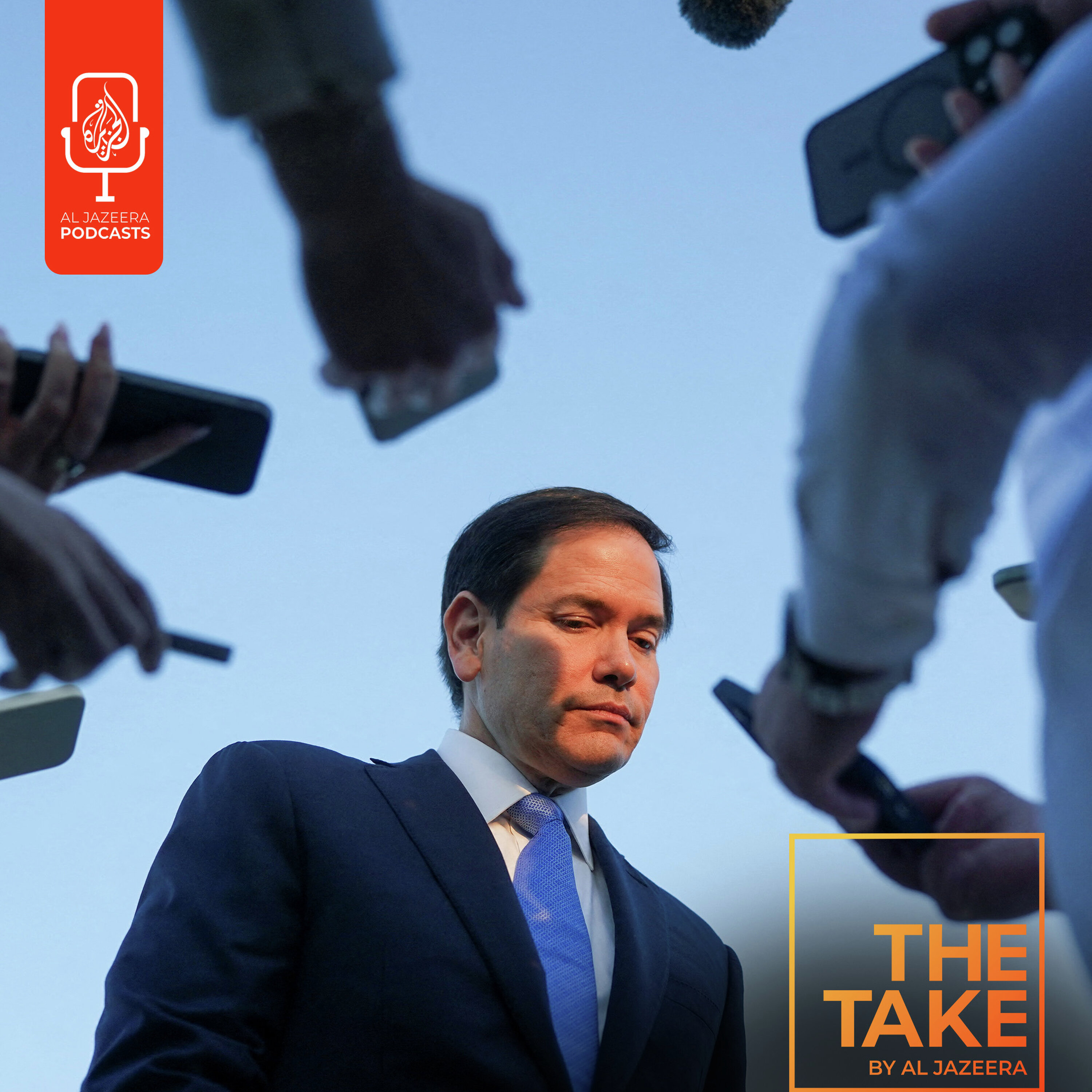
The hidden battlefield: Censorship in the Israel–Iran war
from The Take
23m 12s
The discussion examines the ongoing war's impact on Israel, highlighting a pervasive information war where governments restrict details about military actions, casualties, and objectives. It notes a divide in public opinion, with overwhelming support from Jewish Israelis contrasted by Palestinian citizens' opposition, who face discrimination and are excluded from protective measures like adequate public shelters. The analysis underscores Israel's strict censorship regime, which controls journalist access and reporting, often preventing full disclosure of damage and strikes, especially in areas densely populated with military bases. The human toll, particularly on Palestinian communities within Israel, remains underreported, with significant physical and infrastructural damage unaccounted for and daily realities overlooked in international media coverage. The conversation calls for greater attention to these marginalized perspectives and the broader implications of the conflict.
Today, what do we really know about the war's impact on Israel? We are neither told what's happening in Iran. We're not told how long this is going to last. We're not told what the end goal is. We're not told what's happening inside the country either. As governments restrict information from the US to the Gulf, how that plays out in what we see in Tel Aviv. I'm Malika Bilal and this is the take. Hey everyone, today is the day to subscribe to the take on your podcast app. We ask because we want more people to get their daily news podcasts from Al Jazeera. And while you're there, rate us and leave a review. It helps other people discover the show. Here's today's episode. My name is Diana Poutou and I am a lord. Diana, welcome back to the take. It is always good to have you on the show. The last time that you and I spoke, it was during the announcement of the ceasefire between Israel and Hamas, a ceasefire, broken by Israel time and time again. And now I'm binding you when Israel and the US are bombing Iran and Iran is retaliating across the Gulf and Israel. This war has caught you outside of Israel, but you are a resident of Haifa. So how has it been for you to watch it play out? This is absolutely terrifying and the reason that it's terrifying is because this is a war that the Israelis had been planning for such a long time. Benjamin Netanyahu said as much. He said that he's been yearning. Those were the words you use, the word used, yearning for this for 40 years. And he has not only roped in the United States, but it's affecting countries all throughout the region and it's going to affect the entire world. But also when you look at what it is and how this war is playing out, the Israelis and the Americans are doing to Iran the very same thing that they did to Gaza. And so Gaza has become the model, both for what they're doing in Iran as well as what the Israelis are doing in Lebanon. And rather than the Israelis being held accountable, they're spreading this system all throughout other places. Iran, Lebanon, it's continuing Gaza and also in the West Bank. And we just don't even know where this is going to end or how it's going to end. Well, thank you for talking to us about some of the stories that are very likely falling under the radar because all eyes are on this war. And it's the war being in the headlines. That's exactly what I'm hoping to pick your brain on. Because one of the things we've been talking a lot about in the last week is the information war. And it's not just Israel, of course, Gulf countries and the United States are all restricting public access to military information to some degree. But I'm curious about your take on what's happening in Israel from what you can make out. How is this war being covered? Well, it's important to keep in mind that this is a war that is very largely supported by the Jewish Israeli public. Actually, it's kind of shocking. I've never seen people yearning for war as much as these statistics are showing us. On the low end, it's 81% of Jewish Israeli society on the high end. The figures are 93%. That is incredibly high. And so when you see these figures, one would expect that there would be some desire to at least be portraying this war in the way that it should be portrayed. But instead, it's been a war in which a lot of it has been kept silent. So there are things like we don't know exactly what places have been hit. We don't know exactly what the Israelis are doing either. And so it's been an information war, both in the sense that we are fed a lot of propaganda about how quote unquote successful this is. But then not at all really told about what the goals are, how long it's going to take, and any of the damage that has been inflicted. And so this is quite frankly astonishing to me. Okay, so then I'm trying to make sense of that because with, let's say, 80% at the low end, you mentioned public support for this war, inevitably war comes with casualties. And some of those must be happening in the places where missiles and bombs land. So what do we know about the toll? And is that affecting public opinion or is that sort of out of the spotlight? That too is out of the spotlight. We've seen a few of the casualties, but not the extent of it. And also in these public opinion polls, they've pulled people and they've said that they can withstand war for about a month. So again, it's just shocking that because we have such wide support that they're using this wide support to just kind of keep everything under wraps. And it's really shocking when you live in a place where your phone is always going off because you're getting these warnings of missiles coming in. And then lately there've been warnings saying, well, we can't really predict all of the missiles they're going to come in. And so the information war has been one in which we're neither told what's happening in Iran. And we're not told what's happening inside the country either. What are the restrictions and the reasonings behind why the public isn't told? Well, the restrictions are that you're not allowed to film and that you're not supposed to be showing any of the sites that have been hit. And it always comes within under the framework of court on court security. And so we saw this, particularly back in June last year when Israel attacked Iran and there were some hits back that the Israeli is not only blocked a lot of the coverage, but then went after a lot of journalists as well who were trying to, who were trying to cover where the Iranians had hit. And this time too, we're seeing the same. This time, however, they have allowed for some footage of some damage in certain areas, but again, not as widespread. But it's important to keep in mind, this isn't the first time. And it isn't just under the guise of war. Israel has an active censorship office. In fact, their press office is called the censorship office. And so a lot of what foreign journalists have to go through working with Israelis is that they have to submit to the Israeli censorship rules. So this is not at all unusual. Okay. Well, you mentioned the so called the 12-day war between Iran and Israel and June from what we gather based on the reporting that was done where you reside. Haifa suffered some pretty serious damage. Oh, yeah. The government has come out and said that they estimate the cost of the damage around the country to be around $3 billion. But as you're saying, because the full extent is not really known, does that figure even track for you? Does that feel accurate? No, not at all. Not at all. Because I don't think that it takes into account all of the damage to buildings, the damage to infrastructure, the damage to homes, not just buildings, the damage to cars. I think there's much, much more than that. In June of last year, just in Haifa alone, the places that were hit, many of them still have not been repaired. The ones that did repair, where people were repairing it themselves, some of them are still not open. So this is much more extensive than the Israelis are letting on. Okay. So I'm keeping that in mind with what Israel has said about its censorship, saying that specific information about strikes on military bases and other areas that the government deems sensitive are not allowed to be published in Israel, thanks to military censorship rules. So it's that sensitive word that seems pretty key here. How is that determined? I wish I knew. I think when looking at Israel, you have to just recognize that it's one big military base. That's it. And I say this because where my own house is, there is a military base right beneath it. So what? Okay. Someone who has not had the privilege of going to Haifa. Why does that even like? What does that describe that for me? - Hey, for the beautiful city, it sits atop of
hill and yet even though it sits atop the hill, the Israelis have surrounded the city with a number of military bases. So I live in a place that's at the top of the hill in South Heifa and just on one of the slopes of the hill is a military base. The bottom of that same hill is yet another military base. Looking out from my window when I can see the sea to the left is yet another military base. If I just peek out on the balcony and look to the right there's yet another military base. The place is entirely surrounded by military bases. And so thinking about their quote-unquote sensitive rules, the question becomes like imagine if a field is hit. Is it that they've hit a sensitive area? How is it that it's defined? Because so much of the country is just surrounded by military bases. The Israeli equivalent of the Pentagon is located in the heart of Tel Aviv. It's actually the place where Nassignal went on the first day of the war. He went on the rooftop of it and proclaimed and said that he had yearned for this for four years. That is literally located in the heart of Tel Aviv in the heart of a commercial district as well as a residential district. So Israel's military bases are all throughout the country and they're all throughout these residential areas. And so really again the question becomes what is considered to be sensitive when they've packed the place full of military bases and everywhere that you turn you can see one or another everywhere you go. We'll have more with Ziana after the break. The Inside Story podcast dissects, analyzes and helps define major global stories. We get into the details with experts who explain how policies affect people. The Inside Story podcast by Al Jazeera. Find us wherever you listen to podcasts. I think it was a surprise to many people online at least recently to hear a CNN journalist for example saying live on air during a report on the current war from her perch in Tel Aviv that the Israeli government doesn't want us to show that. She was referencing an interceptor. So how much of this is the cover of darkness, the fog of war that's actually being imposed by governments. How much of this is just normal when it comes to war? I think that that was actually a CNN. And the reason that I say that it was CNN is because we have seen that other networks, other including ISIS, including other Arabic language networks have been showing what she didn't want to show. And so they take the censorship rules and rather than try to push them, rather than demand clarity of information, they somehow capitulate. Well, there's also a label that's raised the anger of people online in its coverage, CNN, not to put them on the spot here, but they are what a lot of people are talking about. They're using this on-screen graphic that reads, CNN operates in Iran only with government permission. Government permission is part and parcel of reporting for many countries, both Iran and Israel. You've been on the ground. You see what doesn't make international news. What is it important for people to know about what we don't see? Well, first it's important for people to know that in order to be a journalist covering Israel, you actually have to get permission by the Israeli authorities. And if you don't get permission by the Israeli authorities, then you can be deported from the country. This isn't a situation where you can just fly in and report some people try to do it, but there have been cases where people have been deported. Not only that, in order to get permission to report, you have to go through a series of examinations. You have to submit your writings, your reporting, etc. to a government office. And that government office can choose whether to give you a press pass or choose whether to not give you a press pass. And again, we've seen that some journalists, particularly those journalists who are affiliated without us that they don't like, haven't gotten their press passes. So that's just on a technical level. Then we've also seen that even if you have a press pass, that if the Israelis don't like your reporting, that they can and will revoke your press pass. And so it's all of these measures that the Israelis use of control before a journalist is even able to cover. But then you need to coordinate your movement to go into one area or another. This is why there are no foreign journalists that are allowed in Gaza even to this current day. There are no foreign journalists, which is why we are relying on our Palestinian journalists who have been doing the work that that beyond all others through all of this and suffering genocide and yet being questioned about it. So they can't get into places as well. And then even after that, oftentimes stories themselves are subjected to censorship and to the censorship rules. Right now, we're even seeing that it's gone beyond that. The Israelis are passing legislation to bar certain media outlets from being able to operate inside Israel, including and Jazeera, but it's not just Jazeera. They're going to be extending this law beyond that because in their minds, it's a question of being able to control and control what it is that journalists are covering and how it is that they're covering it. So this isn't at all a situation of a free press. Well, Diana, I want to continue this media literacy masterclass with your legal and lived experience with one more example. So there's another incident. I want to get your take on this time from Spanish media. There's a journalist, Laura Di Chicanana, she's seen on video reporting from HIFA and precisely from an Arab quarter in the city. She explains that in the whole neighborhood, there's only a public shelter. So people have been given the option to either pay tens of thousands of dollars to build a private one or try to go to another part of the city in a Jewish area. But she says that they weren't being allowed into those. Later in the broadcast, the anchors on the show get a call from members of the Jewish community who say, "This isn't true." What do you know about how that resonates for people in places like HIFA? It's so grand for people who have never lived this to say, "Oh, it isn't true." Of course it's true. So let me step back and say, there are about 11,350 public shelters throughout the entire country. In Arab areas, 37. So of those, 11,350, roughly, public shelters throughout the whole country, only 37 of them are located in Arab areas. So, you know, you can do the math and you can see exactly how it is that Palestinian areas are not at all given any of the services that Jewish Israeli communities are given. So what does that mean? It means that either you are in a place that doesn't have a public shelter, you stay in a place that doesn't have public shelters such as your home. Or you try to go to a place where there is a public shelter. Let's say if you were in a mixed city or you happen to be in Tel Aviv or other places. The problem there is that oftentimes when they see that you are Palestinian or if you're not Jewish, that these shelters sometimes they close them off to Palestinians. And there have been many, many, many reported cases of people where they have been barred from entering these public shelters. Well then when it comes to media literacy, do you think that that's the fact that people outside of Israel know or that we as journalists are doing a good enough job of explaining to people? I think that the whole situation of Palestinians in Israel is something that isn't really not very well understood. I think that even when you look at the ways in which people are reporting on this war, there hasn't really been a lot of input from Palestinians in Israel who are some of the people who are perhaps going to be the most affected by this. And how is it that they're most affected? This is a community that is
community that is a very small number, two million people, that the Israelis have treated as a fifth column, that you have Israeli ministers who've said that the only reason that they remain is because David Ben-Gurion didn't finish the job in 1948, meaning that he didn't finish the ethnic cleansing process in 1948. You have a lot of racism against this community, and then at the same time, it's assumed, even when they do their opinion polling, it's assumed that people are somehow in favor of this war when they're not. The opinion polling is showing exactly the opposite, that this particular community is entirely opposed to this war, because we see and we know what the ramifications are, we see what's happening in Lebanon, we see that the Israelis are going to go into Lebanon, seize Lebanese territory and stay there, just in the same way that they've gone into Syria and are staying there, just in the same way that they've gone into Gaza and are not leaving, and just in the same way that they remain in the West Bank and are slowly trying to ethnically cleanse the place. And so it's a community that has been entirely forgotten, and yet at the same time, it's a community that it's assumed that they are so unbored with this war, when they're not unbored with this war, and at the same time a community that hasn't at all been protected by any of the systems that the Israeli government has in place for Jewish Israelis, quite the opposite. They're the ones who are being targeted. So in the big scheme of things, as people are focused so heavily on whether soldiers are being killed in Lebanon, and we've seen headlines about that, and where missiles are falling until a wave, I think the human element of what it means for Palestinians, what it means for this community, these are people who have survived the Nakba, or who have, who are the descendants of people who have survived the Nakba. These are people who are now living amongst people who have either perpetrated the genocide or are supporters of a genocide. Very few people are asking this community, what is your day to day like, and what does the future mean for you? And that's the take.
Podcast Summary
Key Points:
The war is characterized by severe information restrictions, with governments like Israel, the US, and Gulf states limiting public access to military details, damage assessments, and strategic goals.
There is a stark disparity in public support for the war within Israel, with very high backing among Jewish Israelis but strong opposition from Palestinian citizens of Israel, who also face systemic discrimination and lack protection.
Israel employs active military censorship, controls journalist access and reporting, and restricts coverage of strikes and damage, particularly in sensitive areas—often defined broadly due to the widespread presence of military bases in residential zones.
The impact on civilians, especially in Arab communities within Israel, is significant and underreported, including inadequate public shelters, extensive unaccounted damage, and daily hardships that are overlooked in mainstream coverage.
Summary:
The discussion examines the ongoing war's impact on Israel, highlighting a pervasive information war where governments restrict details about military actions, casualties, and objectives. It notes a divide in public opinion, with overwhelming support from Jewish Israelis contrasted by Palestinian citizens' opposition, who face discrimination and are excluded from protective measures like adequate public shelters. The analysis underscores Israel's strict censorship regime, which controls journalist access and reporting, often preventing full disclosure of damage and strikes, especially in areas densely populated with military bases.
The human toll, particularly on Palestinian communities within Israel, remains underreported, with significant physical and infrastructural damage unaccounted for and daily realities overlooked in international media coverage. The conversation calls for greater attention to these marginalized perspectives and the broader implications of the conflict.
FAQs
Public support among Jewish Israelis is very high, ranging from 81% to 93% based on statistics mentioned in the interview.
Israel employs military censorship, restricts filming of strike sites, and requires journalists to obtain government permission and submit to censorship rules, limiting coverage of damage and goals.
Palestinian citizens in Israel face discrimination, lack access to public shelters, and overwhelmingly oppose the war, yet their perspectives are often overlooked in media and opinion polls.
Casualties and the full extent of damage, such as the estimated $3 billion in costs, are underreported and kept out of the spotlight, with limited information provided to the public.
Foreign journalists must obtain press passes from Israeli authorities, submit their work for approval, and risk deportation or revocation of credentials if their reporting is disliked, severely restricting access and coverage.
The interview suggests Israel is applying tactics used in Gaza to Iran and Lebanon, spreading a system of warfare without accountability, and continuing patterns of occupation and ethnic cleansing.
Chat with AI
Loading...
Pro features
Go deeper with this episode
Unlock creator-grade tools that turn any transcript into show notes and subtitle files.
 PodcastTranscript AI