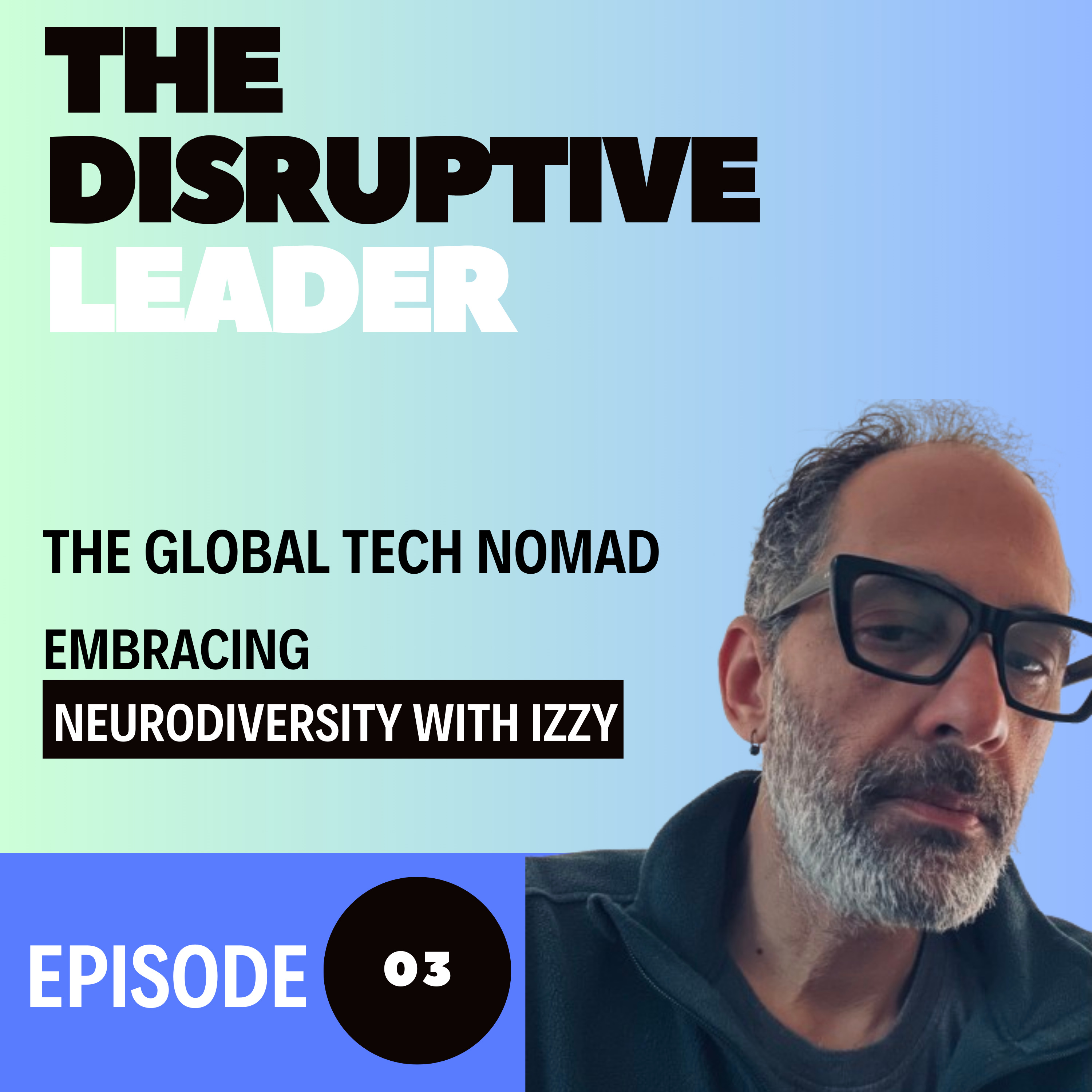
The Global Tech Nomad: Embracing Neurodiversity with Izzy
from The Disruptive Leader
48m 3s
In this episode, Izzy shares his extensive global career as a software engineer and entrepreneur, working across regions like the US, Asia, Latin America, and Europe. He explains that transitioning from coding to entrepreneurship was natural, as both involve solving business problems, though entrepreneurship required a broader view of marketing, sales, and scaling. Izzy leads a distributed team across three continents, facing challenges like an 11-hour time difference and scheduling conflicts, but reaping rewards such as access to a global talent pool, happier employees, and the perceived value of an 18-hour operation. His CRM solutions are customer-centric, focusing on removing friction, publishing prices, and integrating systems to transform business processes, not just technology. Izzy also discusses his recent AUDHD diagnosis at 52, which brought clarity and relief, explaining past struggles with time management and social interactions. He views his neurodivergence as a superpower for creative problem-solving, but acknowledges communication challenges in leadership. Finally, he predicts remote work will continue to evolve, with technology already in place, but emphasizes that companies must shift their culture and processes to fully embrace it.
All righty. Good morning, Izzy. How are you doing today? Good journey. How are you? I'm well. Comcompany. Sun is shining. Almost the end of month. Thank you for taking the time to do this episode with me. I appreciate your time. I just want to introduce you very quickly to our listeners. Izzy is a globally seasoned entrepreneur and software engineer. And what we're going to be talking about today is Izzy's journey across the globe. He's a recent AUDHD. So that is autism and ADHD together. His recent diagnosis at the age of 52. So welcome to the episode. Izzy. It's a true honor to have you here today. So why don't we just start by you sharing your experience working in every corner of the globe, except Antarctica? I started my professional career back in 1994. And since then I started working in the US. I worked there for a couple of years. I've worked in Egypt for a few years. I worked in Australia. And that was more of an Asia pack roles. I've done work in Australia and New Zealand and Malaysia and Singapore. Indonesia. And I also moved to Latin America. I lived there for about eight years. Working Chile and done work for Colombia and Mexico. And in the last three years. I've been working out of Sweden. I've been working in the US for a couple of years. Lots of flying. And many different cultures. Different approaches. When it comes to work. How we tackle problems. We solve challenges. It's quite different from every place. I think it's a lot of work. It has a stunning landscape. A wide life surrounding. I think it's one of the few places in the world where you can see. Can you please open a cross campus. That's fun. Places in Asia like Singapore and Kuala Nguyen. The really high energy cities. So that exposure of So that exposure of solving it in different ways in different approaches. because you've been old over the globe. must be overwhelming. And just talking about sort of software engineering. as you journey through the whole world. you transitioned You transitioned from being a software engineer to an interpreter. So that means you went from. debugging code to debugging. and diffrent environment around the world. How is that working out? - Like I think, like transitioning from software engineering to entrepreneurship was more of an etcher progression. Software engineering, it's more than coding. It's mainly about solving problems. Usually those problems are business problems. They could be lack of resources, lack of high cost or there's no time and we have this challenge that we need to solve. Coding is just one little part, but usually we solve the problem and the architect of the solution and the algorithm. But we're gonna solve this specific problem and the code is just that little part where we write instructions for a computer to do what we need them to do. But we need to solve the problem first before coding it. And entrepreneurship is exactly the same. We're usually solving a problem, solving a challenge, helping specific industry or business to overcome a specific challenge. So they're quite similar in that sense. However, this transition also helped me to shift my views from just that technical part into a more holistic business view which I had to think beyond building a product and think of the other aspects, how we will market the product, how we will sell it, how we will scale it. It's still the same approach as software engineering, but I had to learn other parts of the business also. - Yeah, I'm probably having that global exposure also gave you that have to pull the opportunity where you can solve not only software problems, but also business problems in many different ways. And I was doing research about the teams that you manage and what I can see is that you're leading a distributed team that spans across three continents. Talk to me about that, how what are the challenges or the opportunities in having this globally distributed team? - So like leading a distributed team, like we spend across multiple time zones, so we have 11 hours difference between our first team member when they start working and the last team member when they start working. So it comes with its own set of challenges, yet it's a very rewarding experience.
So the challenges with that distributed team that requires us to put more effort, no effort but focus and build effective communication. We do not have the luxury to have vague communication because of this 11 hour difference. Our communication has to be clear because usually when someone wakes up and they start working on something, it's not going to be possible to communicate with another team member to ask for clarification. So we have to put more effort in the effective communication. We don't have that luxury to work into someone's desk or get them on a Zoom call or a Slack oven for that. Also, with time zone, we have the challenge of schedule meeting. We have very few time slots today where we can have those meetings. I'm not with everyone, but with some. We have the time changes that also create some issues because suddenly we used to have two hours difference, but now they're like three hours difference or four hours difference because some 14 members, it's not just the hour difference, but we have a northern hemisphere and southern hemisphere and when they're like saving kicks, it's not one hour difference and becomes two because we have a group that's entering their summertime and the other group is entering their wintertime. But the rewards, like I said, is significant. Having that global talent pool, this is one of the biggest rewards. We're not confined to one geographical to find talent. We can hire anyone anywhere with the processes that we put in space. So what we look for is the mindset for the team members and we get this infinite pool of talented resources to choose from. The other benefit of the distributed team is our team truly appreciate the flexibility that they can work for anywhere. You don't have to commute to an office. They work their own time, they organize their own space. So that made them like happier, that improved our team member attention. They're happier, so they have more jobs at the faction, which results in happier clients. And from the client perspective, having this distributed team that perceived value from the client side, that we have this 18 hour a day operation. So we can, we're much more efficient, we can build faster, we can produce faster and deliver faster. We're not truly working the 18 hours, but this is the perceived value that the client gets. >> Yeah, okay, and that's pretty fascinating. 18 hours, three continents, asynchronous work. That must be a setting up an operation like that. I'm guessing it's not easy, but coming from your sort of software background where you've been trained to solve all of these type of problems before. I'm sure it was a breeze for you, seeing the results that your company has generated. And just talking about this distributed team, I understand that part of what this team is doing is transforming businesses around the world with CRM solutions. What's your approach when it comes to transforming businesses with CRM solutions? How do you add value or how do you impact your customer's business or business growth with these CRMs? >> Right. So like we follow the very simple model. So CRM is the customer relationship management. The C and CRM is for the customer. So what we did is that we built our processes for the customer. We put the customer in the center. It's our customer's centric. Before I'd like to be good at something and deliver value to our customers, we have to do what we preach. So like for us, for example, building our website. When we built our website, we built it with a customer's centric approach. We didn't look for the traditional website metrics of lead conversion rate, how many visits we were getting a month. We put the customer in the center and thought what does a customer or a prospect need to achieve when they land on our site. So we ungate it all our content. So we remove all friction points. We published our prices. We published our processing. The only thing we added is our calendar for a prospect to book us when they're ready to talk. And we applied that same methodology in every touch point throughout the customer life cycle during the sales process. It's a very straightforward, we're not really pitching. We're trying to understand the challenge and pose a solution. So during our sales process, when we have a customer there, they want to implement their CRM integrated with their tech stack. We drilled down, we spent hours building the proposal, the architecture structure. How we're going to solve this problem, how we'll train the team. And we're not worried to give them all the information, even if they want to go ahead and implement it themselves or another partner in a way. Because we are trying to put the customer in the center. And with this approach, it actually works better for us. Right now we have 60% win rate and opportunities. I think that's outstanding. But if we see they're putting ourself in the center, guarding our processes, not spending much time to understand the challenge for the customer, we're not going to achieve that win rate. The other thing, for a good CRM solution, there's no existing isolation. It has to be connected to other systems, like accounting software, ERPs, any tech stack that touches our client customers in a way. And usually we approach the CRM implementation this way. Giving that vision and visibility to the prospects to show them like the end goal, how this should work and look like, how much time would that save you when you have all those systems connected, how would they impact the relationship with their customers. And I also have been like a unique setting of any proposition in a way. Yeah, it sounds like the whole approach is super unique. Like when you are saying the way you approached your website, the first thing that sort of came to my mind is, when you worried that the other agencies would take your pricing and process the copy it, like how do you use it? Yeah, I don't think prices are secret. Everyone knows the prices of their competitors. And if you don't know the exact price, you still have an idea of how do they price. And usually pricing is not, it's not what makes someone decide to buy it from you or not. It's the perceived value that they're getting. And price does not equate value. That definitely makes a lot of sense. It's like you approach that in a really open, transparent, realistic way, as opposed to following this playbook, I need to gather these specific conversion metrics and I need to put my customer through this entering journey and you just build
your own playbook on how to generate demand and yeah put your customer at heart I like that. You removed all of the frictions and the fact in the process to just keep it really agile and on point in sweet and night. Exactly because like at the end CRM is not a technology it's not a platform I see CRM is a business process. It doesn't matter what CRM you get, be it the hotspots or sales force if you don't have that business process. If you're not willing to transform your business, CRM is not going to work. It's not a magic solution. So and this is what we like the ideas to show our customers and prospects that CRM is part of their process and we try to do it at every touchpoint with them. Yeah I love that CRM is not a software. Let's let's write on it's spot on. It's a mindset in a way. Yeah. Okay, okay this is quite interesting and now let's talk about your autism ADHD revelation. How did you discover this? What happened? What happened is I was actually having the conversation with you when you asked me to check or read about neurodiversions. I read a lot. My hobby is to read and not just books but to constantly, I'm constantly online searching for anything that pops in my head and I was surprised like we didn't I search for that before. Well anyway like when you turn me check this out I start to googling, going to Reddit and reading about neurodiversions and the more I read the more I self identified in a way. So I started doing those online assessments and every assessment that I did came back with a score over 90%. And that was, you know what I need to talk to someone that knows about this. To like I wanted to know I booked a psychiatrist and a psychologist for like an assessment. It's for performing diagnosis that you go through a set of like interviews, different interviews with different people some cognitive tests and I took around like six weeks and the outcome was I'm both like autistic with ADHD and like finding out it was more like like finding a missing piece in a puzzle. So it was a mix of a shock but the shock was not because of oh my god I'm autistic and ADHD. The shock was more like how did I know this before. And the same was at the same time it provided like relief and clarity. So like looking back at my life a lot of things made sense when I found out so I had my struggles in time management, the whole sense of time. I sometimes I can be very intense hyper focusing and some of the projects or some of my work tasks while I ignore others. Also I have like social challenges. So going through this experience and getting the diagnosis it was it gave me an explanation to a lot of things before getting diagnosed it. It always felt like you're swimming against the current. I always felt I'm doing with nobody efforts just to keep up. Do you feel like being neurodivergent contributed or enabled you to have such a unique perspective as an entrepreneur and a techie for that matter? Definitely like I think being neurodivergent I had this ability to think outside of the box see connections where others can miss it. So that way of thinking helped me a lot in my career to be more creative as problem solving. Like I used to say like solving problems is one of my hobbies that's what I like to do. And I think having that in a way could be as a special interest is having those challenges. I feel like credit is all around. It gets me excited and focused. So on the flip side it feels like having some superpowers and at the same time having some challenges when it comes to like time management. Working like I'm lucky to work with a small team but I I think also have some challenges working in a bigger team where there's like strict hierarchy and flow of orders because I like my first instinct is to question and challenge and that doesn't go well in a bigger organization. Yeah and I guess that makes sense where that entrepreneur in you has been your last two or three decades. And what's it like being a neurodivergent leader? How do you think neurodivergence impacts leadership? I think it's like it has this unique challenges because and again I think every new divergent is different but I'm speaking for myself. A communication would be a primary challenge because sometimes my thought process would not be linear. I will jump between topics. I might not be like able to articulate and complex ideas. I think also I can be I can be hyper focused on something and I miss a lot of what's going on around me and that could be a problem. So I miss like the social cues maybe body language. And sometimes I can be very direct in communication and that can lead to like potential misunderstanding especially sitting in a leadership seat because if someone working and reporting to you know everyone would like openly challenge you or give you like a hundred percent honest feedback and I can just move on in the conversation without sensing that you need to say something. Yeah. And also the unconventional thinking patterns I think sometimes they might see in as illogical or unconventional. So I think that could also be a bit of a friction. That's important. Yeah. If the members of the team expect conventional yeah or are not forget expect maybe a more comfortable with conventional. Yeah that makes sense. And what do you think you've worked everywhere in the world and you've worked in office you've worked remote what are your predictions for the evolution of remote world.
around the world. What do you think is happening? I think remote is, like remote work is the work today. And I think that transition from an office environment to remote, it happened before the pandemic. Like usually everyone associated with the pandemic, I think the pandemic accelerated the transition, but the transition started way before the pandemic. It's the evolution of technology. Laptops were, everyone was using laptops, I think since the 90s, at least in 1997, 98, it was very common for businesses to have laptops. And all the way to 2020, where even in 2019, when everything was still office-based, people go into a meeting room to sit next to each other and everyone opened the laptop screen. People commute for hours to go to their office to send an email or get on a Zoom call. So the transition was happening. I think what was slowing it down is the nature of businesses invested in real estate, in offices. And it was hard for them to let go. The pandemic accelerated it. A lot of businesses turned into remote or the strength of the office space and turned it into hybrid model. But with the advancement in technology, like everything in the cloud, the office historically is an extension over the factory, but now even factories, most of them are run by robots. I believe the office is not the future. The technology is getting so good that eventually we will have a physical meeting like, but it's all virtue anyway. Yeah, I remember when the pandemic started, all I could think of, why does a Zoom make the meeting room 3D? Because then it's like literally, that's what's missing. It is not 3D because the rest is all the same. I hope we can all become like digital nomads and the kind of anywhere. Yeah, but the challenge, like the challenge that existed a few years ago was technology. I think the challenge that it exists today is more into that company culture shift towards being remote. So again, businesses need to go through that transformation to build everything, to be remote person. Right now, still for a lot of businesses, I gave a Zoom to all of our employees so they can log in, but the processes are far from remote. Yeah, because it's one thing to be online and a call and it's one thing to actually have operating systems and processes and KPIs and a team. And clear communication that focus on outcomes and rather than the process itself, with different type of leaders. Yeah, not that traditionally leadership style. That makes sense. And what sort of baffling me is I'm hearing from a lot of at least the prospects that I speak to that yes, can't come to pandemic, everyone was remote. But now there's also a trend where some companies are sending their team back to the office. And I just find that a little bit overwhelming because the only thing I can think that could have gone wrong is it's not you have bad employees that can't be controlled because they're not in an office, it must be something related to your process or the way you work or the way you measure. I think it's a, yeah, like a big part of it is the process how we work, communicate and measure. I think another part is the way we built our homes and apartments that they're, they were just for the home and apartment. Like we did not take into account a working space and sometimes that that challenge for some people that the spaces, if you have two, a couple working in the same place in a tiny 40 square meter apartment, then it's challenging for both of them to be a cause at the same time. Yeah. And that would take a very long time to solve because you have all everything structured that the work is not from home. And I think like just on the other side of the scale because again there isn't that one sort of one size that fits everybody. There are some industries, you know, can't be remote. You have to be in a factory or your most allow you have to be in the, in the plain field. I know everybody has the luxury to have a comfortable working place at home. And so I think maybe those could be contributing factors but based on the assumption that everyone has a comfortable place at home where it's quiet, they can concentrate, there's enough sunlights. And you have good processes, good technology. There really shouldn't be a reason to that could be my own bias though. All the offices self can be remote and we have those shared working spaces. So like an actual company office one exists but A office would exist. Like the place you can go work one or two times a week like a hybrid model. Yeah, I think I would thrive in a hybrid model as well. Like one of the caveats of remote work is it can get lonely? A little bit. Yeah. But it's a model where you don't need to commute for a couple of hours to reach the office or be in traffic but as well you can just walk five minutes away from where you live and just be there and connect your laptop and stuff. Yeah, so it's like a co-working space where you can just go plug in and you have that sort of office environment around you. Not necessarily pertaining to one specific company. Yeah, that makes sense. And look, what's what's one tool you can't live without and don't say coffee. That's a good question. How can you about remote work? What's the one tool that is maker breaker company? I think I think that tool is for all type of work whether it's remote or in an office. I mainly think of the different AI tools that exist today. Like today with the state of the economy, the inflation, margins are tight, profitability margins are tight and that would pressure on every business that they need to be more efficient. The business that will fail to adapt, they will cease to exist. And to be more efficient, it means we need to produce more with the same resources that we have. So we have to work more deals. We have to have more proposals, serve more customers with the same resources. And at the same time, the amount of information that we have, big information about the customer, information about the existing customer, the technology and the different solutions that we work with and implement for our customers. This knowledge, it's constantly increasing at an exponential rate. So for us to be efficient and able to produce the amount of work we need to have rely a lot on AI. And I'm not talking about AI that we try to email. I'm talking about have the workflow embedded in your processes that at every step we have an AI utilized that will help us summarize the tons of documents that we have that will help us analyze the client requirements that will help us come up with suggestions for solutions based on what we've implemented before. That will help us to identify what's the biggest challenge for the customer and what's the one thing that we need to implement that would solve for them. Because it's the same thing for our customers. They cannot afford
to have month and month waiting to see results. We need to come up with something that would somehow move the needed for them for us to stay working with them. So I think it's the AI workflow that we need to embed in our processes in setting, proposing, delivering the service, and coding, and after sales, even onboarding the clients, and off-boarding the clients of me, and getting the case studies. So we need to work with the massive amount of data with the same resources that we have. Yeah. Yeah. In such a little time frame with customers all across the globe with so many different industries. Yeah. And at the same time, don't have that one solution that you pitch to everyone. It has to be customized to their unique challenges, which is even within the same industry, the challenges to unique. Yeah. I admire your self-awareness and how you've worked across the globe with different cultures, starting as a software engineer, CRM, and consultants, then becoming a interpreter, managing a globally diverse team, working 18 hours, going through this sort of late Eurodivergent diagnosis, and all of this self-awareness and has been contributing to your personal growth as a human being, and that's very apparent. What advice would you give to others that are struggling in their finding a niche, or finding what they're good at, or finding a diagnosis in itself? What advice would you give people? So, like self-awareness is a big word sometimes. It's taken out of context. But I truly believe, like the incentive, like, why should someone be self-aware? What's the incentive that I provide? So, for talking business, your business can only grow as much as you. So, if you stop growing, your business won't grow. And you cannot grow without having that self-awareness that you reflect, that you dig down in your weaknesses, as well as your powers. It's very crucial that you know both what you're good at and what you know good at, who else in your team is good at those things, where you can lean on them to do that part. That's very important. But in general, the whole idea of being self-aware is for personal growth, is to find out the areas that you need to improve in, and also find out the areas that are not interesting to you, where someone else in your team would put the time and effort to grow in those areas and you can lean on them. Maintaining that self-awareness is not easy because it's, first of all, you have to give yourself time to reflect. Sometimes we get into the grind and forget to reflect. And I think that's one of the dangerous parts. So I remember a time I quit like, lack of self-awareness. And I'm sure you know that time too. And you're almost cost me the business because I was focused on growth so much, I was focused on tracing a specific tier for the business. And I ignored the thought that it was taking on the team on myself. Everyone was near burnout. However, like honest feedback from some team members, from some customers forced me to step back and reassess. And that was a turning point where I started to right-erase self-reflecting and personal growth. And I think this is the winning key that you constantly self-reflect, that you constantly learn new things. Because everything is changing. Changes the only constant in the world that we live in. And sometimes it's, it's, you tend to, we tend to be afraid to explore and experiment. But exploring and experimenting should be a constant process. It should be embedded in the business. Because we have to be constantly adapting to changes, we will never have the magic solution at the first goal. And if we don't have the exploring and experimenting culture and processes embedded, then we're shooting ourselves in the foot. Because time will force us to change, but we won't know change to what. True, very true. That's really sound, that's really sound advice to, I think to other entrepreneurs that are trying to find their niche, their spot, what they're good at, what they're not good at, what their purpose is, what their driver is. This is all, this is all great stuff, is it? Thank you for sharing all of that inside and being so open about your experience and your diagnosis and the hardships and the superpowers. I think there's a couple of statements that I'll quote you on moving forward, very well articulated and said. So yeah, thank you for sharing this time with us. I hope to all of our listeners, they enjoy this episode. I thoroughly enjoyed it. Thank you very much. I enjoyed it too. I really have a wonderful day. You too. All right, bye bye.
Podcast Summary
Key Points:
Izzy is a globally seasoned entrepreneur and software engineer with work experience across the US, Egypt, Australia, New Zealand, Malaysia, Singapore, Indonesia, Chile, Colombia, Mexico, and Sweden, covering multiple continents.
He recently received a dual diagnosis of autism and ADHD (AUDHD) at age 52, which he discovered after reading about neurodiversity and undergoing formal assessments.
Izzy transitioned from software engineering to entrepreneurship, viewing both as problem-solving roles, but expanded his focus to include marketing, sales, and scaling.
He leads a distributed team spanning three continents with an 11-hour time zone difference, emphasizing clear communication, flexibility, and access to a global talent pool.
His CRM approach is customer-centric, involving transparent pricing, un-gated content, and a focus on business processes rather than technology alone, achieving a 60% win rate.
Being neurodivergent gives Izzy creative problem-solving abilities and intense focus, but also presents challenges like non-linear communication, time management, and missing social cues.
He predicts remote work is the future, accelerated by the pandemic, but notes that cultural and process shifts are needed for full adoption, not just technology.
Summary:
In this episode, Izzy shares his extensive global career as a software engineer and entrepreneur, working across regions like the US, Asia, Latin America, and Europe. He explains that transitioning from coding to entrepreneurship was natural, as both involve solving business problems, though entrepreneurship required a broader view of marketing, sales, and scaling. Izzy leads a distributed team across three continents, facing challenges like an 11-hour time difference and scheduling conflicts, but reaping rewards such as access to a global talent pool, happier employees, and the perceived value of an 18-hour operation.
His CRM solutions are customer-centric, focusing on removing friction, publishing prices, and integrating systems to transform business processes, not just technology. Izzy also discusses his recent AUDHD diagnosis at 52, which brought clarity and relief, explaining past struggles with time management and social interactions. He views his neurodivergence as a superpower for creative problem-solving, but acknowledges communication challenges in leadership.
Finally, he predicts remote work will continue to evolve, with technology already in place, but emphasizes that companies must shift their culture and processes to fully embrace it.
FAQs
Izzy is a globally seasoned entrepreneur and software engineer who started his career in 1994, working in the US, Egypt, Australia, New Zealand, Malaysia, Singapore, Indonesia, Chile, Colombia, Mexico, and Sweden.
Izzy sees both roles as problem-solving. Software engineering involves solving business problems with coding as a small part, while entrepreneurship requires a holistic view including marketing, selling, and scaling, which he had to learn.
Challenges include managing an 11-hour time zone difference, requiring clear and effective communication since team members can't easily ask for clarification, and scheduling meetings due to limited overlapping slots and daylight saving changes.
Benefits include access to a global talent pool, team flexibility and happiness, and perceived value for clients with an 18-hour operation, leading to faster delivery and higher efficiency.
Izzy uses a customer-centric approach, putting the customer at the center of all processes. They ungate content, publish prices, and focus on understanding challenges, resulting in a 60% win rate, and emphasize that CRM is a business process, not just technology.
Izzy discovered it after being prompted to research neurodiversity, reading and self-identifying, then undergoing formal assessments with a psychiatrist and psychologist over six weeks, which confirmed he is both autistic and ADHD.
Chat with AI
Loading...
Pro features
Go deeper with this episode
Unlock creator-grade tools that turn any transcript into show notes and subtitle files.
 PodcastTranscript AI