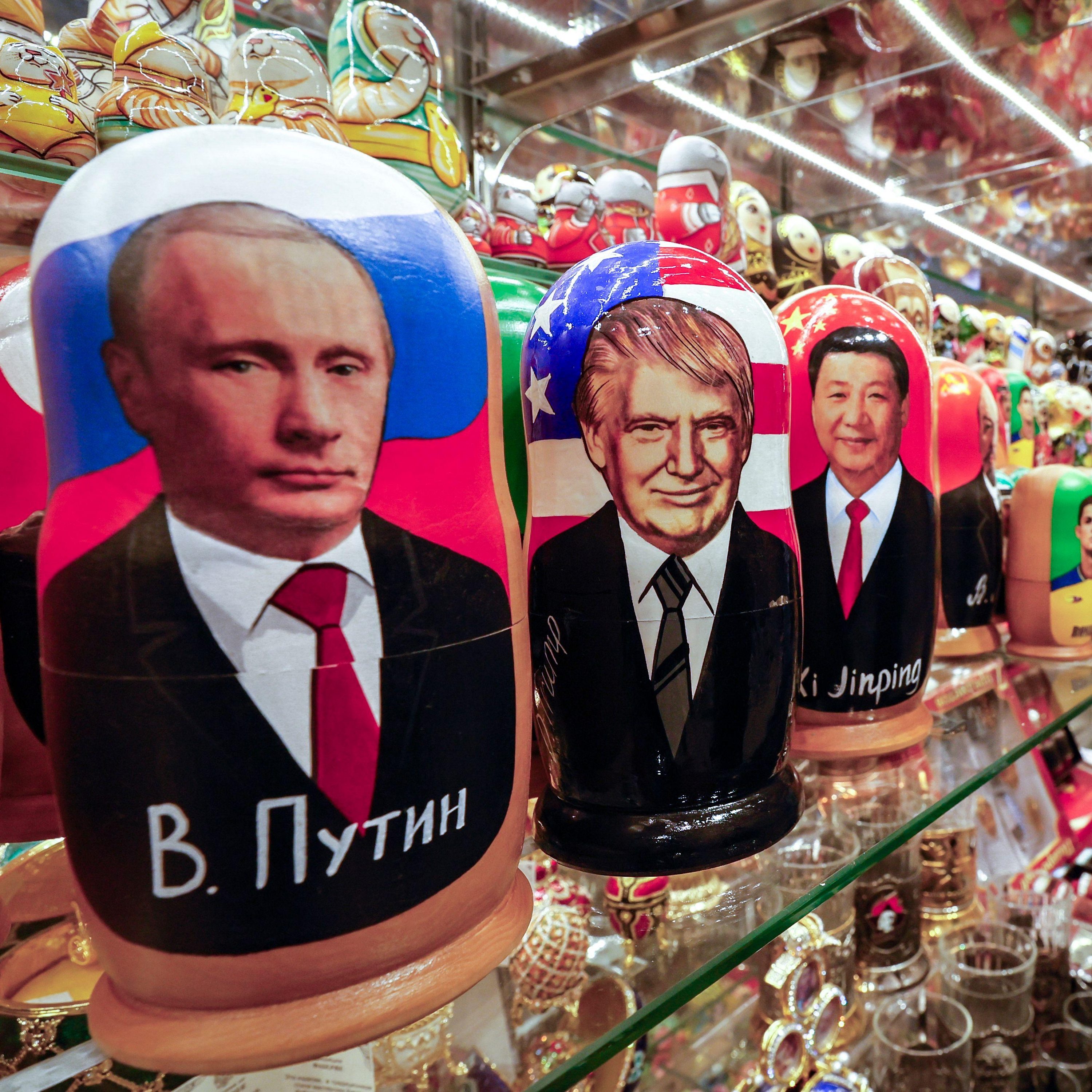
This BBC podcast is supported by ads outside the UK. If journalism is the first draft of history, what happens if that draft is flawed? In 1999, four Russian apartment buildings were bombed, hundreds killed. But even now, we still don't know for sure who did it. It's a mystery that sparked chilling theories. I'm Helena Merriman, and in a new BBC series, I'm talking to the reporters who first covered this story. What did they miss the first time? The history bureau, Putin and the apartment bombs. Listen on BBC.com or wherever you get your podcasts. Hey there, I'm Asma Khalid. And I'm Tristan Redman, and we're here with a bonus episode for you from the Global Story podcast. Every day, we focus on one story, looking at how America and the world shape each other. So we hope you enjoy this episode and to find more of our show, just search for the Global Story, wherever you get your BBC podcast. The world order, as we've known it, is being upended. Great powers and strong men are trying to use their muscle in might to expand territory. And there's no better man to help us make sense of these tectonic shifts than the BBC's international editor Jeremy Bowen. The world has changed so much that it's going to be very difficult. For a couple of strong leaders to impose their will on everybody, the danger is that little crises can become big crises and suddenly things start slipping out of control. One of the things that would stop you'd hope things slipping out of control is some kind of rules based system. From the BBC, I'm Tristan Redman in London and I must my Khalid in Washington, DC. And today on the Global Story, the post World War II era is over. What comes next? Could you introduce yourself, please? I'm Jeremy Bowen. I'm the international editor of BBC news. Thank you for joining us. Good to be back. So all this week we've been talking about spheres of influence around the world. We've looked at the American, the Chinese, the Russian spheres of influence and we've looked at how they've been vying for influence in Africa. Today, we're going to try and patch it all together as well as looking at parts of the world that we haven't talked about yet. So I wanted to just go back in time a little bit and set up where the idea of a rules based international order came from. So last weekend, Jeremy, I found myself listening to a speech by Winston Churchill. This is not normally the sort of thing I do on the Saturday. But my daughter picked up a book about Churchill and read it. She's 11 and when she finished reading it, she saw this vinyl record that I had, which was a vinyl record of Churchill speeches that I was given by my mother-in-law. And we ended up listening to this speech. He gave in 1943 to Harvard University about the way he saw the world after the Second World War. The people of the United States cannot in state world responsibility. We have now reached a point in the journey where there can be no pause. We must go on. It must be world anarchy or world order. Basically, he said the United States has a responsibility to operate in the world. It cannot withdraw from the world. We have learned from hard experience that stronger, more efficient, more rigorous, world institutions must be created to preserve peace and to for store the coordinates of future world. If there was going to be peace after the Second World War, there needed to be something that he called a world council. So I guess something resembling the UN Security Council. And then after the war, the Truman Doctrine happened. And it just so happens that this week is the 80th anniversary of the beginning of the UN Security Council. So Jeremy, what do you make of that ambition to create this kind of international rules-based world order? Was it an admirable thing or was it misguided? It was, of course, admirable after the horrors of the Second World War. And indeed, the horrors of the first half of the 20th century to try to find a better way. There had been a failure after the First World War. There was an international organization called the League of Nations that never really worked. So after the World War II so much had changed, the United States had become a world power, a world military power, an industrial power. The old European powers were broken, Britain included. And when Churchill was speaking in a speech you referenced. His whole strategy in the Second World War, apart from just fighting on, was trying to get the Americans as engaged as possible. So, yeah, they were rules because awful things had happened. And they brought in things like the genocide convention and a lot of the fabric of international law that we might recognize now. But naturally, there were other things going on. States do things not out of charity. They do things because it benefits them. And the feeling was that some sort of apparatus of Western security with America leading it would benefit America in terms of getting some stability and a continent that would be terribly unstable in providing new markets as well for the Americans. And as the relations between the West and the Soviet Union rapidly deteriorated after the Second World War and the Cold War kicked in and started going, there was a sense that they had to get together to stop what was seen by some at the time as the inexorable rise of communism and Soviet power. So by 1947, Britain was bankrupt and Britain sent a message to the Americans saying we can't do what we would like to do. Ben got the money. So the then president of the United States, Harry Truman, decided that America had to formalize its global post-war role. What he came up with, the Truman doctrine, which was an idea that America would intervene in conflicts to protect people and also in their own interests. And really it was about resisting Soviet communism. And out of the Truman doctrine came the Marshall Plan to rebuild Europe. And out of that to came in 1949, the North Atlantic Treaty, which was the foundation of NATO, North Atlantic Treaty organization. Those things allied with the other conventions, genocide, human rights rights of the child and so that came in. All of those things shaped the way that they thought the post-war world might go. And for a while in different places, it did work actually in some ways. But now many years later, things have changed. This new world order that was created in the aftermath of World War II, complete with some of these large-scale global institutions. If we look at something like NATO, you mentioned a major, the largest national security alliance. These were created in the aftermath of the war. And whether or not they were done with, you could say, altruistic intentions are not, is debatable. But nonetheless, there was a lot. I don't think nations are altruistic. I think they're self-interested. I'm a realist in these things. Yes. Not everybody is, but I am. Nonetheless, though, regardless of their intentions, there was broadly this direct line between the Truman doctrine after World War II. I would say, maybe with some ebbs and flows, but up until Biden's foreign policy during the last US administration, you have written this really thought-provoking analysis piece, I would say, on the BBC website, where you talk about whether Donald Trump now is creating a new world order. And so I want to dig into that in a little bit more depth. You have been reporting for the BBC for what is it for four decades? Is that right, Jeremy? Uh, something like that, yeah. Yeah. I'm losing count. You've seen, nonetheless, where this doctrine has worked and where perhaps it has it worked. So let's begin with that. Is there a story where the rules-based order that was created after World War II worked as it was intended to function? Well, first, let me say that from the outset, the idea of this rules-based order, not everybody accepted it was going to be a great idea. As European empires decolonized in the 50s and 60s into the 70s, countries became independent. They didn't necessarily want to be told what to do by the old colonial powers, plus the United States and the other superpowers, Soviet Union, or whatever. There was something called the non-aligned movement in that period where countries said, we're not going to be part of the East or the West. We're going to try and do things for ourselves. But yes, it's certainly in terms of the security of Western countries. And you asked for a specific example. Now, this isn't actually about European security. At the time, it was something about global security. And that was the invasion of Kuwait by Iraq. On the morning of August 2nd, thousands of people in Kuwait City woke up to war. By Saddam Hussein, the authoritarian leader, the dictator of Iraq in the summer of 1990, August of 1990. The invasion by 100,000 Iraqi troops backed by air cover and tanks was brutally efficient. The first to go for, yes, first Gulf War. Iraq wants control of Kuwait's territory, its oil, and the money that comes with it. Kuwait, major, of course, oil producing country and at the time, the United States and the West very much depended on oil coming from the Arabian Gulf. And as a fairly young reporter, I was part of the BBC reporting of that. I went to Saudi Arabia just after the invasion of Kuwait in August of 1990. On the road to the border through the sandstorms, American convoys are bringing more men and more equipment to confront the armies of Saddam Hussein. Drove up to the border with Kuwait. This is where the Americans say they've drawn a line in the sand against Iraqi aggression. The Americans have started deploying troops to Saudi Arabia. There was an enormous military buildup. The Saudi intelligence told us that the Iraqis are dug in about 25 miles inside Kuwait. I think when you say did this work, the system worked, I think, because the then president, George H. W. Bush, went to the United Nations. Just two hours ago, Allied Air Forces began an attack on military targets in Iraq and Kuwait. If ever there was a rules-based order guy, it was probably the first President Bush. This military action, taken in accord with the United Nations resolutions, and with the consent of the United States Congress, follows months of constant and virtually endless diplomatic activity. And he did it all through various UN resolutions and the UN resolutions passed and they were enforceable resolutions. The President Bush took really big steps to deploy a vast army with a lot of help from allies to the Gulf area, particularly to Saudi Arabia. But he did it with the authorization of United Nations resolutions, so there was international legality on its side. And the state of justification for this intervention was that it was not acceptable that Iraq tried to annex territory of a neighboring country. Under the UN Charter, the only justifications for legal military action are self-defense, one. If a country is invited by a state to fight for them, that would be one. And also, if there is authorization through a resolution through the Security Council. So there has to be one of these Chapter 7 resolutions that is voted through that can authorize the legal use of military force and they got one of those through. And that's how they did it. We begin with news of the attack, Jeremy Bowen of the BBC reports now. I was in Baghdad as the Americans were pushing up through Kuwait and they got into Iraq as well. The air aid started just before midnight and continued for almost five hours. Up to 20 large explosions were heard in Central Baghdad. We're shaken by a number of the attacks. And certainly the Iraqis of the Saddam Hussein regime, they really believed it was going to happen. And try to overthrow you're saying the Saddam regime at that time. Yeah, well, they thought their days were numbered. But then one morning I was woken up by gunfire. Suddenly, in the hotel where we were all staying, the hotel Rashid, and I thought, "My God, the Americans are here. Must be, must be the Americans." And then I listened more and I thought, "No, hang on, it's small arms fire. It's nothing heavy. It's no tanks, there's no mortar. It's not a fight, it's not a battle." This feels like celebratory gunfire. So I got out of my bed. I went to the window and I had a look outside. I could see Iraqis in the courtyard and down in the garden firing their Kalashnikovs. Hundreds and hundreds of rounds into the air. So of course a gold dress went down. What had happened was that the Americans and the Iraqis and the coalition actually led by America had done a quick negotiation and there was a ceasefire. Kuwait is liberated. Iraq's army is defeated. Our military objectives are met. Kuwait is once more in the hands of Kuwaitis in control of their own destiny. They could not believe that the American led forces had stopped. The justification they gave was that they only had authorization to go as far as they went. They also realized that they had authorization from the UN. It was more complicated than that. Of course, but also they didn't have a resolution to say you can remove the government of Iraq. They had a resolution saying you can remove Iraqi troops from Kuwait. But in a sense, in that case you could say the system worked. By contrast, what would you say was an example of a story that you've reported on where the so-called International Rules Base order didn't work? Well, there have been numbers of examples where it didn't work. For example, let's just get on to the next Gulf War 2003 when another American led coalition removed Saddam Hussein and opened up a Pandora's box of killing and violence, catastrophic consequences over a couple of decades. They still feel the consequences of that invasion, one of which was the rise of Jihadi groups, which in the end morphed into Islamic State, ISIS. But one of the big issues about that invasion was they couldn't get a second UN resolution authorizing specific action. Because famously the French veto did, right? The French were against it. This was the period when in the US capital, French fries were renamed freedom fries, because that was very good way of getting back at the French for being, you know, such what they used to say at the time. Oh, cheesy eating surrender monkeys or cheesy eating surrender monkeys. Yeah, so they couldn't get the same sort of consensus that George Bush senior had, but they went ahead anyway. And not long after that, the UN Secretary General Kofi and I said, well, yeah, they broke international law. This is an illegal invasion. He said that in the BBC interviews, but it was a year or two afterwards. But that was a situation very much where the system didn't work. I'm more recently, of course, the war in Gaza has been it's looking very much to be a textbook case in the way that international laws have been violated by all parties. Can I pause a bit because here we are having this conversation about the breakdown of the way the rules were intended to work for decades. And yet we're talking about two decades ago that the US invaded Iraq was already breaking down at that point. I don't think the system has ever functioned perfectly. There's almost never been a point when it didn't function at times really quite badly. International laws have been quite widely broken, especially by the most powerful countries in the world repeatedly since the Second World War. And the criticism of the idea of a rules-based international order is that they're Western rules and they're Western rules which are normally applied to adversaries of the West. And they are applied in either half-hearted or not applied at all way to the friends of the West. So it's very imperfect. But I think what is changing right now is that Donald Trump doesn't even pay lip service to it. So it's every sign of wanting to sweep it all away. There's a counterpoint to the examples that you gave replaces that would seem to prove that the international rules-based order hasn't worked. So the Second World War in Gaza, there are people who might say that those two wars, those two conflicts are examples of why it's right to try and pursue a rules-based international order. Because, for example, if George W. Bush had listened to the United Nations when it refused to give a resolution approving the war, then maybe the war wouldn't have happened and maybe hundreds of thousands of lives might have been saved. And there are other people who might say that the quote-unquote rules-based international order tried to intervene in Gaza. So, for example, the International Criminal Court has indicted individuals, including Benjamin Netanyahu in the leadership of Hamas, for alleged crimes committed in Gaza and on October the 7th. The International Court of Justice has attempted to intervene as well. What would be your response to that? I think those are all fair points. There's no doubt about it. I think that what these international rules over the years, inter-humanitarian law, war crimes laws, Geneva conventions, the UN Charter, all those sorts of things, they provide a template against which you can measure the severity of a story. It's not simply saying, well, this is awful, all these people are dying, but getting to something a little bit more forensic where you can say, for example, well, you shouldn't blow up hospitals, but if someone sets up a firing position on the top of the hospital, then you're perfectly entitled to destroy that firing position and if the hospital gets damaged as well, there's not an illegal act. That structure of laws and customs, it is a way of trying to hold states and hold leaders to account. But yeah, its look has never worked perfectly well, but I think the question you also have to ask is, if you don't have it, what do you have? I'm Helena Maryman, and in a new BBC series, I'm talking to the reporters who first covered this story. The history bureau Putin and the apartment bombs. Well, what do we talk for a moment, Jeremy, then about what is the alternative and what we're witnessing right now from President Trump. He has outlined this self-described done road doctrine. He wants to focus more. He says on the Western hemisphere, and it seems that he believes in almost going back in time to this era of empires, kind of carving out the world into these different spheres of influence. It strikes me that maybe that's not possible in the year 2026 to do ever so neatly. I mean, all this week we've been looking at this story, and yet there are large swaths of the globe that we haven't talked about. I mean, where does Iran, where does India, where does Europe fit into this suggested new paradigm? The reason why I think the idea of returning to the way things were back at the end of the 19th century, when there were spheres of influence, very much so, the way it doesn't work in the modern world is because the world has changed. When European countries, the French, the British, were carving up Africa and different parts of the world between them, they were dealing with countries that in the main were not developed. There were elites, they were probably kings and people who inherited their massive wealth, and that the vast majority of people lived very hard lives and weren't very well educated if at all. Things are massively different now. You look at the incredible transformations in India. I mean, that's one good example. It's the, you know, the jewel and the crown as they were saved the British Empire. Now India is a rising power with more than a billion people, and undoubtedly is going to be stronger and bigger power as it continues to develop. And they don't want to be part of anyone's sphere of influence. They want to have their own sphere of influence. The world has changed so much that it's going to be very difficult for a couple of strong leaders to impose their will on everybody. Jeremy from Europe, and I'm particularly curious, both you and Tristan are joining us from London. And we haven't talked at all about how Europe fits into this. That's because Europe is feeling like we're bystanders, that we're watching things which we can't control anymore. Security wise, they have been freeloading off the backs of Americans for a long time. The Americans paid the money because they felt it was in their interests. Trump doesn't feel it's in the US interests or his interests, so he doesn't want to pay the money. That's one thing that has changed because that consensus that American security meant European security has gone. Where does it all go for you, Jeremy? Asmon, I have had quite animated conversations about whether it's a given that this ends in more chaos or maybe stability. What's your take? Well, I hate to say it. I'm on the chaos side. Having been a foreign correspondent for the BBC for most of my adult life. And I have been to many, many wars as a reporter and seen hopes risen and hopes dashed. I think this is a really worrying time. I think we are absolutely right to worry about the stability of the world. Look up. The way the world is, the number of places that are on fire, the number of places where conflicts aren't just not being resolved, they're getting worse. I've spent a lot of time over the years with the Arab Israeli conflict. It's in a terribly dangerous place right now. It's going to end well. And I don't see where the positivity is in that. And I think more widely around the world, there are so many unanswered questions. Perhaps is how the Americans and the Chinese sought out their relationship. If they can achieve some degree of strategic economic military stability between them. And maybe the answer is that the Americans say, look, this is our half of the world and we'll try and do what we can here and that's your half of the world. Maybe that's an answer, but China's a rising power. It's getting stronger. And America is still massively powerful militarily and economically, but history says that empires and superpowers don't last forever. I look with great interest on the next decade or two and some fair degree of trepidation because I think the danger is that the crisis can become big crises and suddenly things start slipping out of control. One of the things that would stop, you'd hope, things slipping out of control is some kind of rules-based system. If you like little interruptors along the way, people are using this phrase guardrails these days. I don't quite know what it means. Certainly, if there's a shape of rules and customs that people at least can be held to account if they don't follow them, in a way you know where you are. But if it's quite a chaotic, might as right atmosphere happening in the world, what it guarantees a great deal of work for people like me, but frankly, a lot of worry for anyone who wants to live a peaceful life. Thank you so much for sharing your insights. We really appreciate it. Not at all. Thank you, Jerry. That was the BBC's International Editor, Jeremy Bowen. And that's it for the global story today. By the way, if you want to catch up on the latest news from around the world, then we recommend checking out the BBC's global news podcast. You can find it wherever you listen to your favourite shows. Please send us your thoughts and ideas by emailing us. Our address is the
[email protected] and please rate us wherever you're listening. It helps others find us. And we want you to know that even if we can't respond to all the emails, we definitely read them. They don't go into a black hole. So let's share a few from this week. Surely in Toronto got in touch to say she was very interested in the idea that the world has seen the US take the Venezuelan president and ask what could this mean in the future for Taiwan if China ever decides to invade. Now, Asma doesn't want me to read this email out because she thinks we shouldn't share pure praise, but I'm going to do it anyway. Bonnie, formally of the World Bank got in touch about the series we've been broadcasting this week. And she said, what a thoroughly excellent series. Having listened to only two episodes so far, I'm greatly enlightened. Thank you. So thank you, Bonnie. That was a very lovely message, but I am clearly a bit uncomfortable with always accepting praise. Let me move on to Richard from the University of Virginia. Thank you. You got in touch with a light correction for us. Yes, thank you, Richard. So we said in our episode early this week with Anthony Zürker that in the early 19th century, the US didn't have sufficient military muscle to ensure the Monroe doctrine when it was first enacted. And as Richard pointed out, he said that the Monroe doctrine was actually enforced by the Royal Navy of Great Britain, not as a formal endorser of the Monroe doctrine, but actually as a day facto enforcer because US and UK interests aligned at that moment in history. So thank you very much indeed for that Richard. Our episode today was produced by Kat Fardsworth and Sandra Ellen and it was mixed by Travis Evans. Our studio manager was Ben Andrews and our senior news editor is China Collins. Thanks as always for tuning in and we'll talk to you again on Monday. I'm Helena Merriman and in a new BBC series, I'm talking to the reporters who first covered this story. Listen on BBC.com or wherever you get your podcasts.
 PodcastTranscript AI