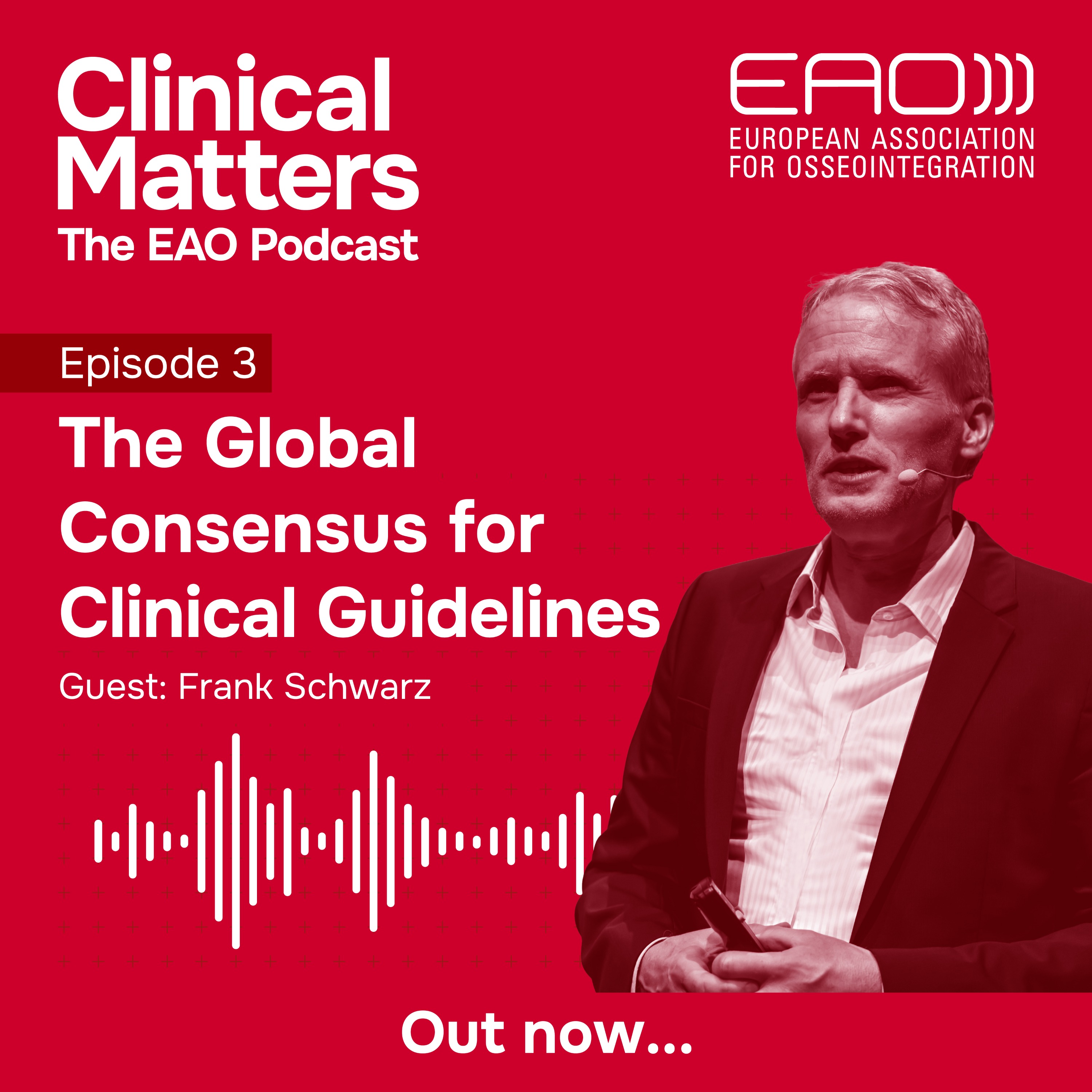
The Global Consensus for Clinical Guidelines with Frank Schwarz
from Clinical Matters: The EAO Podcast
30m 27s
This episode of the Clinical Matters podcast features an interview with Frank Schwartz, a lead scientist in the recent consensus conference that developed new guidelines for managing the edentulous maxilla. The conference introduced a novel methodology, the Global Consensus for Clinical Guidelines (GCCG), designed to address the frequent lack of strong scientific evidence in implant dentistry. Instead of relying solely on traditional voting among experts, the GCCG integrated structured surveys from over 200 global clinicians and, uniquely, incorporated patient perspectives to capture real-world practices and preferences. This evidence was then combined with available literature to create practical recommendations, even in areas with limited research, such as the use of short implants or CBCT scans.
The resulting guidelines, published as an open-access supplement, provide clinicians with clear decision trees to guide patient selection, diagnosis, treatment planning, and maintenance. A significant achievement is the establishment of a core outcome set (COS) that distinguishes patient-reported outcomes (PROs), like satisfaction and decision regret, from clinician-reported outcomes (CROs), such as aesthetic assessments. The discussion emphasizes that these tools are meant to refine clinical routines through shared decision-making and retrospective case evaluation, ultimately aiming to standardize and improve care for complex edentulous cases globally.
[Music] You're listening to the Clinical Matters podcast with Lucas Furozor and me Nikol Vynitsky. Very welcome to our latest episode. Yes, welcome to Clinical Matters. It's brought to you by the European Association for Osteonigration, the ELO. A community of the leading scientific minds in the implant and industry. Clinical Matters is all about celebrating the exciting developments in implant and industry. Each episode we bring you an amazing guest to discuss their research and latest thinking in their fields and most importantly to support us all in our daily practices. Our topic today is the guidelines following the brand new consensus conference about the Edentialism Exile. We have a wonderful guest today. It's Frank Swartz. He was the leading scientist of the recent consensus conference. Frank Swartz is one of the leading voices worldwide in implant and industry with numerous of scientific publications and international awards. He's truly one of the key figures shaping the evidence-based implant and industry today. Frank, we are really honored that you're here. Thank you for having me here. Thank you. Great. Wormly welcome and let's get into it. Yes. So Frank, very welcome to Clinical Matters. We would like to start the questions to you by talking a little bit about the consensus conference by describing what is the consensus conference and why do we have them. Well, that's a very good question because consensus conferences are all over the place and we wanted to define something new unique. So Frank, could you please explain what the GCCG is? So GCCG is an acronym for Global Consensus for Clinical Guidelines. And this is an umbrella term for a unique methodology that we of course are going to discuss here. Okay. And when you work with it, how is the work being done? So what is your feeling when you see a consensus conference? How do you feel about the consensus conference? What do you expect from a consensus? First, I look at what is happening during the consensus conference. And then I see a lot of people sitting around the table. Oh, yes. And discussing different kind of topics and one person thinks this and one person thinks that. And in the end, you do some kind of voting. This is just what's in my head now. You do some kind of voting and you come up with the numbers that's X amount or percent things that this is the way we should go forward in this specific topic that we're discussing. Yes, that's a consensus conference. Yeah, you got people. They all have very different opinions and these opinions are being consented in a structured way. But this is exactly how it shouldn't be. Because we don't want to gather opinions. We want to base the opinions on evidence. So a consensus is not necessarily a fundamental basis for a guideline. And here we approached a mechanism to come up with a guideline. So how do you get the scientific base in there? The scientific base is of course a literature search, a literature review. But we are talking about a very, very important clinical indication. And by the way, that the Edentious Maxilla is really a demanding scenario. And we would assume that for such a demanding scenario, after all these years of doing research in the implant industry, we would have a bunch of literature. But this is not a case. This is not a case. So how many of the situations today? I know you can't probably answer exactly. But how many of the situations do we not have any research to base our decisions on? Is it 50 percent or is it? It is hard to define by a percentage. But of course, and this is one of the core aims of this consensus-based guideline that we establish recommendations based on the clinical workflow. Yeah, what the diagnosis or patient selection diagnosis, treatment planning, treatment execution, complications and maintenance. So this is the full workflow. And when you try to identify the true evidence for specific clinical steps, you would be surprised to see that we don't have it. And in which field do you think we have the best evidence-based literature and in which not of these topics, different topics? Yeah. So we have quite good understanding on how many implants we need for a removable or a fixed stancher. But when it comes to tiny little details such as the diameter or the length of implants, short de implants, it is not that obvious. Yeah, so that means in such a scenario, we have to rely on the expert, not opinion, but the expert experience. And a good guideline always combines the two components, the evidence and the best available evidence, and this is the expert opinion experience. Very interesting. And what else was coming into this consensus conference? Because it's a new way of thinking or doing a consensus conference. What could you tell us about that? So the methodology has completely changed. So we have changed it in a complete way. And this is the first time it's done in the way it's done now. Exactly. Because for the adventurous Moxilla, we know it beforehand that we are running into a lack of evidence in the lack of existing literature. And that's why we define a new way to approach such a scenario, to avoid it at the very end, become to conclusion such as we don't know, and we cannot make a recommendation. And this is what you see in many consensus conferences as a conclusion. There are not sufficient data to make a sound conclusion. And then we don't have anything to go back. And then you don't have anything to think about the practitioner looking at such a recommendation on Monday morning. Yeah, we don't have the evidence to guide you through a difficult case. So how did you do it this time to gather some more substance to build the representation? The approach was different. So the approach was that we have invited experts, also of course from the EAR own network, worldwide, also a global approach, by structured surveys. So we have predefined questions for the different workflows that we have just briefly summarized. And we asked specific questions. How do you do this? How do you do that? Do you use short implants for the eventualist Maxilla? And so on. So there are many structured survey questions. And we got a clear picture, but the people our colleagues are doing in real life. So that was the bottom line. And how many were answering the survey? Well, those that have been involved, they all answered. Yeah, but how many were involved? Okay, we are talking about about 200 experts per survey. So we had her area. Per area. So we had four different surveys. Plus, and this is the addition, patience and stakeholders. So that have a completely different perspective. So this is the first time you actually bring the patient into the equation, and also listen to them. At least the patient took an active part. Because patients were also involved in these surveys to provide their view on treatment choices and experiences. And how were the patients picked? And where did they come from? So worldwide or or yeah, look, as this is exactly when such a project runs into, I would say, technical and logistic problems. And I would say problems, but challenges. And this is what we had to master. And at the end, we had a global, let's say, a global perspective also from the patient's view. So patients from all continents, from all, I would say, major regions where we have, of course, the aim to spread and to disseminate the results. We have a picture of what Lucas is doing, what I'm doing. And on this basis, we have now to evaluate if this is consistent with the available evidence. So for some of these procedures and areas, we have, of course, evidence. And for others, maybe not. Or in the verse case scenario, the survey, the experts are proposing things that are even contradictory to the existing literature. So that was a funny part. Yes, that's exciting. So how do you deal with that?
Well, sometimes we were quite easily able to match the survey results with the existing literature. So, an easy one. It's a number of things. So, this is very well established. But the recommendation to use, for instance, a CPCT for the Adventurous Maxilla, this is likely what you feel, what I feel. But which is hard to demonstrate. So what does the true benefit of a CPCT scientifically for the patient? And this is where, of course, we have to define an area that is not supported or where no data are available, and where the expert opinions on site in Boston and the group work came along to say, "Well, this is an obvious, I would say, a no-prayner for the Adventurous Maxilla, a CPCT has so many advantages." But we don't have arseities that prove any, let's say, safety or any effectiveness of an additional CPCT. So, that was the unique scheme. And at the end, we could also identify areas for future research. I just want to continue on that, because if you then have some consensus from the clinicians or the experts, and then you also have the science, and they are, like you said before, they contradict to each other. How do you deal with that? What kind of recommendation comes out from a scenario like that? Do you want experts on the research, how do you mix them together? Well, this is again the beauty of a consensus. We have a discussion, so we had 105 people on site from different disciplines. Let's put probing on the table, yeah, for probing implants. The pedantist would of course say, "Yes, without any discussion." But there are other disciplines, they are a little bit more careful. And what comes out of a discussion is at the end, the true core, the DNA of such a guideline. You get a concentrated opinion, which is ideally based on evidence. And what should we do today with the probing? Yeah, with the probing. You should have a look at the recommendations of probing is essential, but likely not in each and every case. When it's obvious that the implant, the tissues are healthy. So we always have this risk that you can also compromise a little bit, very implant seal and so on. I would say it's always a case-to-case definition, of it's, but of course the majority of the recommendation goes towards probing is a key. I wanted to ask about, because I think it's really important who is, who the consensus people are. Do you, is it one third surgeons, one third prostitutes, and periodontists, or how is it, and also from different countries? Is it, do you do it so that it's the same kind of amount of people or how does it work? Yeah, that was the global approach. So we envisioned that at the very end, the consensus should be disseminated in each and every corner of this world. So we took care right from the beginning that we engaged the most impactful or powerful societies, but also foundations in order to get the message out in the second step. And the second step comes after the publication of these 20 papers supplement in clinical over-implants research, where we translate these core recommendations into clinical procedures. And this is the second wave of publications. It's really great. We have the new guidelines of the big consensus conference out now, and where do our clinicians and we get access to it? So the guidelines are published as a supplement to the clinical over-implants research journal. You will find them on Wilei, the core homepage. It's open access so you can download the entire supplement for free without having a subscription. And as an EO board or EO member, you have access anyhow. And you will find, of course, a link on the EO website. So Frank, we touched a little bit upon the outcome measurements, the prompts and the roles and the clean roles. They're very strange words. Please explain what they mean and why we use them. Yeah, it's quite confusing. And again, it sounds very academic. But this is something that is the fundamental basis for this shared decision making. Shared decision making is at the beginning, you define with the patient what you want to achieve. And by the way, you have touched clean role, clean ROM. So M always stands for assessment for measurement. So a PASS is a clean ROM in that sense, a quite objective one. A clean role would be a static outcome. So what is the aesthetic outcome? PASS is one measure to define the outcome. This is for our clinical scenario, very well established. We have so many of these outcome measures. But for patients, it's not that well established. The very catchy one is, for instance, a decision-recred score. You can, by the way, also use for your private life. Very interesting. So do your regret a decision. It's a very simple one. I don't know. It's very effective. It's very effective. You come to a yes or a two, no. And not the score from zero to nine. So do your regret that you have received implants. And this is a typical outcome, not a measure, an outcome for patients. And now you always have to go where the patient is. So better don't try to bring the patient to the past level. Rather go down to the decision-recred score. Are you, Lucas, happy with the implant-supported restoration? And is the patient happy? And all of a sudden, you both speak the same language. So to clarify, froms, we talk about patient-related outcome measures. Patient-related outcomes? Outcomes? Because this is what the patient can tell you. Right in the chair. Otherwise he has to score it. He can say, I'm happier or I'm not happy. And there are outcomes that make it even a little bit more precise. And then you call it pro. Then you call it pro. And then you have clean road. Is the clinicians related outcomes? Yes. This is an outcome that makes you happy or that it is for your own judgment, but which is not necessarily understood by the patient. Great. Great. So I think we clarified that, which is really important before we continue with the next part. And we did surveys as well for this to establish a core outcome set. We call it COS, 40-identulous maxilla. So we have, based on the expert survey results, we did a three-round delphy survey. So we could establish identify outcomes, pros and clean rows that are essential. I wouldn't say mandatory, but essential for the dentulous maxilla in each and every step of the workflow. Again, patient selection, diagnostics, treatment planning, execution, complications and maintenance. This is one of the main achievements that we have now, a list of outcomes on the very catchy table. And you can really use it for your daily work. So when we come to daily practice, this is maybe a very important part for our clinicians because they want to use these guidelines for a decision-crease. So a patient is coming in and our clinic with an dentulous maxilla. How we can shape our decision-crease with the guidelines. So a lot of time, a lot of time, went into the establishment of decision-crease. And you would see in this umbrella paper, we have very catchy decision-crease, very nicely illustrated and simplified. So they bring all these heavy recommendations. Sometimes a recommendation is, I wouldn't say one picture, but half of a page. A lot of text inside, which you cannot capture. And we bring it down to a very simple box. And this box is within a decision-crease. So you start with the patient. You see this patient for the first time. And let's make this example.
the patient are you satisfied with your existing tension? So it's not you who make the decision that he needs implants, you're asked the patient, are you happy? And if the patient says, "I'm completely unhappy, I cannot eat, there is no stability," then there is a common ground that you start with, I would say, the option to use implants. But if the patient is completely happy and you cannot even understand why he's happy with the danger, leave it because he's not in the mood to receive implants, so he would always be opposing whatever you do. And this is very simple but a fundamental or fundamentally important first step. Don't fix what's not broken. Yes. Yes. Let's put it that way. Yeah, you cannot push a patient in a direction where he doesn't want to be. And what are the key factors in selecting the patients in implant therapy in the dental is mixellum? Well, you know it much better, there are so many components and atomic factors. Of course, medical risk factors. So there are so many tiny little factors at the beginning and these are all sorted out in this decision tree. Yeah, you can really easily follow step by step that guides you through the patient's election. You look at the availability of bone, anterior, posterior. We have different scenarios and these different scenarios guide you in different directions. So what I need to do to use the guidelines is to identify what patient I have in front of me and follow the decision tree and say, "My patient is on this point in this decision tree and the next point and the third point." Exactly. And then I come down to some kind of decision where it says, "For this patient, the best treatment according to the guidelines is. " Yes. Is that right? Patient's election guides you into, is there an indication for a conventional over-danger because this is also part of this guideline and implant support that fixed or an implant supported, removable, tension. So this is, let's say, the bottom line for the first phase of the decision tree, patient's election. With that decision, you move to the next step of the workflow. Which is treatment planning or diagnosis. Yeah. Okay. And then the diagnosis component, we, of course, we go into each and every detail because these scenarios are rather complex. And it's, especially for the diagnostics and the treatment planning, is there something different now because we are living in a digital world in a digital dentistry. Is this coming in in the treatment planning now? Oh, yes. Oh, yes. There is no escape. There is no escape. Now it's the time to go the digital way because we have, of course, we always consider conventional approaches. We see in so many areas that the digital workflow just provides advantages. So I think if we should try to conclude what we've been talking about, we will be able to get help within the areas of patient selection, diagnostics, x-ray imaging, treatment planning, the procedure, complication management, and maintenance. So, the combination of tissue crafting is all in good. Yeah. So all of the comprehensive treatments that we can think of will be in so many restorative aspects. So this is really something amazing that needs to be known to all the conditions working out there. Yeah. So we want to encourage everyone to keep their eyes open for the clinical guidelines to be out there. And especially for the decision trees. Yeah. And how do you see the clinical guidelines being used? Imagine me working in the clinic with five private clinic with five other dentists in Stockholm. Do we start up with a meeting where we go through the guidelines and talk about what they say or do, how do you see the work on the clinic? It's a very good question. I would encourage you to follow the guideline retrospectively for patients that you have treated to look what you actually did in the past and what the guideline recommends. To see? To see? To like, acclimate myself in relation to the guidelines. Because you always have to understand you have your own routine. And the guideline should help you to change at least not your complete routine, but at least some aspects. Yeah. Some fine tunes, some small details here and there. Otherwise, you would stay in your routine and you just pick up tiny little details where you think that could make your work flow even better. But try to to to set it from the top to the bottom. Look at your cases, bring them in line or try to to to bring them over the guideline and see what you maybe missed or maybe did wrong in a way that it was not optimal. Yeah. And if you learn how to apply a guideline, I think in a much better way. I think that sounds really great. I think in about a year or so, maybe we should have a follow-up podcast and we should talk about how we or maybe get implemented this in our daily clinical life and how it works. And this will be part of the second wave of publications because we will do exactly additional surveys with experts asking exactly this question. How does the guideline change your way of of treating or selecting patients? This is a really fantastic tool. Now you're on the list. Great. We'll do that. Yeah. All right. Frank, thank you so much for coming here and sharing the knowledge and sharing all this information about the clinical guidelines. Yeah. Really. It was really cool. Thank you so much. Really. Yeah. We'll help our practitioners also. If you would give three takeaways from the discussion we've had now to the clinician out there, what would that be? So the first is definitely evidence-based approaches. Yeah. We are living in times where we cannot just make decisions based on what we think. Many people act based on what they think. We should act based on what we know. And this is the pure thing. Very important. The second is engage the patient early on. At the end, you treat the patient and the patient needs to be happy. Yeah. And you're doing this for the sake of the patient, not for yourself. Only for the patient. Yeah. And the third is, of course, try to rethink each and every step that you do because you cannot follow the same procedure for half of your life as a dentist. You have to change. And you have to adapt. And this is something that the guideline also supports. And before the guideline is, or after the guideline is again, before the next guideline. And the next one is already set because we have asked the experts on site, but would be your favorite second topic. And we envision many more to come. And it's not the adventurous mandible. What is it? Give it to us. Yes. It's a static zone. Yes. Yes. It was more relevant to the delegate stand the adventurous mandible. So that will be the next one, which will hopefully be completed by 2027. Very exciting. So in 2027, we're doing a next seven. Yeah. On the next topic. On the next topic. On the next topic. We will meet Frank earlier. Yeah, maybe. Maybe. Do you allow me one final question to you? Please. So, yeah. And now I really challenge you. Shoot. Yeah. Because the acronym for the global consensus for clinical guidelines is GCCG. And now both of you try to say GCCG very fast. GCCG was once see too much. What? Once or several times. No, no. GCCG. Wow. Wow. You're natural professional podcast. Natural talent. Because this is very hard to pronounce GCCG. This is how it easily happens. And this is the only thing that we have to find you because this is really challenging. Yeah. So that's acronym. So let's. But you did it perfectly. You did it perfectly. Thank you so much. Thank you. Thank you. We love having you. Being on the show is my pleasure. Thank you. Take care. Thank you. Thank you all listeners out there for joining us on clinical matters. It's been a pleasure having you here. Join us next time for more great insights and tips. Also help you deliver excellent care for your patients.
And keep doing the great work that you do. And in the meantime, please do follow, rate and review the podcast. It really helps others to find it. See you next time. Bye for now. See you next time.
Podcast Summary
Key Points:
The podcast discusses new clinical guidelines for treating edentulous maxilla, developed through a novel consensus methodology called Global Consensus for Clinical Guidelines (GCCG).
The GCCG approach uniquely combines structured expert surveys (including input from over 200 clinicians and patients worldwide) with existing scientific evidence to form recommendations, especially in areas lacking strong research.
Key outcomes include decision trees for daily practice, a core outcome set (COS) distinguishing patient-reported outcomes (PROs) from clinician-reported outcomes (CROs), and open-access publications to aid clinicians in diagnosis, treatment planning, and maintenance.
Summary:
This episode of the Clinical Matters podcast features an interview with Frank Schwartz, a lead scientist in the recent consensus conference that developed new guidelines for managing the edentulous maxilla. The conference introduced a novel methodology, the Global Consensus for Clinical Guidelines (GCCG), designed to address the frequent lack of strong scientific evidence in implant dentistry. Instead of relying solely on traditional voting among experts, the GCCG integrated structured surveys from over 200 global clinicians and, uniquely, incorporated patient perspectives to capture real-world practices and preferences. This evidence was then combined with available literature to create practical recommendations, even in areas with limited research, such as the use of short implants or CBCT scans.
The resulting guidelines, published as an open-access supplement, provide clinicians with clear decision trees to guide patient selection, diagnosis, treatment planning, and maintenance. A significant achievement is the establishment of a core outcome set (COS) that distinguishes patient-reported outcomes (PROs), like satisfaction and decision regret, from clinician-reported outcomes (CROs), such as aesthetic assessments. The discussion emphasizes that these tools are meant to refine clinical routines through shared decision-making and retrospective case evaluation, ultimately aiming to standardize and improve care for complex edentulous cases globally.
FAQs
The GCCG is an acronym for Global Consensus for Clinical Guidelines, representing a unique methodology for developing evidence-based guidelines in implant dentistry, particularly for complex cases like the edentulous maxilla.
It combines structured expert surveys with patient input to address evidence gaps, avoiding conclusions like 'insufficient data' and instead providing actionable recommendations based on real-world clinical workflows and experiences.
Patients were included to provide their perspectives on treatment choices and outcomes, ensuring the guidelines reflect patient-centered care and shared decision-making, which is a first in such consensus efforts.
The guidelines are published as an open-access supplement in the Clinical Oral Implants Research journal, available for free on Wiley's website, with links also provided on the European Association for Osteointegration (EAO) website.
PROMs are Patient-Reported Outcome Measures, reflecting patient satisfaction (e.g., decision regret scores), while CROMs are Clinician-Reported Outcome Measures, based on clinical assessments like aesthetic or functional outcomes.
Clinicians can follow step-by-step decision trees to assess patient factors (e.g., satisfaction, anatomy, and medical risks), guiding treatment choices from patient selection through maintenance, ensuring evidence-based and personalized care.
Chat with AI
Loading...
Pro features
Go deeper with this episode
Unlock creator-grade tools that turn any transcript into show notes and subtitle files.
 PodcastTranscript AI