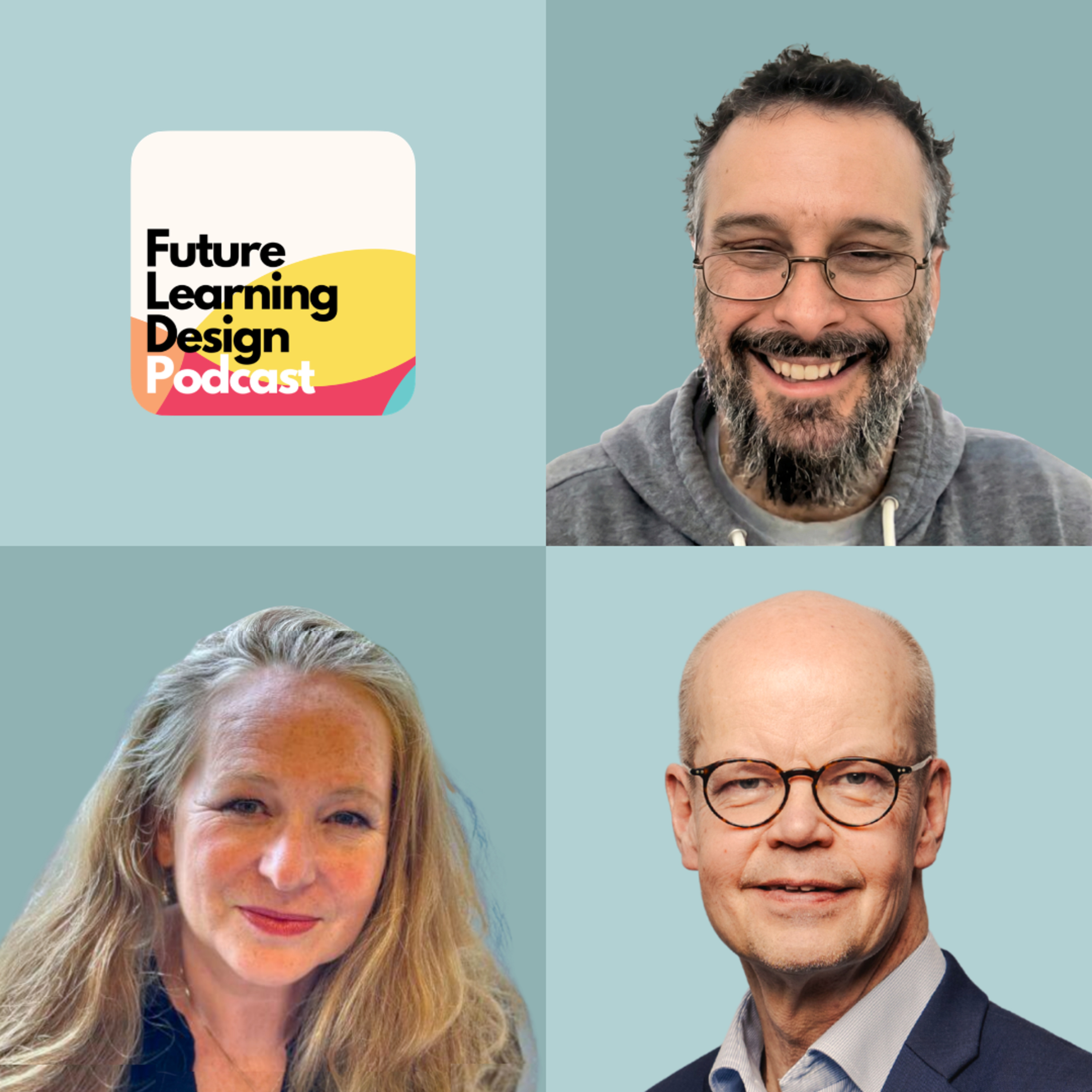
The Future of Schooling in the Age of AI - A Conversation with Nora Bateson, Dr. Zak Stein and Olli-Pekka Heinonen
from Future Learning Design Podcast
76m 20s
This podcast episode explores the profound challenges and opportunities AI presents for education. Nora Bateson, Zack Stein, and Oli Pecker-Hynonon discuss how schools’ long-standing focus on measurement and efficiency has made them vulnerable to AI, which often prioritizes speed over genuine learning. Stein warns that AI can cause cognitive atrophy—where students lose core skills—and, if anthropomorphized, may harm attachment systems and create personality disorders. He compares using AI to wearing an exoskeleton: it makes you appear stronger without actually building strength. Pecker-Hynonon sees a positive disruption, as AI forces a reexamination of education’s purpose, emphasizing slow, meaningful growth over fast knowledge. He advocates for schools to help students engage with their communities, find value in helping others, and develop practical muscles for change. Bateson highlights the need for perceptual and relational capacities—wisdom that takes time to cultivate—and notes that organic growth, like learning, is slow and non-linear. The conversation underscores that education must move beyond stopwatch metrics to foster nuanced, human-centered development, where students learn to perceive and respond to the world around them.
Welcome to the Future Learning Design Podcast. From my perspective, it's a massive experiment, an old relation of kids, even just being aware that it's at risk. It can kind of make you do things that seem to be smart faster, possibly. But is it making you smarter? That's like saying, if I put on an exoskeleton and I go into a gym and I live heavy weights I'm getting stronger, I'm not getting stronger, I'm just lifting heavy weights. Hi everyone, and thanks for joining me again for this week's podcast. My name's Tim Logan and the podcast is produced by Good Impact Labs. What are the questions we should be asking of the radically new and rapidly accelerating technologies that we are all now living with? Where are the possibilities? What are we hungry for? And where are the challenges and the dangers? What are our responsibilities as caregivers, parents, educators and policymakers? How are we creating opportunities for our young people to really connect with themselves with each other and with the world to develop their own perceptual and relational capacities? This week's episode is a wonderful reflective space exploring these profound questions with Nora Bateson, Zack Stein and Oli Pecker-Hynonon. As a brief introduction but with more details in the show notes, Nora Bateson is an award-winning filmmaker, research designer, artist, international lecturer and author. She's the founder and president of the International Bateson Institute and currently serves as the president of the International Federation for Systems Research. Dr. Zack Stein is the philosopher of education, psychologist, futurist and author. He is a founding member of the AI Psychological Research Coalition and the Civilization Research Institute with Daniel Schrecktonbauer. Oli Pecker-Hynonon is a Finnish, political leader, educator and director general of the International Baccalaureate. He served as Finland's Minister of Education and Sign and later as State Secretary to the Prime Minister and Director General of the Finnish National Agency for Education. This episode begins with a dialogue between Nora, Zack and Oli Pecker which was recorded as part of the warm data lab host training earlier this year. So, Zack and Oli Pecker, here we are. And I guess where I wanted to start was with the question of susceptibility and looking at the way in which schools for a very long time have not really tended to the rich learning world of students. And the habits, the patterns of the way that information was shared and tested and measured and measured and measured, I'm seeing that now when we're bringing the AI into this classroom, that it's actually taking hold because there was a susceptibility that had been brewing for a long time. But I know that both of you have been, in me too, we've been very concerned about what the potentiality of school could be in contrast to the way that it had become very entrenched in institutional habits and expectations. One generation to the next, you have to have a 4.0 average, you have to get into the university, the university can only look at these scores or grades or tests that the whole thing has been building on itself in a way that left it wide open to have all those questions answered so beautifully by AI. But they weren't the right questions in terms of the well-being and the possibility of the next generation. So I wanted to start there and just invite you both to hop in and Zach, maybe you want to share some of what you're seeing with some of the damage that you're witnessing. Yeah, I'd be happy to speak to that. It's interesting the schools are in a very difficult spot as they have been for decades with respect to the digital technologies. So schooling has kind of always changed in relationship to the technological base. It's just the technological base used to change much more slowly. The first time you get things that look like schools in the long arc of human history is when you get the early scribal cultures where it's actually just doing the thing of writing was complicated enough technologically that not everybody did it and so you had a little school for writing. And then of course we know eventually printing press and then things just accelerate the post-war era where every several years the entire technological base of schooling changes. So I got to remember when I was I think in sixth grade I took homec. And so therefore I made macaroni and cheese and sewed a little bag and learned how to do shopping and stuff like that. The very next year the homecoring was replaced with the computer room and we had those first little thing or your program done a little like turtle moved around the screen. And homec disappeared. So that acceleration has destabilized schooling I think quite a bit in the past several decades. It made it so we've been very confused about how to proceed. You know what are the literacies that matter of what are the four most assessments that matter what will your job look like when you finally do graduate. And I think AI has brought that to a head. It has radically accelerated that and now everyone has to face the fact that the future job markets are uncertain. The forms of literacy that matter quote unquote reading writing arithmetic are uncertain. And this sends us back towards what are the perennial questions of schooling which I would say are more about socialization and education than just about schooling. And how do we resurface those and focus on those? These are the very important things that are the often what nor would we call the second horror communication of the educator and schooling context. And I was called the hidden curriculum, which is all the other stuff that teaches us how to be human irrespective of if we use a calculator or do it by hand or doing it in our head or if we write the essay or have it written for us now. So the damages are that cognitive activity. And if you control for anthropomorphism, which you must, then the concerns are cognitive atrophy, which is just you lose the capacity to do the things that you ought to be able to do like read and write and the critical thing and pay attention. If you don't control for anthropomorphism, then you run extreme risk of a personality disorder which is worse. It's worse than ADHD, which is caused by you know, TikTok and social media. This is because it's hacking the attachment system through anthropomorphism. It's creating personality disorders. So strongly about us against any relationship with deep anthropomorphic AI and young people. It's just a bad idea. But if we just put that aside and just pretend that we figure that out. And again, like the biggest vendor in the United States to the public schools of AI technologies is this place called Magic School. And they have guardrails and they spend millions of dollars. They were financed by Bain Capital, which like usually finances like military industry. military defense, but guardrails, but all just ran the roar of the zone. So that means that they're stopping your kid from having a relationship with some kind of weird AI tutor. But they're not stopping your kid from checking his spelling with it, writing with it, researching with it, do literature reviews with it being tutored by it in a way. Here we run these risks of not even knowing the kinds of tacit knowledge not being developed. And from my perspective, it's a massive experiment, an whole population of kids. So there's a range of kinds of the cognitive adrophy. And we can kind of get into that and kind of how it works. But even just being aware that it's a risk as opposed to seeing the AI as the thing that makes you smarter, which is kind of how it's pitched. That's like saying, if I put on an exoskeleton and I go into a gym and I live heavy weights, I'm getting stronger. I'm not getting stronger. I'm just lifting heavy weights. So being aware that just because you're doing the thing faster, more efficiently, seemingly more complicated and smart, doesn't mean you are becoming smarter. If you wear an exoskeleton, you could be becoming weaker while you're lifting heavier things, right? And so you just have to be super aware of that. And so any responsible teacher or even if you're a student, you should think, do I want to become stronger or weaker? I want to become smarter or less smart. And if the thing about it, when you look at the way you're using the tool and think about it, if I put this tool aside and I had to go back to doing it by hand, would I be better able to do it? Would I be actually smarter? That's the cognitive algebraic question. The attachment disorder question is different. That is, you know, who are my closest friends? Is my closest friend a machine? That's a different kind of question. A more profound problem, I think. Yeah. Thank you very much. Zach and great to meet. So thank you, Nora, very much for this opportunity. I agree with what you said about the disruption that schools have been struggling with in connection and do the shifting technological.
solutions for a long time. I'm kind of seeing with AI coming in also. I'm seeing, of course, I'm seeing the same challenge is definitely and I really enjoy the analysis on how it changes the attachment capability and how we see it and how we connect with others. But I also see a possibility in the sense that now we're in a situation that we cannot anymore even pretend that just giving the knowledge would be enough for the young generations to succeed or live through a life. It becomes so obvious that it won't fill the role of an institution where governments around the world are spending a lot of their budgetary resources. And I see that in a positive opportunity to see that a lot of things need to change. And I think same is connected that it makes it obvious that our ability to see what is the character of human growth, that the way that we've been thinking about speed, for example, in learning. And the idea that human growth is extremely slow and there might be a kind of a harm moment, but behind those a harm moments are kind of years of figuring things out and not getting there. And that idea, when it's kind of confronted with the AI tool that throws at you pages and pages of analysis on certain things, you see that there is a mismatch somewhere there happening. So I feel that there is a possibility to utilize this moment to really start making the changes on what's the purpose of education, what's the purpose of assessing what's success in education, all those topics and what's the purpose of schooling and also understanding the fact that I often feel that schooling has become something that for good intention, but still it has created a block for students to engage with the world. There's often the idea that we want to make the students to learn in a safe environment. And then there is also the blocks of, of course, the different subjects which don't connect with each other and don't connect with the reality. They are kind of about a science behind the subjects, but they don't make sense in the way that the world works. And I also see that there is a possibility to break through that now. Of course, the safety as a core question for young people to be supported, to learn is very central, but it doesn't mean that they could have should not engage with the world. And engage with the world in a way that creates meaning. And that's something that I also feel that a lot of school systems in the world don't pay much attention to, that what the young people are doing or could do in those communities. Small things, but things that have meaning for other people, that what are learning possibilities at this? To first of all learn that there is value in me. I am valuable. Somebody needs me. I can create something that is meaningful. And then seeing actually that neediness between us humans, that relation. But then also the question that's in so many parts of the world, the young people are really struggling with the world that we have created for them. How to utilize that possibility to do something good for somebody else? Because we know that helping somebody else helps yourself. You see your value and you see yourself also in that relationship and how that could be also a way to support the well-being of the young people. But that's an entirely different way of looking at education and looking at schooling. It's more concentrating on the meaning and the motivation to do something valuable and also make changes. Of course we somehow think that once somebody has knowledge and some skills, then they are automatically motivated to use them. But if they don't know how to use them, how to use them in practical life, it is also a muscle that needs to be strengthened and being capable of making that change in creating your own path and the path for the community that you are living with. It needs to be exercised. And I think that's an excellent task for schools to help those young people grow through the muscles. It's interesting because that description, Olipeka, is really a description of being able to perceive communication and relationship and not just between humans. But to be able to notice this person is in pain. This person is lonely. This person is needing something. These are not just, you know, easily identified situations. The requirement to be able to perceive the shifting not only in your own daily existence, but in somebody else's is like it is a muscle. It is absolutely something that requires knowing what Zach looks like when Zach hasn't slept on his grumpy or how Olipeka looks when Olipeka hasn't slept in his grumpy and it's not going to be the same, but to be able to have a practice of perception and communication that allows for that kind of nuanced responsiveness between us. And of course, human beings are incredibly fallible. So of course, we're going to screw it up. But that's not the point. The point is the ongoing life long. I mean, I think in some ways this is what people were talking about when they were talking about wisdom is noticing, oh, you know, if I say or do this thing that might feel right in this moment, the consequences will ripple out in relationships that could last generations. And that sort of perception is really not being tended to anywhere right now. And yet we feel the repercussions and the pain when we get it wrong readily. And so then that wrongness seems to confirm the need for isolation, right? When we're saying what's a safe environment, a safe environment is one in which you have the flexibility, the elasticity, the nuance of possibility to respond to. Right? Like I've been working on this book or on food and you know, I started off with, well, how do you cook? Well, I mean, what's in the kitchen? And then how do you start from what's in the kitchen with what you're going to cook, which means you actually need to understand the ingredients. And you need to understand what you're hungry for. I need to understand the culture. And you need to understand, there's a lot of things going on way below the idea of a recipe. And that replacement of fast knowledge for the relational understanding, just thinking about, you know, the sort of irony of how funny it is that, you know, when I was a kid, when we were all kids, we didn't trouble for talking in class, right? And now bringing the warm data lab into the classroom is we basically come to the place of it. It's actually urgent that kids start talking in class. We need to have a special time but then to talk in class because they're forgetting how to talk to each other. And the thing about how slow it is, and I would say something even more general, which is that organic growth processes are slow. It takes time for things to become mature. A tree is a great example of this, you know, but for humans, it's particularly slow. Like if you compare the duration of our childhood, which means that time that is spent being a immature member of the species, being not able to do all the things that they grow up members of the species to perpetuate the species takes us a very long time compared to like a gazelle or something, which within a week or so is basically doing almost all of the adult things. And then nor mentions wisdom, which is kind of the ultimate example of this, of just the time it takes to build that type of complex perceptual and relational capacity, which we would usually call wisdom. So what schools do you have?
it was, in a sense, in part because of the stopwatch and behaviorism and a few other odds and ends with a certain way we approached educational psychology was to put a premium on speed. This was part of the adaptation of the human to the machine, probably it would be the one way to character other. Where time is money, less time means you're saving money. So the faster the kids learn, the cheaper the education is somehow and that's the imagination right now another wonderful person from Geneva, Jean P.J. he used to call this the American problem, which was every time he spoke in America, he'd get a question and they'd be like, how do you speed up the whole development thing? Jean P.J. like you've got these stages and you're saying it's like 13 or so whatever by the kid when the kids form operational, but can't we speed it up? And then of course they pointed all these examples in history where percocious kids did a younger age, just perform and they changed the task to bring it down to look like a kid could do it, but actually he was scaffolded to there was like a cottage industry around showing that you could speed up development and appalling P.J. because he was a biologist and he was like that's like speeding up the way the tomato plant grows and creates a tomato. Like you could rush the ripening of the tomato, but that seems like a bad idea and process after process after process in nature where if you artificially speed it up, the net outcome is worse than if you let it grow by its own natural predilections. It's just a very important lesson and I think it's important to understand for your own self-awareness, right? But no actually it is slow. I think about food too, like when you bring food into your body, the goal is not to digest it as quickly as possible. The goal is to enjoy it but then also to get the nutrient such your body needs out of it, right? And that's not a function of the speed of its digestion. It's the function of the quality of the preparation of food, the quality of the food, the preparation of your microbiome and a bunch of other things that have you absorbed the nutrient or not absorbed the nutrients. So if you're just doing a stopwatch on digestion, you're a fool. And so if you're a learning scientist, if you're just doing a stopwatch on learning, like that's really, really stupid. And if you're a person who wants to learn and be come full of your own potentials and like move forward with your learning, just timing yourself is not a good idea. How quickly you've done something is not a great sign that you're making a lot of progress. The other note with growth is it's non-linear. So as much as it's slow, it's also not like slow in a linear way where all of it is accumulated at the same rate, which means there's plateaus, which means they'll legitimately be periods where there's not that much growth occurring and then there'll be periods whereby comparison there's a lot of growth occurring. And then periods again where there's not as much growth occurring and then lots of growth occurring. So that wave-like function has been empirically shown in the cognitive development literature. That's what we call about stages of development. But you also see it in growth, like if you actually look at bone growth in any young organism, it's not linear. It's actually mostly at night. So it's slow, it's non-linear. It's like, "I'll just manage to have regressions before you get progressions. I mean, you have to go back down and like work over earlier stuff and then move up." So all of the assumptions of measurement in schooling worked against the way kind of, quote, unquote, natural learning works. And so that it didn't just separate us from the social world. It separated us from just reality period because it put us in situations of doing things that looked like learning, like gathering a bunch of vocabulary words, like way above where your actual conceptual understanding is. But now you have all these vocabulary words. It looks like learning, but it's not learning. And it's very confusing actually. I was lucky enough to be dyslexic. So I wasn't, I kind of protested against all of the simple forms of learning that I wasn't good at. I couldn't do spelling. I couldn't do vocabulary tests. All that stuff was just it makes sense to make a dyslexic. In retrospect, I realized it allowed me to engage in more deeper, maybe interested in deeper forms of learning that weren't just superficial memorization and multiple choice tests. So yeah, there's a time now as you're saying, I'll let Becca, that the basic idea here of, well, AI is forcing her hand. Like, AI is forcing us to admit that all of the things that really matter and learning don't look like the stuff that we've typically been testing for, right? Because if the AI can do it, what a heck. Like multiple choice tests just throw them away. So there's this question of then, what are these longer arcs of human development that school is interested in? And now has to become more fully responsible for. And you name so them, you know, can you make things happen in the world, but ought to happen in the world? Can you be embedded in your community and your family? And know what it means to perceive it in such a way that you can feel like you're improving it. The second order communication of the school as an institution is we keep you out of the world. The whole like doing things in the world, stuff we post, poem that probably till you're out of college. But that's finally now you can go do something in the world, right? And the school is just communicating to you again and again and again, like literally you can't leave campus literally for like eight hours during the day. I know you literally can't go in the world. You have to stay here. And then the work you're doing, the second order communication of it is, well, you're in competition with your peers. This is not you and your peers collaborating to build something the world needs. This is you working on your own work, proving you're better than your peers at the school thing. So you can get into some other more fancy school, right? And we don't want to admit that, but that is the vibe. The vibe is not all of us young people working together to make the world better. The vibe is us. All of us young people having to compete against each other to get into competitive college. And so that's pretty rough. And it's not like in other cultures, the second order communication and child raising was better. So not saying like we've done, you know, but this is a difficult spot to put all of the young people in. And so taking the lid off of that, taking the walls of off the school a little bit, allowing the young people to go into the world to cooperate in context where they can make it better. So many opportunities for that. Like making and bringing food to elderly people, for example, amazing. Like talk about something that will lift depression and bring meaning, those types of things. And in that process, you could learn a whole bunch of stuff. You could learn accounting. You could learn cooking, right? You could learn all kinds of stuff just in the process of collaborating to make this food and bring it to the elderly people in a way that could be sustained for the rest of the school year. Right? How much money does that take? How much ingredients? Like do we have enough people to do that? Do we have enough cars to do that? How do we make connections to the places where the old people are who handles those phone calls? Like you could imagine all of that becoming something much more like what would prepare you to do with actual thing in the world than reading some books and taking some tests. And I love reading books and I like writing papers. But yeah, the things I ended up having to accumulate outside of school in order to do something in the world innovative. It was totally not how it should have been. Like many of these lessons can be conveyed through the instruments of schooling if we innovate it a little bit. And so yeah, I think now's the time for the AI to take that lid off. Brief focus, if you will. Like I had homeic. Yeah, it's huge. The domestic ecology is huge. In as far as it's capacity of people to be human. Like can you clean a bathroom? Can you make a meal? Can you go to the grocery store? Can you care for a person who is sick? If you need to, these are essential skills. And again, things robots will not be caring for sick people anytime soon. They may be doing a surgery or something because it's different from caring for sick people because the sick person needs to feel held in respect. Right? There's a whole bunch of things that have to occur in that which again fall into the class of wisdom, behavior, which will not be outsourced to machines in any humane society. So that will be a thing the youth will have to grow into the capacity to do now. And then I think there's also just the teaching about the technology to the kids. They're going to open a blanket different door of the curriculum. Make them aware of what these tools are. Make them aware that they're not safe. Make them aware that they're run by very large corporations that are mostly interested in making profit and not in creating a future that benefits them. The ecological devastation that follows from the exploitative mining and the Congo of the rare earth minerals just goes on and on and on. And we're willing to teach kids terrible things about realities in other parts of the world. Actually, some of the curriculum's, I say, are pretty intense. For like, you get into high school, these kids are learning about genocide and all kinds of stuff. But we're given the tech industries of past here in terms of raising the awareness of the youth of the very thing they're holding in their hand, being a supercomputer arrayed against them by billionaires to extract profit from their brain. That's like what the thing is. And we give it to them like, I literally say it's important. Right? So it's like, wait. So I think that's another element. We need to control the technology. We also teach them about it. That's real technological education. Wouldn't just be how to use the tool as it's been given to you. It would be what is the tool? How does the tool work? Who made the tool? Why did they make the tool? Yeah, I think there's so much in that. But I think one of the best ways to engage with AI that I've seen that some educators are using is that they are, for example, making the AI an extra student in a class. And once there are questions that are kind of looked at, the AI is one of them giving an answer or contributing. And then that allows the discussion that why does it give that kind of an answer?
Where is it come from? Is there something in that answer that surprises you? Is there something that kind of is out of order and kind of what's behind of all that? Where does the information come from? Who's information is it? And in that way, exactly go what you said about to enable those moments for the students to understand that what is that technology? Where does it come from? That's definitely what is truly needed. I very much enjoyed the way that you describe the time in schooling and how it kind of goes. It's exactly the opposite way how learning and human growth happens. And I think I started thinking about the question that we're not only thinking about it here and now, but we're also making future a threat for young people. Because we're creating these deadlines that you have to study that by that date. And there's a test in two weeks time and then you need to master this. So the way of looking at time in the future is that it represents a threat to you and kind of also on your way of learning things. And it's part of the school culture and in a similar way, the question of the kind of school culture that there's often that idea of if there is something that is happening in the society, the school tries to keep it outside. And for example, new technologies often the first idea is that let's ban it. No, that's not for us. No, no, no, no, let's keep it outside. Or I know from my own home country Finland that when there was the stronger migration flow coming to Finland, there was the idea that well this is not for us. And so there needs to be somebody or when there is well-being challenges, there needs to be a specialist somewhere else. We're here to teach these somebody take care of these well-being challenges. And that's like kind of treating the school community as it were a kind of a plastic plant that it stays always the same. And it needs to be done that it should not change. But it consists of human beings who change every day and who have different needs and feelings and kind of approaches day after day. So it needs to change. It has to change. It needs to become in a way the curriculum also, the way that it lives. And that's what you're referring to the hidden curriculum that's kind of where we come there. But the question is that how much should it be hidden? Or should it be actually made the core that that's how we work together, how we come together every day. And that's the thing that we need to learn. Of those are the challenges that we are faced with in the world. They are by nature those questions, how we treat each other, how we solve problems together. What is our identity? Are we consumers? Are we citizens? What is it that how we see ourselves and others? And I think there are many educators who understand this, who really kind of get this. And who are doing a good job every day trying to live that way. But again, we have kind of created the model of schooling and the expectations and the assessment systems and the way the curriculum is atomized that make it impossible to happen. So I think it's a good question that how big is the chance that it's needed? Whether we are talking about the kind of evolutionary development or something kind of bigger that is needed. And is it so that the kind of path dependency with the current way of schooling and arranging all it is so strong that if you try to tweak it here and there, it always comes back to the path. Because it's really the way that we look at the world, what's kind of embedded in our ways. So that's the real big question. How do you do it in a systemic way? I think it is possible to do on an individual school level. It's possible to create a different type of school. But then how do you do it in a systemic level? That's the question. It's almost like we need to have just having this fantasy of future students talking about how in the old days they used to separate the subjects. And the ages. And separate school from the world. So the pushing right now that AI could, you know, if there is an upside, this thing of being kind of pushed against the wall now to address that which has been there all along, which is that we as mammals have these multiple faceted cognitive processes that learn in all kinds of ways. I mean, we learn in our in our cells, we learn in our nervous system, we learn through our senses, we learn through each other, we learn through language, we learn through silence, we learn through culture, we learn through food, we learn through talking to strangers, we learn through talking to people that are close to us, sharing meals. There's even there's so many different ways in which this deeper understanding of life is actually nourished. And one of them is actually, I think to be able to look at this history of education as it is right now and be able to say, we thought this was how it worked because we were kind of infatuated with factories. And so the factory model made its way into the classroom and everywhere else, but then we learned that that's not where it was actually happening. And what an opening that is to begin to, I think bringing something that is substantive to the systemic change. It's a meta, right, because it's a systemic change of recognizing systemic change. If you're actually looking at how systems learn, you will see that the way that we're teaching is not systemic. And yet it is. And the problem is that it has entered a kind of systemic arrangement with the economy and with the culture and with all the other pieces into which the familiarity of the categories, the silos, the optimizations, the measurements have taken hold. So interesting time to be looking at all of this. And again, schooling as we know it as a fairly recent invention, relatively speaking from the history of humanity. As I was saying, probably most of our history, although not recorded history, there wouldn't have been anything like schools period. You only get schools and you get certain types of civilizations. And then you only get the modern school, you know, basically after Napoleon. And then you only get the postwar standardized testing school after World War II. So it's all very recent. And so that idea that we're used to it is true, but we've also run very successful, very large scale, human cooperative enterprises with very different types of schooling, very different types of education. The infatuation with the factory, I think, is a large part of it. The wage labor system that requires both parents to be out of the home for the majority of the day also requires the state to basically babysit the kids. And then the way we've structured the economy that it's exploitative requires the kids to be kept out of the labor market. So that also requires them to have like a holding pen, whether or not made subject to the predatory capitalist economy, only the parents are. So a whole bunch of systemic things, changing is required to make the nature of large scale education very different. I think of Ivan Ilych's book from I think it was 1972, de-schooling society, right? And he showed that even just the principal is a completely different way to do this, which would make more use of all the potential educational resources in a city than just locating them in a school and busing all the kids to the school and making the school run like a factory. And I think that vision is one that we can approximate now with digital technologies way better than Ilych could have ever imagined in terms of the ability to take the walls off the school, make all of the educational and vocational resources of a community available to basically everyone in the community. And then you get this, what I call a distributed educational hub now.
which isn't a school, but it's an educational system. And it allows for a thousand pop-up classrooms a day to occur as a result of this very complex kind of time and skill sharing, curriculum and psychometric tracking system. There are other ways to do it that are actually not that hard to imagine. The problem is that it is hard to imagine the whole society changing its relationship. As Norris said, this is structured into all of these other things as they require schooling to be a certain way. So it is a challenge now. The United States has a huge homeschooling movement, which has not slowed down, which is piloting and innovating with the approaches that look very, very different from traditional schooling. And a pretty thorough one they continue. And the technical tools made available to the homeschooling communities will also only continue. So to the extent that the large schools want to not just be exited and have an exodus from, they need to start looking more like these things that are happening over here, which are often tied to faith communities, which are often tied to very local types of problem-solving needs, either of the parents, business or of the local communities, geographical area. So I think taking the big schools apart, spinning them out into a whole bunch of micro schools, enabling those to be embedded in community life such that you return the raising of the children to the community and allow the children also to take part in the success of the community to contribute to its continuity. So it's pretty abstract to say in that, to imagine it in a particular location, I think it's what becomes interesting. I think it's something that can only be done at the scale of a town or a city. It's not something that can be done at the scale of a single school. But that will happen. It's an inevitability of these types of technologies. You could argue that the factory system of school was an inevitability of the printing press. If you wouldn't like taking that rhetorical strategy. And so here, the digital would be distributed. Knowledge not as a scarce resource, knowledge as it's completely available to anyone, anywhere, the scarce resource being the right types of human relationships. So the AI has to be able to basically customize and bring together the right public classroom, which is the right configuration of relationships. The alternative vision, which is the one where I'm path for now, is replacing the teachers with machines. That's the alternative. Actually not getting people to be into better relationships with each other, but getting people mostly out of relationships entirely and into relationships with machines. And so that has my biggest fear. And the reason we need to re-prioritize and make much more compelling again, really human education relationships, peer-to-peer relationships, student teacher relationships, because the tech companies are really pushing obsolete teachers with teaching machines, which goes way back to like 30s. The imagination of behaviorism and psychology. And so here we do have. We have some people building tools to help teachers, but a lot of these tools look to be like teacher replacement, they look like ambitions to replace teachers. So I think we have to actively stop that and find a way to use AI and other forms of digital technology to increase human education relationships and their power, their frequency, and their effectiveness and their availability. It's a different designer hasn't for the technologies, but it's the only one that allows us to say human, I think, in the presence of this exponentially more powerful technology. If it got exponentially better at getting us into good relationships with each other, that would be okay. If it gets exponentially better at replacing teachers and parents and ministers and rabbis, like that's bad. Like that's the shouldn't get exponentially better. So if it's going to keep getting better, let's make it actually get better. Yeah, that's my sense, because you don't want to be a lotite. In fact, you don't want to make it so that you're just running away and fear from the technologies. We need to find a way to leverage them. So yeah, there's more to say on that. And then of course, but that's a very radical view. So that's not something like an easy way to do it, but the scale of a school. I noticed that I've come from a place where we're kind of a background where in my mind, and I'm starting when we were talking about homeschooling, for example, I'm starting to see the question of how to make sure that that doesn't mean that those children are not having any human connections, that they are kind of being separated from others. And I'm also starting thinking about with the idea of creating that kind of AI-enabled learning possibilities that how to make sure that those who haven't gotten that home the kind of basic abilities to learn and utilize those possibilities also have a chance to grow into their potential. But I agree that those are becoming reality in different parts of the world. We are seeing those being created in different pockets in the world. And it's just a question that how do we do it in a way that also certain societal values are kind of embedded in those models? Yeah. I mean, freeing parents from certain types of extraneous wage labor, right, which is to say job automation from AI, could free the parents to be more available, right? Could free the parents to be more participants. So there's, as you're saying, it's a whole bunch of stuff has to kind of be rearranged in order to not make this just something that benefits the elites, right? Which is what it actually is kind of a little bit doing right now if you think about what I'm describing. So yeah, I'm with you 100% there. It's been really nice to have you both here. And I look forward to doing this again. I think this is going to be really wonderful for this course and probably beyond. So I'm happy that we have this. And I guess just sort of as we're wrapping up, really recognizing the way that these technologies have created separation to the point of isolation. And I think the teachers are suffering from that also and feeling that they don't have time to make real contact with the students and know what the students really need and be able to respond to that because they're bound to a curriculum and a test and a, you know, a set of extenuating circumstances that break the relationship. And somehow this process of breaking relationship was efficient toward a particular sort of outcome. And that happens to be the outcome that AI is really good at. So maybe the response then is to not be serving toward isolation, but into relationship communication, having us be among each other again, and attending to those muscles of contact, of attunement, attunement to one another and to life, which is a lifelong practice. And I think there's many things that would be alleviated by that in terms of health and mental health, societal, communal issues from crime to suicide to addiction to. There's a whole lot of side effects of isolation that I don't think anybody really wants. But somehow it's become such a dominant feature of being in a world that we're in. The second part of this episode is a dialogue that Nora Zach and I shared on the way in which warm data is meeting many of the challenges being raised now by the ubiquitousness of advanced artificial intelligence in our young people's lives, as well as the very exciting ideas being shared by Nora from her father Gregory Bateson's work on second-order teaching, being published in a new book edited by Philip Goodemi entitled Gregory Bateson's Ecology of Mind to the Course. Just reflecting on the work that we've been doing with young people around the world in different schools and coming together in different places, really recognising some of the need that young people expressing some lostness or some disorientation significantly around how to hold themselves and their aspirations and the things they're trying to do in schools and in their learning in this moment with all of this AI stuff around. Teachers also that perhaps struggling to know exactly what is it that we are being asked to do in terms of not only the learning that's happening in schools but also this broader question of well-being broadly or just how young people are feeling in themselves, how are they relating to each other and to these technologies? So I don't know, yeah, perhaps you could just speak to some of that maybe some of that work but also how do you see it connecting with some of the warm data work within them? It's interesting because I have seen for a long time that the warm data work was meeting a need for human-to-human connection and conversation but that would be a very oversimplified description of what's actually happening with the warm data work and I'm a
a little bit surprised myself to kind of be in this moment and recognizing the way in which the particular format of warm data and the warm data labs, the people need people processes, allows for some deeper study and exploration and experience of how cognition and learning are happening beyond the idea of we're going to directly teach the students these direct tidbits, testing items, these things that we're going to pour into them like they're empty vessels and that learning is much more than that, it's culture, it's language, it's memory, it's history, it's technology, and it's also in the body and in this very sensorial realm. So I've been very surprised to see the way in which in this moment where AI is rising, warm data is also catching people's attention and they're wondering, will this help? What is this? Is there something here that's not there? And there is, but it's difficult to describe. Zach, you attended a training and I'm curious how you would describe it. Yeah, I mean, it's, when cars came out everyone thought bicycles would disappear, but we actually have the most remarkable bicycles and the most remarkable bicycling culture even though we have cars and planes and things. So my experience was just that this is the, it's a simple primordial way of being human together and we need more than ever we need to remind ourselves what that is because many of the young people don't even know what they've lost because they've never actually experienced the opportunity for this type of open, embodied kind of multi contextual conversation, which is teaching you without didactically lecturing at you about all of these things. And so if you take kids who've been screen addicted and now attachment hacked by conversation bots and you take those from them, just cold turkey and then you send them to like a school to answer something. It's, it's a bad idea. They have no skills to even get up and into the conversations like especially young boys and so you're in the situation where you have to create contexts where they can experience that fluid kind of like all of that hidden tacit knowledge that comes from all interacting with all different people here in different stories from different contexts all held by responsible adults who've set it up for them. And then of course the adults get to see kids now being kids interacting not being strange cyborgs attached to computers. So there's also a year saying or the opportunity for seeing how learning works real time. And remembering again, oh yeah, it's not about all these books and the blackboards and the standardized tests and stuff. There's actually something much more fundamental happening. So it's kind of like a video experience and it's kind of blindingly simple, but it took it takes so much to distill that second simplicity of that experience. So I really have been saying because I've been talking a lot about the risks that come from the anthropomorphic AI to educators. And they're basically like, well, what's the therapeutics? How do you get a kid? How do that? And it's not as simple as cold turkey. It actually looks almost exactly like the form data lab. It becomes a more compelling environment than sitting in front of your chat box and a more compelling environment than even social media. And you can do various inexpensive things. It's not. So anyway, I'm just, it was my experience in North Carolina was that it was as I said, kind of blindingly obvious and simple and yet no one is doing it. And so we have all of these weird approaches to social emotional learning and like systems theory. And we're just lecturing a kid and doing slideshow and stuff and not getting them together organically having it all occur. Can I maybe just say the other piece that I think is so interesting is also the like schools and education and in general is so goal oriented. And even some of those things that therapeutics that the things that you mentioned Zach are still very goal oriented. And so one of the things I find so incredible about the warm day to experience is there is so much happening in so many directions. So it's all this mutual learning happening, but in kind of ecological ways, let's say, rather than saying, all right, I'm going to set the agenda here. This is what we're going to, we're going to go from here to here because as soon as that happens, then you know, you're back into a particular kind of experience. And that one is one of the things I think, yes, simplicity, but also this is like incredible unfurling like multi layered complexity that is also happening in such beautiful and simple ways as these people are interacting. So I don't know, I just I find it incredibly generative space in that way. I want to pick up on that piece too about the tacit learning and you know, the way in which if you have kids, you might have noticed or you work with kids that they don't often do particularly the thing you told them to do. But the things they come away learning are the things you never mentioned. And this is true, I think in every household, how, you know, gender expression is learned, how basic understandings of things like success or health or family or actually life and death, love. How these things are learned is not something that's explicit, but rather it's taking place in multiple experiences that are overlapping. And that's what the Warm Beta Lab does is it makes a moment where those connections can reconnect and you can begin to see things in a way you didn't see before and make new connections. So given the concern that we've been receiving from educators and especially from students, it felt like this time we would take the online course and offer it with this particular tilt, which is not something I usually do. Usually I'm very much interested in keeping it as mixed as possible in terms of the professions and the backgrounds and the interests of the people who attend. But this feels important and so Zach and Tim and I are going to bring this training in particular to that group of people who is involved in the education world and especially as it's meeting AI, what is in that deeper experience of being human, of being alive, that is part of a mutual learning process that is already left behind by schools. And then at AI and it's going to be very difficult to trace back even the warmth and the character and the difficulties that we all had with teachers, but at least they were people. They were alive. Right. Yeah, 100% agree. And again, because you said it was already kind of taken out of schooling into which you put a whole bunch of things that became more compelling than schooling, which confused us about the value of teachers and the value of these types of environments to the point where you don't know what you've lost. It's kind of like if you've only had junk food and you've never had healthy food, you don't know that experience of actually feeling better. If after having a meal that's healthy as opposed to a meal that's unhealthy, so even just making available the healthy choice for kids to go to something like this rather than to spend time with their technology, they could experience something that is actually feels better. And I think that's a lot of what I try to communicate to teachers. Like if the chatbot's more interesting than you, right, then you need to make a more interesting experience for the kids to be in. And again, their instincts, they're literally built over millions of years of evolution to be able to do this. Right. To have mirror neuron activity and to gain empathy and if they're designed to do this more than they're designed to use the screen. So the screen's actually cause brain damage because we're not nervous systems aren't built to have that kind of stimuli. So I think there's like a, there's nothing really, really powerful here that we can get this to spread as a commonly done practice in certain kinds of schools. I think we would see as a natural experiment the benefit and especially to supplement what is coming with your age bands on these technologies. Now they said we're about to cold turkey these kids and give them nothing instead. Giving them this instead could actually make those age bands, you know, net beneficial won't regenerate some of what has been lost in their skill sets and nervous systems because that is coming. I think we're learning that lesson and what we put in its place as a huge question. Yeah. The thing I also find super interesting about that is that for the teachers as well, it's a such and much more nurturing environment than the machine they're participating in to deliver the outcomes that they are being asked to deliver. And so there's just something there for me as well about how much more generative for educators this can be as an experience of participating in education. Right. I'm a teacher like in a warm data lab environment, I'm going to learn so much about all the kids and get to know them so well and be able to intervene and do things that you'd never be able to do if they're in roads of desks like lecturing to your lecture. I mean, that was my experience in North Carolina just, you know, I wasn't even a teacher there. I was just, but I was able just as a participant to observe so much of who people were and what was going on and people were helping people spontaneously. People were learning spontaneously. It's interesting because then the role of the teacher is distributed amongst the students. Oh, totally. If you do it across classes, if you take second graders, third graders, fifth graders, sixth graders, for example, or if you take seventh graders, eighth graders through high school or something and you mix them together, then you've got that one room classroom thing where where you've got a not fully.
intergenerational transmission of parent child, but older kid, younger kid. And you get all of these dynamics that kids are completely held out of. Literally, like legally required to stay out of the age mixing. So if that's all done well, it becomes a very unique experience for a modern child. But it was a fairly common experience back in the day when we just threw them all together at the do farm work and threw them all together to, you know, go to war or whatever, we had crazy things we had to do. And so again, it would be amazing to get like the international match with Laura at Community doing just widespread international across different locations. And then that becomes a natural experiment. We just compare that to what's going on in schools that don't do anything like this. And it's very the week with Jonathan Heit in Davos. It's clearly age bands are going, France is going to do it all over Southeast Asia with their do-h-head. Australia did it. So that's going to happen. And it's going to be tough for the kids. Like it's not going to be easy. In Australia, there's a lot of VPN activity at first, which means like kids going in and figure out how to get in. But then it dropped off. And the theory is basically like the point of social media is the ease of access. You can kind of do it between things and it's easy to get into and you can check it 100 times a day. But if it's a log into a VPN, do another thing, like it loses there's too much friction. Yeah, you got a ton on the dial up and wait for the old internet, you know? Exactly. Yeah, but the concern is that the mental health of the kids is going to tank for a while until they restabilize. So we'll see. Well, that's a big part of it. I mean, I think for me, the way in which the transcontextual storytelling and conversations that take place in the Warm Data Lab holds the possibility for learning and learning in a very therapeutic way that is not directive. It's not so telling about your issues. And we can solve them for you. OK, it's not that. It's just people talking to people and learning from each other's stories. And we hear all the time this refrain, your story changed my story. And that is, I think, really important in this idea of we need to be able to have education that is about complexity. So that people understand the complex systems that they're in. But the way that that seems to keep happening is to talk in terms of new vocabularies and models of complexity. But it doesn't touch the complexity we actually live in. And so that experience of actually looking at our own complexity, then when you learn the vocabulary of the complexity theory, it's a very different vocabulary. Yeah, that's the even more exciting possibility is that it does more than just kind of re-normalize conversation and all of it, but it actually loads in what will eventually become as they move into adulthood, a truly complex understanding of the world. Like not to kind of Newtonian billiard ball way of thinking about things. But this, you know, they'll have instincts about nonlinear systems. They'll have a repulsion at black and white thinking. And they'll just instinctually, not because they were lectured about how it's the better way to think. But because they came to just see that as how the world works, yeah, that's in terms of integrating into curriculum. That's where it becomes this thing, where there's the educators going to be tempted to load it more content and make it more about something. When it actually works because it's content free and not about anything. So that's, to me, there'll be an emerging tension. But that's a good problem to eventually have is the educators liking it enough to figure out how to kind of bring it into the overall offering of a school or a great level. The other thing that's super interesting is what you were saying, Nora, about how it-- I don't know what you think about this actually in relation to-- I know, you know, I shared that quote of your dad's recently-- that it almost distances yourself from trusting that your body understands the complexity somehow, or something like that. When we're constantly told, in order to get something, you have to learn about it first, like learning about complexity, as you just said. It's almost the implicit communication areas. You don't understand it yet. Your body doesn't understand it already. You need to learn about it to get it. And so I don't know. Do you think that humans just get it? Like in their elbows, as you say. And then we are taught out of it almost. We're somehow we unlearn that intuitive understanding of complexity by being taught about this Newtonian mechanistic world to oversimplify. But you know what I'm saying? It's an interesting question I have. I think absolutely. We get taught out of us, particularly when we experience success by being reductionist, by living in a Newtonian separate world. And if you get an A in math, it's because you did well in math. And that's a very strange thing, actually, because what's happening in math is fantastic possibilities of actually perception and computation and learning about how proportions and relations. And there's so much more to math than math. Beautiful. Yeah. When I hear kids say I hate math, it's I'm like, I'm so sorry, because it actually is life. And it just got packaged. You're a computationalist after all, no, it hurts. And I mean, I'm a mom, you know? And if you're a mom, you do algebra all day long and calculus. So it's this question of-- and my hope is that this course is actually the precursor to something bigger that I want to be working on with you that's bringing in a whole different way of teaching. And I'm really excited about this. Well, that was the other thing about the Warm Day 11 astronauts that you did some great teaching or from the stage with the slides. And people were primed and they were connecting it to their embodied experience. So it opens up a door for a certain type of teaching and called response with a group who's been having this experience. So you can load a lot in there. And I think it's never either or-- there are some things you do need to kind of learn about. And then there are other things that you totally should never be taught about. You should just go do it. Like, my experience as a musician was that. You can pick up a guitar and learn to make beautiful sounds just by playing with it. You don't need any music theory. Or you can learn music theory and never touch the guitar. And there's this complex thing where you eventually need both, but the practice and the theory have to have this ratio that allows you to learn the way the thing works, the physics of the guitar, the ratios of the placement of finger on the string. You'll be able to hear a chord that sounds right. And a chord that doesn't without being told that this is the right one, that's the raw of those things. So it is in your bones. Can I add almost like a middle layer in there? Because I did the training in Singapore. And the thing I experienced there was the merging of the theory and the practice in the stories that you tell Nora as part of the teaching. So yes, there's the practice. Yes, there's the theory. But then you do this thing of weaving it through the stories that you tell from your own experience in life. And that's not to be underestimated. I'm not here to fluff your ego right now. But there is something really quite significant and beautiful that happens there in that emerging of those things together. Well, this is-- we're eking into the next project here. But it's very exciting to me because I've spent the last whatever 13 years holding these trainings. And some people are coming to the trainings trying to figure out what's the tool. What's the toolbox? Out of way. And I'm always trying to say, no, no, no, no, no. You don't have to worry about the toolbox. Just take it in and see what happens. And it's interesting that sometimes there's a resistance to that. Because the resistance is in the habituated way that people have learned to learn. And to learn to learn is to get something and to then to have it and then to reproduce it. And this is not that. This is where you get a lot of things. And your task is to bring them into different kinds of connection. And I'm not here to control that or dictate which direction it goes. My joy is for that to be wild. And so this is really the next piece. And I'm excited because Philip Gidemi, who has been working with the Bates and Archives, has just published a book, well, it's coming out soon, of course, my father taught at UC Santa Cruz in 1976, called An Ecology Line. And the whole book, 465 pages of transcripts and conversations with the story is all this sort of second-order teaching. And he comes into the classroom on the first day, not trying to get tenure or academic prestige or any kind of even monetary benefit, but standing at the lectern thinking, how can I bring this group of students to an understanding of the incredible complexity and the movement of the ecologies of our world, of their own minds, of their impressions, their perceptions.
And he's very open about this being the task. And then he starts in by just saying, and now I'm going to tell you this story. And then this story, and then this story. And from the outside, they don't look like they have anything to do with each other. And yet, what's happening for the students is that they're making connections in ways they haven't made before. And that's the task, right? In doing so, you don't get something that you can necessarily regurgitate for a test. What do you get? You get people who are perceiving and thinking differently. He had this fantastic test at the end of his class. There's only two questions at the end. Only two questions on the test. What is sacrament and what is entropy? That's it. Wow. How about it? And it's awesome. It's my kind of task. So it's very exciting for me because I think I grew up in that kind of an environment where I was learning to learn like that. And so in order to stage true to the complexity itself, I had to actually create the course in a way that doesn't violate it. And that's what I see as the art form of this, the art form of teaching. I think every good teacher since ever has done this. Well, I was about to say it's a huge part of the rabbinical lineage of just like rarely do. I mean, the Bible is just a bunch of stories. Some somebody did it tactically teaching. And then when you are in the context and you ask, good grab a question who'll usually tell you a story about some acidic master or something, some weird, almost zen-like story where you're like, oh, I'm not telling you what to do, but just telling a story. So that I think you're right, Nora. I think there's a real lost art there. I'm very interested to read that book. So I'm excited to work on that with you. And this is the continuation of this this year, because this is about the educators and about the students. But really, it's also this question of, you know, you can't teach the thing that we need to be learning right now. And if teachers and schools stood up and told stories about their lives, kids would pay attention. Way more than that. Exactly. Raymore than if they're telling some story about George Washington or something. Ray. But if they're like, you know, I had this experience. So it's to me, it's again, it's blindingly obvious, but it's so weird how far we've far from it in modern schooling. You know, I'm going to think my best teacher ever has was my fifth grade teacher, Mr. Born. First of all, he was a male teacher in elementary school, which made him unique. And then he was an incredible storyteller, just incredible. But I still remember his stories more than I remember anything. He taught it, technically, in class. But he was just such a compelling teacher because of his ability to do the story thing. I've experienced that again in my religious training with Bozen and Jewish. So we're very, very, I'd love to work on that. Yeah. So interesting. Rachel's story. So we were in Cardiff for a couple of weeks, guys acting in the I.B. offices. But to your point about the story being compelling, we started, we were in this like almost kind of warehouse corporate space with nothing in it. And just a bunch of people didn't really know why they were there. And then, you know, welcome to everybody. And then Rachel started telling this story. And just like everybody was there. Like, so in this story, she told it beautifully. It was really kind of quite a profound reflection, personal reflection. And it was like, it was so compelling to people in the room. Suddenly, I say that because it's like, when does that happen in a work environment, that kind of moment where someone's telling a really personal story? You know, that's not part of the script of what you say at work, right? That's just not the toes. Discoached. Well, exactly. It's like actively discouraged. And it's just it was, it just has such a different feeling to it, you know? And then the stories next to each other provide new in person and Batesoni in language, new, abductive process, new ways that things reflect off of each other and through each other that create very different descriptions of our experience in the world, even experiences we've had in the past. Yes, I think. Yeah. And that's so fascinating because that's, I think, what many people don't see and the way the way that kind of storytelling has kind of gotten a little bit zeitgeisty and buzzwordy and everyone's into storytelling now. But that point, I mean, this clearly, like a whole bunch of issues around that capture, but that point of the side by side and the multiple description and is like, that is not in the room in those conversations about storytelling. And that seems to me such an interesting and important part of that. Yeah, because the point is known in the story. Right. That went back and it's not at all. That's the whole thing. That's the thing. Yeah. And there's that, there's that meta context when a question has been asked where you know he's so and supposed to be doing something like teaching, but instead they're telling a story, right? So it's like it's this interesting, it's a fascinating thing. Stories within stories, stories juxtaposed. As you're saying, or you can't help but see the abductive kind of thing that's trying to emerge from the different stories. And my might not be your might not be Tim's generalization from the stories because it's kind of advantage of it. So yeah, it's so fluid and organic. Amazing. So much. And it's alive. And if you're trying to learn about life, that we don't destroy life, then we need to study in a way that's alive. We have enjoyed this episode. Please feel free to continue the dialogues with our guests, with us, our good impact labs on our blog or on social media, or within your own networks.
Podcast Summary
Key Points:
Schools have long neglected rich learning environments, leaving them susceptible to AI adoption that answers the wrong questions about student well-being.
AI poses risks of cognitive atrophy (losing abilities like reading and writing) and, with deep anthropomorphism, potential personality disorders in young people.
The hidden curriculum—socialization and relational learning—is more critical than ever, as AI accelerates uncertainty in job markets and literacy demands.
Organic human growth is slow and non-linear; speeding up learning with AI mirrors rushing tomato ripening, resulting in poorer outcomes.
There is an opportunity to refocus education on meaning, community engagement, and perceptual skills, rather than knowledge transmission and speed.
Safe learning environments should foster flexibility and nuanced responsiveness, not isolation or fast, decontextualized answers.
Summary:
This podcast episode explores the profound challenges and opportunities AI presents for education. Nora Bateson, Zack Stein, and Oli Pecker-Hynonon discuss how schools’ long-standing focus on measurement and efficiency has made them vulnerable to AI, which often prioritizes speed over genuine learning. Stein warns that AI can cause cognitive atrophy—where students lose core skills—and, if anthropomorphized, may harm attachment systems and create personality disorders.
He compares using AI to wearing an exoskeleton: it makes you appear stronger without actually building strength. Pecker-Hynonon sees a positive disruption, as AI forces a reexamination of education’s purpose, emphasizing slow, meaningful growth over fast knowledge. He advocates for schools to help students engage with their communities, find value in helping others, and develop practical muscles for change.
Bateson highlights the need for perceptual and relational capacities—wisdom that takes time to cultivate—and notes that organic growth, like learning, is slow and non-linear. The conversation underscores that education must move beyond stopwatch metrics to foster nuanced, human-centered development, where students learn to perceive and respond to the world around them.
FAQs
Zack Stein warns of cognitive atrophy, where students lose abilities like reading, writing, and critical thinking, and personality disorders from deep anthropomorphic AI, which can hack the attachment system.
AI can make tasks faster and seem smarter, but it risks weakening cognitive skills—like using an exoskeleton to lift heavy weights doesn't make you stronger, and could make you weaker.
The hidden curriculum refers to the untaught lessons on how to be human, including socialization and relational skills, which are crucial regardless of technological tools like AI.
He views AI as a chance to rethink education's purpose, moving beyond knowledge delivery to focus on meaning, motivation, and helping students engage with their communities.
Organic growth processes, like cognitive development, take time and are non-linear, with plateaus and regressions; speeding them up artificially can lead to worse outcomes.
Safe environments should offer flexibility and nuance for responding to others' needs, not isolation; they require practicing perception and communication, like noticing when someone is struggling.
Chat with AI
Loading...
Pro features
Go deeper with this episode
Unlock creator-grade tools that turn any transcript into show notes and subtitle files.
 PodcastTranscript AI