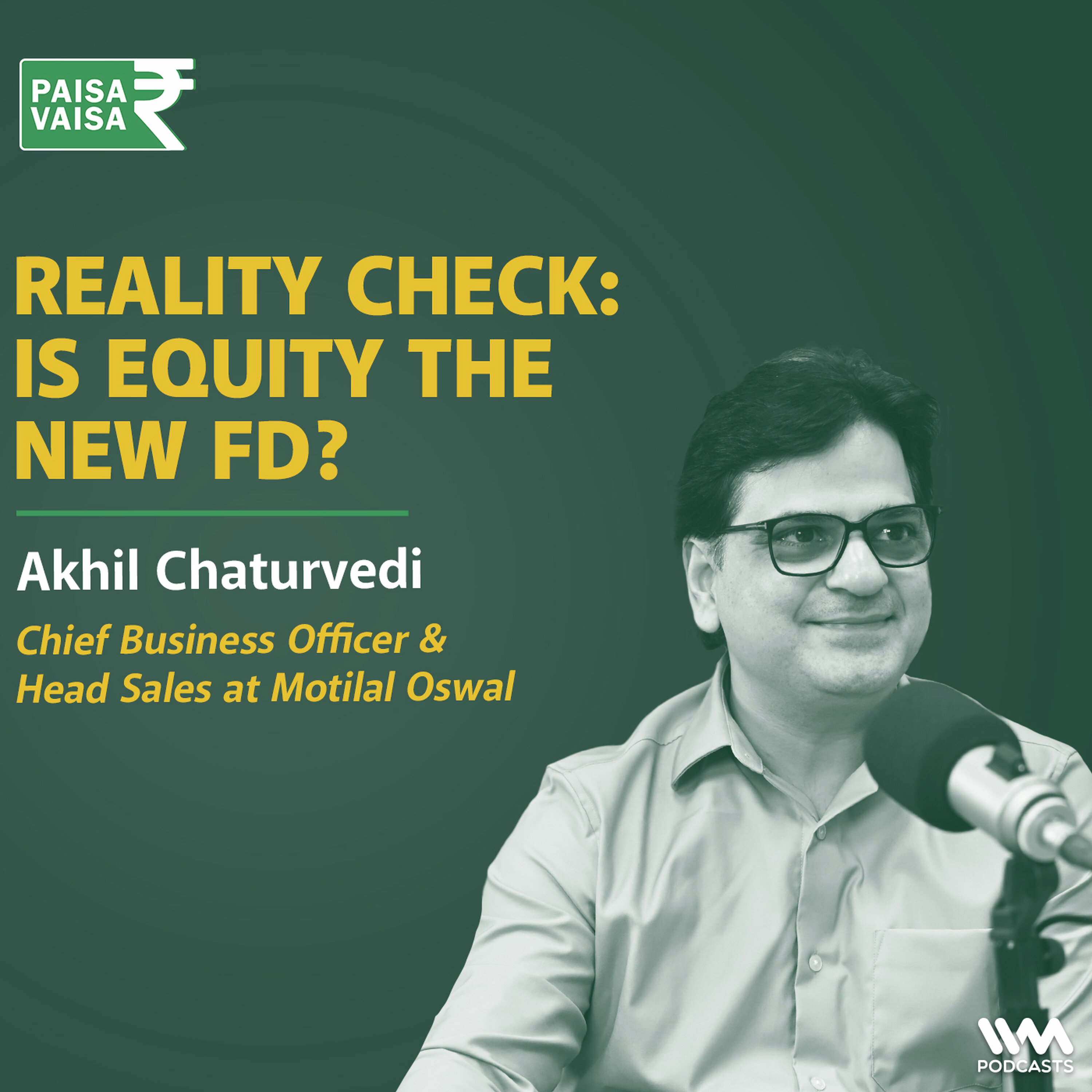
The Future of Indian Markets: A Deep Dive into Active vs. Passive Investing | Paisa Vaisa
48m 52s
Motilal Oswal Financial Services, known as I.V.M., encompasses multiple business divisions such as retail brokerage, institutional brokerage, asset management, private wealth, investment banking, private equity, and home finance. The company has experienced significant growth, benefiting from the trend of financial savings in India. Notably, Motilal Oswal's emphasis on equity investments, guided by the QGLP philosophy, has played a crucial role in its success and wealth creation journey. The firm's active involvement in equities, along with a mix of active and passive mutual funds catering to various investor preferences, has contributed to its growth and market relevance. Additionally, the company's Portfolio Management Services (PMS) have evolved to accommodate the diverse needs and risk appetites of clients, reflecting the increasing interest and participation in wealth management services in recent years.
Transcription
8931 Words, 48969 Characters
I.V.M.
Thank you so much, Anupam. Pleasure talking to you.
So, the oldest business goes back in 1990s. So that is our retail brokerage business. So there of course we have the top positions.
So retail, brokerage and distribution, that's one business. Then we have institutional brokerage side which is basically catering to all the foreign investors.
Then we have my business which is the asset management business and we do mutual funds, PMS, AIF, these kind of products.
We have private wealth, where we have your friend Ashishankar out there. We have investment banking, Amitram Chandani, who is the CEO out there.
We have private equity, we also have home finance. So these are all the businesses.
You know, and touch wood I think last couple of years all the businesses are hugely tailwinded which reflects in the numbers also.
And today you finished 12 years, so congrats.
It's a good opportunity to be talking to you on 12th anniversary.
Let's talk about what you've seen in the last 12 years. Let's talk about across every businesses.
What are some of the trends that have driven growth, right? Because this thing of financialization of savings that has happened in India, it just continues.
26,000 crores of SIP, you know, 10, 15 years early, this was hardly even, I don't know, 4 or 4 or something of that sort. And here we are at this. So in your 12 years, what have you seen?
What are the trends and from there we can extrapolate what we see going forward.
No, I think it's a good way to start and that will live my 12 years also.
So you'll remember India between 2008, lemon crisis and subsequently right up till 2013.
I think we've seen one of the worst decades at that point of time because first we had the global financial crisis and then within India we had our own political crisis and we had a lot of crisis in the corporate sector and a lot of scams.
And because of that, it's a very leveraged economy as well.
Businesses were not doing well, companies were not making enough money, growth was virtually absent, right?
So the very, very tough time for equities and equity investors because virtually at that point of time between those 12 years equity returns were like 0 to 45% right, barring you to bought some defensive sectors.
So 2013 is where I joined here, right? It was like the bottom of the bottom, right? So I joined here and that is the time we had the paper tantrum issue.
So again, one more year of a crisis kind of a year and and Mutti was at that time more like a startup, the whole objective of me coming here was basically to build the distribution business and build the asset management.
It was very, very small, I would say we were more like a startup with some small 800,000 crores of away, we went back in 2013.
One good thing what happened immediately after I joined was we were having the general elections and we were looking out for a change and we got a pleasant change in the end of 2014.
And I think rest is a history ever since 2014. We had our ups and downs but broadly if you see and all the numbers which you spoke about so around 4,000 crores of shipbook back in 2013 today is 27,000 crores.
2013 total equity mutual fund AUM was one like crore, today it is 55 like crore. And we have a scheme that is one like crore. And then we have many schemes which are now one like or closer to one like now, right?
Number of investors, I think unique pans in 2013 were about a crore close to a crore, today we have over 5 crore unique pans.
So it's been a marvelous journey and all the kind of things we have seen in terms of reforms, economic turnaround and the very same businesses which used to make losses back then have started to make a lot of profits which is what is reflecting in the markets and the kind of numbers we are seeing in the markets.
So it's been an exciting journey.
But you know there's one thing that I always am fascinated by your organization is equity. And whenever I've seen Namdev ji or even Muthilaal ji, they just believe in the power of equity.
Other fund houses will have other asset classes, asset education, which is of course it has its own place. I'm not saying that's what is a deal with equity.
You're the office, the Muthilaal office, the lighting on that, when the nifty goes up, if you go from the night to the building, then it becomes green.
And if the market is down, then it's a building.
And then it also goes ambient on the over the weekends.
I'm telling you, I think Ramdev over one, I think he's at the center of the whole equity as a strategy, right?
So he was a balance sheet reader when he was young, he was doing a started accountancy and he got this knack of understanding businesses and he always had this passion of getting into.
He wanted to do something in equities, right?
So when he tells us his story, he talks about that briefly after his CA, he was practicing in some CA form, but his knack of reading balance sheets, understanding equities and all of those things was right at the core.
And there is where he and Muthilaal, you know, kind of joined hands together and they said that, you know, I can understand balance sheets, I can understand businesses and Muthilaal can run the business, right?
So that's how the whole birth of equity, wealth creation journey or whatever you call it.
So what used to happen that time was Ramdev used to research on companies and Muthilaal used to go in the ring and he used to execute the trades, right?
And that's how they made some small money in terms of the brokerage, which he started to invest.
Not that you take your money out and you start enjoying life.
You never traded, right?
Always long, always long only, never speculated.
Then subsequently he started following Warren Buffett and then he started traveling for the Berkshire Hathway.
But that initial capital, which they earned out of the brokerage business and what he tells us is about 12 lakh rupees.
That 12 lakh rupees compounding over the last 40 years is in several thousand crores right now.
And the business itself, over the last, so on 26 July on Friday, this Friday, the company will complete 38 years, right?
And in 38 years, this firm is now what, 60,000 crores of market cap.
So that's separate wealth creation and the prop money, which they manage, that's a separate wealth creation.
So what you see over the last 30, 40, even 20, 25 years also, this is one asset class, which just continues to compound that, you know,
anywhere between 13 and 15%, roughly every five years your money keeps doubling.
All you need to do is stay put. That's the only thing you need to do.
And this is the only asset class where you just, you know, you just do the right things and give it time and it works for you.
Let's talk about your products that you have, you know, the numbers that you just gave.
Because the mutual fund business of Motilal is also very interesting.
In the products that they have, some of them I think, either before the time like the NASDAQ and the international investing pieces, let's talk about that for a bit.
What do you have across the board?
And what does that reflect as if philosophy, right?
Because I think you would have started this.
I remember I had Ashishomaya quite some time back in 2018.
Otherwise, it would have been 60 years.
Time flies.
Time flies and that time he was at, he was in the mutual fund business at Motilal.
What are the philosophy behind the products that you have?
I want our audience to kind of understand that because this is like a pure equity business.
Yeah.
What is that?
So this business started back in 2003, out of the passion of Ramdoji, you know, he himself made a lot of money.
He wanted Indians also to participate in this whole asset class.
And with that passion, you know, we started off with our portfolio management service license back then.
Briefly, he was a fund manager also, Ramdoji.
Then he gave it up to a professional.
But initially, the first few months, he used to manage it.
It was a value strategy.
Now we call it value migration.
So between 2003 and 2013, they were running two PMS strategies, about 1000 crores in size.
And they got the mutual fund license, I think somewhere between, somewhere in 2008.
And initially, we launched this group is all about trying to do simple things differently.
So when they came into the asset management business, they wanted to do differently, you know, different products and all.
So early in time, they started launching passive funds.
So we had the first Nifty 50 remakes fund passive.
So Nasdaq, we were the first ones to get the exclusive license and we launched the Nasdaq 100 ETF.
And I mean, between the 2003 and 2013 period, the form was just about kind of scratching the surface.
And then they decided that, okay, now it's about time, 10 years completed, let's build the business up.
And they got Ashish Omaya home, you met and talked to.
He became the CEO, then he bought me and we started building the business.
So the first thing was that, let's play to the strength of the group.
So the group strength was all about equities.
Then we had Ramdo Garwal.
And then we had his well-defined investment philosophy, which we call as QGLP philosophy, quality growth longevity price.
So we had all the ingredients, we had 10-year track record of our portfolio management services.
We started going outside and positioning was very clear.
We will do only equity.
We will do limited products.
We will do focus portfolios.
We will do high conviction investing.
And we will focus on consistent performance.
That was the message in the market and which people kind of took up very well.
So we had the brand of the group, Motila Loiswal.
We had brand of Ramdo Garwal.
We had an institutionalized investment philosophy, which very few AMCs at that point of time would have been practicing.
We practiced QGLP.
And then very differentiated portfolios, focus portfolios, 30 stocks, 40 stocks, that's about it.
And conviction you would see in the portfolio.
And then as Luck had it, the performances came like super.
So it's a very performance-oriented business.
So from a thousand crores, literally I can tell you, every year we were doubling.
And we picked out in 2017, 18 at 40,000 crores.
So yeah, that was a journey.
So on your question, yes, we do only equities.
We practice high quality, high growth style of investing.
We continue to have focus portfolios, 30 to 40 names, high conviction investing.
And all the products what we launch on the active side, where we are trying to deliver alpha,
would be around either market cap-oriented products or certain high growth themes, where we feel we can produce outperformance.
And those categories where we feel we cannot outperform or we don't have the right to win,
those strategies we do on the passive side.
And some of the thematic strategies we also do on our alternate platform.
So if I have to just kind of simplify this, we have mutual funds.
Within mutual funds, we have active mutual funds, we have passive mutual funds.
As we speak, active mutual funds, we manage about 85,000 crores.
Passive mutual funds have grown to almost like 33,000 or 34,000 crores.
So our mutual fund basket is about 1,000 crores of asset under management from zero.
Portfolio Management Service, we have very limited products, only five strategies.
We do that both on the PMS and the AI platform.
And this is about 34,000 crores.
So this is how the whole one like 50,000 crores, active volume stack up.
So do simple things, simple philosophy, simple products, focus on performance.
Nice.
I want to go into both sides.
I'll start with the mutual fund business and then I'll come to the PMS business.
Sorry.
So in mutual fund, you've got almost 3x in active versus passive.
Yeah.
Now there is a story, theme, narrative, whatever in the markets that people watching,
you know, podcasts like this or reading or consuming content believe that passive is the only thing.
Passive middle or bull jump.
Okay.
Now I don't know whether that's right or wrong.
You have both.
Yeah.
I remember I had Pratik on the show also and he was doing a lot of very interesting ETFs.
Yeah.
A lot of interesting beta, smart beta stuff.
So if you could just help our audience figure out, why is active important?
For someone who's got 85,000 crores.
Yeah.
And probably looks like it's on the verge of it hitting one like also in some time.
Yeah.
Versus passive.
How do investors really make out a difference and fit both of this in their portfolio?
Yeah.
So simply put, see, at the macro level, India is a young country.
It's an emerging market.
We are a developing country.
We have a lot of new entrepreneurs setting up their businesses out here.
We have a lot of new ideas, themes, sectors where a lot of entrepreneurship is really building up.
We have just about become the fourth largest economy.
We are, you know, on fast track to becoming the third largest economy.
If you just compound at 9% dollar terms growth rate for India in the next 25 years, what we call as Amrithkal 2047,
we would be at $30 trillion economy.
Right.
So we are going to be extremely fast growing economy.
In such kind of an environment, you will have several entrepreneurs who will do extremely well,
who will grow phenomenally, right?
Now, index will not represent all these entrepreneurs because index will have his own way of getting stock inside market cap bases,
free float, all of those things.
Yeah.
So we feel that India for the next several decades.
It is for the next two and a half, three decades would offer to the active,
portfolio managers, several opportunities where companies can grow faster than the index companies.
Right.
And therefore, there is a case for outperformance.
Now, if the index is giving, let's say, hypothetically 12%,
and a portfolio manager can aim to deliver 2, 3, 4%, higher than the benchmark,
you make 2, 3, 4%, additional compounding for 10, 15, 20 years,
which adds to your network.
Right.
There is a clear opportunity for making alpha out here to participate in businesses which you generally cannot participate through the index.
So therefore, there is a big case of alpha.
And this is going to continue for a reasonably good period of time.
That's point number one.
Point number two on the passive side.
I think passive side, we are getting a lot of differentiated products.
Okay.
Now, I would say who should look at passive?
Maybe early investors, first time investors.
They don't know what to do which active manager to buy so many mutual funds are their hundreds and hundreds of schemes.
First thing is you participate in the market.
Right.
So you come with in a nifty 50 or you come in a nifty 500.
You like mid cap, you come in a nifty 150.
What are the products?
We have all.
So right from a nifty 50, next 50, mid cap 150, small cap 250, micro cap 250.
And now we have a BSC 1000 index.
Everything possible.
So everything under the sun, if you want to participate in any of the market cap bucket,
you are not sure whether which fund is going to do outperformance or no outperformance.
Then at least come in the market and at least get the market returns.
At least you get participation in the asset class.
Right.
Other set of investors are the evolved investors like super H&I's, family offices, institutions,
who have made a lot of money.
Right.
And they just simply want beta.
They are happy with beta.
Right.
They are not really gunning for alpha.
And they want low cost products.
So these are the people who take a lot of interest in the passive side.
And I would say the early investors now.
So these are for the basic products, like I said, nifty 50, 150, 250, etc.
But some of the differentiated ideas here are like the whole factor strategy as a concept.
Right.
Momentum, momentum, value, quality, low, well, there are four factors.
Right.
Now let's say we are in a very trending market.
Markets are in big momentum, bull markets.
Right.
So if you add 10, 15% of momentum factor in your portfolio, you can get that additional half percent,
1% additional return in your overall portfolio.
If you are in a correcting market, then low wall will protect your downside.
Again, it will add to the alpha to your portfolio.
If the market is recovering, then you know the low P stocks come up fast.
So now you have several factors which you can add to your core portfolio to get that additional either protection
or additional returns through the factor strategies.
So this is the second basket of passive strategies.
The third basket of factor strategies are the international funds.
Right.
Now we are India experts.
Motila Looswal is India expert.
We are not experts in US or Japan.
So simply by their index, we have created a S&P 500.
We have created a NASDAQ.
Unfortunately, those limits are not there.
It's all frozen up.
But we are going to use gift city.
And we will allow Indian investors to use the LRS limit.
And invest outside of India through the gift city vehicle.
So we will create that opportunity.
So that is what I would say between active and passive.
So much to choose from.
Both have room to grow and passive is actually growing at a very fast pace honestly.
I would say 70/30 now.
It was 70/10, 90/10.
Now it's 70/30.
I just feel that why do people go this way of active or passive?
Should I be active?
And passive.
And passive.
Why should you lose out on this?
Yeah, I mean see.
I understand that one is a low cost product.
Yes.
And if you have one of your expenses, you will add to your performance.
Yes.
But I guess.
What should we want that to?
No, so I think it was more to do from knowledge perspective.
Awareness of passive products.
How to evaluate this?
Even the intermediaries, the mutual fund distributors, they took some time to understand the concept of passive.
And then kind of position that into client portfolio.
And we are seeing now a very good, very healthy participation of direct investors as well as mutual fund distributors who are actively now combining active and passive together.
So this whole argument of active or passive actually doesn't happen any longer.
It's a combination.
Just about Akhil said out here that he said that if you're new to the market, you don't understand equity than you want to just get in and have an exposure, at least start with that.
Asking you to choose to hunt for the best performing fund.
Yes.
For a simple BSE 1000 to understand how the market works and at least get that beta in your pocket.
Absolutely.
And that it's a gateway to understand the markets better maybe later on you can start an active contribution.
Absolutely.
So I mean the markets itself compound at 12-13%.
So at least do the asset allocation.
When you're comfortable and you have some idea that now it's time to really hunt for some good manager who can give me 1-2% extra.
Once you understand the asset class then you try to beat it right.
Okay.
Now to move on the other side of the business which is basically your PMS and you have that.
I think wealth as a class in the last 3-4 years has just exploded for whatever reason.
Yes.
There are family offices, they have money, they want to try and you think some of them like you said are conservative.
They want to stick to low cost.
But there are others who want to be more adventurous.
How is that moved? You know that entire PMS bunch because you also distribute for other PMS also.
So how have the externalized, ultra externalized, super externalized evolved in the last 4-5 years?
What are the trends that you see?
Yes. So clearly like you rightly said a number of rich Indians have actually gone up in truck loads and most people have become rich because of equities.
So the basic understanding of equities is there.
Now what we have seen is that generally over time see mutual funds, the entire history goes back almost 50-60 years right.
It's the most acceptable, convenient, tax evasion vehicle to participate into any asset class you want to participate.
But incrementally when you have a lot of money, a lot of investable surplus and within that you have tons of mutual funds.
So beyond a certain level it doesn't add to the diversification right.
You get the same things through different managers.
So what we have seen over the last 5 years more specifically is that there is a lot of, one people have lot of money so therefore there is appetite to take more risk.
And when that is there then they are open to going into a portfolio management service where products are niche, they are boutique.
Very very index agnostic, the active share will be very very high.
They run on certain themes or certain styles and much more focused than a mutual fund strategy.
So these investors with large investable surpluses are happy to put 20-30-40% of their investable surplus into alternate strategies.
Not only the long only, what we have seen in the last 5 years people are open to putting in unlisted securities, in private equity funds, in venture capital funds, in real estate funds, in high yield, private credit funds.
So in 5 years honestly Anupam it's, the game has changed. No, no, no, nothing. I mean it was a bad word.
PMS, it was a bad word. Right. Today, I mean there are calls which are coming that we...
The numbers show for themselves. Absolutely. And you go by data, right. See, mutual funds have grown at about 15-16%.
PMS in AIFS is grown at 25%. So again, go back to 2013 when I came into Mutila Losval, that's when I got exposed to PMS.
The entire industry for long-only products in PMS was 30,000 crores. That's it.
Today it is 4 lakh crores. And AIFS, CB started giving out licenses in 2012 for AIFS. So it was zero in 2012, right.
In 2012 to 2025, that's 12.5 lakh crores. So now at 12.5 lakh crores, plus 3.5 lakh crores, so that's about 17-18 lakh crores of alternate strategies.
With at least, I would say close to a million investors. Right. So they've done well. They are differentiated.
So I think they appetite differentiation, differentiated strategies. People want to experiment.
And a lot more still has to come. I mean this whole quant stuff. You just have one or two managers who are doing quant strategies.
But this is very big in US. It's a $3 trillion industry. So I think next 10 years you'll have a lot more new ideas.
CB is coming up with SIF. I'm going to talk about that also.
So I think as the industry becomes big, risk-taking appetite goes up. You will have many styles, differentiated fund managers.
And you can very nicely choose depending on your risk appetite, on your understanding from a simple mutual fund to quant or whatever.
So last question before we go into break, you think that this tailwind, this financialization, this flow into mutual funds into AI, this PMS is here to stay.
I mean, it doesn't look like 100%. I mean, five years this post-COVID, every time the market fell, the market's gone up.
What is the population size of our country? It's 150 crores.
Out of which eligible? Five crore people have put money in mutual funds. How many people have Adharkad Pankad linked?
I have 40 crores. 40 crores, okay.
And how many DP holders we have, D Metacon holders, who are trying to venture into direct equity.
That's I think closer to 20 crores now. Adding 30, 40 lakhs every month.
So instead we are scratching the surface. Out of the total household assets of 1000 like crores, about $12 trillion.
Just about 5% is an equity. So you imagine that this 5% penetration, if it doubles, 1% every year, if it migrates from gold fixed deposits and realist it into equity, only 1%. That will give you 10 lakh crores.
So next 5 years it will give you 50 lakh crores. So I feel that Adharkad Pankad linked that data is good. 40 crores.
So our job, my job is to ensure that in that kind of a growth, we reach that 40 crore number.
So you can imagine the kind of tailwinds which are there. It's not going to happen overnight. It will take time, but definitely we are very tailwinded.
Fantastic. Folks, we are going to take a small break out here on the other side, we need to come back and talk about how this affects your portfolio.
Okay, because this has gang and so on. Obviously the firm is doing well, which is great for them, as well as for people who are investing into equities.
How does this affect your portfolio? We get into that right after this small.
And welcome back.
Okay, let's talk about, you know, I don't want to call it a dark side, but I just want to put in some kind of a sanity reality check out here.
Like we were talking in the break. In this 5 years, the market every time it has fallen, it has gone up.
Okay, you yourself spoke about some insane SIP numbers which are just on tap.
Now I understand that when the market fell 40% back in March, a lot of new investors came in.
Every time the market has fallen after that, the market has gone. So they've just, what am I going to say is this?
I think Nareen also spoke about it recently. In some interview, the demand has been raised. It's like equities has become the new fixed deposit.
Which cannot be true. You've been in the market for so long. You've seen so many cycles come and go.
Is there a reality check to be done out here? Because there are so many contradicting things that are happening.
At one point of time, retail used to be dumb money. They used to create the top and institutional guys would sell.
But that's also if that's fallen apart. And 5 years is a long enough time of boss S.
I've been talking about this for the past 5 years. So I'm just saying, my first question is this.
Is this 15% does this need a reality check? Someone who's watching this, he's got his Excel file open, retirement copies made every 15 years.
No, certainly I think reality check is needed 100%. I would say that in realistic return expectation,
Ideal is should be your long term average. And long term average is 12%. So ideally, you should have so much expectation.
And if you compound on 12% then your 6-6 years of money is double. Which is also 2 times higher than a fixed deposit.
Now gold is being very well said. But at least 2 times higher than the fixed deposit or bonds etc.
So, have your expectation of 12% or 13%. So this logic is that your country's normal growth is what is the normal growth of our country.
Normal growth is basically your real GDP number, real GDP growth number plus inflation.
Long term inflation for our country has been 5%. Our real GDP today is 6.5%. So broadly 11% is your normal growth at the rate your country is growing.
Ideally, if you can make a percent or 2 higher than the normal growth because the companies will also grow 1-2% higher than the normal growth.
Now if the normal growth comes down to let's say 7% for some reason, let's say 6.5%, real growth is intact but inflation is down to 2%.
So now your normal growth is 8.5%. So then the expectation should be more like 10%.
So we have to see some of the basic macro numbers and then try to align our understanding of the returns.
So last 5 years also if you see there have been some good years, there have been some bad years.
So your 2020 of course was like a very volatile year because you saw 40% fall and then you saw plus 16% same year.
21 was like a top. 22 was a very bad year because that is the first time we saw the Ukraine Russia war.
23 was again, it was a good year. 24 has been flat, 8%.
But yeah, I mean people have had a great experience, good time.
And mutual fund disclaimer was like fast returns, no guarantee.
But certainly I can tell you that if you can, you should expect like 1-2% more than the normal growth, that's a good way of having a realistic expectation.
That's what we say and that's what we get, that's what we get from the business.
If you do a job, you get salary, that's what we get from the business.
So salary is always normalized, and the business goes like this for years.
The more important part and I'm sorry that it's become such a cliché that it's all about time in the market.
You have to stay there for the longer. You don't have to keep on time in your business.
In the market is more important than timing the market. Let me give you a stats here.
You see last 25 years, between 2000 and 2025, Nifty 500 top 500 companies of India.
How do you invest it and state put for the last 25 years?
In the top 500 companies of India, index fund.
Your compounded annualized return was 13.6%. Now I'll give you some reality check.
If you were doing timing in the market, you were going in, going out, trying to top, trying to bottom,
moving out from one mutual fund to another, mutual fund for whatever reason.
Then if you would have been doing that, you would have been in cash.
If you would have missed the best five days in the market in the last 25 years,
the return falls down to 9.5%. From 13.6% you come down to 9.5%.
If you would have missed the top or the best 15 days, then the return comes down to 7.6%.
And if you missed the best 30 days of the last 25 years, your return is down to 5.5%.
Might as well buy your fixed deposit and enjoy life.
Because eventually by doing all of these things, if you're making 67%,
there is a risk reward in favor of...
Sir, that's the best.
We're going to a party for a statistic.
We're going with friends, we're going with them.
The market is doing great, and then you give this.
No, it's not. I go to a party, and as I say, I'm from Mutila,
so that's the first thing.
No, no, no. But here's the thing. Do they give you tips?
Do they ask you for tips?
It's a great thing. So, I'll tell you, in two or three parties, I go to a party.
So, as a Mutila, I go to a party.
Ramduji's running is a good company. He talks about it.
So, he doesn't go from there.
He says, "What are you saying?"
I mean, you're 12% and 15%.
We're doing an option study.
So, you become 5% for a month, 3% for a month.
I said, "Okay, I'm good luck to you."
I said, "What's wrong with you?"
No, but I mean, you know, now that you've brought that up,
and I just want to spend just one minute on this.
Yeah, I hope this is temporary. It's not a good sign.
Yes.
It's not a good sign.
It's not a good sign.
But the people who want to make money in the market say,
"This is a route they choose."
Seeking it. I mean, can I tuition fees any birthday?
Right. Successful to own it, you have to pay tuition fees.
I know, man. I just...
I'll give you my own example.
I started working in 2000, early 2000.
I also wanted to be very rich, very soon.
And, first of all, it's equity.
At that time, the future option...
At that time, it was a big deal.
In 2008, it was a good deal.
So, I also started doing all this.
Future option.
I started doing a good job in the beginning of the company.
I became a bit of a risk-capitant, a bit of a mid-cap.
I went to a small-cap. I don't know which one I went to.
Eventually, I came to see it.
The margin I started was zero.
Okay?
Wow.
After that, after a lot of great market, I got zero in 2008.
Zero.
What do you say?
Absolutely, by doing...
But, but, one thing is that...
Market was not wrong.
I was wrong.
From 2008, I was religiously started doing my SIPs.
I told you, you don't have to do anything.
You have to do your SIPs for 20-30%.
That 2008 till now, SIP, the discipline...
Is compounding very good, very healthy.
It doesn't go into losses any time, right?
So, so, this is what I should do this time.
Try everything you want.
Then, you will come to the right things.
I think, Namjav Ji, I had said it once in an interview.
If you want to buy a Guru in the market, you have to give it to you.
I'll give it to you.
That's, I think, what I like about him is that he...
And you'll find that in a lot of veterans.
There's a humility.
No one has bigger than the market.
Anybody you think he's bigger than...
Yes, you think that...
This is the last year's market.
If you get the next year's market, then the market gives you five.
I know.
But, one thing I've been thinking about this a lot.
And I started speaking in my seminars also.
I feel that between the two genders, male and female,
men and women, I feel women are better investors than men.
What's the matter?
I'm telling you.
See, people like us, you know, we earn money.
We start money.
We understand the market.
We understand when to buy, what to buy, what to buy, when to...
Everyone knows.
And they invest.
Give it to them.
That's all.
You give the same thing to your wife.
You give it to your mother.
Right?
Momya, your wife.
And even your daughter or sister.
She goes to a bank account and you buy a mutual fund.
She won't send you any money.
It's good, it's bad.
It's great.
When she buys gold, you ask your mom.
When she buys gold, she gives it to her life.
One thing, what I was thinking to myself.
Men have a tendency to react.
And women don't have a tendency to react.
They don't understand the cell button.
They understand only by but on and on.
Very interesting.
You don't have to sell anything.
I'm very happy to do a contemplate.
I'm thinking that my name says you transfer everything to my wife.
To become a better investor.
Buy and hold.
Buy right, sit tight.
You can't do anything.
Wonderful.
That's a great tip.
Okay.
I want to go into the SAP numbers.
Because the headline numbers that comes out every month,
of course, have been increasing.
20,000, 25,000, 26,000.
Now, probably 27,000.
Internals, sometimes I read that 50% is cancelled within some time.
And all that.
So momentum is going in the favor.
But internals are fine.
Or you think that requires some amount of correction here and there?
So you're talking about the realized cash flows.
I'm talking about investor behavior, chasing returns.
And whenever I feel that the net money going into the...
Understood.
So what is happening is that your absolute SIP amount is going up.
So even if you see last month number, it has gone up.
Month on month by about 1200 crores.
So the absolute number is moved up.
But what I've seen from first April this year till date,
is that about a crore SIPs were...
New SIPs were registered.
But in the last three and a half months,
we have seen two crores SIPs getting closed.
So net net in terms of number of SIPs,
there has been a negative one crore kind of a number.
But the amount has gone up, which means that possibly...
I mean a large number of retail investors who have either stopped or paused.
Because of all the uncertainty which is happening.
In fact, we had our own India Pakistan war.
We've had the tariff issue.
The markets itself have not given great returns over the last one year.
So maybe I think retail SIPs have got numbers are there to see.
But the larger investors were putting bigger money is still positive.
So the amount is going up, but the count is coming down.
It's a typical phenomenon.
When you go through a patchy period, a shaky period,
you tend to degrow on the SIP count.
The only thing surprising is that the amount is going up,
which I've never seen in the past, so this is a new trend.
We'll probably have to wait for a longer term trend to emerge from these numbers
to figure out what's happening.
I don't know why people do it.
At least for myself, the SIPs that I have are all 10 years.
I just choose 10-10 years options.
Or even they get perpetual.
So they get fixed.
So I don't know.
Chasing returns, I'm not sure about that.
But that's a separate discussion altogether.
Let's go, sir.
Now, everything is favorite topic.
What do you think?
What do you think?
I have two thoughts out here.
One is a medium-term thought.
A medium-term thought is very simple that we've had a great four years.
Very good four years.
2001 to 2024, 25 till date.
Great money has been made across market cab.
Large cabs have grown at 20%.
Mid cabs have done 30%, small cabs, 35, etc.
We are seeing some amount of slowdown in the earnings growth of the businesses,
which is reflecting in the price growth also.
We feel that we are at the bottom of the earnings growth slowdown kind of patch.
So maybe in the next one quarter, two quarters,
that bottoming out of the earnings growth should happen out.
And then maybe second half of this year,
going into the next financial year, growth will start to come back.
So at this point of time, when the earnings growth is coming down,
the prices are pretty much out there.
So the valuations are looking stretched across, right?
I mean, ifty-fifty is at a 10-year average.
But a mid-cap and small cap clearly at 30%, 40% premium to nifty-fifty.
So markets are not very easy.
You used to buy anything in the past four years.
You would have to touch the stone and sleep.
But if you touch the stone, you would have to touch the stone.
That's the situation.
So one has to tie this trend very, very cautiously.
This is the time where DIY, do it yourself.
Don't try to do it yourself.
Go to professional managers, have very, very realistic return expectation.
Maybe flat to nothing for the next six months or 12 months.
Markets will be little volatile, I feel.
And we also have a lot of geopolitical issues,
which are where we need a lot of clarity,
whether it is war related issues, whether it is two or three countries fighting with each other.
And all a whole bunch of things with tariff related issues.
But so this is all for like six months, nine months, 12 months.
I would say this is a year of allocation.
Markets might time correct.
And when the time correction, I don't expect major faults,
but I expect market to just be here.
What's happening in the last two weeks?
Upani Chow, Upani Chow, right?
Range bounded.
So in such patches, you invest.
And then when it will be bottom out, whenever the market will move and then it goes up, you make a lot of money.
So this is a year of allocation, not return expectation.
Subsequently in the next two, three years, hopefully everything will look good.
And all this money will grow back, right?
How did you get the sense of target is valid, right?
You were saying that?
Look at it.
In front of you.
In front of you.
Wait, your advice to someone who's just starting is,
who's watch this episode so far and he wants to know from you,
how do I start my investment journey in the stock market?
See, maybe one principle is,
invest early, invest regularly, invest for long term.
Market top, market bottom, that should not be the criteria that I'll wait for the markets to fall.
Then I will start.
You will never start.
Warren Buffett has a good quote from him.
And I don't keep, invest when you have money,
redeem when you need money.
So whenever you have money, simply buy.
And stay on till the time you need money.
Don't sell it because market is high or market is low or you are losing money.
When you need money for whatever reason you need,
you want to buy a car, you want to withdraw, withdraw it.
You want to buy a house, withdraw, withdraw it or retirement.
Till such time, stay put, right?
So my suggestion is that India is not a six month, one year, two year story.
India is a 25 year bull market.
That is what I feel for all the reasons I told you that,
I mean, up to a day,
today, our economy is $4.2 trillion.
Market cap is $5 trillion.
Roughly about 120%.
Simplicity purposes, let's understand that market cap to GDP is 1 or 100%.
So if in the next 25 years, our economy will grow by 9% to $30 trillion,
then how much market cap is in the next 25 years?
At least 30 trillion.
So 5 to 30 means 6 is 25.
So that's it.
Makes sense.
Okay, we spoke about SIF, specialized investment funds.
What is this?
Who is that ideal for?
So it's a very new asset class, which is now getting created.
It will be something between plain Vanilla mutual funds,
and what we are doing in the PMS and the AI side.
This particular vehicle will have combination of long only plus option strategies.
Right, to give you products where returns could be somewhere between debt and equities.
Now what I can think of, I mean, there are many categories within the SIF.
We also have to still learn, you know,
we need to get the right capabilities to manage those kind of products.
But immediately what I can think of is something like a long short fund.
You can design a long short fund to beat the debt category returns.
You can do a long short fund, which is targeting, let's say,
nifty minus kind of for return or nifty plus.
I mean, you can design it the way you want to design it.
That's the first category of funds, which I feel will come.
And because of the tax efficiency, this is coming under the mutual fund license.
So in a mutual fund, when you buy and sell stocks within a mutual fund scheme,
there is no long term capital gain or a short term capital.
For me as a unit holder.
For you as a unit holder.
But you as a unit holder in a AIF, every trade is taxable.
So the first, I think the leakage of the term, which is tax and tax is full tax.
I mean, full capital gain, full long term, all dividends are also taxed.
Plus when you do option strategies in a AIF, these are taxed at the top 42% income tax.
So the taxation disadvantage of AIF is plugged in the SIF.
So now this product or this category can become a very meaningful category.
So simple, I mean, I think with some, long only you put some derivatives,
put some options and try to create flavors of different risk reward kind of opportunities.
For different kind of investors, that's a small ticket size of 10 lakhs.
Okay, my last question is, you know, there's a growing category of people
who are kind of making the transition or having seen the mutual fund portfolio grow
now to a certain size across 50 lakhs.
I'm just saying, now I'm going to go to a PMS.
What's your advice to someone in choosing a PMS?
Okay, and here I'm talking only equities.
I'm not talking about asset allocation.
I'm not talking about diversification.
What's up?
But for someone who sees this entire list of PMS in front of him,
what's your advice to him?
How should he choose to put that 50 lakhs for the very first time?
See, two, three things.
Either you look at the longevity of the PMS house.
So, for example, Mutila Lozwali MC is a 25-year-old PMS house.
So, it's lived through all kinds of things.
And it is delivered, what it is delivered.
So, you can predict something that, okay.
It's done like this.
If you do something like this, you'll do it in the next 25 years.
There is a new portfolio manager.
And let's say it is a well-recognized portfolio manager
who's starting his own PMS or AI shop.
Then you see the track record of the fund manager who's starting that shop.
Okay, this fund manager over 25 years.
This is how he is behaving.
So, one is the manager selection
or the institution selection.
Either that's the first very important thing.
Second thing is what is the philosophy
or what is the style of investing of each of the institution
or the fund manager.
So, somebody might be practicing value style of investing.
Somebody might be practicing growth style of investing.
Somebody practices quality style of investing.
So, that's the second thing that, you know, okay,
do I go value way or growth way?
That's the second.
Third, I would say, is how the portfolios, the underlying portfolios of securities
is different from a mutual fund portfolio.
Because eventually, by buying more number of products,
you are just trying to de-risk your portfolio through the diversification risk.
Into different products where the correlation is as low as possible.
What I mean to say is that if you invest in three products
with same similar portfolio, similar style of portfolio manager,
the return outcome will be very similar.
Means, it will all go up together, it will all come down together.
But the moment you make it a low correlation,
then some products will go up, some will come down
and you don't know who goes up, who goes down.
It might be a hedge against the other also.
But your portfolio will continuously,
you will always have some winners, some losers,
and those winners and losers will keep rotating.
So, therefore, there has to be a definite distinction
between what you are underlying owning in mutual fund,
what you are underlying owning in PMS.
I think if you can do these three basic things,
fund manager selection, fund house selection,
style selection, and then actually the overlapping of portfolios
between mutual funds and this, then you can achieve your diversification benefit.
You know, why I've had these conversations?
And every time I have, when someone asks me this,
when this kind of discussion happens,
every buddy just focuses on returns, returns, returns.
It is not for returns.
Let me, thank you for raising.
And I see this.
What happens is, if you talk to someone about my PMS,
there are 25% of them.
There are 35% of them.
There are 40% of them.
So, they have left out feelings.
But what just give me this reality check right now,
and people can hear this and understand it.
Let me tell you that, you know,
with my experience of over a decade in PMS,
versus the mutual funds.
In fact, the volatility of a mutual fund is much lower than volatility of a PMS.
By design, it is designed to be high-volatile,
and high return, right?
So, I would say that don't look at PMS in AI for higher returns than mutual funds.
Look at PMS in AI for the differentiation they are offering in your portfolio,
and how they are giving you a differentiated experience,
not that, you know, just because I bought a 50-like product.
So, now, it has become more than 5%.
It can't happen.
It's expectation is not like that.
This is the medium, which I am clarifying.
Well, I keep using this example that, you know, you want to go to Delhi, Bombay Delhi,
you can choose to go by flight, you can choose to go by train.
Right? Within the flight, you can choose to go by business class,
premium economy, or economy.
It is the time when you reach Delhi.
Yeah.
It is a way of experience.
Right?
So, for example, a mutual fund,
typically, Flexi-CAP is the most popular category.
It is good enough for you to have a Flexi-CAP.
But in India, I have some good themes.
Only for example, I am saying that,
there is a theme in which we invest Indian entrepreneurs.
It is called Founders theme.
So, you have that experience.
Let me take out 10-year bet on futuristic Indian entrepreneurs.
Then you come into PMS for that.
Come for the merit of the product.
Return could be, sometimes they will be high.
Sometimes, mutual funds will be higher.
It's not predictable.
Yeah, I mean, is there that people are carrying over their experience
from mutual fund, they're kind of saying that,
"C, I started at X and now I am at 50 lakhs plus 10-15 years."
"5-10-15 years."
Whatever the mutual fund is, now I won't be excited.
So, I have 50 lakhs and 50 lakhs in PMS.
I have 50 lakhs in PMS.
I have 5 crores and 50 lakhs in PMS.
I have also said in an interview that your PMS or AIF
should not be more than 20 or 30 percent of your portfolio.
So, don't put your all your mutual fund, the moment you touch 50 lakhs.
Because both of them have a lot of beat-ups.
It's a very safe journey.
It's a very peaceful life.
So, it should be done only, as long as you have,
I would say, 5 crores, then you come 50 lakhs and 1 crores.
Because if you have a little bit of a beat-up, you can tolerate it.
It happens, right?
I used to live here at one time.
Now, I have progressed in life, so I am moving my location.
I am moving to a more, you know.
So, I'm clarifying this too.
If you have 50 lakhs, don't put 50 lakhs.
If you have 50 lakhs, don't put 50 lakhs.
Okay.
On that piece of valuable advice, that is a wrap.
On this very exciting episode of Pesah Pesah,
my guest, Akhil Tatar, very chief business officer,
Admoti Laloswala.
Akhil, thank you so much.
Thank you, thank you Anupam.
It was pleasure talking to you.
And as always.
As great to have you, please keep coming back.
Thank you so much.
Thank you so much.
Thank you so much.
And listeners, if you like this podcast,
you can subscribe to our YouTube channel
where you get to watch the full video episodes.
You can check out other interesting podcasts on the AIF Network.
You can also follow us on our social media.
We are IVM podcasts on Twitter and Instagram.
If you want to reach out to me,
I'm your host Anubham Gopta, B50 on Twitter.
And thank you really for,
thank you so much for listening to Pesah Vesah.
Podcast Summary
Key Points:
Motilal Oswal Financial Services (I.V.M.) operates various businesses including retail brokerage, institutional brokerage, asset management, private wealth, investment banking, private equity, and home finance.
The company has seen growth and success over the years, reflecting the financialization of savings in India.
Motilal Oswal's focus on equity investment, particularly following a QGLP (Quality, Growth, Longevity, Price) philosophy, has been central to its wealth creation journey.
Summary:
, encompasses multiple business divisions such as retail brokerage, institutional brokerage, asset management, private wealth, investment banking, private equity, and home finance. The company has experienced significant growth, benefiting from the trend of financial savings in India. Notably, Motilal Oswal's emphasis on equity investments, guided by the QGLP philosophy, has played a crucial role in its success and wealth creation journey.
The firm's active involvement in equities, along with a mix of active and passive mutual funds catering to various investor preferences, has contributed to its growth and market relevance. Additionally, the company's Portfolio Management Services (PMS) have evolved to accommodate the diverse needs and risk appetites of clients, reflecting the increasing interest and participation in wealth management services in recent years.
FAQs
The company mentioned in the transcription is involved in retail brokerage, distribution, institutional brokerage, asset management, private wealth, investment banking, private equity, and home finance.
The financialization of savings in India has been a significant trend, with substantial growth in SIP investments and equity mutual fund AUM.
The company follows a QGLP philosophy, focusing on quality, growth, longevity, and price in their investment approach.
Active investing is crucial to capture opportunities in fast-growing sectors and companies that may outperform the index, providing potential for alpha generation.
The company offers active mutual funds for higher conviction investing and potential outperformance, while passive funds are suitable for market exposure, low cost, and diversified factor strategies.
The increase in wealth among individuals, particularly from equity investments, has led to a surge in demand for wealth management services, catering to both conservative and adventurous investors.
Chat with AI
Loading...
Pro features
Go deeper with this episode
Unlock creator-grade tools that turn any transcript into show notes and subtitle files.
 PodcastTranscript AI