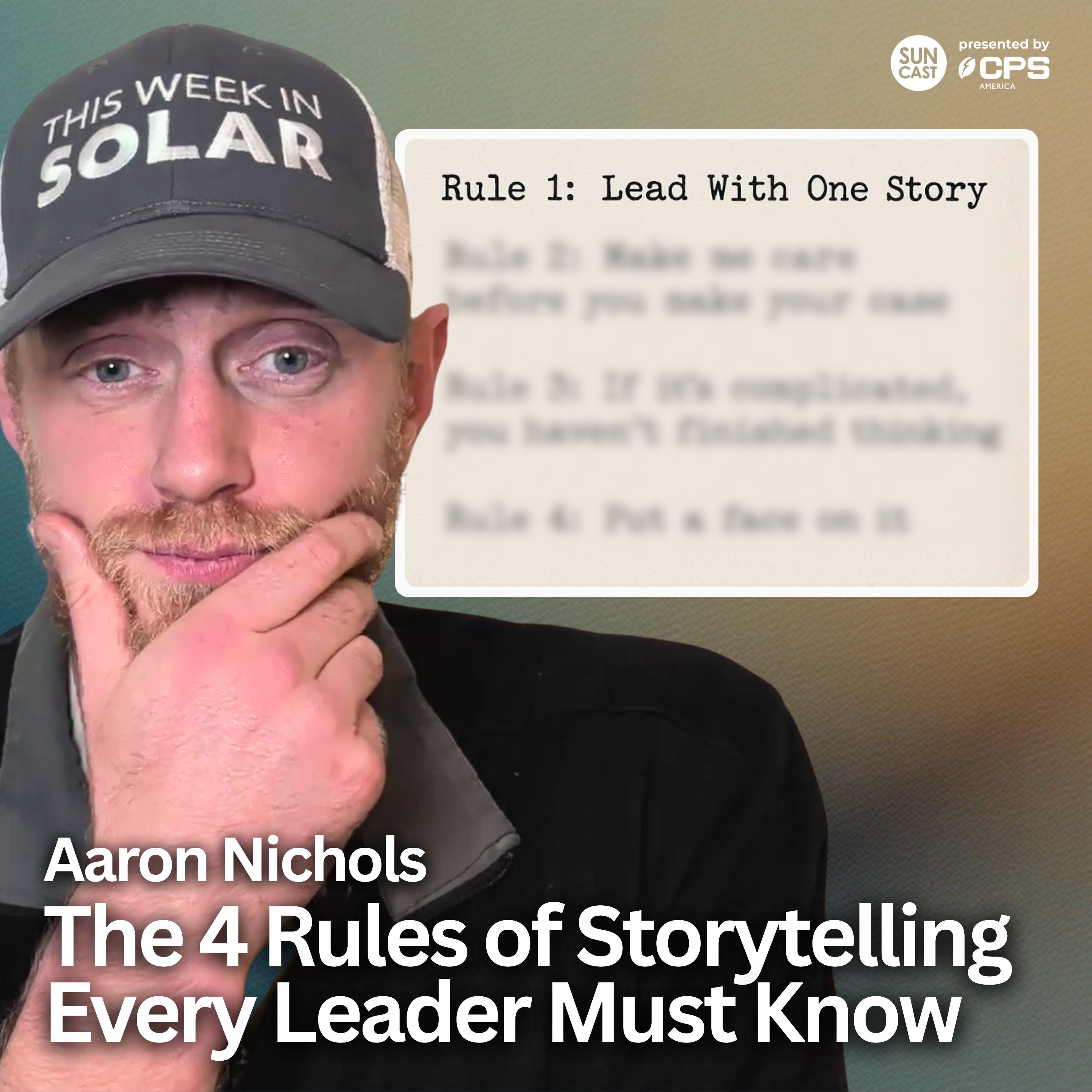
The Four Rules of Storytelling | with Aaron Nichols
56m 56s
The transcription is a conversation about the significance of storytelling in corporate America and the clean energy sector, emphasizing the need to connect with audiences on an emotional level before presenting facts. The interview with Aaron Nichols focuses on the four rules for effective storytelling, including leading with one story, making the audience care, simplifying complex information, and putting a face on the narrative. The discussion also highlights how storytelling can influence decision-making, as seen in the example of the Georgia power crisis. Overall, the conversation underscores the power of storytelling in conveying messages, building connections, and driving action in both business and community contexts.
Transcription
9118 Words, 49544 Characters
Suncast is proudly brought to you by CPS Americas. Hey, are you listening on Apple Podcasts or Spotify? Don't forget to hit that follow button. This is what you should be terrified of if you're going to be a thought leader but you lean too much on AI. Is you're eventually going to get into a room that someone has invited you into because of your content and you're not going to deliver. You're going to be an absolute disappointment. Corporate America's latest hot job is also one of the oldest in history. Storyteller, that line is from a recent Wall Street Journal article. On the surface, it sounds obvious. But when you look closer, what corporate America is calling storytelling today isn't quite what most of us mean when we use that word historically. But in the clean energy sector where the stakes are infrastructure, communities, capital and trust, the distinction really matters. How do we define storytelling and what does it mean for you as a business and as a person who cares about elevating thought leadership or at least cares about getting more eyeballs on the work that you're doing compared to your competitor? Today's episode is all about reclaiming what storytelling actually means and how founders and leaders can use it to cut through the noise in 2026. Welcome to Suncast where we help you separate truth from fiction and find the facts and the stories in the clean energy transition. We're out interviewing folks on the front lines of this clean energy transition week after week, nearly 900 episodes now. In the back catalog that I hope you will go listen to and I also wanted to say I hope that you've had a fantastic 2025 because it's almost over. Or if like many, you just had this cute up and it's now January, let's get ready for an awesome 2026. My guest today, returning for another round, is Aaron Nichols. He's a resident storyteller for exact solar and he's coast installer for solar power that has done quite well recently based on the stories I hear from Aaron and he also recently wrote a story called Four Rules for Storytelling that corporate America desperately needs. Aaron, good to see you my friend. Nico, it's good to be back. I was just looking. This is my fourth time on Suncast. I think we can call me a friend of the show now. Absolutely. You're more than a friend and I think we probably can now call you a regular contributor. Woo! I made it. I mean, it's no small feat, frankly, that we round the year out with you and I think it's a testament to the fact that, frankly, you've become one of the better industry storytellers. You've built a personal brand. You're getting more impressions on LinkedIn than I am. You've got a growing audience with you this week in solar that shout out to your colleague and get exact who made that smoke and swag for you. Pimpin had people watching us here on YouTube. But I loved about the article that you wrote. You messaged me, we're now, as recording this, is almost Christmas. We're going to publish this as the final episode of the year, of course. But this Wall Street Journal article just came out and you messaged me and you liked it. But if you read this, I've got a hot take on it. And you almost immediately published it as a LinkedIn article. I just love how quickly you are moving and how fascinated you are with setting the record straight for our industry on what storytelling really looks like. And I think that your article doesn't romanticize storytelling. It strips it down to what it actually works, especially in a complex technical industry like ours. So I wanted to use that as the frame for folks. If they haven't read the article, obviously they're going to want to go read it. We're going to talk a lot about the underpinning philosophies that you are pulling from to outline what you call the four rules for corporate America. Some of this stood out for me that I'll use as our stepping off point. The Wall Street Journal article points out that Google, Microsoft and many others are hiring storytellers. I'll put that in air quotes. But I feel like when you really read the descriptions of these job titles, it's just brand narrative shaping, customer story harvesting. You could probably say content strategy. I worked in corporate marketing for a long time and it kind of reads like the new job description for the person that's going to write the white papers inside of the company. I don't think our favorite novel writers would agree with this article around what storytelling is. When you read the Wall Street Journal piece, what jumped out at you? Not just what they said, but what they meant by storyteller. The first thing that jumped out of me was that I'm very happy that storytellers and storytelling are getting recognition as a powerful tool. I think that's amazing, especially when we're seeing the devaluation of storytelling in the age of AI. Now, when content becomes fast and cheap like we're seeing with AI, the role of someone who's shaping narrative or theme becomes much more important. So when we're talking about a storyteller at a large company, we're talking about someone who is going to be taking control of the larger story and making sure that all small pieces of content fit within the same theme and the story that the company is trying to tell. What I was worried about and the reason that I wrote the article is I'm afraid that storytelling is going to become another meaningless corporate buzzword that people basically just say at each other. Like sustainability. Yeah, like innovation. Exactly. You know, I'm afraid that it will just be like, you know, we need better storytelling and then someone's like, you're right, we need better storytelling. And then they'll both go their separate ways and they have no idea what that means. It's very important that we define esoteric terms. Aaron, I thought one of the smart things that you did in your article was establishing a baseline, what's the fact, what's the story. Where do you think companies are getting confused about the language and the foundation that we need to start from if we want to really empower storytellers? Yeah, I'll talk about what my goal is and where I think we miss the mark, especially leading up to the one big beautiful bill and then work backwards from there. So there's this interesting thing in the United States. A lot of people refer to it as the diploma divide, which is the higher educated people get, the more "progressive" they tend to be. And the higher in education levels that you get, the more you're used to working to reach conclusions. Now, when you have people who get into the higher echelons of corporate America and are working to control the flow of information at large companies, they tend to have either advanced degrees or at least bachelor's degrees in certain areas of communication. And what that means is they rely heavily on technical information and they pump out white papers and reports that are full of charts and graphs and they don't tend to do the work of breaking those ideas down into their simplest possible iterations and sending those out to the public in bite-sized pieces. And this is no one's fault, but it just has to do with the way education works, the way that we're used to showing our work in mathematics classes we're growing up or writing long essays in English class. We're used to doing a certain amount of work to reach conclusions, but we don't realize that so much of America has no desire to do that. It's like 50% of America doesn't reach what we would consider literacy. And so if you're not publishing things at a fifth grade reading level or below, you are losing so much of your potential audience. So to establish ground rules and make sure that we're actually talking about the same thing when we talk about storytelling, I think it'd be useful to define what is a fact versus what is a story. A fact is a thing that is known or proved to be true, the truth about events as opposed to interpretation. That's the Oxford English definition. And a story is a structured sequence of events designed to entertain, involving a character facing a problem, making choices, and experiencing change or growth. Human beings aren't wired to remember fact. We've been storytelling creatures for hundreds of thousands of years. And it's only recently that we've started thinking of things in the scientific method, but it's very difficult to remember facts, and they decay in the mind much faster than stories do. I think my favorite example of this that I wanted to talk about on the show is the New York Times published an article a few months ago that was in the lead up to the regional elections. One of my favorite English words, gubernatorial elections. Where they were talking about the power crisis in Georgia, and the power price crisis in Georgia. They zoomed in on a story of a single mother who was working three jobs and her energy bills had gotten out of control, and now she just couldn't make ends meet. That story went on to influence the elections, and it helped elect new people to the Public Utility Commission in Georgia. The reason that it worked is that it told one emotional story. It told the story of a single mother who is living right on the edge. And if one thing goes wrong, she's going to spin out of control, and that one thing did go wrong. It was something so far beyond her control, and so preventable that it made people take action. And it made people vote out the older public utility commissioners and vote in new public utility commissioners. And the thing I love about that story is that I remember it because it's so emotional. But what I don't remember is the amount of dollars that her bill went up by. I don't remember any of the hard facts of the story. I don't remember the numbers. But if you ask me about that New York Times article, I can tell you that there's a single mother over there who's suffering. I love that in your article. Not only do you reference this story as the place that you start, but there's this notion of story distance. And the idea that the story we're telling has to have some sense of proximity to the listener, the receiver. Folks can identify with struggling to make ends meet. They can identify with one small thing going wrong, and it blows up your budget. In the same way that at a corporate scale, the one small thing of tariffs on not just one, but 50 pieces of your balance of system, can blow up a project. And that narrative of like, you know, thousands of projects are going to stop is irrelevant to a community. But, you know, you know, John, I think you used the different name, but John, Tim, Joe, Roberto, like, they're going to lose their job. And they've trained for this. And so actually these tariffs impact a person in your community who's otherwise not paying taxes, but contributing in a healthy relationship and to kids at your kid's school. Being able to tie that to like, there's a real person whose job in procurement is going to get lost. And we're going to lose this, potentially, this company. And I would love to expand on that for a second. The example that I use when I speak about this is we always say, we're going to lose 100,000 jobs if this legislation passes. Or like you said, you know, like if we don't, if we tariff this part of the supply chain, we're going to lose X number of projects. The public has no concept of what that means. And there's a concept in sociology that certain organizations have grasped very well, which is just the bigger that a problem feels, the less likely someone is to take action towards fixing it. So if you say we're going to lose 100,000 jobs if this legislation passes, it doesn't mean anything. The human mind can't wrap itself around that other than that's big and bad. But when you say, Jim's going to lose his job. Now, Jim has a beautiful little nuclear American family. But Jim has in the past struggled with substance abuse. And he went and took a solar installer training that paid him to learn how to install solar panels. He's now a crew form and a company. He has dignity for the first time in years. His wife and his kids just absolutely adore him again. There's all of this happiness in his life. And if we pass this legislation, it's very likely that Jim's going to lose his job and that dignity and that skill set he's cultivated are going to be pulled away from him. And that will happen 100,000 times. That's what we miss when we're like big graph, big number. Totally. You know, one of the things I loved about your article is how like as intellectuals, we feel like we have to jump through all these hoops in this performative way to like maintain our esteem as intelligent people. But the story tying it to Jim or page or whoever the one singular person that you focus on is, it doesn't, it doesn't argue policy. It doesn't lead with outcomes or number of megawatts. It lets us inhabit this person's reality and then to your point. And I love this the way you did it in the article as well as you just did it here in our conversation. And that will happen to ex many others. And if you care about one, then we have to buy extension care about many. You notice this everywhere with, let's say, compassion international, one of the most successful charities ever, you sponsor one child. When you look at the Humane Society website, you see one dog at a time. When a problem is fixable and it's right in front of you, you are so much more likely to act to do something about it. And I think that we miss that as people who are used to working for conclusions and think that we like to draw our conclusions from data. And we like there to be the charts and graphs to convince ourselves that we're intelligent. I think we miss that that's not how most people operate. I mean one of my favorite jokes is that I think smart people can be way dumber than dumb people. Because we can use anything as evidence. We can convince ourselves that anything is evidence. And that's the emotional component that we've convinced ourselves that we're not subject to. While pumping out all this unemotional messaging that no one resonates with. When you're working on a solar project, you know that the right products can make or break your success. But what if you get count on one partner for all your needs, inverters, energy storage, and even balance of system components. That's exactly what CPS America delivers with a range of solutions designed to help you scale faster and more efficiently. Did you know that CPS America offers energy storage solutions that fit every size of project. Whether you're looking for a 5kWh stackable battery for small systems or a massive 5mWh battery container for utility scale installations, CPS has you covered. Their 125-250kW C&I turnkey solution is perfect for larger commercial projects. Giving you the flexibility you need to design a truly scalable system. But CPS doesn't stop there. They also provide the balance of system needed for utility scale projects, everything from medium voltage transformers to breaker boxes and switch boxes to ensure your systems are optimized for performance. And with CPS's Flex-Om remote monitoring, you can even keep an eye on your entire system in real time, making it easier to manage operations and stop potential issues before they become problems. Don't settle for less. Choose CPS or liability. You can count on. Learn more at mysuncast.com/cps You said in the article something along lines of facts are what people reach for once they already want or bought into or want to believe what it is that you're saying. That story of the lady in Georgia does more work than a stock of pulling data ever could in convincing people that there's a real need, a real story. It does more work, did more work. That story was so helpful in dethroning old people who'd been in the utility commission forever and bringing in fresh blood. So, I don't want to go through every part of the article. I would love for folks to go read the article. Those who are so inclined, I want to zoom out here from the example. Your four rules start to feel less like marketing advice and more like survival skills, especially framed in the context of this Wall Street Journal article. This is a job where the underlying skill set is being a storyteller. Let's walk through these rules. If someone wanted to stop losing people before they even get to the facts, where do they start? Rule number one is lead with one story. Start with one story. Rule number two is make me care before you make your case. Rule three is if it's complicated, you haven't finished thinking. Rule four is put a face on it. So, the first one we already kind of covered, but I'll give you another example that leads things in a positive direction. So, if you say we've helped 5,000 customers, again, big number, probably good, no one knows. I don't know if that applies to me. If you interview one of your best customers who fits into a particular use case, and then you contact people who fit into that group, and you say, "Here's how we helped Jim put solar on his warehouse and reduce his operating costs by 67%. And now he has all this money to put back into his organization and his employees are very happy." And then you say, "And we've done that 5,000 times." Once again, you have narrowed in on the emotional human impact, and then you have explained that you've done that over and over and over again. And so, even if you say, like, "We've helped 5,000 customers like Jim," the average person is going to assume, "Okay, most people had an experience like Jim." Once again, zooming in on a human impact, you have to start with one story, and then you can bring in the facts and the numbers and the data and the graphs. But if there's no context for those, if there's no anchoring piece in the framework that the human mind is just wired to understand, you're going to lose people. Now, rule two is make me care before you make your case, and it's very similar to rule one. But the idea is we overestimate the impact of logic because believing that we're rational is part of our self-mythology, especially if we're educated. We want to see ourselves as rational beings. We want to believe that, like, we've reached our conclusions through this careful search for knowledge that is based in evidence. But the truth is, you probably already believed something, and then you went and looked for stuff that backed up what you already believed, because we live in a time of infinite knowledge. And there's so much pseudoscience and influencers and people that will leads you towards whatever data they want to to justify what you already believe. I mean, that's what an echo chamber is. This is what the phrase, until they know you care, they won't care what you know is about. Now, this is why you have to meet people where their values align with your product. And this is why, at Exact Solar, we don't present environmental impact to our more conservative leaning customers. We talk about protecting your family during power outages and independence, because if we came at them with the environmental benefits argument, we'd be fighting an uphill battle that we don't need to fight. But if we come at them with the story of your family is going to be safe, then we're meeting them where they are and we're showing them that we care. So, yeah, just to review, start with one story, then use the data, rule two, make me care before you make your case. Now, rule three, my favorite one, if it's complicated, you haven't finished thinking. This is our mutual friend Spencer Meeks likes to say, "Facts fundamentally don't speak for themselves." And it's true, people have absolutely no trouble dismissing facts out of hand. They have no trouble just saying, "Ah, you've fabricated that, you made the data look like whatever to support, whatever narrative." Big words do not get your point across the way simple emotional messaging does. That is where that famous Mark Twain quote, "A lie can travel around the world twice while the truth is still putting on its shoes comes from." And this is, I mean, yeah, it's so frustrating to me that we tend to lean more on logic than emotion and clean energy. But there's so many websites out there that say things like, I mean, the thing I said in the article, the fake sentence that I wrote to make people laugh, was we offer integrated end-to-end synergistic solutions that advance materials and advance technology. Yeah. And people look at that, and their eyes glaze over, and then they leave. I mean, if it were up to me, we wouldn't publish any more white papers, we would only publish more. Yes. I actually, when I hear the word white paper, this is a personal side rant, but I sort of just like turtle into my whatever I'm wearing and I'm like, "If I'm in here, they can't make me read it." To that end, we actually, the first time I ever sold a customer on working with us on a tactical Tuesday, was when I read their white paper and said, "I can't get through this. You need me to let me interview the person who wrote it." And I'll turn it into an audio story that people will listen to. It's true. You can be self-aware there. You can be like, "Okay, well, if the point of this is to show that we're so smart that no one can understand us and therefore you should work with us because we're just in this much higher echelon." Be self-aware about that. But the point of your white paper is not to get people interested in what you're doing. So, yeah, that's what I mean, but if it's complicated, you haven't finished thinking. If you haven't taken time to write out the benefits of your offering and then break it down into the simplest terms possible, then you're asking people to put in completely unnecessary work that many people won't do. So, the four steps for doing that that I laid out in the article are just asking yourselves, you know, sitting in a group, asking the question, "What does our product do? How did we make it do that? Who has it already helped by doing that thing and why should anyone care?" And if you can answer those questions below a fifth grade reading level, you are so far ahead of so many people in this industry. And then the last one is put a face on it. And I have a line about thought leadership that you'll love that I came up with because I got some invitations to speak at some very cool events that just showed up in my inbox one day. All because of my LinkedIn presence and, you know, have been offered awards and have been invited to amazing things, all because I started writing on LinkedIn. And for anyone who's thinking, "Should I invest in thought leadership?" I have a simple yes-no matrix for you. The question you have to ask yourself when you're thinking about investing in thought leadership is, "Do I want people I don't know to talk about me in rooms that I am not in?" If the answer is yes, invest in thought leadership. If the answer is no, then it's not for you, and that's fine. Not everyone wants to be public figures, I get it. The public is not said. But so when we're talking about put a face on it, in today's world branded content from a company gets far less attention than content from a creator. And there's a couple of reasons for that, including widespread distrust of brands as a whole. Now, there are a couple exceptions to this rule, but if you're not duo-lingo liquid death or black rifle coffee, it's very unlikely that people are going to follow along with your brand and become upset with it and follow along with it like they would follow a creator. I don't know of any energy brands that want to lean into, like, off the wall zany madcap marketing. So if you don't want to do that, you need to invest in thought leadership because there's no one in the world, including me, who picks up their phone and goes, "I wonder what Bank of America is up to today." No one cares. But when you think of the Chicago Bulls, you think of Michael Jordan. When you think of Microsoft, you think of Bill Gates. Like, it's okay to tie a leader to a company and have them be the face of it. Now, audiences don't want to hear from a brand. And as traditional media shrinks, and it becomes much harder to get earned media and for that earned media to matter, people are leaning way harder into owned channels and following people with influence. So, yeah, to review, those are the four rules. Make me care before you make your case. If it's complicated, you haven't finished thinking and put a face on it. All right. Let me pause here for a moment just to make sure this is practical for you. There are just laid out his four rules that explain how stories work. What I want to add is simple way to organize the stories that you already have so that you're not starting from scratch every single time. This is something that we use in our work at Suncast, and I call it a story stack. It's part of our story map process. And if you think of it in four layers, this is not necessarily content creation, but structuring your thinking. So, let me unpack it really quickly for you. First, your origin story says not your founding date. It's the moment something bothered you enough that you couldn't ignore it anymore. A frustration, a failure, a constraint, a line that you cross where you said there's got to be a better way fill in the blank. So think through that origin story. Maybe it's multi-layered multifaceted, but you've got to have something that is akin to an origin story. And again, it's not, you know, January of 2016. It is, it's not date bound, but it could be event bound. The second is your hero story. And this is where most companies get it wrong, frankly. See, the hero is not you, as you've heard from some of the stories we've covered. It's the customer, the community member, the operator, the employee whose life or work changes because you exist. You have to identify one or more hero stories so that you can repeatedly tell them. The purpose of the hero story is to help someone identify with the change you seek to make through your business. Here is your impact story. And this is obviously different from the hero story. It's the before and after. Not in megawatts or percentages, but in what became easier, safer, cheaper, more dignified because of the work. So the distinction between the hero story and the impact story could be thought of as the distinction between a person and a project. Often an impact story will like the greenhouse story that Aaron tells often will unpack an impact on a broader community through a specific story line. Whereas a hero story will identify a specific person and the journey they grew through and transforming because of their in their ability to interact with your product. The fourth is your future story. This is where you're going to be if the work scales. It's not a vision statement. It's a picture that people can step into. When you pair these four layers with Aaron's rules, you start with one story and make me care before you make your case, simplify relentlessly and then put a face on it. Telling stops being a creative exercise and starts becoming leadership work because it is how you compel others to come along in the journey with you. And that's precisely the distinction that I want to leave you with. You know what's striking to me is that none of these rules are really implicitly about storytelling. It's about doing the hard thinking that folks often will rush past when they are simply being reflexive. It's like the line that often I think attributed to Churchill, I'd written you a short letter, but I didn't have the time. I've heard that by twin. Yeah, by twin. That's one of the great thinkers of our time. I mean, it's hard to simplify complex things. It's hard to take complex things and make people interested in them. But that's the work. That's the job. And it's also the coolest thing in the world when you get it right. And someone comes to you and someone who normally wouldn't have understood something now understands it and wants the thing that you sell. I feel like sometimes folks skip it because it doesn't look productive and it's not easily tracked back to a KPI. But the problem is when you skip this step, you don't just end up with bad or errand messaging. You end up with stories that don't really survive contact with the real world. We saw that this whole past year, right? Folks thinking that we were coming up with great data and reasons logic for why the IRA needed to exist. The reality is that communities don't trust it. Customers don't repeat what you're saying back to you or to their neighbors. And then your opponents get to define a reality for them. I think we see this all the time, certainly in the kind of grassroots marketing or on-the-ground marketing that folks like you are doing in residential solar. Yeah, and I'm very grateful that I've started my career in residential solar. I don't know where my career is going to take me, but I am so grateful that I have been forced to be beholden to the public because that hasn't been a standard in energy. I mean, the standard for energy marketing was set by the utilities forever and they were regional monopolies. They didn't have to market to anyone. And so we're starting with a low bar, but this work is so fulfilling when you get it right. The reason that we're seeing Storyteller as a label, as a job description is because companies are recognizing that often it's there's maybe one or two people. Inigmatic charismatic people inside the business who are great storytellers, but it's so hard to capture that story and put it into a translatable format that others within the company understand and can repeat and that customers will tell in rooms where you're not present. I think that that for me is kind of like when I reflect back on the Wall Street Journal piece, it's like that's what people are trying to get at. They're like, what's the evolution now of marketing if we don't trust white papers? And we got to use this thing called social media. And I think one important thing that I want to expand on that you said is identifying people who want to be thought leaders within your organization is key. But giving them creative control is the only way anything's going to grow. I mean, when we talk about like I started this week in solar in April, we just passed 450 subscribers today. The only reason that's worked and is working is because I have full creative control over it. The only reason I have generated 1.5 million impressions this year on LinkedIn is because I have full creative control of it as a channel. And, you know, you have to make sure that someone has a good moral compass. Like they're not going to, you know, share interior company gossip and slander the CEOs on their channel. But if you force a creative person to go through six rounds of approval to post anything on social media, it's going to lose anything that makes it interesting or good. Hey, really quick note. I know that you probably have heard me mention open solar here. I've had Bertie, the founder on the show before open solar has been a trusted platform for solar design and sales globally for thousands of you all. And now it's something much, much bigger with the release of OS 3.0. Open solar has introduced app power design, lead gen, smarter proposals, upgraded CRM and invoicing and an all new shop experience for equipment ordering. Yes, all in one platform, open solar is not just about design and sales anymore. It is literally an operating system for your whole business supporting your team from lead to install and beyond. You check out OS 3.0 by clicking on the link that we've put down in the show notes. Congrats, open solar for the latest launch, break in records and changing the way the industry operates. Hope that you'll try it out too. Hey, pardon the interruption, but I wanted to just let you know how much of an impact you have on Suncast. Yeah, you, thank you for clicking play. Without you, this show is just me shouting into the void. But there's still people who don't even know about Suncast. I know I can hardly believe it myself, but that's where you can help me yet again. There's a simple way that you can show some love and help others discover the show. If you cruise over to www.ratethispodcast.com/suncast, I'd love it if you would leave a five star rating and enthusiastic review. That's possibly the single kind of thing that you could do for me today. So if the show has helped, inspired or even entertained you at all, I'd love it if you would head over to rate this podcast.com/suncast and give me a virtual two thumbs up. Alright, back to today's episode. In modern storytelling, there's one more forced multiplier or forced pressing as it might be on all of the ecosystem. The ecosystem and that is AI. When your story isn't clear and human, then I think that the model, the LLM, the way that our collective stories are being compressed. They give flattened or worse, it'll make a story up for you. I'd love to hear your thoughts, Aaron, in this AI affected world, the importance of owning a story and being proactive about it. I've been very grumpy and curmudgeonly about AI and I've been an AI skeptic since day one on LinkedIn. I've finally come around because I've been challenged a couple of times, people are like, dude, it's not going anywhere. You're not going to do anything by this. It's like being a search engine curmudgeon. Yeah, exactly. You're lucky with that. But my main beef with it has been the devaluing of art. But I've finally realized that AI art just really isn't that interesting. I mean, you see it once and then you're like, okay, now that's the new thing the computer can do. Whereas if you're someone who enjoys human art, it's the process that went into the creation of it that makes it interesting. If it can be generated in an instant by a computer, then it has no value. That's where I finally was like, all right, I'm okay. So, to bring it back to what we were saying at the beginning, the role of a storyteller in the age of AI is to be in control of narrative. It is now so much easier to generate 10 times the amount of content you could before. But if no one is watching that, you're going to end up with a bunch of stuff that goes in a bunch of different directions that has no soul and no personality and doesn't move anyone towards any sort of emotional action. That's why it's very important that you have a hybrid model, where if you're using AI, you have someone who's, you know, I don't want to take my own horn too much. But just someone who has studied narrative and who has a background in education or marketing or can actually say, like, we can't put that out. That doesn't represent us well. Right. And I think the question that a lot of people don't ask themselves before they post AI content, and I'm very brutal on my own LinkedIn with just hitting the X when I see content that's clearly AI generated. I'm not, I don't want, I have no interest in this because you're demonstrating to me that you're not an expert if you have just generated something and just put it out there without editing it. And I think the thing that we don't ask ourselves enough when we're about to publish AI content is, is this dumb? Because I think AI is an accentuator and left to its own devices, it sounds ridiculous. Yeah. That's the thing that has made me very hopeful is realizing that it's an accentuator and not something that'll do it for you. Because if you were previously annoying, you can now be annoying at scale. If you previously weren't that good at what you were doing, you're now very not good at what you were doing, louder. And more people know. I think a lot of folks who are going to hear this episode at the end of the year, maybe beginning of 2026, and they're sitting down thinking and planning 2026, they're probably using AI to help them get through the, the, the drudgery of it as most, as most of us are kind of using AI as a thought, a thought partner. And it's amazing. I love bouncing ideas off of it. I've never, I've never, I don't have writers block anymore. That part of it's fantastic. I used to sit there for like an hour at a time, just looking at a word doc, unable to generate words sometimes. And then sometimes it would flow. But you know, it's, I don't deal with that anymore. That part of it's great. For folks who are sitting and thinking about their content strategy for 2026, and how they're going to infuse storytelling and perhaps higher story tellers into their content process. I want to focus not necessarily on content, but on clarity. Is there advice that you would give them like do this in the month of January to gain more clarity in your storytelling process beyond the four rules? If you go back to rule three in my article, if it's complicated, you haven't finished thinking and look at my exercise for creating clarity. That is four parts. Yeah. I think the most important question and the question that very few people ask themselves because it's terrifying is why should anyone care about this? I love that part of your article by the way. I sent it to my team and said every product in our, in our portfolio needs to go through this litmus test. Well, that's amazing. And I'm very flattered. Thank you. But if you've never asked yourself that question, I promise you on the other side of it is the most beautiful freeing feeling. But it's a difficult exercise to go through because you have to be very honest. And you have to be honest about what you actually care about. You have to be honest about what content do I actually consume? Am I creating content that I would consume? Like what new letters do I actually read? What stuff do I actually listen to? Would I listen to this if I put it out? Yeah, I think one of the things that I find when I press, when I stop recording after having deep conversations with folks asking them about their stories is to my surprise. And this is not a knock on marketing teams. I find a lot of folks don't kind of straight to production. And they're so busy with website redesign and event trade show strategy that it's hard to capture story. I find so many executives say, gosh, I've never told this story before or we should be using that some of the things I said in this interview. So I learned from that and it's part of the product that is now sort of the productization of the Suncast method if you were as it were is. We help folks kind of slow that thing, but at moment down do the thinking once and let the stories flow from it capture them and be able to repurpose them. It's really difficult work exactly as you said before the hard part is the work of capturing the stories and thinking in the micro not the macro thinking about the individual who is losing their job not the statistic of job loss. I'm noodling on and if if we successfully do this in the next week, I will publish it as a link here, but folks should be looking for it like I often walk through sort of a series of story arcs that I coach people on how to tell origin story your hero story. An impact story and future stories are for examples and it's not content it's a thinking tool helps you unpack where impact has been found just to refer back to kind of how you unpack the way to apply rule three in your work force workplaces what is the product do how do we make it do that. Who has it already helped by doing that and and why should anyone care and if you can use those frames of reference while thinking about your origin stories start to be able to pull in. Human interactions that have influenced the way your product is shaped have influenced the way the execution on a product like the I remember the greenhouse story still sticks with me like the way you guys executed on that project. And therefore the story implicitly helps others see I am like those people and I want that thing and knowing who to bring in to help tell that story for you but I yeah I want to take a second to honor. That work that you do at suncast with executives because that's what we lose when people lean too much on AI and that's the value of writing that's the value of sitting down and saying like what do I actually believe like what's going on in here. That's the thing that keeps me eternally curious and that's what we lose when people lean too much on AI is the outsource that and then this is the scary thing this is what you should be terrified of if you're going to be a thought leader but you lean too much. On AI is your eventually going to get into a room that someone has invited you into because of your content right and you're not going to deliver you're going to be an absolute disappointment. And so that is the value of sitting and going through those exercises like Nico just laid out and thinking of a product story and being like really honest with yourself about why someone should care about this. Now the greenhouse story I love telling this story because it's just one of the proudest the coolest things I've ever been involved in as a human being and one of the proudest moments of my career but. In late 2023 we put the finishing touches on a project for a school in Philadelphia it's very close to the Kensington area which if you're not familiar with it Google it it's infamous not for good reasons. Kensington is a food desert and we through a series of nonprofits and a bunch of people working very hard to make this happen we were lucky enough to install a off grid battery backed solar energy system that powered a hydroponic greenhouse in right on the grounds of this school this beautiful open lawn. And the students from the school work in there to grow organic produce and then they take the produce that they couldn't eat and they sell it in an onsite farmers market. And like I said before that areas of food desert which means there's no access to produce yeah. There's so many things I love about that story but when I give talks on this which I've been lucky enough to do a couple times now get on stages and explain this. I'll say like I'm going to tell you two stories and you tell me which was more compelling and I tell the first one which is what I just said and then the second one will be like. We built this off grid solar energy system with this brand of batteries and this many of this brand of micro inverters and it produces this amount of electricity. And I'm just trying to illustrate and how many trees it offsets and cars exactly just trying to illustrate the point that we lose what's important about this what the beautiful work we do in the technical specifications and then I tell a joke that always does really well where I'm like. How many of you here have gotten in an emotional argument with your significant other and then immediately pulled up a graph to show them that you were right. And then if someone raises their hand I'm like and how did that go and they always shake their head yeah obviously. But we think that we can do this to strangers that we don't know online is the that's the exact same thing and it's crazy but then. Like the thing that I love so much about the greenhouse story is that we were able to segment messaging and bring in so many people who just went and told the story for us. We were like hey congressman like the federal congressman came and spoke at the event and cut the ribbon because we were like this is a school this is green energy there's going to be you know like you can be photographed in front of these kids saying that you care about this thing. And then we talk to the press and we were like the federal congressman is going to be here and you can photograph in front of these kids in this solar energy system because you care about this thing. And then I mean it's on and on that story got us into NPR we were able to package it is all these materials on the inside of our company and show it to nonprofits and it's just it's had this incredible snowballing effect. But it's it's so important to reiterate that zero of the things that are interesting about that system are the panel brands the inverter brands the battery brands and the amount of power it produces. And thank you for sharing those stories I genuinely enjoy and as a result believe that you are great storyteller I hope the folks can recognize that the conversation today isn't really about becoming a storyteller but rather becoming understandable and relatable there's much to do it's like finding the introducing sustainability into a business or like you said arriving at innovation. These are words we try to wrap around a process of of sharing relatable authentic commentary. I think that that's the piece that stands out for me about the stuff that I see that you put out it's so it's also it's a lot of underlying element of the work that we do as sunglasses trying to humanize the story. The example I give folks sometimes is that a lot of folks even within companies have come back to me and said I didn't know this about founder that I work for. But when you can help someone who's perhaps working for a guy like an enigmatic sort of huge charisma personality founder like a dance sugar recognize that he puts his pants on one like it old time like you and I. And beyond just trying to engage communities with our stories about why you know these huge metal structures and glass panels are helping save the environment. Even within our industry and within our companies these telling these stories gives the here the viewer the ability to hold on to something that they that wasn't tangible before right. So as we're wrapping this up. I just I want to commend you for the work that you do at some cast and also just the impact you've had in my own life when I think about my own story I'd like to talk about the fact that I met circus girls on the beach in Ecuador and that's how I ended up in solar energy I didn't take any sort of. Clean career path to get here I was traveling for years after getting evacuated from the Paul thinking I was going to be in peace core for two years only being there for seven weeks. And I came home and I wanted to work in clean energy and I had just done a six week solar installer training. And the only thing I had back then was my ability to post on LinkedIn and I was going through a fruitless job search and then eventually just was doing contract work. And you were one of the only people that saw potential in that you were one of the only people that reached out to me and asked me to join a you were the only person that reached out to me and asked me to join a. A returned peace core volunteers group and helped me get work with some of the biggest companies in the industry before I went full time with exact solar and so you have believed in this in the power of storytelling for a very long time and that's why I was so excited to when I saw this article and why I wanted to do an episode like this is because I knew that you see the value. And I know that you are more skilled at this than many people in the industry and that you've talked a lot about how you've gone to conferences and people have said story tellings in need in the industry and you know I that's that was the example I thought of when I was thinking of what do we mean when we say storytelling do we just go to conferences and everyone says we need better storytelling. And then we all go our separate ways and we're like we've all agreed that we need the thing and we've all made the noise the experts have spoken and they said the words so now we go on with our lives i don't want to be like that. And that's what you do beautifully at suncast and that's why anyone should come go through the work of doing their product offering with. Thank you for those kind of words Aaron if this episode accomplishes its goal I hope that it is reframing storytelling for you not as marketing polish but truly as leadership work putting together a story stack worksheet where you can learn to unpack your origin hero impact and future stories paired with errands for rules and designed as an end of your reflection tool. And even a twenty twenty six planning weapon if I may be so bold and if this resonated perhaps you consider joining us for a story map workshop part of our story studio help companies do this thinking before it turns into content will link in the show notes how you can find more resources let us know in the comments on youtube if you'd like to see us do. A full on workshop would you be willing to pay to attend that workshop would you be interested in a mini series to break down each of the steps that we work through and I'm curious to hear your own reflections on the stories to help move your narrative forward. Thanks as always to Aaron and to you all it's been a hell of a year we've been through a lot the stories that we tell. Be those of lamenting the woes or building each other up and projecting into the future that reality that we wish for ourselves and everyone else as the host of sun cast. I wish you well thank you for two thousand twenty five and all that came with it and I wish for you in two thousand twenty six as well as for ourselves. A prosperous positive year of momentum remember you are what you listen to thank you for showing up solar warrior today and every day for giving us a chance to earn your attention. Showing up is half the battle you know happy new year.
Podcast Summary
Key Points:
Suncast podcast is sponsored by CPS Americas.
Discussion on the importance of storytelling in corporate America and the clean energy sector.
Interview with Aaron Nichols, a resident storyteller for Exact Solar, discussing the four rules for storytelling.
Importance of leading with one story, making the audience care before presenting the case, and simplifying complex information.
Example of the impact of storytelling in influencing decisions, such as in the Georgia power crisis case.
Summary:
The transcription is a conversation about the significance of storytelling in corporate America and the clean energy sector, emphasizing the need to connect with audiences on an emotional level before presenting facts. The interview with Aaron Nichols focuses on the four rules for effective storytelling, including leading with one story, making the audience care, simplifying complex information, and putting a face on the narrative. The discussion also highlights how storytelling can influence decision-making, as seen in the example of the Georgia power crisis.
Overall, the conversation underscores the power of storytelling in conveying messages, building connections, and driving action in both business and community contexts.
FAQs
Storytelling is crucial for businesses and individuals aiming to elevate their thought leadership and stand out in their industry by effectively communicating their message and engaging their audience.
Storytelling in the clean energy sector is essential for conveying the importance of initiatives, building trust with stakeholders, and cutting through the noise to educate and inspire action.
Key rules for effective storytelling include leading with one story, making the audience care before presenting facts, simplifying complex ideas, and putting a human face on the narrative.
Human stories resonate more with audiences, evoke emotions, and drive action better than just presenting data or statistics, making the message more relatable and impactful.
Tailoring stories to align with the values and perspectives of different audiences helps in creating meaningful connections and engaging them on a personal level.
Chat with AI
Loading...
Pro features
Go deeper with this episode
Unlock creator-grade tools that turn any transcript into show notes and subtitle files.
 PodcastTranscript AI