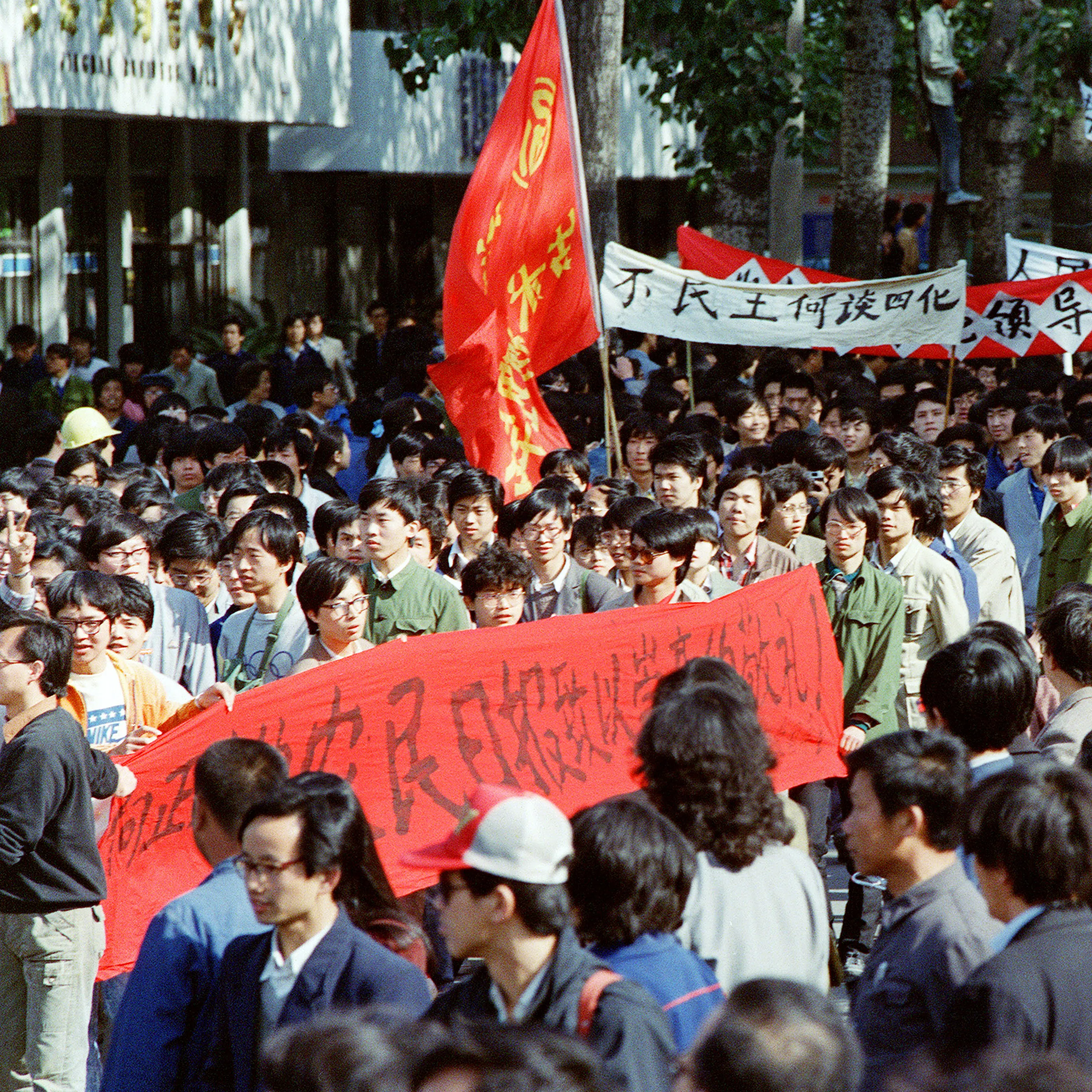
The Economics That Drove the Tiananmen Square Protests
38m 44s
The Lionel Gilbert Prize, presented by the Monk School at the University of Toronto, honors the best international affairs book in English. The 2026 winner is Francis J. Gavin for *Thinking Historically*. The podcast episode "Ones and Twos" launches a mini-series on hidden economic histories, focusing on the Tiananmen Square protests of 1989. It argues that these protests were not solely about political rights but were deeply rooted in economic dislocations from China's rapid reform and opening up. By the mid-1980s, China's economy grew at 11% annually, causing overheating and inflation that reached 20% in 1988. A complex multi-tiered price system led to distributional struggles, with urban intellectuals and workers bearing the brunt. The protesters demanded democracy as a way to manage these socio-economic changes, linking rights to the need for accountable reform. After the crackdown, U.S. sanctions and a halt in World Bank financing worsened the situation, while China imposed deflationary austerity, slowing growth. Deng Xiaoping's 1992 southern tour reversed this, doubling down on market reforms and attracting a surge in foreign investment. This accelerated growth but also set the stage for later social protests in the late 1990s, as Mao-era industrial workers were displaced. The episode reframes Tiananmen as a pivotal moment in China's economic trajectory, where repression and neoliberal reform became intertwined.
Every year, the Lionel Gilbert Prize honors the world's best book on international affairs published in English. The prize is presented by the Monk School of Global Affairs and Public Policy at the University of Toronto. The 2026 winner is Francis J. Gavin, for his examination of how history can help us understand and navigate the complex and confusing world around us. It's called Thinking Historically, a guide to state craft and strategy published by Yale University Press. Gavin will deliver the 2026 Lionel Gilbert Prize lecture on April 15th, 2026 and you can register to attend online. Visit gilbert.monkschool.u Toronto.ca for more details on the 2026 Lionel Gilbert Prize. Hi and welcome to Ones and twos fp's economics podcast every week. We take a couple data points. Use them to try to explain the world. I'm Cameron Abadi, fp's deputy editor with you in Berlin, Germany. Joining me as always is fp's economics columnist and Columbia University professor Adam twos this week in New York. I'm just fair warning, Adam just returned from China's feeling a little under the weather. You might hear that over the course of the episode through the microphone, but he is prepared for the episode so we shouldn't otherwise notice. We soldier on. We soldier on. That's right. That's the motto. That's the motto of this podcast. We soldier. But in any case, it is a special episode actually this week. Since the Tiananmen Square demonstrations and massacre that began in April 1989. So we're coming up on an anniversary if not a round one. And preparing for this week's episode, Adam actually had proposed the idea of a new intermittent mini series. We have a variety of those at any given time. And he suggested basically something under the heading of the hidden economic histories. Basically looking at historical events that otherwise might not be thought of as having an economic dimension and looking at them from that perspective and Claudia or producer and I both thought that was a great idea. And what better way to start than the Tiananmen Square demonstrations, which are coming up as I mentioned to this anniversary. And I would imagine most listeners are familiar with Tiananmen Square basically for those who need a very brief refresher. It was the site of one of the largest protest movements in modern Chinese history with students calling for reforms and accountability. And in the early days of June, there was a violent military crackdown. And yeah, again, mostly thought of this incident in the context of the sort of democratic reforms that the students were demanding. But the premise here is that there is an economic dimension both in the run-up and the aftermath. And we thought we would try to unpack that. And basically to start off with that, if we were to look at the sort of circumstances that led to the protests in the first place, could we say that there are economic circumstances that were informing these protests? And fatiguedly yes. And I must admit, this came to me as a considerable shock when I first encountered the work of Chinese scholars on this question. I had a brilliant graduate student that was working on these issues and for whom it was just completely obvious that Tiananmen Square was a socio-economic protest as well or a political protest linked to socio-economic change. And it's worth underlining, I think, that in 1989 we think the fall of the Berlin Wall on the one hand and Tiananmen on the other. And I do think in our minds that the fall of the Soviet block economic system has a clear economic etiology. We associate the collapse of the regimes with economic failure first and foremost in a driving force of the Berlin Wall coming down was the huge gradient of the standard of living between two parts of a city. The Chinese events on the other hand do I think tend to get read fundamentally first and foremost through the language of political rights, civil rights and not surprisingly given the heroism of the protesters and the consequences they faced. But digging into this and coming very much under the influence of what's known as the Chinese new left, I had the privilege recently in Beijing of sitting down with Wang Huai, the leading figure of the Chinese new left. It's quite clear that a far more satisfactory way of thinking about the 1989 moment in China is as part of a broader global process of economic and political upheaval that begins you might say with Satjara and Reagan and the Latin American debt crises and rumbles through to the collapse of the Eastern European economy is but also to China. And so from this point of view the 1989 protests in China are not as it were the vain heroic charge of human rights activists against the monolithic totalitarian state that lashes back with massive force but much more familiar if you like protests over the process of reform in China. So they aren't just protests for reform, they're protests about reforms which are ongoing and they are inherently political but they're inherently political because it was only by way of full democratic participation, freedom of the press, democracy ultimately, the protesters believed the economic changes that were ongoing in China could be given an acceptable direction. In other words you could say that these were social democratic protests or if they were liberal they were liberalism in the service of a social democratic vision. What concretely do we mean? Well everyone will be familiar I imagine that from the early 1980s China embarked on this process of reform and opening up and this is a two track process most of China still lives in the countryside. The countryside is not heavily involved in the 1988-1989 protests but urban China truly is in a very comprehensive way. The protests in Gen. Square, the great central square of Beijing, Beijing's political heart are just part of a much broader fermant of social protests across urban China and those protests they could be read a little bit more like Solidarnoskin Poland for instance which was the great trade union movement which unhinged communism in Poland. These protests are about the consequences for Chinese urban society including intellectuals and academics and university students of the increasingly disorderly chaotic politically indecisive process of reform that was being driven by Beijing from you know Deng's return to power. There was never any question in Deng's mind that those reforms were first and foremost about centralizing political power and maintaining the power of the CCP. So if you protest about the reforms you're protesting about the CCP you're protesting about the terms under which this is ongoing and what is the substance. Well again you can just normalize this if you have an economy like China's that in the mid 1980s is growing at 11% per annum what would you expect the problems to be? The problems were essentially those of an overheating economy suffering from huge price pressure and inflation which are even on official numbers by 1988 had reached 20% and was heading in the wrong direction and the associated pressures within society that result from any kind of inflationary process like this. Influations are first and foremost distributional struggles over who gets access to credit, who gets the raised prices, who gouges who if you like in the inflationary process. And the genomics where protests are a demand that if we're going to do this economic reform and there's going to be a huge social and economic redistribution then it's all the more essential that we have human rights freedom of the press and ultimately democracy. And this comes to a head in 8889 over very specific economic issues because China was operating this complex multi tiered price system which had many attractive features because it stabilized bits of society where you had stable prices but the bits of the society where prices were liberalized where where you could make the profits. Unsurprisingly, stuff resources services get siphoned from one sector to the other. So then market reformers within the party say oh you know what we ought to do is comprehensive price liberalization and when you say that to people as they did in the summer of 88 everyone in their right mind starts yanking their money out of their savings accounts. So as to prepare for the inflationary shock that's coming because it's quite clear that prices aren't equilibrated and when that happens you have the makings of a financial crisis and you have huge social tensions within Chinese society as different groups notably including public servants and academics who of course are this distinguished class within Chinese society who are going to many cases head towards civil servants careers which have been reinstated in the 70s and early 80s through the competitive exam system and so on.
They are at the wrong end of the inflationary bargain. So unspricingly, this isn't in any way to diminish the heroism of the student and other liberal intellectual protesters in '89, but they had some to protest about. That's the key point to make, right? That these demands for rights were tied to a diagnosis of the massively lopsided nature of socio-economic change in China, in the '80s, which wasn't just a stagnating, fossilized, Stalinist, Soviet, Maoist system on the country, it was a rapidly growing, increasingly marketized system, and that made it all the more important to have these rights. So this is the, this is, you know, there's controversy, there's arguments back and forth, folks from the liberal side will stress other elements of 1989 more, but I don't think anyone disputes that, you know, that immediate driver here were socio-economic dislocations, which also accounts for the fact that the protest drew in not students only, and that by itself wouldn't have been so worrying, but also large parts of working class and indeed even white collar workers across China. And so, yeah, really, it's a little bit like civil rights in the US, which has been subsequently rewritten as a story of lack in franchisement only, which is, of course, crucial, but that too was actually, and this is something we made me should come back to in another episode in this series, that too was a socio-economic protest as well, because it's only the two together that both socio-economic and liberal rights together that really, that really, you get the full package. - Mm-hmm, yeah, that is certainly a good idea for a future episode in this series, but yeah, and I do wanna talk about how these tensions were resolved in China in the medium term, but clearly in the immediate term, this struggle you're describing was resolved with this military crackdown I mentioned, and hundreds at least were killed in tens of thousands or arrested or imprisoned, and that itself had an immediate effect on US politics, and the United States imposed sanctions on China in the immediate aftermath, and I'm just curious in that sort of short term aftermath of the massacre, what was the effects of those US sanctions on China? - Yeah, this again is like a really pivotal moment in contemporary US debates, 'cause this listeners will be well aware, like there's a huge ongoing debate now, 20, 30 years later, over the terms under which the United States shepherded midwife the Chinese economy into the global economy, and this arguably is one of the absolutely key turning points in that process, the WTO accession at the end of the 90s and the early 2000s, but the immediate aftermath of Chen and men is another such moment, and I think crucial to think about. On the face of it, you'd say the stakes were clear, you have a near conservative government underbush in the US, though one that's also quite pragmatic, you have a hugely unequal balance of force, so US trade to China is a couple of percentage points of US GDP, or even a couple of percentage points of US trade, so really a modest share, whereas Chinese trades to the United States could account for as much as a fifth of all of Chinese exports, so hugely unbalanced, and of course you can add the Europeans into this picture who were also incensed at what had happened. By the end of the 80s, in 88, 1988, you had over 15,000 ventures with foreign capital in China, foreign direct investment had reached noional commitments of 28 billion with actual paid in capital of close to 12 billion, so there was something to work with here, right? And there were pressure points you could exert, and this was after all the high point of the end of history moment, so it didn't take long for American liberals to label China as a discredited regime, as a backlash state, as a state that had to be civilized and brought into line, it was a small step from Chenerman Square to, I don't know, looking at what was happening in Romania at the time, or the Soviet Union, and saying to yourself, "Right, okay, we're going to roll back this entire regime." And so in the immediate aftermath, there are wide range of sanctions, not immediately on trade, but on international finance, especially through the World Bank, of which China at that point was still a significant recipient, a total end of any kind of mill-mill contacts, the sort of thing which had grown out of Kissinger's visit, famous visit to China in the early 1970s, where all of those shutters come down, and a freeze of intergovernmental contacts at the public level, famously the Bush administration sent back channel messages to Beijing that they had to understand the politics of this, but offering to remain interested in the relationship. There is also a huge drop-off in corporate FDI, and corporate investment in China in the immediate aftermath in 1989, 1990. If you read like the Californian Business Review in places, in fact venues like that, there is a huge pulling back. But again, the crucial point to emphasize here is the macroeconomics of China itself. And this is where the continuity to the pre-1989 history is also important, because if you believe that what the crisis as a socioeconomic phenomenon was about, or as a political phenomenon was about, in other words, the collective political management of very rapid overheating growth, and one of the triggers were proposals for various types of price-shock therapy, if you like. Then the real hit that's coming the Chinese economies way is the economic answer to those problems, which is imposed very vigorously by the people, the more conservative forces that take power in Beijing in the wake of the disaster, the liberals are discredited by the protests and the need to call in the PLA. And so China imposes on itself a deflationary austerity regime in 1989, 1990. Now that goes hand in hand with the fact they can't get foreign finance, right? So the World Bank is no longer funding them. International agencies aren't funding them. They're suffering a sudden stop of external finance. So like any other developing market or emerging market under those circumstances, what do you have to do? You have to shrink domestic demand in China. And that's what really leads to this sudden of rough slowdown in Chinese economic growth in the early 1990s is the working through of the internal macroeconomic logic, which had led to the popular protest of AT889 is the decision by Beijing then to just slow down the growth, reduce the inflation refresher, which they finally get under control in the mid 1990s. Yeah, so I guess this is sort of beginning to address the next question I wanted to ask, which is to the extent that these protests were informed by this economic situation, what sort of economic shift then happened in China after these protests? I mean, did China produce a new economic model to respond to the tensions that informed the protests in the first place? So initially that is the open question and the drama of Chinese politics in the early 1990s at the governmental top level is what next? If the reform program of the '80s had led to increasingly unhinged growth and chaos and then the protests and then the crackdown, could you go back down that route? And conservatives within the CPC are arguing that China shouldn't go down that route. It should maintain a kind of oppressive conservative position and slow growth down so as to make it more manageable. And this is then the drama of Deng Xiaoping's famous southern tour between the 18th of January and the 21st of February 1992 when he gets in his personal train with his entourage and China so vast, right? So this is like 19th century America. The president goes to the West Coast or whatever. Now, Deng Xiaoping processes down from Beijing to the southern centers and the coastal centers of Chinese economic growth and says, we are restarting this growth process. And that's the drama of Deng's southern tour is no, we are not retreating from the special economic zones. We're not going to shut Chen Zenduan. We are going to double down on market-driven processes of reform. We're going to increase foreign investment, which surges extraordinarily dramatically in the early '90s. We're going to double down on growth and then it comes with this classic, dengist line development comrades is the hard truth. So we are going to have to, the only way out here is through. So we're going to push on with economic development even at the risk of further destabilization. And if necessary, at the risk of further repression, that's the story. It's a double message, right? This is very much the new left Chinese vision that neoliberalism comes to China, not despite Chen nmen, but because of Chen nmen. It's what Chen nmen sets up the conditions for the accelerated dramatic growth of the 1990s, which culminates in the most radical form of market reform in China at the end of the 1990s in the strategy of breaking the iron rice bowl of comprehensively stripping down the Maoist heavy industrial sector, which produces.
It's a huge social shift in China because the modern growth in the new growth in Chinese cities is driven by peasants from the countryside migrants, whereas at the same time in the late 1990s, an entire generation of mal-era industrial workers, folks that had become industrial workers in the '56s, '70s, are thrown out of their jobs. And there's a huge new wave of social protest in the late '90s and early 2000s, which goes largely under-reported. But yes, this is the incredibly high drama of Chinese economic period policy in this moment, is this doubling down in 1992 after the Chairman. That's interesting that there is also this new element that you suggest, the potential for repression is explicit. And I don't know if that was implicit, prior to the Tiananmen at all, or whether that was itself a kind of shocking realization to the system to have that level of repression, but then I guess afterwards this was then sort of integrated into the model in a more explicit, politically economic way. Well, it goes through phases and we can talk more about that later on, but I mean, the PLA had after all been the decisive factor in the stabilization of the cultural revolution as well. So for the PLA to play this role is not in and of itself, you know, anomalous, but it's a sign of existential crisis if you're going to do this, right? This is an army which understands itself after all, as the party's army, that's clear, but the party's claim is that it effectively represents Chinese society, so to find yourself in a position where you're having to, you know, a certain martial law, you're going down the route of the polls, because the Chinese, of course, anxiously and continuously scanning events in Eastern Europe is a disaster. I'm not saying this lightly, I'm not saying that, oh well, now they have the military, they are going to do pinotio stay on there. A little bit of no, that's not the point. The point is the den says we need to go on rolling the dice, we need to go on pushing down this route. Okay, we're going to take a quick break right here, but we'll be back in a second to continue talking about the hidden economic history of the Tiananmen Square protests. Today's episode is sponsored by IQT. Modern missions depend on systems that can adapt quickly, but traditional supply chains and production models often cannot match the pace of real world demands. Robotics, automation and advanced manufacturing are beginning to change that landscape. IQT works with innovators, building technologies that help the United States produce, repair and scale critical capabilities faster, with greater flexibility and with better resilience when conditions shift unexpectedly. Learn more at IQT.org. The digital world feels more chaotic than ever. Change data breaches, AI threatening jobs, foreign meddling, that creeping feeling of obsolescence. It's information overload. I'm Dina Taborest, host of Click Here from PRX and Recording Future News. Wanna understand how we got here and how you can get ahead of it all? Listen to Click Here. We can help you make sense of all the noise wherever you get your podcasts. To shift back to the international context again, clearly the post-TNNmen sanctions set certain terms it seemed like of a relationship with China from international institutions and countries like the United States. But then China in the years afterwards was ultimately reintegrated into the global economy and I'm curious about the terms of that shift. What was the bargain then involved in that reintegration of China into the global economy? Yeah, I mean, let's do it from the US point of view because that keeps it moderately no-containable. And again, it's a very interesting moment because the transition from the Bush to the Clinton administration is decisive, not just as a piece of history, but because the key actors are literally the people that only just a couple of years ago left the American political scene. And so the actors within the Democratic Party include Joe Biden and Nancy Pelosi. So there really is, I mean, the, you know, the general on top of the United States means that whereas China has cycled through successive generations of new leadership since the 1990s, the Americans didn't. I mean, essentially the people that were making policy around China in the early 1990s are still making policy around China in the Biden administration, at least on the democratic side. And Nancy Pelosi starts a career in Congress by coming from California with a highly motivated Chinese constituency in California pushing for a hard human rights line. Joe Biden is a national security guy and he's worried about nuclear proliferation and the Chinese proliferating missiles. And there is a convergent power block in the Democratic Party that is rising to power as the Bush administration leaves the scene to condition any comprehensive, most favored nation trade relations with China on political human rights criteria. And Clinton in his campaign against Bush ceases on this and Pillar is the Republicans as being to China friendly sellouts to business, not taking this issue seriously enough. And that kind of runs out of control within the Democratic Party camp, that rhetoric. And so Clinton finds himself taking office in 93 with a pretty packed agenda of issues both at home and globally with an insurgent Pacific, California, China orientated constituency within his own party that wants to make this relationship conditional on human rights. And Chen and men and Tibet are the key, Xinjiang is not yet on the radar, but Tibet and Chen and men are the two other two issues. And it's about for Pelosi, it's things like, you know, whether Chinese students in California and universities after the expiry of their studies are required to return to China or not. That matters as concrete as that, to thousands and thousands of people. And Clinton compromises by saying that most favored nation's status will be extended, but conditionally on a rolling review. And so this means that the issue will come up again in 1994. And the hope on the Clinton side is that they can bully Beijing into conforming to this vision. Surely Beijing must understand that we're actually on a path to convergence. And they really need to quote unquote clean up their act and get with the program. And Biden and Pelosi's pressure is quite welcome. And so we can move China down this road. But when they send American delegations to China, notably, Christopher's, they are treated incredibly roughly. Like Beijing is in absolutely no mood to compromise. And meanwhile, the American business community has realized that they were steam rollered into in 1993 by this liberal national security coalition into this destabilizing conditionality on what the business community in the US sees as an absolutely fundamental, long-term economic gamble. The scale of this is going to be gigantic. And within the Clinton administration, like Benson, the Treasury Secretary is really gung ho about China. This is the time where Clinton administration is pushing first NAFTA and then WTO. So they're really in the business of doing this large-scale liberalization. And so in this, you know what, at the time seems like almost a humiliating U-turn in the spring of 1994, Clinton delinks is the phrase that's used. American Chinese economic relations from explicitly says we're going to pursue economic relations independently of human rights concerns. So the Chen and Men issue fades into the background and is replaced by and becomes a sort of hobby horse of people like Pelosi and is not a central defining moment. And American relations with China are restructured around the basic realization that a China is an autonomous actor and isn't actually going to be bullied. This was obvious already from 3, 93 and B within America, there are powerful business interests and of course consumer interests attached to those that are actually heavily invested in expanding and opening, if you like, the United States to denge out Ping's strategy. So the two bits on the Chinese side and the American side click into place and to a much more effective degree than say American policy towards Russia, American policy towards China meshes with the ongoing changes in China, all of which are super-intended by a party which at Chen and Men are demonstrated its willingness to crack the whip. Fascinating, I mean, I imagine on one hand it must have helped that these priorities were probably bipartisan in the US. I mean, you know, that this was not a Republican versus democratic battle. But then in just sort of historical terms, it's remarkable that seemingly there was not even an attempt to, I don't know, extract concession, say, like just for this kind of-- It surely went apparently and said to the Chinese in Chinese terminology, "Can you do something to save our face?"
released two dissidents and help us out here. We need to have something. So this series is a really good idea because these moments are so telling and they really do echo through subsequent decision making. Well, I suppose that leaves us with a long-term question about China because to a large extent what we've been talking about is Tiananmen Square has a struggle that China had to maintain political stability in the face of economic change. And I'm curious what is China's current overall economic strategy for maintaining political stability? I mean, has it integrated these priorities into a single national strategy and has that changed over time? Yeah, I think I would put the emphasis on change. I think it's really important to maybe think of the Chinese growth story and its politics as a four-phase story, the first phase which ends in AT889, which is coming out of the cultural revolution, the focus on growth, the crisis of that model, the question of whether it's going to continue and then deng's doubling down. And then you have this phase of ultra-rappard growth from the early '90s through the early 2000s, which culminates in the drama of the smashing of the ion rice bowl and the love of the stripping down of the state sector. This is a period where recent calculations suggest that not only inequality but outright poverty actually dramatically increased in China. So though they didn't do the combination of massive price liberalization and privatization at the same time, which is shock therapy, which you saw in Russia and Poland, nevertheless, the impact on Chinese society is absolutely shocking and it leaves huge lines of trauma and the winners and losers of that moment define how the game goes on and the older of an industrial working class is a loser and the new bourgeoisie or winners and the workforce for that growth is driven by mass migration from the countryside increasingly. And I would set off against that, this is also a story that I track in this new book on energy policy and industrial policy and technology and climate. I would set off against that the new era that's entered with the new team who and when that come into power in 2003, who are in a very explicit program of stabilization. If you say we need to do a bunch of social democratic things to keep the wheels on this bus because this is too hard and too complicated and too dramatic and what you see then emerging is this new and stabilized package and key to it is no retreat from reform. Those people will argue about how the state sector's controlled crucial thing is private property because it only in the late 1990s, the big driver of, you know, China's bourgeoisie and accumulation from the moment onwards is really fully formalized, namely the private rights to private property and the ending of provision in kind of housing on a large scale by state employers. So really smashing open the private property market, opening it, allowing private mortgages to begin to happen and that then becomes the big driver of growth in China and then we need a sort of fourth phase which would be the she era. People talk about a new normal from the early 2010s onwards but you could go even stronger and say it was really from 2020 with the ending of the housing boom, the construction boom, the urbanization boom that we enter that new phase fully. But that would be my rough sketch and what we've been talking about today, 88, 89 is the hinge between the first two phases and underline the point here which I think is the absolutely key point which is the protests themselves were protests within this reform process. They were demands for political different types of political framing of this reform process. I mean, answer given in 89 is one line of continuity in all of the three phases that subsequently succeed it. After 89 the question of whether or not the party's monopoly of power is going to be fundamentally challenged, has been answered. From then on in the question is if the party presides over a process like this, how do you maintain the party's autonomy? How do you avoid the party becoming essentially sucked into this growth of Chinese bourgeois society? And that's where the fourth phase of the Xi Jinping, however you chronologically demarcated his crucial because explicitly referring back to 89 and the contrast between China and the Soviet Union, Xi from the very beginning of his period in power says we need to keep the lessons of 89 in mind, right? We need to understand that we have to have the autonomy of the party at crucial moments so as to be able to act. And that unleashes in Xi's era, the just rolling, rolling anti-corruption drive, right? Because it's corruption which is a key issue also in 88, 89 is the way in which the party is going to lose not just popular legitimacy but more generally its distinct autonomous power in relation to Chinese society as it becomes more affluent. Yeah, wow, that is fascinating. And the terms of this consideration is just so different than we're that I'm used to hearing about in Western political discussions just because the explicit kind of integration of political and economic goals is just so rarely kind of. Makes more sense of it. Yeah. These are interpretive gestures. People can take this or leave this as a reading. But what I hope we can show in this mini series or this occasional series is just like what you see when you look at it this way, it's really profoundly illuminating. And bracing, I think also just almost in terms of drawing lessons from a Western perspective just because we talk about stability in the West but we don't talk about it in explicit terms of the government's authority or its ability to act in certain ways. We talk about legitimacy very abstractly. In China you could almost feel that you're reading Machiavelli. That's what came to my mind. And there is obviously a French reading of the role of the Communist Party, Alphazine or these kind of people. But there is a real sense in which these are the new Machiavellians. These are the people that the CPC are. This is a rather glorified over intellectualized reading because notoriously a lot of the intellectual processes have been the CPC of dead. And the new left, one of their arguments is that this depoliticization, which is what's being produced here. So their reading of China is near liberal is that crucially what's happening is the depoliticization of the terms of economic growth. It goes into the party itself and paralyzes its brain, basically its political brain. But nevertheless, if you look at this compared to the challenges of managing complex societies and how they're adjusting the West, yes, I agree with you. You can't help thinking this is a different league here in terms of the complexity. And it goes down into local government. It's a do-think political theory as well is going to have to grapple with. I mean, this is one of my obsessions. We need to grapple with this phenomenon. It's not just a matter of shift of GDP shares between the West and China. It's also a matter of wearing the end, the political problem was addressed most explicitly as you're saying and most cogently. Well, as I said at the beginning, this is the first in an intermittent series. I think it's a great start. But for now, we will bring this to an end. And of course, as always, we'll be back in a week with new data points. For more information, visit www.ForeignPolice.com.com. Or visit www.ForeignPolice.com. This episode is sponsored by IQT. Today's security environment moves fast. A supply chain breaks down. A critical component is needed sooner than expected. A system in the field must be repaired or replaced quickly, long before traditional production can catch up. These pressures are now common across today's missions. Advanced manufacturing offers a different path. Robotics, automation, intelligent design tools, and distributed production networks make it possible to build critical components faster, adapt workflows in real time, and reduce dependence on single points of failure that slow operations. These technologies strengthen the nation's ability to respond under pressure and maintain essential systems when conditions shift unpredictably. IQT works within
innovators developing these capabilities and helps connect breakthrough technologies with mission needs. The goal is clear. Ensure the United States can build, adapt, and sustain essential capabilities at the speed and resilience modern challenges demand. Learn more at IQT.org.
Podcast Summary
Key Points:
The Lionel Gilbert Prize is awarded annually by the Monk School of Global Affairs and Public Policy at the University of Toronto for the best book on international affairs in English; the 2026 winner is Francis J. Gavin for *Thinking Historically*.
The podcast episode introduces a new mini-series on "hidden economic histories," starting with the Tiananmen Square protests of 1989, framing them as socio-economic protests about the consequences of China's rapid reform and inflation.
The protests were driven by economic dislocations
In the aftermath, U.S. sanctions and a sudden stop in foreign finance combined with China's internal deflationary austerity caused a sharp economic slowdown in the early 1990s.
Deng Xiaoping's 1992 southern tour doubled down on market reforms, accelerating growth and foreign investment, but also set the stage for increased repression and later social protests in the late 1990s.
Summary:
The Lionel Gilbert Prize, presented by the Monk School at the University of Toronto, honors the best international affairs book in English. The 2026 winner is Francis J. Gavin for *Thinking Historically*.
The podcast episode "Ones and Twos" launches a mini-series on hidden economic histories, focusing on the Tiananmen Square protests of 1989. It argues that these protests were not solely about political rights but were deeply rooted in economic dislocations from China's rapid reform and opening up. By the mid-1980s, China's economy grew at 11% annually, causing overheating and inflation that reached 20% in 1988.
A complex multi-tiered price system led to distributional struggles, with urban intellectuals and workers bearing the brunt. The protesters demanded democracy as a way to manage these socio-economic changes, linking rights to the need for accountable reform. S.
sanctions and a halt in World Bank financing worsened the situation, while China imposed deflationary austerity, slowing growth. Deng Xiaoping's 1992 southern tour reversed this, doubling down on market reforms and attracting a surge in foreign investment. This accelerated growth but also set the stage for later social protests in the late 1990s, as Mao-era industrial workers were displaced.
The episode reframes Tiananmen as a pivotal moment in China's economic trajectory, where repression and neoliberal reform became intertwined.
FAQs
The Lionel Gilbert Prize is an annual award honoring the world's best book on international affairs published in English, presented by the Monk School of Global Affairs and Public Policy at the University of Toronto.
The 2026 winner is Francis J. Gavin for his book 'Thinking Historically', which explores how history aids in navigating global affairs.
The lecture will be delivered by Francis J. Gavin on April 15, 2026, and registration to attend online is available at gilbert.monkschool.utoronto.ca.
The protests were driven by socio-economic dislocations from China's rapid economic reforms, including high inflation (20% by 1988), price liberalization, and distributional struggles over credit and resources.
US sanctions included cuts to World Bank funding, a freeze on military and intergovernmental contacts, and a drop in foreign investment. This compounded China's internal deflationary austerity, slowing growth in the early 1990s.
After initial austerity, Deng Xiaoping's 1992 southern tour doubled down on market reforms, accelerating foreign investment and growth, leading to neoliberal policies that dismantled Mao-era industries and increased social protests.
Chat with AI
Loading...
Pro features
Go deeper with this episode
Unlock creator-grade tools that turn any transcript into show notes and subtitle files.
 PodcastTranscript AI