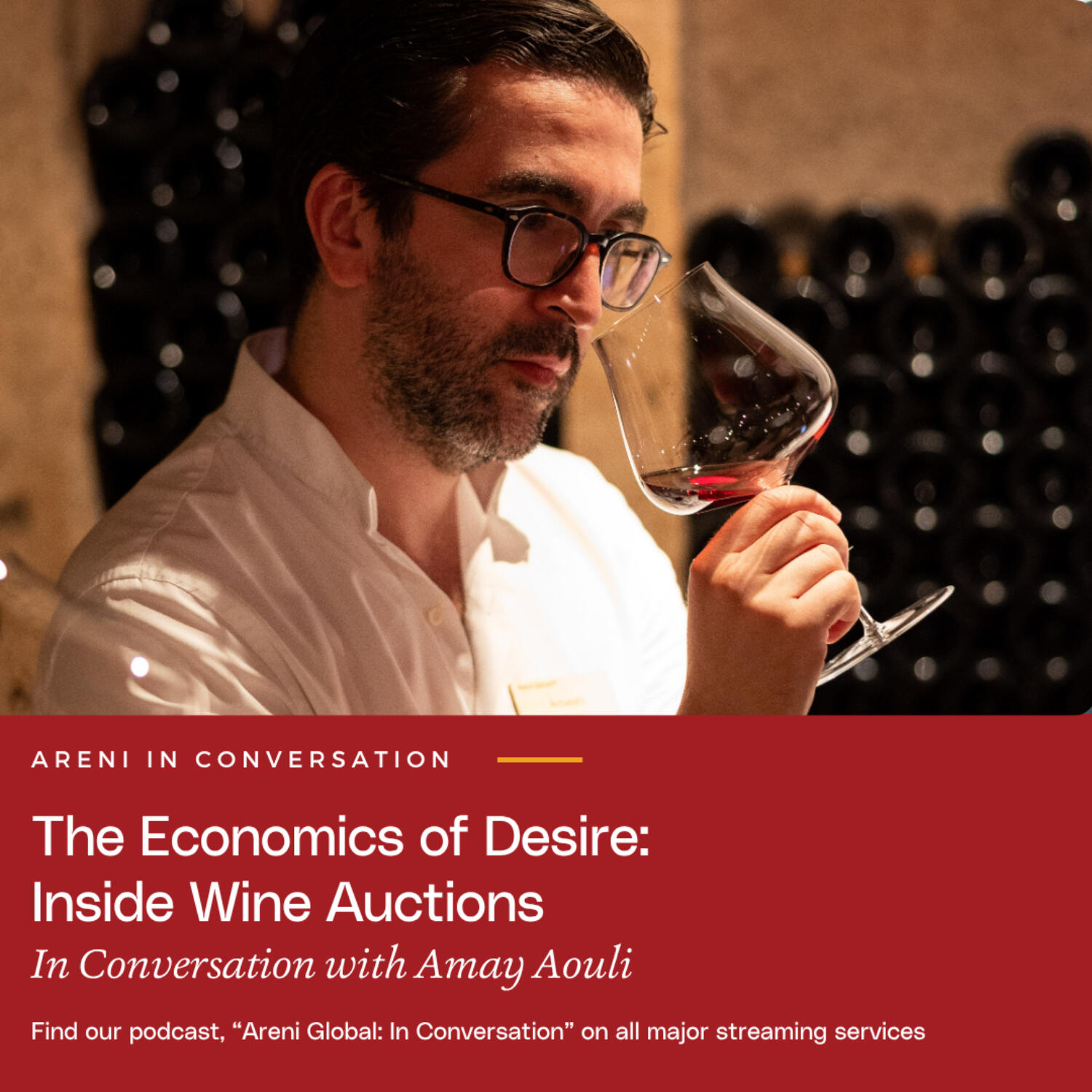
The Economics of Desire: Inside Wine Auctions with Amayès Aouli
72m 4s
The podcast explores the fine wine auction ecosystem through a conversation with Amayes, Global Head of Wine and Spirits at Bonhams. Amayes explains that auctions are a historical mechanism for price discovery on illiquid assets, requiring elements like globalization, reliable shipping, and collectible recognition—wine only became a major auction category in the 1980s after domain bottling and global demand emerged. He describes his role as balancing client relations, logistics, and strategy, noting that wine is particularly challenging to transport due to sensitivity to temperature, tariffs, and weight. The evolution of auction houses from 18th-century bookstores to modern digital platforms is highlighted, with online bidding (post-2000) making auctions more accessible and frequent. Live auctions now represent a small fraction of sales, reserved for charity or gala events. Looking ahead, Amayes identifies geographic shifts as wealth disperses globally, requiring more offices, and changing collector tastes—such as the rise of spirits, which now command higher prices than wine. He emphasizes that auction houses cannot create demand but can amplify existing interest, as seen with trends like NFTs or sneakers. Ultimately, the auction world reflects broader societal and economic changes, with value driven by scarcity, desire, and global competition.
[Music] Welcome to the Eurene Global in Conversation Podcast, where we talk about the future of Fine Wine. I am Paulin Vigard, Director of Eurene Global, and in the series we bring you conversation with some of the most interesting and influential figures in and around the world of Fine Wine. To talk about how the world is changing, how these changes impact the production, distribution and consumption of Fine Wine, and how that create risks to be managed, and opportunity to be seized. [Music] They are conversation you have because they're pleasant, and then they are conversation you have because they help you understand something more clearly. This one sits somewhere in between. I've known MISI really for a long time, and it's always been there for me, whenever I wanted to debate the modern interpretation of Pierre-Bordier, or share an incredible bottle of San Javéza, one of his favorite great varieties. But when he is not discussing French sociologist or opening bottles, Amiaise is global head of wine for bottoms, one of the oldest auction house in the world, created in London in 1793. And it's precisely that position that makes him such an interesting guest today, because if there is one corner of the wine world that attracts both fascination and misunderstanding in equal measure, it is the world of auctions. It carries a certain mythology, the raised paddles, the falling hammer, the idea that somewhere, somehow, value is being decided in real time. But behind that image lies something far more complex. Auctions are not just about selling bottles, they're about translating desire into price, about navigating scarcity, logistics, trust, and increasingly global demand. And very few people sit at the intersection of all those forces as directly as Amiaise does. So rather than staying at the surface, the spectacle, the assumptions, the clichés, I wanted to take the time to go deeper, to understand what this role actually involves, how it fits into the broad-of-fine wine ecosystem, and perhaps more importantly, what it tells us about where that ecosystem is heading. Enjoy! All right, good morning, Awa Yes, and welcome on the show. Good morning, Pauline. Thank you for your invitation. Well, I'm so glad to have you on the show. You and I, we've been friends, we need to acknowledge that, but we've been friends for a very long time, but the reason that you're here is not because we like having conversation like this together, but it's also because you are, you're role in the wine world, I think it's quite fascinating, and quite logically, my very first question would be to ask you to introduce yourself and tell us what you do, and what is that role in place that you have in the global fine wine ecosystem? Yeah, absolutely, so we'll again be naming them as alien, and the global head of wine and spirits at Bonam's. I've got the pleasure to serve a team of wine and spirits that are across the globe. We're doing primarily auctions, so the most definest and the rarest wine and spirits we're partnering with domains and we're doing a lot of charity auctions. I was born and raised in France, as probably my accent would have told by now, and yeah, but the chance to travel the world, to meet collectors, producers, the men and the whole ecosystem, and trying to do that very difficult and complex mechanism, which is auction, trying to do that with the highest care and the highest standards possible. When you say you the global head of wine and spirits for Bonam's, what kind of responsibility does that and tells mainly? Yeah, so again, as you said, very well in your question. So auction can be made very differently. Auctions and mechanism is a selling mechanism, primarily to have a price discovery on what is illiquid or difficult to sell. It's been something that has been invented by ancient Greece, or at least the first trace from an history. And so now you've got many auctions, like for tools, for words, for bridges, for telecom licensing. So like you've got many, many form and different form of auction, effectively to price and to sell, what is very difficult to buy a bridge day. Get what? Sorry for the answer. There is no average day. Buy the fold. I can be called 24/7 by a collector for an important collection to jump on. And I've got a lot of logistics of like, less fancy and glamoury things to solve. The shipping is complex, wine, effectively more than spirits, is probably the most difficult product to ship. It's sensitive to almost any single element. You've got tariff, you've got warehousing, it's heavy to transport. So my day to make it simple, is like 50% of the time with clients, whatever they are in any country, effectively. Then probably 25% solving the logistic aspect, and 25% for walking in tendering, with all our colleagues, like marketing, IT press, and all of that, trying to bring all the strategy, trying to bring the auction, to the maximum number of people, to explain the story that we have behind each auction, to the base place possible. The auction house that you work for Bonnams, was founded in 1793. You also mentioned Sotheby's, that's the oldest of the three big London ones, that was founded in 1744. And Christie's, the other part of the trio, was 1766. And all of those ones were, you know, formed and still are based in London. But I think the very first auction house that I found when I did the research, is set to be Stockholm Auctions' work, sorry for my pronunciation, I was really sure. But that was founded in 1674, by another aristocrat, Baron, I'm not going to try to pronounce his name, because I'm going to do a terrible name. You mentioned that auction is a sell mechanism, that dates back from Ancient Greece. But what led to the creation of auction house? Why were they, you know, needed at the time? So when you say the creation of these auction houses, they are very specific into the fine arts and luxury categories. So all of them, the three London ones, are effectively position auction, to sell, to sell, yeah, fine wine, sorry, fine arts and luxuried them. Funny enough, they all started to be bookstores at the beginning. Okay. They were library. Why? Because like, three, three hundred and fifty years ago, books were expensive. You needed to be, you needed to be, you need to be, you know, while novels, entrepreneur, you know, the highest of the society at the time. And one generation of readers started to die then the heir, that person came back to the library and said, hey, I've got like, you know, usually a sorry, that was a mail, but I've got my dad's collection on the library. How do I sell them? And they started doing, let's say, modern day lifestyle-oriented auction with books. And then gradually, it was like, you know, a couple of centuries after the Renaissance, the beginning of the, you know, the economy as we know it, et cetera, et cetera. So, decade by decade, new category came. Supernaturally, he was the paintings. Because like, white people, this is art oriented. This is like, you know, auction material. And then we add and add categories every, every ten, 20 years. Up until, like, you know, five years ago, you had the NFT at auction. Yeah. You have like, you know, sneakers. You've got like, you know, NBA jerseys. You've got like a lot of different categories that are, you know, following effectively the trend of humanity. What, you know, the younger generation likes to collect and view as collectible. Wine and tea effectively very recently when you think about it. So wine has been produced by the first trace is in a place called Arrani. I don't know if you can really remember that place. Yeah. Yeah, exactly. And so it's like 10,000 years ago. Okshane, as I say, is 4,000 years yet the two combined very recently in the 80s. All right. So wine was, you know, before let's say more drinking products, more usual in everyday life, but to become a collectible asset and be sold on an international stage, we needed to have some elements before. Shipping AC, the ratings, the magazine, the quality of like exactly a collective recognition. You needed first to have the bottles being bottled by the domain, right? Yeah. At the domain. And it's very recent. It's after World War II and I think we're talking about child. Yeah. Where the first one to start it. So you needed to have like a lot of pre-existing elements so that you've got a global competition. And, you know, a buyer in Los Angeles can fight against a buyer in Tokyo. But you had to have some sort of globalization as well because, exactly, because as you were saying, and I never thought about like this and this is very, very interesting.
very useful to understand, but auctions are useful when it's very difficult to put a price on something and wine becomes very difficult to put a price on when it's no longer just bought by the people that are around them but is in demand in like very different corners of the world so that makes a lot of sense. So the sauce beads, the bottoms and the Christie's from 250 years ago, I understand that they were selling probably other goods than today. Although they're still I'm sure sell fine books and rare books. But were they any different in the way they operated the way auction worked compared to what they do now? Listen, same as the rest of the world, there is one massive change and it's called digitalization. So auction in the previous century was effectively live, live and live only. So it was in the room and it was like a gathering that was like the extension of your private clubs. Exactly. You had to be there. It's a social gathering. Of people liking a category whereby individual can meet some merchant and trade and etc. You've got various crowd in the room. After let's say the 2000 to make it simple, you had a digitalization which made all the houses pivot to online. Online, sticking out slightly a little bit the fun on one side but making that much more accessible, much more widely open to people. You don't have to be there. You don't have the time difference. You've got like you can click effectively on millisecond on the lots. You can follow much more lots. So for the auction house, you can do more auction more efficiently and with an easier access. When was that? Like when was the big milestone of digitalization? It started in the 2000. I think the first one was in auction. The first one was in 2008 or 2010. But it's fairly recent. The first, so Brunam's created the first period, the partement as a single category before that period was included into wine with no dedicated experts for that and it was in 2008 as well. So I think all of that is extremely, extremely recent. I've read some sales mechanism and auctions. I was wondering if you still do it some time for the show or for the candle sales when you like to candle and whatever happens when the candle is done, then the price that it goes or things like the Dutch auction where you start at a very high price and you go down until someone accepts it. Are those mechanisms that you still use today? Or is it always we start with a price that we agree with and then we go up and up and up? So the candle one, we use it for fun and at your spes the burn, we sell the charity barrel called the pre like a piece de president. We sold that by the candle, but it's more often like even the candle burning the finger of the present. And so for the Dutch auction, it's very interesting. It's something I would like to try but no. So all the auction house works on the model which is called English auction, well by effectively you bidding on the price going up. But you've got many other auction, you've got Silbead, you know, you're putting your max bid and so like without knowing where the other are, you've got the second Silbead as well, whereby you win if you put the highest price but you bet only the price of the second. And so it's like, you know, what are the mechanisms that are pushing people to go up in price? Yeah, exactly. Yeah, to maximize the price. But that must have been changed. So do you still have and I kind of know the answer because I went to one we that you invite me to this summer, but you still have those in person auctions where you have your little tablet that you put up and then you shout the price to the boom. Yeah, yeah, we of course, of course we do them. So what we do a lot is charity based, like gal ad tenure live auction because it's fun and an auction is a fun mechanism and we're selling guess what? I hope fun elements which are bottles of wine and bottles of spirit. So I hope people are having fun, you know, receiving them and drinking them and sharing them. So yeah, we do live auction, we do them when there is a value at we conceive them, we create the number of lots, we adding funds. So for instance, we did the original one, we had like 505 zero bottles given by the consigner to taste. So like people were coming in the room tasting, we had the caviar house, you know, making kind of like less and then tasting on on caviar, you had my colleagues from the watches, from the jewelry department, from the fine arts as well. So we try to do that in a very, very fun way. In Hong Kong, we've got Michelin Star chef. So regardless of the time where you coming, if you want to, you've got a three courses Michelin Star, lunch or effectively pre-delivered pre dinner plus wine that you taste. So yeah, we will do that, but when we do it, we'll try to do it for. Okay, so it's not your everyday auction. Give you a number to your to your recently last year, 2025, out of 60 auction, we did three live. Okay, and all the rest were like outside of the gala, outside of the charity one. We did three, let's say commercial standard auction lives. I mean, when we look at the different milestones that, you know, were on the evolution of those auction's house from 250 years ago to today, I guess digitalisation is really like the biggest one. Like you guys had done a very similar work for 200 years and for the last 40 years, a lot of things have have changed. Because I guess the client psychology and how you get people to engage with the auction changed drastically when it's online and when it's in a room as well. But when you look ahead, how do you do you see a lot of change in the next decade also in how auction house and that type again, particular auction house is going to evolve? Yeah, absolutely. You've got to like let's structure it. You've got to be evolution for all of them. The first one is geographical. The wealth is much more widespread than it used to be before. So you can be, you know, wealthy and lifestyle oriented everywhere in the world in much more countries than before before you needed to gather in a place to run your company or to do whatever you have to do economically. Now you've got, you know, wealthy people everywhere scattered, not only in New York or London, Paris, Hong Kong. So what it implies is like, for instance, we've got like 30 offices everywhere in the world. So we've got people from, you know, Germany, Taiwan, you know, we just open Indonesia, etc. because you've got much more interesting people there. So the first thing is like geographical. The second is in terms of category. As I joke earlier, you've got yeah, evolving tastes. New categories coming in, some other like kind of like falling or not not not interesting anymore for as an auction material. So you for example, what would you say? What's the category that was, you know, 50 years ago, something very important for auction house is it is not really considered interesting by collectors today. So it's not it's not like kind of like important and less important, but like, I don't know 40, 50 years ago, photography was one of important. Now, like, and I love photography, don't get me wrong. Now, as a standalone, less and less auction of photography there either included in corporate rites, etc. But the nuts as a standalone category, you know, some kind of a few Jim potens. You've got many other thing. You've got classical instrument. You know, so the number of function of classical instrument like the Stradivarius and, you know, wonderful panel. But guess what? Less and less so because like, yeah, that was what we heard about when I was growing up. Yeah. Exactly. So you've got many, many changes in fine out by default changing. How do you do an auction of Andy Warhol before it was born? Very difficult. So you need to have contemporary art in the 70s and the 80s so that it became a new category and actually one of the biggest in every auction houses. So again, you're evolving with your world with your faith. Do you have signs like what do you look at to actually try to guess what's going to be the next collectible? Because it feels so if I understand what you've said for something to be collectible, it has to be difficult to put a price on. Probably scarce. Bloats, you know, wanted in either one market, but ideally globally as something that most people will look for. You mentioned for wine that logistics had to be in place. I can see that for, you know, arts and those big paintings having to cross the world, although we've done that for quite a long time now. How do we know that something has the potential to be collectible? The client stills.
- Like, same as like 300 years ago, they look at the door. And so, and of course, again, that's not something that's happening on one day. It's like, you see a trend in the pattern. The most recent one was NFT, right? - Yeah. - We, like, don't pronounce that word any longer, right? When you think about it, we're speaking about AI, but not about NFT so much, right? And five years ago, just five years ago, was like a big, big trend on NFT and on things like that. And so we add every auction house and NFT program. Because like people were discussing it, et cetera. - So you have like a sneakers program, like a. - Yeah, okay. - Not at Bonnams, but I know so business is doing it and effectively doing, you know, great sales of sneakers, right? Why? Because like, yeah, probably there is a market with like collectible, with care city, et cetera. Whether it will last 200 years or five years, I have no clue, right? Like that will be the taste of the people that will tell you, right? And closer to us, same for spirits, right? Spirits was like, back in the days, 20 years ago, was like at the bottom, like exactly like a typical French meal was like at the bottom and really, really at the end of wine cell. Before, it became something effectively more valuable than wine, right? The highest bottle of spirits is around two million town where the highest bottle of wine is half a million, right? There is a four times difference one with the other. - So how does the chicken and egg work in your case? Like does something become collectible because Bonnams are the reason, Christie's sell it? Or is it because it's collectible already that you guys sell it? - I wish I would have the power to, you know, create something out of nothing. No, what we can do best is magnify something which is already in demand, right? Outside. We can shed those bottle lights, we can speak it well, we can understand it, we can try to price it, very, very unbley and then sometimes we're surprised on the high, sometimes we're surprised on the low. But so we can try to do our job best, but the demand must be there before, right? So we do not produce, we cannot create something from scratch that doesn't happen and this is not our job, we not equipped to do. So I've got domains that are like, just let's say opening, right? Like creating a new QV or something like that. They look at the door and I say like, listen, do you first the job of creating your community, your space in the market? And when you arrive at a very particular point whereby your wine is in demand, enough, then we can probably discuss a production, but I will do a very, very bad job introducing a new QV or new domain from scratch. - So you quite logically, auctions an auction house of that type, follow wealth, right? You've explained it really well, like where wealth is, that's where you want to be. So where next? I mean, you've mentioned New York, London, Hong Kong. Are there places in the world that you think are going to become more important for auctions that they are today? - Yeah, it's a very interesting question, fascinating, absolutely. So the New York Hong Kong London model is a place of trading, in the sense that the place of exchange, whereby we do have our warehouses, we do have like legal, physical, whatever you want, like payment, et cetera, there, and we needed that. - And you have ships that arrive with the, like it's a physical trade. - Yeah, yeah, yeah, yeah, yeah. Like every single bottle in cases have been, you know, weighted by a human being. - No, no, I'm just underlining this, because even for me, sometimes we live in a world where, you know, logistics is not that visible. So when you visit a big port with like containers and stuff, you suddenly realize, but yes, or at least for me, but yes, of course, you know, goods have to come that way, because you kind of imagine that they magically appear on your doorstep and you don't see that the huge, logistic chains that actually allow them to be here and that always gives me that impression when I see, you know, a 40 feet container cargo coming into a massive port. It's just like, yeah, that doesn't happen by magic. Sorry. - Yeah, exactly. - No, no, no, no, it's not. And effectively, that the vast majority of our world, as experts, we've got seven warehouses. - Okay. - In the world, we've got sub warehouses, you know, to facilitate sometimes. And we've got to full network of, you know, partner of shippers, and border exporter, et cetera. So that effectively we're serving 130 countries. We've got bidders, sorry, - Okay. - Coincline and spirits from 130 countries. So you're absolutely right. You've got the place of a chain, which are like the big hub. And then we target the clients everywhere, right? We're doing tasting in the Middle East, even though the area is a little bit challenged. You know, with the wall, like in Asia, we've got an expansion program in Korea, in Japan, Taiwan, in Indonesia, etc. - Can you do auctions there as well? Or is this just a matter of getting the customer engaged and getting them to bid for either online or in person but to an auction that technically happens either in London, New York or Hong Kong? - Yeah, but I understand your question, but like my point is like, there is little to no points to do an auction letting in Indonesia, for instance. Why? Because you will probably gather slightly more in the nation people because it's like, okay, the auction is closer, fine. But then you will exclude the rest of the world because people are not, you know, maintain prepared to pay in the local currency to understand the tax system, etc. Like all the pain points of buying overseas, right? So what we want is to ease the life of time. Once you've bitted ones in Paris and Hong Kong, you get it, right? Like, and we know how to ship it and we know how much it will cost, etc. So you want to gather in big hubs to effectively facilitate the life of time. - Yeah, but you go where they are to engage them in the job. - Exactly, so especially with online which kind of giving us free time, quote unquote, we can do tastings where endiners and presentation and conference, etc. Where more, you know, in many more countries, right? So we do it. - Because it's also, I mean, I'm also asking that question because auctions are highly regulated and you can't do auctions cells anywhere the same way. And that's one of the things where, for example, very close to home between London and France, you don't need to have, you have to have different kind of certifications and skills to be able to conduct live auctions, for example. Because in auctioneer is not defined the same way in all countries and they have different rules and regulations, right? - Exactly, yeah, you export license, you need whatever bounded warehouse, you need like, you need a lot of things. So there is no point in fragmented the auction. Like the place of auction is effectively to gather as many people and most, you know, - And you go and you get a way of bidding, etc. Yes. So that's why you need that flexibility. - And now I was also wondering and knowing our joint love for those philosophical questions. When I was researching the history of auction house in the UK, they also explained that one of the things that really helped London is industrialization because during that period of the late 1700s, a lot of people became wealthier. So not only was the UK bringing goods from all over the world, they also had a class of people being the middle class and upper middle class being created that had more money and also the aspiration to imitate, replicate whatever, what the aristocracy was doing. And if you look at how the world is going in terms of economic class at the moment, what we see is the shrinking of that middle class and gross not coming from them, like it had been for the last 50 years, but gross really concentrating at the very, very top of the ultra high net worth individuals. What impacts does it have for you today? I mean, how does auction house generally thrive better when they are just more super rich or when we know an economic cycle where the middle class and upper middle class have more power? - That's a very, yeah, we love that feel that you call this global and demographic question for in Dundee. - It's like, is that going to affect the way you work, knowing that in traditional markets, like probably Hong Kong, London and New York, those places of trades, the wealth will be concentrated in the hands of less people. Does that change anything for your job? - I don't think that the wealth will be concentrated in less than that. I think the hands will be richer. Our business is based on the as well the knowledge and that's true for every category and even more so in wine. So you need to have a conversation. A slight joke, I like to say, like the master of wine and the writers and the books and all effectively the one pushing the price higher, like notice because they're sharing knowledge. And if you know that I don't know more as some is a wonderful place in Burgundy, if you know that within that, you've got that keynet which is going through and within that, you've got that producer that magnified thing. If you know that, guess what? - Now I want to drink it. - Anyf I'm rich enough, I'm ready to pay 20%, 30%, 40% more than the neighbor, or then another village. - Interesting. So anyone sharing knowledge is pushing the price up of one. - Exactly, some extent. - Because, because,
because it's a recognition base. So for all the fine wine, they are limited by the Ottawa, like in volume, right? You cannot push up and there is out there of the estate. And the more people know about it, the more people won't taste it to drink it. And if they do once and they find it good to their taste, guess what, they want it again. And so that's how you have the price is going higher on certain domains, certain region, et cetera. So the sophistication and the knowledge, the more you've got that knowledge shared, the more you've got people buying. While at the beginning of the podcast, I was seeing about the magazine, like the DeCanter, the OneSpecTetter, et cetera. They were all created around the '60s, right? Late '60s. Guess what, 10 years after you got to a report, guess what, you got auction houses rising exactly at that same period and same time, because you're starting to have a problem. And at the same time, that wine makers started to clean up their operations well and basically in the '80s, consistency of quality. Exactly. So it's those two movements. OK, that's interesting. I never really considered people pushing knowledge as having the effect of pushing the price. But that makes a lot of sense when you look at premiumization movement and when a market becomes ready for premiumization. Are there a lot of difference between a private client and a producer in the way you operate and how you're going to advise them? Yes, of course. So all our advisory will effectively like doctors or lawyers. Like, so we know, and again, we challenge even that, but we know what works, what doesn't. We know what we can do, what we can't do. When we partner with a producer, it's effectively understanding his wine, his wine journey, his story, where is that, and where he'd like to go. And so why does he want to do an auction? And we cook a specific program for them. Hey listeners, just interrupting the conversation for a few seconds. First, to let you know how grateful we are that you are listening to this episode. Thank you so much. And also to kindly ask you to subscribe to our podcast channel on whatever platform you are listening this episode on, and to give us a cool rating. It's such an easy way to support us, and it really makes all the difference. Thank you. Now, back to our conversation. So let's go into kind of an example. So first, I'm a collector. So I'm a private collector. I've got, I don't know, I don't know if there's a minimum size, like 3,000 bottles to sell. I'm based in a South of France, and I contact you. What happens next? What are the different steps between me wanting to sell my collection and my collection ended up in different other collectors, cellos and restaurants, cellos all around the world? Based on myself, myself and my team will call you. Thank you for you all. I think I'm contacting us in the first place and trying to understand why it's coming from. The provenly key. So trying to understand who you are, why did you collect that? Or what is collection about? Because usually depth, divorce, and death are the three main factors. Why am I selling it now? Et cetera, why are you selling, et cetera? Then understanding where is wine with part of France, which storage, et cetera, et cetera, with the composition. If you've got a list, that's easier. So usually people got a list, kind of, Excel, by email. And then we're starting to think about a cell strategy. So you will give us for 3,000 bottles, you will give us, I don't know, 48 hours, 72 hours, and we'll get back to you with a cell strategy. Hey, we believe, according to your wine, according to the quantities, et cetera, you can have 3,000 bottles, by the way, I've seen that, right? Of the exact same wine, right? And you can have-- Same wine, same vintage. Same wine, same vintage, and make everything, right? People have bought 3,000 bottles of the exact same wine. It depends. Why? It's where? What was their motivation at the time? I'm not a different grade. I'm not sure if it's-- I mean, that would have been my first question. It's like, what was the purpose of-- like, did you plan for a big boss? I don't know. Like, I don't know. Your friend with a producer, et cetera, I've got no clue. But like, yeah, 3,000 same wine. So again, that could be that. Or that could be 3,000 of very, very fragmented. That could be 3,000 of only the finest, 3,000 of a mixture, 3,000 of very old wine, 3,000 of very young wine, et cetera, et cetera. So according to that, according to the volume, as we said, the nature and the pricing that we're going to offer, we've got an automatic tool that do estimates where faster than any other auction house. And then the human nature or the human expertise will come on top of that. We'll see. Listen, let's do an auction in May from Paris. We'll come to you that and that date for inspection and shooting. And then we'll bring the wine to our warehouses, whereby we're going to do another inspection of cataloging and world tech photography. And then we're going to come back at the office in front of our computer and create the narrative around your auction, which is going to be the wonderful cell of Pauline Vicar, being sold in Paris in May. And we'll tell you your story with wine. We will tell how did you get it, why, et cetera. How do you measure success for wine cell? When do you know when something's been successful and how do you measure it? So there is, like, let's say, one indicator in terms of pure KPI and that's called the South Who Wait. So that the percentage of lot sold in your auction, because it means first you've done well, you estimate to that your collection has been well presented to the market. And three, that you had, let's say, enough buyers and bidders to go there. That the primary was simple measurement of success. Now it's a little bit cold. I would say to be a little bit more poetic that the number of thank you email that we received from the consigner and from the bidders. And probably a few days or a few weeks or a few months after people opening the bottle and say, oh my god, that's wonderful. It's even better than I was expecting. Do you have a little feedback like this? Yeah, effectively, we do, yeah. To my greater surprise, yes, we do. And a lot of clients call us and say, like, it's great, et cetera. They do do when it's bad, but really rarely. So last year, out of 15,000 lots, we had two claims. Two negative feedback. And just as a curiosity, but when that happens, let's say, a wine is called, there's nothing you can do, it's too bad. It's too bad. Plenty of things we can do. OK, so what can you do with the wine's called? Yeah, so again, we are effectively like a restaurant in that sense. Right? We want to please your experience, because we want you to be happy and to come back again and to have trust in what we do. So provenance is one thing, which are then condition, then, et cetera. We refuse 90% of the lots that we've been offered. When we're not sure, we're not taking the risk of losing a client for one bottle. That's a bad trick. If at all, there is a cork thing. We take back the lot and we remove both the client more often than that. Sometimes it's because the producers, sometimes it's because the bottles, sometimes it's because of the condition. For the last part of the podcast, I'd like to address some of the things that-- some of the questions that I'm sure you and I hear the most when it comes to auction and whine in particular. But first, I was wondering, who are currently the most successful wine brands at auctions? If you had to give the most successful wine brands at auctions, who would they be and why? Yeah, I let you use the 10 brands. I would say-- I know. It's both French people talking about brands. It's always weird for me to use it, but it's a domain. Or-- Old domain. Listen, like history matters. And so I think a fine wine is-- and I know you're spending tremendous amount of time and energy and resources to define that. But I think one key element is consistency. What usually people confuse is the pricing and the taste. I think the pricing is much more about the level of consistency of one particular estate through decades and for the most-- the oldest one-- through centuries, effectively. So you need to have time and global recognition on top of that, which usually comes with consistency in global recognition. And that's the bottle that will be the highest price at auction, kind of mechanically. So France as a country, because by default, it's been the country of fine wine producing for longer than others. And then within that, that's Burgundy, Bordeaux, and Champagne. And within each of the region, you've got producers that all some long-term status of being the highest price. So of course, in Burgundy, that's-- Domendor, woman, actress. Histocratic, Domendor, or many contis, Domendor, or, et cetera. And for Bordeaux, it's much more structured by the 1855 rankings. And whereby usually the prices follow that. The right bank is slightly different with Pamole and the patrieces, et cetera. But for the left bank, it's pretty much following the rankings. If you want to do kind of a ninjax of the most powerful brands or the most powerful domain in the in the auction sales. What kind of. criteria would you measure? Would that be the amount of money raised around the world, like spent on those states in a year? Would that be the number of wine sales and auction sales that included wines from those states? So that's another measure of reach and influence. Or would that be the highest price for a bottle? How would you measure that kind of index? It isn't simply by the average price of a bottle. Average price at a bottle? And not an occurrence, so that wouldn't be the number of time you saw that estate? Yes, but that would be a secondary factor. As you, and if you compare to fine arts, you will get it. The number of occurrence is always linked to the very team, the first place of that particular domain. If you take the Domendor Arminiconti, you've got 6000 bottles for used per year on average. You take the nearby Bordeaux, you can multiply that by like, you know, Petrice is what? 30,000. So it's like five to six times that, depending, of course, on the vintage. So effectively, if you take naturally, you will have more purchases than the Domendor Arminiconti, right? Like mechanically, you should take 10, 15 years later. So the number of occurrence doesn't tell you much, right? So for fine arts, it's even clearer, right? Like you can have a little amount of DaVinci operating in the at auction once every 20 years, right? But once you've got it, it's like a hundred million plus. So again, the occurrence is not, it's a measurement of 3DT. It's a measurement that you want and you still like. That's a measurement that you want is exchanging. But the price is, you know, effectively the level of recognition of the particular domain. Okay. Certainly, by the way, I mean to give you more power to cancel than this. That's interesting because again, it's when you, I mean, we spend quite a lot of time for us at Orinny, you know, defining what influence means. And there's quantity metrics about, for example, the price, but the reach as well, the fact that you are, you know, that you have the couple of bottles of your estate in every kind of collection around the world and that every collectors want to have one of your bottle, you know, within the collection to see the collection complete is another form of influence, I suppose. That's why I was asking you to. So you didn't want to quote names, but I can quote them. So probably I'll guess that, you know, Domain de la Romaine Conti, of course, would be one of those powerhouse in options. And I'm making an effort to say Domain de la Romaine Conti and not the RC because I know that, or be honest, isn't like that. And Chateau La Fied would be one, probably also, Henri-Jayet would be one as one of the more niche, bear kind of Leonardo that Vinci bottle that turns every now and then. Henri-Jayet was to quote you here. As been the first, let's say, well-known global artist like Winemaker. It was one of the first estate to actually command that type of price on the auction world or like to be actually auctionable. Probably not the first, but that was like, yes, and like he was making wine at the exact same time as the wine auction market was started. So like they weren't parallel with that, without noticing it. Back in the 80s and then 90s, etc. But it was probably at the end of his life, during the 2000, considered as an artist. And guess what? After he stopped making wine after he died, then the same plot, like the Copau Tour, for instance, where spread out across throughout the demand and then the prices were not the same. Even though the Taiwan was the same, even though the burgundy, especially doing better and better wine every vintage, he is the iconic status of being the first recognized wine artist. And so if you take those three estates in a couple more that we often see turning up at auction's commanding record price. A successful one of these estates are today, they were not 40 years ago. So what would you say was a key milestone that led them to become so iconic? The number of books, the number of conferences of podcasts, etc. So like all these estates with more than 50, 100 years, etc. They were producing fine wine back in the day. It was probably less consistent because of the technology, because of the knowledge that we have now was more, let's say, you know, command sense knowledge back in the days. But so you've got much more variability in terms of of the integers and you have today. But apart from that, that the knowledge. So I think what I think is not that knowledge. Yeah, yeah. So that the number of wine club in in San Paulo, in Rio de Janeiro, in Dubai, in sale, that change. And the number of podcasts around wine and the number of think tank around wine and all of that created an attention and more and more people in one more country are interested. And so when you get interested in that journey, you're only going to be fine wine. Whether you can buy it or not, that's that's depending on your wealth primarily. But at least you will know it. So you will recognize a bottle of petrol, so it's even though you don't have access to that. And that's that's the question of dreams, right? That's visibility, desirability, purchase. But I never I never associated knowledge spread with visibility, which is what you're saying is that visibility, desirability, but visibility for wine is not just a matter of having your your label everywhere. It's also a matter of people understanding more why you special. So it's just I'm trying on the marketing side. It means different actions. How I mean in four-site how in hand site, well, looking back, never. How active were those estates in shaping that I think they all add a very, very active role differently using different methods and different support. And and primarily that's linked to their primary market distribution. Okay. So when you are when you are boredom and probably you're the best place person on on earth to know that you've got a class the bottle. And so they were doing dinners, tasting, books and a lot of activation in various countries. They did that in Belgium, they did that of course with the UK trade. You've got a wonderful program called Master of Wine create a community of people that we all recognize as knowledgeable so that they can share their knowledge and master of wine becoming more and more specialized. I'm thinking about Jasper Murray's our Jan Ensign for our brandy and bottle. And so to come back to bottle they were doing an active promotion of all these days. So they were sharing the ranking of 1855 plus whatever's happening on the right bank to the to the go. So the first one to be collected were bottle. I give it to you. Easily. And so for Burgundy because the primary market were slightly different. We like direct education, we like negotiations etc. They are the different type of promotion that again, we did not focus on the number of many conties but the number of conties has been extremely consistent in that distribution with a system of allocation, with a system of assortment cases, with being extremely respectful to their importer to etc. to the whole ecosystem, sharing a lot of bottles, sharing a lot of a element. When I'm about the villain that you and I know is doing the climate Burgundy at UNESCO, that's an active act of promotion. It's like it's recognized to be one of the humanity, you know, treasure. So all of that created desire. And that desire is then magnify with a delay, with 20, 30, 40 years delay when I do a auction now, a foreign from the 80s and from the 90s. So all the books, all the material and intellectual production that the estate did or their partner, thinking of Laplace is effectively what created the recognition and the price. How important is the personality leading the wine brand or the wine estates? I mean, Uber is a very unique character in the world of wine, for example, and the originier was, it's harder to associate a personality though to Bordeaux sometimes, like it's less personalized. So can you, I mean, if you look at estates today that do wish to be in that position at one point, how important is the personality leading their brand and how active they are and visible in the market again, as that important for visibility? So we had the whole world, one on one and an excluding wine, we had a personalization movement. Right? Yeah. So 40, 50 years ago, you were giving your trust to a brand, right? And you expect to be consistency, being a hotel, being a wine, etc. So like that's that's kind of effectively, as you said, of the Bordeaux-based model whereby you will seek that consistency out there. And then becoming more and more personal media and know where the social media, and so you will look to see who's
owning and what the character and what the person is saying, etc. So, yeah, you had a pivotal shift, which is much more marketing trend, whereby you need to see people. We like to see people usually with social animals in their first place. So we moved toward that. And so, yeah, so that's why you've got rising stars effectively outside of the classical one region. You can have a star in Nong Duk, you know, follow my lead, Kansh De Pére, or in Hun, or, you know, Hayas. And so, you've got a lot of domain in Lour, a lot of domain in Italy and outside of the world, of course, in the US. And data led by people, whereby we know them, we appreciate what they say, we appreciate them, you know, their personality. And so, yeah, but that's, I think, a trend, which is beyond one, which is a trend in that effectively in society. So I'm going to give you some words that are from your former life of finance that we hear about, you know, when we talk about auction world. And usually when I talk about auction world with producers, they have two reactions. One is actually telling that you people are evil, because it's all your fault that wines are too expensive, that they are not drunk. And now, you know, I could buy my Romantic one, T for 200 francs and now I can't afford them. So, I'm going to give you, and the rest of the producers, well, tell me how I do to get there. I want to be in that position of, you know, Domendela Romantic on T or even if they've got a bit less ambition, you know, of some of the very successful brand on auction as well. Or at least when they want to do an auction, someone like Hugh says, of course, we'll build an auction around your wine because there is demand for it. So those words are like speculation, valuation, commoditization and finance salizations that, depending on where you are in the world, you see either as a positive or a negative. What do they all mean for you? I know that you have a very clear way of explaining the difference between speculation and valuation, for example. I'd love to have your take on this. And in what context are they good thing and in what context are they bad thing when it comes to fine wine in general? Yeah. So, and the third category, but they're probably not expressing that, is the one of the domains or client, you know, looking at the auction very secretly and trying to, you know, see if their wine is going to be there. Yeah, yeah, yeah. And like, how can I do to be there? Like, whether they'd express it very openly or not? Yes. Oh, even sometimes calling me and say, hey, my wine is not expensive and I say, like, you know what? And I will tell you the exact answer. I don't have the power to make the market, my life would have been way easier if I had the power to dictate the prices of the wine and effectively sold them. When it comes to speculation, I think there is a massive confusion. And it's a kind of like, you know, ready to think idea. There is a massive confusion between speculation and appreciation. Right. Okay. So speculation is a passive act of buying something today that you're hoping to sell tomorrow without any, without a profit, sorry. And so there is a passivity. There is like money, money, easy to make. So it's kind of it's almost biblical. You've got like, you know, all the sins there and especially for wine because it's a kind of, you know, there is a religious tone to wine. It's used by one main religion. That's kind of dynamite, right? Like, oh my God, you're going to make money on something which is, you know, heaven and men to be shared, etc, etc. We cannot make the price of the wine. Like the markets and the appreciation as we said in the past, in the past minutes is effectively what, what it is. What we can do is be probably one of the only player in the ecosystem to be trans, fully transparent and fully accessible by anyone over 18 in the world. You cannot buy at the domain in Berlin. You try to knock at the door and say, hey, I'm, you know, I'm a billionaire and I want to buy. See, see their reaction. It will be no, we have no wine there. So now if you are a wine lover of 25 years old in, in South Poland, Brazil, what's your chances to get an education to whatever the domain? And if not, you can buy it that retail for probably 30 or 40 percent of the price on average more. That's normal. The retailer needs to do a margin there than that auction. So mechanically, we're transparent and we try to do our job well. We're transparent platform accessible by anyone on planet earth. So when you see a price is going up and when you see crazy prices, it's not because no external decided to do speculation. It's because the wine is appreciated. And yes, we put that on the market. That's the same for art, that's the same for real estate. So it's not the real estate agency who's pushing the price in West London, right? Like they don't have that power, right? That's the appreciation of London by a huge community of person that pushing the price high. So I think it's, yeah, I think it's not the right, the right, the right element. And then for the investment parts, listen, I don't have anyone that I know of my car that are purely investor. They all are drinkers with a buying power and buying purchases higher than they can consume. So by default, they will have a collection and by default when something happening in their life, they will have to sell it. That's the same for trades, that's the same for hotel, that's the same for sumriage, et cetera. By the system of allocation and premium and all of that, you need to buy more. You cannot cut your allocation. So you need to buy, you need to store, you need to do a job of keeping the wine safely in the best possible condition to have a mature wine that either you will drink or you will have to sell the market. And you don't know how much you're going to drink in your life. You don't know how much you kids are interested in to wine. And so the usually appearing in the markets at a point in your life's change. And so I had a conversation last week about someone telling me that when I was asking them their definition of fine wine, they were telling me loads of things and then they were said, "Well, and then a fine wine by definition has to be drunk." So if a wine becomes to be in that realm of, and of course it was thinking of like auctions and trading and secondary tertiary market, and if those bottles are never drunk, that they're not fine wine. And I have a lot of opinion about this, but I was wondering if you had because the questions that usually follow is those wines that are exchanged at such a high price, are they drunk? They are not, is that a problem? And do you also have a responsibility in your position as global head of wine to make sure that those bottles are drunk and not just bought and possessed or is it? Yeah, I'd love to have you opinion on that. Yeah, sure. Listen, big scheme of things, everything will be drunk, right? Like we're all going to the same direction as humanity, right? So they're all going to be drunk. Now anyone listening who had the pleasure of drinking a wine before her or his birthday, like you have people keeping them for the next generation. And if you are fine wine, usually you've got the capacity to age, right? And so I had the chance to drink bottle from the 18th, sorry, for the 19th century, right? And it has like crossed one century full to get to my, to my mind and to my palate, right? So it's been a whole chain of people keeping it there. And guess what? There is a little number of bottles there. So it will be drunk at some point, we just don't know by who and what. Okay. I've got zero responsibility there because you know what? It's a free world. Is there a part where it starts becoming negative when not a lot of people have access to those wines? And then they don't become something that enough people have drunk or taste in their life to become, to maintain their reputation as benchmark. I'm trying to determine if there is a limit to what exclusivity brings in terms of advantages. Yeah, but I will see, I will see the more positive aspect of your question. So when you've got a wine recognized and that's fairly normal, we've got different knowledge. If you are wine lover, I'm happy to taste like the new person, etc, etc. I don't want to live in Showsedizek, that's the highest, you know, real estate in Paris. I don't want to live there. Like some brands need that address. I don't find it. So like, and I'm happy that the Showsedizek is extremely excited because it's helping the whole Paris and then the France and then Europe, etc. as a consequence. Right. Like the worst thing is for wine to be forgotten. As you rightly pointed out, right? But again, if you have appreciation in wine, then other region will benefit. Other fine wine will benefit. Other clubs will be there to share the knowledge. So I don't, I see like as effectively a positive measure. Right. And again, by the cost of storage, by the fact that we last said by like all that, don't hurry. It will be like it will be shared. It will be drunk. It will be moving. Sometimes it will be moving faster for certain wine because okay, have you tried it, it will be more exciting. But yeah, to your point, I don't see that as negative. And to the contrary, I think that when some region and some wine struggles, this is where you get the most social difficulties. So as you know, we've just released a study that's called the New. fine wine consumers and how do people under 40 find their way into fine wine? How do people under 40s find their way to your auction house or to your auction house in general? What lead them to bid at auctions? That's a fantastic question and the reason why we are global in geography, but as well global in category. So that bonemme says the chance to be the widest auction house in both terms. So we cover much more category than any other and we are in the widest geographical representation. So they're coming to the auction by all of that, all of the above, right? They can come to sell a watch and then okay now they're registered. So they can come for small paintings when I say small. I would say like not a top one something that you and I can buy is it and then they get into the wine thing. They come from the tasting the events, the fair that we do, we're spending all my team and I we're spending you know on days and nights meeting new people. We're invited by by domain, we're partnering by domain, we're doing galadiner, charity, etc. So you've got many ways of getting to of getting to to the auction. I will do an partnership. But you have an idea, I don't know if you have that data, but like the percentage of your client that comes to wine as the first thing that they buy from bonums or the percentage of client that by wine having bought something else before. That's a category. Yeah, so wine is specific so I would say probably in wine it's higher than the other category. So wine is usually a door opener for the other category. It's way easier to engage in the bottle of wine than it is even to watch and. Oh yeah, because you're very good at cars as well. So again the program we're having placed like you know I'm doing courses to business school, far too many types of schools. I'm going to you know to get to do dinners everywhere in the world. The press is an important way of getting people less months in Paris when we did the yesterday, we had like 45% of new buyers. Some people that we didn't know wasn't now that the base, etc. So you need that constant influx of new client and then they can come by geography, by category, by the press, by the excitement we provide. Again because we're so transparent as it's effectively what we what we can bring to the market that will attract in a position the client to come to come back. What I mean what would you say works the best to keep young consumers engaged? So are they kind of pathways that you build with your team that when you know someone which is rather on the younger side of things start buying wine with you? Are there any kind of steps, consumer journeys that usually work to keep them engaged? So yes and no, yes because we do have that but not specifically for young customers like what we don't categorize by age. Yeah exactly by age. Whether you can be young and very knowledgeable of very specific in your needs and you can be old and starting your journey because like etc. So age is not a good. So maybe like yeah, the reason is the fact that there are new clients for you more than young clients. Yeah. So exactly so recent clients we've got less of their age. Yes we'll try to know what they like. We'll you know call them, we'll invite them so depending on what they like and you know what they want you to buy and bid, we'll invite them to different programs. So we've got your programs for the let's say ultra high buyers and we've got program for the more discovery phase and so you will have something that's image more casual on a discovery phase so like you know standard tastings you know like combining with watches and jewelry and cars with the tasting of the Miami F1 race and you know this kind of like experiential element which is more more fun with a bit of wine knowledge added there and for the to the other extreme the top VVIP will have like you know private lunch with whatever chef with you know master of wine with whatever so that we discuss we have of course very important dinners with a lineup of wine to discover a specific region to discover specific plots and so yeah that's I mean what you say programs are they you know for me to visualize are there something that you have strictly not strictly defined but that you have well defined with your team like this year in the discovery program we're going to do those type of events we're going to do those type of wines we're going to bring those type of people or is it more organic in the way you manage that. No it's you're right it's slightly more organic because contrary to a producer we don't master what we have to sell right so I don't know I know part of it but I don't know my control you mean like you don't know why I don't control so I can have like a restaurant salon and guess what we'll do six sections everywhere in the globe with the chef etc so it will be like you know a high Michelin style type of program I can have a partnership with like you know a more it's a casual discovery phase domain fine I'm happy with both this one I mean so but because I do not control I've got several projects several collection that I'm following at different stage I don't know when they will be hitting the markets and where and for spirits at the same so because I do not control we can plan and we can see the vision where we want to go but we don't know how fast and with what type of wine is what type of narrative we will have to go there and and you're I mean the the key metrics to determine in which kind of program someone you know recently joined will come would they be the spending power? No not necessarily that will be probably a kind of like sophistication and interest right okay you've got you've got you've got people in cland that are reading about wine like you know 24/7 right like they've been doing wine three point you know they know burgundy and bottle they know the estate etc even though they are individual like you can consider them as one professional like in their and their knowledge and to the to the other extreme you've got people they hey I like wine casually please advise me etc etc so so I think probably the knowledge and the capacity to spend six hours in the dinner speaking about wine is what defines then of course you've got the the spending power but but that's let's say a second of a real amount to to okay basically nothing um I'm thinking so when I hear you speak it's a bit like the conversation we had with Haymech grinning on you know how to break the young collector codes when it comes to wine is that it seems to me that there is a lot of human interaction because basically to know what program to put your people in you have to talk to them a lot and you have to listen to them a lot about what they want to do and how they react to things can you how do you deal with that with with scale like is your only way to scale your consumer base to have more private client manager or are there other ways that you can do to make sure that you can operate with I don't know with more than a hundred clients in the world to give them that kind of service so very interesting question so the scalability is yeah we we spending hours and to discuss about it you've got two but for the buyers pure buyers that's primarily through it's a large communication right right you you do to make it simple you do a very cool social media program you're getting much more client than like you know try to do that with dinars and physical uh days things etc so but that's a combination of the two so we're trying to be as present on the market as possible as a team we've got the chance to partner again with our colleagues uh from from colors from finance etc so one client will be invited to to occur our execution to whatever um but then I don't think I like I'd like to to multiply it to the extreme right but because it's effectively you've got this kind of like limitation uh human you you don't want to be uh a fluid like you know sending too many invitation like that you know you want to send a good invitation uh we've got probably one of the most beautiful uh database of client because like by default again geography and category wise um and we tracking uh everything the bidding the under bidding so you know if someone is buying I don't know a half a million paintings and just one lot of mine then okay he's got you know the power of the capacity to buy but probably no one talked to him or he did one try or etc so let's have contacts in first right so that so we've got all of that we've got bio demography if someone is only buying border uh you know large format etc we like okay let's try large format with them etc etc so we've got many ways of of looking from let's say pure uh quantitative uh I said before to even based business naturally in a minute but like quantitatively we deal with a huge volume of data uh we've got someone in my team uh specialized there creating tools creating elements to uh again to to be the most dedicated to to a person so when there is uh can give you an example when there is like let's say large format of photo anywhere in the world uh from your shop
that a person we know liked, then he will receive an email dedicated to his buying pattern. And so that's how we create attention. And you multiply that by brands of spirits, by regions, subregion, by by level. So yes, effective. I mean, yes, thank you for everything that you've shared. You've been extremely generous. Maybe one last question before we part ways. What gives you very, very general, nothing to do with the auction world. But what gives you joy? What gets you excited when you wake up in the morning when you look at the present and the future of wine? To meet people. I think this industry I've seen and I'm probably, you know, one example of people coming from, you know, other part of the world, other industry, other background. That's a very friendly industry. I'm not like, you know, putting my pink glasses on, but like usually it gathers the finest people, of humanity. People that are interested in many other fields than just purely wines. And so, yeah, meeting people is a greatest form of joy every morning. Thank you so much for your time. Thank you for listening to this episode of A Reign Global in Conversation. A Reign Global is a think tank dedicated to the future of fine wine and when we're not podcasting, we publishing reports, white papers, articles and marketing sites. So if you are interested in the global conversation around fine wine and what the future holds in terms of production, distribution and consumption, add over to our website www.a rene.global. That's A-R-E-N-I and subscribe to our newsletter. All the links are in the show notes because whether you are producing or selling fine wine, you need to know what's happening in the world so you can make informed decisions. Until next time, cheers!
Podcast Summary
Key Points:
The podcast features Amayes, Global Head of Wine and Spirits at Bonhams, discussing the fine wine auction world.
Auctions serve as a price discovery mechanism for illiquid, high-value items like rare wine, requiring globalization and logistics (e.g., shipping, storage) to function.
Major auction houses (Bonhams, Sotheby's, Christie's) originated in London as bookstores, evolving over centuries to include categories like wine, which became collectible only recently (post-1980s).
Digitalization (post-2000) revolutionized auctions from live, in-person events to accessible online platforms, enabling global participation and efficiency.
Future trends include geographic expansion to emerging wealth centers, evolving collectible categories (e.g., spirits surpassing wine in value), and client-driven demand rather than auction houses creating trends.
Summary:
The podcast explores the fine wine auction ecosystem through a conversation with Amayes, Global Head of Wine and Spirits at Bonhams. Amayes explains that auctions are a historical mechanism for price discovery on illiquid assets, requiring elements like globalization, reliable shipping, and collectible recognition—wine only became a major auction category in the 1980s after domain bottling and global demand emerged. He describes his role as balancing client relations, logistics, and strategy, noting that wine is particularly challenging to transport due to sensitivity to temperature, tariffs, and weight.
The evolution of auction houses from 18th-century bookstores to modern digital platforms is highlighted, with online bidding (post-2000) making auctions more accessible and frequent. Live auctions now represent a small fraction of sales, reserved for charity or gala events. Looking ahead, Amayes identifies geographic shifts as wealth disperses globally, requiring more offices, and changing collector tastes—such as the rise of spirits, which now command higher prices than wine.
He emphasizes that auction houses cannot create demand but can amplify existing interest, as seen with trends like NFTs or sneakers. Ultimately, the auction world reflects broader societal and economic changes, with value driven by scarcity, desire, and global competition.
FAQs
The primary role is to provide a selling mechanism for price discovery on illiquid or hard-to-price items, such as rare and collectible wines, through auctions.
They began as bookstores in the 17th and 18th centuries, selling rare books from deceased collectors' libraries, then gradually expanded into paintings and other luxury categories.
Digitalization, starting around the 2000s, shifted auctions from live-only events to online platforms, making them more accessible and efficient globally.
Yes, but rarely. Out of about 60 auctions in 2025, only three were live commercial auctions, plus some charity galas that are more interactive and fun.
They observe trends and client demand, as seen with NFTs and sneakers. They cannot create demand from scratch but can amplify existing interest through expert marketing and pricing.
Wine became collectible only recently due to elements like domain bottling (post-WWII), shipping improvements, ratings, magazines, and global competition enabled by digitalization.
Chat with AI
Loading...
Pro features
Go deeper with this episode
Unlock creator-grade tools that turn any transcript into show notes and subtitle files.
 PodcastTranscript AI