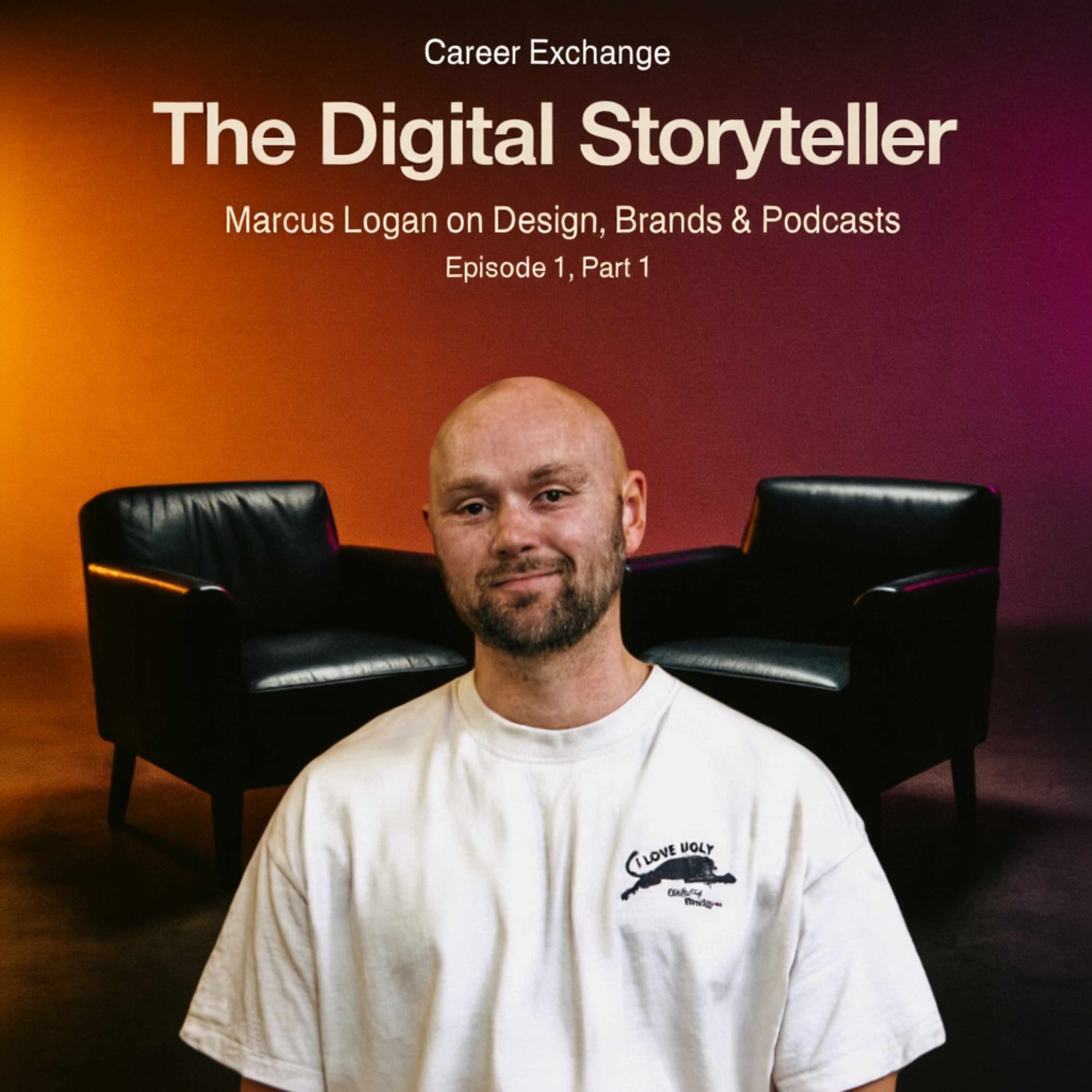
The Digital Storyteller (Part 1) - Marcus Logan on Design, Brands & Podcasts
from Career Exchange - Real creative journeys. Honest detours. Unfiltered stories from bold minds.
30m 32s
Marcus Logan, founder of We Are Digital, shared his unconventional career journey on Career Exchange. After studying journalism and disliking his first job, he traveled, worked in traditional marketing, and moved to Berlin, where he fell in love with social media at a travel tech startup. Returning to New Zealand during COVID, he gradually started his own social media agency by first contracting part-time for his former employer, moving back in with his dad, and signing three clients during lockdown. Confidence, he says, came from being brave enough to try and not being good initially—competence builds confidence. Podcast marketing entered his life by chance when a friend asked for social media help for his podcast, Between Two Beers, which became New Zealand's biggest. Referrals led to clients like Dom Harvey. Marcus's marketing strategy starts with deep audience understanding, then creating valuable content (entertaining, educational, inspirational). He advocates for testing organic content on social media, using immediate data to refine, and turning top performers into paid ads. He warns against relying on outrageous content for attention alone, stressing authenticity and audience focus for long-term brand growth. His approach blends calculated risk, experimentation, and strategic ambition.
Well hello there and welcome to Career Exchange. This is where creative journeys get real, the wins, the risks, the dips, the fails and the people shaping what's next. Amya, who's Sachi and Fair Warning, in this episode we go a little off track. You'll hear a few extra voices jumping in, some laughter and maybe the sound of organized cures. But that's kind of the point. This isn't a perfectly edited interview, it's a live unfiltered, exchanged full of ideas, honesty and a few unexpected details. My guest today is Marcus Logan, founder of We Are Digital and one of the leading storytellers behind some of New Zealand's biggest podcasts. So brace yourself and enjoy the exchange. This is Career Exchange, the digital storyteller Marcus Logan on design, brands and podcasts. This is the person we're doing this. This is a lot of fun for everyone who's involved here and who's available to us here. Being met Marcus when we were in a marketing association, he went and what was really exciting was the fact that you are one of the most humble marketers I've ever met and incidentally everyone was giving him shout out, which is rare because everyone on the panel was like shout out to Y-Dish-Till and Marcus and I was like, who is this? Because you know he's just there, he's so calm and I think that was very impressive because you don't get to see that very often and that of course when we realized that you know you've taken a journey and you were really doing so much in the world of podcasting, podcasting and marketing as such. I learned a little bit more about the journey you've had and what I know is that Marcus has worked with some of the best podcasts. Alright, I'm going to, I won't spend a lot of time in reintroducing Marcus because I think a lot of you heard about what he's all about and we do not have a lot of rights. So Marcus has worked with some brilliant people. He's worked with Dom Harvey podcast. He does do a lot of Instagram content as well. So I remember Hannah mentioned this on the go that you know these guys are doing this stock farm content etc and you do talk a lot about social media which I did not know. I thought it's all about podcasting so it's very interesting to know that there's so much you're covering as a marketer. So I'm not going to do, I won't take a lot of time because we want some questions in as well. And either all aspiring candidates, Marcus. So just to get you started and I have sections here so there's origin and career path. What is your origin story and it seems to be a very exciting linear journey so it's not as quickly. You know it's very strategic. Tell us a little more about that because a lot of them you want to know what is the start to you know get to where you're at. Yeah, so I studied journalism and I got a degree in journalism and growing up I always wanted to be a journalist. I thought I'd be a you know a feature article writer or like a magazine journalist or a print journalist of some kind and then I got a job as a journalist straight out of uni and I hated it and it was at a travel magazine but I was kind of writing a lot of editorial content and I mean it was great and I got to travel a lot actually as part of that but then I kind of caught the travel bug myself and quit after 12 months or so and went backpacking with my mates across South America and Central America which was amazing and then I got a job kind of in traditional marketing and again didn't really love it probably spent about two years working for a company that was owned by Subway managing just kind of corporate communications and then I decided to go traveling again so I actually moved to Berlin and I lived in Berlin for two and a half years and when I was in Berlin I got my first job working in social media so I worked for a travel tech startup called Omia and I was in charge of all of their like English language social media channels and that's where I kind of fell in love with social media as a platform and as a kind of outlet of marketing it was just so much more creative and dynamic and interesting than anything else I'd done in the traditional marketing world and that's where I first kind of realized that I wanted to do social media as a career and then I came back to New Zealand for a holiday and March 2020 about two weeks before COVID shot the world down and as we're here to travel a startup and all of the borders had closed throughout Europe and their projected revenues just went you know went off the cliff and I decided I'm just going to stand in New Zealand and I was like okay I want to do something in social media I think I actually want to start my own social media agency and so I was applying for jobs in marketing agencies because I wanted to kind of learn how they operate behind the scenes and I applied for one job outside of Auckland because Auckland was just slammed with so many people desperate for work and I got it as a job at a marketing agency down Hamilton running social media so I decided to shift down there and I just kind of dedicated myself to learning the ins and outs of how to run a marketing agency I was in charge of social media there so it was just obsessed with kind of getting the best results for clients and figuring out best practice social media marketing and then about three maybe a year and a half two years into that I decided to shift back to Auckland and start my business so that was about three years. Well that's a lot of so the the answers three of my questions there are not risking all the running point in your career and early experiences and this particular storytelling narrative and this is my important because we're all about career and this is career exchange so one of the questions that a lot of our students ask is have a doubt just just set out is about I don't have enough experience and you seem to be getting a lot of opportunities you've changed countries and you've come back and you managed to get those I'm going to say put in the door or however you do fit so how did that happen for you is it just immediate confidence or is it a very nice nice as you may it's important to think to know because that's something that they ask about that you know how did how did he get to where he is like all your opening doors I mean I think he built confidence through being brave enough to do things and being willing to not be good at it in the beginning and it's just repeated exposure to that makes you makes you a much more self assured confident operator and there's a good saying that like competence builds confidence as well so if you dedicate yourself to just getting really really undeniably good at something you gain a lot of confidence from that and then your work is you know kind of speaks for that as well. But that's that's that's very short and put a lot of people here because that's very inspiring for me as well because you're talking about something which we call as a rejection muscle and you need to build that so much when you're starting off with your own agency format. How was that experience with all the you all the let's say multi regional experience and traveling around and you come back and you back in the country it's post-coded how did podcasting start though in that in the same journey like how did you get that first plan which is starting your agency how was that experience because a lot of us aspire to start something of that nature and that's a lot of risk and non-aversion right and that's that's your that's your personality but just what about that journey how was that yeah for you also there just hold it Jesus Christ. For me it's alright guys we completely on record not very well prepared but you can see that there's very good information that we're getting today so let's live with that. Harry has never been in this campus before this is the first time I'm I've seen him and he's just here because he comes from a music background and he went background and I really wanted him to sort of be there for this and he's a videographer so clearly he knows what he's doing. Starting an agency we're starting an agency in the in-hatted podcasting. This is not in an agency I think I'm used to hear all records so I still want to be able to talk about that and I don't think they're recording there either at this point of time to be very honest in I'll be recording in teams. We've got always other cameras rolling. Alright brilliant. Yeah so just coming back to where Nigen was directing us towards which is starting your own agency. Yeah so I was lucky enough to work at an agency where when I wanted to do my own thing I went to them and I said hey I'm looking to do this and I want to shift back home to Auckland and I want to just work part-time for you I want to instead of being a full-time employee I'd like to become a contractor and do 20 to 30 hours a week and then in my other time I set myself up as a contractor to try to go and get other clients so I had built up enough value in what I was doing at that agency that they didn't want to lose me so I had a bit of leverage to kind of get more freedom in my professional situation so so that's how I started off doing it I moved back in with my dad I was 27 running this from you know my old bedroom when I was a teenager and I just went out and I started trying to get clients myself and I was lucky that it was actually during lockdown it was during Auckland's lockdown in 2021 and there was a relief fund that small business owners could apply for and that service providers could apply for I registered myself as a service provider and I got contacted by three or four business owners to get my help with their marketing and so I was really lucky in that I just I've managed to sign three clients pretty much straight away then I retained those clients for you know a year plus and so eventually over time I just started doing more and more of my own client work and then scaling down the work that I was doing for my old agency and so I finally set a card done but I need the the financial stability anymore of creating enough revenue from my own personal clients so it was quite a gradual process and because I had started how the agency I was working at operated I kind of just implemented the same software and systems and billing and everything to my own operation and it's just been scaling up since then you just said you were 27 when all of this was happening yeah right and I'm just going to add this because we threw the word hustle quite you know a lot and generously at people but I can see that there's a lot of strategy but would you call yourself a hustler yeah yeah I think more so just ambitious strategically so yeah yeah but because because you you sort of taking a journey where you were there's a runway and you're looking at taking risk but calculated risk and I think those are very intelligent decisions so how did broadcasting start featuring and because I can see that they will
lot of social media plans, but I can feel that there's a bit of a pivot to a podcasting very specific. Yeah, definitely. So I've been doing my own business for about a year, year and a half. And one of my really close friends that I met working at this small agency in Hamilton, he had a podcast. It was, it was a host of this podcast called Between Two Beers. And when I was with him down in Hamilton, it was still this kind of side project that he was doing. And I've never had listened to it. I never really paid much attention to it, to be honest. But then after I've been doing my business for about a year, so he came to me and said, Hey, could we get some help with our social media? I said, Yeah, sure. One hour I'll give it a go. I have always loved podcasts and been like a really avid consumer of podcasts. So I was pretty confident that I could help them. And then they've gone on to become like the biggest podcast in New Zealand in the last absolutely. Yeah. Two and a half years. And from that, it's just kind of snowballed of, you know, being referred to other podcasters. So my second podcast and client was Dom Harvey, who's still a podcast client of mine today. She's here in office with him now. And it's just been real word of mouth and referrals because it's quite a small industry in New Zealand. But there's not too many podcasts that make money, especially enough to afford, you know, good quality marketing. So they all kind of talk amongst each other and figure out because it's still such a new space in New Zealand, like they're very interested in how to monetize, how to grow, etc. So I've been lucky enough to be referred to, you know, lots of people and now that people are a bit more aware of the work. So people come to me directly and it's, yeah, we probably 70% 80% of our clients now are podcasts. It was 100% chance. Like I never would have gone and gone, hey, I want to be a podcast marketer. Let me find podcasts to market. It was 100% chance. I got presented this opportunity. I thought, oh, hey, I love podcasts. I'll try and do it. And it's just gone so incredibly well that, you know, it's just an opportunity opened up and I was open to trying it. Yeah. And it's just like changed the trajectory of my business, my life. We did say chance and not just design. And I think it's important to take those risks that you've taken. Now, how do you translate a brand strategy into your general marketing or podcast marketing? Like what is the theoretical framework of marketing or what is your framework of marketing that you take? What is the journey that you take as a marketer when a person comes to you, they want something done. What this is my agenda? What is your process? I think the most important thing to start with is a really deep understanding of the audience, you know, or their customer, like a really, really detailed idea of who that is, what they look like, where they live, what do they do with their spare time, like a really thorough understanding of the audience and everything has to build out from that. And then in terms of like what we do, it's what kind of content would resonate with that type of person that we're trying to reach. And the content has to resonate in a way that provides value to that person, to that audience. And we think of, you know, what does value, valuable content mean? It's content that's entertaining, it's educational and it's inspirational. These are the three kind of reasons why people ultimately use social media. So we kind of, yeah, start with the audience and build out what would resonate with them. What can we create? That's going to get them talking and engaging with your brand and a digital on a digital platform. And then it's about having a smart, a dad targeting strategy to convert those people that are engaging with your brand. We really love doing organic content because organic content, it's the way that the algorithms work right now. You could post one piece of content. And if it's, you know, in the right tone, director of the right people framed the right way, it could get a million views tomorrow from a brand new account on Tik Tok or Instagram. That's just the way that the platforms work now, which is really exciting. And then, and then from that, you can look at the content you put out and the stuff that resonates best with your audience and use that organic piece of content as a paid advertisement, rather than design a paid ad with no understanding of if your audience likes it or enjoys it or gets something from a test your organic content and then use the best performing one as a paid ad. Brilliant. That's a very strong strategy because one of the things that you said, which really resonates with a classroom, a textbook classroom setting is, no, your users better because we spend a lot of time making user personas. Why are we doing this? But it seems that that is your, that's your not start in a lot of ways. But the other thing you mentioned experiments. And to me, from what I gathered in my last discussion also was that you do have a growth hacking mindset or a growth marketing mindset because you're talking about gorilla strategies, you're talking about testing a lot more than let's say what we hear from regular marketers. Would you want to talk a little more about maybe the mindset that gets you that particular strategy or just a little more about both marketing from your perspective? I mean, social media is the perfect testing ground because you can put stuff out. You get immediate feedback of if it works or if it doesn't work. And your audience has a really short-term memory span too. So if you post something today, they're going to potentially have forgotten about it tomorrow. So you're able to put out high volume of content to test what works. And that's the amazing thing about social media is you get all of those data points. You get the feedback. People are sending this to their group chats. They're sending it more than this other piece of content. So we can make more of that. So it's just the perfect testing ground. And the more testing you do, the more you understand what works and what doesn't work, the better that you can go on to be. And again, if you want to run paid advertisements, you can take the stuff that's resonating as a kind of feedback and implement paid ads based on the learnings that you get just from experimenting and testing. It could be for a podcast, it could be for a business, like just an organic piece of content. So if you put out like seven posts a week on your Instagram, you look at the one that performs the best. For a podcast, it would be more like, here's a clip that, you know, when viral from this podcast, we'll pick that up and turn it into a paid advertisement for the podcast. And we'll drive that to a YouTube channel or, you know, a landing page. Yeah, to get more followers or subscribers. Yeah. And then for a business, it would be, you know, you put out seven posts on Instagram. The one that works the best, use that, put some money behind it, target the audience that you want to. And then use that to drive them to your website or your product page or things like that. Because people hate being sold to on social media now, you know, like it is an advertisers have kind of ruined, you know, the social media platforms. So you have to speak in a way that's much more organic and native. And you have to like build the trust of, you know, the audience and the people on the platform. Because you've got so much other content that people could engage with that, you know, they might want to engage with much more. So it's kind of like, how do you buy that attention? How do you get that time? How do you get those eyeballs? You have to be doing stuff that's actually, you know, valuable to those people. Otherwise, they're just going to, you know, scroll past you in a second. That's a very important question because I'm going to say, what about outrageous content? outrageous content. Because a lot of people talk about the fact that, you know, you get eyeballs because you've got to be outrageous. You go to have content, which is out of the box. It also now no more the way to put that presented. A lot of times strategically, one just imagines that and that's one speaking of one trends because you have data driven trends. If you're looking at a trend, which are front end trends, and then it's like, you know, make it outrageous or make it, I mean, no one is wanting inspiration. You know, people want eyeballs. You've got just a matter of time for attention. What about that strategy? Because a lot of people may just take that as a direction and run with it. Yeah. I mean, outrageous content is always going to get attention and get eyeballs. But I think, I think you're better suited doing something that's more authentic and focused on the audience, that you're trying to reach. Because you could do some outrageous skit and go viral. But what does that really accomplish for your brand or for your business or for your podcast or for your portfolio? Like a lot of attention on social media is, can be quite shallow. It doesn't lead to any depth of engagement or conversion. But I think better focus focusing more on creating content that's really quality that speaks to a certain group of people and their needs and their wants and their, you know, interests, doing that consecutively over time is going to get far more results than trying to be outrageous or trying to do something crazy just for eyeballs. And just because we've got a lot of people who want to know this, three trends that you've seen lately, like just, you know, this week or this month, that you feel a sort of trans which you would suggest someone to just take up as a content strategy trend or maybe an Instagram or TikTok short form content. Anything that you notice that is happening which we will not have noticed otherwise. Now, a question. I did hear that Instagram was doing 20 minutes now. So they've got a long form content format which is suddenly something they're testing. So anything that you might have picked up on something that we've noticed lately for one of our big podcast clients is, like we do a lot of video editing and we put a lot of production time into our video editing. But some videos lately we've been just editing them really organically looking using the edits app and Instagram. So it's a podcast. So it's just like displayed horizontally in the middle of the screen with just, you know, some simple basic text just done on the app at the top with some automated subtitles at the bottom. And they've gone, like, incredibly well. Also, then some content that we would spend hours polishing and designing. So that's been quite interesting. And I think it's because I don't know, it might look more organic or less kind of overtly eye catching in because you mentioned authentic. And I saw this in newsletters as well. A lot of times, nowadays people want a little bit of a type of in a newsletter. And you know, not have that screaming newsletters just because they want that sense of it's human made. It's not just, you know, cut piece and share kind of content. So that's that's that's very interesting. [BLANK_AUDIO]
from your experience because I know that you're creating content on your own and for others, any content piece that went viral for you guys is something we wouldn't want to. We haven't done enough stuff ourselves yet because there's one of the traps of working in an agency as you spend all your time on your clients and not enough time on yourselves. I mean, the most content that's gone viral is for our clients. We have a, I can't remember the exact number, but I think we've had over 600 million views for our clients this year, so hopefully getting to around a billion, which is quite insane. The majority of those are podcast clips. It's great stories, interesting insights, funny moments, impactful highlights from podcasts, piece together as a trailer. That's the content that our businesses built on. It just shows that we have this year ending to hear people's stories and hear about others' experiences. I try to do a podcast, not a podcast, or reporting, and I went to an AI tool and it's a retell you, watch part of this conversation is going to be frenzy or viral, right? And I was told for it, so what are your thoughts on AI in general? And I've got listed questions, but just how are you looking at the landscape right now in your context? Yeah, I mean, it's really exciting and terrifying as well. I mean, it's going to disrupt every industry on the planet eventually, and one of the ones is going to disrupt the most is marketing. So, yeah, I mean, it's an interesting one. Think of it as like an assistant, but you can use for your daily tasks. I mean, I'm using chat, you can see all day, every day, basically, for everything that I do. Not to do the actual stuff, but as a sounding board to test ideas and brainstorm with, I mean, it's brilliant. It's amazing. And technology isn't there yet, like this one that you've said is a called opus clip. Yeah, yeah. So, I mean, I have a subscription to that. I'd test that out sometimes, but never find that it works probably because I still think that there's a gap in human understanding of other humans, the culture that we still have the advantage of, don't know how long we'll have that for. But I mean, I think it's a really exciting, incredible space. And yeah, no one really knows what it's going to look like. It's a way to conversation we've constantly having. If you want to be able to give it a positive direction, I'm guessing. I mean, it was started by just as in your team and your work, what part of your work are you exploring to the AI? How are you working with anything at this point of time? Has it made life easier for you guys as a team? Yeah, definitely. I mean, I use it as a, like I said, like a sounding board for ideas. So, look one thing we do a lot of is building strategies, you know, social media strategies for businesses, for podcasts and using AI as, you know, a sounding board of ideas, training it to understand all of our clients, like my chat GPD understands the business, all of our clients really, ultimately, building a strategy, able to extract all of the data and all of the insights that it knows about the clients to, you know, this potential new person that we're working with. And it's just, you know, you can ask it to review your strategy and act as the marketing manager for this business, review the strategy, is it going to be valuable and achieve business goals, etc. And the feedback is actually really good. So we use it a lot for that. We don't, we don't use it for everything that we do just yet, but like I said, it's changing so fast that that answer will probably be a lot different next year. Absolutely. But just so that we, no, I'm getting some information here for my class, we use what tools are using at this point of time? Petri Patig, any other tool that we feel is, is have, it's a creative contact? Yes, come on, give us a secret, we want to know. One cool thing we've done is like, we've found this AI tool that like clone someone's voice. It's all the podcasts that we do and some of the businesses that we do, we do a lot of video content. So we have like hours and hours of them speaking. So we uploaded to this AI, they create like a chat voice. They sound identical to them. And so sometimes we're like, when we're building a trailer, we're like, ah, we wish that this person just said this and now we can make them say that. That's a very nice track. I mean, that's a very good use of that tool. And then we can like hide, we can like hide the person speaking with some like B-roll overlay video or imagery, but just have the audio go over the top and it just sounds flawless. We've never prepared for this. It's we've never prepared. All right, my dear life, come on in. Tell us about the camera not working Matt. It already does. Everything has happened. That had to happen. The connection went down. My team stopped working. We're working with John Cohen at the moment. So we did a content shoot with him two weeks ago, a media content, but he had like a cough, or like something gone, gone on as an astro. And he did like this intro video to this content series that we're doing. And at the end of it, he just goes, I just like stumbles and goes, it just kind of like smiles awkwardly the camera and I didn't notice it at the time, but when we're editing it, I wish they had a nice proper ending. But we just, I cloned his voice and just pasted it on the top. And no one noticed. He didn't notice. You, you wouldn't notice it all. He's very beautiful use case of hair. All right. Sorry for that a little bit of an introduction, but that was a very exciting nugget. This is the AI conversation is something that we really want to be able to have. It's just one question which we're getting because a lot of people are trying to apply to jobs and internships that you have to offer on your LinkedIn yourself. So if you're hiring right now today, or the next day, are you looking for people who are good at AI? Can say that they use AI or would you steer clear of people who are students who are saying that I understand AI? It is going to be your approach. Love people that use AI and experts in AI. Definitely. I think it's super. Yeah. So that's very important, guys. If you're listening, your resume is need to be able to have that because we want those skills, we want prompt us, we want people to understand the game as opposed to. And you would not take that as a authenticity or a credibility kind of initial, right? No, it's a skill set in tools that are incredibly valuable and disruptive to the whole, you know. And then we're earlier doctors. I think it just shows anyone who is sort of on to that game already is a people who are not, most of you not earlier doctors anymore, but they're not laggards. Yeah. They're sort of in the game. And just while we're talking more, so I'm going to any more AI conversations in the five people that we have been front of us because I don't want to leave that conversation. I mean, AI for researching is incredible. You know, you can get a compiled list of whatever you want to know about in 30 seconds. And particularly for audience targeting, too, if you plug in everything, all the information you have about a business or a brand or an audience into something as simple as chat GPT, it can give you a pretty good, you know, targeting strategy. So it saves you hours and hours of research that you'd have to be doing and Google or anything. And then I think like we have GPT's that are built for each client now as well. So we've got like a between two beers GPT, a Dom Harvey GPT, a generic, he was having the GPT. So that has like a ton of voice and you can just feed your research and your data and everything underneath these. Are you coding or are you just, are you just, how are you training? You're not coding right? Not coding it. No, just plugging it in as much information as possible and just saying, store this. He has a paired version, guys. You remember, they're paying for it. So that there's a difference here. We have free version. We have five front people here. So I'm sure it's going to be behaving very, very differently. I'm going to take us back to the brand in the story telling experience. Everyone's talking about building their own and I've noticed in marketers in New Zealand, they all have a secret source sort of process. How we do what we do. You know, so we're going to do ideation. We're going to do this for you. Is it a journey that you take? Or is there a way you preach that, that you know, this is our process and that's why we are different. Is that something that you have running for yourself? Is there a, we are digital or market, market slogan process that people come to? Yeah, I mean, I think having a strong personal brand is a total ganchanger for your business, for your career, for anything that you want to do in this kind of modern digital economy. And so a lot of businesses or podcasts come to us because of me, because they know about me. I'm linked down all they've heard between you beers, talk about me or things like that. So that's kind of like the unique point of difference at the moment. But yeah, like we have a way that we do things. And I mean, we're quite a unique business. There's no other podcast marketing business probably in New Zealand. So already that kind of sets us apart. But that creative, that kind of workflow that you do for businesses, yeah, you have to have something that creates great results ultimately as well. And I think for us, like we get really good results for our clients and that's a much stronger proposition than we go away and we brainstorm and then we come to you with five concepts. It's like people want to know and you actually do the stuff. You know, they want the outcome. They want the sales. They want the impact. They don't necessarily care about the process so much if you deliver the results. That's very notable because a lot of time we just spend so much time talking about how we do something as opposed to what is it that we really deliver. But then do you have clients come in and say that I want to go billion or why aren't you making me why do you have these kind of struggles as well? Like you like this is this doesn't make sense at this point of time. How do you convince someone that this is a journey and everything is not going to be that way that I get to. I mean, like we have a lot of clients that at long term, you know, that are being with us for a year or so. And I think with that comes a really strong level of trust that they kind of understand our strategy and that they see good results from it. I think if you have people asking for, you know, million views overnight, then they're probably not a good fit. So not every business or not every podcast or not every job is going to be the right fit for you, your situations. Yeah, well, we work with people that trust us and trust the kind of processes that we have rather than being obsessed with their kind of quick wins. Thank you for listening to Coriwak.
exchange the digital storydala with Marcus Logan. If you like this one make sure to follow the show we've got more raw creative conversations coming your way. I'm Sachi and this was an exchange worth having. And yes this is just part one of a two-part series because well we got a little carried away. This conversation was recorded live in front of an audience and there was just too much good stuff to fit into one episode. So stay tuned for part two where we go even deeper into creativity, careers and the beautiful kiosks of making ideas happen. See you there!
Podcast Summary
Key Points:
Marcus Logan is a digital storyteller and founder of We Are Digital, working with New Zealand's top podcasts.
His career path was nonlinear
He built confidence through repeated exposure, being willing to be bad at first, and focusing on competence.
Podcast marketing started by chance—helping a friend's podcast led to referrals and now 70-80% of his clients.
His marketing framework begins with deep audience understanding, creating valuable content (entertaining, educational, inspirational), and testing organic content before using it as paid ads.
He emphasizes experimentation and data-driven strategies on social media, leveraging immediate feedback to refine content.
Summary:
Marcus Logan, founder of We Are Digital, shared his unconventional career journey on Career Exchange. After studying journalism and disliking his first job, he traveled, worked in traditional marketing, and moved to Berlin, where he fell in love with social media at a travel tech startup. Returning to New Zealand during COVID, he gradually started his own social media agency by first contracting part-time for his former employer, moving back in with his dad, and signing three clients during lockdown.
Confidence, he says, came from being brave enough to try and not being good initially—competence builds confidence. Podcast marketing entered his life by chance when a friend asked for social media help for his podcast, Between Two Beers, which became New Zealand's biggest. Referrals led to clients like Dom Harvey.
Marcus's marketing strategy starts with deep audience understanding, then creating valuable content (entertaining, educational, inspirational). He advocates for testing organic content on social media, using immediate data to refine, and turning top performers into paid ads. He warns against relying on outrageous content for attention alone, stressing authenticity and audience focus for long-term brand growth.
His approach blends calculated risk, experimentation, and strategic ambition.
FAQs
Career Exchange is a show where creative journeys are discussed, including wins, risks, fails, and the people shaping what's next.
Marcus Logan is the founder of We Are Digital and a leading storyteller behind some of New Zealand's biggest podcasts, specializing in social media and podcast marketing.
He studied journalism, worked as a journalist, then in traditional marketing, and later moved to Berlin where he fell in love with social media working for a travel tech startup.
He negotiated a part-time contractor role with his old agency, moved back in with his dad, and used a COVID relief fund to sign his first three clients.
A friend with a podcast called Between Two Beers asked for social media help; it became New Zealand's biggest podcast, leading to referrals and a focus on podcast marketing.
Start with a deep understanding of the audience, create valuable content (entertaining, educational, inspirational), test organic content, and use top performers as paid ads.
Chat with AI
Loading...
Pro features
Go deeper with this episode
Unlock creator-grade tools that turn any transcript into show notes and subtitle files.
 PodcastTranscript AI