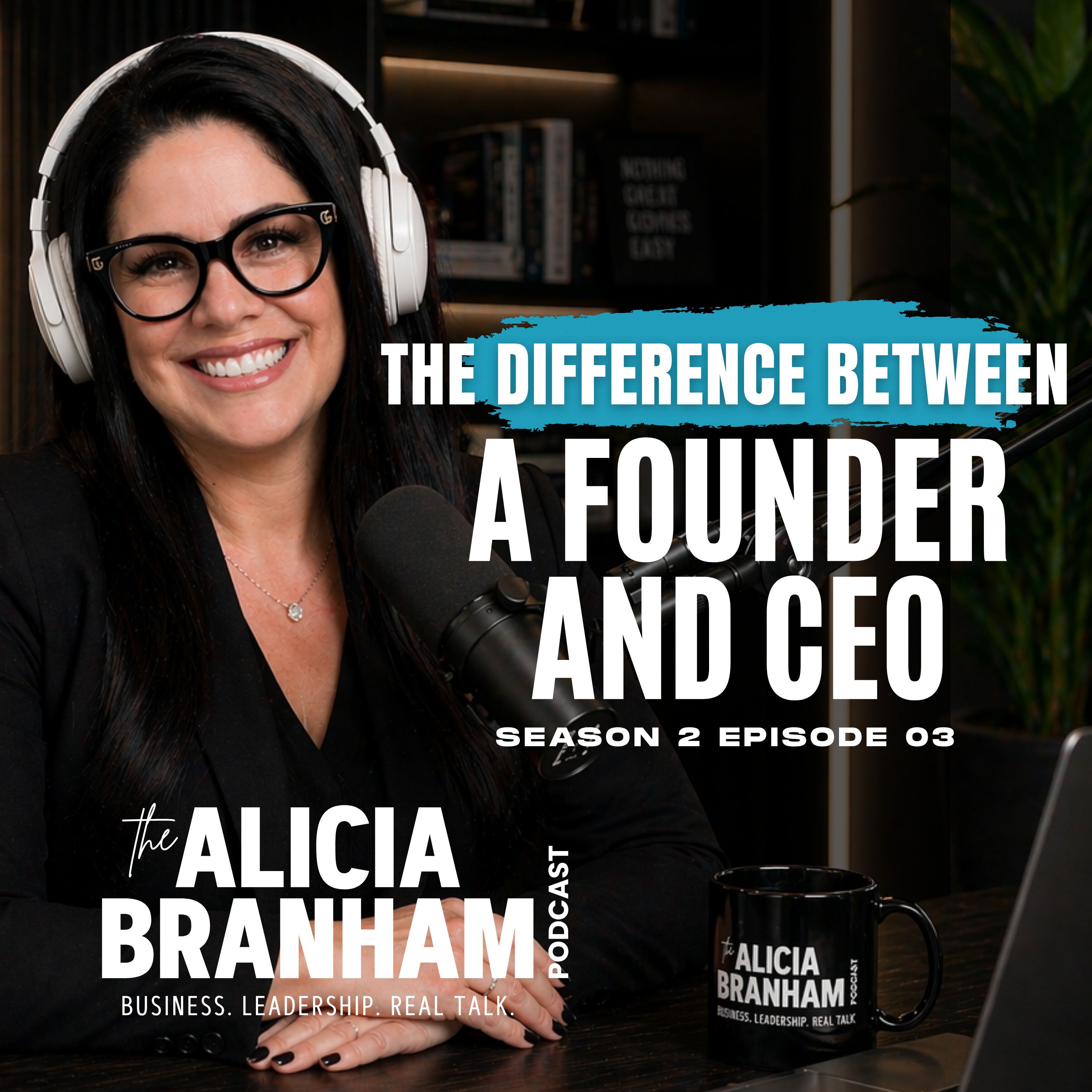
The podcast highlights the critical shift from being a founder to becoming a CEO, emphasizing that scaling a business requires more than passion or hustle. Founders often operate in survival mode, doing everything themselves, but this mindset fails when growth demands structure and delegation. A CEO must implement systems, processes, and clear communication to manage teams effectively, delegate work, and maintain accountability. Emotional intelligence is vital for managing difficult interactions and responding calmly, especially during client changes or layoffs. The speaker stresses that building people—through regular team meetings, personal check-ins, and genuine care—is central to long-term success. A CEO doesn’t just manage a business; they build a team that enables growth. The episode urges business owners to reflect on their leadership, step out of control, and engage in growth communities like the Goldman Sachs program to develop essential skills. Ultimately, true success comes from evolving leadership, trusting others, and recognizing that a business thrives on its people—not just its vision.
Hello, hello, hello, and welcome welcome to season two of the Alicia brand of podcast. I am super super excited that you are here today. It has been an incredible summer for me. I hope it's been an incredible summer for you.
Hello and welcome to the next episode of the Alicia brand of podcast.
Today I want to talk about the difference between being a founder and the CEO of a business, right?
I own a business. Starting a business and leading a company actually are two, require two entirely different skill sets. They just do, right?
Anyone can be a founder of a company, but to actually scale and grow a business requires a CEO mindset.
I need to learn myself at brand marketing. Anybody can start a business. There's not like there's a handbook about it, but there's a lot of passionate people out there that they want to share their passions with others or help others and they create these businesses, right?
But the one thing that we don't have is we don't have a secret sauce or recipe book on how to lead a company and what actually needs to happen behind the scenes.
For me, most, let me tell you, I think that most founders operate in survival mode, right? Especially if you're a solo proner when you're starting out or when you're adding in people, right?
You're in hustle mode, right? Because your business has started. You're really engaging. You're working at things, right?
You're doing everything yourself. You're scrappy, right? You're making fast decisions. So think about it from my perspective. I run a marketing firm. I run a creative marketing firm and I'm starting my own business.
I was extra torturing myself with the things that I didn't need to be doing, right? Because I was a scrappy for survival mode, right?
That's what most businesses are. We have this emotional attachment to our business. We're reacting constantly to things that we really shouldn't be because we don't know where it's coming from or why someone's getting on our craft or something, right?
We're choosing to wear every hat because it's either just us or you know, you have a team that you're not really trusting with yet, right?
Honestly, that mentality is kind of necessary early on, but if you're going to scale and grow and actually grow your business, you can't keep that mentality anymore, right?
And that is the difference between being a founder and being a CEO because being a CEO actually requires you to go from actually having it like actually to create vision and structure for your business.
So, the minute you hire one person inside your business, you need a systems, processes, and procedures for all of it.
Just for one person and I will tell you how much it paid me to not have those things early on in my business when I started hiring people because I didn't think it was necessary.
I thought we were too small. I didn't think it mattered. And the reality is, if it's not in writing, it didn't happen and it didn't matter in all those things, right?
It was my fault for not having systems, processes, and procedures written down. And so, we have a Bible.
Most businesses have a Bible, right, of how they're there or you should, I'll just stop right here.
If you have a business and you have employees and you don't have any systems, processes, or procedures set up for your business, I highly encourage you to do that.
It's not really hard to do. I promise you, it can be a group effort inside your organization to come up with them, right?
If you have a manufacturing business, for instance, right? And you've got different departments, different things and bring everyone in on creating these and then have your team follow them because it's really important for your businesses growth.
Anyway, you're welcome. I just took like five years of pain out of your business for you because I had to learn those pain points, right?
CEOs, we need to develop systems. We have, and not just that, we have to have long-term thinking for where the business is going to go.
We need to think about financial strategies, delegating work to people, right? Because when you're a solo printer doing it all and you start hiring people, you're like, no, mine, I'm taking that, you can't do that.
And the reality is that you really need to be delegating work to the people that you're paying to do their jobs for you, right?
And then organizing your business with clarity, so everyone on the team knows exactly what's going on in any given second of any given day because communication will wreck your business.
So let me tell you something about me as a business owner. Because I didn't have those systems processes and procedures in place, you know, I've had some people, you know, not do their best work inside of my business.
I've had people not be accountable for their work and then I've realized that, you know, not just that too, I'm going to, I guess I'm going to digress for more second getting back to those systems processes and procedures just because you have them in place doesn't mean they're going to follow them.
Sorry, that's another thing, but it's a great start. It's a great start because then you have something to refer back to and so I just, that's not your magic ticket, but it's absolutely the start for your business for sure, for sure anyway.
But let me tell you something else that a lot of a CEO suffer from, especially when you're gone, you're going for being a solo printer to working and having a team, you know, beside yourself, is that you're going to find maybe you are the bottleneck inside your own business because some of us just are because we're afraid to delegate.
We're afraid to trust, we're afraid to let go of certain responsibilities, right? To our team for whatever reason, maybe you are afraid of not feeling valued or seen or needed or maybe you have some something to do with that and the reality is that your team is counting on you to really be the leader that they need and to be the CEO that they need you to be, which means that you need to scale and grow and not stay mired in the things that you're paying them to do, right?
You're having a team and you're having to keep going back in and fixing and doing things, you've got a problem there and you might want to address that, right? And if it's not solvable, then you might need to replace the people that are, I'm just sorry, or you might need to change the way you communicate with people.
Either way, something needs to change for you because that's everything that's happened inside my business is because I made a mistake.
I made a mistake just like everybody else, right? We all make mistakes, but you're supposed to learn from them. So instead of pouting, I used to pout, I make a mistake, I'd get something and I'd pout like a kid, not in a bad way, not like, but just I'd feel bad. And then I realized that I was, you know, they tell you to use a mistake as an experience and learn from it.
So you tend to not make those same mistake twice, right? If you did, well then shame on you because you didn't learn the first time. It's okay to make a mistake once.
So listen, another thing I had to learn in this desire to be the best leader for myself and something that you're going to have to learn if you don't have it and don't be insulted when I talk about this, but honestly, you all need to learn to have emotional intelligence.
It's the truth. It is the truth. A lot of leaders are out there running around and they lack a certain level of emotional intelligence and that doesn't make you a bad person. It comes from something that happened to you, you know, growing up, family member, a guidance counselor, a teacher, somebody, somebody somewhere, peed on your weedies and made you feel bad. And it's a human condition, right?
And so what happens is that, you know, we tend to like, I had to go through this discovery. I had a couple of clients are really challenging at a marketing manager that just tried my patients and I acted poorly with her because I let her get the better of me.
And I shouldn't have, but I'm human like the rest of us, right? And I had to really learn to like hone some emotional intelligence inside my business, even to the point where like, okay, have you ever gotten an email from somebody or you're dealing with a client and it just so heated that.
And you want to respond and you're going to respond and I'm going to tell you I'm going to say something you stop, don't do yourself a service.
You are not doing yourself any good responding in a place of anger. It's not going to help you do anything in your life for your business personally professionally either way.
So I highly suggest in what I have I have a rule of thumb something really knows up my craw that I'm dealing with somebody a person, a project, whatever that gets put down for a little bit, maybe till tomorrow, maybe maybe maybe it's so upsetting.
I'm going to put it down for a week, okay? I've done it because sometimes it's necessary to be able to come back to the conversation deal with the problem, calm, cool and collected, a better service to you and a better service to your team, right?
It just it works out better that way. And so trying to hone that emotional intelligence is super hard for anybody. It's a human condition, right?
But I think in order for us to be a successful leader in CEO of the business, it's required and it's probably been one of the most challenging things I've had to work on, especially when I'm dealing with price increases to clients or saying goodbye to clients.
I've had a couple of clients leave this year. They're choosing to do other things with their monies as far as hiring employees or putting a pause because they're frankly nervous about our current political climate.
And I respect that. And they still come to me for other work. So I did have a couple of clients that did give notice and what's interesting actually is that I, the first client when he gave his notice, I didn't handle it correctly.
I just said, okay, and I should have been more direct about, you know, specific dates and times. And then the second client who gave their notice, we was probably three weeks lighter and said, hey, we want to put a pause. We hired like three new salespeople.
We want to put our directions towards this. And so then I use both opportunities to illustrate the other services that my business had for them that they hadn't been taken advantage of and it works 50% of the time.
So I had one of my clients was like, yeah, actually all our forward facing is wretched. Our website needs help. We sure need help with our line cards and our stocking documents.
So I flipped that to we're going to put those monies used to something else that they need, right? And that's okay to pivot to, but like that CEO level stuff, right?
and sometimes you're good at
and sometimes you're not.
But that's just the human condition, right?
And so another thing that I really wanna talk about
before I kinda round this out is or round this down
is that CEOs just don't build companies.
They build people.
So part of your job as a CEO of your business
is to build your team up.
And what that means is it doesn't have to be anything major
or super flashy or wonderful.
I tried it that way and it didn't work for me
or a small business.
I have simple, I have a weekly meeting every Monday morning
with my team.
We go over every project, everything that's going on.
I share details of what's going on with brand marketing,
with Alicia Brandham and all the different things
that are going on.
And then once a month, I have a call with everyone
on my team members to check in how they're doing
personally, professionally, how their job's going,
how I can support them.
That is an important, that's an important recipe item
for you as a business owner.
I don't care if you make donuts.
I don't care if you have a cleaning company.
I don't care if you have a landscape company.
Because if you want your talent to stay
and you want good employees to stay,
you must demonstrate in earnest that you care
about these people.
Because they're the reason you have a business.
And they're the reason that you are able to--
they're the reason I'm able to sit here today
and take this podcast episode.
Because my business is still running
while I'm sitting here entertaining you folks today.
It's the truth.
But I did that because I'm building up my team,
my business, being a person of my word, right?
It's about building up people as a CEO in a business
because you are nothing without your team.
You're just nothing without your team.
And it starts at the top.
If you as a CEO have a bad attitude,
or you have a founder attitude, and you're not giving any--
you're wondering why your business is not growing.
And you're not providing anything to your team.
You need to have some--
I'll be quite honest with you.
You need to have a little inward reflection
and take a look at yourself and see how you can improve.
Because once you improve, and once you make these changes
in your business, you are going to see things dramatically
changed for the better for you.
And sometimes it's hard to make that identity shift, right?
From solar printer to having a bunch of people to,
oh, god, I don't want to do it.
It's required.
I'm sorry.
It's required.
There's no way around it.
If you want to succeed, there is no way around it.
Everyone has a team that keeps them successful, right?
And it means cultivating that team.
Do you not take care of your family?
Do you not take care of your spouse?
Do you not take care of your children?
And your aging parents and all the things.
Then take care of your employees,
care about your employees, because they're the reason
that your business is going to be able to grow.
And they're counting on you.
They're counting on you to level up, grow up,
and be the leader that your business needs you to be, right?
Frankly, plain and simple, right?
But sometimes it's hard to let go of that control,
and you've got to have faith.
You have to have faith that your people
are going to step up to the occasion.
Because they believe it or not.
They really do want you to succeed.
They do, because your success is their success, right?
When I talk about my business to people,
I never say my business, my business.
It's our business.
When I'm dealing with our clients, it's our business.
It's the things that we're doing as a team.
Because it is a team effort, right?
In the earliest of brand, I really did a lot by myself.
I had a lot of hiring struggles.
I had to really learn my lessons and like my wounds
for bad decisions I made.
Lower prices and accepting work from everybody
that just didn't seem to work for me, right?
But at the end of the day, it all changed me
to be a better leader for my team.
And to be the CEO that my company needs me to be.
So as I round out this conversation,
I want to ask you a couple things.
How do you intend to grow and scale your business
if you do not change or you stay exactly the way you are?
Because every leader needs some sort of group or coaching
community or something to be involved in, right?
To help them grow and scale and do a thing, right?
Like even for me, I do have my business brand marketing.
But I also, there's a whole other side of me,
Alicia Brandham, right?
I'm actually a professional coach and speaker.
I train other team members or other company sales team
how to use LinkedIn to build their personal brands, right?
And to the harness the power of business to business selling.
I donate my time here in the state of Utah
with the women's business center
and the small business development center
in the northern counties because I'm truly passionate
about helping others grow.
But I would never be thinking in doing those things
if I still had a founder mentality.
CEO mentality is what you need, friends.
And it is a different, there's a different error about it.
And you can hang out with people that are CEOs
and other business owners so you can glean from each other
and learn from each other, right?
Back in 2024, I was very fortunate enough
to do the Goldman Sachs 10,000 Small Businesses Program.
And it's like a mini MBA program.
I highly recommend you look it up.
It's a nationwide program.
It's free for you, like 20 grand.
It would be like a little mini MBA program, right?
And it's free for you.
It's free for you.
You should check it out.
Goldman Sachs 10,000 Small Businesses Program.
But anyway, because I was in that program,
I've been able to meet a ton of other small businesses owners
here in the state of Utah.
I think we got over 1,200 graduates.
And we get together and we talk.
And we have our own meetings.
And we learn and we glean from each other.
Heck, I'm not a lady who owns a plus garage door here
in Salt Lake City.
And that lady, I'm not worried that it even
be next to her because she is such a badass.
But anyway, because I'm putting myself in those environments
to grow and learn from other people,
you need to do that for yourself as a business owner.
That's what you're going to help you succeed.
There's no handbook on doing things right or wrong.
But there is a way that you can put yourself in environments
that you can learn from others.
And you could be a better leader and learn those skills.
And I don't say any of it as a dig to anyone who's like,
well, what do you mean?
I thought I was a CEO.
And I'm like, OK, great.
But it requires more, it requires more of me.
And I just want to ask you, is it required more of you?
I know you can do it.
I know you can make something out of your business, right?
I know you can get that CEO mentality because CEOs,
they go places in life, right?
I mean, look at people like, who the guy running Amazon
for Pete Sakes, Jeff Bezos, starting a garage.
That dude can start in a garage.
You and I can do anything.
I mean it. So anyway, as I ran out this episode,
I want to challenge you to be the best CEO that your company
needs you to be because your team is truly relying on you.
I am so excited that you stayed to the end
to listen to my podcast.
It really means a lot to me.
So if you like what you heard today,
please follow me and subscribe.
Either you're going to find this on Apple podcast,
Spotify, and on YouTube, because I love YouTube.
And just listen, stay tuned.
There's a lot of great things coming at brand
and I cannot wait to share them with you.
So see you on the next episode of The Alicia Brand
on Podcast.
[MUSIC PLAYING]
Podcast Summary
Key Points:
Being a founder and a CEO require entirely different skill sets, with CEOs needing systems, structure, and long-term vision.
Early-stage founders often operate in survival mode, doing everything themselves, which hinders growth and scalability.
Hiring employees demands clear systems, processes, and procedures to ensure accountability and consistency.
CEOs must delegate responsibilities, trust their teams, and avoid becoming bottlenecks due to fear of letting go.
Emotional intelligence is critical for managing conflicts, responding calmly, and building strong team relationships.
Successful CEOs build people—prioritizing team well-being through regular check-ins and a culture of care.
Business growth requires shifting from founder mindset to CEO mindset, involving self-reflection and intentional leadership development.
Learning from peers and participating in programs like the Goldman Sachs 10,000 Small Businesses Program fosters growth and leadership skills.
Summary:
The podcast highlights the critical shift from being a founder to becoming a CEO, emphasizing that scaling a business requires more than passion or hustle. Founders often operate in survival mode, doing everything themselves, but this mindset fails when growth demands structure and delegation. A CEO must implement systems, processes, and clear communication to manage teams effectively, delegate work, and maintain accountability.
Emotional intelligence is vital for managing difficult interactions and responding calmly, especially during client changes or layoffs. The speaker stresses that building people—through regular team meetings, personal check-ins, and genuine care—is central to long-term success. A CEO doesn’t just manage a business; they build a team that enables growth.
The episode urges business owners to reflect on their leadership, step out of control, and engage in growth communities like the Goldman Sachs program to develop essential skills. Ultimately, true success comes from evolving leadership, trusting others, and recognizing that a business thrives on its people—not just its vision.
FAQs
Founders typically operate in survival mode, doing everything themselves and reacting to challenges. CEOs, on the other hand, focus on building systems, setting long-term vision, delegating responsibilities, and scaling the business with structure and strategy.
They ensure consistency, accountability, and clarity in operations. Without written systems, tasks are easily missed or mismanaged, especially when hiring team members, which can hinder growth and productivity.
It helps leaders respond calmly to conflicts, manage stress, and build trust with team members. Being emotionally intelligent enables better decision-making, especially in high-pressure situations like client exits or pricing changes.
Delegating allows owners to focus on strategic growth while employees handle specific responsibilities. It fosters accountability, frees up time, and builds team capacity, which is essential for scaling a business.
CEOs don’t just build companies—they build people. Regular check-ins, open communication, and showing care for employees create a supportive culture that keeps talent engaged and motivated.
When facing emotional reactions, such as client exits or complaints, it’s better to pause and respond calmly the next day. This helps avoid reactive decisions and allows for more thoughtful, constructive communication.
Chat with AI
Loading...
Pro features
Go deeper with this episode
Unlock creator-grade tools that turn any transcript into show notes and subtitle files.
 PodcastTranscript AI