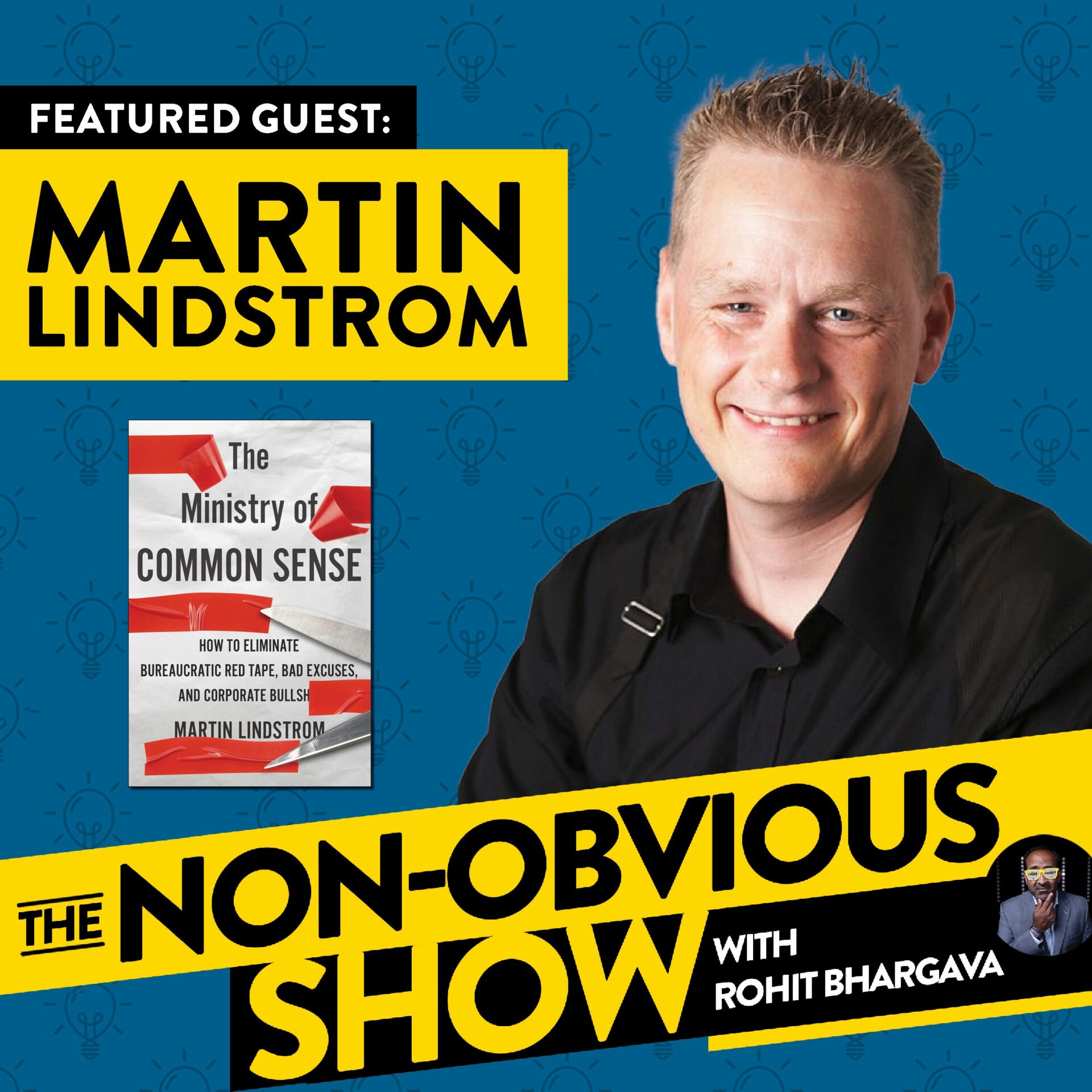
The Death of Common Sense (Featuring Martin Lindstrom) | Ep 5
25m 40s
Martin Lindstrom, a consumer behavior expert who spends over 100 days a year living in consumers' homes, discusses the decline of common sense and empathy in organizations. He argues that businesses overly rely on historical data, which only looks at the past and misses future insights, unlike direct observation in real-life settings. His approach emphasizes "causation" over correlation, as shown in a Lego turnaround where observing a child's pride in worn sneakers revealed that small bricks, not larger ones, were essential for engagement. Similarly, Swiss Airlines improved its economy class by tackling passenger anxiety through transparent communication about wait times and logistics, rather than superficial perks. Lindstrom contends that as companies grow, they become bureaucratic, rule-bound, and empathy-deficient, fostering "nonsense" instead of common sense. He highlights an alarming trend: empathy levels have dropped 48% among students over the past decade, partly due to screen reliance and social media echo chambers, posing an existential crisis for humanity. To counter this, he advocates for rebuilding empathy through direct, human-centric observation and starting with self-awareness, even in a remote world. Ultimately, his book, *The Ministry of Common Sense*, urges individuals and organizations to prioritize understanding others' perspectives to restore practical wisdom and meaningful connection.
[MUSIC] We are running our consumers for remote control. We kind of think that the data and the spreadsheets is doing the trick. But guess what? We all have access to the same numbers. And perhaps most importantly, all these numbers are looking at the past. They're not looking at the future because you can't look at numbers for the future, but you can certainly observe through the future by being in consumer home. So that is really my foundation for how I always worked. And of course, that led to the concept of empathy. [MUSIC] Martin Lindstrom spends more than 100 days a year living in consumers homes. Literally. This unique consultant's lifestyle has given him one of the world's most hard earned perspectives on why people behave the way that they do. He has shared his insights in eight best-selling books about consumer behavior. His new book is called The Ministry of Common Sense. And in it, he suggests that one of the biggest problems facing our world today is that common sense is dying. From bone-headed corporate policies to unavoidable government bureaucracy, Martin explains exactly why we're surrounded by so much stupidity and what it would take to fix it. Here is Martin Lindstrom exploring the death of common sense. In this week's episode of The Non-Avias Show. [MUSIC] Are you ready for a journey through the unusual? Welcome to The Non-Avias Show with host Rohit Bargaba. Every week, we're sitting down with fascinating thinkers to explore their biggest non-Avias ideas. Follow your curiosity. Be more interesting. Be more non-Avias. Our next episode starts right now. [MUSIC] Martin, welcome to The Show. It is very good to have you here. So I want to start off by asking you about the inspiration for this book. And maybe for you to bring us into that with one of your masterful stories of why the world lacks common sense in the first place. Well, I'll tell you why. Many years ago, the wonderful Charlie Bell, the former, former, former CEO of McDonald's reached out to me and he said, "Hey, Martin, I love you to redesign the Happy Meal." And I said to him, "Listen, I could think about nothing better, except I have one condition that I can make it healthy." And Charlie was a good man. He said, "Absolutely yes." So I had an objective. The objective was to create a Happy Meal containing broccoli and to make six-year-old kids eat broccoli. Go figure. That's not an easy one, right? So we did that. And we did it through a narrative. We had the bushes in the forest that was to broccoli. We had the cucumber, which was the murder weapon. We had the tomato. That was the blood. And kids loved it. And parents loved it. And even the franchise sees they loved it. So we ran a pilot in Germany and then I went to the headquarter of McDonald's outside Chicago. And they said to me, "It's interesting." Now, I was from Europe, remember? So I went back to Europe and said, "Yes, the thing is interesting." Interesting. So two years went by and nothing happened. And then finally the big loans of the new Happy Meal came out. And this time it was a cardboard box with a usual sugar bond, the French fries now with an apple. And that was the day I realized good ideas is not going to do the trick anymore. You have to go deeper. So we had to do the higher psychology. For nearly 15 years, I've had four psychologies running around with me to understand that dynamics within organizations. Why are they so detached from what the consumer wants? And out of that, I realized that empathy is dying. So let me put that into perspective. When I say empathy, right, it sounds like a crying children and cupcakes, why is that? But the reality is that empathy, remember, is the capacity to understand or feel what another person is experiencing from within their frame of reference. That is the capacity to place one self in another's position. And what's really fascinating about this is that empathy is to feel what other people are feeling. And we have forgotten about that. And companies have forgotten about it. Governments has forgotten about it. We have forgotten about it. Well, yeah, and you have a very specific way of bringing people into that empathy. And it is very direct. It's not about reading reports. It's not about, you know, focus groups. You actually take people and put them in front of their customers. In fact, sometimes you've taken them and taken them into their customers' homes and shown them this very direct way of trying to understand people and build that empathy. So talk a little bit about that approach and the light bulb that perhaps happens for people when they get that direct interaction. I think my best experience probably was Germany where I was spending time for Lego moving into consumer homes and understanding the issue. Lego had a huge crisis around 16 years ago and actually they're close to bankrupt. So what they've done is they've listened to big data. And big data, as you know, is all about finding correlations. And but big data is not all about causation, the reason why. So what we did was we said, hey, there's an issue here in particular because Lego had changed the size of the Lego break from these tiny bricks to gigantic building blocks. Because they thought the instant gratification generation meant that they wouldn't have time to play with these Lego breaks. So here we are moving into a home of an 11 year old German boy. And I'll never forget it because we're sitting on the couch, entering this kit, which of course have no idea about who we are. And we're asking one simple question, what are you most proud of? And the kit he points at a self. And on the self as an old one down pair of shoes, sneakers. Of course, we completely perplex thinking this kid would have said, Nintendo PlayStation or Sony, no, an old one down pair of smelly sneakers. So of course, we're asking why? And the kid is saying, well, because I'm the skater, I'm the best skater in town. You see, if you're really good skateboarder, you slide down the skateboard and create a certain angle of where I'm tear on the side of that angle. And exactly that angle means I'm number one. And that was really the time where we had a Eureka moment. Because if a kid is willing to spend hundreds, if not thousands of hours playing with, no, they find tuning the angle of a shoe, why wouldn't the kid be willing to spend hundreds, if not thousands of hours playing with Lego? So they went back to the drawing board, reinstalled the small bricks and the Lego movie became a reality later on. And this is really my story. And I call that for causation, the reason why the observations you make in people's homes. And the good news here is you actually will find that very quickly if you do it the right way. I mean, within very few interviews, the good news as well is that very few companies doing this, because they're too lazy. They're stuck behind the screens. We are running our consumers for a remote control. But guess what? They're not looking at the future because you can't look at numbers for the future, but you can certainly observe through the future by being in consumer homes. So that is really my foundation for how I always work. Yeah, it finds itself in many ways through the stories you tell in the book because one of the things that you have done year after year is be called in by a lot of these organizations to say, look, we have something that's broken. And it strikes me when I was reading your book that in many of those situations you come in, they tell you the thing that's broken. And the first thing you do is say, actually, I don't think that's actually the thing that's broken. I think something else might be broken. That's causing that thing in the first place. And you tell some wonderful stories around your experiences with travel. And in particular, I think it was Swiss Airlines. And how you helped them to go from being quite lowly ranked to highly ranked by dealing with one thing that actually it is generally not seen as an airline's job, which is passenger anxiety. So tell us a little bit about that story. Well, the story really began with the fact that Swiss international airlines, what's his Swiss, which means is on time, but not on time, what's his kind of ironic. So the sort of said, we would like to improve our image on economy class. And the first thing I did was really to spend time across the world with passengers joined by a cabin crew member, by the captains, by the pilots, by the dockets, carousel managers, by the headquarters staff. So they could feel the pain and the suffering these passengers would have. Now, one of the things we realized was if I'm going to improve economy class, changing the legroom two inches or giving you five more peanuts in the back or two more movies in the detainment system is really not going to do the trick. And I'm pretty sure I would be fired anyway if I was suggesting that. So we realized the number one factor here really was anxiety. Anxiety of not getting to the airport in time. Anxiety about that you will be bombed. Anxiety about the TSA taking too long time or anxiety about COVID-19. And so we went back and asked ourselves how can we remove that systematically and that the range of different initiatives coming out of it. But one of them was really the night.
announcement by the captain. So let me just play the voice of the captain. Ladies and gentlemen, welcome on board of the Swiss International Airlines bound for JF Kennedy's airport. We are about to descend to JFK and will be on ground in around 40 minutes. Now I am pleased to announce you that I've just been in contact with the cabin or with the ground handing staff and they informed me that we will arrive at gate 107, which is wonderful news because it's only a seven minute walk from the gate to immigration. And even better I've been in contact with immigration, which informs me that the waiting time is only 11 minutes at this stage. And the lock is carousel manager tells me that there's a waiting time of 14 minutes. So with a bit of lock, you'll be through the system in around 40 minutes. Even better, I've been on ways and ways tells me that the traffic to Manhattan is 49 minutes at the moment. So ladies and gentlemen, we expect you to be back home in your safe environment if Manhattan is your home in about two hours time from now on. And that was really the moment where when people heard that on the speakers, they said, my God, and what's fascinating about this is even though the time would not be positive, it may be those five hours of waiting time and immigration, it doesn't matter because Swiss was taking the perception up front and taking ownership of it by saying, guests, this is not our problem. This is what's going to happen from now on, but we are on control and immediately anxiety started to disappear. And of course, we were even more lucky that in fact, Swiss started to change its image in Europe. And this is really my story that when you change things, you have to look at the world from another point of view. And what we did literally was of course to look at it through the lens of a passenger. Yeah, and it's wonderful because one of the things that you really hone in on and you actually, you've named it, you've called it the Ministry of Common Sense and you've answered one of the big questions that I think a lot of companies struggle with, which is whose job is this to think about that, especially when it's not something that's directly under your control. But even when it is, you mentioned laziness, you mentioned some of these barriers that come up that keep companies from doing that. Is it a barrier of leadership? Is it a barrier of it being no one's job? Is it all of those things? Talk a little bit about the barriers that come up that are preventing common sense. I think the number one point to this is that as an organization-grow speaker, what happens is that the organization also starts to remove its empathy and become much more bureaucracy driven. Remember, the opposite of common sense is nonsense. So if I should illustrate that through the chart on the screen, you will see here's a chart we're using a lot. You have shoot on the top, you have shootin on the bottom, you have do on the left and you have don't on the right. Now, if I was to look at a very big slow organization, it was a been around forever, they have multiple reporting layers and it's lots of its size, you will notice that typically would be living down in the bottom. That's where it's don't and shouldn't, a lot of rules, regulations and compliance. And what's fascinating about it is that's also where nonsense grows. That's of course the opposite of common sense. Whereas if I take an entrepreneurial company, you will notice that's living on the top instead. And the reason why this is so interesting is because why is that happening? Well, let me tell you a little story. So a couple of years ago, these two kids were sitting in the dorm room, smoking weeds, and off their head, one of the kids shoots a photo and they upload this photo to social media and of course, she hits the fan. The parents comes after them, it's seriously embarrassing. So one of the kids is saying to his friends, I wish we could interact that photo and that becomes the birth of Snapchat. As we know today, a $50 billion company. So why was that happening at that moment because of empathy? He had a clear feeling of the pain and the suffering you had of all the embarrassment for a photo floating around on the nets. And that really became the driving force just as the founders of Google with a drowning force. But then over time as the founders, a side weight like Google legally comes in because they want to protect what they already have, new people are going through the revolving door so that coolie you're drinking off is no longer the empathy coolie, but it's the bureaucratic coolie, then suddenly, bureaucracy and of course nonsense is growing up. So the reason why is really that the bigger a company becomes, the less empathy it has. And it's super important for me to say because as we're sitting behind these screens right now, of course, we are in my opinion at an all-time low. In fact, I would claim that empathy is having right now is a existential crisis. And that's a serious, serious claim because then we are questioning something fundamentally about who we are, humans. And it also of course is painful to think about if you are a staff member, where empathy is not there because no one cares about you, if you're a customer, and in the end of the day, if you're a human being, right? Yeah, and I think that we have seen a resurgence in the dialogue around empathy, I think now, but maybe because of politics, maybe because of some of the other things that have been happening in the world and a reimagining of how important it is right now. And this book kind of fits perfectly into that. When you've been out there sharing this message, and when you've been talking about the need for empathy, when you've been talking about the need for more common sense, and you've been doing that right now since the book just came out this week actually. And so you've been kind of out there promoting this message, what sort of reaction are you getting from people? Do people say, "Oh, thank goodness somebody's talking about this," or do they say, "What do you mean by that?" Or do they say, "Yeah, we know we need it, but it sounds kind of hard to do." Like, I don't know how to do that. Well, it's a very good question, right? And I want to take you back to one of my previous books, which I know you're very familiar with this biology. I found them in the belief that book changes lives, and biology was among others a neuroscience study, a $7 million study where we scanned Smoker's brains. My mom was a heavy smoker, and because of that, I wanted to find out how I could make people quit smoking. And one of the things I discovered through this neuroscience study was that the health warnings on cigarette packs in fact had the opposite effects. You know, the search in general health warning, opposite effect, it actually concur its people to smoke more or not less. So through this process, we actually start to remove the labels and basically replace the cigarette packs with pure white labels, just pure white, no brand, no nothing on them. Now, to this very day, we now estimated, according to WHO, that 30 million people's lives have been saved because of that initiative, which of course I'm super proud of, and it confirms that book changes lives. Now, he's the reason why I'm saying you this, I'm telling you this. I'm telling this because I actually do think that the Ministry of Common Sense is even more profound. And the best way for me to illustrate that is that if you look into the brain and how we work as human beings, empathy has not always been with us. It's something we've grown over many years, and there is an area in our brain which is responsible for all that stuff of creating empathy. And actually, we're the only mammals on planet Earth was having empathy, which have made us survive because we're able to put ourselves in the footsteps of a polar bear or whatever it may be when we were, no, many years ago. And that made us survive. Now, he's the scary part of this. A recent study is showing from the Michigan University, conducted among 14,000 students over two decades that empathy levels now have dropped some 48% over the last decade alone. And this is a global trend we're seeing happening across the world, and there's multiple reasons why. But we get into this stage now where, as I said previously, it is starting to be serious because we literally are rewiring our brains, losing a sense of empathy because we stuck behind our screens because the social media bubbles are reaffirming what we are standing for. So really, that muscle we once had was had to be trained all the time. And what I learned when I moved into all these consumer homes and established a sense of empathy is now slowly fading away. That means the very concept of being a human being is starting to fade away. So when I've told people this story, not only do people start to cry and I'm not kidding, but people also realize that this is serious. This is not just a fun book. Yes, it has a fun title. Yes, it is. Ministers of common sense exist for sure, but it's much, much deeper than that. This is a fundamental question about who we are and who we want to be in the future. And when we do think about that, when we realize the urgency of it and we want to make the change, a lot of your experience in your background has been getting out into places and that's obviously become more difficult now because of the pandemic. I know that you are a, I think frequent traveler would be an understatement for your type of travel schedule of how often you're on the road and everywhere. And I know you wrote a ebook recently about what it would take to get back to travel and what people should know about traveling again. And you're sort of becoming this in some ways with this ebook, a voice for the travel industry itself. So how do we get back to being more empathetic and understanding people when we're stuck at home and we're not able to go and physically be together? The most important thing
is to start with yourself first. And I think the best way for me to illustrate that is to tell you a little bit about a backstory. We as human beings are not used to separating or to merging private and work. And I learned that for the first time when I was spending time with Malcolm Gladwell a couple of years ago where I was in Samvia. Malcolm and I was looking at the Savannah and what we realized was that at the Savannah there was in fact all these people wearing hats. And Malcolm said to me, "No, why are we not wearing hats in the Weston World?" And it was Malcolm asking the question. So I thought a lot about it. And after a year I realized all this stuff actually happened in 1961. In fact, 1961 one day ago at the JF Kennedy's inauguration which were the very moment where he was the first president not wearing a hat during the inauguration. And you may say to me, "Well, that's not a big deal while who cares, but in fact it is because it's the first time where we were starting to merge private with work. I presume that back in the days you would put on a hat, go to work, you want to work, mood, and you'll go back again and you'll be in private mode or private mode." Then the tie disappeared. And then suddenly we installed a smartphone in our pocket cord and office. And now we have the last tip over the barrier which is that we now have a pipeline of bureaucracy going straight into our homes. So what I am saying right now is that we first of all need to get our house north. You cannot establish empathy if you're mixing the waters as we're doing right now. You basically will break it down that muscle. We know that from all sorts of psychology. We have to start zoning your home. That's number one. Once you've done that, once you have your house north, when you're separating your lives better than you're doing right now, the second step is that you can easily visit other people in their homes through cameras. No, I'm looking into parts of your home right now. And even though it stays, I'm sure if I asked you to walk around with your phone and show me what's in your fridge or what's under your bed, which is exactly what I did when I did a demographic basis across 80 countries. But then I probably would be fairly good at coming up with conclusions. The long story short here is I'm merging myself into your lives and I also see it through the right perspective, through the right lens. So can you do it that way? Yes, you can. Is it as efficient as when I'm in homes and living with people? No, it's not. But I have to say one thing, it's better than nothing. And then I think we all have to hope of course that we are not ending up with a COVID-29. Yeah, I hope that too. So I just want to thank you for putting that message out there. And I want to close. We've got just a few minutes left. And I want to close with your imagining of what the world could be if more organizations had this ministry of common sense. Like paint your picture of the future world. If the organizations that need to read this book and the leaders who need to read this book actually do, what could we benefit from? Like how would that world look? I think that's what I actually I think I know where we're going to end with that because we've set up now seven ministries that some of the largest companies in the world. So they do exist. And they do clean up once stupidity at a time as I tend to say. And he's what's so fascinating about the ministry of common sense. Typically it's a website and build up in a clever way where people submit their own frictions within the organization. There's a lot of frictions going on inside an organization in which you submit. What we was very surprised about as we did this was in fact that people were not just submitting their frictions, they're also submitted their solution to those. So suddenly you become more an intermediary holding a mandate and helping people to push through a solution. And if I take a look at the ministries running around the world in one bank we sold more than 2600 frictions. The result is that suddenly no the share price went up, the culture went up. In Merck the largest shipping company in the world, 21% of all trade. We worked a lot with these guys. Share price has tripled over the last year. Tripled. This is the largest shipping company in the world. And NPS is through the roof where empathy has been compared to it and where removing frictions has of course been part of the game seeing things for another lens. So would clean that a minister of common sense make sense. The problem is that common sense is not that common. No it's not. Martin Lindstrom everybody best selling author time magazines most influential persons several years ago perhaps still one of the most influential people and the author of a brand new book called The Ministry of Common Sense which is all about trying to rid the business and corporate and perhaps government world of nonsense and bring more common sense back to all of us. Martin thank you so much for joining us. Ruheet has been a pleasure and listen thank you so much for following me for all this. Yeah it means the world to me. I do think that your work is making the world a little bit more bright with a little idea and one idea at a time is going to be pretty mind-blowing in the end of the day when you combine it all. Thank you so much. Thanks for listening to the non-obvious show. To listen to past episodes visit nonobvious.com/podcast. See you next week.
Podcast Summary
Key Points:
Martin Lindstrom argues that relying on data and spreadsheets is insufficient because they focus on the past, not the future, and lack empathy.
He emphasizes the importance of direct observation, such as spending time in consumers' homes, to understand the "why" behind behavior (causation), not just correlations from big data.
A Lego case study illustrates how observing a child's pride in worn sneakers revealed that small bricks, not larger ones, were key to engagement, saving the company from bankruptcy.
Swiss Airlines improved its economy class by addressing passenger anxiety through proactive communication, like informing passengers about wait times and ground logistics, rather than just adding perks.
Common sense declines as organizations grow, becoming bureaucratic and rule-heavy, which fosters "nonsense" and reduces empathy.
Empathy is facing an existential crisis, with studies showing a 48% drop in empathy levels among students over the last decade, driven by screen reliance and social media bubbles.
Lindstrom suggests that restoring common sense requires starting with self-awareness and rebuilding empathy, even in a pandemic-stricken, remote world.
Summary:
Martin Lindstrom, a consumer behavior expert who spends over 100 days a year living in consumers' homes, discusses the decline of common sense and empathy in organizations. He argues that businesses overly rely on historical data, which only looks at the past and misses future insights, unlike direct observation in real-life settings. His approach emphasizes "causation" over correlation, as shown in a Lego turnaround where observing a child's pride in worn sneakers revealed that small bricks, not larger ones, were essential for engagement.
Similarly, Swiss Airlines improved its economy class by tackling passenger anxiety through transparent communication about wait times and logistics, rather than superficial perks. Lindstrom contends that as companies grow, they become bureaucratic, rule-bound, and empathy-deficient, fostering "nonsense" instead of common sense. He highlights an alarming trend: empathy levels have dropped 48% among students over the past decade, partly due to screen reliance and social media echo chambers, posing an existential crisis for humanity.
To counter this, he advocates for rebuilding empathy through direct, human-centric observation and starting with self-awareness, even in a remote world. Ultimately, his book, *The Ministry of Common Sense*, urges individuals and organizations to prioritize understanding others' perspectives to restore practical wisdom and meaningful connection.
FAQs
He was inspired by a failed McDonald's Happy Meal redesign where a healthy option with broccoli was ignored, leading him to realize that good ideas alone aren't enough and that deeper psychology and empathy are needed.
He defines empathy as the capacity to understand or feel what another person is experiencing from within their frame of reference, placing oneself in another's position. He argues that companies and governments have forgotten this.
He spends time living in consumers' homes to observe their behavior directly, rather than relying on data or spreadsheets, which only look at the past. This helps him uncover the 'causation' or reason behind behaviors.
He visited a German boy's home and found he was proudest of worn skateboarding shoes, showing dedication to mastering a skill. This revealed that kids would still invest time in small Lego bricks, leading Lego to revert from large blocks to the original small ones, saving the company.
He identified passenger anxiety as the main issue, not legroom or food. They implemented captain announcements that provided real-time details on arrival times, immigration waits, and baggage carousels, reducing anxiety and improving the airline's image.
As organizations grow, they become more bureaucracy-driven, focusing on rules and compliance, which fosters 'nonsense' instead of common sense. This happens because empathy diminishes as companies prioritize protecting what they have over understanding customers.
Chat with AI
Loading...
Pro features
Go deeper with this episode
Unlock creator-grade tools that turn any transcript into show notes and subtitle files.
 PodcastTranscript AI