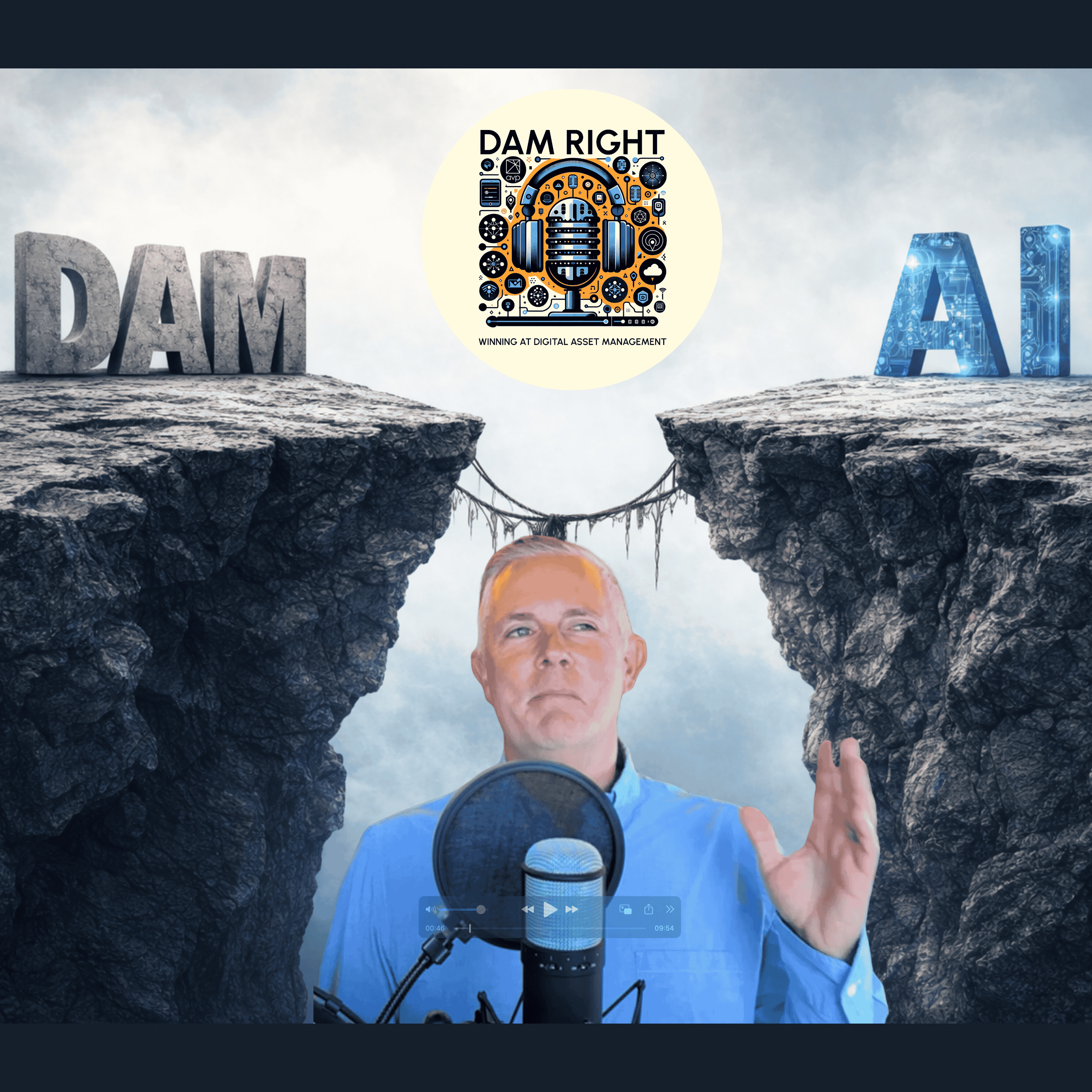
[Music] About six months ago, I started working on a piece to try to get my head around something that I was seeing with increasing frequency and effect. I ended up publishing the piece at the beginning of this year. The label that I put on what I was seeing, which was also incorporated into the title, was The Damn AI Gap. When I was a kid, I don't remember exactly what age I was, but let's just say I was five years old. One day, my dad announced to me and my brother that we were going to go with him to buy a new car. I remember hearing the name of the car and getting excited because of how close it sounded to Corvette. Corvette meant speed, performance, power. So when my brother and I were on our way with my dad at the dealership, I had this image in my head of a red sleek, fast car. As we excitedly followed our dad and the salesman through the lot, my enthusiasm turned into drastic disappointment as we arrived at a lackluster, black box with four wheels and a roof rack. The vet was doing a lot of the heavy lifting in my imagination. This, we found out, was what a shovet looked like. Same vet, completely different, everything else. I think about that moment when I listen to certain people talk about AI at this point in time. There's this Corvette dream and intelligence speed, automation, agents doing work autonomously massive productivity games. And then there is all too frequently the shovet reality chatbot search that doesn't deliver the search results you want. Flatfooted AI agents tripping over each other assets being made available to the wrong people at the wrong place, the wrong time, persistent version control issues. But let's continue with the analogy and imagine that some compassionate wish-granting beans saw the look on my face that day and said, "Fine, I will give you part of what you want. I will put a Corvette engine in that chavette. What I have taken them up on it, absolutely in a second, and it would have been a total disaster. The boxy body would have done no justice to the powerful engine, the brakes weren't designed for that level of speed. The results would have been disappointing at best and dangerous at worst." And this brings me to where we are with AI right now once again. If you look at vendor roadmaps, conference keynotes, product demos, you would think that we have already entered deep into this new era. Every dam platform is now an AI platform. Every roadmaps AI first, every new feature is intelligent, automated, generative, agent-driven. And yet, when I talk to dam leaders and practitioners inside organizations, the conversations sound completely different. They're being asked to do more with less. In some cases, teams are already being cut and anticipation of productivity gains from AI. Executives are frustrated by the lack of results. Teams feel the weight of rising expectations but without the structural support to meet them. That disconnect, that tension is what I'm calling the dam AI gap. It is the distance between what AI can theoretically unlock inside of dam, and what organizations are structurally and operationally prepared to operationalize. AI promises intelligence, but intelligence depends on high quality metadata. AI promises agents that can act, but agents require rules, permissions, and governance. AI promises content creation and publishing at scale. But scaling well depends on strong rights and brand management. And here's the important part. The promises are real. This is not vaporware. AI is not failing to deliver on the promises because it lacks capability. The gaps are not because of AI. AI simply simply puts them under a microscope. It exposes and exposes in very practical ways where organizations are in their dam maturity path. AI is acting as a stress test for dam operations today. And this is not unique to dam. McKenzie is writing about the divide between AI agents and ERP systems. Loyts research shows that while AI investments vary widespread, enterprise level impact remains limited. Across industries, organizations are piloting AI aggressively, but very few are scaling it deeply into core operations. AI capability is et cetera, accelerating exponentially. Organizational readiness is not. That delta creates the gap. Dam is particularly vulnerable to this dynamic and there's growing recognition within the dam community that AI is exposing longstanding structural weaknesses, not creating them. Since publishing my piece on the dam AI gap, I've seen several other organizations and people on the damosphere express very similar sentiment. Digital asset management has always been foundational, but under leverages in my opinion. It sits at the center of enterprises and business units and department sits as often funded like a tool rather than treated like a programmer operation with the same. Program or operation with clear purpose, defined roles and measurable outcomes. A mature dam operation is not just technology. It is purpose, people, governance, process, yes technology, measurement and continuous improvement working together to deliver predictable value. Components I just listed are actually the components that make up AVP's operational model for dam success. It is not a coincidence that those same components are required for AI success. In many organizations, those elements are not fully operationalized purposes ambiguous KPIs and ROI aren't defined roles and responsibilities are misaligned processes are fragmented, metadata is lacking and inconsistent. State becomes the norm, status quo, good enough. Well, good enough until you go to turn on AI expecting results in returns. And that's because AI depends on those foundations. If user-centered metadata and taxonomy are weak, AI generated metadata and search experiences will disappoint. If governance is ambiguous, automation becomes very risky. Information brand management or inconsistent content scale becomes a liability. What we are seeing instead is a surge in surface level AI enablement, automatic metadata creation, chat interfaces layered over repository, generative AI variance spun up from existing assets, eager AI agents ready to fulfill tasks. These capabilities are useful, but we are often mistaken enablement for readiness. And AI enabled interface does not mean the system is AI operationalized. Layering an LLM on top of fragmented data does not produce intelligence. Deploying agents without documented requirements policies and workflows does not produce scale. AI amplifies whatever foundation already exists. If your dam scores low on the dam operational model AI amplifies fragmentation and causes frustration and disappointment. If your dam scores high AI can and will unlock enormous value. The promise of AI and dam is real, but it is unlocked not by chasing features. It is unlocked by strengthening the system and foundation that AI is meant to amplify. The dam AI gap is not an indictment of AI or dam vendors. It's not an argument against innovation. It's a signal. And it's important when to pay attention to it this particular moment in time. The encouraging part is this. The productivity gains people are frustrated by not seeing yet. They're real. The acceleration, the leverage, the ability to move faster with fewer manual touch points. The future is not hype. It is definitely possible. But it is built not granted. It's not a flip of a switch. It's built by solidifying the fundamentals that make dam work as an operation. Clear purpose. Defined ownership. Document a governance. Intentional process. Reliable metadata. Meaningful measurement. And continuous improvement. AI will not create operational maturity for you, but it will reward it. And the good news is the distance between where many teams are today and where they need to be is not a moonshot. It's structured finite visible work. It is achievable work when there's clarity around the model you're working toward. For many organizations, this is not required starting over. It requires tightening what already exists. Clarifying what has been assumed. Strengthening what has been informal. Creating coherence where there has been drift. Sometimes it requires temporary bandwidth. Sometimes it requires specialized expertise often. It requires both. But here's the deeper point. If what you have today is a chavette, calling it a corvette will not make it one and dropping a corvette engine into it will not turn it into one either. If you want corvette performance, you have to build a corvette. You design for performance, purpose, and outcomes, and you align everything you do around that goal. That is what a mature dam operational model looks like. It is designed for scale governance intelligence and measurable value from the ground up. The productivity gains the acceleration, the scale, it's all possible. But they are only realized when you build for them. That is how you close the dam AI gap. At AVP, we can help you close that gap and get you over the hump from frustration to realization. We've got a wealth of free information that you can find at weareavp.com/free-resources and weareavp.com/insights. If you want to find out more about services we offer to help you close the dam AI gap, reach out at weareavp.com/contact or shoot me an email at
[email protected]. And remember, dam right, because it's too important to get wrong.
 PodcastTranscript AI