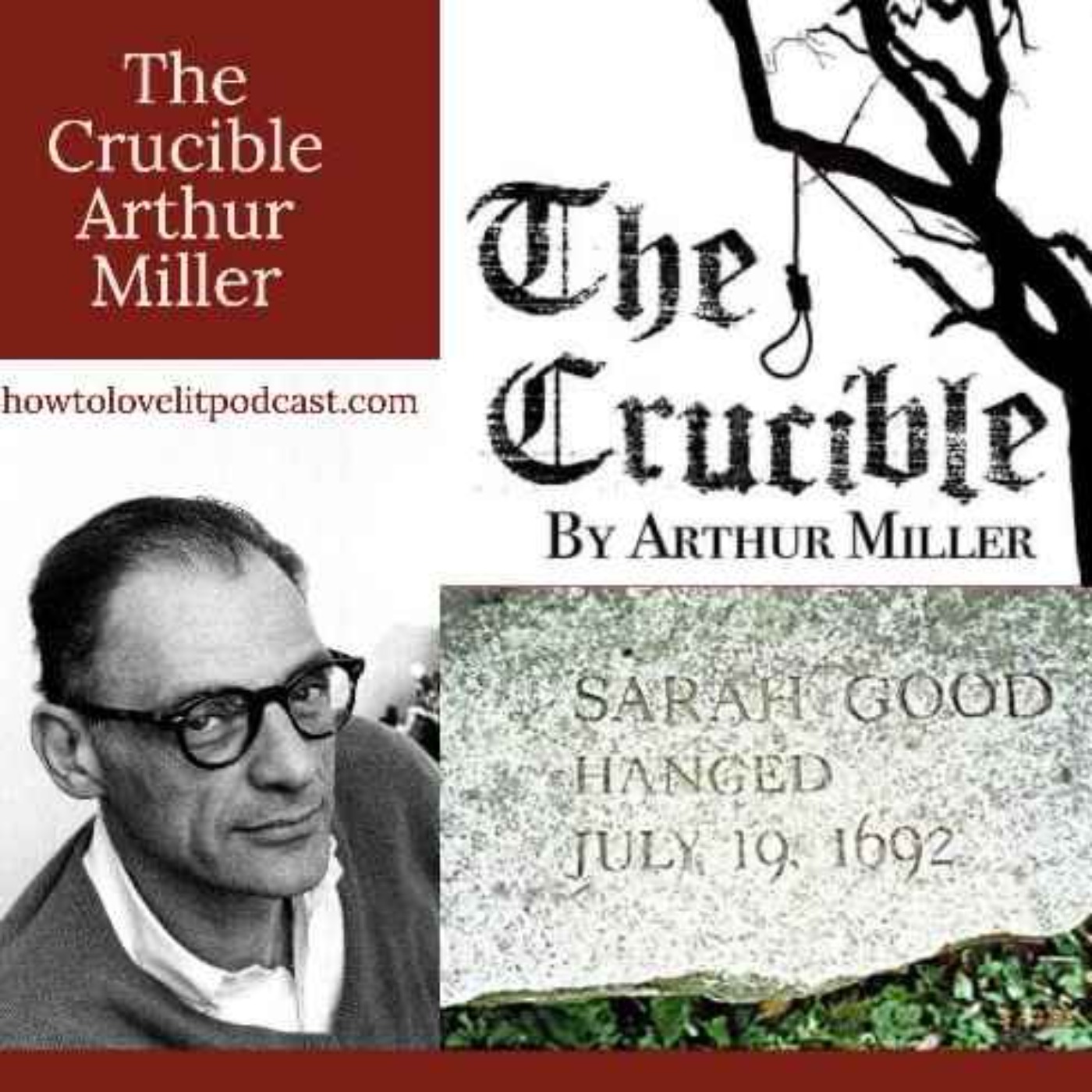
The Crucible || Arthur Miller || Episode 1 || 2026
from How To Love Lit Podcast
49m 15s
This podcast episode introduces a series on Arthur Miller's *The Crucible*. It begins by noting the play's initial box-office failure in 1953, contrasting it with its later status as one of America's most produced plays. The hosts discuss Miller's critique of the American theater's financial model, which he believed stifled artistic risk-taking. The core of the discussion establishes *The Crucible* as a historical allegory, with Miller using the Salem witch trials to comment on the political hysteria of McCarthyism in the 1950s. The hosts provide background on Miller's life, his major award-winning works like *Death of a Salesman*, and his own testimony before the House Un-American Activities Committee. They then set the historical scene for the play, explaining the Puritan context of 1690s Salem, the division between Salem Town and Salem Village, and acknowledging that while Miller based his play on real events and people, he took creative liberties, most notably fabricating an affair between the central characters. The summary emphasizes the play's enduring relevance as a study of universal human tendencies toward fear, manipulation, and persecution.
[Music] Hi, I'm Christy Schreiber and we're here to discuss books that have changed the world and have changed us. And I'm Gary Schreiber and this is the How To Love Lit Podcast. Today is new book day and I always love new book day. We're starting up our series on Arthur Miller and his timeless classic about one of my favorite topics, human hysteria. One of my favorite topics anyway, his book is play The Crucible. I'm particularly excited about the series because it's both extremely historical as well as psychological. There's lots of things hard but in this case it's really heightened in this book. Oh for sure. The Crucible is Arthur Miller's most produced play worldwide, becoming one of America's most popular plays in the 20th century. Ironically though it failed at the box office and it's initial production in 1953. So what does that tell you? I think that tells us that initial box office don't always get it right. Well Miller would definitely say that they almost never do. He was really critical about how we in the United States organized theater. I watched an interview that he did with Charlie Rose later in his life and he talked about the problems of course he would as he saw them with American theater. It was kind of interesting to me because I don't think of things like that. But he complained that as a nation we can never get any good at play writing and we're not that awesome at acting. I'm no offense to any actor. But he doesn't blame anybody. He said it's the financing piece that's the problem. He really wished we had a national theater and he tried to make one. I'm not saying I advocate for that idea because I can see how that would create a lot of problems. But his point was interesting. He made the analogy that if you look at other professions like plumbing or something like that. You create a plumbing company and you hire people to be professional plumbers. And then they have the security and they work continuously. They finish one job then they start another job and it's kind of seamless. And with each new job they perfect their craft. Obviously if it's plumbing they get better and better at that and they can improve their technique and the trade itself moves forward. But he said today the theater doesn't do that. They do things by jobs. And he made the comparison. It'd be like in my case with the plumbing company. The plumbing company going out and hiring different plumbers every time they have a different job to do. And then the between time the plumbers are out there doing something else. Getting out of practice and they don't have incentive to work on the things that would make them long term better plumbers so to speak. So he says this financial piece really keeps actors from getting better. It keeps playwrights from doing more interesting work. And it keeps theaters from taking chances on things that may not take off the first week to be popular or whatever. So he said that doing theater project by project makes that initial box office far more important than it might need to be in the long run because everyone's investment is too high. But anyway, it's just the thought. And there's a little anything to do with the crucible. But I thought it was interesting. And maybe he's right. I don't know how to fix the problem that he's referencing. But it's certainly created in the movie industry lots of sequels. Oh, yes. And maybe even redundancy. Oh no doubt. And we do need to state the fact that Arthur Miller does win a few awards. Yes. Yeah. He has some authority to speak to this. This is also one of the great things about researching a person who really just died in 2005, which is when Miller died. He was born in 1915 and he lived until 2005. There's a lot of video footage of him, especially with his second wife, Marilyn Monroe. Except no one wanted him in the picture. So I guess this is a good time as any to get into a little bit of the facts about his personal life and professional life. Although I know we'll get more into that later on. We can even get into the Marilyn Monroe stuff and of course the McCarthy stuff. But for starters, it's good to know that Miller was a native New Yorker. And originally his family was well to do. They owned a manufacturing company. But unfortunately during the depression his family went baked grubbed and off to the poor house they go, which is not uncommon. It's a very actually common depression era story. A fun fact about Miller's early life for all of you burgeoning students out there. Miller was a terrible student. I know it's hard to believe. Which is something that I find interesting for a man so successful. And he failed algebra for three times. So there you go. There's some hope for all of the non-mathematical types. Exactly. Be a playwright. I took him two years though because he had to work on the front end and pay his own way to raise enough money to pay for his college tuition. But he did get to go to a great school. By 1947 he was lucky enough or fortunate if we're going to use a mock-eveleon phrase. To have a play on Broadway. The name of that play was all my sons. And it was an immediate hit. And there you go. Back to mock-evele. Miller. Being a man of great virtue. Was able to maximize his opportunity. And later he came out with a play you might have heard of called Death of the Salesman. And he won this little thing called a Pulitzer Prize. Yeah. We do need to take a minute to talk about Death of the Salesman because most critics considered Death of a Salesman to be his most important play. It's been called a modern American tragedy. Maybe the greatest play of its generation. And it's been called the most important play of its generation. And it's been called a modern American tragedy. And Miller responded by saying, "Well, that depends on how you're measuring that." And Rose really tried to get him to name Death of a Salesman or the Crucible. But Miller wouldn't do it. He said, "Well, worldwide, the Crucible has produced far more, but many people identify with Death of a Salesman personally." So there's that question for those of you who want to debate such things. That's a good Twitter discussion. I know what makes a play more important, which of his is. And I don't know what I would say. I like the Crucible better because it's more entertaining. But to use a phrase or the words of one of Memphis's great English teachers, my good friend Amy Nolette, when I asked her, she said, "Well, Death of a Salesman, it's just achingly human." What a description. Yikes. Well, both Death of a Salesman and the Crucible are extremely famous now, and both are widely produced. Of course, the Crucible wasn't popular when it came out, but looking back, that likely had more to do with things way outside of the theater than the quality of the play itself. This play was a victim of the political climate in the United States at the time. Or afraid of it in some sense. Here's a play where Miller is talking about hysteria surrounding the witchcraft trials in Puritano, England. But the allegorical nature of the play was so obvious. He was talking about his current moment and only valiant it slightly. Yeah, that's really true. But I do want to go back and define that word allegory. And I know that's not necessary for most people. We've talked about this before. "Lord of the Flies" is an allegory. "Animal Farm" is an allegory. But just in case you haven't listened to those series yet, or you're just unfamiliar with the term, an allegory is a story that has two levels of meaning. On the first level, you're literally talking about what you're literally talking about. A door is a door. An island is an island. But then there's the second level, the symbolic level. Lots of stuff.
stories use symbols. We've talked about them almost in every single book that we've done. But if every single thing in the story is a symbol, well now we have an allegory. So if you remember in animal farm, the story is about animals on a literal level, but it's about communism and specifically a specific period of time in the Soviet Union. Every animal represented something or someone, Napoleon was Stalin and boxer represented the working man. Here you go. But now in the crucible we're doing the same thing. This play is literally about literal witch trials that literally happened in the 1690s. But it's also symbolically about post-war climate of McCarthyism in the United States. And someone say in the instance of what he's going to term a witch hunt or his mass hysteria that we've had ever since in any place on earth. Yes, and just like Orwell, he had something very specific in mind. This play is about Alger Hiss, Owen Latimore, Julius and Ethel Rosenberg as well as Joseph McCarthy, actors had lost their jobs. They'd been canceled to use the language today because they didn't share the proper political views of people who were in power in a political power or economic power or the artistic power. Innocent people were literally being convicted of crimes and sent to literal prison for opinions and associations with people that were considered to be bad or to use their word at the time period. On American, a word everyone knew was bad and elite people and nobles to get back to Machiavelli got to define what it meant to be such. In the introduction of Miller's book, "Collected Place," Miller describes how he felt about America at that point. He says this, "It was as though the whole country had been born and new without a memory even of certain elemental decencies which a year or two earlier no one would have imagined could be altered, let alone forgotten. Astounded, I watched men pass me by without a nod, whom I had known rather well for years. And again, the astonishment was produced by my knowledge, which I could not give up that terror in these people was being knowingly planned and consciously engineered. And yet, that all they knew was terror. That so interior and subjective and emotion could have been so manifestly created from without was a marvel to me. It underlies every word in the crucible." What a quote. And of course, as we will get into during the series, Arthur Miller was investigated and he was called to testify before the House on American Activities Committee, which we'll talk about later. Exactly. In the year 2000, this is when Miller is in his 80s and he published a book called "Echo's Down the Quarter." And in that book, he says this, "it would probably never have occurred to me to write a play about the Salem Witch Trials of 1692, had an eye not seen some astonishing correspondences with that calamity in the America of the late 40s and early 50s. My basic need was to respond to a phenomenon which with only a small exaggeration one could say was paralyzing a whole generation and in an amazingly short time was dying up the habits of trust and toleration in public discourse. I refer, of course, to the anti-communist rage that threatened to reach hysterical proportions and sometimes did. I can't remember anyone calling it an ideological war, but I think now that that is what it amounted to. Looking back at the period, I suppose we were rapidly passed over anything like a discussion or debate and into something quite different. A hunt, not alone for subversive people, but ideas and even a suspect language." He went on to detail how one day he found a book called "The Devil and Massachusetts" by Marion Starkey about the Salem Witch Hunts and he saw the parallel from history to his present experience. "Well, something Machiavelli says if you will read the stories and write it in history of the past, you will see your current moment over and over again." Well, he did. Miller had actually already heard of the story of the Salem Witch Trials. He studied it when he studied American history in school, but because of what was going on in the United States, it just struck him very differently when he read it as an adult. So he went to Salem and he says this, "As I stood in the stillness of the Salem Courthouse surrounded by the Myasmic swirl of the images of the 1950s, but with my head in 1692, what the two eras had in common was gradually gaining definition. It both was the menace of concealed plots, but most stardomly were the similarities in the rituals of defense and investigative routines. Three hundred years apart, both persecutions were alleging membership in a secret, disloyal group should the accused confess his honesty could be proved only in precisely the same way. By naming former Confederates, nothing less, thus the informer became the very proof of the plot and the investigators necessity." "Oh, well, first of all, I want to compliment him on using the word Myasmic." "I know, I've never heard that word." "Well, the reason why this play is likely produced all over the world is that this is not only an American phenomenon. We're very prone to hysteria here, obviously, but it's a human one. It's political, but not only political, hysteria, which is manipulation through fear and evil people deliberately using other people's goodness and naivete against them and incorporating the use of logical fallacies over deductive reasoning. Those are universal and timeless and realistic being human and not just exclusive to the United States." "No, and we will get to talk about every bit of all that lovely news, but this week, let's focus on the back history that led up to the trials chronicled in the play, the actual story of what happened in Salem before the witch trials. Miller will take and you'll see this, it's kind of obvious. Several liberties in the story, he wants to add a little spice that didn't really happen in real life and we'll point those out, at least the obvious ones, but it's important to know that the people in the play are actual people and what happened to them as far as the legal system goes actually happened. It's the John Proctor Abigail sexual plot line that is the biggest liberty, maybe. He actually changes the ages of both John and Abigail and we'll talk about that next week. Abigail's younger and real life, John's much older in real life. And although Miller defends the affair saying it could have happened and he even found the line in a transcript that may suggest that, I don't know, the affair is definitely not part of the record. The question of why Miller made his main character an adulterer in a Puritan town, to me that's interesting and has a couple of hypotheses in its own right. It's a conversation maybe for a different episode, but are we ready? I think we should go back to the 1690s and see what New England was like in that time period. It's a far cry from the Renaissance we just left. Oh, so true. You know, the first first summers came just only in 1609 to a howling wilderness. 1690s, pretty recent. And so first let's get the geography set up in our heads. Salem is a little seaside town of about 40,000 people in Massachusetts, which is in New England. That's today, right? Today, right, north of Boston. If you're looking at the map of the United States, it's also north of New York and that area. To this day, if you go to the town website, it's still famous for the Salem witch trials that we're going to be reading about in a play. In fact, the little town gets over a million visitors a year and they have all the markings of a place that has commercialized an event. I'm surprised Disney has moved in. They said it was shopped. They have a museum. Or it could be on agenda. So they have a museum. There's a witch brew cafe. I mean, all the fun stuff. And I've never been, but Salem is definitely on my list of places to visit. Me too. Of course, for an American city being founded in the 1600s, that's old. We're babies compared to India and Egypt or Europe for that matter. Salem was issued as charter by the English monarch in 1629. And like most of America at that time, most people survived by farming. But Salem, at this point, was up and coming. And there were now mercantile interest. I mean, it was a seaside town. And they traded cod to the
in the starting in 1637 and that's a big deal. So there is a fort, which is called Fort Pickering, so it's also militarily important. And if you remember to go back the old days, it was in the Salem Custom House that in the Thanuel Hawthorne sets his story, the Scarlet Letter, which was the very first book we ever featured on this podcast. - The beginning. Well, of course, most people rarely miss the irony of the first American Puritan settlers who arrived here in the 1600s, searching for religious tolerance because their identities have been persecuted and Europe had very little tolerance of their own for the different identities and beliefs of the people who were already here. And they didn't have any tolerance for the people that were to come, either from Europe for that matter. History has been hard on them, no doubt. - Yes. - But as in all things, it's always more complicated than the first pass. Wouldn't you agree? - Of course, the Puritans have been much maligned. - Well, you know, they asked for, but there's clearly good people. - I'm not sure they asked for it. We can't forget, when we look back, we had to deal with the arrogance of the present moment. There's a lot of goods still embedded in the American psyche that we owe to the Puritans, but having said that, the story highlights a negative. - I'd say. - Yeah. And even though this country's not particularly religious country anymore, Americans are notorious for our moral posturing. - No, we haven't lost that. - No, we haven't. We just have a secularized way of doing it now. Alexis Tocqueville made that observation 100 years ago, or 100 years later on, and I love this one, favorite quote. He says, "Americans live in a perpetual state of self-applause." - I really don't know where we get that. (laughing) - He also said that it appears that an American democracy is in a love affair with itself. - Oh my. - So, but nevertheless, in Miller's case, and he said so many times, we can use Puritans as our straw man, because we're 300 years removed. But Miller's point is that everyone, including Puritans, are human, and because they also were human, they were much more complicated than any over simplified understanding of their lives would make you think. - And Miller opens his play immediately delving into all of this complexity of character, people's personal histories, their histories with each other. And by providing an introduction with a narrator, but most productions don't use this introduction because it's just too long and it would interrupt the flow of the play. So, if you're watching the play, you can't really have the insight that he's providing you with the introduction. But even if you do read the long narrative commentary, it's hard to understand. It's a little bit like listening to someone tell you a long family saga, and they're telling you, "Well, this person is connected to this person and that's connected to this person and you just kind of get overwhelmed with the details." - Like a biblical genealogy. - Yeah, well, there's just a lot of players involved. In fact, Miller himself worried that that was gonna be a problem with his play, as stripped down as he tried to make it, he was worried it wouldn't be accepted by Broadway because he had a cast of 21 different characters and several sets. - That's a lot, for sure. And keeping the character straight is no small feat. So we need to take some baby steps. I think it's worth starting with the lay of the land or the physical geography because that helps kind of keep the alliances straight. We should first understand Salem is two places. There is Salem Town and Salem Village. And today, Salem Village has another name. It's called Danvers, and it's about half the size of Salem. But these are two distinct places, and there is an antagonism between the two, which is at the heart of the scandal, and you can't forget that. The which accusations for surfaced in Salem Village, which is the more rural of the two areas, at this time in American history things were changing, and mostly for the better for the European settlers. And the seaports that I mentioned were thriving, especially in Salem Town, merchants were making money, they were gaining power. One particular family is the Porter family, an old family, fair, distinguished, very prosperous. You can think of their team Salem Town. Then there is, well, not to make a twilight a reference here, but then there is Salem Village. It was not part of the thriving mercantile economy. It was full of farmers without trading interest, and many of them were struggling. This is the poorer side of town. But there is a second family that's just as old and distinguished as the Porter's except there on the farmer side, and their financial fortunes were in decline. The family name for this family is the Putnams. So the Putnams like many in Salem Village weren't, they weren't benefiting from the economic growth. And this matters because behind the which saga there is a financial piece. Isn't there always? Yeah. And one big point that even Miller brings up is that the Putnams are losing land via an inheritance issue, and this doesn't sit well. So there is a money piece that we need to keep straight. So we have the family feud piece. We have the financial piece. But we have one more layer. Of course. The religious piece. And the people in Salem Town were more secular, at least in their terms by our standards. They're not secular at all. But the up and coming people of Salem Town weren't like the older generation who were committed to following all the really strict, puritanical guidelines and designed to make this new world a city on a hill or really just safe haven. And all of the changes they were in favor of today don't seem like anything. Anytime there's changing values, there is a threat. Well, and there is a sense that I can understand this. I'm coming to America because of persecution. I mean, that would have been a big decision to make. People died in the process of just getting here. And I really can't imagine how bad things would have had to have been for me to take my family, get in a wooden boat, cross an ocean, knowing that my chances of even getting there were small and smaller yet after I got there. And the Puritans were coming to create a perfect settlement. They didn't want to fail. You use that phrase, city on a hill. For those of you who are unfamiliar with that, they took that from the Bible. In the Bible, Jesus prophesied that he was going to come to earth and build a new Jerusalem. Well, Jerusalem, the real one in Israel, is a city on a hill. So when the Puritans talk about new Jerusalem, they're referencing a perfect society. And the one in the Bible, which hasn't happened yet, this is, of course, a poccaliptic stuff. But Jesus will rule and the government will be perfect. And things aren't going to have-- people aren't going to have problems. I mean, how many dystopian movies have had this plot? How many communes have tried to create a perfect society? There's countries that have tried to create a perfect society. And the thinking was on the part of the Puritans that with the help of God, and if they all follow these rules, that the risk that they took in getting here would make it worth it. The people themselves would be perfect. Of course, from our vantage point, that just seems ironic. And what Nathaniel Hawthorne brought out in the Scarlet Letter was that it's not really possible to make a perfect society-- well, it's certainly not easy. Well, I'd like to say historically that hindsight is 2020. So perfect societies require perfect people. And that's been an issue from the beginning. And as it often does, it came to factions and disputes about shared space with these groups. And Salem Town and Salem Village had to attend the same church. But the church was in Salem Town. For some of the residents of Salem Village, that meant they had to make a 10 mile round trip every Sunday to church. And that's annoying. They've been trying to get their own church apparently for almost two years, but they'd not been successful. It also be cold now that I think about it. That part of the country-- It's a fashion issue from the winter time. So we have this grudge. But the real mess started when a new minister showed up who was not easy to like and the church is split. And now you have to remember, in the American settlements during this period, church attendance was mandatory. And there was a strong connection between churches state, and the church was the governing body. So in Salem, things were divided into two factions. One of the factions led by the Putnams, the other by the porters, the Putnams, who you recognize that name for the play almost immediately were the more conservative
They were losing their influence in the community. They were losing their financial place in the community and then you had the Israel Porter faction. It is interesting that Porter is one of the names that Miller doesn't use in the play, but you see this Porter faction. You can clearly see factions in the play, but this more liberal faction is represented primarily with his friends in the character of John Proctor. Yes, the group of farmers had ties to Salem Town and business connections and sometimes even personal connections. They are the up and coming group. John Proctor, by the way, in real life owned a tabern and his wife Elizabeth was an herbalist and they were a prominent family. On that note, another curiosity that seems out of place. The Puritans had no stigma against alcohol. Well, that's not something you would think. Well, the history of American stigmatizing alcohol comes much later. Most of that out of the burned over district in New York. We may talk about that with another piece of literature, but the fun fact is everyone drank beer, whiskey, ale, any sort of alcohol. Even though girls weren't allowed to speak and less spoken to with all construct rules to follow, they could run around the local tabern and drink. What they did in fact, the first time Elizabeth was ever accused in real life of being a witch. It was in a tabern. That's an aside that has nothing to do with the play, just a little fun fact. American social critic, H.L. Mcken once said, "Puritanism, the haunting fear that someone somewhere may be happy." And that's where we begin maligning the Puritans in US history. That's so mean. Well, they clearly had their fun with alcohol. Fun fact indeed. The next part really fascinates me because it involves the minister. I think I've referenced before my father is a Christian minister. I find this man, the Reverend Samuel Paris, a particularly hideous and particularly evil kind of human. Samuel Paris is a loser and that's by any definition. He's been unsuccessful at business and in life in many ways. He also is a particularly greedy man. Samuel Paris is totally obsessed with money and made excessive financial demands on his congregation, which is not an endearing trait if you are a struggling farmer who's doing hard physical labor, mostly by yourself with no mechanical parts, six days a week, and then your one day off, you go listen to the minister, there's a written record of all the things that he had demanded. He demanded land, cash, cut firewood. He says this, "When money shall be plentiful, more money shall be paid to me." That's an actual quote. I think I want to adopt that idea. I also want to point out that he's the only one in the story that has slaves. Emellers Crucible, he has a slave called Tituba, which we'll talk about I know a lot. In real life, he also had a male slave named they called him John Indian, who may have been Tituba's husband, maybe he wasn't, but he was definitely living in that household as Paris's slave. And here what's missed is what makes people cynical about this man's true religious sentiment. Everything that happened in Salem revolved around this preacher, Samuel Paris. He's not just the instigator. He's also the perpetrator of the witch hunt. Now, back to the politics of it, the putnams supported this preacher. The porters couldn't stand them. In October before the chaos broke loose, the porter camp had gained control over the church, and they were going to use this to be done with Paris. They cut off his salary, they cut off his cut up firewood that he was to make. I know. They questioned his claim to the village, "Personage and the land." You'll read this. These are all things that are referenced in the play, but not really explained. You have to remember these are congregationalist churches, which unlike Catholics or Presbyterians, they're governed by the majority so they can do that sort of thing. Well, from my perspective, and I know I'm dangerously bordering on the arrogance of the present and getting ahead in the story, but from my perspective, it's just very coincidental and very curious that everything that happened started with this preacher. I find it sacrilege and angering because he's only able to get away with a lot of this because the people of his congregation are actually good people, godly people, moral people, trying to do the right thing, and he's going to use all those things against them. Just a heads up. I'm sure there are going to be comparisons between this preacher and another historical figure in American history soon. I think there is. Obviously you're not alone. It all started in the winter of 1692. First of all, it's incredibly cold, but one evening after dinner at Paris's house, his daughter Betty, aged nine, which is important, and is niece Abigail, aged 11, which is important. Maybe even some other girls, but for sure, these two, they go upstairs with his Indian slave to Chubah. And likely for fun, but we don't know how things started. They began doing things that call black magic, telling fortunes, inviting spirits to come, that sort of thing, which is totally forbidden in Puritan society. And in the Christian faith at all times, like since forever, by the way, but the account goes at all of a sudden they saw something. They saw a specter, which is the word we're going to have to remember. A ghost Betty began to have convulsive fits and she apparently struggled like she was being attacked. And Abigail also began to have these fits, too. And the word they used was afflicted. Paris got frightened. And he sent for the village doctor who told him there was nothing physically wrong with the girls. And that this was witchcraft. And I want to interject here because most modern Americans don't understand this sort of thing at all, but growing up in Brazil and then living in Zimbabwe as a child. This sort of thing isn't strange to me. I really don't think it's strange to many people, maybe even most people around the world. It's estimated today that 40% of the world is animistic. But that just means that 40% of the world believes and occasionally engages with the spirit world. And I bet that number really is far larger if people were honest. The invisible world, but that world where people interact with spirits in Brazil. We have an actual faith that's called spiritism. And 2% of the total population openly identify as being spiritist. But animism in itself is practiced under many different names. And in every culture on earth, including Western cultures, we have practices that are animistic. I want to point out that it was practiced in the Americas. Animism was far before any European settlers ever showed up here. So it was really the original American religion. Tituba, although in Miller's play, she's African American. In real life, she was a native American. This means that her original religion would have been animism, something that lots of people practice. Well, great point. And although no Puritan would have openly confessed to messing with spirits, we know that lots of people do. Even the Valley religious ones. And we know this happened because there are historical records of it occurring. There are documents referring a neighbor of Paris by the name of Mary Sibley who asked John Indian, Paris's male slave to make a witch's cake using Betty and Abigail's urine. And although in the cases of these two girls of witch cake didn't reveal anything, it goes to show that this sort of thing actually existed. Well, today, people are just not familiar with any version of animism, or at least they aren't in academia. And most of us have never met a witch doctor. And we don't understand the thinking behind these kinds of things. And so it makes this play feel strange. And I've read lots of articles trying to scientifically explain what had happened to these girls that made them convulse. You know, were they possessed? Did they air-guide? Which is a fungus that's linked to LSD? Were they just pretending? Were they having an emotional a fit? Because were they going to get in trouble for messing around with Tituba and kind of lose their minds? There's all sorts of theories that have been floating around obviously for 300 years. But no one really knows. We can't get to the truth of what happened to these girls. Miller has his own theory and it's not implausible at all that these girls were just faking it because they had been caught messing with witchcraft. And that is a big no-no. Right so Dr. Griggs died
diagnosed witchcraft to the minister's daughter and niece and that's not good for the minister who's Already in a life I say he's lost his firewood in the middle of a church split What we know for sure is that however it happened Betty and Abigail began to name names of people who they claim They saw spirits up or our specters as they called them Well the concept of specters was nothing that I was familiar with so I mean I've heard of ghosts, but can you explain? What that term means absolutely and remember don't let the arrogance of the present cloud how you view this Because for us this might seem strange and unreasonable, but it's absolutely not unreasonable and so here's how it worked The people are religious people Definitely believed in a spirit world and they believe that all spirits were devils They believe that the devil would come and would make deals with people thus Making it people powerful enough to send their specters or their spirits to haunt godly people so someone could say Christie Spector came to me in the middle of the night and tried to kill me oh dear And you could say but I was at home Gary was there he can prove it and the accuser could say I didn't say your body was there Your specter was there no there and as you can imagine it's difficult to defend an accusation like that I mean there's nothing to verify what you did except a word of the accuser they called this spectral evidence and This is where as we look back at Paris and then put them the story gets suspicious looking from the history Paris the minister under attack Started to accuse people and what we will see over time Historically they were ironically the same people that were opposing him and all of the They were the specters knew to target right in other words most of the accusers are of the putnam faction and almost all of the accused were of the Porter faction interesting well, and then they dragged this poor Native American woman tituba into the mix well You know her roles is critical and it really caused the whole thing to take off But remember tituba is the one player here that we we shouldn't judge too harshly Titu and then her husband John have both been such an interesting part in the story and Titu has been quite Misrepresented even by Miller in this play, but Titu before you feel too sorry for her because she did take a beating literally does This is one player who managed to survive the scandal and did eventually it seems she gets her freedom out of all of this and She is the first accused, but also she's the first real accuser Although history tells us she was likely coerced by Paris to make the accusations she made and she did recant them later in life Titu but confessed to being involved in a satanic conspiracy aimed at the minister She confessed that there were several witches from Boston who's specters met Invisibly at the minister's house and they had recruited witches even in the town and Titu but confessed that she spoke directly with the devil She said was a man dressed in black and that she signed something they called the devil's book She said there were nine witches when she was pressed she named two older women Who were not very well liked in the town Sarah Osmond and Sarah good? Well, I want to say right off the bat that Titu would eventually claim that Paris physically beat her before her first examination and told her Exactly what to say which by the way he probably got out of a book by cottonmather anyway Whether he did that or not what we know for sure is that Titu was interrogated five times That's more than any other defendant and at great length She was busted with these little girls and her life was literally in danger She had to give the magistrate something but to me her story I mean it does it seems so fanciful. I can't imagine I know it's hard to believe but I can't imagine people believing in this Like she told them that she wrote on a pole and blew through the air to the houses of two church families and attack their children Her testimony whether it was coerced or not really set the stage for the judicial conduct of the future examinations and Titu bit talked of Signing the devil's book and witches meetings and all the things you're gonna see in a play that sounds really strange to modern ears By the end of March Lawson the former minister of Salem who had come back to investigate had determined that the devil had come to Rucket Church because of their internal dispute and that this was the devil's doing so he claimed with authority that there were 23 or 24 witches that had been spectrally seen in the village. That's a lot Well, we'll talk about this later and of course they're all women but Gary. Oh my I know other towns I know I know other towns had witches too and that's what I find strange about this particular situation Because why can you give us some ideas about why this? These two little girls and what they did blew up to be so much larger than anything that it ever happened in any other place Well, really there's a couple of important legal reasons oh For this for which sound a little boring to talk about but actually they've made a big difference in the settlements before this time There had been rules and in the past if you wanted to accuse a person you had to present a monetary bond For a prosecution of the complaint you were saying you had to pay money you did yet to put money on the table So the purpose of this was precisely to keep people from running around charging other people with all kinds of Fribblist crimes and if you wanted to accuse someone of anything you had to put some money literally on the table So for whatever reason John Hawthorne and you'll see his name in the play As well as other powerful men in town they suspended this practice So all of a sudden it was cheap and easy to accuse whoever you wanted to and Like you would expect all of a sudden the courts are overflowing with complaints and hearings and arrests and Apparently in this city on a hill there had been a lot of bitterness brewing for a really long time and Many many longstanding grudges and feuds were just waiting for this opportunity and now they had one But another legal precedent was changed this clearly a bad idea and that affected how things turned out In Salem in like other places they didn't separate the accusers from each other So you could accuse people together this allowed people to collaborate and intimidate defendants So they would say yeah, what you should It's a it's basically a small mob coming after you Well, hopefully we've helped set the stage for the start of this not long really it's just a for act play very Packed with all kinds of drama and next week will open the text and see how Miller chooses to represent the story as He understood it to have happened and you know I we're gonna talk about some of the discrepancies in the history But I've heard many many historians say that he does capture the essence of what it means and of what happened But not only is he trying to do that obviously the point to make is it's an allegory as he sees it or saw it evolving again in his day in the American context of The 1950s because for Miller the Puritans are not the only ones capable of which on team So true so we're gonna go from 1690s to the 1950s. I think we are See how they compare well thanks for being with us. We appreciate you listening in We'd like to ask you favor please text an episode of your friends Also follow us on Instagram and Facebook and check out our webpage at how to love lit podcast calm We'd like to remind teachers we have teaching resources on that site for you to use in your classroom along with the podcast Thanks for being with us. Peace out You
Podcast Summary
Key Points:
The podcast introduces Arthur Miller's play *The Crucible*, discussing its initial commercial failure and subsequent global acclaim as a timeless exploration of mass hysteria.
Miller criticized the U.S. theater system's project-based financing, arguing it hinders artistic growth by prioritizing immediate box-office success over long-term development.
*The Crucible* is an allegory, using the 1692 Salem witch trials to critique the McCarthy-era anti-communist "witch hunts" of the 1950s, a parallel Miller explicitly acknowledged.
The hosts provide biographical context on Miller, noting his early struggles, major works like *Death of a Salesman*, and his personal experience being investigated by the House Un-American Activities Committee.
The historical setting of Puritan Salem is outlined, including the tension between Salem Town and Salem Village, which fueled the real trials, while noting Miller took some dramatic liberties, such as inventing an affair between John Proctor and Abigail Williams.
Summary:
This podcast episode introduces a series on Arthur Miller's *The Crucible*. It begins by noting the play's initial box-office failure in 1953, contrasting it with its later status as one of America's most produced plays. The hosts discuss Miller's critique of the American theater's financial model, which he believed stifled artistic risk-taking.
The core of the discussion establishes *The Crucible* as a historical allegory, with Miller using the Salem witch trials to comment on the political hysteria of McCarthyism in the 1950s. The hosts provide background on Miller's life, his major award-winning works like *Death of a Salesman*, and his own testimony before the House Un-American Activities Committee. They then set the historical scene for the play, explaining the Puritan context of 1690s Salem, the division between Salem Town and Salem Village, and acknowledging that while Miller based his play on real events and people, he took creative liberties, most notably fabricating an affair between the central characters.
The summary emphasizes the play's enduring relevance as a study of universal human tendencies toward fear, manipulation, and persecution.
FAQs
'The Crucible' is a play about the Salem witch trials of the 1690s, but it also serves as an allegory for McCarthyism and political hysteria in 1950s America.
It failed commercially in 1953 due to the political climate of McCarthyism, as its allegorical critique of the era made it controversial and less popular at the time.
Miller criticized the project-based financing of American theater, arguing it prevents actors and playwrights from improving their craft and discourages artistic risk-taking.
Miller wrote 'The Crucible' in response to the anti-communist hysteria of the 1950s, and he was later investigated by the House Un-American Activities Committee, mirroring the play's themes.
An allegory is a story with two levels of meaning: a literal one (e.g., witch trials) and a symbolic one (e.g., McCarthyism). 'The Crucible' uses this to critique political persecution.
Miller changed character ages and added a fictional affair between John Proctor and Abigail Williams to heighten drama, though the core events and legal outcomes are based on history.
Chat with AI
Loading...
Pro features
Go deeper with this episode
Unlock creator-grade tools that turn any transcript into show notes and subtitle files.
 PodcastTranscript AI