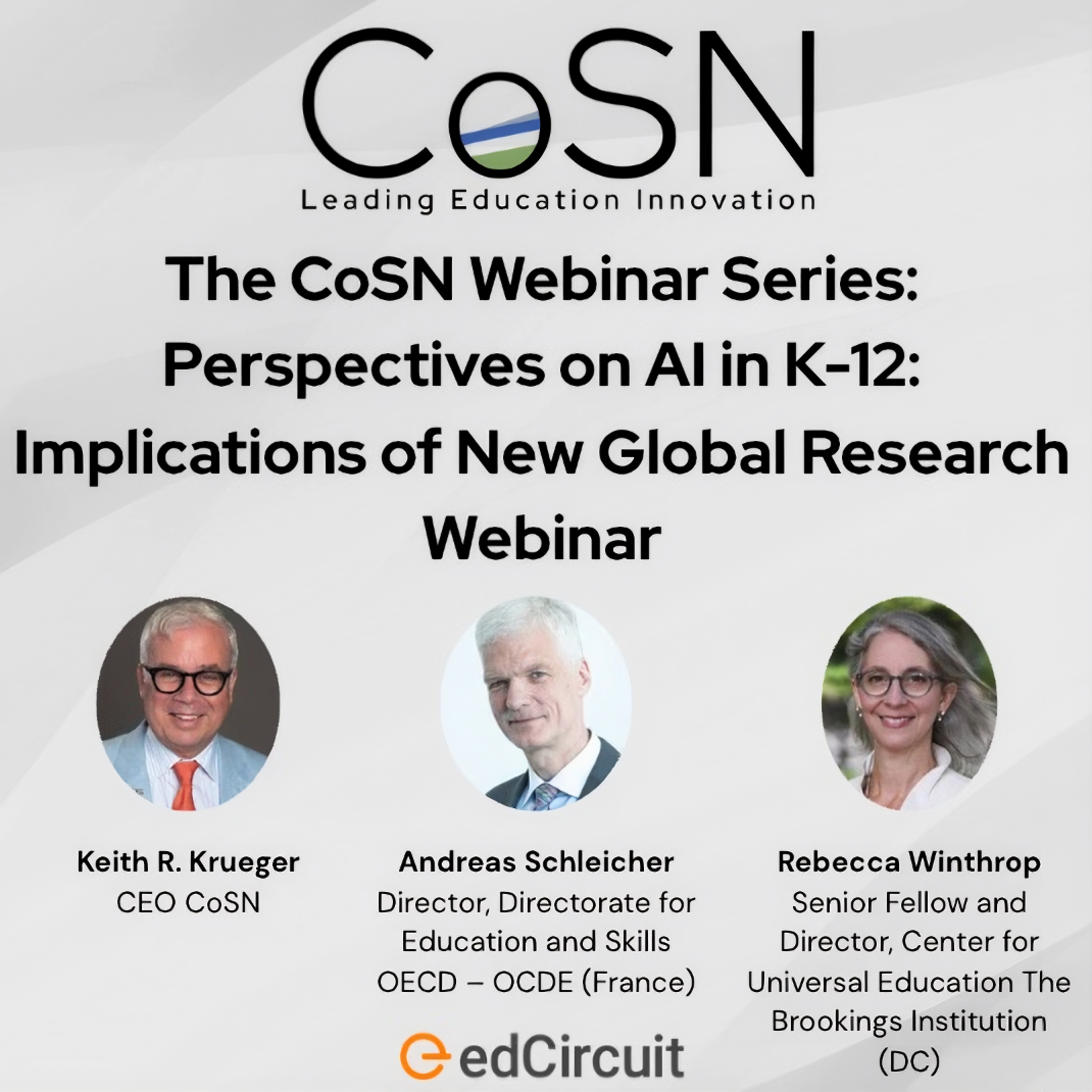
The CoSN Webinar Series: Perspectives on AI in K-12: Implications of New Global Research Webinar
60m 8s
The transcription summarizes a discussion on two key international reports about generative AI in K-12 education, presented by Rebecca Winthrop (Brookings Institution) and Andres Schleiker (OECD). Winthrop highlights that AI use is confusing, with students accessing it through diverse tools, often outside school, blurring lines between entertainment and learning. Benefits of narrow, intentional AI use include assistive technologies for disabled students, personalized tutoring, and teacher support. However, wide, unguided use of commercial AI poses serious risks: cognitive stunting from offloading learning, homogenized thinking, social-emotional damage from sycophantic companions, bias amplification, and eroded trust among students, teachers, and parents. The report concludes that current risks overshadow benefits, but it is not too late to shift course. Three action pillars are proposed: redesign pedagogy to be AI-aware, prepare all stakeholders (including families and students) with AI literacy, and implement protective guardrails. Schleiker adds that AI is an amplifier of good and bad ideas, emphasizing that learning requires cognitive effort; AI can personalize education but also outsource thinking. He distinguishes general-purpose AI from pedagogical tools, noting the need for ethical use to avoid entrenching inequality or bias. Both experts stress the urgency of proactive, collaborative action to harness AI's potential while mitigating its harms.
[MUSIC] Well, we have a great program plan for you today. And so I don't want to cut into any of the time for discussion and understanding of these two important international research reports on AI in K-12. Welcome, my name is Keith Krueger and I have the honor of being CEO of COSEN, the Consortium for School Networking. Welcome today from wherever you are. And we will be recording this and if for those who could not join live, we will make this archive available. There are two very important reports that we're going to be focused on today. And we have two great experts, collaborators who have a lot to contribute to the conversation on Gen AI and how it can or should not be used in K-12. Our first speaker is Rebecca Winthrop and we're going to ask each of these panelists to do the impossible, which is to talk about their great research in kind of a very condensed way. We're hoping that maybe a 15 minute overview. Rebecca heads up the senior fellow and director at the Center for Universal's education at the Brookings Institution in Washington, D.C., although I think she's joining us from New York today. And Andres Schleiker, who it's late in the day in Paris, but heads the OECD, which includes all of the major industrialized countries and their education systems. He's director for education and skills. So with that, the reports that we're talking about both have come out quite recently. I believe the Brookings Study came out in January and I think it was February that the OECD, late January that the OECD report came out. So these are relatively recent ones. I know that too often in the United States we're too insular and don't look at sort of global research. So I really encourage everyone to to download and read these reports. Fortunately though, we're going to be able to hear a little overview on kind of what we should be thinking, especially as school system leaders. What exactly should schools do or not do? And I'm going to turn it over to Rebecca. You know, I, Rebecca, as I was looking at your report again, this morning, you end up making 12 recommendations and every single one of them, there are different audiences, but our audience of school system leaders were either the primary lead or a secondary lead on all 12. So everything you say is going to be of great relevance and take it away. Rebecca. Thank you so much Keith and it's lovely to be here with you. Thank you for the invite. I am going to share my screen. Let's see. Can you guys see it? Yeah? Okay. Great. So first off, it's really fun to be doing this discussion with Andreas. We just finished a very large report as Keith said and the OECD, his team member, Stefan was on our task force. So it was fun to sort of tag back and forth as we were developing, developing these. I would say the two big distinctions of the report is our report focused on students in sort of primary and secondary school learning and development in and out of school. And Andreas and his colleagues report focused on education systems right the way through to higher education, but not necessarily outside of school. And so that is one of the things that I want to center people on is as we did this work, it was so clear that we need to take an account the parental perspective families, the experience of outside of school use. And what we heard from everybody is that the parents and teachers and educators are trying to figure out how to use AI in a way that can both protect and prepare them. We did a large study with a global task force again, incredible people on our task force. We reviewed hundreds of articles, lots of interviews, ran a Delphi panel. And the main question we had was are we headed in the right direction? Our goal was to do a pre-mortem on generative AI and students learning and development in and out of school. And the reason we wanted to do a pre-mortem and just say what are the possible risks? What are the possible benefits? How do they stack up? Is we really don't want to repeat the same mistakes of social media when it was rolled out, you know, people who knew education and child development were not at the table, educators, system leaders, families, coaches, child development specialists. And so I'm going to give you the sort of cliff notes version, the sparks notes version, sort of our five key takeaways. The first takeaway is that it is very confusing. It is hard to tell what is going on. First of all, generative AI shows up in many, many different forms, especially within education systems. You know, you have really interesting assistive technologies that are using AI. You have personalized tutoring. We did find that a lot of the way students are using AI is through frontier model commercial AI chatbots. We also found that it's also confusing because for many kids, they're accessing generative AI wherever they have access screens. And there is a real blurred line between technology for entertainment and communication and learning. Now, we won quote from a kid who sort of summed it up with a high schooler in one of our focus groups who said from the US who said, well, my school band chat jet GPT, but we all just go on social media and use AI friends and companions and do our homework that way. You know, we talk to it, we take a picture and it does it for us. We also know that certainly some of these frontier models, this is chat GPT, have students as a major use case. This is a dip in chat GPT usage globally when most of the countries who are, you know, heavy, heavy AI users are outside of school. And the other reason is confusing is there's a lot of good things and there's a lot of potentially bad things. And here the blue is the good, the orange is the bad. And so we really spend a lot of time with our task force members and all our working groups trying to sense make where are we at between the sort of risks and the benefits. And really what we found is that there are real benefits if generative AI is used very narrowly. So that means with a real intentional purpose and means with vetted content, it means inserted into really good teaching and learning pedagogy. It can be really helpful to bring ideas to life for kids. I think there's real potential with interactive VR, especially if the costs go down for incredible learning experiences that kids haven't had before. Helping neurodivergent kids, this is one area that seems very, very promising with assistive technology. One of the most moving examples was with kids with a phasia who have communication problems using generative AI to communicate now, making a synthetic copy of their voice with teachers and peers in the classroom. Teachers love it in many, many ways, both for an administrative unburdening, but also for unlocking new forms of assessment, really seeing where students can get stuck, which is so hard to do. Access is also potentially really transformative with good narrow uses of generative AI, especially for those learners who are left farthest behind. And this is an example that I love because it's from Afghanistan, where girls are banned from going to school and secondary school. And the adaptive power of Gen AI is really incredible. This group, Sola X, works with a lot of Afghan diaspora teachers who have fled the country to make little many lessons based on the Afghan secondary school curriculum that girls can access via WhatsApp on their phones at home, and then they adapt to their levels. They repeat until they progress. Really, you know, exciting examples of bringing young people into the teaching and learning process. So there are really useful ways to use it. However, we did find that there were also real risks. And the risks mainly, not only, but mainly conferred to what we are calling wide AI use, which is young people, students interacting with largely commercial products, unscatholded lots, open-ended dialogue with chatbots or AI companions in ways that don't really have clear pedagogical supports and evidence. And I would say with tools that are general purpose that are not designed for kids, nor safe for kids, nor designed for learning. One of the things that
that everybody has heard about as this idea of cognitive offloading. We debated greatly in our task force. Do we call it a cognitive offloading? I am now calling it cognitive stunting. We did call it cognitive offloading in the task force 'cause that's the term that everybody is using, but I'm calling it now cognitive stunting because in truth, it's cognitive offloading is when you develop a skill and then you offload it onto technology that you don't need to necessarily do so you can do higher order skills. That's the good part, like calculators and arithmetic, arithmetic. But often what's happening is kids are not developing the skills in the first place. And so I think of it more as cognitive stunting because it's stunting is when young kids in their development don't get the nutrients they need for their body to physically grow. I think of it as the same way, not getting the sort of effortful learning experiences kids need for their brains to develop. One of the things that we're very clear on is that, you know, gender to A.I. is not like a calculator. If you hear people saying that, say, no, it's not true. It makes me crazy when I hear that because of course, Gen A.I. I mean, calculators cognitively offloaded arithmetic even though teachers, of course, taught mental math to kids before they gave them a calculator. It didn't do all math, all English, all physics, all chemistry, biology, history, social studies, poetry, music, art history didn't take the SAT, which is a US-based test didn't give relationship advice. And of course, didn't guilt rip you and act sad when you stopped using it, which a lot of A.I. companions do. There's worry about homogenizing ideas. This is longitudinal research out of Georgetown University, tracking students in the US, tracking high school seniors, essays, applications to college. Each idea is a, each dot, here is a unique idea. They have a natural experiment that shows that, you know, post-Chachy PT, kids ideas and their essays are all sort of clustered around the same thing. There's worry about social and emotional development because of the sycophantic design of a lot of these commercial chat bots and A.I. companions that agree with kids all the time and one in three teenagers in the USA, they prefer talking to an A.I. friend more and equally to a human. And the worry is that if kids are socialized to be agreed with all the time, how can they take feedback in a classroom, how can they work collaboratively, what does that do for their ability to develop relationships which are as important for their life, but also important for their learning. This is particularly worrisome in countries that don't have guardrails. And I think Andreas will talk to some of that in terms of what guardrails are existing, particularly, more in Europe than in the US. They can amplify bias. Of course, people say they're working on this, but they certainly amplify bias at the moment. This is research out of where the exact same essay was put into chat GPT and all that chat GPT knew was one kid likes to listen to rap music and other likes to listen to classical and was asked for feedback to make the essay better. A full grade level higher. The feedback came back for the kid in classical listening to classical music. We also found in our research, particularly our qualitative research, we interviewed a lot of students, teachers, parents, technologists, and leaders, and that there's sort of this slow undermining of trust, particularly in places that didn't have a lot of guardrails, where like in the US, a full half of teachers say they don't really trust authenticity of their kids' work, making it very hard to assess where their kids are and craft their lessons, but students, too, are saying they don't trust their teachers' care about them because they're AI grading. We found some parents doing strange things, like regrading a kid's work and through chat GPT and showing up to the teacher and saying you graded it wrong, look what chat GPT said, so sort of undermining the authority of education educators and their expertise. There's also a question around inequality. I do think that there is a possibility to sort of leapfrog over the late adopter communities to AI, leapfrog over some of the mistakes that early adopters are making, particularly in places with not a lot of guardrails. But in the medium term, we do worry about just the differences in language alone, certain languages are digitized a lot more and hence the products are much more powerful. Ultimately, at the end of the day, I think the thing that might worry me most is a possibility of slowly eroding student motivation and engagement. I've done a lot of work on this topic last year with my co-author, Jenny Anderson, we published a book called The Disengage Teen, Help In Kids Learn Better, Feel Better and Live Better and found that kids aren't either engaged or disengaged. They kind of show up in these four modes, resistor avoiding and disrupting, passenger coasting, doing the bare minimum, achiever trying to get perfect grades on everything. There was high levels of cheating before that, before AI and achiever mode, 'cause it's a really concerned on just the output not the learning process and even more high levels now. And then explore mode where kids are really interested in the learning journey are pretty resilient and are out there trying to take in anything they can to help them learn. A lot of intrinsic motivation. And we found so many kids saying, what am I supposed to do now that I'm here in school? I'm meant to be learning, but AI does everything for me. So really worried about AI pushing a lot of kids into passenger mode much more. Our fourth sort of big takeaway is basically as we stack the risks and the benefits up towards each other, that currently in the current trajectory as AI has sort of rolled out around the world, some more in more intentional ways than others in certain countries, the risks are overshadowing the benefits mainly because they're of a different nature. They are undermining the potential to undermine kids' ability to learn independently, have trusting relationships and take feedback, which they need, that's kind of table stakes for accessing the benefits. Ultimately, of course, it's very early days. There's, you know, this is not a done deal in any way, shape or form. It's why we did the pre-mortem. It's absolutely not too late to shift course. We can take lots of action. It will be in all hands on deck effort to shift our use away from why AI used that dimmicious learning towards narrow use that supports learning. We argue that there's three sort of pillars of action. Again, education system leaders have a role to play. In all of them, one is really shifting how we do teaching and learning. This is a transactional pedagogy that needs to be, have adaptation. We talk about, you know, AI aware pedagogy. Don't assign things if it's, don't assign things if it's not, what's don't assign things if it's not, if it can be hack Bay AI, that's sort of an AI audit, co-creation hubs with educator students, researchers to find the really good ways to use AI. And of course, we need a lot more research. The second thing is around preparing everybody, a holistic AI literacy, really have the online world works, a shout out to the OECD's AI Lit Framework, which we cite heavily in this Task Force report, because that provides a really good scaffolding, along with EU and code.org, who are part of that, and many people are part of developing that. We think Student AI Councils, students, we had a student who co-authors the report with us, and they were very much saying, we need to be at the table, we want to learn, we're worried about making this technology, making us summer, we can, you know, beta test products, we can help teachers figure out which assignments can be hacked. And of course, families, families are left out, and we really need to not forget to pay attention to the AI use outside of school. And then protect, this is basically making sure that guardrails are in place, governments have a role to play, but schools have a role to play in terms of their purchasing power and jurisdictions to help drive criteria. This is certainly something that Kosoone has worked a lot on. And just finally to leave you resources that you can all access. If you're interested, we have the report on the web, we have a one page, a six page, a 15 minute podcast. We also have tips for digesting the report for families that schools can send out to families that we're developing over the next several months. And I have a LinkedIn newsletter that digests this, and with that I'll stop and thank you. - Wow, my head is full, Rebecca, and we'll come back. But this is, you know, as you started, it's complicated and it involves a lot of things, and we've got lots of things to talk about. Andres, tell us a little bit about your report and what you've been thinking about at OECD. - Yeah, thanks so much for inviting me, Kiesin. It's always great to share a screen with Rebecca. You're gonna see a lot of really interesting parallels in our work, also try to share my screen. And I see the first message I think I want to just reiterate is that, you know, AI is not magic power, it's an amazing amplifier. It's a great accelerator, it was good and bad ideas. And I think Rebecca has cited some examples, but it's incredible to improve equity and opportunity, particularly for students with special needs. You know, if you have dyslexia in the past, you sit in the margins of a classroom, now you can just full access to learning. But, you know,
We also see plenty of examples where it is an accelerator of almost any form of inequality. It is a great tool to personalize and make your learning more adaptive, more granular, more interactive, but again also we see plenty of examples where it induces that kind of outsource of thinking. Basically, the lesson here is really very simple. Learning is always about the energy that you spend on learning. It is the cognitive struggle, the cognitive effort. And the AI enhances this. It is great. The AI undercuts it. It is really bad. You do not become fit by watching sports. And the same is you do not become the learner by just consuming content. I think that is a really, really important lesson that this is a polarizing force. It is a great tool for teachers. Teachers can become the most creative designers of innovative learning environments. We see plenty of good examples, but we also see examples where teachers become slaves of scripted lesson plans. And students see through that actually amazingly quickly. AI is a great tool to help us moderate our own human biases. I think that is actually perhaps one of the most powerful ways. When you look at AI based classroom observation, an amazing tool to really help teachers understand what they are actually doing. But obviously it is also a tool that can entrench and amplify human biases. To all that, it can connect you with different ideas, new perspectives, or amplify your own kind of perspectives and thinking. That is the kind of bad social media effect. The great thing is that AI is ethically neutral, but it is always in the hands of people who are not neutral. And that is where the risks come from. And that is where we try to sort of analyze in our digital education outlook. You know, what are the effects of Gen AI on learning? How can we tool for teachers? And how we can use it at a system level? Of course, you know, AI is a very big word. We just looked at Genitive AI and we make a very sharp distinction between general purpose AI tools and tools with pedagogical intent that we are designed for education. You are going to see why this distinction is so important. Unfortunately, it is not sufficiently made. First point, you know, Rebecca made that as well. You know, students are already very active users of AI, but you know, most of the users are constructive, not creative, no, at least in the seven countries where we studied this, we could see very clear patterns. Students are great in using AI to sort of access knowledge, basically an augmented such engine, but very few use it actually for where it is best, namely to let you know, create, triangulate and so on. That's quite rare. Teachers, you could see if you are in Singapore and the UAE, almost every classroom is now AI based. If you are in Japan or France, it's the rare exception, the very, very cautious countries. And what you can see on this chart is that this is not about being well-seer poor as a country. It's very much about, you know, to what extent are teachers leaning into innovation, to what extent is that supported or more hesitant, the US is sort of in the middle of that. Actually, interestingly, you know, one thing that explains that pattern is the professional identity of teachers. You can see on the horizontal axis where teachers themselves consider themselves as learners and actively engage in learning, you could see them all likely to use that in the classroom. There's a strong correlation among across countries between, you know, teachers actively engage in learning about AI and actually using it in the classroom. And that really is important because that's where pedagogical intent comes from. Let's look at some of the effects and maybe start with some of the more troubling findings. I mean, this is data from the PISA assessment to just look at technology intensity. This not AI is just simply to what extent do students spend time on digital devices. Now what you can see and this is just in school, you can see a little bit, you know, can be great, you know, but if this becomes dominant and this is teacher guided teacher-led technology use. A lot, you know, you see a downwards sloping cuff. What's even more clear where this is student-led, you know, students using their own technology, their own smartphone, it only works against learning outcomes. It works against cognitive outcomes like mathematics performance, but even more so against social and emotional outcomes. It really tells you something that technology use is structured, you know, teacher-led can be a source for effective learning where it is just in the hands of student unmanaged, you can see actually more downsides than downsides. Is an interesting case from from Turkey, you know, they gave students an AI tool to improve their mathematics outcomes and yes, when students use that tool, they got better results, right? AI very quickly enhanced task performance, but then afterwards when those students were tested for their mathematical thinking and reasoning skills, actually the group that used AI did worse. It's a good example that, you know, increased task performance is not equal to learning. That's the first lesson I think that we really need to take away that is very easy to do a better job with AI, but it is often not, you know, leading to improved learning. Here's an example from the United States, you know, students have given a large language model to write essays and yes, they wrote better essays, but then, you know, shortly after when you asked them, hey, what did you actually write about? 80% could not remember. It's again, a good example of, you know, cognitive offloading, you just let chat GPT write and you don't engage yourself in the process and therefore you do not own that product. So lessons to be learned, you know, doing something with Gen AI isn't the same as learning from AI. As machines get smarter, you know, the kind of human skills matter even more, can you navigate ambiguity? Can you think critically? Those kinds of very human skills actually become incredibly important to become, you know, an informed user of AI. I'm going to talk about it in a moment a little bit more. And then, you know, that question of age appropriateness. Now, you need to learn to think before you learn to prompt. If you do not understand the underlying processes, if you cannot think like a mathematician and you use AI to learn mathematics, you will not learn mathematics. You would just, you know, manage some procedures. Very, very important kind of find that there is a question of sequencing. And the question of age appropriateness, I think, will need to come back. But, you know, this is some troubling exams. I also want to show you some good ones. This is actually my favorite one from from the UK. Actually different from the US, they didn't give students a chat GPT to write an essay. They gave students chat GPT to actually research that essay to get ideas, get inspiration, and so on. And then right there essays in very traditional ways. And in this case, actually, you could see positive outcomes. The kids wrote more useful essays, also more interesting ideas. And so on lots of variables actually came out better. But again, this did not undermine cognitive effort, this supported and enriched the cognitive effort. Another of my favorite examples from Indonesia, they were always worried that students didn't really learn English very well because, you know, you do not learn language when someone talks to you about grammar and vocabulary. You learn language through interaction. And then of course, you know, something where AI is amazingly good. So they use their eye to enhance collaborative learning. Again, as a tool to connect students, to share ideas and so on. And, you know, students that are becoming better on critical thinking awareness. They did a lot better on their propensity to actually collaborate. And most importantly, they did what the lesson wanted to achieve. Strengths and argumentative speaking performance. Lesson from this is really pedagogically intent. Some general purpose tools actually can function when they are clearly designed to serve a really good goal. And the bottom line is obvious, it comes back to teachers. If you ask yourself, you know, what's the most important predictor of student learning outcomes in B.S. It's not the amount of money you spend, not the size of the class, all about the quality of student teacher relationship. That's when it comes to independent, self-directed learning, the kind of learning that matters so much in the age of AI. And by the way, also when it comes to traditional learning outcomes, that academic achievement in this case, mathematics. So something really, really important AI can enhance that effort. But at the end of the day, learning is never a transactional business. It's always a social, relational experience. So let's continue our lessons. You know, JNI, I work always best when teachers are at the helm of designing the kind of tasks, when they actually use their own professional judgment. And, you know, very importantly, that you do not, particularly when
high stakes decisions are involved, you're very, very careful in actually, you know, making sure that you understand those decisions. That's also, you know, one of the most convenient ways to use AI is for assessment. You know, it's a great tool. AI is actually doing a better job than humans in assessing student learning outcomes. Still, we argue teachers should not outsource all of that process because the moment you do that, you lose that connection to the student. You lose that understanding of who that student is, where they struggle is, how they progress. So something a double-edged sword is a technically great tool, but again, comes at great risks. When you think about, you know, what can AI do for teachers? It can replace some of the tasks in some areas. AI is better than teachers. You know, assessment is a good example. It can complement teachers' capabilities, they're also good examples, or it can augment that. These are cases where AI+ teachers gets you more than the sum of both separately. Two examples that we studied, lesson preparation, AI can actually be a really powerful tool to help teachers, you know, design really, really good lessons then, you know, again, grading or coding, where it's quite clearly proven that AI actually doesn't only get you more reliable answers, but actually also better and more real-time answers. I think that's a very, very important point. We also look at tutoring, and this is interesting when, you know, you give high performing tutors AI doesn't make much of a difference, but, you know, less proficient tutors got a lot better when they used AI tools. And we actually figured out why, you know, what we could see is because they used these tools, they were actually prompted by the technology to do more the kind of things that good teachers do. You know, asking students to explain what they were doing, asking questions to guide their thinking, and so on. And they were less likely doing things that poor teachers do, like, you know, giving away the answer or, you know, encouraging students in some general way. So you could really see how AI can become a really good tool to actually augment teachers, capable of from very different levels. So if we can see that, you know, specific educational AI tools are so much superior to general puppets AI tools, why are we not doing more? Part of this is, you know, education actually doesn't make much of an effort to think about its future. If you actually look at R&D budgets that are allocated to education, it's a tiny, tiny share, you can barely see it on this chart, particularly when you compare it, you know, the R&D money we put into health or defense or agriculture, things like this. Also, the markets for AI tools are incredibly fragmented. More or less, you know, it's only large companies who can afford that game of selling products to individual schools with an army of health people. That's a really difficult market. That's where we do not see the kind of educational tools that could really, really help us. So what can we learn here? First of all, you know, it's really important that those tools are built for classrooms with pedagogical attend, not just, you know, consumer markets. Then obviously the question of safety is very, very critical. The co-design with students and learners, with teachers and learners, very, very important. Global yachts, figuring out what walks in what context, the tools are global and I think we need to become better actually to assess those tools themselves. Let me just give you a couple of examples here, you know, safety. This is one of the things that we should perhaps worry a lot more than we currently do, you know, when we build a road, we don't give a toddler the same rules as a truck driver. We build, you know, passways, we build sidewalks, we lower this speed limit near schools. And so on and that kind of thinking is not yet well established when it comes to AI, you know, six year old and the 16 year old, they see the same screen, but the experience just is very, very different reality. Our brain as a child is hot wire to trust authority. We won't survive if we wouldn't trust the people around us. So if AI plays that role of authority, you know, as children will, you know, fall for that. And that is I think a really, really important part that, you know, there need to be strong guardrails, there need to be strong filters, there should be no emotional manipulation, there should be no pretending to be a friend or a confident or worse, a replacement for social interaction. I think that's perhaps the strongest guardra. Then, you know, if students, as students get older, you can relax some of those kinds of requirements in guardrails, but even then, you know, even if you have teenagers, we look at 15 year olds in our assessment, you know, yeah, they can handle some uncertainty, but still you don't want, you know, AI to become a source of truth, a kind of article. You want AI to become more counterpart who questions who guides, and so on, we're still strong guardrails. So I think this is a really, really important agenda where I think we all have to work a lot harder to do that. So what the lesson here is, you know, Black Box AI really should have no place in education. If you don't understand an algorithm, you're going to be the slave of that algorithm. Now, I think that's very, very clear, safety standards, very important, also global agenda, continuous guidance, and finally, you know, it is important that AI decisions remain open to human challenge, particularly when they have high stakes for kids. And very last point, really, we need to keep in mind that, you know, still a good share of young people do not even have access to the physical tools. And there it's important to use the kind of analog world to prepare them for the world of AI. And there are a lot of really, really good opportunities, how we can do that AI and Black tools. Now, that's something that, you know, we shouldn't forget, what even say, you know, most, the most important skills that you need in this AI world do not require any technology. They're very human skills. This is about, you know, can you make ethical decisions? Can you live for people who are different from you? Can you navigate ambiguity? Manage complexity? Distinguished fact from opinion? Those skills actually can be developed in a very analog and human world. And then, you know, super empower people to use AI. That's all I wanted to share. Thank you. Wonderful. That was terrific. From both of you. Thank you, Andrus. There's so many things to discuss. You know, what I like about both reports from my perspective is when you read them, they're actually quite nuanced. Sometimes in the media, you know, you see or the discussions at professional conferences, all of AI is good or all of AI is bad. And certainly, our audience of heads of technology and school systems, perhaps, have a propensity to see the opportunities. But I think both are quite balanced. Although sometimes the media coverage of them is perhaps especially around the the Brookings report, you know, the headline was sort of don't do AI in K12 or it's not ready yet. So I'm kind of curious, as both of you listen to the other report, what strikes you as things that where the findings really align. And Rebecca, I'll give Andrus a chance to take a breath after that amazing presentation. Where do you think there really is alignment between these two reports? And what are audience that have to kind of implement technology? You know, what do you think that we have consensus on? Yeah, well, I appreciate you highlighting sort of media. And media does what media is going to do. We don't control that every single, all three of us know that very well. But I think actually we are extremely aligned. Like if you read them side by side, the messages, it could be amazing. We have to be vigilant and make it amazing because if we don't, there's a lot of terrible things that are going to happen. And we've heard certainly feedback from our report where we've had, there was colleagues in various states across Canada, for example, who were working with state ministry, said this was really helpful to say because people were really afraid of AI in these certain sets of states. And they realized, oh, if I don't actually jump in and be at the table, it's going to probably just go in a direction that isn't great. And so to me, that is what we want. We want people to, as one of my colleagues says, you know, if you are not on the table, at the table, you're on the menu. So we want people to be at the table, grapple with it and figure it out. Because as Andreas said, the incentive structure and the money, and again, you know, I'm based in the US, Cosen is global. We work globally, but the US is where a lot of this is being produced by Nomeansol.
So the incentive structures are really that the R&D is huge, huge amounts of money in the corporate sector developing these commercial products. And we need to assert ourselves as people who know about education, who know how to run schools, who know about child development and learning that we have a perspective. And there's things we want to let into our schools and there's things we don't. And I think that's, we're totally aligned on that. And again, it was really fun to have OECD be part of our task force. And I think the reason you see the media framing is just really like the intro and the headline, like the OECD report is exploring effective uses, right? And ours was the headline was new directions, but the thing that people picked up was if we don't do anything, we're on the risks are going to outweigh the benefits. And we did debate that deeply and everybody said, well, that's, make sure you say currently. It's not forever because we have agency. We can change this and it's very early days. It's only a couple of years. So that's, I don't know, Andreas, where you land? I think that that's, particularly for our audience, there's sometimes this breathlessness of, we have to do something. And school districts do need to think through kind of their policy and framework and be thoughtful about it. We can't just sit around, we know the kids are already using it as both of your studies have shown. But there's also, AI is touching everything. As Gen AI is going, is touching every aspect of teaching, learning and running school systems. So we need to be thoughtful about that. And one thing I heard in both reports was kind of the difference between general tool, AI's and things that are designed for K12. And I think that's a big, big warning sign that we need to think carefully about how we use these general tools. Before we got on the call, both of you were talking a little bit about the lessons from social media. Anything you want to say about that and how we want to avoid the crisis of. I'm happy to, but Andreas, I'll pass it to you. I really do think this is a massive opportunity for education. I think to me, it's the printing press, the internet and general to AI. It's on that magnitude and under, you know, we were talking about that before the call. Yeah, this is a big deal. If we get it right. And there were, there are good benefits of social media, by the way. Like when people go on and learn to, you know, learn a skill on YouTube or on Instagram or learn to cook or make sourdough bread. Like there are benefits. The issue, I think, is that the way it's been rolled out is so detrimental and harmful that it sort of washes out the benefits. And that's why I think we need to have this distinction between wide versus narrow AI use. The thing I worry about is there could be, if I fast forward a decade from now, seven years from now, five, it's hard to know this technology moves so quickly. There could be really, really good in-school use cases that are highly effective. But if we don't lock down the wide AI use that is completely unsafe in many cases, you know, all the many worries. For, again, for young kids, for children, it could wash out overall the picture of Gen.A.I. use for students and learning. And I think that's what's happened with social media, which is why I think we really need the ed tech community, the ed community, to see their job not just within the four walls of the school, but the students trajectory and out of school. Because I just think, well, we'll miss the force for the trees if we don't do that. It's a different way of working and thinking, but we need to do it. That's great. Andres, I hopefully we could give you a moment to capture your breath. But as you think back to the Brookings study, what strikes you as an alignment with what the work is that we see the same? You know, I actually see that the two studies very, very closely aligned. And actually, I think most of the research is actually pointing to very similar kind of findings. I think Rebecca has taken on the tougher part, which is really also the out of school, the personal use of AI. Where personally, I'm also a lot more skeptical. I think the in-school part is the one that we actually could get right. You know, I think that's actually something where we do see very, very good example. If I look at, you know, the digital textbook in Korea, you know, the use of AI in parts of China, Singapore, Estonia, those are countries that have a very, very strong system around that. And you can see amazing results. You see an army of teachers who are well prepared, are very active in this. They have great tools. They have universal platforms. They can share kind of materials. I think that really good, you know, at the system level, there is a little bit of, you know, smart policy. We can actually take huge benefits out of this. And I think again, also ensure that AI will not, you know, under my learning, not, you know, faster, the concept of use. But actually, you know, get students, you know, learn in what differentiated ways in more personalized ways and and actually strengths and the social interactions of school. So I think that's the part, you know, where, you know, posse clearly can get it right. I do think the out of school part is is very, very hard because that's what we saw in social media. You know, honestly, it's very hard to see positive sites out of social media and the kind of personal views. I think the negative use have really dominated the picture. And I think that's the great risk. You know, unfortunately, you know, our brain is designed to save energy. So humans are always trading autonomy for convenience. And that's basically, you know, something that's very, very hard to prevent in school, you can do something about it, but you know, at home, if you find out it's so much easier to do something with JN AI, even if it's only half is good, you know, it's very, very hard to get around it. I really appreciate unders how the OECD report certainly talks about in classroom use, but also references some of the opportunities there are for certainly making the life of a teacher improving their workflow. And also, you know, I know Kosen has done a lot of things on thinking about the whole school system. And obviously we use technology for lots of things, whether it's running the school bus schedule or running the student information system. And so sometimes these things get obviously teaching and learning and in the classroom is the most critical thing we do, but it also could be the hardest thing to do in terms of use of things like JN AI. And so how do we have that bigger conversation? You know, I actually think that's that's almost, you know, something that we can take away from the current experiences. There is a lot more evidence that AI does a really great thing to support teachers, then that is evidence that it actually does good things, student facing. And again, if you look at the countries that are most advanced in this, you don't see that much screen use in the classroom, but you can see the learning analytics everywhere as a teacher, you get so much. I mean, extreme example is AI was based classroom observation as a teacher, you can see, you know, the quality of your interactions dynamically with different students, you get that kind of feedback that, you know, no, there's no other way to obtain it. That's the biggest strengths of that. The kind of analytics it creates for, you know, helping students learn whether teachers teach better in schools to become more effective. The question part is more on the student facing tools. Yeah, I agree and Keith, I want to touch on your point. If I had a crystal ball, I would say the back office workflows, the job of managing and running a school, which is what the people you work with is I think going to be made much easier by AI. And I don't think we're going to have to do a huge amount to make that happen. The tech is there. It's how we all use it in our own. I use AI all the time for literature reviews, right, in our own work and it's commercial tech, like, and we can adapt it and make sure, you know, it's got privacy, privacy, guardrails and, you know, the big companies are beginning to make sure that they comply legally for data privacy and stuff for schools. That's a trajectory. I think that's going to get there. I can see huge amount of benefits, you know, but schedules calendar and lunchtime table and all, you know, all sorts of workflow management. The teachers, I wanted to make a comment on the teacher stuff because I totally agree with Andre is that the real issue is the student facing again our report focused on students squarely and there's a layer layer of the onion where we didn't really focus that much on the back office operation stuff. It all contributes, but we were so squarely focused on students. The teacher facing has a huge teacher facing AI use has a huge opportunity to really be transformative exactly exactly like Andre's talks about. But there is an asterix that I just want to put out there for all of us to consider and keep our eyes out on, which is a number of the number of our interviews. Teachers said, gosh, I hope my like in the US, for example, my school board, which sort of governs what happens in a school district.
doesn't learn how much time I'm saving, because they're going to fire a bunch of teachers and make me do their job. So there's different ways that the tech will help teachers both do a better job, but then there's also just the administrative efficiency that let teachers do much more with their time and be better teachers. But there isn't, I do worry that it only holds if we keep teachers workload the same, but that's a good thing to do. - Well, and I think in the news, two days, two news articles, one a week ago, the White House did a major AI across all sectors. And the first lady walked out with a humanoid, it was a robot, and some of her comments were that, you know, maybe kids can be better taught by humanoid teachers. And that framing the robots. And I think that framing is problematic in terms of, obviously the Trump administration has been very forceful in arguing for AI literacy, but I think when you, I think Andre, your study, and well, both of your studies, talk about really AI being alongside of the teacher not replacing the teacher. And I think that's a better way to think about it. All of the research are, you know, so I don't know if either of you have thoughts about that. And then we'll come back to my second today's news report. Any thoughts you have, Andres, on that? - Yeah, absolutely. I mean, that's what our data is for very clearly. Again, you know, learning gains are not about the time you spent on something, they're not about the money, the class size, the very much about the quality of your relationship with the teacher, you know, when students say, you know, my teacher knows who I am, my teacher understands who I want to become, my teacher, you know, supports me on my journey. You can see them as self-directed learners. You can see them motivated. You see them engage. We have one single question on the piece of that question we ask students, you know, if you come back to your school three years from now, do you think your teacher will be excited to see you? And you can actually see, you know, where students say, yes, almost everything works, where students say, no, you just have so many obstacles in AI, you know, again, can support teachers in that relationship, but, you know, again, also if teachers start to outsource, they are kind of social responsibilities. You're gonna see actually, you know, a weakening of that link and also a weakening in the status of the teaching profession. If you look at countries where teaching is an attractive profession. So mainly countries where teachers actually spend a lot of time on other things and knowledge transmission. They are a great coach. They're a good mentor. They're an amazing facilitator. They're a creative designer of innovative learning environments and as soon as you should never forget that. And Keith, I, you know, it is, I'm all for AI literacy. I think anybody who wants to do high quality AI literacy the right way is it's an, that's good and we should lean into that. I am not at all for robot teachers. Replacing humans for all the reasons. And I said, but you know, it's not just the first lady rolling this out. The, you know, Mrs. Trump, which you know, it's kind of a PR thing and we might dismiss it as, oh, that's a sort of PR stunt. We did find in our research, at least two classrooms with robot teachers in India. They were with a human teacher, but we certainly found in places that had teacher shortages that sort of leaders of systems, not necessarily educators, but sort of at the higher national level, we're like, do we, do I need to hire all these new teachers? Can, can we use AI to lessen the number of teachers? So I think we need to be vigilant about that. And some of these questions are stemming in places that have a few resources, large teacher gaps, but I also think that's a terrible thing to do for children and how they develop. We know we have evolved to be in relationship, human relationships matter, and learning is situated in relationships and is relational. We will not evolve differently in the next 50 years, maybe in a thousand, but like that's gonna be key. And I'm thinking about the jobs of the future. Like I think teaching is one of the jobs that is not gonna be, you know, just sort of, you know, replaced by AI. So there's many layers, I think, for why we need to be vigilant and make sure teaching is a really important valued profession and invested in our countries. - Yeah, yeah. And I think as both of you point out, things are changing so fast. And I was just reading an article on the front page of the Washington Post today talking about it, it was a professor and how a few years ago he saw the quality of the work diminishing by students, but he actually used AI to design an iterative, it didn't give students the answer, but rather ask them deeper questions. And I think that as we think about whether it's tutoring or how we design the AI, AI is not like any tool, is not inherently good or bad. It's how we use it and how we design it. So I think my last question for both of you is, you know, if for school system leaders, what one thing should they do at this moment? - Mm, Andreas, this is a hard one. We both have reports that are like over 200 pages. What would you say? I'm like, what is the one one thing? - You know, as system leaders, you know, channel and coordinate demand. You know, I think that's the weak part of the moment we have great supply, amazing tools, but you know, the market is so fragmented that actually schools have no purchasing power real and no real influence on the design. You know, I do think if there would be one thing as a system leader, I would coordinate that demand get teachers in the driver seat and ensure that the tools self-defense that are designed for. - That's great. I second that and I think maybe taking a slightly different tack then from sort of the student standpoint. I would say as system leaders, I think the number one thing I would want everyone to center and remember is that the kids who are gonna thrive in a world of AI are the highly motivated and engaged kids in what my colleague and I call Explorer mode. If you are an Explorer mode as a student, you're gonna use these tools and fly. We in the US found less than 4% of kids were in Explorer mode. So anything you can do without AI, with AI, to get kids into Explorer mode, I think is a great sort of North Star for school leaders to sort of put a sticky and put on their wall. And you will have to, you know, you can't get into Explorer mode only by interfacing with a screen. You have to ensure you have a sufficient human contact and then bring in the technology that supports Explorer mode. Whether a math class or creating new things altogether, right? There's many different ways. - Well, great advice. - My only comment on this is, you know, every three year old is in Explorer mode. But as frightening as how quickly we get them out of that. - Yes, exactly. - Exactly. - And my advice is for everyone who's listening to download and read both reports. We have barely scratched the surface in all the great work. I'd also just wanna mention a couple of resources that Kosohn provides. We've developed an AI maturity tool to help school systems think through because there's so many areas that technology that the AI, Gen AI will touch. And so this can help you and you can see we've worked in partnership with the superintendents and principals and state leaders to help design the school boards. So if you're not familiar with that, we also have a team effort. If you wanna bring your team in Boston, the one we did in January sold out and we'll be doing these around the country. So if you're interested in kind of exploring these over two days, that can be a helpful thing. And finally, I hope that some of you will come to join us in Chicago where in just a little over a week, we'll be having these conversations further. So thank you so much, Rebecca and Andres. I know your time is very short. You're very busy Andres is spending his evening with us from Paris. So we thank you for doing this. Have a great day. You're shaping the future of education. Why do it alone? Cosen brings K-12 tech leaders, coaches, and innovators together to connect, collaborate, and create real change. Jump into vibrant communities. Dive into professional learning that actually moves the needle. Access resources built for the challenges you're tackling today. Share breakthroughs, swap strategies, solve problems with people who truly understand your world when education leaders unite? Incredible things happen. Cosen, powering collaboration that transforms learning. Discover your community.
at kosen.org. That's c-o-s-n dot-o-r-g.
Podcast Summary
Key Points:
Generative AI in K-12 education presents a confusing landscape with both significant benefits and risks, especially when used widely via commercial chatbots versus narrowly with pedagogical intent.
Benefits include assistive technology for neurodivergent students, personalized tutoring, teacher administrative support, and potential to leapfrog inequalities in underserved communities.
Major risks involve cognitive stunting (preventing skill development), homogenization of ideas, social-emotional harm from sycophantic AI companions, amplification of bias, and erosion of trust between students, teachers, and parents.
The report emphasizes that risks currently overshadow benefits due to the undermining of foundational learning abilities like independent thinking and trusting relationships.
Three pillars for action are recommended
Summary:
The transcription summarizes a discussion on two key international reports about generative AI in K-12 education, presented by Rebecca Winthrop (Brookings Institution) and Andres Schleiker (OECD). Winthrop highlights that AI use is confusing, with students accessing it through diverse tools, often outside school, blurring lines between entertainment and learning. Benefits of narrow, intentional AI use include assistive technologies for disabled students, personalized tutoring, and teacher support.
However, wide, unguided use of commercial AI poses serious risks: cognitive stunting from offloading learning, homogenized thinking, social-emotional damage from sycophantic companions, bias amplification, and eroded trust among students, teachers, and parents. The report concludes that current risks overshadow benefits, but it is not too late to shift course. Three action pillars are proposed: redesign pedagogy to be AI-aware, prepare all stakeholders (including families and students) with AI literacy, and implement protective guardrails.
Schleiker adds that AI is an amplifier of good and bad ideas, emphasizing that learning requires cognitive effort; AI can personalize education but also outsource thinking. He distinguishes general-purpose AI from pedagogical tools, noting the need for ethical use to avoid entrenching inequality or bias. Both experts stress the urgency of proactive, collaborative action to harness AI's potential while mitigating its harms.
FAQs
The report focuses on generative AI's impact on students' learning and development both in and out of school, emphasizing the need to protect and prepare students while avoiding social media's mistakes.
The Brookings report targets primary and secondary students' learning in and out of school, while the OECD report covers education systems through higher education but excludes out-of-school contexts.
Cognitive stunting refers to students not developing foundational skills because they rely on AI for tasks, hindering brain development similar to how poor nutrition stunts physical growth.
Risks include cognitive stunting, homogenized ideas, weakened social-emotional skills, amplified bias, eroded trust between teachers and students, and reduced student motivation and engagement.
Benefits include aiding neurodivergent students with assistive tech, bringing ideas to life via VR, personalizing learning for marginalized groups, and helping teachers with assessment and administrative tasks.
Leaders can shift teaching to AI-aware pedagogy, promote holistic AI literacy through student councils and family engagement, and enforce guardrails via purchasing power and government policies.
Chat with AI
Loading...
Pro features
Go deeper with this episode
Unlock creator-grade tools that turn any transcript into show notes and subtitle files.
 PodcastTranscript AI