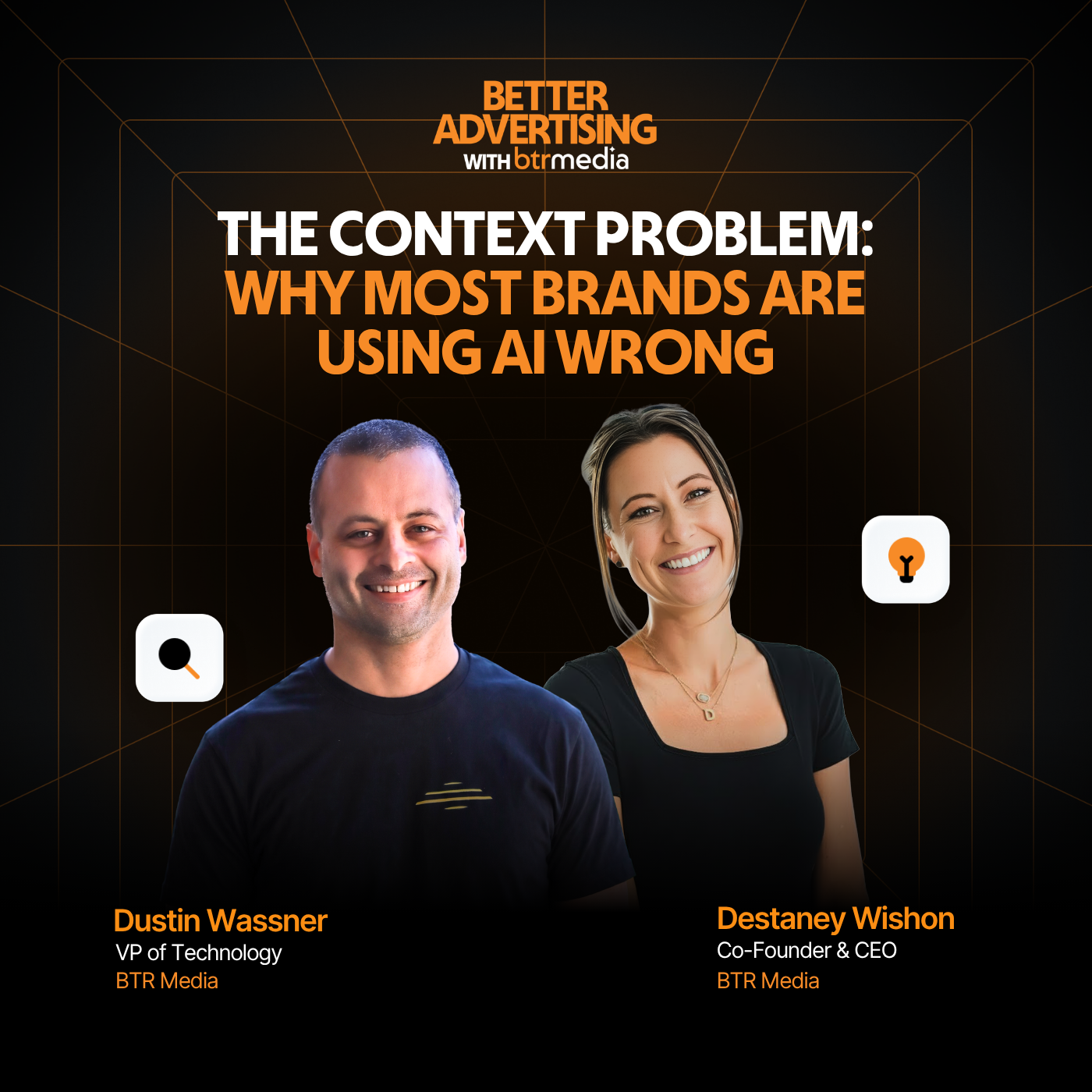
The Context Problem: Why Most Brands Are Using AI Wrong
23m 42s
The podcast highlights the dynamic shift in advertising technology driven by AI, acronyms like MCP and AMC, and the urgent need for strategic agility. Dustin emphasizes that no one can be an expert in all areas—instead, success comes from balancing deep specialization with broad contextual awareness. Personalization is now central, requiring agencies to go beyond surface-level metrics and uncover deeper brand objectives like shareholder pressure or household penetration. MCPs enable customization and data control, allowing brands to retain proprietary information while still accessing critical insights, but they demand robust technical safeguards to protect data and prevent token exhaustion. A major challenge is the gap between vision and execution—agencies must shift from delivering generic reports to becoming strategic partners by identifying hidden brand needs. Dustin and the team are training account managers to ask deeper questions, using AI tools like custom query generators to solve real problems, not just follow templates. This approach transforms agencies from administrative support into strategic advisors. Ultimately, the key to success lies in fostering a middle ground between technical precision and strategic insight—where tools like AI are used not just to process data, but to unlock strategic clarity that clients didn’t know they needed. The conversation underscores that staying ahead requires continuous learning, curated resources, and a focus on meaningful context over buzzwords.
(upbeat music)
Welcome back to the Better Advertising
with Better Media podcast.
I have a friendly face on the podcast.
Everyone I'm sure has listened to Dustin's content,
whether it's here, LinkedIn,
or at an Amazon event.
You are very much well known as one of the experts
in this space, whether it is releasing
information on all of the APIs.
Or nowadays utilizing all of the buzzwords, MCP, AMC,
that could be confusing.
And every other acronym in the space, Dustin,
thank you so much for hopping back on.
- Thank you, yes.
I like to stay up to date on those buzzwords.
That's my specialty.
- You know, we used to always laugh in the PPC days
about all the acronyms.
You have 1P, 3P, AMS, PDA, HSA.
And now we're sitting here like it's only gotten worse.
Like the dictionary is outdated
by the time like six months passed.
- Yeah, now it's true now with AI
and all of its acronyms, MCP and whatnot.
So, yep, I agree.
- Well, the last time we hopped on,
I think we may have done an episode on just kind
of the future of AI.
Everything was still emerging.
I think we talked a little bit about AMC.
What have you been doing since then?
What have you been learning about?
- Geez, one thing that I've learned
is that you can't be the expert in all of this.
Like I used to be with the Amazon as API.
So I've learned that you have to have some degree of FOMO
that you're comfortable with living with
because everything is just changing so fast.
Experimenting a lot with using Quad desktop,
all of its nuances, its artifacts and projects
and how we're trying to utilize this across the team.
It integrates some of the rollouts that we're trying to do
that you know about internally
to make everything better for our clients
and for our account managers.
- I think that is a fantastic call out on the FOMO.
I have felt this way just as an entrepreneur
as we've expanded into full retail media.
It's incredibly hard to keep up.
And AI is just an additional layer to that.
And I think something that we've learned
and I'm laughing because you and I are apparently
a little bit of LinkedIn protagonist as well.
But we recently got into a really good LinkedIn discussion
around whether or not
or the best way to apply a concept
that you and I were really leaning into.
And the argument was basically,
I think surrounded around or centered around missing context.
And I think that's something that is really important
to consider with AI and prioritization
is we are shifting to a world of personalization, right?
We're seeing it on the consumer end.
Serbs are personalized.
I gave all of my health information to chat GPT the other day.
I don't know if that's a good thing
or a bad thing or not.
But it's allowing me to get much more personalized responses.
We're also seeing the same thing on the SaaS side.
It's how quickly can we ship products
that are personalized and customizable?
And it's the same thing with AI.
You have to be able to zoom out,
view the landscape and say,
I'm not able to, I shun it,
prioritize seven out 10 of these things
because it's not best for what I am building.
And really being able to balance this, you know,
objective view with, hey, let's zero in
and get really good a certain thing.
And I think that's something that a lot of people struggle with.
They there want to be absolute experts
at one specific thing or they're too like me.
I would say pie in the sky
and you have to find that middle ground.
Yeah, yeah, definitely have to find that
and what you're speaking to about the context of it
is absolutely critical.
So fully agree with what you're saying.
I think that's also going to the next wave
of challenges for both SaaS companies.
And I would say agencies as well.
SaaS companies have always had to ship, you know,
what is the greatest common denominator
for all of my brands?
And let's make that happen fast.
We've always taken the approach
of being more selective with the brands that we work with
which allows us to drive more customization.
But at the end of the day
and or to drive the appropriate customization,
you still have to have context.
We need to make sure we're gathering
the right information for our brands
to build what they need.
And that can be a little bit difficult
because you're working with so many different personalities
that maybe don't all communicate as well.
And I think that's a problem
that we're definitely trying to solve at better media.
Yeah, 100%.
And when you're working with accounts or clients
rather than have multiple accounts, Walmart target,
they have four vendor accounts
under their vendor central login and DSP for some of them.
And it creates a scenario where at least it,
maybe it's just my skill level,
but I find it very hard to build tech
that wrangles all that together in such a meaningful way
that you can provide good reporting.
And so that's why we're moving in the direction
of trying to empower our account managers
by removing that tecmo between them
and the angle that they're trying to achieve,
which may involve using my team
to build out the final solution.
Well, instead, why harness them
by requiring that process
when we could just train them to use the context
around AI and try to build systems that have guard rails
to assist them so that it's all the easier to get them
to where they need to be with all this custom reporting
that a lot of our clients are needing.
Which brings us to the topic of MCPs.
Amazon has an MCP.
I think a lot of the big SaaS companies
have started rolling out their MCPs.
Can you give a little bit in sight to the audience
on why you think everyone's leaning into MCPs right now?
- Well, for one, it's a buzzword.
We talked about earlier.
But second, for those who are actually needing it
and wanting to use it, it does just what I described.
It empowers you to pull the data directly
into your context window to manipulate the data
however you want to to have it formatted in the Excel
or CSV file the way that you want to
with the specific metrics and acronyms
and way to break up your catalog
in a way that you want to, that's most meaningful,
that if you're working with another agency
that isn't trying to do what we're doing,
it just, it feels the gap that the agency
may not be equipped to fill.
And so it makes total sense as to why people want to connect
everything under the sun into their cloud desktop app
so that they can arrive at what they're trying to.
Which, if they didn't do this,
they wouldn't really be able to get there.
I love it and I think at the end of the day
there's going to be things or information
that brands don't want to share with agencies.
And I don't think that's a bad thing.
I think that there's some level of privacy
that a brand's always going to have.
They're maybe not going to share all of their D to C
information with an Amazon agency
or maybe they don't want all of their retail information
being shared with whoever's managing their e-commerce, right?
There's things that are just a little bit risky
to give away.
And I think that's where it becomes so beneficial
is if we're able to give them everything that we have
in a way that's customizable and a lot more flexible,
they're going to be able to pull that into any other MCP
or I would say like you mentioned context
that is needed to really drive more beneficial results.
And I think when we got into a debate about this,
the question was all of the main KPIs that a brand needs
should be pretty systematic.
Your ACOS, your ROAS and your Tacos.
But we've actually not seen that with a lot of our brands.
They have very specific needs.
They need to just slice and dice their data
into specific portfolios, whether it's tier one, tier two,
or retailers, their point.
And I think this unlocks the opportunity to do that
while still then applying their own contacts
that maybe they're not willing to share with their agency
because it's like proprietary information.
Yeah, and that's what makes it even more critical
during say the onboarding process where you're gathering
that critical context of what their goals are,
what their KPIs are, what their acronyms are.
All the details that can help an agent
make real meaningful decisions.
This is what, in my experimentation,
I'm finding takes the responses that an agent gives you
from good to great and takes it from having to go back
and forth chatting maybe five times
to get the actual answer that you want
to gathering that critical information
and getting the correct response the first time.
Yeah.
I've seen a few posts talking about the cons of an MCP.
And this is pretty normal when the people
that ship products first maybe take a little bit of risks
on the security and the compliance side.
You are doing a lot of due diligence when it comes to that side.
I think it's one of the reasons we've held off
on fully releasing our MCP just yet.
What are some of the risks that you see with an MCP
and some of the ways that you are working
to mitigate those risks?
Sure.
So I mean, you can't build into a prompt
something along the lines of only let this person see this data.
I mean, there has to be rigid guardrail.
There has to be rigid guardrails around it.
You could partition it.
So much as say for an agency like ours every client has their own database, but an MCP still needs to be able to connect to each database.
So there's more architectural setup requirements that are needed for authorization and access purposes for a database that I will it's beyond the scope of this discussion, but it's definitely more in the weeds technically to make sure that it's.
It's basically bulletproof and failproof as far as keeping customer client data private and the other the other thing that I'll point out alongside the authorization portion is that.
What I have found is when I talk to people in the space they they may not realize that if you connect your canva and your notion your Google and your Google drive and add the MCP and SP API MCP every single time you study a new chat session.
Every single one of those is like an instruction manual you're handing to the chat window.
And some of those instruction manuals are rather large and so people will come to me.
Few people on the team have and then others in the space saying why is it that my context window runs out so fast why do I hit my token limits so fast.
And what I say is that you should really try to only use the MCPs that you are needing to use I wouldn't say get into like disconnecting them for each individual chat session, but it will use up context window if you're pulling and canva and notion and you're trying to ask something about bit ops it is no context relation to it.
So you're better off being a little bit more conservative about how you go connecting is just keeping that in mind.
Yeah, that makes sense and that's where in my my personal experience I'm going to be honest like I can't keep up with it. I'm really struggling with like the overwhelm of keeping up with all of that's still changing so incredibly quick and I feel like every time there's a new addition I'm like do do skills you know my context window how do I need to best structure that then every time I watch a video it's like three months later I feel like the video is already outdated.
How are you keeping up like where do you go for your resources to stay in tune.
Well, we get into skills and plugins a little bit more if you want to that's a little bit more in the weeds but where I go honestly is just linked in I just have a handful of content creators that I follow and a few newsletters that I subscribe to that I read every morning.
So it's it's really like 10 to 15 minutes of trying to cut through the noise and look for meaningful updates but.
Another little tip that I do is I have the Serp results on YouTube when I search cloud desktop or cloud code or cloud code work.
And I just have those Serp pages bookmark so that when I open my folder every morning with everything that I'm going to look at those pop up so I can see okay is there anything in here that somebody just released that is a new update to any of these things.
Wow that's absolutely incredible I want to pivot really fast and talk about your son.
Mac is a recently joined the team to start a sitting with some editing skills can you just give a really quick high level on Mac and how he got started with what he's doing because I think it's a cool story.
Yeah give him a little shout out because he'll be seeing this anyways as he's doing the editing for it when he creates the shorts so everybody.
Yeah so a few years back I mean he's 16 now probably when he was 13 like many 13 14 year olds he wanted to be you know YouTuber and twitch streamer and all those kinds of things but he really pressed into it hard.
Focusing more on the video editing portion and just getting deeper into the whole concept of why do certain YouTube videos work.
Studying the metrics setting the drop off rates and a lot of things that I honestly might I have a grass bump but I've never really gotten into the weeds on those and just trying to perfect his art around that and then trying to utilize.
Quad co work as it came out I told him you've got to stay on top of these things to really differentiate yourself if you want to do this in a career.
So staying on top of all the tools that release as AI is going after industries like that and so he took my voice and has applied it and I think that you and I were chatting one time and I somehow that came up in conversation and.
He ended up on our team now in the rest of history and I think that so far is doing a pretty good job from what I hear from Colby and key key so yeah it's awesome to have them.
It's incredibly it's an incredibly cool story of someone I think that's really been able to be empowered through a tool like Claude or maybe some of those resources would have been out of reach for the younger generation.
How do you you know you have six kids five I love six but we'll talk about that later.
How how have you raised kids that take so much ownership and that feel so empowered to go after something like how do I actually become a youtuber what goes into that what do you think are some of the kill or the some of the.
Key things that went into having a child that would potentially be a successful as Mac.
No I wasn't ready for this this is not something I had no type of work.
I really don't know how to answer that I feel like I'm inventing fatherhood as I go or rather just discovering how it works.
I don't have a good answer for that well when I look at my other kids like they're they're they're driven the same way but towards different things like my second youngest son he.
You know he'll play video games and it'll do stuff in front of screens like Mac will but for the most part he's.
He wants to be out on the tractor with me and swing and hammers and doing house renovations and so it's just too very very different people but the overlap is definitely that.
That drive to learn as much as possible and apply yourself and I don't really maybe it was through example without realizing it I'm not really sure.
That's amazing well when I just want to say congratulations I also wanted to shout it out for those listening in on just what's possible.
You know I get overwhelmed and I think sometimes that prevents me from diving in a little bit deeper like I can't hold my weight in conversations with Dustin half the time Dustin and I had to I think overcome a few communication or hurdles with each other because I am typically too high level and too much of a visionary.
And Dustin's very technical very in the way so finding that middle ground where Dustin's able to explain things in a way that I can say yeah absolutely that's the right way and on the flip side I think Dustin's also very good at translating destiny speak.
Whenever I help on a leadership call him like this sounds like something easy we should run with it I think he figures out a way to make it happen and he doesn't realize it but Dustin you're the reason I think everything is so easy.
You're 16 year old has taught himself Claude and is now diving into all of our video editing so in my brain I'm like yeah that sounds great I know Dustin can figure it out and even if he says he can't he does which is exceptional like I think that's why I always want to help on these podcasts and really unlock that part of your brain like where are you learning from what am I missing here because you just things click for you.
I mean I appreciate all those very time words you know after four and a half years of working together yes I've learned some nuances of our how our personalities.
Click and clash and everything in between so and for what it's worth those listening any gram is a really helpful tool I would definitely suggest anybody looking into that for.
Any kind of relationships you have and don't put in the claw and see what it has to say so my my proudest breakthrough as a leader was the day that I think any gram really clicked for you because.
When you roll it out if you don't take the time to really deep dive on it and if you don't take the time to have those in your personal inner circle take the test to validate its responses it kind of seems a little fluffy.
Like it seems like something that's not very actionable but I've really invested in the gram over probably the last eight years I think I took it in college for the first time and it has absolutely been one of the most beneficial career progression tools for me.
Because I've lean so much into the leadership elements of it of how do I work with other personality types and Dustin is a very very deep learner he wants to learn as much as possible about something in order to feel confident and secure moving forward.
And I am not quite like that I like to learn you know more surface level enough that I can speak to something before you know taking bigger risks and being a little bit more actionable.
And I think being able to highlight those differences allowed me to understand where I need to adjust my communication with Dustin and the flip side.
We're not going to talk too much about it but I think some of my favorite projects right now I have nothing to do with MCP but really about how we're building technology that empowers us as leaders as managers but also how we work with our brains you know things like how do we build the context window.
To really understand what is a brand's actual needs you know a brand can tell us its row as all day long and that is the typical answer but then you'll start digging deeper and you're realizing oh you know the CEO has a lot of shareholder pressure they need household penetration and subscribe and save members that's a lot of what we're trying to uncover with the work at better media that Dustin's driving forward.
100% and then incorporating that into the auxiliary tools that surround that like getting that data how do we incorporate.
any kind of MCP or AI in general around AMC to extract that data that isn't
surface level. We find that it makes us stickier in the sense that it provides
things that most clients just aren't going to be able to find on their own
because as good as for instance the AI query generator for AMC that Amazon
provides it's good it does have its issues I've been able to build something
that is very similar but because of a few different additions it provides a
lot more consistent queries that have been really great so far. Yeah I love
that I was on a podcast I want to say yesterday and we are discussing one the
biggest issues with AMC is people do start with all the templated queries
first but really with AMC you need to start with your actual problem in order to
make it the most actionable. You know what problem am I trying to solve? The
problem with finding the problem is no one actually knows what the problem is
and that's something that we're trying to solve. Again we're trying to do a
much better job of building that context window of really digging in deep. I
think we're training our account directors to speak a slightly different
language as well. How are you communicating with your brand to uncover these
issues rather than hopping on a call and just reporting here spin sales budget
row as let's really dive deep on some of these more holistic issues and then
how do we use our tools to connect the dots of hey we can actually build a
query that answers this for this problem we uncovered on this call. Yeah it helps
us go from the level of being like a glorified VA that just follows instructions
and gives generic reporting to becoming the strategy leaders that most clients
would expect you to be at an agency but unfortunately often doesn't turn out
to be that way when a client will visit any given agency and so by using AI
correctly AMC correctly custom reporting like we started this discussion with
correctly it allows our client our our account managers to really leave that
conversation a lot stronger and provide the client with things that maybe they
needed that they didn't even realize that they needed that we can show up and
then say here's the unlock that that CEO actually needs to help his stakeholders.
Absolutely we're trying to answer the questions that I don't think brands have
even realized they have a question about we're trying to uncover those that
next deeper level which allows us to truly lead strategy outside of you know
here's a few simple objectives. Yeah yep that's what it's all about. Well this
has been an absolutely amazing podcast Dustin as always I think we could talk
for another 45 minutes but we may lose our audience if we go any die if we
dive any deeper do you have any last minutes you know call out or anything that
you're absolutely excited about in the next 12 months. You know anything that I
say really now is probably going to be outdated in three months so I'll just
hold off on that it's been a blast though as always. And for those listening
in Dustin post a ton of content on LinkedIn so make sure you like share and
follow always feel free to reach out to us on any questions you may have we try
to either answer them on the podcast or through our LinkedIn network and again
thank you so much Dustin. Thank you.
Podcast Summary
Key Points:
The rapid evolution of AI and related acronyms like MCP and AMC has made it essential to stay adaptable and avoid being an expert in every area, emphasizing the need for FOMO and strategic prioritization.
Personalization in AI-driven tools requires deep contextual understanding—brands need tailored, meaningful data and reporting that aligns with their unique goals, not one-size-fits-all outputs.
MCPs offer significant value by enabling brands to customize data access and analysis while maintaining privacy, but require strict technical guardrails and responsible context management to mitigate security, compliance, and token-overuse risks.
Summary:
The podcast highlights the dynamic shift in advertising technology driven by AI, acronyms like MCP and AMC, and the urgent need for strategic agility. Dustin emphasizes that no one can be an expert in all areas—instead, success comes from balancing deep specialization with broad contextual awareness. Personalization is now central, requiring agencies to go beyond surface-level metrics and uncover deeper brand objectives like shareholder pressure or household penetration.
MCPs enable customization and data control, allowing brands to retain proprietary information while still accessing critical insights, but they demand robust technical safeguards to protect data and prevent token exhaustion. A major challenge is the gap between vision and execution—agencies must shift from delivering generic reports to becoming strategic partners by identifying hidden brand needs. Dustin and the team are training account managers to ask deeper questions, using AI tools like custom query generators to solve real problems, not just follow templates.
This approach transforms agencies from administrative support into strategic advisors. Ultimately, the key to success lies in fostering a middle ground between technical precision and strategic insight—where tools like AI are used not just to process data, but to unlock strategic clarity that clients didn’t know they needed. The conversation underscores that staying ahead requires continuous learning, curated resources, and a focus on meaningful context over buzzwords.
FAQs
An MCP (Model Context Provider) allows users to pull and manipulate data directly within their context window, enabling personalized and customized reporting. Companies are adopting it because it empowers agencies and brands to work with tailored data, improve decision-making, and maintain privacy by limiting data sharing.
Risks include data security breaches and unauthorized access due to lack of strict guardrails. These risks are mitigated through rigid access controls, database partitioning, and limiting the number of connected tools to avoid context window exhaustion and potential data leaks.
AI enables account managers to go beyond basic KPIs like ROAS or ACOS by identifying hidden strategic goals—such as shareholder pressure or household penetration—through deeper contextual analysis and natural language conversations.
Context ensures that AI responses are relevant, accurate, and aligned with specific brand goals. Without it, AI may generate generic or irrelevant outputs, limiting its effectiveness in delivering actionable insights.
By training account managers to use AI tools with guardrails and clear context, agencies can deliver more personalized, insightful, and timely reports that uncover unspoken client needs and drive strategic outcomes.
Personalization is central to the future of AI, as both consumers and SaaS platforms increasingly demand tailored experiences. AI helps deliver this by adapting to individual preferences, behaviors, and data patterns in real time.
Chat with AI
Loading...
Pro features
Go deeper with this episode
Unlock creator-grade tools that turn any transcript into show notes and subtitle files.
 PodcastTranscript AI