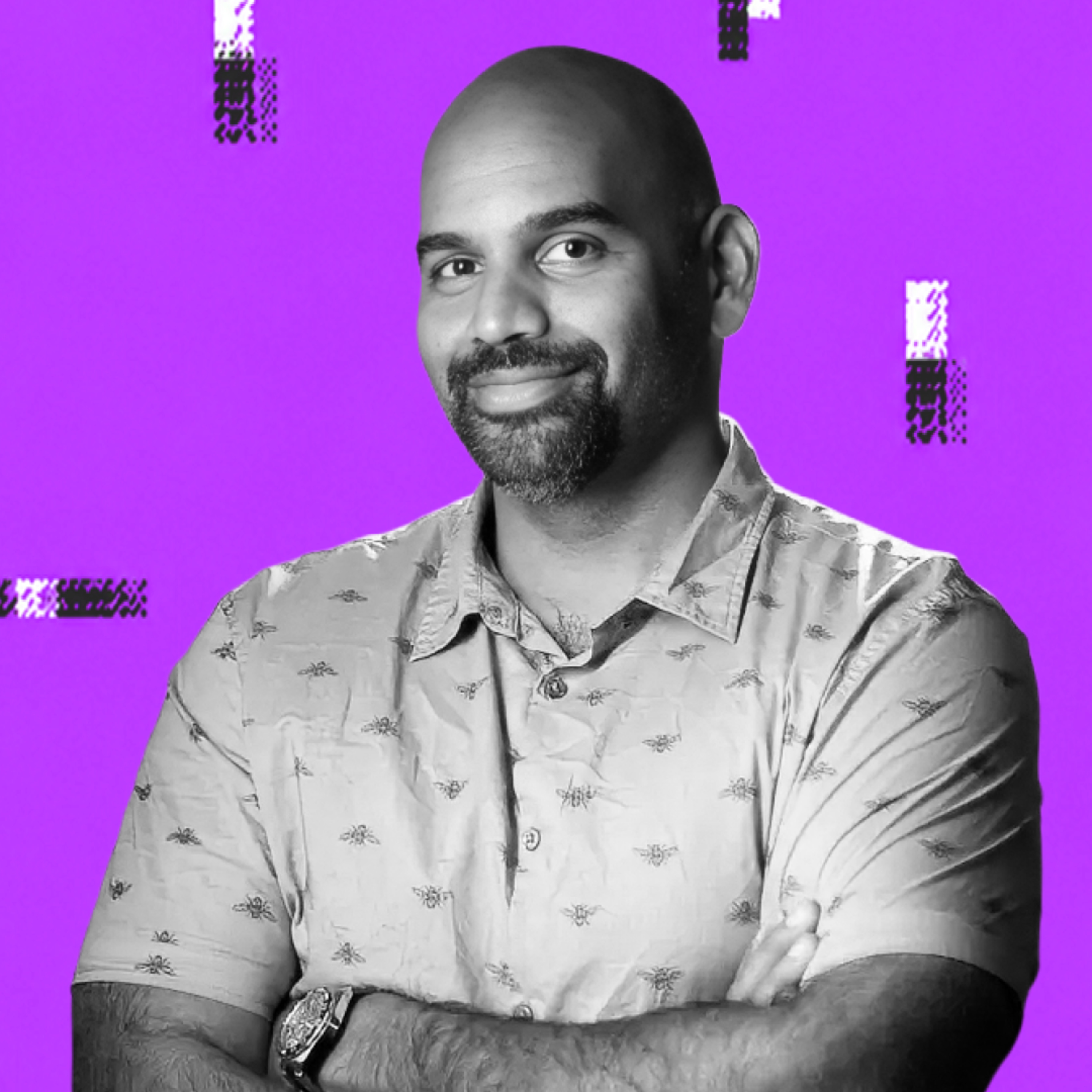
The Compute 100: Naveen Rao, Co-founder & CEO of Unconventional AI
from The Compute 100
1h 9m 6s
Naveen Rao, a veteran in the semiconductor and AI space, is now at the forefront of a revolutionary shift in computing. Drawing from decades of experience in startups like Nirvana and Mosaic ML, he has built Unconventional AI to fundamentally reimagine how computers operate. Rather than relying on traditional digital architectures, Unconventional leverages time-based, physical dynamics—inspired by nature’s biological systems—to create more efficient, intelligent, and adaptive computing. This approach eliminates the energy-intensive data movement between memory and processing units, offering potential efficiency gains of up to 1,000x. The company focuses initially on data centers, where energy consumption is most acute, using AI to optimize token generation and inference. Long-term, it aims to enable decentralized, edge-based intelligence—critical for robotics and real-time physical systems—by making computation inherently local and efficient. Unconventional avoids the memory wall by integrating memory and compute on the same chip through die stacking and distributed architectures, using standard semiconductor manufacturing. Rao sees this not just as a technical evolution, but as a deeper aesthetic and philosophical shift—where computing becomes more like nature itself, time-aware, dynamic, and inherently efficient. This vision aligns with a future where AI is not just centralized, but embedded in physical reality, transforming how machines interact with the world.
So today's guest is Naveen Rao.
He is a legend in the world of semiconductor industry.
He's the co-founder and CEO of Uncomventional AI.
Prior to that, he was the co-founder, CEO of Mosaic ML.
So the Databricks prior to that.
Nirvana sold to Intel.
So he has now done two startups with successful exits.
What he's building on conventional AI is a life's work.
Everything he has done from his startups
to his academic studies is sort of prepared him for this moment.
So it was really fun listening to him
talk about what he's going after.
It is a huge swing of reinventing how computing works.
What did you think?
I mean, it's incredible.
The story of unconventional, when it first came out,
they raised nearly half a billion for their seed ground.
It's a remarkable feat.
And someone like Naveen, who has timed some of the biggest markets
in history by building these incredible startups
for each of those moments, whether it be really the early iteration
of compute for machine learning with Nirvana,
with model training with Mosaic ML, and now with unconventional,
which is really kind of what does the future of compute look like?
Talking with him gives me so much inspiration
for our thesis around the future of compute
is going to look fundamentally different than it does today.
I think unconventional is really pushing the limits of what that could be.
I was also surprised by the level of sort of poetry
and sort of a kind of aesthetic orientation
that Naveen has in less try to gain to build unconventional
and look forward to the conversation here.
The Compute 100 is a podcast about the most consequential
market in AI.
These are the conversations with builders and investors
about the technology and the capital
of powering the greatest infrastructure build ever.
I'm Brian Schecter.
I'm Gabular Edzie.
We're investors at primary.
Let's dive in to the Compute 100.
This podcast is for informational purposes only
and does not constitute investment advice or an offer to buy or sell any securities.
Naveen, welcome to the Compute 100.
We're thrilled to have you here.
Our goal is really to think deeply and publicly about where compute is heading.
And we want to address that question from various perspectives
for laymen in the space, mainly investors, but also for builders
who want to be aware of the full playing field.
And Gabby and I are particularly excited to have you on
because not only are you building at the frontier of where compute is heading,
you just have a fascinating set of experiences, both in academia and as a founder
and as a builder inside of some of the biggest compute companies
in the semiconductor industry.
So really excited to be chatting with you.
Thank you for making the time.
I would love to just sort of start with you kind of talking about your fascination
with compute and where it comes from for you.
Sort of early days of how it got going and then we'll go from there.
You know, the earliest days it's hard to really pin down is sort of a fascination,
I guess, but probably probably from reading too much sci-fi as a kid, I think.
But you know, I've always been, I've always had a computer in my house,
which is for people my age, I'm 51.
That's not super common.
I had a computer in my house as I was three years old.
And so I actually learned a code when I was like, I don't know, seven or eight,
which back then was super weird.
It wasn't a normal thing.
And so to me, it was always just kind of the norm of a computer is just around.
And, you know, I think this idea that we could build something that, you know,
exhibits the properties of an intelligent being was just always something that I just found fascinating.
And so, I guess I was like, older, I kind of started to take that apart more and more.
And, you know, even when I went to undergrad in 1993, I was like,
you know, I want to understand how biology works, how biology does computation and figure out how to build it.
And you know, back then it was, that was much more of a vague notion.
I ended up studying computer science and electrical engineering and device physics.
And, you know, it didn't really get close to the answer, but I started to understand
what the bounds of the problem were.
I mean, sort of what artificial intelligence meant back then?
How do we make that work in existing computers?
And there was still this pretty big divide between what we knew how biology works
and how to computation and what how computers work.
And that's why I learned about the 20 watts of human brain and, you know, kind of the implicit computations
that happen in biology, it just sort of got worm through evolution.
So I think all of that just kind of kept on building on itself.
And it's like, it's just that the further you go down the raffle, the more interesting it gets, you know.
So I kind of, I mean, at this point, I think of the vote of most of my life to thinking about this.
And yeah, here we are. It's a, we're in a new place for the computing industry.
And I think it's very exciting for me.
It feels a little bit like, you know, what you're building at unconventional is kind of the biology
and the compute world coming together.
But at different points in your career, you've been more biology or more compute.
And so talk about how, you know, the learnings along the way of the companies you've started
that have led to unconventional and how that's, you know, ultimately been the amazing synthesis
of biology and compute that it is today.
I mean, well, even earlier in my career, I designed microprocessors.
That was like my first job at Sun Microsystem.
So, you know, I did that.
I went to several different startups doing like reconfigurable compute, things like that.
Back in the late '90s or early 2000s.
And, you know, after six, seven, eight chips, you sort of, you know how computer works.
I had a very good intuitive sense.
And, you know, that's actually why I decided it's time to go back to PhD in neuroscience.
Like actually understand what the state of the art of biology is and, you know, our understanding
of biology or other.
And see if we can apply that back to engineering.
And so at the end of the day, I am an engineer.
I mean, I think I have played a scientist and did that for a few years.
I think I'm reasonably good at it, but in my heart, I'm an engineer.
I want to build stuff.
And so when I came out, started doing research on neuromorphic computing, again, kind of came
back full circle after my PhD, and then started to see that, wait, now we have this algorithmic
framing of how we can build learning systems.
And that, to me, was a real big trigger point because it basically showed that this idea
of a strict separation between hardware and software was now going to break.
And I don't think a lot of people saw it that way, but to me, when you build a system
that can learn, it can adapt to the physical attributes of the computer.
So the way we designed computers up until that point was that there's this very hard contract
that the hardware has to supply to the software.
And the software builds on top of that and assumes it works perfectly every time.
When you have a system that can learn and adapt, it can actually incorporate attributes
of the hardware into the learning of the neural network or a learning system.
And then also, of course, you can inform the hardware to do that even better.
So now we end up in this loop, which is no longer this hard contract.
And so to me, that was a big deal.
And so Nirvana was actually, can I just jump in for a second?
And I want to just be sure we're like, as you say that, where I go is thinking about
the GPU being extremely effective for neural nets.
Is that the right sort of place to be thinking about here?
Yeah, I mean, to some degree, I think the GPU, even today still largely falls into this
kind of traditional way of thinking about the hardware software divide.
It's getting more blurry in a sense.
They, you know, Nvidia is talking about, oh, they're co-design in this and that.
Like, the co-design cycle is still a whole generation.
And it's still little tweaks.
It's not fundamentally changing this, you know, making this boundary between hardware
and software fluid.
They're still saying, okay, I deliver this many flops.
Those flops are sort of deterministic, they're not exactly deterministic.
But that's still this very traditional way of looking at it.
And, you know, the paradigm is being stretched and they're stretching it from a very, very
strict point of how they use to work.
We're kind of rethinking it altogether.
We're not stretching it.
We're just breaking it.
We're throwing away the baggage of the past.
So I think there is a bit of a difference here.
But yes, this is all in the same vein, really.
That's with unconventional.
You were going to talk about Nirvana for a minute.
Let's do that.
Yeah.
So Nirvana, you know, was really kind of the first foray into this.
We were the first AI chip company.
And back to then, this is 2014, mind you, like beginning of 2014, started thinking about
at the end of 2013.
No one knew, most investors didn't know what machine learning was or why it was important.
Much less, why we need to build hardware around it, right?
It was kind of obvious to us at the time, but, you know, convincing investors was
a large part of my job and it was very hard to raise money.
And so we couldn't take a giant leap at that point.
We had to take a bit more of an incremental bite, but it was still a pretty big leap by
most people's standards.
Like, oh, you're going to completely change how architecture looks for processing neural
networks.
And, you know, we introduced this kind of tensor core idea very early.
That and highly distributed matrix multiply was really the main two innovations, which
are now standard in GPUs and other things.
But at that time, GPUs did not have easy ways to distribute computation between GPUs.
They were literally made to run on one GPU.
And they also didn't have ways to do tensor math.
very effectively on the chip.
And if you kind of back up a little bit further,
why that even mattered at that time was linear algebra
and tensor math was kind of the thing that was built up
in the high performance computing days.
And it became the natural basis to build neural networks
because it's already parallel.
But that being said, it's actually not the right basis.
It's a better basis than serial compute,
but it's really not the most natural fit.
And I think that's what we're going to work now
is something even stronger affinity to neural networks.
But at that time, that was like the biggest leap
we could take.
It was already pretty hard to get people over the line
to invest in us.
But we did.
And we started to build it and sold the company too early
to Intel because we legitimately
had a 10X over Nvidia at that time.
And the rest is kind of history.
It was there for a few years at Intel
and built their AI division.
But through that, we saw this evolution of the whole industry
happen much faster than any of us ever anticipated in 2014.
Can you just double click for us on tensor math?
What do you mean by tensor math?
Sorry about that.
I started using jargony terms.
I mean, basically, what I mean by that
is that you have more than a 1D construct
for the way you weigh your data out.
So basically, it becomes a matrix 2D or 3D matrix multiplication
as an operation.
And so this is a very well understood algorithm to paralyze.
So this is why this was used in high performance computing.
Like you can take a matrix.
You can decompose it in a smaller matrices.
And then you can multiply two matrices together.
This is like a fundamental operation of the way
neural networks were laid out at that time.
And so we said, let's go optimize that.
Let's make it distributed.
Let's make it fast.
And so Nirvana, I did not actually
realize the degree to which it was at the forefront
of that sort of build the hardware
to work with the type of parallelization
that supports machine learning, neural nets,
paralyzed matrix multiplication, et cetera.
So you did that, then you're in tell.
Let's talk just about the mosaic moment
of why you decided to go do mosaic.
What were you seeing in the world?
So at this time, this is the post transformer world.
So transformer is like 2018.
Again, there was another moment there where it's like,
ah, OK, well, now we have something
that can embed languages and scaling seems to work.
So it's pretty clear then, well, a scaling works
algorithmically, well, how do you do that in the practical world?
It's actually really hard.
We have to orchestrate a whole bunch of chips
to do one single task.
This is not something that was super common.
And there were no easy ways to do it.
Also, now that I'm going to throw at that time,
let's say 1,000 GPUs, which sounded
like a lot at the time at a problem,
or 1,000 compute elements, it starts getting costly.
So you start seeing these like economies of scale
have to start kicking in, where if you're 5% more efficient,
it actually makes a huge difference to your cost, right?
Because you're spending millions of dollars now
on these training runs.
And so we saw that as like an opportunity
to say, well, let's build a platform
that makes it easier for people to scale compute
and apply essentially one large job across a huge number
of compute elements.
And then make sure that when you do that, each one of those jobs
is as efficient as we can possibly make it.
So we define this idea of a Pareto optimal frontier
for cost, time, and algorithmic performance.
So those are the three axes.
And we actually published a lot of data around different clouds,
different GPUs, different software packages
that people used in the industry.
So basically, it's like, we wanted
to say, this is the optimal frontier,
and we're going to keep pushing that by optimizing software
and algorithms.
And that was really the aha moment.
We knew scale was going to be important.
This is well before chat GPT.
This is actually started contemplating it in 2020.
But we started the company officially in 2021.
And that was just an incredible run.
I mean, mosaic at the start of 2021
was building for what was going to be obviously the AI moment.
But also, like we were at the end of a lot of the kind
of big data, ML, and then the early endings of AI.
And so you also benefited from everything
that was going on with data science machine learning.
But then it was perfect for AI.
And so talk about that kind of transition.
And then obviously landing at Databricks
that ended up being a really opportune place
to for the company to expand its product.
Yeah, I mean, it was an interesting thing
because we had a lot of internal debates about,
do we build the platform to do like computer vision,
versus LOMs?
So because a computer vision and smaller machine learning
models were actually the prevalent use
of machine learning at the time.
Like large language models were still a bit of an almost
an academic interest.
I mean, Open AI was going after them.
Of course, Google was.
But Google wasn't really talking about it internally
or externally.
Open AI started to-- there was GPT-2.
So these things were kind of bubbling out of the surface.
But it wasn't really clear that it was going to explode, right?
I think after a chat GPT moment, everyone became a genius.
They're like, oh, yeah, of course, that was going to happen.
Well, it wasn't so obvious.
So we really had to figure out where we're
going to put our energy, because as a startup,
you can't do everything.
So we made actually a strategic decision
at the beginning of 2022, I believe,
to focus only on large scale models like LOMs.
And--
What were the signs you were seeing that,
obviously, in early 2022, that was post-chatch BT,
by all of the groundwork?
No, before.
Oh, yeah, you're right, actually.
Yes.
What were the signs you were seeing that were saying--
so yeah, January before October 2022, November 2022,
and things explode?
What were the signs you were seeing that got you
conviction to make that decision?
It's a few things.
So one is that large scale models
are where our technology shined the most.
So the benefit was greatest, right?
So if you think about a small computer vision model
that takes, let's say, a data train on AGPUs in a single node.
If you make it a day versus half a day, like, OK,
it's not that big of a deal, right?
The impact wasn't huge.
Whereas if a model takes a month and you make it two weeks,
that's actually a much bigger impact.
So we said, all right, our stuff actually
has a much greater impact.
The absolute numbers are so much bigger
when we talk about the big models,
I think we should focus on that.
And then, at that time, it was really
more about language and anything else.
Multi-modal wasn't really a thing yet.
I mean, there were some video models,
like video classification models and things
that also required a lot of data.
But we wanted things to be in the scaled compute regime,
not necessarily massive amounts of data regime.
That actually was a pretty big divide.
So if you think about it, video was lots and lots of data.
But the models really weren't that big yet at that time.
Whereas language models were the inverse.
The data was relatively small, because text is compact.
But the models grew very big.
And so the latent space, the space of representations
was actually very large.
So that lend itself again to scaling
and to large impact from efficiency gains algorithmically.
So we said, if we're going to win,
we have to go after a thing where our tech
has the biggest advantage.
That's what gave us the conviction to go that way.
And we knew this was going to happen.
It was very clear at that time to me
that language models were going to do something interesting.
I mean, we already had chatbots at that point.
I think that article from Google
where some guy fell in love with one of the internal AIs
that had come out maybe late 21 or early 22, something like that.
So there were signs, right?
I did not realize that Mosaic was born that early.
Because when you--
I remember the moment when people were talking about Mosaic
as sort of on this tear that kind of went from 0
to 20 million in revenue or something like that
in a six month period of time, was that just like folklore
in startup land?
Or what's the level of truth in that?
Like walk us through the moment of acceleration
from Mosaic and the decision to sell?
No, it was true.
We went from less than a million error
over 20 and about five months.
But that was two years in the making, right?
We were preparing for that moment beforehand.
So it wasn't that we just conjured a product
out of an error in a couple of months.
The product was in the works.
And this whole idea of actually almost a neo-cloud
where we have a bunch of GPUs.
We basically scheduled them on behalf of a customer
to do large-scale work was completely new.
No one had done it before.
So that had actually happened earlier.
We had done that even late '21, early '22.
And one of our first customers, actually not even a real customer,
was a center for foundation model research at Stanford.
So we had built some models with them.
We basically said, hey, we want an external user
to try our stuff.
And they were happy to do it because we're
giving them free compute.
They're academic institution, right?
Percy Wang and for your others, actually.
started together AI after that, but we were actually the first ones to kind of do this model
of the NeoCloud. And so that's what we were working on. And then when chat GPT happened,
we've effectively had the platform worked out. We could dynamically allocate GPUs in a large
cluster to do one customer's workloads, you know, do it securely. And then we also had the tools
to basically say, okay, here's your data. This is your data streams from, you know, some buckets
somewhere. And we had the compute orchestrator that basically did all this automatically,
it dealt with failures of GPUs. All of that stuff had been built. And so when chat GPT happened,
and people wanted to train their models, boom, we had it. So you had to prepare for it, right?
>> Yeah, yeah. I mean, it's again so excited to be talking because, you know, we got sort of turned
on to the GPU shortage at that moment, but all of a sudden, Naveen had a ton of GPUs, they knew
how to turn on for people. It was like incredible timing. And I want to just get to unconventional,
because there's these are two different moments that we've talked about, Nirvana and Mosaic, where
you really were ahead of the curve of what was happening with AI and compute. And this sort of
the demands that the market and the technology would kind of arrive at when they came together. So
we've talked already about unconventional as like a life's work kind of business for you.
And so what are you seeing talk to us more about like what you're trying to do with unconventional
and would love to just spend time there like in the spirit of like, where is compute heading?
I think this is one of the most exciting periods, frankly, is all those other moments were great,
and it was like, it was almost the proof that AI will work. And I think now the world is convinced
of this, which wasn't true 10 years ago, you know, I think that had to happen. So that moments happen,
and now we can really think about how we can actually change the physical medium of a computer
to build something that's a better basis for an intelligent system. And that's that's really what
I'm excited about. And you know, what's what's interesting now if you look at from an industry problem
standpoint, like you said, I mean, my timing's been pretty good. I would say if I had a super power,
that's it is getting the timing right. And right now we're in this place where we're kind of on
the Titanic and the iceberg is power generation. You know, 10 years ago when you built a data center,
you thought about four space. That was really what what was the big focus of the operational focus
would be of building a data center. Now it's about getting the power contract. And you know,
it went through a few intermediate stages, whereas like networking equipment, cabling, then GPUs,
actually none of those are the constraints anymore. It's really, can I get the power contract?
And there's been people doing all kinds of crazy strategies like buying up a land that comes with
power contracts inherently and then and then one thing gets together. All this stuff is all about
the power contract. So just kind of put some numbers on it. In the US, we make, we have about a
thousand gigawatts of energy generation capacity, give or take depending on peak and this and that.
We use about 40 gigawatts in data centers, some total. Google published recently that they're
at 3.2 quadrillion tokens per month in terms of all their services. I just multiply that out
about 10 joules per token, which is a reasonable number. You get three, you get 12 gigawatts just for Google.
So then we have the other AI providers, of course, like OpenAI and Anthropic, maybe at least as large,
maybe bigger than that. So today we're at 40 gigawatts in the US, they're 12 by themselves.
And that's just keeps accelerating. And so if models get bigger, if they double in size, it grows
quadratically. The power power is 4x, generally. If demand grows 10x, we're kind of in a place where
we're running out of energy pretty fast. So I think the moment we're in right now is that compute
has never been constrained by energy. Ever. Every computer that's ever been built since the 1940s,
these kind of digital vannoyment machines has been built for the purpose of going faster.
It's been faster than people in the 1940s. We were trying to do calculations during war faster
than humans could do it. And eventually it became spreadsheets and web serving and graphics rendering
and this and that. But everyone had the purpose to go faster. Not a single one of those machines
gave two shits about efficiency. Ever. The only reason you cared about efficiency was
could have fit in the farm factor. And so that that mentality has pervaded computing to now. Like
Jensen will go on stage and say, my new thing is 2x faster than my old thing. Great. I'm sure that
is absolutely true. But what's not being said is that the way you're getting 2x faster is by jamming
2x the energy into it. So we're not solving the problem. Time is no longer the dimension that
matters is energy. And so if I'm 2x faster, but I'm 2x the amount of energy, I didn't really solve
the problem. I can't keep scaling. So we're in this place where we have to solve the energy
efficiency inherently. And so what we've done on conventional is really make that the front and
center problem. Yes, we want to be fast. It's going to want to be low latency, but we have to make
this thing much more efficient and not 50% or 20% more efficient, but orders of magnitude. We're
shooting for 1000 x efficiency. What is your response to when people are thinking about energy and
power bottlenecks as a whole? There's a lot of different ways you can tackle that. Some people are
like this is a permitting problem. This is a we don't have nuclear yet problem. You're obviously
a chips guy. So wanting to go to the chip space makes sense. But talk to me about how what gets you
most excited about the way that actual compute will drive so much efficiency on the power side as
opposed to the other ways that people are attacking the power bottleneck. I mean, we should build more
power. I'm 100% an advocate of that as well. Don't get me wrong. But I think building power is
very expensive. So it's about 10 to 20 billion dollars to build a gigawatt. I mean, forget about
permitting. Permitting is another problem. Yes. But if you just multiply this out and you say you
want to double the footprints of energy for data centers in the US go from 40 gigawatts to 80 gigawatts,
just do the math. Best case, 10 billion dollars per gigawatt and you want to build 40 other.
It's just a super expensive thing to do. And so it just doesn't happen overnight, right? And I think
that's the problem. So we have to solve this problem within three or four years, not in 20 years.
And so that's kind of where I'm attacking it. Now, what's exciting about it for me? I'll give you
an unconventional answer. I do want to solve the industry problem. I want to see AI everywhere.
I want to see it in different form factors. All of that is great. But for me personally,
I think it's an aesthetic thing. I think I want the world, I want the world of computing to do
computing in a way that's more beautiful than it's done today. I know that's a strange answer.
But really, that's my deepest motivation is to build the computer in the way it should be built.
More about that. Like, like, yeah, say more about that.
So if you look at biology and you look at nature, computing is not some
constructed humans came up with. Computing is everywhere. It's all around us. Our bodies
are built out of computation. Like literally when we're forming, you have DNA unrolling into RNA
and expressing proteins. Those proteins start to build cells and those cells start to like
find each other. Then those cells kind of like route to connect to the right places. Like,
all of this happens through diffusion gradients and it's a type of computation in our bodies.
Literally, all around us, trees, everything grows in this way. It actually is a type of
computation. Our brains, of course, are another version of this. It's all built on the inherent
physics. And none of them use this kind of contrived von Neumann architecture. We don't use fixed
bit number of bits for numeric representation. Then this like, you know, very contrived movement
of data in and out of a memory subsystem. These are all like very human looking things. That's not
really how the world has worked. So can we build artificial intelligence on I'm kind of naturalistic
looking constructs? That's what I want to see. And so we can, we can build computers like that.
We just never had to do it because more as well as working great. There was never a set of work
loads that necessitated us to think about efficiency. We were getting plenty of speed ups from from
Moore's Law. And that's what the economy was supporting, right? Again, we always build computers
for a purpose. And you have to put the, you know, the requisite investment in to build that computer.
And now we're at a place where energy does matter. We do have to start taking some hits from
from nature and look at why and how it's super efficient in terms of energy. So that's that's my
weird answer is that like, let's go like where as you're going, when I'm assuming where you're
heading with this is around analog, but talk like take us further into the unconventional strategy.
How do you make computers that draw from from nature? What do they look like? Yeah. So analog is one
of many tools that we can use to build a different kind of computer. But it's not the be all end all.
I mean, there are companies that have started to say that we're going to build something in analog
and therefore it's going to be more efficient. That's not actually true. You have to do a lot
more work than that. And I'll tell you a few of the basic ideas I have.
how nature has built a computation.
So all known physics in the universe has a time dimension.
And the world is generally described
by what we call differential equations,
ordinary differential equations.
And so these involve the time varying dynamics of the world.
Like if I roll a ball, it has time varying dynamics.
It interacts with the table and creates friction
and all that has time associated with it.
When you think about a computing system today,
it has operations like multiply, or add, or subtract.
And it doesn't actually have time as a construct.
Computation is timeless in a sense.
It's just a bunch of operations.
We try to make them go as fast as possible.
So the fundamental abstraction of an existing computer
it actually doesn't have time.
It just has bits, ones and zeros,
which are an abstraction of the physical.
So there is no such thing as a digital transistor.
I've heard people say digital transistors.
Like every transistor is analog.
There is no digital transistor.
We abstract its behavior and say it's 1 or 0.
And then we try to make time go away as much as possible.
We want the transition from 0 to 1
or 1 to 0 to be as fast as possible.
The pure abstraction would be that it would transition
with 0 time.
But so that's actually--
Can we just spend once again?
Because this is a fascinating thing that I think people
should understand.
When you say that it is not actually sort of a 1 or 0
with the transistor, what is it then?
A transistor is a physical device that actually
just has voltage that it interacts with.
So it's when it's at quote-unquote 0,
it's what we call quiescent or it's at ground.
But it's still not going to be 0.
It's going to have fluctuations constantly.
Everything does.
And then we basically engineered circuits
that can-- if you input a small amount to a certain point,
they cross a threshold in which they go to the other rail,
the VDD or the higher voltage.
And so we call that a 1.
But while it's doing that, there is a time of transition.
It doesn't go from 0 volts to VDD in 0 time.
There's actually a time of transition between them.
And actually it goes through all the voltages in between.
It's a continuous thing, right?
It's a continuous variable.
So it has to be.
That's how the physical world works.
In fact, if you made something--
if you made charge transition from 0 to 0.8 volts in 0 time,
it would take infinite energy.
So the physics of the world does not support
the subtraction of going from 0 to 1 in no time.
It's just-- it's impossible.
So another way to think about it is like,
if I say this means 0 and this means 1,
I have to move my phone, right?
And moving my phone takes energy.
It's true in every physical system.
And also it goes through all the intermediate states, right?
If you think about it.
So computers have up to now been sort of in a sense timeless.
And in part, that's connected to the sort of Venn
noise and contract of 1s and 0s.
And so what are you doing?
If unconventional, you're trying to build a computer that
takes time into account?
Exactly, yes.
So we call this dynamics.
So if we can build circuits that actually
have dynamics to them, that they time vary.
And then we can actually steer those dynamics and train them.
They start becoming more like a neural network, right?
In fact, if you think about our brains,
there is no neural network in software.
It is just a physical neural network.
And literally, the time varying dynamics of the neurons
is what gives rise to the behavior of the neural network.
It's what gives rise to our brain and intelligence.
So it's basically saying, can I build a system that
has time varying dynamics?
Can I steer those dynamics to do something useful?
And then can I build a scalable, manufacturable system
on it?
That's the question we asked at unconventional.
What is it that time gets you?
I understand that you then can steer the dynamics.
But tell me a little bit more about where
does that actually result?
What would an end user experience that--
what would an end user experience that's
better with an unconventional system
than a system that doesn't take time into account?
I'll come back to that.
What it solves for us from an engineering standpoint
is reduction of movement of charge.
So in a computing system, almost all the energy
is about moving information around.
When we say moving information around,
it's not really moving information around,
it's moving the representation of information,
which an electronic system is charged.
So that whole idea of moving the phone back and forth,
if you do that trillions of times per second
with a little bits of charge, it adds up.
And that's actually where all the energy goes.
So if we can build a system that actually
has its own inherent time dynamics to it,
and it actually knows how to almost do unrolling computation
all in one place, you simply don't move back and forth
from memory to compute element.
So I'll give you another example of this.
So if I have a ball and it's rolling on a table,
I said, OK, go model this in an existing computer.
You'll say, OK, well, the state of the ball
is the position and the velocity vector of the ball.
And I'm going to write that to memory.
And I'm going to make a function that takes
those two things as inputs and maps it
to time t plus delta, some time in the future.
So current position, current velocity function maps it
to time t plus delta, then I write that answer back to memory.
And so basically, I do this back and forth
from memory to compute, memory to compute
to simulate the ball rolling.
Now, think about the ball for a moment.
The ball knows its position and it knows its velocity.
Just inherent to the physics.
And what's more, it also knows how
to map the current position of velocity
to the next position of velocity.
It doesn't have to move any information
to an explicit state store or an explicit memory.
It simply knows how to do it because of the physics.
So we want to build circuits that actually behave like this.
And so it's time unfolding the behavior of the circuit
actually is the computation that I care about.
That's doing the neural network inference.
So it's almost like there's intelligence
in knowing time itself because you're
able to kind of continue that calculation
for the ball example.
If as long as that ball knows how time is evolving,
it's able to say, I know these physical properties
that I-- as the ball speaking, I know these physical properties
that I exhibit.
And if time is changing by T plus 1, T plus 2,
then I know how the properties are going to evolve
if I'm aware of time.
Exactly.
And everything is aware of time.
That's just a fundamental fabric of the world.
And so that's why nature chose to do it this way
because everything already time varies.
It just does.
So what we do in computers today is we
try to lock the world in these little boxes that we like.
And it's actually kind of--
it's interesting because it actually
recapituates a little bit of the evolution
of artificial neural networks themselves.
So machine learning at one time was all about feature engineering.
You may have heard that term from your--
when I say your, like 15 years ago--
we did a computer vision using feature engineering.
Like, OK, I'm going to say, here's a nose.
And here's an eye.
And those are features I care about when I do face detection.
And then what deep learning did back in 2012
was say, I'm not going to feature engineer.
I'm just going to learn the features from data.
Give me enough data.
And I'll figure out what the important features are.
In essence, we're taking that to the physical layer.
We're saying, OK, you don't have to spell out.
It has to be four bits or eight bits.
And it has to move data this way.
We're actually going to make a machine
that can have sort of time varying physics that are
steerable, that actually get matched to what the computation
is required for the work what we care about.
So it's like not feature engineering the hardware.
I love Gabby's customer question.
Like, is this going to be helping for training, for inference,
for something entirely different?
Like, what's the-- because it's on the one hand,
it's fundamental research, but the other hand,
I know that you're commercially minded.
And so where does this come into the world?
Maybe on that note, we'd love to talk about the first model
that you guys released on zero.
Is that what you guys are saying it on zero?
Yeah, some people call it Uno.
Uno, I was going to say it looks like Uno on zero.
And given that you guys have now built a model
that is based on these physical, the new way your chips
are represented, we'd love to connect the customer question
to that.
So to answer your question, what will a customer feel
or what a user feel?
So there's a few things.
Building machine learning out of systems
that are inherently causal will actually
take us in slightly new directions.
You don't have to think causality.
You actually have causality in the physical system.
So I think these will actually lend themselves
to problems that are inherently causal, like robotics.
So when I choose to move my arm like this,
there's a causal set of things that have to happen.
And our brain actually has a causal definition
of what our arm will look like.
And it actually maps quite nicely.
So these machines actually could map
to temporal dynamics problems very well.
So in terms of the problem space,
I think there will be new ways we can look at applications.
But let's put that on the shelf for now.
I think when you start to think about systems
that are drastically more efficient, like 1,000 times
more efficient, it opens up whole new possibilities
of form factor.
So today, if I want to have 10 billion robots in the world,
just do the math of the complexity of these models
that people are building and the complexity of the robots.
There's just no way you can do it with data centers, just too much.
bandwidth, too much compute. You just can't get the information, the intelligence, where
it needs to be. So if I think about a world like that, you actually have to have to compute
much closer to where the intelligence is required. So, yeah, data centers are great when I'm processing
data for, you know, enterprise enterprises who are running things in Databricks. Great. We should
totally do that. But when I want to have things that are interacting in the physical world,
or let's say I have a bunch of bots sitting in this room and, you know, something breaks,
and it has to go like dynamically assemble, figure out how to like orchestrate itself, fix the
problem, and then, you know, disassociate again. It's sort of like a bunch of physical agents.
That's going to be super hard to do in one centralized place. It needs to be decentralized.
And the only way to do that is to make these things run much more efficiently, more locally.
And yeah, that sounds like edge compute. I think what we've done with edge compute has been horrendously
uncreative. It's a bunch of stupid stuff that we, you know, do like just in our phone or like a wake-up
world. Like these are super uncreative. I want intelligence. I want things that actually can
move devices around, actually solve problems, you know, in real-time. And it all has to happen
locally. So I think that's how the user will feel this is that we will have intelligence everywhere
around us, not through some little chatbot, but like in the physical world.
And so in the world of, you know, more things happen locally. It's almost like the way I'm hearing
this is there's that idea of the hardware lottery of basically like we are building the software
and the systems that work with the hardware we have at the time. And it's almost like a few tile
exercise for us to try to go back and forth here and be like, what's going to, what's the customer
going to feel? Because at the end of the day, like, it's the hardware that will enable us to have
this like another Cambrian explosion of potential. But we're going, if we stay on this kind of like
local edge trends, like I would love to hear a little bit more about what you think that edge has
done wrong in the world today. And then, you know, really how unconventional is thinking about that
from a commercial perspective of, you know, making sure that you guys are aligned with the kind of
physical AI explosion that's happening and the people that will be your partners long-term.
Yeah, I mean, if you look at the world today, like on the edge, what is it all interesting?
I mean, the iPhone makes pretty much all the profits of the edge, right? I can't even think of
a single device on the edge that even slightly competes with the iPhone. So the iPhone is useful
because, well, it's big enough people do enough engineering on the battery technology and got it
to a point where it's low enough power but still does interesting things. Like, yes, there are
fit bits and there are trackers and I'm wearing one here. These are great and they do, they're kind of
interesting now, but this is relatively new. Like, this is the last few years. And prior to that,
like, edge devices were completely boring. I don't think they were super useful at all. Like,
people tried a bunch of stuff, but it was mostly about they couldn't do anything
terribly exciting at the edge because of power. And that was again because we were building the
same kind of digital machines, but using low power circuit techniques for the edge. And really,
it took the phone and, you know, connectivity, 5G connectivity and stuff like that to make that
actually do something useful. Now, in terms of robots, there really no real robots that we use
at the edge. The only examples of those now are probably self-driving cars, right? So there
are no robots and there's only one device that does anything at the edge, right? That's the way I
look at the edge today. And it's all because of power. I mean, the car can work and do intelligent
things because it's big enough and we can jam big batteries into it. But now, let's start thinking
about like, well, if I can make something a thousand times more efficient, I start bringing in more
and more of these capabilities and I start enabling whole new applications. So from a commercial
side of things, I think that's a very long-term goal for us. Robotics is not a real market right now.
Like, I'm an investor in robotics companies. I love it. I'm not just hopeful. I know it's going to
happen. But it's going to take seven, eight, nine years to happen. There's a lot of fundamental
problems we have to solve. But in that seven or eight, nine years, we're going to have the thing
that actually powers those robots. So I think I'm very bullish on that. In the short term, when I say
short-term, I mean like three years, we are focused on the data center because that's where the
problem is most acute. The economics are super favorable for us. Like data center operator tries to
set up a data center. They buy, you know, a hundred megawatts of power and they need to monetize
that hundred megawatts. The vehicle of monetization is token generation. So we can generate a thousand
more tokens per unit watt than anyone else. Pretty much a no-brainer, right? So we're focused on
that problem for now. And the big, the two big problems that everyone cares about in the generative
AI world are image generation and text. And so those are going to be the short-term goals for us.
And actually just brought up the unzero or unknown model. Yeah, this was an image generation model.
And we wanted to show the world that you can actually use physical time varying systems
to build AI inference. It can be the compute substrate for AI inference. And that's exactly
what that model shows. It's a, it's a set of coupled oscillators. So oscillators just are
free running oscillators come metronome and they can influence each other's phase. And you can
build a simple physical system. And then we, we, you can basically steer that system to behave
in certain ways. And that steering is done by training a neural network to generate images.
And we did this at a, at a pretty decent size scale. It's like an image net size scale.
Can we, I want to do a little bit more digging in the, in the technology of like, it's, well,
TSMC make these chips for you. Like we'll use HBM. Like how, like there's, there's a kind of,
there's a lot of attention right now into how like AI accelerators are working and a lot of
activity from the hyperscalers, the startups and the incumbents that are all, you know, there's
some variation. But you're really proposing something quite distinct from your architecture standpoint.
So I'm curious about like how you build this. And then also this sort of the software challenge,
which obviously you're very aware, but like everyone will say like, well, what's the software stack
that is required to be able to run on that hardware? Can you talk about how you're tackling those two
different sort of ends of the, the getting into the data center over the next few years?
Let me tell you the software stack really fast. It's actually kind of interesting. So on the one hand,
we have cloud is taken over the world, software engineering is dead. And the other hand is like, oh,
how are you going to deal with the software stack? So bring the two together, right? Like software is
not going to be written by humans in a couple of years very much. I mean, there'll be some tweaks to
go, of course, but like what we need to do is make sure that we can run a useful work load on this
and have an AI basically magnet. So the software problem I think is solving itself. I don't think
Nvidia's CUDA mode lasts in the world of AI. It just doesn't because humans don't need these
like nice little boxes that things fit in. We can actually just use models to do this. So I think
that's going to get a lot better and a lot easier over time because of AI models. And in terms of
the fundamental architect architect for shifts, there were a couple of bounding boxes we put on
this company when we started it. One was that we have to solve the problem within five years,
product in five years minimum, maximum. And two is whatever solution we come up with, it has to be
manufacturer. So if I have the best solution in the world, but I can't manufacture it, I still don't
solve the problem at the global scale. So like quantum and other things kind of fall into this
category. Maybe you solve it. Great. We should do those things, but we have to be able to manufacture.
So we said the best medium actually is electronics. So we know how to manufacture these things. We
know how to scale it. We know how to do all kinds of stuff. So we are focused on building systems
out of electronics. We could build it out of anything. Internally, we say we could train a
bowl of jello. Literally, you can use a bowl of jello for kind. But we are going to use electronics
because it's most manufacturing. So we've already built our first prototype. We haven't talked
about this publicly. I am not going to disclose the numbers. The numbers are really, really good.
I'll say that in terms of efficiency. But we already built our first prototype. So within six
months, we built a prototype, which is because we want it. Yeah, it's kind of nuts. And it's fabricated
on CSMC. So we can use standard fabrication techniques. But some big differences are going to be
you mentioned HBM. We are not using HBM. And the reason is let's kind of go into why memory is a
distinct thing from compute. So over the last 40, 50 years, we started to we bifurcated these things
because it became an economically wise thing to manufacture DRAM separately from logic. So DRAM
actually uses a separate silicon process. You cannot manufacture CPU logic or GPU logic
in a fab that's built for memory. They're completely distinct. So Samsung has a memory division
and they have a logic division. Never the two shall meet like they are completely separate.
And that's basically created this industry where we have this big clump of memory and we have to
connect it back to, you know, a big clump of logic. And that's the bond known and bottleneck.
And there's there are lots of reasons why Samsung and SK and these guys want to continue that
because they have to strangle hold on the market because they're the ones on the memory fab.
But if I think about this dynamical systems framing, go back to the the nature discussion we had
earlier. We don't have state in one big glob and then compute in one big glob. They're completely
intertwined with each other. And in fact, they're intertwined with each other.
at a device level. So state and computation, just like that ball rolling, are in one place.
And so we're actually looking at new memory technologies that we can build on top of a logic die that are highly distributed.
And so it obviates the need to have a separate HBM chip. We don't want to, we don't want to mitigate the memory wall.
We're just going to walk around it completely new way of looking at the problem.
It's, I think it's a broken manifestation of the system that we have this memory wall right now.
We, we, we backed ourselves in this corner of having two different things.
But, but not SRAM. So I think SRAM is being sort of integrated fully into a logic die.
It's always been SRAM is logic. So the problem with SRAM. SRAM is the problem with it is in, you have to make a very hard trade off between SRAM and DRAM.
SRAM is not power efficient. It's not dense. It's 10 trends are eight transistors to make an SRAM cell, whereas it's one transistor for a DRAM cell.
And SRAM cells have a lot of leakage. They're on the order of 10 to 100 times less efficient than DRAM, but they're about 10 times faster when you're on the logic die.
So you get this trade off of like, I get something is faster, but it's way less efficient.
So go back to the original discussion. We have to optimize around efficiency. This is not efficient.
Rock made that made that trade off and they made something very fast. It's not super power efficient.
So what's your, what is your memory? So we're SRAM is obviously the gold standard for on chip. We, this is a, this is an area of investments.
I'll talk about that in inducing. We have some really cool stuff cooking there though.
It's exciting. Yeah. I was going to say on the, on the memory trend, and not not specific to unconventional, but people have been thinking about, well, can we put DRAM on top of a logic chip, but DRAM on top of a logic chip has its own concerns around heat.
They, it obviously, like warpage that ends up leading to or silicon warpage because of that.
And so talk a little bit more about, you know, maybe the state of what you, the reason that you guys feel like this is the way to to do it.
What a lot of people have said like manufacturing, this is going to be really hard and obviously manufacture ability is something that's core to what you guys are working on.
So they're talking about still DRAM separate from the logic, right? Not intertwined, but it's closer. And I think it's a good step.
I am very bullish on packaging. I think packaging of what I can die is a huge unlock. Now what's happened for 10 years, we've been talking about this.
When I got acquired by Intel in 2016, we were talking about 3D stacking. Why isn't it happen? It's because pretty much all performance scaling in silicon is not happening through anything others in energy.
So at that time, I think the P100, the NVIDIA P100 was on the order of 300 watts, the GB 300, I think is on the order of 1400 watts. So all the performance has basically come by jamming more energy into the system.
And so we're now greater than one watts per square millimeter of silicon energy. So it's just a heat problem.
We can't stack because of heat. And so we're trying to come up with weird ways of cooling and interposing cooling into the stack and stuff like that.
But fundamentally, you have to get heat out of the system before you can go further.
What we're building is actually inherently lower energy by orders of magnitude. We can actually do die stacking now.
And we get actually some some some really nice efficiencies when we die stack. So that's actually another part of our strategy is pretty aggressive die stacking here and way beyond just one layer of DRAM on top.
Because what happens in those cases is yes, you get DRAM on top and you get better movement from DRAM to the logic die, but you have to run the logic die much lower.
So you have to operate to make it actually work in terms of the thermals. So you're trading off a lot of things here, we don't have to do make those trade off. So we can actually have highly distributed memory in logic and die stack them.
So something that I found so fascinating about the way that compute is progressing is it feels like.
And you mentioned this with like the kind of way that compute and memory as industries have been so isolated is that it feels like so much more value is accruing to whoever is doing that packaging step or whoever is figuring out how to actually like package these systems in the right way, because it doesn't make sense for us to be looking at these as all isolated system.
So maybe like on just a broader kind of like future of compute question, like I would love to hear about how you think about you guys are obviously now playing the role of kind of this connector in a way that maybe you wouldn't before you'd be just using commodity DRAM you'd be using commodity products underneath the hood.
How do you think that's going to impact the way we think about chips and kind of like what does that look like for the future of even like fabricating these systems packaging these systems when you kind of hold all the cards on how they get put together.
Well, I mean, that's a great place for us to be right.
Putting it where the value is going to be, I think.
I think I think packaging is something that hasn't gotten enough attention of late, I mean, it is getting some attention, but I think frankly, that's where almost all the value is going to start accruing when we start building these large scale systems.
And for us, we are now in this place where startups can raise enough money to do non commodity things.
And what I mean by that is, you know, when you build a new system that has different requirements, the current commodities don't have those things, right, you have to kind of make them work for you.
So when you did that traditionally, like look at Nirvana, right, we couldn't do anything but use commodities, we had to use standard to some seas cells and stuff like that.
It's not exactly what we need, but we can make it work close enough.
But that was because we were tiny, we can only raise a certain amount of money.
Now we're in a place where we can raise large amounts of money, we can actually start to build things like packaging that are really perfect and perfected for our use case.
And if our use case is what's going to drive the most value, guess what, that whole stack actually has the most value.
So instead of using this problem of like trying to get the commodities to shift to you, we can just say, alright guys, we'll just do ourselves.
And we'll build a thing that we need and that will actually shift the entire commodity industry over over time.
So we're in a weird place in startup land, I think, where you can do the thing, right, you couldn't do this and it started before it was like, alright, well I gotta go join forces with intel before I can go think about building something so big.
I don't have to do that anymore, you know, I can think about it like I'm gonna build the whole thing myself.
Let's stay in this for a minute, I'd love to get here, because we're thinking a lot about where to invest at seed in the context of compute with an overarching thesis that the compute industry or semiconductor industry is undergoing this massive transformation.
Because of the need that the AI revolution is putting on that for more hardware, more efficient hardware, new types of hardware, and that incumbents have gotten incredible at hyper optimization and working within the context of extremely sophisticated but fragmented supply chain.
And then another thing that we think about a lot is the sort of arising generation of people that want to get into building hard things and want to do being a compute.
You know, we're investors in etched where that's like an incredible example of that.
There's another angle, which is like the availability of capital, which you're now speaking to, where it used to be like, well, you just can't go compete because you can't get the money to.
Now, we may not, you know, there are some people who can go out and raise something in the neighborhood of half a billion dollars because of who they are.
There's also just some teams that can raise 10, 20, 30 billion dollars, make some really compelling proof points prove that they can hire and then raise hundreds of millions of dollars prove that they can simulate and then raise ultimately billions of dollars.
But in quick, in quick succession to be able to actually go compete against the incumbents, how do you see this playing out over the next decade.
In terms of like it's, you know, let's, you know, let's assume that unconventional is a big winner.
I'm sure you don't think it's going to be the only winner like what else is the sort of what else do you think will happen in this semiconductor industry because of this new demand.
Yeah, there's going to be some pretty big shifts in who those suppliers are and what the supply chain looks like what he said is completely fragmented is fragmented in a way that almost assumes a staticness to the way you build a system right.
It's like, okay, well, I build a big die that is a certain size and that die has certain power characteristics and this is the kind of packaging that works for that and this is the kind of memory that works for that.
All of these things are cookie cutter and they're fragmented, but they assume that there's basically one way to put it together.
And I think what's going to happen is we're going to see people going, you know, it's a different levels of depth to change this like I invested in a company called automorks.
That's a it's actually changing how we can you can do like lithography effectively like you do 3D printing at the like, you know, nanometer scale.
So I'm super bullish on things like this because we could change, there could all of a sudden be this new invention that just boom, boom, completely changed what changes the need to have lithography.
I think lithography, as it is today, is commoditized, like, I. I understand why we're trying to go after it as a country and bring it back on shore and
all that kind of stuff.
I get it.
But at the same time, it's kind of yesterday's problem.
Like, to me, I'm like, I actually don't care.
Someone go fabricate these things and give me the bump outs that I need.
That's all I care about.
And we're not getting any more fundamental gains from lithography, right?
We're getting a little incremental things and we're getting better at processing it.
It's been cheaper and all that, but it's not really getting any more efficient.
So to me, I'm like, let's let that just be commodity.
And then there's going to be this other stack of like packaging interconnect boards.
That's where a lot of the value is going to occur because now you can start verticalizing
that around the problem and build something just that's just much, much better.
It's like I can go build a, you know, I don't know, a Bugatti that's like super optimized
top to bottom.
And the value becomes is coming from that top to bottom optimization.
It's not coming from the whole, you know, I can buy an engine from this guy in a suspension
pieces from that guy and put together a car that works.
Car that works isn't super interesting.
It's the car that's super high performance or super high efficiency or whatever that's
more interesting.
So I think we're going to move to that.
And so I think the next 10 to 15 years are going to be this disruption of the silicon
supply chain and people going highly vertical, including us.
Interesting.
Sharing and talent, what's been interesting is that sort of the value of these, you know,
n equals one people is just skyrocketed because AI takes a lot of toil out like an example
would be, you know, I could ask a question of how does noise propagate when I chain these
circuits together?
That might be a question I come up with.
And normally I'd have to go to my team and say, hey, you know, can we model this and try
to like, yeah, okay, I'll get to it.
I got some stuff to do.
So it'll be a week and the rights and codes will simulate it.
So maybe in two weeks I get an answer.
I can literally just go code that myself in 20 minutes, you know, and not have to think
too hard about it.
And then get an answer that's pretty satisfactory.
It's not perfect.
I'm not going to build products out of that.
But I can basically use that to reason over different ideas very quickly.
So this is why we have been able to go so fast in terms of building prototypes.
Is that these reasoning loops and I mean, human reasoning loops are just accelerated
by AI.
But I don't think AI gives you the new idea.
It has not really ever once given us a new idea that's useful, but it allows you to iterate
on your own thoughts so much faster.
And so people who are very creative, who come from various backgrounds are actually extremely
important to us.
As a company, we've had to hire a very interesting set of people.
I would say, I mean, this team is incredible.
I mean, of course, I'm going to say that because in the CEO, but it's, I don't know how
to, I don't know how to like, just convey how I really feel about this.
Is that like, we built a team of people who are really focused on the problem of efficiency
and how to make a novel paradigm of compute work.
And they're looking at it from different perspectives.
We have people with pure math PhDs, dynamical systems theory, that kind of stuff.
These folks have actually been a huge leverage because they come up with these ideas that
actually come from old concepts.
Like a lot of the math has been done in 100 years old, right?
Dynamical systems theory is 100 years old.
But they're looking at it from a new way like, oh, I now have this physical system that
does these things.
How do I connect that?
And then they basically can talk to people who are experts at circuit design or experts
at architecture.
And so we have the whole stack of people and actually facilitating the communication between
that stack was really the hard problem for me and the founding team at the company.
But now, I think we've got a really strong system in place and it's actually, we formalize
certain types of communication and things, and it's actually working really well.
So in terms of hiring, we need people who are super creative and across the entire stack.
And almost no talent, you know, from most theoretical, like, you know, kind of abstract
thinkers all the way down to the people who just, this is the best way to wire this thing
together.
Like, we need to all, you know, so I think you're going to see more of this and it reflects
that discussion we're just having is that there's kind of a grand verticalization that's
going to happen.
You know, it doesn't make sense to have commodity because commodity makes sense when I have
a commodity, I use it for 50 different things.
If I have a thing and I'm going to use for one thing, I'm going to verticalize it.
And now the one thing is, that's all that matters and like in the future, that's it, you
know?
Yeah.
So take us behind the scenes into how you're thinking about hiring.
Obviously you're trying to hire end of one people and they're becoming, you know, infinitely
more valuable to the growth that you're driving at, unconventional.
Where are you finding these people are there like, and I mean that from a, is it largely
an academic, like largely academics, is it people who are wants, is it biologists given
that you guys sit so cross-functionally like you're trying to build something that is integrating
a ton of different worlds.
How do you actually find people that are up for that challenge?
I don't think we've hired a quant yet.
I actually was a quant for a year.
But quants are kind of a funny thing.
It's kind of where dreams go to die.
I sort of joke because everyone who's a quant did something else before they're a quant.
So we haven't hired a quant yet, other than me.
But I think academia is one part of it.
So there's a lot of interesting papers coming out now with different ideas.
And I think in academia people feel that, you know, they can be very creative.
And so we can get a glimpse of their creativity that way.
And so actually our CFO of all people built the tool, vibe-coded it that scans all of
our applicants and then scans all the papers we have discussed, like on Slack and other
places, and actually cross-references them on constantly.
So we have like a target list of people, it's like, hey, this person just applied.
Go reach out to him.
So that's one source, obviously network matters a lot.
So Mike Carbin, who is one of the co-founders, he's a MIT professor, and Sarah Assure is
a Stanford professor.
So they have a pretty good network into academia, I know what kind of interesting things are.
Who are great students, that sort of a thing.
Well, you haven't said is, you know, pulling lots of people from the semis industry.
So how does the kind of like traditional semis or compute world, especially having been
someone at Intel, there's lots of companies that come out of Intel and kind of carries
over.
We'll love to hear more about how you're pulling people from compute.
Yeah, we are pulling people from the semis industry, but there's a certain mindset you
have to have.
So a lot of people in the semis industry, because it's an older industry, it's been, you know,
the cycle times were long, right, product cycle to three years.
And people just kind of settle into this thing, like, I need people with a certain level
of aggression, I need people with the desire to want to change how things are, not just
do it, do it the same way they've done it.
That's hard to find in this industry, to be really honest.
And we have some really interesting folks who, you know, they did work on projects like
at Google.
Actually, one of the guys, one of our head architects, he, he was at Google and kind of got bored
with the way that she was working, was just saying, hey, I don't want to work at a company
because it's all kind of boring.
And I'll just, you know, I'll, I'll, I'll, I'll contract, but he loved what we're doing
is like, all right, I want to do this whole time.
So we got to get those people who have that right mindset.
And I think that's the hard part on the, on the semis side.
So I'd actually rather have people who are well versed in using AI tools who can explore
design spaces very quickly and come up with ideas, maybe more junior and support them
with a few senior people who know how to actually get stuff done and bring them on in this
area.
Rather than people who have spent 20 years designing one little thing, like sometimes
it's not great.
So we're trying to skate this balance right now.
So people who, anyone who is listening who is in the semis world, who is, who sees themselves
as being creative and wants to change how things work, come talk to us.
That is the mindset we need.
It's much more about that than it is about what you can do on day one.
Cool.
Naveen, thank you so much for joining us.
As you mentioned, if people are interested in what you're working on, unconventional,
they know now to reach out and it was awesome to have you on the podcast.
V here, thanks for the great discussion.
How do people find you if they want to work in unconventional?
What's the best way to find you?
My personal ex-handle is at Naveen G-Row or you can go to UnconvUnC-O-N-V-A-I.
Unconv.ai is our website, so you can apply there if you want.
There's also an email, you can email us directly.
Reach out.
Amazing.
We'll put it in the show notes.
Thanks for joining us.
Podcast Summary
Key Points:
Naveen Rao’s lifelong fascination with computing stems from early exposure to science fiction and a deep curiosity about biological computation.
His entrepreneurial journey—from Nirvana to Mosaic ML—demonstrates a consistent shift toward blurring the hardware-software divide, especially in AI-specific architectures.
Unconventional AI represents a fundamental rethinking of computing by incorporating time dynamics and physical laws from nature, moving beyond traditional digital von Neumann models.
The core innovation lies in building systems with inherent time-based dynamics that simulate natural computation, enabling more efficient and intelligent processing.
These systems reduce energy consumption by eliminating data movement between memory and compute, offering orders-of-magnitude efficiency gains.
Unconventional targets data centers first for immediate economic impact, with long-term focus on enabling decentralized, edge-based intelligence in robotics and physical systems.
The company avoids traditional memory walls by integrating memory and compute at the device level through die stacking and distributed architectures.
Naveen views the future of computing as an aesthetic and biological evolution—where machines mimic nature’s efficient, time-aware, and distributed computation.
Summary:
Naveen Rao, a veteran in the semiconductor and AI space, is now at the forefront of a revolutionary shift in computing. Drawing from decades of experience in startups like Nirvana and Mosaic ML, he has built Unconventional AI to fundamentally reimagine how computers operate. Rather than relying on traditional digital architectures, Unconventional leverages time-based, physical dynamics—inspired by nature’s biological systems—to create more efficient, intelligent, and adaptive computing.
This approach eliminates the energy-intensive data movement between memory and processing units, offering potential efficiency gains of up to 1,000x. The company focuses initially on data centers, where energy consumption is most acute, using AI to optimize token generation and inference. Long-term, it aims to enable decentralized, edge-based intelligence—critical for robotics and real-time physical systems—by making computation inherently local and efficient.
Unconventional avoids the memory wall by integrating memory and compute on the same chip through die stacking and distributed architectures, using standard semiconductor manufacturing. Rao sees this not just as a technical evolution, but as a deeper aesthetic and philosophical shift—where computing becomes more like nature itself, time-aware, dynamic, and inherently efficient. This vision aligns with a future where AI is not just centralized, but embedded in physical reality, transforming how machines interact with the world.
FAQs
Naveen was inspired by sci-fi as a child and had access to a computer at age three. He became fascinated by the idea of intelligent systems and studied how biology and computation could intersect, leading him to pursue a PhD in neuroscience and engineering.
Unconventional AI builds computers that use time-varying dynamics, inspired by biological systems, to perform computation more efficiently. This approach treats time as a fundamental part of computation, unlike traditional digital systems that ignore it.
By eliminating the need to move data between memory and compute units, Unconventional AI reduces energy consumption. It leverages physical dynamics to perform computations in place, cutting energy use by orders of magnitude—aiming for 1000x efficiency gains.
Biology provides a model of efficient, time-based computation found in nature—like neural networks in brains or cell growth. Unconventional AI draws from these natural systems to design more intuitive and energy-efficient computing architectures.
Unlike GPUs that rely on fixed digital operations and strict hardware-software separation, Unconventional AI uses analog, time-varying circuits that simulate natural computation, allowing for adaptive, efficient, and inherently causal processing.
The technology is especially suited for causal, time-dependent problems like robotics and real-time physical interactions. It enables intelligent, decentralized systems that can operate efficiently at the edge, such as in robotics or IoT devices.
Chat with AI
Loading...
Pro features
Go deeper with this episode
Unlock creator-grade tools that turn any transcript into show notes and subtitle files.
 PodcastTranscript AI