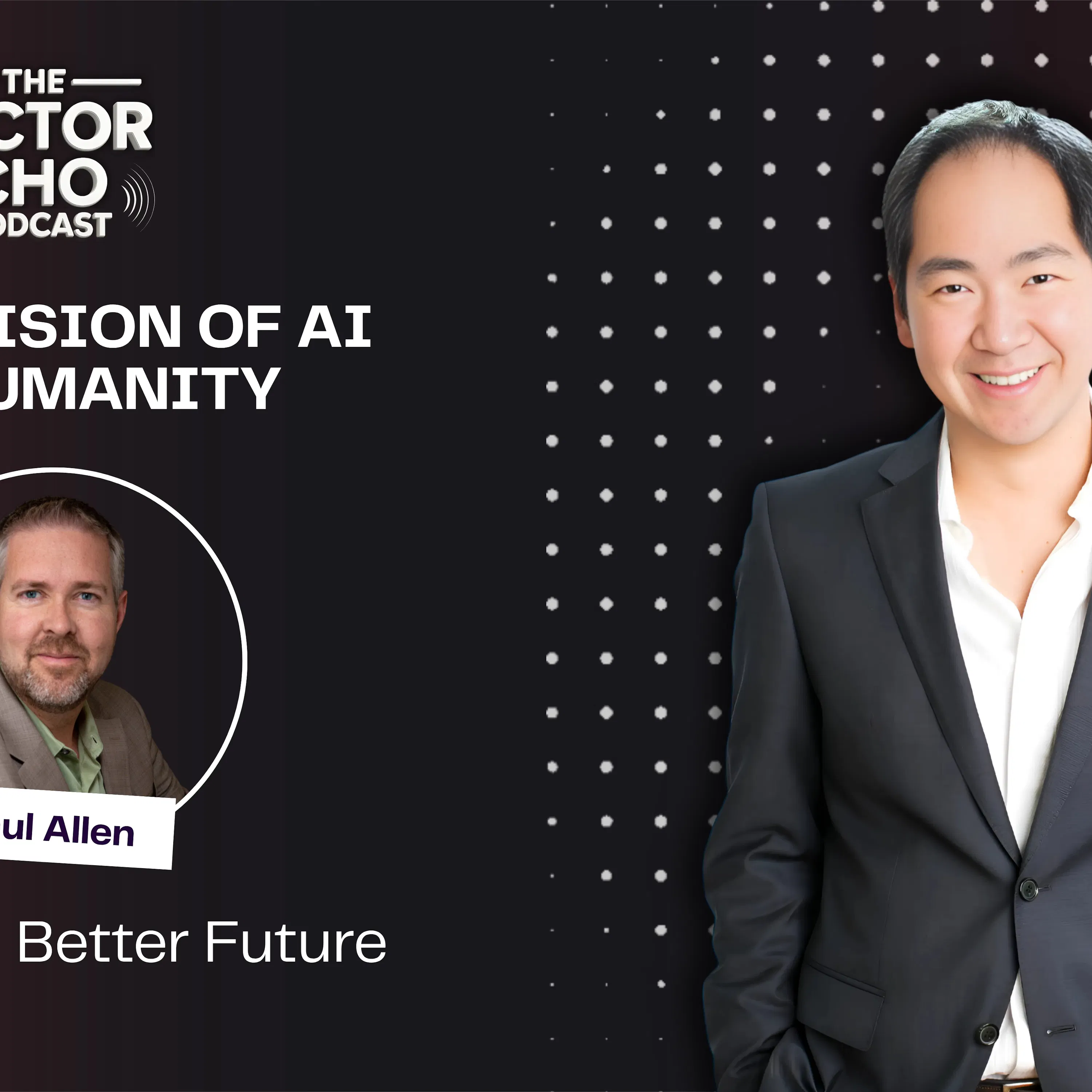
10. The Collision of AI and Humanity: Designing a Better Future with Paul Allen
from The Victor Cho Podcast
50m 9s
In this podcast episode, Victor interviews Paul Allen, a serial entrepreneur known for building Ancestry.com and other internet brands. They explore the theme of career optimization, questioning whether individuals are in the right job with the right skills. Allen shares insights from his father, an engineer influenced by W. Edwards Deming, who argued that 94% of workplace errors stem from system design, not individual failures. He applies this systems thinking to modern society, blaming current economic structures for widespread loneliness and depression, as they have shifted from community-oriented production to consumption. Allen discusses the potential of AI and technology, urging a focus on what should exist to foster human connection rather than isolation. He references the litigation against Facebook and Google for designing addictive platforms that harm children, highlighting the power imbalance between corporations and individuals. Allen proposes alternative corporate models, such as B-Corps and employee-owned cooperatives, to prevent negative second-order effects and ensure long-term positive impact. He remains cautiously optimistic about the future, believing that intentional design can lead to a prosperous, fulfilling world, but warns that without accountability, technology could exacerbate societal harms. The conversation emphasizes the need for human agency, messy interactions, and purposeful living in an increasingly automated age.
[MUSIC] In this episode of The Victor Show Podcast, I have this amazing conversation with Paul Allen, serial entrepreneur, and the one amazing thing that we're really going to go deep in is this idea of, are you in the right job? Do you have the right skills? Or are you banging your head against a wall in the wrong career with the wrong skill set? How do you manage and optimize your own career from a what you're good at perspective? Paul has a really interesting perspective on this. He's actually built an entire company around this. So, can't wait to get into the discussion. Hey everybody, welcome to another episode of The Victor Show Podcast. I'm so excited to have Paul Allen on this episode. Now, you may know, a Paul Allen who was, I found him a Microsoft, but there is an equally impressive, maybe even more impressive, Paul Allen, who has been what I call a platform entrepreneur over his career. He has built some of the largest internet brands, including one, which is dear to my heart, ancestry.com. I'm still a thriving, growing platform. My family.com, for those of you that went through the first internet wave, a serial entrepreneur, exec. He's doing a really interesting new AI incubator. Can I call it an incubator? Would you say that's the right term, Paul? A studio kind of an incubator. A studio. It's kind of both. Excellent. And what I'm excited about today is, we're going to go deep into some of the human dynamics, of course. I mean, that's the whole goal of this podcast, right? This collision of technology and humanity. So, doubling into some of these questions with, with really an industry veteran. So, Paul, so excited to have you on. Thank you for taking the time. Thanks for having me, Victor. I am barely, I have a fraction of the successes that the other Paul Allen had. I just admired him so much. Have you ever read his biography called Paul Allen, IDM, man? It is so cool. I have no. He said about in his entire life. I listened to one of your podcasts where you had a very clear vision of wanting to be a company leader when you were kid. And then all your decisions were based on that. His mantra, which I really am inspired by, is he asked the question throughout his life, what should exist? And then he would go invent it or fund it. Like, I love that. It's a beautiful question. What should exist? What reality do we want? And then let's go build it. So, I'm inspired by his life. And I hope that in the next few decades that some of the projects that I work on could actually grow and expand. And because I do think very clearly about what should exist. And what kind of world I want to live in. Yeah, it's a beautiful thought, isn't it? Now, I love it. I want to say, we're probably both living that journey right now. I'd say, you have the startup, right, that I co-founded. It is exactly that. It's like, wow, in this world of AI, what has to exist or else the world is going to kind of burn down in ways that we don't want. I know you're doing the same. Yeah, it's super excited to have this chat. So maybe we'll just start with, I would love to delve a little bit kind of on the ancestry and kind of my family side of the world, even though that was kind of a kind of V1, V1 of Paul Allen, maybe, or maybe V2. But I just, I would just love your perspectives. We're entering this world of AI and increase in technologies, right, that I think are going to move people away from other people. And of course, I think you and I share this DNA, we're passionate about actual people being connected and knowing each other. And so, I just, I would love to just riff a little bit on, yeah, what's your take on what's happening? Like, where do you see things headed? Are you optimistic, pessimistic? You know, just like, large language models are stochastic or probabilistic. They're not, they're not deterministic. Well, neither is the future that we're going to end up with. It's not determined pre-aggressive. You know, it's, it depends on what we all do, right? It depends on what gets built, what gets designed, what doesn't get built, what doesn't get designed. My father was a world-class engineer. And in the 70s and 80s, he built software out of the computer-aided manufacturing laboratory at Brigham Young University. My father wrote a textbook on materials that could be used in manufacturing. And it was popular for over 30 years because you can study material. You can study all the physical things, raw materials that can be used in manufacturing. And you can classify it and diagnose it and understand it and then design processes that will create finished goods that are way more valuable than the raw material. So my father kind of built this field around decision trees for large manufacturing companies. And his first client was Boeing. And they had 13,000 kinds of screws that had been designed by all the different engineers who, you know, they had no standardization of parts until he could classify it all and then eliminate duplication. And so one of my father's early experiences when he was in college was Edward's Deming, who was the brilliant man who created the Japanese economic miracle after World War II. He was a systems thinker and he created kind of quality, total quality management and just all these things. And it worked. And he actually says that when there's a mistake in a factory or in a company, 94% of the time that wasn't an individual's error, it was a system design error. Yeah. Okay. So if you think that way, why do we have so much loneliness and depression in today's world? Why is there so much fear and anxiety? Because the economic system that people have decided to build and scale induces that. And in the 100 years ago, when there were farms everywhere and multi-generational communities, you'd have your grandparents living with you and grandkids nearby. And like families mattered, faith matters, community mattered. And that's what the economic system enabled. In fact, most families were units of production, not just units of consumption. And today, I've heard one religious leader talk about in the modern world, a lot of kids, teenagers, view home as a place where you occasionally go and have a meal, but you don't do anything productive with your family. It's about consuming. That's depressing. But it's by choice. Right? Okay. So we then herited is flawed in these ways. And then the question is, what should be designed to counteract that? And I would add right then, we have all these technologists. You and I are not in this bucket, but we literally have technologists that I feel like I was thinking of the end game. What's the limit of the success of your product? And if you extrapolate out the limit of the success of some of these products, it's like, oh, we never have to talk to each other ever again or interact with them in beings. I'm like, why do we want to build that? I mean, if you remember the animation film, Wally? Yes. So, so my kids tell me about that. Like, I can't remember it very well, but I have eight kids. And so we watched a lot of interesting Disney films and Pixar films. And growing up, we had policies around no screen days, Monday through Thursday, no screens, no TV, no computers. There were no smartphones when my kids were young. And then on Fridays, we would have movies or on Saturday, they could play computer games. So we had this very kind of small window where they could use screens. And, but Wally, I remember a dinner table conversation where my kids, probably teenagers were younger. We're talking about the future of robots doing all the work and humans would have to do anything. And they said, we don't want that world. Yeah. No, that's right. That's right. And because you don't have to be in the matrix. It would be completely pressure. If it hadn't been for a temper. I'm like, that's the only difference. I'm like, okay, well, we're going to. That's too fun. Oh, my. Okay. But, but so it's so fun to be alive in a world where there's so much opportunity to ideate and invent and to build 100 or 1000 times more faster than you ever could before. Like, it's crazy. This vibe-coding stuff and just the ability to think of something articulated and boom, it happens. One shot, a SaaS product or like, it's crazy. We are the code X 5.3 and the and the opus 4.6 and these new models, I think open AI is supposed to come out with 5.3. And it's like anything you can imagine and articulate clearly the AI and or the robots will be able to build for you. Now, the question is, what should we build? What do we want the world to be that we and our children and our loved ones live in? And it might not be a world that gets distributed everywhere because there will be designers building systems like you talk about that you never have to talk to a human. You're glued to your screen or you're you're tapped into the matrix. You've got an AI companion. It's a beautiful girlfriend that knows exactly what to say. And so you don't need a real woman in your life. So all those things will be designed and probably will spread to a lot of people that might be susceptible or vulnerable to that. But then the question is, well, what all turnip will exist and how widely will they be distributed? And I think that's in a very exciting time to be alive where amazing people are doing incredible things and the
pendulum can swing away from fear, anxiety, depression, loneliness to a world that is prosperous and abundant in terms of economic goods and food and access to medical and all those good things that could come with robots and healthcare and all that. And then what do we do with our free time? What productive things do we do? And what do we do together with our vital friends and our family ties? And I just think it's quite exciting. There will be kind of a K, what is the chart we're talking about, the K design of a future forecast like economically, but also in terms of life fulfillment. There will be people who have more fulfillment and flourishing than ever before. And then unfortunately, because of these designers of these projects and platforms that are harmful and have second order effects, they're really bad, there will be sadly a lot of people that will suffer more. - Yeah, yeah, my big fear, I would love you to take on this, is that because our systems can get so good at making things one easy, but two, also taking some of the messiness and discomfort away from human interaction, like it is messy, humans are messy, right? We have arguments, things are not perfect, but that's part of what at least in my mind what it means to be human. And I just worry that we can make these artificial systems, whether it's an agentic companion, right? Just so much more pleasant that the mass curve moves into that direction and we just get fewer and fewer people that go through the messy joy of living, right? It shouldn't be life, it shouldn't be that optimized, right? There's a beauty in the mess in my mind, but that's my fear. - No, I think it's beautifully said, I think that, if you just have a system that is with no opposition, with just tailwinds and everything's easy or everything's given to you and food on a silver platter and all the things, you just don't have to do anything and you're well fed and shelter and all the things. Yeah, I think without opposition and even pain or messiness, you get zero growth. You can't stretch and learn and accomplish. So I think the world was designed to be a place where human agency, you can choose good or bad, you can choose all kinds of experiences, you can avoid all kinds of experiences and just kind of shelter in place and not experience an adventure of life. I like Jordan Peterson talking about the adventure of life and having a mission or a purpose or a calling and my goodness, that's a beautiful journey. And you never know in advance how it's gonna end, but the process of going through it is exhilarating and painful at the same time. It's a different time. It's a roller coaster. But that's what life is. It's like, let's bring it on. The good and the bad, because in the end, when you look back and you reflect on what you learned from the failures and then who you got to celebrate the successes with. There's a lot of things to cherish about that whole journey. - Yeah, amen, I love it. I love it, love it. You mentioned something, I wanna delve into this idea of second order effects of businesses 'cause it's near and dear to my heart. We're building these platforms and systems that are so massive that they're, the impact circle is transcending the design, right? And there are some really gnarly effects that the huge activity, literally this week, this month, Facebook and Google are going through litigation down in Los Angeles for those of you that aren't familiar with this case at a super high level. It's quite simple. There's a basically class action against these two companies and it was originally included a snap and TikTok, but they actually settled offline for a private amount. So it's basically left to Google and Facebook. But the premise is fairly simple. It's, hey, you guys knowingly put addictive psychological constructs into your experience to make people wanna use it more, to spend more time because oh, that was the way you're an advertising driven model. The more time people spend, the more money you make. And the end result of that is you have designed a digital addiction tool that is damaging our children. Now that wasn't your state, of course that wasn't your stated intent, like let's go create a bunch of psychological harm. But oh, if you make a digital addiction machine with known psychological levers, like stuff like that's going to happen and you need to be held responsible. I can't wait to see how this plays out. My, well, I would love to hear your check, Paul, on this case and how do you feel? Just about the fact that we're here. Like, I don't want you to predict where it goes, but just would love your observations. Is there a sponsor? - Well, I think it's very clear that we, the people, kind of the average everyday people and our elected officials who create law, even corporate law and even our legislatures in the 1850s allowed limited liability corporations to be formed for the first time by individual citizens. Like this hasn't always existed. Corporate law used to be limited to parliaments and monarchs. Like the East Indies trading company and the Hudson Bay company were actually monopolies granted by the Crown. So we only live in the last 180 years in a world where individual humans can form a corporation that has legal status to own as much property and amass as much wealth. And as Peter Teal says to try to be a monopoly. Like that's kind of the inherent thing that corporations aim for. Like if you can have a monopoly, de facto or de jour, then you can charge whatever prices and make a fortune. Okay, so this is a system that was designed by political leaders and people in business to instead of have some sole proprietorships that you would die and your children would inherit something. Now you've got corporations that can last forever and become worth trillions or in our lifetime, tens of trillions of dollars and to have more power in a corporation than at almost every nation's state on the planet. So it's kind of bizarre that we, in the last 180 years have gotten to the point where corporations are way more powerful than most nations. And with billions of users and with algorithms and products that are addictive, who's gonna hold them accountable? Our lawmakers really generally don't understand technology and finance and so they're kind of outgunned and outmaned in most ways. And so these judicial cases are really kind of the only attempt right now to like say, well, you are liable, we're gonna find you two billion dollars. Okay, well for a multi trillion dollar company to pay a few billion to the EU or a few billion. And will that money go to the parents whose children were harmed by these, you know, it probably won't, you know, maybe the lawyers will make a lot of money. I don't know if it's a class action lawsuit and you know, you get a hundred dollars for the pain and suffering that your family. I don't know, we're just outgunned. Corporations have so much power and influence and we've allowed that through our representatives. Now, you can't really kind of put that journey back in the bottle easily. I think the concept of a B-Corp, I got to have dinner with Governor Martin O'Malley who was the governor of Maryland when B-Corp legislation was created for the first time in 2009. - No, excellent. - It's a fantastic new version of what a corporation could or should be. So somebody had the idea, the Senate and the House in Maryland, PASA, Governor O'Malley, enthusiastically signed it and now B-Corp, public benefit corporations are a thing in about 30 or 40 states and there are thousands of good ones. And I think that's a good step. But I do think in the coming years when you have multi trillion dollar companies and companies vying to own all the data centers, all the compute, have all the energy, nuclear, we're now getting yeses to nuclear energy because corporations want it. For a long time, decades there was not enough will to allow nuclear. Even though France did a good job with it, we kind of had the three mile island and then there was Chernobyl. But now that corporations want it, it's gonna happen, right? And so that just kind of shows how much power they have. But I think Victor that we, the people in our legislators are gonna have to rethink corporations to some degree. - Yeah, I completely agree. - And instead of having five people on a board of directors that run a multi trillion dollar enterprise that affects three or four billion people and what they read and what they know and what they do, we, I don't know whether it's limiting the size of corporations, but I have a vision for a new type of corporation that's even better than a B-Corp that would allow entrepreneurs like you and me who aspire to do good in the world and to have that good remain and to not have some future owner or board, board of directors of our company to start doing those negative second order effects. Like if you have a concept of building a good company that always does good in the world and takes care of its stakeholders, what if there was a decorporation, which is what I've called this, or a massively distributed corporation where the cap table has hundreds of thousands or millions of shareholders.
no one person can control it or dominate. It's almost like a democratic corporation. But it's a choice you make after you harvest, after you have a liquidity meant for the early investors who took a risk and early investors. And now it becomes this publicly traded, widely distributed company. Pattern after the model that I love the most is the John Lewis partners in the UK. In the 1940s, John Spett and Lewis turned over the ownership of his very big and successful retail company to 14,000 employees. He gave them ownership of his company. - Yeah, no, it's gonna say it reminds me of like the RTI cooperative structure where you've got distributed ownership of employees. I think that's a super interesting model. - The SOPs are just not as common as they should be. But I do think that if enough people can realize the harm that comes from concentrated power in the hands of unelected corporate leaders, whether they're the founders or not, there's just so much power in their hands. And I think there needs to be alternative opportunities for entrepreneurs and investors to invest in companies that are designed to not get ruined by greed and ignoring these second-order effects. So do you know Eric Ries is publishing a book in May of this year? He of course is famous for lean startup and millions of people, millions of people wanna build a lean company and do an MVP and all the things that all the vocabulary gave us will on May 26th, he's publishing a book called Incorruptible. And he's gonna introduce millions of people to the concept of the long-term stock exchange, which will be an alternative to NASDAQ and NYC, which is an alternative to NASDAQ and NYC, where the goal will be long-term governance that's in true to the mission, the good mission that the corporation has to do good for the long run and to not be ruined by the pressures of short-term thinking and the quarterly earnings pressures, which cause a lot of CEOs to get up. - No, I love that. - So it's coming. It's coming. - This is one of those pendulums could swing in a really good direction so that more and more, the future Googles and netizens of the world won't end up doing a lot of harm because they started out with a mantra, don't be evil. Like Googles. - No, that's right. I talk about that. It's, you know, I tell people, like no, no corporation starts out to burn the world down. No, like they're all trying, they actually do all start with good intent and it is to your point about systems, right? These systems just get and the incentive structures and the competitive vision to get, let's drive it to an opality because that's the only way we survive, right? It's if we get, you know, dominant market, like these systemic pressures take us to this place where unless you have what I call true citizen shepherding of a business, which we don't have in many of these businesses, it really comes down to some of the personalities. You run into these issues. No, no, no, I have a couple of mentions in Eric Reese's first book, so I can't wait to get his second one. - I'm reading the draft copy right now and I've been a little slow to get to it, but just the opening chapters were just like, so exciting to me. Like incorruptible is such a cool word. If you, - No, it's great. - That's a great time. - If you launch something that is good and you want it to stay good, then you have to align the long-term governance, the incentive structure, the whole corporate culture around that goodness that you're trying to bring into the world. And I just think he's onto something really important here. - No, I love it. I love it. So speaking of this kind of new world of companies, you have moved on to the next thing, which is super exciting. I would love you to just share more about the studio and soar and kind of the vision. - Yeah, what are you working on these days? And what do you want to share? - I mean, it's so much fun. I really started the ancestry 30 years ago and it's kind of bizarre to think it was that long ago. The mid 90s was 30 years ago. And I wasn't even 30 yet. And I go to San Francisco to an internet conference and I'm like, holy cow, this is gonna be the future of all the information will be on the world wide web. And my brother had been in search engine development and hypertext industry for about 10 years. And so I had heard a lot about it, but now I got a first hand look at it and then I got a front row seat and got to participate in the building of the modern internet. My family.com at the time was probably the best social website ever created. - Yes. - And so, but now today what we're trying to do, Victor is look at, and I've learned a lot in 30 years. I've learned a lot about not how to not raise too much money and give up control of your company. So, you know, like I've got supervoting rights, all the things we've raised about $15 million from hundreds and hundreds of individual investors and angel groups. So, a little bit of VC, but it's, you know, all common stock. And we think there's no limit to how much impact sore AI studio can have. But the thing we're trying to do is to take the findings of Gallup. Gallup is, I think the most underrated company on the planet. They invented modern polling in the 1930s. Dr. George Gallup used mathematical sampling to get public opinion polls that were aligned with the whole nation. And he actually studied agricultural science when they were sampling the soil in Iowa to decide how much fertilizer to put on. They didn't have to study all thousand acres. They just kind of mathematically sampled it and he's like, hey, could that work for public opinion? And of course it does. And it doesn't work as well anymore because they don't get a 70% response rate to phone calls anymore. They get like a 5% or less. So, but anyway, Gallup does a world poll and they've been doing that since about 2005. And they study human well-being around the entire world. They had a whole bunch of smart people, including Nobel Prize winners and behavioral economists and psychologists helped them decide what questions should we ask the citizens of every country of the world for the next hundred years. And now the United Nations uses that data to power the UN happiness index. Okay, so Gallup, and not only that, but Gallup does what I think is the most important thing in the world, which is they analyze your personal talents at an individual level using their Clifton Strengths assessment, it used to be called Strength Spinder. So, they ask you 177 carefully picked questions. You have 20 seconds to answer the questions. And then after answering those 177 questions, which Dr. Don Clifton wrote, they reflect back to you, what are your top five greatest strengths as a human being, as a unique human being? And Don's definition of a strength was naturally recurring patterns of thinking, feeling, behaving that could be productively applied. And Don believed that every human had enough talent to generate what he called near-perfect performance in something. - In some way. - So Don was obsessed with helping people figure out how much talent do they have and how do they develop that talent so that they could have near-perfect performance in something. And when you do that, when you do excellent work, you feel fulfilled and you get rewarded and recognized for doing great work. So it's a beautiful part of life. Work is essential and doing great work brings a plethora of rewards and we all should have that experience. But the problem is, I think maybe 90% or more of the people don't have any idea that they have any talent whatsoever. - Yeah, and they're in the wrong field. They're in the wrong job. The factory education system is standardized and boring for many people. And it just fills your mind with knowledge or facts that you may or may not ever use. But so if you think about it, what if a billion people or more could figure out what their talents are and then have personalized alpha school like AI tutors or Giggle, the CZ from Binance is gonna put, I don't know, billions of dollars into Giggle. But an AI that will help you learn the things you need that apply to the talent you have. But more importantly, find the human connections that will help you develop and use your talents, find the collaborators you need. But I think there is a potential era that we all enter into in the next few years where almost every human on the planet can more clearly see their talent, develop your talent, and experience the joy and rewards of doing great work in the field that they choose. I just think it's possible that we'll go from 10% of the people in the world loving their job to 50 or 70 or 80. Because maybe there's abundance somehow because the economic pie is growing. But if we can use our discretionary time to develop our talents, I just think Gallup has many of the elements needed to bring human flourishing at scale to the masses all over the world. - Yeah, I love that vision. And if you think about the, you could argue it's a meritocracy on a global basis, right? The meritocracy of the current system, it's so brutal because we don't have good mechanisms for doing all of that. But to your point, with AI, we find the can. We can finally understand what our strengths are and we can supplement that and enhance right, optimally, which I love. So how does that relate to sort to what you got to do? - Well, so I'll get to that in a second. But you mentioned meritocracy. I just have to follow up on that. Do you know who invented the word meritocracy?
I have no idea. I have no idea. There was a sociologist in England in the 1950s who coined the term. It's a modern invention. Interesting. And he wrote a book called The Rise of the Maritocracy, 1870 to 2033. And it's a scary dystopian novel about a future society that equipment, and it's a quib, it equates merit with IQ. So if your definition of a meritocracy is IQ, then there are a few people that won the IQ lottery, they won the genetic lottery, and then the rest of people are lower on the curve. And so meritocracy should not be narrowly defined. It should be everybody's better at something than the next 10,000 people. That's what Don Clifton believed. So, yeah. And I think that meritocracy is a word that almost everybody embraces, and yet if you narrow, if you narrowly define meritocracy, you have these winners that get all the benefits of IQ or whatever, and maybe looks, maybe athleticism. And then the rest of the society, too bad, you lose. And what we ought to do is what Don did is look at everybody through the lens of what talent do they have that nobody else in this room has. I love that. I love that. I admire them for that, and then give them a chance. So, so, so, so, has taken a look at the Gallup well-being assessment, the framework for analyzing human thriving, and it comes with career well-being, like you, you should love your job and be good at it. That's a huge part of thriving, okay? Because we spend 90,000 hours of our life in our career. So we built an enterprise company to use AI to help people get better at work, to become a better leader, a better salesperson, a better communicator, a better manager. So, there's an AI feedback loop, and we have millions of meetings a year now being recorded and transcribed, and then AI can coach people and help people level up in their career. And that's just the beginning. Like we've had some pretty cool partnerships announced. We're doing the same thing for our Founder Portal. We want millions of startups to record all their calls and meetings, and then have AI coach you from idea to exit. Like 90% of companies probably fail after five to 10 years. Well, what if AI could coach a founder from idea to exit, and maybe 90% of companies could succeed instead of fail? So we want to address work, and we want help to help people thrive at work, whether you're an employee, whether you're a founder, whether you're an investor, whether you're a leader, a manager, or a frontline employee, an individual contributor. So we have a bunch of companies devoted to workplace success. But then we take the other Gallup elements of well-being, such as social well-being, and we will launch a family portal, a friend portal. We'll launch probably a dating portal and a marriage portal. We will try to do things where AI connects you to the people you should know, and you should spend time with because they are your vital friends, and you get energy from them. And you are productive together. So I just think our goal is to build a series of AI tools that help people live their best life and thrive at work, and in the more important areas of life, which include family, safe, health, financial well-being. So our studio is tackling all of the above simultaneously, and it wouldn't have been possible even three years ago. That's incredible. Are you guys looking for entrepreneurs then that are with ideas in this? Are you guys looking for these? We'll instantly, we set it up as a Delaware C Corporation. We may end up changing that to Nevada or Texas, but we'll see how the Delaware corporate law goes down. But we are setting up a Delaware C, C, and then we have to find both a great leader for that enterprise and channel partners who have unique content and IP and a channel. So we're not organically competing for customers. We'll build an AI for leaders and then find one of the world's largest leadership companies to private label it and take it to the market. So it's not as hard as it would be if we were trying to build a product, get an MVP, go get our first customers. We just instead look for a huge channel partner, such as our sales AI partner is seventh level, one of the fastest growing sales training companies in the US. Jeremy Miner is a total rock star. He's in Scottsdale, Arizona. He's trained millions of people on his NEPQ methodology of how to ask questions with the right tone to bring down the guard and to connect with the person at a human level and then to help them make the buying decision. And we've launched ask Jeremy.ai, which I think millions of people will start to use. And then seven q dot AI, which is their version of Gong. Now you get training on sales and AI reinforcement of that training. If you use Gong, Gong doesn't know any pq. Gong doesn't have 33,000 hours of proprietary content from Jeremy and his top coaches. But so our goal is every industry, find the experts who have great content, but don't have AI and partner with them to bring the world's best solutions to as many people as possible. With the ultimate goal of sore AI helping kind of help you thrive in every part of life with the right content and expertise and AI that helps you implement it properly. So you get the benefits of doing the thing the right. I love it. It's such a such a cool innovative model, such a unique approach to market like high leverage, high scale, love, love, love what you're doing. I never heard about venture studios until 2016. The former CTO of Ancestry who's been a childhood friend of mine. In fact, we grew up on the same street in Oram, Utah. So Mike Wolf Graham, he left Ancestry and he was there when they went public and so he was there for a long time. But then he co-founded a venture studio with one of Utah's top investors. And so they, when I met with him, I think they already had 28 companies coming out of their venture studio. Yeah. And that was 2016. That was the first time the concept of a venture studio. Now I had studied Bill Gross from Ideal Labs for a very long time. Bill Gross, I think, is one of the most under estimated entrepreneurs in US history. One of the most innovative creators of all time. Ideal Labs spun out dozens and dozens of phenomenal companies and he had a really cool process. But I don't think it was a venture studio where you had, I don't know, it was more of like an incubator and just, yeah, yeah. Ideal to spin up and go raised capital. So we're kind of doing something similar, but SOAR AI Studio has its own cap table and we got some six billionaires on our cap table. We have amazing strategic investors. So then you get that brain trust together and say, okay, what should we build? Who's the right leader for it? And who's the right channel partner or channel partners to scale that up as fast as possible. So we're in our, that's. We're in our first hockey stick year. I think this will be a 10X over last year, but I think there is tremendous potential to 10X again and again and really build a company that has only one goal to uplift humanity in every sector of life that matters. Yeah, so that vision, it's so powerful. And for those on the kind of listening in or watching just SOAR.com, you guys have a nice domain there. That's a pricey domain. I mean, don't go down. Don Clifton wrote a book in 1991. I never met Don. Don passed away in 2003. I didn't even hear about Strengths Finder or Gallops work in that field until 2012. So nine years before I even learned about it, Don passed away. But in his 50 plus year career, he literally helped hundreds of thousands of people discover their talents, develop them and aim for excellence. So yeah, I loved the book SOAR with your strengths, which he wrote in 1992. It's to me the best blueprint ever written by a psychologist or any thought leader in any field that would lead to universal human thriving. He's got eight chapters that are so simple. This is a Midwestern Christian psychologist who came home from World War II after running a bunch of bombing raids over Europe or Northern Africa because he was fighting against the Axis evil powers. And he came home after destroying buildings and installations. He came home and thought, I want to devote my life to building the world in a good way. And so he started in the field of psychology where almost every book in the field was focused on what's wrong with people. Have you ever seen the DSM, the Diagnos, like the Diagnostics and Syscolonial? Like, there are lots of things wrong with all of us, right? We could focus on it and where does that lead? I don't think it leads to, I mean, you do have clinical diagnoses and you do need psychotherapy and psych. Psychiatry and probably medication in some rare circumstances, like you've got to deal with problems. But what if you do what Don did for 50 plus years, focus on what's right with you and what's right with everybody you meet and everybody you lead? - Yeah, and it's funny. - The result is so much better. - Yeah.
Reminds me in a weird way of the net promoter methodology for customer experience, which is so many companies, right? They attack like what's wrong with what's broken with the experience, but where you really create exceptional businesses is you create the delight moments. Like how do you how do you layer in on what's positive? It's kind of like that for a human or the other. I love it. Last question before we have to close out that so so much craziness going on in AI, the pace of technological change is just insane. Any top tip that you have or just for yourself, how do you keep up to speed in this moment, which is clearly a moment, right? This is like the internet time you in my mind. I mean, it is, I remember in the internet years, I had a search engine tool called Folio that my brother invented and I personally typed in notes and I copied and pasted things like every meeting I was ever in. So for 22 years, I had a personal knowledge base of everything I read, every meeting I was in every phone call I had. And it was my cheat sheet. It was like my brain, my digital brain. I had perfect recall of everything. Then in 2012, the operating systems no longer supported the old Folio software. So I haven't used that for 14 years and I miss it every day. But the world is moving so fast. I remember in 98, 99 when we were raising millions of dollars in venture capital for the first time. I was so proud. I would stay up till two or three every night. I had a high speed satellite dish starting in 95. So I was the first person I knew to have high speed internet. And I had lots of kids, but I would stay up till after putting them to bed. I would stay up till two or three in the morning and capture knowledge about every startup, every funding event, every marketing strategy, every internet company. And I remember being proud of myself, no VC ever mentioned a company or product that I didn't already know about. Wow. That's incredible. So I felt like I wanted to write a book on entrepreneurship called the omniscient entrepreneur. If you know everything in your field, then you're going to make the right decisions. If you have perfect customer intelligence, competitive intelligence, if you understand your employees and anyway, now it's impossible. It's not even, and I'm probably overstating how much I knew back then, but I read like crazy. I preserved. I had a search engine of all that data. Today, there's no way that any human, look at Robert Scobal on X trying to keep track of the 40 plus thousand AI engineers and scientists. And he's got a grandfather to count on Twitter or X where he has unlimited people that he can follow. And he's got the best lists in the world. And if you look at his, his tweet deck, it's like insanely fast. Like it's no way that any human can keep up with even a fraction of what's going on. However, we all now could have open-cloth agents and nano-cloth agents and all these latest greatest tools, not only the large language models, but a gentica. Pretty soon, each of us will be able to set up our own configuration so that whenever we want to follow and keep track of and learn about whatever people we want to meet, the AI agents will be looking at all their posts and all their travel plans and like help us triangulate. When can I go meet with Victor? And it's like, whatever you can imagine and articulate to your agents, you'll be able to get. And I'm just super optimistic. I started setting up these things. I'm bringing back to life all my old computers. I probably have six old computers and I'm firing them all up and setting up open-cloth on all these dedicated devices. All my old phones, I'm getting phone number like I'm setting this in motion because I am making this night in just room with all these old Commodore 64s and like landlines. But at a high level, I love what you're saying, which if I had to play it back, it's basically you're on in the same way you were on the cutting edge of codifying knowledge back in the first wave. Your premise is like, let's get these, let me get, let me be at the tip of the spear of the agentic systems and leveraging them for helping me stay up to speed because it is complex and I think that that sounds spot on. I'm actually behind personally on that front. I haven't set up any personal agents like at that level. So that's a great tip for folks to get ahead of that train. And the goal is figure it out and then find a way to deploy it so that it's easy for 99% of the population to not only deploy it, but to deploy it in ways that lead to your personal well-being. And that's how many people are financially strapped right now. They're living paycheck to paycheck. They have less than $1,000 in the bank if they had a medical emergency. They go bankrupt. Well, imagine if it was possible to set up, to go to a website and set up five AI agents that study your financial well-being and coach you and guide you to spend less to say more, to learn how to increase your wage by talking to your employer and figuring out learning about equity, learning about assets, rich dad board at agents that do that for you. And so in a few minutes a week, you're checking in with these agents and pretty soon you go from being bottom 10% tile in financial well-being to top 1%. And you had to only set it up, give them a little bit of guidance and then give them access to your data. I'm hoping that that data exists locally on your own device. We're partnering with Liberty, Project Liberty, which is promoting the human context protocol that will allow humans to store their context on their own devices instead of having corporations and governments have all our data. So there are some really important steps that have to be taken. But imagine in five years when a billion or more people have a bunch of AI agents helping them financially prosper without the huge effort that it takes today and what if that happens and what if you're part of that saying with your physical health. Absolutely. Absolutely. Absolutely. The last podcast episode I did was actually a talking head because I give this speech around like what would you tell the kids? What would you teach you? What would you tell your kids to do in this new world of AI? And it taps straight into this, which is one of the core premises is this new world, you're going to be a conductor of resources and agents. And now imagine going back to this concept of meritocracy. In the past world, it was like humans fighting for humans to get position. Now you've got humans supplemented with AI. So imagine what a human supplemented with AI can do from that perspective and how much more effective they're going to be. So that engine is going to be hyper competitive. If you don't have those skills, you're just going to get blown away, right? Because there is going to be a subset of the population that moves up in skill so high and so fast. Well, and when it becomes easy for you to deploy the AI and the robots that will help you thrive financially, have good health and longevity, the most important part of life is people. And what's going to be needed is design of systems and community and gatherings and faith and family and community that will bring you in contact with other people that become your friends and your collaborators, your teammates. And whatever those adventures are that humans need to go on in the future together, we just need systems. I remember meeting Scott Hepburn and who launched Meetup.com after reading bowling. Oh, yeah. Robert Puntnik. Meetup.com was one of the greatest ideas ever. And as long as he was running it, I thought it had a really pure mission. And I'm not sure who bought it and who runs it now. But it's a beautiful thing that you could take digital, you know, connect everybody online. And that is pretty shallow and time consuming. And now you're not actually with people in real life. And then Meetup said, we're going to create meetups. And so I think in this AI world of high productivity and agentic swarms doing work for you, robots doing your gardening or your washing or whatever, whatever's coming. I think humans need to think about designing systems that people will inhabit in real life to connect us with each other, to build love and compassion and empathy and to help us really feel as one and have a beautiful society going forward and not just winners and losers. And if we don't design a system that leads to that, we'll end up with the system that's currently growing in power, which is multi-trillion dollar companies basically dominating our every waking hour of our lives. As a perfect place to end, I love the hopeful tone. And I think with folks like you out there in the world, we will get there. So Paul, thank you so much for the time. This has been an awesome chat. And everyone, please go check out sword.com and the work that Paul and his team are doing. It sounds really amazing. Thank you, doctor. In addition to running this podcast, I'm also the CEO of Immovid. In business today, it's impossible for anyone to tell what digital communication is real versus AI generated or modified. This is a huge issue that we have actually solid in Immovid. Immovid is the only guaranteed authentic asynchronous communication platform that has been built for business. If your business relies upon relationship and trust building, this is a must-have platform for you and your teams. Please check out Immovid.com at emovid.com or even better if you can see it. Scan the QR code and you'll get to see the product in action and even get a special podcast offer. Thank you again for listening.
Podcast Summary
Key Points:
Paul Allen, a serial entrepreneur and founder of Ancestry.com, discusses career optimization, emphasizing the importance of aligning one's skills with the right job.
He critiques modern economic systems for fostering loneliness and depression, contrasting them with past multi-generational, community-focused structures.
Allen warns about the second-order effects of technology, such as addictive platforms designed by corporations that prioritize profit over human well-being, citing the Facebook and Google litigation as an example.
He advocates for alternative corporate models, like B-Corps and employee-owned companies (e.g., John Lewis Partnership), to mitigate harm and promote positive societal impact.
Allen expresses optimism about AI and technology, but stresses the need for intentional design to create a world that enhances human connection and fulfillment, rather than isolation.
Summary:
com and other internet brands. They explore the theme of career optimization, questioning whether individuals are in the right job with the right skills. Allen shares insights from his father, an engineer influenced by W.
Edwards Deming, who argued that 94% of workplace errors stem from system design, not individual failures. He applies this systems thinking to modern society, blaming current economic structures for widespread loneliness and depression, as they have shifted from community-oriented production to consumption. Allen discusses the potential of AI and technology, urging a focus on what should exist to foster human connection rather than isolation.
He references the litigation against Facebook and Google for designing addictive platforms that harm children, highlighting the power imbalance between corporations and individuals. Allen proposes alternative corporate models, such as B-Corps and employee-owned cooperatives, to prevent negative second-order effects and ensure long-term positive impact. He remains cautiously optimistic about the future, believing that intentional design can lead to a prosperous, fulfilling world, but warns that without accountability, technology could exacerbate societal harms.
The conversation emphasizes the need for human agency, messy interactions, and purposeful living in an increasingly automated age.
FAQs
The podcast suggests reflecting on whether you are banging your head against a wall in the wrong career with the wrong skill set. Paul Allen emphasizes optimizing your career from a perspective of what you are good at, using insights from his experience building companies around this idea.
The economic system people have built induces fear, anxiety, and loneliness by moving away from multi-generational communities and productive family units. Paul Allen notes that 94% of mistakes are system design errors, not individual errors, pointing to flawed system designs.
He is optimistic but cautious, noting that AI can either connect people or isolate them further, depending on what gets built. He stresses the importance of designing systems that counteract loneliness and promote family and community ties.
He believes these companies knowingly use addictive psychological constructs to maximize user time, harming children and society. He sees legal cases as attempts to hold them accountable, but notes corporations have immense power that requires rethinking corporate structures.
He proposes a 'decorporation' or massively distributed corporation with hundreds of thousands of shareholders, modeled after the John Lewis Partnership in the UK. This aims to prevent concentrated power and ensure companies always do good for stakeholders.
He advises asking 'What should exist?' and designing systems that create a world of prosperity and human connection, rather than isolation. He emphasizes the need to avoid products that replace human interaction and instead foster family and community.
Chat with AI
Loading...
Pro features
Go deeper with this episode
Unlock creator-grade tools that turn any transcript into show notes and subtitle files.
 PodcastTranscript AI