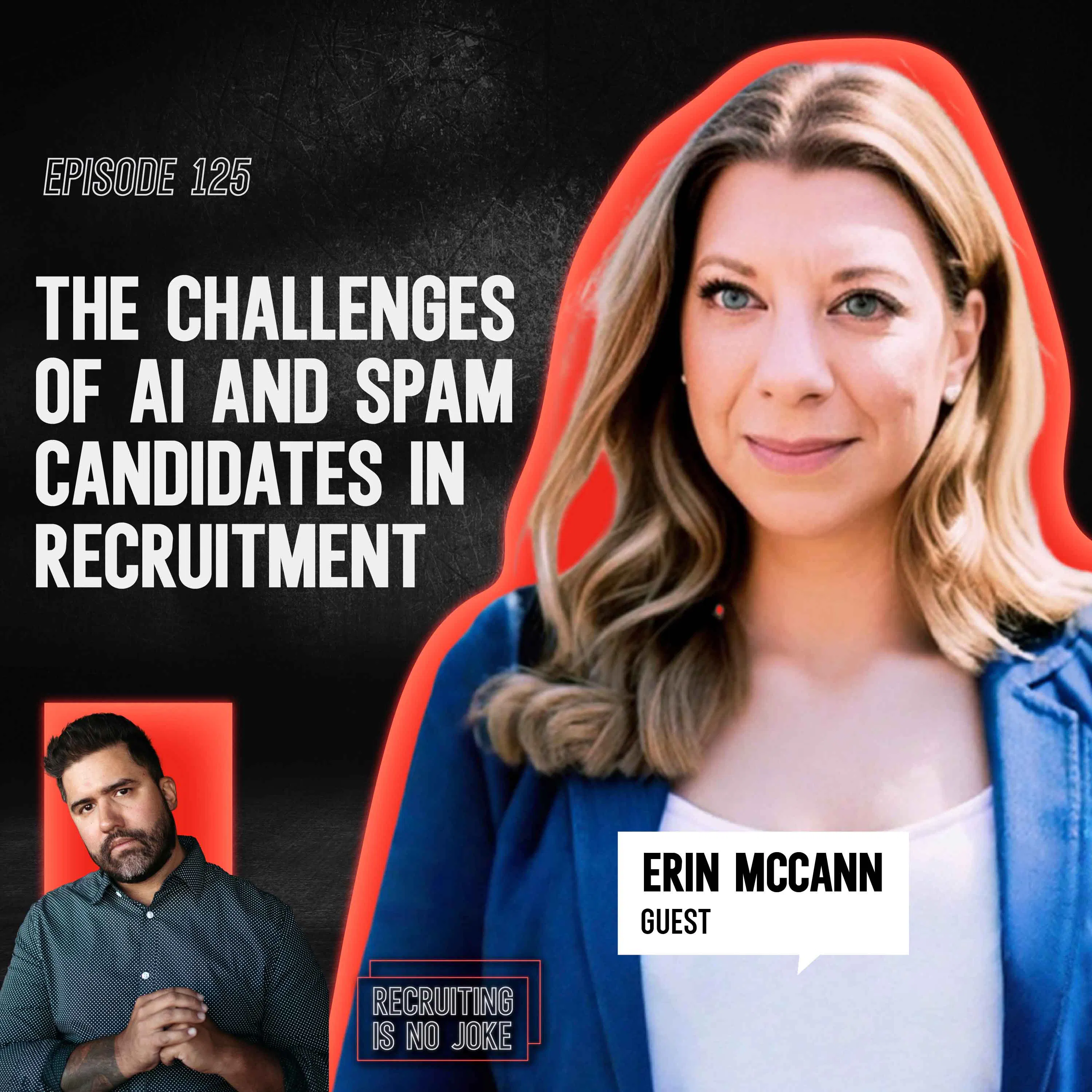
The Challenges of AI and Spam Candidates in Recruitment with Erin McCann
41m 16s
In this episode of "Recruiting is NoJoke," host Joe Laugie interviews Aaron McCann, an executive HR professional with a unique career trajectory. McCann started in commercial roles, including wedding planning, hotel sales, and customer success, before transitioning into HR about 12 years ago. He highlights how his background in customer success provided him with critical business acumen, enabling him to better understand company operations, support cross-functional teams, and design effective onboarding and career pathing similar to customer experience models. McCann discusses the value of strategic partnership in HR, advising professionals to engage with other departments, utilize resources like LinkedIn Learning and GPT for learning, and actively network through communities and one-on-one conversations. He also addresses current recruiting challenges, noting the rise of AI-generated spam candidates and the importance of human discernment to identify fraudulent applications. Overall, the conversation underscores the benefits of diverse career experiences in HR and the need for continuous adaptation and strategic thinking in the field.
What's up guys, welcome to another episode of Recruiting is NoJoke. I'm your host Joe Laugie and this is the Ultimate Recruitment Podcast that brings you a blend of entertainment, known on-sense insights and of course the latest trends. Join me as I expose bad takes in the recruitment industry and get real with town leaders to give you an inside view of the industry. Recruiting on Recruiting is NoJoke. Welcome to Recruiting is NoJoke. I am your host Joe Laugie, it is good to be here with you guys. I have another outstanding guest for this week's show, Aaron McCann. Welcome to the show, Aaron, why don't you give everybody who maybe doesn't know who you are? Why don't you give us a quick who are you, which is such a loaded question. Who are you? What do you do? And who do you do it for? Yeah. Well, thank you for the nice introduction, hopefully I can live up to that and I'm sure there's a lot of people who have no idea who I am, so this is the best episode ever, too. By the way, that's all the past episodes, now I'm building it up. You are. Well, I'm Aaron McCann. I live outside of Chicago and I am an executive HR and people professional, mostly focused on startups. This is actually my kind of second career as I call it. I started in commercial and migrated my way over into people in HR works. It's kind of an unusual path. Currently, I lead people in HR for Janamanan, which is a 150 person biotech company, global, mostly remote in the US. Very cool. I love it. So when you say you started in commercial, like you started in sales, what do you mean by that? I started in sales, actually right out of college, I wanted to be a wedding planner. So I always joke, like the people of these days might not know what the wedding planner is with J.L.O. in math, but that was my dream job, was to go and plan these very fancy weddings and interact with brides. And I got out of that fairly quickly after starting the work worst because it was very stressful. But I ended up finding my way into hotels and did sales and catering for a while. So sold the event space, did have to manage weddings for a while and then migrated into corporate sales, managing large accounts for hotel chains and eventually found my way into sales trading and marketing and customer success. I like customer success for a couple startups. So I really did have a kind of trajectory in the commercial side. And at one point, just kind of stopped in an old CEO of mine said, you don't seem very happy here. And I was like, I don't know if it's here could be here in this company, but I also don't know if I'm happy in this seat anymore. I've been so focused on customers externally that at this point, I feel like I have no control over what's happening. I want to internal go internal service customers internally. So it was kind of a different path, but I will say an unexpected way of sales marketing and customer success really serves me well in this role. Super interesting. Yeah. I would say 99% of the people who I have on the show either just kind of fell into recruiting and then either went into kind of work their way up and became like a talent leader or an HR leader, or I think I've had two people out of a hundred and something episodes that chose to go into HR or recruiting and kind of work their way up. This is the first to have somebody who kind of went through like sales and customer success, which I'm curious to dig into because I think that customer success mindset of that external customer translating that into a now working with internal customers or internal stakeholders that's fascinating. So how long have you been in kind of like the HR people role for now then? About 12 years. Okay. I started in a very small scale startup. I took a couple steps back in my career. So I mentioned I was leading customer success and education for it was actually a sales startup, a sales tax startup and found through networking as all a lot of jobs happen this way. I found someone who was looking for people operations managers. So it was the person who was in charge of the office, but also was doing recruiting and also was doing value creation and onboarding and all of the things performance management for a 13 person marketing SaaS company. And so I took a couple steps back. I took a pay cut because I felt like it was important for me to try a new career path. And 12 years later here, but the executive level for 150 person company. And sometimes I kind of blink my eyes and I'm like, am I doing that? Am I here really like, should I be doing this? I think HR work scares a lot of people because of the legal component. I had to teach myself. It took classes. I took a lot of webinars and have found a career. I love it. So what's more stressful, wedding planning or working in HR? That's a real question. Well, I guess I'll answer. I would never go back to becoming a wedding planner. So the stress in HR is manageable. Yeah. I used to wake up in the middle of the night, like three. I might wake up and ask myself if I ordered a cake, like a wedding cake. I can't even imagine. I was actually one of my first jobs when I was in college. I was playing kind of the wedding coordinator when my boss was on her pregnancy leave. I had a local banquet place and I was covering all the weddings and I went back to college and a bride sued me personally. She tried to sue me personally. I've never personally been sued as an HR executive. So I guess that's a double answer that wedding planning is way more stressful. Maybe the stress of the wedding planning like prepared you for some of the stresses in HR. I mean, I think when you're dealing with people that's different stresses and that's awesome. That's such a unique path. So you started in these kind of like people operations roles. I'm curious. I mentioned some of the upscaling, were you kind of just like learning on the fly then? It's kind of like things came up like how did you kind of manage that even like some legal side and the compliance? How do you manage that in those early days? Yeah. So we were fairly small. The company I mentioned, I think I was in play 13 or 15 or something, but we were growing fast. We just closed a series B so that meant we were outscaling up. So I had to work with in this instance. I was reporting into like the chief design officer because he was in charge of internal and external design. So communications design was really excited about things like values and onboarding and they built this pre solid recruiting model alongside the head of marketing at the time who was really invested in doing recruiting, right? And so I kind of took their model and just ran with it but tweaked it along the way. We were on site. This is before I was fully remote executive. This is on site. So you're thinking back to kind of wedding planning. It's about creating experiences and what does it mean when you walk into an office? It'll be great to you. That's the first impression. What does it mean if I don't have a bathroom break during a four hour long on site? What if I knew food during the day? So it was just really creating that experience for people and we had a lot of really good luck securing some pretty high level talent for a growing startup. But I think part of that is because they could see that we were operating at a different scale. So yeah, a lot of it was working with people who weren't in the HR field and that I would reach into people that I would just reach out to folks. I was in New York at the time. I would connect with people and LinkedIn and say, "Hey, could you just talk to me?" I'm new here. Can you help me?" And I had a lot of success just connecting with folks, going to meetups and start-up meetups and HR meetups and just learning the ropes. And I don't know if I'd advocate for this now, but back then, it was kind of the leader in HR education. So I studied for my show exam and got my show MCP. 50% tells me that was really useful. Part of it is just something you could earn your resume because people ask for it. Some of the education was useful around legal compliance, but more often than that, I found myself just talking to a lawyer or Googling things or using my best estimated guess based on what I knew of the legal world myself, and you kind of just have to go with it and hope for the best a lot of the time. How much do you think you lean on that customer success experience that you had? What are maybe some of the things that you brought in to your people role, your HR role, that maybe gave you an edge? A lot of people I think kind of just go down like a traditional path. So if there any kind of elements of that customer success that you noticed, hey, I'm implementing this within my processes within the business that maybe as you start to go networking and start to get into some of these communities, you think, you know what, there's elements that I'm kind of bringing from my past experience that maybe other HR folks could learn from or maybe they're potentially missing at times. Yeah, I mean, I think a lot of the just business operations and the business acumen coming from understanding one, how is a company making money? And so as a customer success leader, you have to understand what the customer needs are, you have to understand what retention means, what upselling means, what customer education and onboarding mean. There's a lot of crossovers there. And I think one thing that is challenging if you go from traditionally HR path all the way up in your career, you don't ever really understand the ins and outs of working on the business side. And that's actually where most of the investments coming from on recruiting, right? Early stage startups need to hire salespeople, they need to hire marketers, you need to support your customers. And then of course, you've got your tech and your R&D and your product. A lot of the customer success ecosystem has to manage all of those different cross-functional areas. You get to understand their pain points and how to work with people and as an HR person for me, as I'm doing things like recruiting, finding talent, but also so I can speak their language and sell people. And then on the back, I'm like for people team work, building scalable career pathing and cross-team education, onboarding is very similar for customers and for individuals coming into an organization, right? Like there's certain milestones and just thinking through pathing in that way. I think it's really beneficial. And if there are people who are interested in kind of upping their game, I think spending some time with your customer success or customer support, whatever that department is called in an organization can really do you some good. Help to understand how the company makes money, which is really, really important so you can see how you can support it. It's huge. I was just on a podcast the other day and there was some data that came out that a lot of, I think it was CIOs and CIOs, they were surveyed and one of the areas that they wanted to see more from HR and TA was more in this like strategic side of the business, which is what you're talking about, like understanding the business. So obviously not everybody has that experience of, hey, I got to actually work in a different department that's really involved in customer success. I mean, you're involved in sales at times, like set onboarding, making sure customers aren't churning. I mean, you're kind of involved in every department. So I guess what advice would you have in terms of really becoming that strategic partner with leadership particularly for people who are maybe upcoming in HR or maybe someone who's been in HR for a long time is just thinking, okay, they're asking me to get more strategic. What advice would you have and like how do you start to get in there and without actually sitting in the job, how do you start to build those relationships in a meaningful way like that? Yeah. I mean, I think there's a lot of external resources that you can lean on. So there's certainly classes you could take LinkedIn learning or there's definitely customer success cohorts that you can go and learn from if you have an L and D budget or just going and taking some free classes reading. First round review has a lot of really good articles about the broad spectrum of what it is to, and I'm coming from a startup perspective, working to start up at all of these different departments. So if that's where your interests are in startups and in tech, understanding the customer success and sales function, you can read those and understand what your leaders are managing or dealing with. If you have a supportive team around you, certainly go and ask, hey, if I'm an HRBP, or if I'm a recruiting leader for a specific part of the organization, if I'm doing commercial or go-to-market recruiting, you should be sitting in team meetings or whatever that function looks like in terms of how they meet and gather or just meeting regularly with those leaders and just asking questions. I think a lot of up and coming, even people who are senior in their careers feel like they should know everything and they're afraid to ask because they're afraid they look stupid and actually that really doesn't serve them. If they don't ask questions, they'll never learn and they're going to make some really bad assumptions about what a certain role is or an acronym or something like that and asking a lot of questions, I think, is the best way to do that. Yeah, I love that. GPT is obviously a good cheat sheet, if you ever want to just ask GPT, like if you're on a meeting or in all hands, like I know it's easy to check out of an all hands meeting, but have GPT open on the side, hey, what does CAC mean? Like if you don't know, you don't feel comfortable asking, ask your GPT and you'll start to understand what the language is. Yeah, it's huge. Many you mentioned too, and I though we had a call, we were talking about it right before we jumped on the podcast. I think we told like two months ago, I know one of the things you mentioned was how important networking and building relationships within the space has been, what advice for maybe people who haven't networked for a while, like what's kind of your strategy, what's your goal, and like how do you approach these networking at all? Because I know a lot of people I've talked to recently is I think a lot of people have done networking in the past, and I think obviously we had the pandemic and people kind of isolated everyone's day at home. And I think some people struggle to kind of get back in the networking, but I know you mentioned to me you're in some different communities, but just talk to us about like some of the value in that and like how you kind of approach that and how you stay active in these communities and these groups you're a part of. Yeah, first I'll say like one of the things that sales and customer success taught me, I feel like I'm fairly good at presenting, I can talk a good game, but put me in like a networking room of people I'm supposed to talk to, even back when I was doing sales, that's not my comfort zone at all. I do not feel comfortable going up and saying hello to people, especially if there's groups of people who seem to always know each other and it feels clicky, I don't feel comfortable and be like, hi, you know, interrupting in a room. Yeah, they're all circled by the bar, like laughing somehow, like they're old, and then you get in there and you're like, oh, everyone just met each other like 10 minutes ago. That's right. Right. Yeah, and it can be uncomfortable. It's like you're the vendor going and trying to sell it, even if you're not, it's like you don't want to interrupt their flow. So there's definitely kind of guided groups that I think are good locally. The people collective is one that I'm in and they have networking meetups, but also webinars and they tend to be a little bit smaller. And yes, people definitely know each other, but you're going to sit at a table with somebody and you'll get to talk or just listen and exchange cards. I probably don't contribute as much as I should to some of the communities I'm in, but I hate it here, which is Hebaz Network Group. You have to pay to be a member, but there's an online portal and then she does events where you can just kind of show up and talk about the challenges you're facing. And those are pretty safe areas where you can feel like you can talk to people and ask the silly questions that you just might not know of. But also just reaching out to people on LinkedIn. I try my best to keep up with my requests, but asking people who you admire in the space or who might be at a place where you want to be in your career and say, hey, like I would love to have your job in 10 years. Can you talk to me? You know, people will generally be flattered and say yes. And then going into those one-on-one conversations with an agenda, what do you actually want to get out of this? So it's not like an awkward, hey, how are you kind of chat? Like what's your end goal here? I know first Ron used to do mentor pairings. I don't know if they do anymore, but there's definitely a lot of virtual things like that that you can take advantage of and maybe even create real life friendships, relationships out of those. Yeah, it's huge. And I think what I've noticed too is I think there's a lot more of just like almost like a demand right now or people want to meet up. And I know for people who haven't either ever done that or they haven't done it for a while, I think what you described at the beginning of, you know, it's even like intimidating and it can be hard to feel like you're apart or something when you see everyone that seems like they know to it. But I do think it's just such a crucial activity now as well with just definitely for recruiters. There's a lot of recruiters on the job market, like looking for opportunities kind of tired from just applying and applying and applying and I always a big advocate of going out there, meeting people, trying to add as much value as you can. But then also being bold enough to just ask for referrals and be asking for those opportunities. So I think that's great advice. Before we were talking about some of the things that you're seeing in the recruiting world and kind of applicants, I'm curious, what are some of the kind of unusual things we're seeing right now? A lot of talent leaders are kind of seeing a lot of things with AI in the marketplace. What are some of the things and some of the challenges your team is facing right now? Yeah, just for talking about this, I've been playing kind of an IC role because limited bandwidth on my team to hire a couple of engineers and we identified, I will give all credit to my CTO identified fairly early on that there seemed to be a lot of spam candidates coming through a pipeline. Unfortunately, most of them came from LinkedIn, which means that there's probably some kind of challenge on LinkedIn's end to fix. But what we were seeing, they started to become patterns was a lot of people with Texas state resumes with email addresses, like it would be Aaron.mecan 1500 and 22 instead of Aaron.mecan 27 or something like that, you can kind of pick those things out. Or their resume was almost too good and their salary expectations were too low. You kind of start to pick out the patterns and AABOT would not have caught that. AABOTs would have pushed every one of those candidates right through to phone screen and we started to pick up on those patterns fairly early. And then once even us, we had to go through the process. Our CTO would get out of call or a video screen with somebody. And on the phone, what I think was happening was people were using AI voice bots. And so he would ask a question and there would be like this very awkward pause, like be like, hey, how do you like Dallas? And it would be like, Dallas is really hot this time of year. You know, so strange. It was like, if he tried to ask questions in the bot gut, we'd get frozen. You could kind of tell. So I think we are just seeing a lot of spam candidates and you kind of ask yourself, what's the point of these? And I do think there's a world where some of the bot interviewers are interviewing bot candidates and then they get pushed through and it's either a time waste or they have someone else show up on a call for a culture fit interview and someone totally different show up for their first day. And if you're at a small company, you can weed these things out pretty quickly, but at large corporations, these people can get into a seat, get paid, potentially steal data. And it's really hard to weed them out. It takes off to 90 days for those folks to get fired and now you just lost 90 days. So it's crazy. There's just a lot of, I think, the AI component has really helped in some wrote tasks, but I don't know that right now we're in a place where we can say confidently, we can get rid of in-person recruiter reviewing resumes and doing interviews and screens still. And we might not want to. I mean, we know work days going through kind of a lawsuit from what I understand with the way that they were screening out applicants. And I think we're just not to a place where we can rely heavily on it yet. Yeah, you know, was that a conference last week? And there was definitely a lot of AI interviewer type technology, which is really just responding to the amount of inbound applications that a lot of the teams are facing. But I think in some people's minds, it's like, oh, well, then recruiting must be easy, right? Because you've just gotten so many people come in and it's just created a whole new set of challenges. So, yeah, I'm curious, especially with these like bot candidates that you're talking about, what are some of the ways you're thinking about trying to get past that or like alleviate that problem? Like what are some of the things that your team's been looking at in order to even just curb some of those applicants? What are some of the solutions your team's looking at? We've chosen not to post our roles as heavily as we used to on the engineering side. We have not seen this outside of tech. So we haven't seen this on our sales open roles. We haven't seen this on we do genetic curation. We haven't seen this on our curation roles. I think they're too niche. And I think people of the bots and the fake candidates are really focused on engineering roles because they're highly compensated, typically. So for engineering roles as we're kind of thinking through this, we definitely use we use greenhouse for ats and that's they have some new from what I understand features launching that will help weed these things out for us. The clear verification or something like that. I think that's what their goal is. Yeah, it's not there yet, but I think that's what it's like on their roadmap, which is cool. Like I know that they partnered with clear. It's a great way to make sure we have real candidates. But for now, we're just kind of doing keyword searches. And then unfortunately the reality is there's probably some real candidates that are getting rejected because their profiles look fake and we can't take the risk. We hear about fake candidates again, trying to steal data and it steals our time. So we very limited on the text side, open the role. Most of our time is spent finding the right places to post roles where we can get verified candidates or sourcing on our own. Yeah, I did a video the other day where one of the things that I'm just for candidates, one of the advice that I give out is you got to apply to a lot of jobs, but they got to be the right job. So it's like quality and quantity. And I had a career coach that jumped on and said, well, that's not a good strategy and blah, blah, blah, blah. And I think the challenge that I see is it's almost like a vicious cycle right now. And I think that's why some teams are looking at, hey, do we have a new phase in the recruitment process that's like a pre-pre-screen, so with a bot. And whether it's a chat bot, a voice bot, whatever it is, just at extra level. And then the recruiters going into that what traditional phone screen with a little bit more information. But again, like I've seen some of these tools. I know a couple of them have like hallucinated and just a bunch of stuff's gone down and then you've got to think about, okay, is this a good kind of experience? And I think it's just easy to even get lost in the fact that like, okay, if this person gets a job, they're going to be working here. So is this the first representation that we want for our company? And then I come back down to the still is like, hey, we are actively searching for people. Even if you get thousand applicants, there's no guarantee that you're going to find that person that's going to come in and make a real impact in the company. No guarantee in that. So it's a real challenge. You mentioned that you are using AI for some different tasks. And I'd love to just kind of hear like, not just like how you're using your specific tools necessarily, but like how you think about from your processes, whether or not you bring in AI or like how your thought process in bringing in AI and any of the processes that you're looking at. Yeah. We recently, I mentioned we work with greenhouse and they have some AI components like they actually can suggest interview questions now based on real specifications, which is interesting. I found it to be good, but not great yet. I think it just needs some time. And we also just recently lodged with lattice for our general team needs for performance management. And they have a tool and AI agent that we can populate with knowledge base information. So once people are in the door, thinking about a new candidate, right? Like a new hire instead of coming to us and saying, what's the time off policy? It can go to agent AI. It's a much more integrated way of thinking about a custom GPT because it's in your platform and you can actually ask it questions that are related to some of these performance like as a manager, you can ask questions and have AI summarize. So we're thinking about those things as a starter. We've also built a couple of custom GPTs internally. So before we use lattice, I had built a custom GPT that we were thinking, oh, this could be a way to help answer rope questions or on benefits and things, we'll obviously migrate all that to lattice. But for other purposes, we have a leadership GPT that's a lot more specific on leadership in coaching questions. We have a couple of sales specific GPTs to help our sales team that I built for them as it means to help with messaging. So we definitely are trying to expand our reach and how we think about it. I still think there's so much value in human touch. And I think as we enter this new AI world, people are really going to value companies who send a personal email, even if it's pre-written with AI or use GT to write it, a one-to-one communication is really going to be valued on the recruiting side. Somebody who is a point person who you can get a response from, who's human, and even if it's a fake human on the other side, but somebody that's trained like an AI agent that can respond quickly that feels like a human voice, I think those things aren't going to be valued from a candidate perspective in those companies who over leverage some of these things are actually going to be viewed as outdated at some point. It's kind of going to go in reverse, in my opinion. Is this something I think about all the time? Maybe it's just because I'm agency and I'm just doing a lot of sales as well all the time. I think it's gone easier to do activity, so it's so easy to blast. I mean, it's always has, I guess, in some ways been easy to send out, like, talk messages. We need somebody to help to help me brainstorm a creative message for this candidate. There's their LinkedIn profile crafted. That's possible, though. Yeah, exact. But it's almost like personalization. And I think what I've seen happen, because I see it in my own inbox is people like pull random the things that just don't even make sense. Yeah. And so they're like, oh, I'd sell that podcast episode and they'll like summarize the podcast episode. And then we're like, do you want to meet so I can demo you on my tool and I'm like, okay. I think the whole, even idea of like personalization is person in there. So it's like. I think a personalization is just pulling something from someone's profile and just showing that you've looked at something. If that's what personalization is, then yeah, I think the tools do it. But there's like this added level, which I think to your point, either AI is going to get really good at that and we're not going to be able to tell which is could be a possibility. Or it's just like those short messages that you can tell a human, those messages are going to stand out. And I think in recruitment, everybody has access to the same tools. I'm just like, okay, if everybody can produce a sequence really quickly and we're all sending out five stage sequences, then the real battle in the future, whether your sales recruitment, whatever you're in, is like, how do you craft a message that gets the attention of someone that someone's doing gauge with? And I think to your point, either just like it kind of just pull back and then we enter this age of actual personalization where like you're just taking the time to actually write something one to one, which is funny. I'm curious, obviously you're doing some of this recruiting as well, please engineering position. What's like the sentiment that you get from people? Like are people looking for new opportunities? Are you seeing like more hesitancy? Like what's the kind of the general nature of people right now? I definitely think there's people on the market. We're seeing layoffs. It's late. I said this to my CEO the other day, and the board meeting, it's layoff season. We should be capitalizing on this before hiring it. It was like, what's layoff season? Like, oh, this is the time period before the holidays when everyone does layoffs because no one wants to be a jackass and fire someone around Christmas. As you have this like short window in queue for where you realize the year's not closing the way you want. And you've got to get people out the door before it's the holidays or you got to wait till January. It's like such a weird cycle that we've decided that this is appropriate, but I digress. It's hard to because it's like, never a great time to lay people up, but I do. It's never a good time. There's definitely a worse time. Yeah, there's definitely the worst time to do it. So yeah, I think there's definitely a sentiment that people are looking and people are looking for stability. That's something that I've noticed over the past 12 months is it used to be like, join this startup. We're going to the moon. You get all this equity and like, yes, that's a promise, but a lot more people are thinking are being thoughtful about stability. Have you done layoffs? Are you profitable? What's your goal to profitability? Once you're next funding round, like, people are not as willing to just jump on like a cool idea because a lot of times what happens is you get in for the cool idea and then that cool idea is in pan out and you get laid off or there's people who we are saying who were go forced to go back to the office because of Amazon's new return to work and we're seeing people in Washington who are just really open to new opportunities because they moved to Washington to work at Amazon and they laid off thousands of people. So we're seeing some hesitancy around big companies as well. Like, it is I had to find this kind of middle ground where it's not a 10 person startup that's kind of not off the ground yet, but not quite a fang company. There's like this middle ground of companies where I think they're going to find a lot of success if they have that stable footing going into the next year and stability for the next year economically. I think it's going to be really important. So obviously you can't ever, I guess, mom, maybe you could, but you can't ever guarantee anything right when you're recruiting. Do you think that this whole even notion of stability? I mean, is that still attainable or I guess what advice do you have for people? I mean, you actually gave some really great questions to ask, but what are some of the things that you would look at in terms of, hey, is this company going to be stable or is stable? You can be right now. Like, what are some of the things you think people should be looking for? If they're looking for a new role, yeah, they're looking for a new role, like considering a new opportunity, like, what are some of the things to look for and what are some potential red flags that you would see and just trying to find a new role? Yeah. I mean, I think it's fair to ask like, when was the last time you've had to conduct a company wide layoff? Why did you do it? What was the rationale? Was it handled, especially for people who are potentially going to HR and people or talent roles? Talent roles are the ones that are cut most often, recruiting roles because we're not growing. Why do we need the recruiters, right? Yeah. So if I'm going into a new opportunity as a recruiter, one's the last time that you did layoffs and what happened to those recruiters that you laid off, did you find other places for them in the organization? Did you cut the whole team? How many hires are on the roadmap? What could happen for us to block those hires from happening? Are we reliant on funding? Are we reliant on customers? Are we profitable? Are we raising money this year? When is the funding round supposed to close? If yes, if you're operating in a big company, I think it's, hey, what's going on with all these big companies layoff? What's your philosophy on that? What's your philosophy on AI taking recruiting's jobs? That's something that we're seeing and software engineering, we're seeing and recruiting. How are you augmenting that with humans? I think there's a lot of things to dig into there and if you're seeing companies when you get the offer who are favoring equity and their pitching equity over base, is that something you're really comfortable with because that equity is not worth anything. Even I think equity is great. I think it's a great selling point for candidates, but the reality is until it's worth something, it's worth nothing. You have to be really comfortable that this might be the base salary you have two years and that equity is the gamble you're taking. As like an interview, when someone's asking questions like that, because I think sometimes people, they get an interview mode and they don't want to ask tough questions, but from your perspective, and I guess obviously you're with the interviews with the hiring managers while you're getting feedback. Is it a favorable thing if people are asking tough questions like how is that really viewed? I would say yes, but this is me. I can't say that every HR and people person feels this way, but I also think HR people talent sometimes is divorced from a company in some ways because we're here for candidates and we're not the CEO. So you're not offending us if you ask us a question. If there were layoffs, I would be honest because was it my full, even if I'm on the executive team and I'm part of those decisions, was the really difficult ones, it wasn't just my decision. It's coming from other places, so I wouldn't be offended by that. I would hope that candidates make the decision that they need to for their own life. I would rather them ask tough hard questions in the interview process than have them quit after 90 or 120 days when they see the reality isn't matching up with their expectations because you get in honeymoon mode. So it's amazing. It's amazing. It's amazing. You're going to hit pretty hard if you realize after 90 days that you didn't ask the right questions in the interview process. Yeah. No, it's huge. And it's tough right now too because obviously people want to land the job. Maybe they're in more. It's even laid off themselves like you need a job and I get that and maybe it's a placeholder job and that's okay too. Yeah. Yeah. Yeah. You know, I understand that from both sides. No, it makes sense. I want to touch upon this as well. You mentioned you building these custom GPTs, which is awesome, by the way, and I think it's a massive way that someone didn't HR or the people function. I mean, what a way to add value to the business. I'm sure in hearing that, there's probably people out there of like, well, how did you learn how to do that? So what's been your approach? Obviously you got the company AI on your personal side like e-spending time researching. Like what's been your approach to kind of getting to that level of being able to kind of use chat GPT and kind of build these custom GPTs agents like how have you approached that? Yeah. So we came out of a need. We're meeting to replace a VP of sales on our sales team and our executive team. I mentioned earlier, I have this background in commercial, and so in this interim period, I worked very closely with our CEO to figure out how to shore up the sales team and give them what they need. And our CEO had gone to an event in Ann Arbor where the company was headquartered and founded when he was like a startup event and he was like, yeah, everybody's talking about AI and chat GPT. And I was like, he said something about custom GPTs. And so I just kind of thought I was like, couldn't we find a way to support the sales team? So I'm not doing everything for them. And neither is marketing that the sales team can teach themselves and what does that even mean? I had a personal GPT account for a while that I was using for messaging for internal things and helped me craft a message for a candidate like I wanted to be this, this, this, or help me write a document. And so I started to play around with it and my personal GPT was like, oh, no, this is pretty good. And it's, you know, I'm in biotech. I'm not a scientist. And it was so gut check it with my other leaders and say, is this actually makes sense? And they were like, this is great. It's just for marketing messaging. So I ended up creating a company wide GPT account. And right now we're beta testing it with sales marketing and the people team because we want to make sure it's limited access so that we're figuring out how to use it. And I uploaded a bunch of stuff to the knowledge base. There are a ton of webinars on how to do this for HR professionals. It's very, very low lift. You don't have to code. It's writing prompts and really just thinking about messages and how you want the GPT to answer on your behalf, practicing with it. And then get beta testers to try it on your behalf before you launch it. So definitely it was over the summer. I just kind of sat down over two days and built it because I was just like gotten a flow with it and it ended up being a pretty good tool for the sales team. I love that. I mean, we talk about like adding value being a strategic partner. I mean, that's, you kind of written a playbook here. You had sort of a need, so for the problem and even like the testing it out again at the conference last week, obviously everyone was talking about AI and one of the topics that they come out was piloting tools, testing things out is huge. And another piece is just like not being afraid to just do stuff and figure it out to your point earlier. I think what happens is people don't want to make mistakes. They don't look dumb. Right. Let's just call it what it is. But the summarize I can stop you from just adding value in different ways. I'm curious just from like a company perspective, do you have like an AI specific team or like an AI governance team, like how are you approaching that? And is that something you're leading or someone else in the company's leading? We have an AI specific team on the engineering side because AI is incorporated in our product lines. So they definitely kind of lead the charge on the tech side of the AI governance. On the people team side, we wrote with them how like our AI best practices, like our kind of rules and regulations for the team and how to use it. Do I have certainty that everyone is using the GPTs the way we want, no, and how could we? We can give people access to it, but there's still a tool just like anything else. So we want them to use the AI to maximize their output. But in a lot of circumstances, especially for folks during the scientific work, it can't replace that human touch. Again, just like we talked about with recruiting, you don't want AI specific solely looking at a scientific article and trying to pull up genetic information because things will get missed. So it's using AI as a starting place and then making sure that you're doing QA over everything. So if you're sending out messages from a sales, from I don't care what team and you're not QAing what the output is, you own the output even if AI wrote it. And so that's something we've been pretty clear about on the training side. We are going to be launching this review season. So we are coming up on annual assessments that we do, we do them quarterly, but then we do a yearly look back. And we're using lattice this year for the first time, but we also have Ask Geno, which is our leadership, GPT, and we're launching that with our managers that is much more trained on specific feedback, tooling to help them write and be bias checked on some of the things. So we're going to launch that this review season too. That's exciting. Well, I love it. So I know we're kind of coming up on time here, which I know like the time goes by extremely quickly on these shows. And this is super valuable, just kind of hearing how you think about things, your approach. In terms of what you think, and obviously just want to just get your prediction, your thoughts on this, what do you think the next year to 18 months is going to look like just from a recruitment perspective? And is anything like you're really excited or you're thinking, okay, potentially this could be really great or is anything you're looking at just curious to get your pulse on what you think recruiting in the even HR is going to look like over the next 12 to 18 months. I don't want to be pessimistic. I think that everybody's a little anxious going into 2026. I don't have a good answer for what I think it'll look like. I think there's going to be a lot of ups and downs this year and I think the best thing that we can do is be the study presence for the team and whether that's the candidates that have been on the market for a year after a layoff or for internal folks who are managing through rising health care costs and family struggles. I think we really need to be the solid foundation for the company overall. So I say my prediction is that HR will be tasked with keeping folks steady and productive and we're not the fault police by any means. It's going to be a lot more, how do we support the business through some tough times? And my suggestion I guess for HR and recruiting professionals is to not take on too much going into the new year. It's to give yourself some space and really think about what your bandwidth is going to mean because candidates are going to slip, they always do your favorite candidates going to find another job or that rule is going to have to be deprioritized because something else is more important than you don't have the budget and to figure out a way to stay flexible with yourself and don't take ownership of everything. I used to take control and say, oh, I'm responsible for how every team produces because like I do it all and it's just not sustainable. So you can only control what you can control and just give yourself that grace, I guess. I love that. But yeah, I think it's just preparing ourselves for that as well because I think one of the things, even just going back to that stability conversation, a lot of times just telling people to mentally prepare for like, you're not going to know the future. I mean, it's been like that now for like what, five years, like that uncertainty just seems like we've been in these uncertain times for a long time now. And part of it is almost like that's kind of like the new normal. Like you just have to, you must have to kind of not like expect the worst because that is super pessimistic, but you have to almost just mentally prepare that, hey, things might not go according to plan or things might not happen, and especially even with this tech, like just being open minded and going, okay, yeah, like it's probably going to be a lot of change. And I have to be okay with the change because it's not even in my control. More so in HR than maybe recruiting, but like definitely in HR, I think there's going to be a lot of easing people's mind with some of the fear around AI having open conversations, being transparent, just kind of being real and authentic with people as well. And hopefully other leadership as well, yeah, HR can't own all of this. It has to come from the executive team as well. Exactly. And I just think having that pulse so in just like one of the big trends I've seen is that it's just the lack of trust right now. I think with company leadership and then candidates and job seekers, it's just a lot of kind of trusted. Yeah, and I'm gonna say it's tough because we've just been so trained into selling people into jobs, but now it's like, you can almost tell like if you're on a screening call with someone like, oh, yeah, we got a great culture, it's like no one buys that anymore. I think we're just entering a season of like transparency, being authentic with people, being vulnerable at times, and really just trying to care about people. And I think HR can help bridge some of that gap, but like you said, it's not all on them. A lot of this is coming from the leadership as well. So Aaron, what's the best place for people to find you? Where can people find what you're up to and where can people connect with you? LinkedIn is the easiest. Yeah, connect and follow them with me on LinkedIn, and I wish I posted more thought leadership, but I do occasionally. So there's other podcast episodes up there. There's some posts and things like that, but that's the best place to find me. Any kind of conferences or anything that are on your mind for going into next year, I'm always curious like where are you gonna be or if you got any plans that in that capacity? No plans yet. I'm hoping that I actually have time to go. I always do prioritize my own learning. So I hope that I can prioritize it next year. Amazing. So look, if you connect with Aaron on LinkedIn, I just always say, be patient to not on LinkedIn all day like me. So just say, hey, I heard you on the podcast, connect up. And I definitely think people are going to listen this episode again, so much value in there as well. And I appreciate your time. And hopefully, I think I should be planning a trip down in Chicago soon, maybe in the spring time, but if you get to meet up in real life as well. Yeah, that'd be great. Don't come down here in January. Yeah, I'm digging my way out up here. Yeah. And we'll talk soon. Thank you. Thanks so much for tuning in to this episode of Recruiting is no joke. If these conversations resonated with you, don't forget to hit the follow button to stay updated on our latest episodes. To stay connected with me, head over to therealistrecruited.com. It's your go-to place for more content, connections, and a deeper dive into the world of recruitment. See you next week.
Podcast Summary
Key Points:
Aaron McCann transitioned from a career in sales, marketing, and customer success into HR/People Operations, bringing valuable business acumen.
His unconventional path helps him act as a strategic partner by understanding company revenue, cross-functional needs, and translating customer-centric practices to internal HR processes.
He emphasizes the importance of continuous learning, networking, and asking questions to build strategic HR capabilities and navigate challenges like AI-generated spam candidates in recruiting.
Summary:
In this episode of "Recruiting is NoJoke," host Joe Laugie interviews Aaron McCann, an executive HR professional with a unique career trajectory. McCann started in commercial roles, including wedding planning, hotel sales, and customer success, before transitioning into HR about 12 years ago. He highlights how his background in customer success provided him with critical business acumen, enabling him to better understand company operations, support cross-functional teams, and design effective onboarding and career pathing similar to customer experience models.
McCann discusses the value of strategic partnership in HR, advising professionals to engage with other departments, utilize resources like LinkedIn Learning and GPT for learning, and actively network through communities and one-on-one conversations. He also addresses current recruiting challenges, noting the rise of AI-generated spam candidates and the importance of human discernment to identify fraudulent applications. Overall, the conversation underscores the benefits of diverse career experiences in HR and the need for continuous adaptation and strategic thinking in the field.
FAQs
It's a recruitment podcast that blends entertainment, common-sense insights, and the latest trends, while exposing bad takes in the industry and featuring interviews with leaders.
Aaron McCann is an executive HR and people professional focused on startups, with a prior career in sales, customer success, and marketing before transitioning into HR about 12 years ago.
He transitioned after feeling unfulfilled in customer-focused roles and wanting to serve internal customers, taking a pay cut to start in people operations at a small startup and learning through networking and self-education.
He recommends understanding how the company makes money by learning from customer success or sales teams, asking questions, using resources like LinkedIn Learning, and participating in relevant meetings to build business acumen.
Join guided groups like local collectives or online communities, reach out to admired professionals on LinkedIn for one-on-one conversations with clear agendas, and attend events to build relationships and ask questions safely.
He notes an increase in spam candidates, often with suspicious email patterns or resumes that seem too good, and potential use of AI voice bots during interviews, which require manual pattern recognition to filter out.
Chat with AI
Loading...
Pro features
Go deeper with this episode
Unlock creator-grade tools that turn any transcript into show notes and subtitle files.
 PodcastTranscript AI