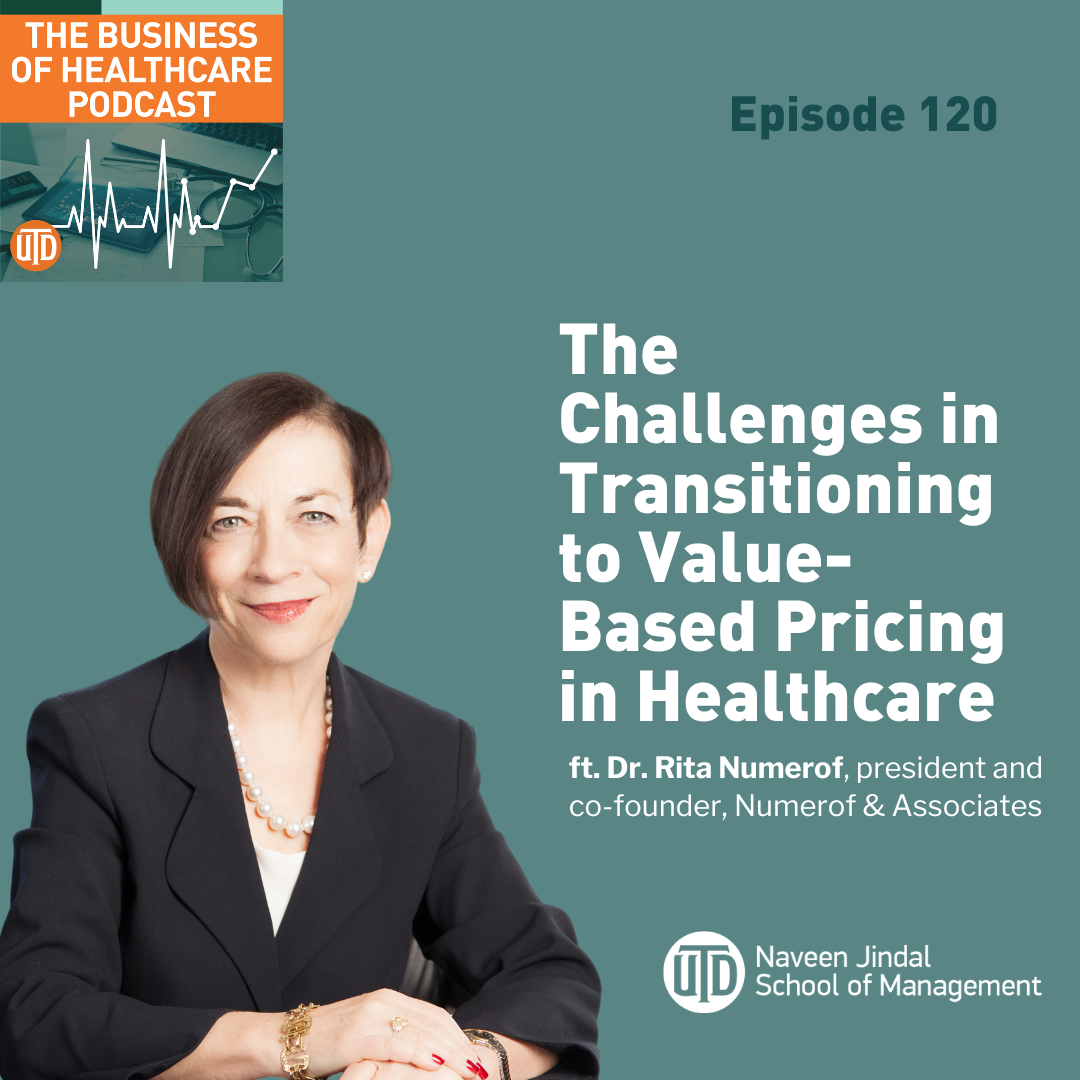
The Business of Healthcare Podcast, Episode 120: The Challenges in Transitioning to Value-Based Pricing in Healthcare
48m 52s
The podcast discussion centers on the persistent difficulties in transitioning the U.S. healthcare system to a value-based pricing (VBP) model, where payment is linked to care quality and patient outcomes rather than service volume. Guest Rita Numerof argues that since the 2010 Affordable Care Act, the situation has deteriorated, not improved. She attributes this to an industry in extreme transition, pressured by regulatory, competitive, technological, and market forces. A key historical obstacle was the introduction of Medicare's Diagnostic Related Groups (DRGs), a fixed-payment system that, while aiming to control costs, created incentives to cut corners and dismantle non-reimbursed services like mental health support, harming care continuity. The conversation highlights that moving from the entrenched, provider-centered, fee-for-service model requires overcoming deep cultural resistance and fundamentally rethinking business models, roles, and processes within healthcare organizations, a complex challenge that consultancy firms help navigate by providing external perspective and strategic guidance.
from where I sit, things have gotten worse, not better relative to where we were in 2010 when the Affordable Care Act was first put into law. (upbeat music) - Welcome to the Business of Healthcare Podcast. From the Center for Healthcare Leadership and Management at the University of Texas at Dallas, Navi and Jindal School of Management. Here at UT Dallas, we bring together business heads and other thought leaders to help navigate the challenges of our rapidly changing, increasingly complex healthcare ecosystem. On your host, Professor Daniel Karnuda, Director of the UT Dallas Professional Program and Healthcare Management. Be sure to subscribe on Apple Podcasts, Spotify or your favorite podcasting app to ensure you don't miss any future episodes. You can also join us online at businessofhealthcarepodcast.com. Today, we'll be returning to the often discussed topic of value-based pricing in healthcare. Value-based pricing or VBP, the concept has been around for decades, but was really brought into focus by the Affordable Care Act, which itself is over a decade old. It's easy to conceptualize, pay for healthcare based on quality and efficiency of the care that is delivered, rather than just paying for everything that's encountered with a doctor, hospital or other healthcare provider regardless of the outcome. But it's far more difficult to put into practice, which is made VBP an ongoing discussion topic for providers, payers and policymakers. Today we're fortunate to have returning from episode 27 as our guest, Rita Numerov, an internationally recognized consultant and author with over 30 years of experience in his strategy development and execution, business model design and market analysis. For work across the entire healthcare industry spectrum, gives her a unique perspective on the challenges of pharmaceutical and medical device manufacturers, healthcare delivery institutions, payers, physicians and suppliers. Dr. Numerov has served as an advisor to Congress on issues related to healthcare reform, and she authored the Heritage Foundation's policy paper, why accountable care organizations won't deliver better healthcare and market innovation will. She's the author of six books, including Bringing Value to Healthcare, practical steps for getting to a market based model, which outlines a market based model and healthcare focused on transparency and cost and quality, and payment connected to outcomes that matter. These themes are reflected in her biweekly column, "Performs." Dr. Numerov is the co-founder and president of Numerov and associates based in St. Louis. The firm is a strategy and implementation consultancy focused on industries and transition. Rita, thank you for being with us again today and welcome to the Business of Healthcare podcast. - Thanks, Dan. It's an absolute pleasure to be with you again. - Let's start by learning a little bit more about your firm and what you do. - So beyond what you graciously described about the company, we literally work with industries and transitions. So if you think about companies that are going for massive change because of one of four factors, they're either dealing with major changes in the regulatory environment, or they're dealing with changes in the competitive landscape, so that they're dealing with not-in-kind competition, where they're dealing with changes in technology, which in the case of healthcare, allows care to be delivered in very different settings under different auspices, often in a patient's home. Or the fourth factor is that they're dealing with a change in market expectations. When you have one of those four factors, it creates the conditions we've called transition. And when that happens, it forces even leading organizations regardless of the industry to step back and challenge fundamental assumptions about their business models, how they go to market the nature of their products and services, the competencies that they have within their own teams. It is wrenching change and most organizations, particularly if they're doing well and the cash is flowing, tend to hold on to the current model and they don't make the kinds of investments that are needed as the market that they're working within begins to change. And I mentioned, Dan, that when you have one of those four factors, you're dealing with issues of transition, which causes all of this internal turmoil, if you will. In the healthcare ecosystem, regardless of the segment in which we're talking, you've got all four of these things happening simultaneously. So I liken it to an industry in transition or steroids. And I think that serves as a backdrop for some of the things we're gonna be talking today. The work of the firm falls into three buckets. Obviously we're a strategy firm, so we do it on work and strategy and implementation. I'm called upon regularly to do either a regional within the US or a global landscape of where the industry is going on what the implications are for various parts of the sector. And then secondly, we do a lot of work in developing the organizational infrastructure, redefining roles, competencies, and getting as tactical as building playbooks and redefining processes or a wide range of core functions. And then the third bucket is the area that houses our analytics. We are known globally as a firm for the work we do in economic and clinical value. We think it is the source of competitive differentiation. And I think that too has bearing on the conversation you and I are gonna have today. My last point will be if we're talking about this kind of change in an industry, one has to be really focused on the cultural dynamics. Because whenever you're talking about major change in any kind of an organization, you're dealing with natural resistance. People are schooled and want to do what they've been doing before it's comfortable. They've been successful doing that. So it's often very hard for people to think about doing things differently. So that in that shell is the focus of our work. - Yeah, and it's interesting. I don't wanna turn this into a consulting discussion, but just to kind of piggyback on what you said, I was just talking to a colleague about this recently. And obviously you've got smart people running businesses, CEOs, CFOs, CIOs, and they're capable of running their business and working through these changes, but they've also got a day job. And they've also got a culture that they're dealing with that's in that business. And so the consulting firm like yourself, and correct me if I'm wrong here, you come in and basically help them, guide them, focus them, we're at point A now, you need to try to get the point B. Here's how you could do that. And it's very difficult coming from my background as a CFO of the healthcare organization. Sometimes it's hard for us to do that internally just because of cultural hurdles. But when you have some guidance of a consultancy that comes in and helps you with that, it helps you to actually be able to make those moves. - I think what you said is really well said. And I think the issue of, we've got a day job, there are things that we need to do to run things. I think it's really critically important. The other side of it is often helpful to have an external partner that you trust who understands the ecosystem and changes and can help you anticipate where that market is going. And so it allows one to challenge assumptions that one might have and to pressure test what's going to work, what's not going to work. And as you said, get from point A to point B. And beyond. And value-based pricing is one of those things in the healthcare space, specifically this putting pressure on management of all sides of the healthcare industry to make changes or react to changes that are happening. So the value-based pricing model in healthcare is easy enough, like I said before, to conceptualize. I mean, if we compare it to say your car, if your car breaks down, you get some quotes from different mechanics. You take a look at those quotes for pricing, but it's not always price. You can also look at quality, reviews, word of mouth, that sort of thing. And you choose your mechanic. The mechanic does the work and you pay them for what they've done, but if they don't do the job correctly, you don't pay or they have to continue to work on it until they do get it done. That's not how we live in healthcare space, which frustrates all of us, but part of this because it's our body and we don't know what the doctors know. Our car is a little bit different for us. We can tell if it's not working right. It's not quite so easy in healthcare. We live in a largely fee-for-service healthcare pricing world today where we go see a doctor or we go to the hospital and we get a bill and we pay it. And then we might get another bill from another clinical body that saw us. And we're like, where did this bill come from? Well, that's from the anesthesiologist. That's not the doctor that actually did the procedure and you've got to pay that as well. In a nutshell, it's confusing for us the patients because that's fee-for-service. We pay for everything that the physicians or the providers do for us. Where in a value-based pricing world, we look at metrics like quality. We base our payment on the quality of the care or the outcomes that we received or at the primary care level, we look at a population. How is this primary care physician? How is his quality or her quality treating that patient? How does that compare to?
a metric, a target, and if they do a good job, they get paid more if they do not as good a job as average or the target they get paid less. That's a value-based pricing model and concept, and it's not the way it works in the healthcare industry. So, with that as hopefully a little example of a background, Rita, why is this so hard in healthcare and what trends are you seeing as you follow the market and work with your clients? I think you've done a great job dancing up the dynamics of the industry and some of the complications that the patient consumer experiences today. I think to answer the question, it's important to provide a little bit of historical context because we're still dealing with that history today. And from where I sit, things have gotten worse, not better relative to where we were in 2010 when the Affordable Care Act was first put into law. And I say that with the understanding that I've been a critic of the healthcare industry for about 40 years. And I was focused on changing the model, changing the dynamics to get to, as you described in your opening, a market-based model, a value-based model that is focused on transparency in both cost and quality, that is focused on the continuum of care rather than looking at things from an episodic perspective. And that information is provided to the patient consumer, the third element of a market-based model, so that we as patient consumers can make informed choices about what we need, where we're going to get it, which providers are going to be more or less likely to be a good matched, based on their experience, in a particular clinical area of interest, need, and concern to me. And the same thing in terms of overall measures of quality and outcomes, if I'm talking about connecting with the Brewer Healthcare System. And so with that as background, the model that's evolved over decades is one that has been very much provider-centered, provider-being-the-position, the provider-being-the-healthcare-delivery-institution. Fill in the blank, it's been provider-centered, the patient consumer goes to where that care is being delivered. Remember the days when you used to wait in the waiting room for hours, sometimes when the end, half an hour was not at all unusual, it was more typical, and you got in and out pretty quickly if you only had to wait an hour in a physician's office. So the idea, even of basic things that we as consumers experience in other parts of our lives, we make reservations for most restaurants. And the idea of having a reservation, IA, an appointment, to eat at a particular establishment, and then heading to wait for your table for 30 minutes, folks are going to get a little in Pnecia. And depending upon the establishment, you may actually get a glass of wine, an appetizer or something, and some kind of an offset to the inconvenience that happened to wait. Historically, it was expected that we just wait until the physician or the service where we're getting X-rays, whatever it might be, is able to take us, and it is, was ingrained, was built into the culture that we would just wait for them. There are institutions, healthcare delivery institutions, that have on billboards, that the average wait for an ER visit is five minutes or ten minutes or whatever. And the fact that they have to advertise that as a point of differentiation is another example of the fact that it has not historically been a patient, consumer, centered, and a price. So that's one, maybe it's minor, but I think it's really telling about the overall orientation. The other piece of it is that the team at model historically has been one of, you do the service if you're a physician or you are a outpatient clinic or a hospital system, whatever, Surgery Center. Historically, it was a usual and customary charge, but after you finished the service, you submit a bill, and depending upon the region and what has been negotiated, the institution wouldn't get paid. And CMS 40 years ago, the Centers for Medicare and Medicaid Services, which is the largest provider of healthcare services, largely, since you're in this country, namely the government, essentially said, we need to bend this proverbial cost curve. And this is over 40 years ago. And so what we're going to do is move from this usual and customary rate of reimbursement where you do the work and then you submit the charge and we pay, commercial insurers do the same thing. What we're going to do is move to what has been called DRGs, diagnostic related groups. And so there was a bundling of services and healthcare institutions and physicians would get paid based on what this negotiated bundle would be. And CMS, which was put from the American Medical Association and the Hospital Association, what those reimbursements would be. And so this created quite an upheaval. And I remember in 1987, it goes back that far, I had just finished my doctorate and I was then on faculty at Washington University in St. Louis and I was teaching graduate courses in healthcare policy. And I had made the uncomfortable prediction that DRGs were going to lead us down a path of higher cost, poor quality and poor coordination, the exact opposite of what they were intended to do. And the conventional wisdom was that DRGs were finally going to bend the proverbial cost curve. And I was saying against a tide of others who were really applauding this move that it was going to have the opposite effect. It was not going to solve the problem, but rather would make things worse. So why did I think that it was going to make things worse? I think it gets back to the question you raised before. There was no connection in DRGs between payment and outcomes. There was no focus on the quality of what was being delivered. And now there were incentives to yes bundle up and do prospective payment so that people knew what they would get. But now they're more incentives to begin to cut corners. And so things related to social services and social determinants of health, where you had people within hospitals, social workers like colleges, psychiatric nurses, whole variety of others who were really focused on what happens to that patient after he leaves the institution. What kinds of services are in the community where they might get hooked up if they're having financial issues or housing issues or food issues. And back then, there were services that were engaged in the community that the government was typically subsidizing because these were social services agencies not coordinated, but they were in place and they did things to some extent across the country. And so what happened because hospital systems, CFOs like you, Dan, who were more concerned about what their job was, which is ensuring the well-being financially of the institution. And they had to do that. I'm not criticizing that focus. But if they didn't look at what happens outside the walls of the institution. And so little by little, those non-reimbursed, non-essential physical services that were being offered that focused on the continuum of care were slowly being ratcheted back until in a lot of situations. They were essentially eliminated. And we had a split between physical health and behavioral or emotional health, mental health. And fast forward, guess what's happening, particularly exacerbated by the pandemic, everybody is all up in arms now about our lack of attention to mental health services in this country. Well, they should be concerned about that because the entire field was essentially decimated in part because there was no money devoted to those particular services because they were seen as non-core, non-essential. So DRGs over time got more complicated because individual institutions were interested in how do I continue to make more money within the current system. The rules put in place in 2010 under the VACA, the Affordable Care Act, that were to quote encourage, quote, "these healthcare delivery institutions to be given."
in mapping quality outcomes to the payment that was delivered. You would have thought that this would have been welcomed given that these institutions across the board claim that they are a patient center and concerned about outcomes. And the fact that it didn't get focused that way so that there is something else fundamentally that's going on within a lot of these institutions that is not really focused on that patient experience and reimagining what they need to do within the healthcare system. So Rita, if I can just see if I got this right as an example of what you're talking about. So you go to the old rules on this is Medicare and Medicaid we're talking about now, which is the largest healthcare payer in the country pays for over half of our healthcare expenses. So prior to this DRG you're talking about, which, and for the listeners, if you think about a DRG just think about, it's a menu pricing. Okay, here's what the service is, you're going in for whatever, gallbladder extraction, whatever, here's what the government will pay for that. They set the price, it's a menu price, you can't negotiate it, that's what you're gonna get paid if you're treating a Medicare patient. Prior to this DRG concept, Medicare was just getting charged the usual and customary rate that that institution would charge for that and that differed among institutions throughout the country. And Medicare couldn't control that, is hard to control a cost like that when you go, you have so many people, so many people on Medicare and you're getting so many different charges for the same procedure. So Medicare said in the 80s, they said, "Listen, no, we're not doing that anymore. You can't just charge us whatever your customary rate is for everything you do for a patient. If someone's going in for a gallbladder extraction, then here's what we're gonna pay you. It's a fixed fee, it's what we call a perspective fee. And we don't care what you do for that patient. When they're discharged, here's how much you're getting for that procedure. And so if you now think about being in charge, being the business leader of a healthcare institution that has that kind of pricing, it's a fixed price. So as a CFO or as a CEO or as a business leader, we're trained to say, okay, how can we make the most money now? We have a fixed price. So now let's look at the services we provide because we can't charge the government now for every single service we provide for this poor patient. We're just getting paid one amount at the end when we discharge the patient and we know what that amount is. So let's start cutting things that maybe we used to do for that patient that aren't absolutely necessary like a mental evaluation maybe, or little things along the way and what's gonna happen? Well, your profit's gonna get better 'cause you're cutting costs, but the quality of that patient's care may not be getting better. You know, it may be getting worse. And so that's the one we went from a charge for every single thing you do for that patient along that trajectory of their procedure to a fixed price for that procedure. Yes, it helped Medicare control the cost because they knew how much they'd be spending now for the procedure, but it also incentive management to be as efficient cost-wise as possible, which may have cut quality. I think you did a nice job summarizing it with a caveat, Dan. The issue was that there was no connection between the payment in a DRG and the outcome that was achieved. And so if you think back to the days of the HMO, the health maintenance organization, which came into vogue in the late 1980s, early 1990s, as a way to really focus on health and well-being, it was really about prevention. The HMOs like what we're talking about with the DRGs in the hospital situation, how no connection between payment and outcomes. So just like in DRGs, where ironically, they were incentives to do more DRG-based services, not less, but more because you got paid now on a DRG integrated basis, there were incentives implicitly built into the HMO where these institutions could do better by doing less, doing better financially, by doing less service, and it's the same problem. I don't have an issue with fee for service, the problem I have is that there's no connection between the fees that unchain, where they're being paid by my insurer or some other third party and the outcomes that I'm achieving. And there is no focus on a trend analysis of how does this institution deliver care and produce outcomes relative to similar organizations across wide range of people, wide range of populations, however you want to define them. And so I think this is part of the core problem of where we are today and what we're talking about you and I are the really problematic, I'm gonna call them unintended consequences of legislation that's put in place with, let's say good intention, but not really understanding what it is they're legislating and they don't really understand some of the fundamentals of human behavior and then large organizational dynamics. And because there is no understanding of that, the things that you and I understand that we're talking about today, that make a ton of sense to both of us, are elusive to them and so that they focus on some of the nits and grits of a specific legislation and don't really understand how this is gonna play out in terms of incentives. And so today we are actually paying or then we did even in 2010, the outcomes in a lot of cases are worse than they were in 2010. And we have spent millions upon millions of dollars turn of the healthcare delivery system upside down, facilitated an unbelievable level of consolidation under the guise of what we need to consolidate to be able to manage populations better, which wink, wink behind closed doors was really an effort to control and negotiate more favorable terms with various insurers. More physicians today are employed by healthcare systems or insurance companies and others than we have independent practitioners. The rules for being involved in delivering healthcare are unbelievably complex and bureaucratic and small practices can not afford to stay in business. We have rural healthcare in total disarray and the list goes on. These were not things that our legislators intended to have happened as a result of the legislative efforts over the last 10, 15 years, but they were predictable because of some of the things you were talking about before. This episode is brought to you by the Center for Healthcare Leadership and Management, the definitive resource for healthcare management education in North Texas. The center is based in the Nabean Jindal School of Management at the University of Texas at Dallas. It plays a unique role in training the next generation of healthcare leaders to meet local, regional and national demands. The Jindal School uses its strengths in accounting, administration, finance, marketing and information systems to educate highly qualified personnel for healthcare administration and executive leadership positions. The center is home to seven healthcare leadership and management programs, including undergraduate and graduate programs, as well as executive programs for physicians and working professionals. For more information, visit us online at jindal.utdallas.edu/healthcare. This is not unusual in a complex situation like this where legislation will be put in place and it doesn't completely work. This is how our government is supposed to work. We put legislation in place, we monitor it to see if it's doing what we hope it will do, and if it's not, then we've got to go back and make some changes. We're seeing some changes that have been put in place since the Affordable Care Act in 2010, pricing transparency in healthcare is now a rule that's in place, it's not particularly successful yet, but it's there that no surprises act, things like that, have been put in place, so it's steps. It's put something in place and then try to fix it if it's not working the way that you are hoping it would work. So Rita, are you seeing anything out there that is working or that is semi-working? - I think that's a great question, Dan. I am known as an equal opportunity critic, and I'm sure that's coming through loud and clear, and it's not from the perspective of being critical, but from the perspective of helping organizations to reconceptualize a different way of doing things where they win, the society wins, and the patient consumer wins. Let's be honest,
I did a couple of pricing trends behind C-Roll. I wrote and was interviewed quite a bit on this. I've written about this in some of my Forge articles. And this was a measure that we thought would be incredibly important. And the thing that I think there's mention, and I take your point about change being incremental and that's part of the way in which our system works. And I think that's generally a good thing. But there was enormous pushback from the Market Hospital Association. Millions of dollars spent lobbying and also A-Hip, the lobbying organization for the insurance industry. They pushed back on pricing transparency, saying that this was somehow any competitive and a challenge to their IP, which is in some respects, kind of bizarre. This is something where in every other walk of life, and you use it as an example, what happens when we take our card to the shop to be work done, every other part of our society has a level of transparency. This is what you're going to get. This is what you're going to tell. These are the outcomes and I stand by my outcomes. Unless something egregious was done in a healthcare experience and you brought lawyers to bear, there typically was little if any accountability historically. Are we seeing a little bit more? Yes. I think it's too little. I think the consolidation that's happening and the financial, it's great that so many of our healthcare institutions are under right now, very concerning to me. So at a point in time where they had the money to invest in a different model, some in the invested and took a trip that was very different. We have a number of exemplars, if you will, that I'm not a liberty to share one in particular. There's a client of ours and perhaps next year we can get together again and I'll be in a position to tell you more about them. But there are examples of large healthcare systems who have taken what you and I are saying very, very seriously, they have invested over the last 15, 20 years on technology that is focused, not just on getting paid, but on delivering better care and better health outcomes. There have been examples with organizations like Kaiser Kerman entay. None of these are perfect organizations by any stretch of the imagination, but historically Kaiser had invested in a very different model, a capitated model, if you will, where they would be paid a fixed amount per year for treating people and they were also very focused under the leadership of George Halverson to focus on outcomes that mattered and continuously improve what they were doing to understand what was leading to better health outcomes for the people that they were responsible for. There are pockets of excellence, if you will, that we've seen with names that are familiar to everybody at the university, I'm sure, whether it's Mayo or others in examples, but not overall system looking at outcomes differently. We're not where we need to be and the economics, I think, are going to make it very challenging for these organizations to go forward. What about the government? The ACA, the Affordable Care Act in 2010, essentially put value-based pricing on the back of CMS, the Center for Medicare Medicaid Services. The ACA said, "CMS, you will start to put into place these value-based, quality-based pricing opportunities for providers that treat Medicare patients." But then led to the creation of the accountable care organization, also known as ACOs, or the Patient-Centered Medical Home, which are essentially Medicare's attempt to put into place these pricing schemes where they will pay institutions like hospitals or rehab facilities or physician practices. They will pay them a certain amount for treating Medicare patients and then give them a bonus if they hit targets and do better than quality and pricing targets that they've been set or they may have to pay a penalty if they don't hit those targets. Over the last several years, these ACO accountable care organization type concepts have been put into place. Do you have any view on those and the success of those or the failure of those or they headed in the right direction or are we still fumbling around what do you think? I think we're still fumbling around. The heritage paper that I wrote in 2010 that came out in 2011 that you cited earlier in your introduction. I think it's still extraordinarily relevant. I would urge people who are interested in this subject to take a look at that, write to me, offer critiques, offer different perspectives, but what I laid out then, I think is still very much on point today. Part of the problem is it's very difficult, even well-intended bureaucracy, to dictate what internal processes and procedures should be of another realm of life. Anybody who's dealt with the bureaucracy, dealt with the government knows that it is not transparent too often and it is complex and it is too difficult to navigate. Putting in place a set of rules and formulae it responses to how they're going to do various things, often misses the mark in terms of what the overall objective is. I think that CMS and the government has had a really important role and should continue to play a really important role in establishing what expectations should be, what are the standards by which certain things should be met, but enable the market to be able to determine what that best mechanism is. The government is not an expert in all of the aspects of delivering healthcare. The government is not an expert in understanding diagnostics and medical treatments and what's going to work in certain circumstances for a given patient and not. So imposing that set of complicated rule on a system which already is complicated often makes things a lot worse rather than better. I think the construct of patient-centered medical home is lovely. It has not led to the outcomes that were intended. I think largely because of the bureaucracy that we're talking about here, and the level of minutia. It's very difficult to pay for minutia relative to overall outcomes over a much longer period of time. If you're thinking about designing a process, you want to design an integrated process. Let's go back to your car analogy. If somebody wants to design a car, we need it fit for purpose. Just because you develop wonderful steering columns and I develop wonderful doors and windows doesn't mean at the end of the day that we can collage all of this together with brakes and engine and spark plugs and a variety of other things. At this point, I'm getting out of my comfort zone in terms of building cars that we're going to have something that's going to work. There has to be an overall design. There has to be a fit for purpose design. The elements that are part of it need to fit together. What I was trying to describe before is we focus on the minutia rather than stepping back and understanding more macro level, what's the problem or set of problems, plural, that we're trying to solve, anticipate the unintended consequences, and then what do we need to design to allow us to get from point A to point B? I think we're still struggling. We do an annual survey in our company of the state of population health in the United States. Most of the participants over time, we've been doing this for about 10 years, most of the participants have been engaged in some aspect of ACOs and patient-centered medical homes. They themselves as institutions have more experience with these value-based pricing outcomes oriented programs. When we look at that data, which you would expect would skew to be more successful in these areas, we find that somewhere in the neighborhood of 10 to 15 percent of their total revenue is at risk. And potentially downside, most of the at risk is the upside. So the consequences for not performing are still not built into the mindset, if you will, of most of these institutions. They believe that value-based pricing in population health is core to their future.
But most of them have not yet built in the systems to be able to manage their poor internal processes of delivery and manage variation of cost and quality and ensure that they are able to engage in the kinds of dialogue that's necessary if you've got outliers in whatever part of your institution that needs to be brought back under control, if you will. Until they're able to do that and have tough conversations and make sure they have the tools and infrastructure to get to these outcomes, they will continue to struggle. So when you talk about patient-centered medical homes, just for again, the listeners out there, I'll try to do a very high-level description of what that means. And it is very complex as Rita said, which is part of the problem. The concept is one of population health, where a primary care physician will treat a certain number of Medicare patients as their patients. And instead of the government paying that provider, that primary care physician, every time that patient comes to their office for whatever, a physical exam or this hurts or it, you know, I've got a cold or whatever it is. Instead of paying them every time that the patient comes to the office, the government will pay them the provider, the physician, what called a "capitated payment," which would be a certain fixed amount per month for every patient, every Medicare patient that doctor has. And that's the payment that the doctor receives. It's then the doctor's responsibility to coordinate the care for that patient. To see that patient when they need to be seen by the primary care physician, or in determine whether that patient needs to see a specialist and then refer them to a specialist and just basically control the whole health of that patient through the whole continuum of care. And if that physician does a great job of treating those patients and is incentive to keep those patients healthy, because the less time they see those patients, the better, because the doctor is still getting paid the same amount per month for that patient, every month, regardless of if they see that patient or not. So if they can keep that patient healthy, then they'll make more money. They won't have as much expense. And they may even get a bonus at the end if their whole population of Medicare patients ends up with better quality scores and costing the government less than some target the government sets. So that's the difference between value-based pricing and just paying a physician for every encounter they have with a patient. But there's a lot of complexity in what I just said. How do you set those targets for the bonus and the penalty? And how, like Rita just talked about the IT infrastructure, that physician practice now has to have the ability to communicate very quickly with other providers with the specialist or with the hospital or with the rehab facility. And they have to be able to track that patient's care and the quality that patient's getting. And a lot of physician practices just don't have that technology to be able to track that type of quality throughout the system. So it's really, really complex. These things, they tend to make sense on paper, but trying to get them implemented is very, very difficult to do. So Rita, ask you a question. If you're backtracked 20 years or whatever, is there anything that any one or two things or more that you would have done if you were the overall czar of healthcare in the United States, it's so complex. How do we get from the mess we have now to where we want to get to, which is this population-based health type of concept? Is there anything that we should do, where we're thinking about doing to help us get there at some point? I think there are a couple things. One is to be aware of what's the overall goal. What are we trying to achieve and make sure that we don't lose focus on that and that you're across, restrain themselves from getting into the weeds and being too prescriptive. And so if we're focused on outcomes that matter with transparency, so we're engaging the patient consumer very differently and insisting on that. That's a very easy thing to do with all due respect to the American Hospital Association, the American Medical Association, that push back on some of those things that are such fundamental to everything we do in our society. We engage an educated consumer differently and I have been an advocate for people to be knowledgeable and more comfortable in asking those simple questions of whoever it is that they're engaging in the care of them and it's a partnership because physicians will say, I don't have any control over you patient, you get to make choices about how you're going to live your life and whether you're going to abide by the prescriptions and the medical advice that I, for example, might be given. And so an informed consumer, patient consumer is absolutely critical asking questions and feeling empowered to ask questions. Silly questions are incredibly powerful. And I think that's really important. And on the societal side, I think patient consumers need to be knowledgeable about the overall system and insist on those outcomes that they know intuitively makes sense and not just leave it to the bureaucrats. And I think we will begin to make some of the changes that we need to, we have to do better in this country. Yeah, I agree with you. And that's something that I tell my students when I'm going through this topic with them and you said it a few times during this podcast, which is the patient focused healthcare system. The patient hasn't educated consumer. You know, when we go to buy a television, we hit the internet and we do a lot of search on what's the best one, what's the best quality, what's the best price. We can't do that in healthcare today with the system that we have. And we're not up in arms about it as consumers because it's just something that has always been there and we've lived with it. And so until we as consumers start to demand these type of things, we've just been talking about it's going to be hard to get any traction on change. But as soon as we start to demand it, it's really tough. It's just the system's not out there right now. I think Dan is another element to put on the table. There are databases and there are reports. I don't know the extent to which you're familiar with the publication called On Health that's put out by consumer reports. And so probably about 15 years ago, they made a ton of investments in getting information around the country based on publicly available information that is out there with guidance also about the kinds of questions that patient consumers should ask even about whether or not they need surgery. So there are publications that are available. CMS has put information on their website. And so increasingly we are seeing more and more available. And I think to your point, we need to demand more. I think that there are things that are out there. We need to ask questions at the individual local level and to do the shopping that is really important. Obviously, if you're in a emergent situation, you're not going to be in a position to shock, but fortunately most of the health and care that we have are not under emergent conditions. Yeah. And it has been getting better in the internet age as we can now search. We're all getting to be a little bit better consumers, but we need more tools just like that. And Rita, thank you so much for being with us today to discuss this evolving landscape around value based pricing and health care. We will continue to follow your bioletely Forbes column and the activities of numerous and often associates to keep us up to date on your latest thinking around this important strategic topic. Thanks, Dan. It's great to be with you today. Thanks for listening to the Business of Healthcare podcast. To learn more about the Center for Healthcare Leadership and Management and the Healthcare Management Business Degrees and Certificates available to season clinicians, master students and undergrads through the University of Texas at Dallas, go to jindall.utdallas.edu/healthcare. [MUSIC]
Podcast Summary
Key Points:
The healthcare industry remains in a challenging transition, facing simultaneous pressures from regulatory changes, competitive shifts, technological advancements, and evolving market expectations, making progress toward value-based models difficult.
The shift from fee-for-service to value-based pricing, which ties payment to quality and outcomes, is conceptually simple but hard to implement due to deeply entrenched provider-centered systems and historical payment structures like DRGs.
Historical payment models, such as Diagnostic Related Groups (DRGs) introduced by Medicare, inadvertently incentivized cost-cutting over quality and continuity of care, contributing to current systemic issues like fragmented services and neglected areas like mental health.
Despite the Affordable Care Act's intent to promote value-based care, the industry has seen limited success, with the speaker arguing the situation has worsened since 2010 due to persistent cultural and structural barriers within healthcare organizations.
Summary:
S. healthcare system to a value-based pricing (VBP) model, where payment is linked to care quality and patient outcomes rather than service volume. Guest Rita Numerof argues that since the 2010 Affordable Care Act, the situation has deteriorated, not improved.
She attributes this to an industry in extreme transition, pressured by regulatory, competitive, technological, and market forces. A key historical obstacle was the introduction of Medicare's Diagnostic Related Groups (DRGs), a fixed-payment system that, while aiming to control costs, created incentives to cut corners and dismantle non-reimbursed services like mental health support, harming care continuity. The conversation highlights that moving from the entrenched, provider-centered, fee-for-service model requires overcoming deep cultural resistance and fundamentally rethinking business models, roles, and processes within healthcare organizations, a complex challenge that consultancy firms help navigate by providing external perspective and strategic guidance.
FAQs
Value-based pricing in healthcare is a model where payment is based on the quality and efficiency of care delivered, rather than paying for every service regardless of outcome. It aims to reward providers for better health outcomes and cost-effectiveness.
It's difficult due to historical fee-for-service systems, lack of transparency in cost and quality, and cultural resistance within healthcare organizations. The complexity of measuring outcomes and aligning incentives across providers adds to the challenge.
DRGs are bundled payment systems introduced by Medicare to set fixed prices for specific medical procedures. They aimed to control costs but often led to reduced focus on non-essential services like mental health and social determinants of health.
The Affordable Care Act brought value-based pricing into focus by encouraging payment models tied to quality outcomes. However, progress has been slow, and challenges in implementation persist over a decade later.
A market-based model emphasizes transparency in cost and quality, focuses on the continuum of care, and empowers patients to make informed choices. It shifts from a provider-centered approach to one that prioritizes patient outcomes and value.
Consultants help organizations navigate major changes by providing external expertise, challenging assumptions, and guiding strategy. They assist in anticipating market shifts and overcoming cultural hurdles to implement new models like value-based pricing.
Chat with AI
Loading...
Pro features
Go deeper with this episode
Unlock creator-grade tools that turn any transcript into show notes and subtitle files.
 PodcastTranscript AI