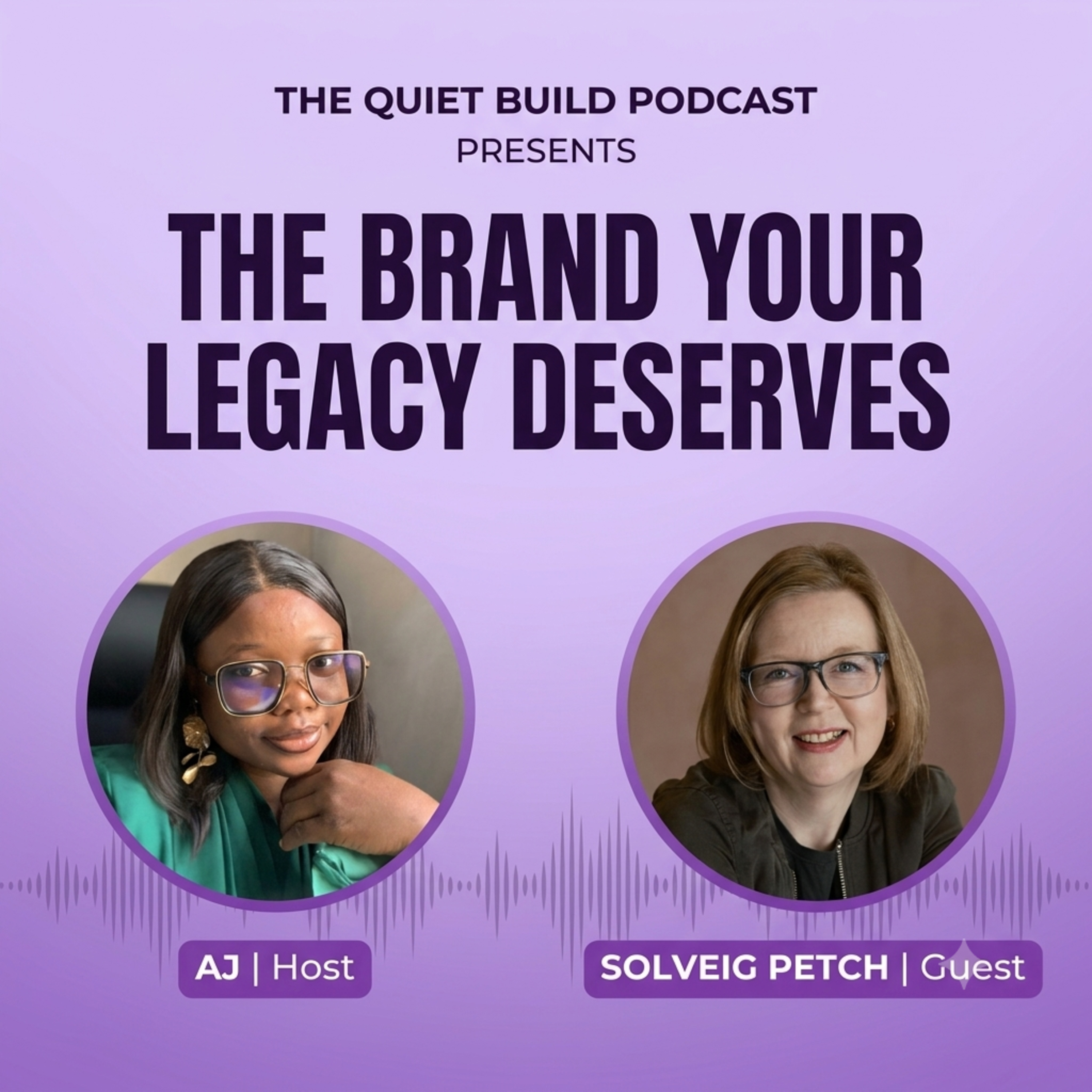
In this episode of The Quiet Build, host Cheryl and guest Peci discuss the deeper purpose of branding beyond visuals. Peci explains that many business owners mistake a brand for its logo or colors, neglecting the foundational questions about values, purpose, and long-term vision. This leads to a disconnect where founders feel they are pretending, which is exhausting and unsustainable. The real purpose of branding is to make people feel something, building trust and recognition over time. Brand equity—the premium customers pay for a trusted brand—allows businesses to avoid a race to the bottom on price. Peci emphasizes that branding is an evolution, not a revolution, and that rebranding fails when it is merely decorative rather than rooted in strategic clarity. In the age of AI, authentic brands with human connection and shared values will thrive, while generic, AI-generated brands will fade. The key takeaway is that a brand is the accumulated value of how people perceive, trust, and remember a business, and lasting impact comes from building for longevity through intentional, quiet work.
Hello everyone, welcome to another amazing episode of The Quiet Build. And today is going to be very exciting because we are talking about power to build or brand your legacy deserves, right? So most business owners think about growth, revenue, sales, marketing, scaling, but very few stuff to ask deeper questions. What are you building that's no matter 10 years from now? These are the kind of questions you should be asking as a business owner because businesses that last I reviewed on tactics, they are built on foundations, on clarity, on position, and on a brand that grows in value alongside the business itself. And in the studio today we have Peci, joining us, she has worked at the intersection of strategy and design, helping establish businesses on cover patterns and opportunities that are often invisible from the inside. Peci, I'm so glad you're able to join today. I'm so happy to be here. Thank you so much for having me and thank you so much for that very, very warm intro. All right, so Peci, let's kick off from here. You often talk about businesses at growing the brand wrapped around them. I want you to explain that in clear terms. What does that mean? You mean for a business to build a brand that's just like a rougher? Yes, and they at grow them with time. Yes, and this is something I see happen again and again, especially with startups and people who are newer in business. When they start up, they confuse a brand to just mean a logo and their colors. And they fail to stop and think like you said in the intro, they they don't necessarily think about the deeper things and the questions that are going to give them answers to inform their brand so that they can stick around for a long time. And so what that often looks like is that a founder starts a company and they get very excited and they think we need a brand and they jump straight into what I call the fun parts. I'm putting that in quotation marks here, the fun parts of colors and logos and fonts and all the things that look pretty and that you can see. But it's just decoration. So it's just a fancy wrapping paper. And if the gift inside the wrapper isn't good, people are going to be disappointed and that's not good for your long term brand repetition. Yes, Peci, I couldn't agree more. You know, when people get new business ideas, they get so excited and the first thing I want to do is pick up the brand colors, you know, sets of the whole brand that they're sitting in and it's always about visuals. What should my website look like? What should my page design look like? They really forget to concentrate more on the value, on the content and I think that is what it misses. So what are the first signs that a brand and a business are no longer aligned? Oh, I think it's like often it will feel like something is not quite right. But it's difficult to put your finger on it. They can't quite articulate what it is. It's just that when you come to post or to share about your business, you're like, oh, I should share my website now, but I don't really want to because it doesn't feel like me anymore and it feels uneasy. Like disconnected. Yeah, a bit disconnected and like, like they are putting on a mask or pretending to be someone they're not. And doing that for a long time is really exhausting because pretending is exhausting. So that's why I like to encourage my clients to step up and show up as themselves fully in their brand instead. So, Cheryl, and if we are being honest to tell us, especially for businesses that are just starting out, it's easy to get a little bit confused when you're just starting out. So what do we do at displaying? For like, businesses that find themselves in this kind of situation where they are no longer aligned? Okay, so in most cases, in most cases, that's because they didn't stop to ask themselves the deeper questions when they first started. So what I would suggest they do is to not do anything just yet. Just start the inner work. Leave everything be for now and then go back and ask yourselves the fundamental questions like, who am I really? And what do I stand for? What are my values? What is still going to be true for me and my brand in 10 years time? That is true now, but it will still be true in a decade. Ask yourself uncomfortable questions like, what am I not willing to compromise on? Like, integrity is really important. And also that's important question of, let's say we take money completely out of the equation. What's the reason your brand exists? If money doesn't, if money didn't exist, why would you when you have the answers to all of the deeper questions? That is when it starts to become easier to align the visuals with the strategy behind everything. Interesting. So it's more about defining the value that your brand offers. You know what picture you said something that found us often the last questions to see what's wrong with their brand. Which is very interesting because they are the most consigned, the body of brand. Yet they are the last to see it. Why? Oh, I like to compare that to having children, you know, because a brand, when you start your business, it's like your baby, right? You are, you're bringing it to life and you're watching it grow and you're so proud of it. And you don't really want to see the parts that aren't so good, right? It's more difficult to see when if your child misbehaves, it's easier to overlook when your own child does it than when someone else's child does it. So I think sometimes found as a too close to their brand and business to be able to spot things or sometimes they even see things but they don't want to see them. So they kind of pretend that they don't exist. Yeah. And I know this because I've been there myself. Wow. Interesting. Some was like pretending not to see it. Isn't because they can't accept the fact that it isn't going the way they want it. Like said, deny it. Yeah, a little bit of denial there. And also I think in many, this kind of fear that, oh, we did something wrong, people are going to call us out, people are going to see that we didn't have everything sorted from the first day, people are going to think that we have failed. Maybe it also, oh, this is going to be expensive to fix. And none of that is really true. The most expensive thing you can do is just to keep on going in a track that doesn't feel right. Because the further down the line you get, the more of a job and the more expensive it's going to be in terms of not just money but in time as well. It's going to be to turn it around again. Okay. Without the biggest misconception when it comes to branding in business. Yeah. I think one of the biggest misconceptions and the most basic one is this whole brand is your logo thing. And the second thing I see is what we have just been talking about, the fact that you think you have to have everything figured out from the beginning and if not, then you're a failure. But branding is not something that you can just do once and then it's done. It's, it's an evolution. It's not a revolution. So it's something that will adapt to changing markets. It will adapt to how you as a founder change. And I mean starting a business is kind of the heaviest self-discovery journey that you can ever start, I think. So there's going to be changes. And if your brand is too static and you don't feel like you can adapt as you go, I think that is really harmful. Okay. So Petty, before we move forward, I wanted to just help me put it out there. What's the real purpose of a brand is because now we've established that it's just way beyond visuals, beyond the logos and the aesthetics. So what then is the real purpose of branding? Ah, right. Okay. I can go deep on this one. I think just to make things a little bit clearer for the listeners and to give them some context, I think I'll try to briefly explain the difference between a brand and branding. A brand is something that you can't be 100% in control of because it's made up of all of the thoughts and all of the emotions and everything that people think and feel about your business. Okay. And that's, you can't go into people's minds and decide what they think about you because I mean that would be kind of creepy. And then you have branding on the other side. Branding are the actions, the actual things that you do to try and influence people's conceptions of your brand. Yeah. And I think to most people,
the logo, the visual side of things feels like it's all of branding, but it's not. It's part of branding, but it's really just one small part of it. And what branding is intended to do is to make people feel something. I think that's the most important thing your brand can do. You don't want people to be indifferent about your brand, you want them to feel something. And you're never going to be able to just make people feel good things. You're going to sometimes need to push some people away as well. So you have to be confident enough to be the right fit for your people, but also at the same time just accept that you are going to not be for everyone. More like establishing like defining your niche right. Yeah, I think that's a different part of branding as well. I am not a big fan of niching in the traditional sense. I am much more drawn towards niching based on psychographics more than demographics. So finding your ideal people based not just on age, location, occupation, salary, numbers, but I think the stronger brands find common ground elsewhere. So they will niche based on shared values like what do we stand for? The world views of people. It's much more powerful than just going by demographics alone. So a picture you walk across both strategy and design and you have a busts who portfolio already from your experience. Why do many rebrand fails to deliver meaningful business results? Like people want to rebrand for some reasons. It's kind of leads to harmful business. Oh, they still don't pick up. Why does that happen? What are they wrong? Well, there are as many answers to this as there are businesses out there. But the things I see with my clients and especially the ones that have tried to rebrand before and it didn't work. It's often it's because they didn't really need to rebrand in the first place. All they needed was to figure out who they really are. And that's when a rebrand can turn really expensive right if it's just decoration. And a lot of like new businesses, they grow tired of their brands after a while. They're like, oh, I want to change things up now because I don't sick and tired of this color. Or I like I don't like my logo anymore. And what they don't realize is that there is equity in your existing brand assets. If you're not careful, if you just change everything around every so often, people aren't going to have enough time to get to know you and to get to recognize you. Because at the end of the day, brand equity is the difference between what people would pay for your service versus what they would pay for just like any similar service without a brand name on it. And what you really want your brand to do is build recognition over time so that people start to trust you. And if you keep changing up things like every six months, every two years, people don't get that time to build recognition. And it's a shame. - It is. You just mentioned a 10 year that I want us to view on a bit. You mentioned equity. Brand equity. Can you speak on that? - I can. And it's one of those things that sounds like fancy corporate or consultancy jargon. But really it is. And it's what I mentioned earlier as well. It's the difference between what people will pay for your brand versus what they will pay for whatever other brand that delivers exactly the same thing. So for instance, if we take a really well known global brand like Coca-Cola, and then you have like maybe a smaller, very local brand like even here in Norway, we have some like companies that make cola drinks, not Coca-Cola, but other similar drinks. And you will, when you get into the shop, you will see that Coca-Cola branded products are more expensive than these smaller off labels. The difference in price there, that's your brand equity. They can like Coca-Cola and all the other big brand names can get away with charging more for their products and services because they're brand is well known because they're built up a reputation over time and a recognition over time. So that's your brand equity. - And trust you, I'm just trying to sit on that. It's making a whole lot of sense right now. So more like this is stage your brand gets to after you build value that you just have the trust of clients or customers regardless of the competition out day. - Exactly. Because people know about you and maybe other people recommend you to them and so they start to trust you, which means you can increase your prices usually. - And this is where building for legacy really comes in, right? - Absolutely, absolutely. You want to make sure you take care of that brand equity. If you're going to be around for a long, long time, it's what's going to save you because if you, a lot of smaller brands fall into that whole trap of trying to compete only on price. Like, okay, I want to be cheaper than my competitors because then people will choose me instead of the others. And that's just not always true. Unfortunately. And so what that ends up with is what is often called a race to the bottom because, okay, so we have one small business, one side, another small business here and their competitors competing for the same clients. One of them will lower their prices to take clients from the other brand. The other brand will then respond by putting their prices down even more. And then like you really, really do have this sort of race to the bottom. And you don't want to be a part of a race to the bottom. It's much, much more viable and more sustainable for a business to build something over time, something that instills trust in people so that, okay, so you cost 50% more than your competitors do. But I've heard good things about you. So I know that you will deliver what you say you will and that I will get a better result with you. So I will buy your thing instead of the cheaper one. Well, trust me. Actually, this has been a wonderful conversation. And I believe listeners are they are getting, you know, clear up pictures of what brand in, brand, brand equity is all about. Thank you so much. Well, I hope it's been useful. It has, honestly. It has because people get confused about distance. You know, I'm a product designer and we get distance of the time. People come, oh, I'm going to start a business. The first day, the one is a website, even without a PRD. We just want to get a website or a logo or something or fly us fly everywhere. We thought clearly defining the value they have to offer or would your target or customers are, they just don't have any strategy in place. They just want to get the vigorous and with AI and social media to talk everywhere. It's just a little bit confusing. But you know what? And I think if you have time before we go, I will say this, this final thing for your listeners as well. I mean, we are, we're in the era of AI. Anyone can whip up a design in seconds now with the help of AI. And so I think that the businesses where the stronger brands are going to be better off in the long run because everything now that AI is churning out is looking the same. Everything sounds the same. Yeah. Nobody is really unique anymore if the AI slot takes over. And so if you as a business take that time to take a step back and think about who you really are, that's going to make the job of creating content of creating like a website, a flyer, a brochure, any kind of messaging is all going to be so much easier because you know who you are and you can route everything back to that strategy. And I think, and this is my prediction and I hope I'm going to be right. I think that in a couple of years time we're going to have a whole bunch of AI generated brands that are going to go bankrupt or they're just going to disappear quietly because they didn't have any substance to them. But the brands who are based on something solid and a founders vision for say a better world or that they are the brands that are going to be with us in a decade or two or even ten. I couldn't agree more catchy honestly. Totally agree with that because it's even terrible. People are now tired of the entire AI, you know, generic websites, collets, everything. People are actually tired of that. They are not even craving more of human connection, trying to figure out what value they can get. People are placing higher parity on value now than just branding and aesthetics. So that's actually what I'm looking at. And also of shared values of like, okay, here is a brand that has the same political view.
point that I do, they care about the same things that I do. They use other brands, people are going to connect with. And that connection is, I don't think you can get it by AI. I am not against AI. I use it in my own work, but very consciously and very carefully. And it's a tool. Exactly. I like to say to people, anybody can use a hammer, but not everybody can build a house, right? Correct, correct. So you need to know what to do with the tool and how to use it in a good and conscious way and make sure that there's a human touch throughout. There's a human behind the steering wheel. Of course. A bit in the decisions. Yeah. Fetchie, you've perfectly summarized the entire thing. Thank you so much. I'm so happy that somebody else gets it. Honestly. I could put this at her and talk for another couple hours if you wanted to. Oh, we have to go now. But would like to connect to you after the show. Where can I find you? The best place to go is my website. It's petsy.co. And that will link you on to all my other places of contact. I would love to connect with people on LinkedIn as well, for instance. So I'm very open to new connections. And yeah, if people just want to say hi, that's perfectly fine. All right. So that's it for today, guys. I am very, very sure you've picked a 10 or two from today's episode. It's been power-parked. And with petsy, it was me in the show. It's been absolutely wonderful. I've learned a lot and know you have two. And I know you've gained clarity as it concerns branding, brand and brand equity. And the biggest takeaway from today's conversation is that a brand is not a logo. It is not a color palette. It is not a website. A brand is the accumulated value of how people perceive, trust, remember, and talk about your business. The companies that create lasting impact don't just build for attention, they build for longevity. And the strongest brands are often the result of years of quiet, intentional work. So don't just go for aesthetics, guys. Go for value. And it's a wrap for today, guys. Until next time, keep learning, keep growing, keep developing yourself, keep building your business and now always be here, rooting for you. Cheers.
Podcast Summary
Key Points:
A brand is not just a logo, colors, or visuals; it is the accumulated perception, trust, and reputation people have about a business.
Many founders skip deeper foundational questions (e.g., values, purpose, long-term vision) and jump straight to aesthetics, leading to misalignment and exhaustion.
Branding is an ongoing evolution, not a one-time task; it should adapt as the founder and market change.
Brand equity is the premium people pay for a trusted brand over a generic alternative; it builds recognition and allows businesses to avoid competing on price alone.
Rebraning often fails because it focuses on decoration instead of first clarifying the brand’s true identity and strategy.
In the AI era, strong brands with authentic human connection and shared values will outlast generic, AI-generated brands.
Summary:
In this episode of The Quiet Build, host Cheryl and guest Peci discuss the deeper purpose of branding beyond visuals. Peci explains that many business owners mistake a brand for its logo or colors, neglecting the foundational questions about values, purpose, and long-term vision. This leads to a disconnect where founders feel they are pretending, which is exhausting and unsustainable.
The real purpose of branding is to make people feel something, building trust and recognition over time. Brand equity—the premium customers pay for a trusted brand—allows businesses to avoid a race to the bottom on price. Peci emphasizes that branding is an evolution, not a revolution, and that rebranding fails when it is merely decorative rather than rooted in strategic clarity.
In the age of AI, authentic brands with human connection and shared values will thrive, while generic, AI-generated brands will fade. The key takeaway is that a brand is the accumulated value of how people perceive, trust, and remember a business, and lasting impact comes from building for longevity through intentional, quiet work.
FAQs
A brand consists of all thoughts and emotions people have about your business, which you can't fully control. Branding is the actions you take to influence those perceptions, including but not limited to visuals like logos.
Rebrands often fail because the business didn't need a new look—it needed to clarify its identity. Changing visuals too frequently also harms brand equity and recognition.
Brand equity is the price premium people pay for your brand over a generic alternative, based on trust and recognition built over time.
You may feel uneasy or disconnected from your brand, like you're pretending or wearing a mask. It becomes exhausting to share your business because it no longer feels authentic.
Stop and ask deeper questions: Who am I? What do I stand for? What values will remain true in 10 years? What am I not willing to compromise on? Then align visuals with that strategy.
The real purpose is to make people feel something—not just to look good. Strong branding builds recognition, trust, and connection, and it may even push some people away to attract the right audience.
Chat with AI
Loading...
Pro features
Go deeper with this episode
Unlock creator-grade tools that turn any transcript into show notes and subtitle files.
 PodcastTranscript AI