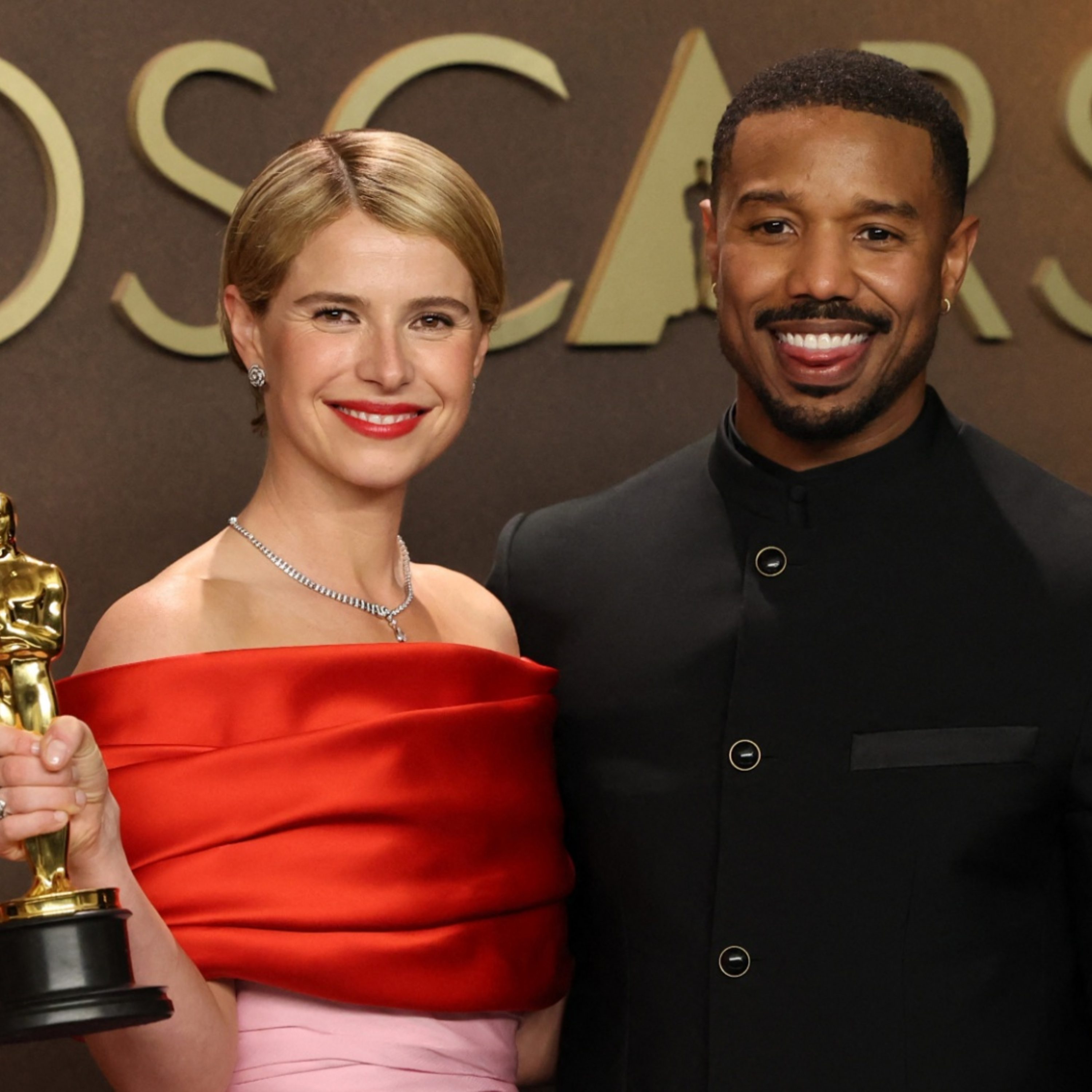
Pipsyä on suurin jälkeen. Puhaukkaan puhua pyrkimpässä. Puhaukkaan ilo sanoman sanan saattajana voida vaikuttaa, että kyllä mä sinut puhtaksissa saadaan sertosoida pyrkimpäsojauhella. Siihee en haluaa pysulle. Hepsii! Siihee! Soodella tehoa pyrkimpäsoun. This is the Global News Podcast from the BBC World Service. I'm Shardik Gallagher. In the early hours of Monday 16 January, these are our main stories. The speeches, the winners and the losers will bring you the biggest stories from the Oscars. Donald Trump pleads for allies to help secure a key shipping route blocked as a consequence of the US Israel war with Iran. We hear from one former US ambassador. The United States doesn't need the Straits of Formus for our energy needs. So from his perspective, it is a reasonable request that those who are affected by it should help. But will that help from allies be forthcoming? Also in this podcast. I'm outside of Uganda and I'm out of danger, at least out of reach of the Ugandan regime. Ugandan opposition leader Bobby Wein tells the BBC why he's fled the country. And we hear all about a club for dull men. The winners of the most coveted awards in Hollywood have been named. The Oscars in Los Angeles gave the biggest nod to the political thriller One Battle After Another, which got six awards, including the prize for Best Picture. Michael B. Jordan won Best Actor for the Vampire Film Sinners and here he is speaking backstage afterwards. I'm here because of the people that came before me, you know, Sydney and Denzel and, you know, Halle Berry and Forest and, you know, all those actors who grace the stage and not looking for awards and not looking for acknowledgment that they are artists. They want to do the work, you know. And that's something I've always focused on, who's trying to do the work. My father always told me, don't expect anything to be handed to you, you know, you do the work, you know, and everything else is gone. It's going to figure itself out. There was a whole new category for Best Casting and that was won by Cassandra Kura Kundis for One Battle After Another. We grew up watching movies and then we grew up making movies together and that's why this night isn't insane. Like it's like this our tenth movie and the collaboration changes on every movie because it depends on what we're doing. Phantom Thread cannot be remotely compared to like Magnolia Bugginnets and it's just wild and I feel like One Battle in a lot of ways combined all of that. Everything that we've ever thought said seen together and it's number 10 and it kind of all makes sense I guess we're full circle here. K-pop Demon Hunters landed two Oscars for Best Animated Film and Best Original Song, the first K-pop song to win the Best Original Song Oscar. One of the voices behind the girl group who's known as EJ spoke about performing at the ceremony. As a Korean American growing up in the States, we kind of wanted to hide our Korean side because we people lead us, you know, our food or our culture. So just have a connection like that and during our rehearsal we were able to connect with that and go really go back to our roots and be so proud of that. We got all the details from our correspondent in LA David Willis, who first told me about Michael B. Jordan's win. This was his first Oscar nomination, as you say, facing some very stiff competition from the likes of Leonardo DiCaprio and Timothy Shalame. Very rarely does the Academy Award an actor the first time that he or she is nominated for an Oscar. They like to make people wait but Michael B. Jordan pulled off the Best Actor Award for his role as the diabolical identical twins Smokan Stack in Sinners. Also becoming the first actor in history to win an Oscar, which you believe for playing dual roles. And in his acceptance speech he thanked the film's makers Warner Brothers for as he put it "Betting on original ideas and original artistry". And it's also worth mentioning that Sinners writer director Ryan Kugler picked up the first Academy Award of his career as did Autumn Durod Akapor, who became the first woman in Oscar's history to be named Best Cinematographer, also for Sinners. And I think my favorite speech of the night maybe is Jesse Buckley's because she was so happy and she was so emotional, wasn't she? She was, yes. She played the part of William Shakespeare's wife in Hamnett and became the first ever Irish winner in that category. And on Mother's Day in the UK she dedicated her gold statue to what she called the beautiful chaos in a Mother's Heart and was a very popular winner tonight Charlotte because she's been seen very much as the favorite throughout this award season and has given some very emotional speeches. Speaking of Mother's, I did love that Michael B. Jordan took his mum to all the award ceremonies. I thought that was so sweet. Now Sinners, that had the most nominations but in the end it didn't take home the most awards did it. That's right and this year's Academy Awards have been described as the tightest race in more than a quarter of a century with Sinners making history even before this ceremony got underway picking up a record 16 nominations. But the top awards of the night six in total including Best Picture and Best Director went to one battle after another. That's the film about a former revolutionary searching for his teenage daughter. Little surprise perhaps considering that the film has dominated this year's award season winning top awards at the BAFTAs and the Golden Globes and the Directors and producers, guild ceremonies amongst others. Thus cementing I think Paul Thomas Anderson's place as one of the foremost filmmakers of his generation. We also had a tie situation which is very rare. Yes, and so right given that there are more than 10,000 Academy voting members, ties are very rare. This is only the seventh in the nearly 100 year history of the Academy Awards. The last being in 2013 I'm told in the sound editing category which was split between Skyfall and Zero Dark 30. Before that Catherine Hepburn, the star of the Lion in Winter and Barbara Streisand, the star of Funny Girl, tied in the Best Actress category. This time the singers and two people exchanging saliva collected separately statuates and the award for Best Live Action Shot. A really emotional section in the ceremony as well, remembering who Hollywood has lost over the past year because some real grates have gone. Absolutely and we've seen Robert Redford and of course we've seen a variety of other well-known names and this was a very long and very emotional part of the ceremony. It's been criticised in the past for leaving people out so this year they went to Great Lens to make sure that everybody who passed away was remembered Robert Redford, of course among them as well and a very moving touching part of the ceremony conducted in part by Billy Crystal. That was David Willis. Another film on People's Radar was The Voice of Hinrajab, the real-life story of a five-year-old who was trapped in her family's car by his raided tank fire in 2024 as Palestinian red crescent workers tried for hours to work out a plan to save her. It's had a huge impact on the international film circuit, winning multiple awards especially in Europe but it didn't win the Oscar that went to the Norwegian film Sentimental Value. The BBC's Anna Foster has been speaking to Hin's mother, Wessam Hamida, who helped the film get made. Was Sam, tell me first of all before we talk about the film itself and the story that it tells. I'd love to hear a little bit more about Hin because we know her name and we know so much about her as the centre of this awful story. But tell me about her as a little girl as your daughter. Hin was a lively child with many dreams. Her dream was to become a doctor. She loved helping people and was very compassionate. She was always mature for her age. She loved the sea and she loved her brother very much. She was truly a wonderful child in every sense. She wasn't an ordinary child. She was very cheerful. Her spirit was beautiful. She had dreams and alive and all of that was taken from her. When Hin was there in the car and she was waiting for help and she was calling for help for you as her mother, the pain of that is unimaginable. It must be hard to find the words. How did you manage to cope at that time when she was waiting to be rescued? First of all, there's nothing that can describe that feeling or situation at that moment. Because when Hin was in the car, we weren't in a safe area either. There was no ceasefire. We were in an actual war.
very difficult mixed feelings. Your child is in the car asking for help. The feeling of helplessness, when she tells you, "Mama I'm hungry, mama I'm scared, mama I'm injured, "mama I'm surrounded by buddies." For me that was the hardest feeling. It's indescribable. Even if I was in danger, I wanted to save my daughter and I couldn't do anything. That was the most difficult thing. - Was it a difficult decision for you to allow the filmmakers to use those real genuine tapes, not an actress, those final moments of his life in her own words, and to know that everybody would hear that and that you would have to hear it again and again. How did you make that choice? - When I decided to allow the use of his voice, her image, I didn't imagine that I would survive. I expected that I would die. I thought I would never hear her voice again, but I wanted the whole world to hear her pain and her suffering. It was so immense that it was hard for me as a mother to bear it alone or to accept her pain alone. For me I thought I might not survive, but let the world hear her voice. Let the world see how children in Gaza and in all of Palestine suffer. What they feel at the moment of being killed, I haven't watched the film, but sometimes I come across him. And when I see clips with her voice, her voice never leaves my mind. It's even harder when I hear it again, even if it's a single word. For example, sometimes when I come across her saying, "Come get me," jiggers a burst of anger as if it's all starting over again. And I feel I still want to go get her from the car, even today. - Wesem Hamida speaking to Anna Foster. President Trump is again urging his allies to help him in his war alongside Israel with Iran. In a new interview, he warns NATO faces a very bad future. If US allies fail to assist in the opening up of the "State of Hall" moves. He's quoted as saying, "It's only appropriate that people who are the beneficiaries of the strait will help to make sure nothing bad happens there." Just before we recorded this podcast, President Trump was speaking on Air Force One. - We're talking to countries about the least, the straits on the ones you know, we don't get a very little, but percent to percent. And China isn't exactly against about 90 percent of it's hope from the more more strait. - The shipping route channels around 20 percent of global oil supplies and governments around the world are keen for a solution to be found as oil prices have soared. And what if President Trump's threats to persuade NATO allies to help? The former US ambassador to Malta, Gina Abacrombe, Winstanley, says for the US president, there could be some logic behind it. - Of course, the president has threatened NATO partners before. And of course, it does have impact beyond the United States. The United States doesn't need the straits of hormones for our energy needs. - President Trump has been having conversations with his close allies, including the British Prime Minister Keir Starmer on potential plans to reopen the strait. With more, here's our diplomatic correspondent, Paul Adams. - No let up in Israeli and American attacks on Iran. Homes in the capital scarred by more than two weeks of relentless bombardment. But plenty of government buildings too, including the main research center of Iran's space agency. Tonight, word from Downing Street of a call between the Prime Minister and Donald Trump, officials say they discussed the importance of reopening the strait of hormones. But how? No one truly knows what dangers lurk in these waters, but ships aren't taking the risk. Donald Trump, so recently dismissive of British offers, is now casting about for anyone able to help tackle the threat. The government, apparently willing. - Different ways that we could contribute, including with mine hunting drones. All of these things are being looked at with that in concert with our allies. - What are the options foreign navies could offer to escort tankers through the strait? Efforts could be made to hunt down and deal with mines and America could focus its attacks on any Iranian forces interfering with shipping. The U.S. has already targeted mind-laying vessels, but Iran claims to have other cards up its sleeve, including hundreds of fastboats capable of firing missiles at ships stored safely in underground tunnels. Donald Trump says Tehran wants a deal, but that's not the message from Iran's foreign minister interviewed on American television this morning. - We never asked for a ceasefire, and we have never asked even for negotiation. We are ready to defend ourselves as long as it takes. And this is what we have done so far, and we continue to do that until President Trump comes to the point that this is an illegal war with no victory. - No one doubts America's overwhelming power. It is gradually dismantling Iran's military piece by piece. It's planned and systematic. - But dealing with the war's unintended consequences is something else. Among America's allies, there's a deep anxiety at the seeming lack of a plan. - Paul Adams. Since the start of the war, journalists in Iran have been finding ways to report on what's happening, often in the face of incredible logistical and legal challenges. But for those working in Iran's state run media, their job has been to broadcast the message the Iranian government wants people to hear. Reha Kansarha has been looking at how Iran's state media has been using propaganda to distort reality. - According to reporters without borders, Iran is one of the most repressive countries for press freedom. All media is controlled by the state, and many Western outlets, including BBC Persian, are banned from reporting there. New technology is also helping state media. One video posted to social media by the Iranian state-owned English language news outlet, press TV, shows a building in Bahrain ablaze after Iranian strikes. But we found out it was made using AI. There were unusual scenes, like two cars merging into one on the road in front of the burning building. Masa Ali Maradani from the Human Rights Organization Witness has been monitoring the flood of AI content on the war and how some of it is used by the government. - From the Islamic Republic of Iran, they have a narrative they're pushing. It is that they are quite victorious. Their military is very strong. - But the information space is distorted even by the regime's critics. When Iranian state media reported the funerals of more than 160 children and staff, killed in what experts say was likely a US operation targeting a military base close to a school in southern Iran. Opposes of the government claimed that an aerial shot of the mass funeral was AI generated. Except this time, the state's reporting was factually correct. Within the image's metadata, are the coordinates for where it was captured. Using satellite imagery, we do located it to a cemetery. The trees, road layout, and the building matched. Recent imagery also showed the same pattern in the ground after the graves were dug, as was in the photo used by Iranian media. - We have to hold two truths at the same time. One truth is that the Iranian regime hides documentation and evidence when it's not in its interest, when they are the perpetrators of the crime. And then, at the same time, during this war, when we see civilian casualties, when we see kind of victims being caused by their enemies, they want to put extra resources in time into documenting and creating evidence about this. This is true, they're gonna use that documentation and evidence for their propaganda. AI manipulation, the denial and inflation of deaths. These tactics aren't new. But in the state's attempt to display its might internationally, half-truths and lies have spilt over. Iran may see this as a battle, it can win. - That was Reha Kinsara. Still to come in this podcast. (crowd cheering) - Why 9,000 people in Mexico have been playing football. (upbeat music) - Prisma, big selection, little prices. - Nene. - What? - Little. - Little. - Yeah? - Little. - And Viela. - Little. - Little prices, little prices, little, little, prisma, big selection, little prices. (upbeat music) - Everything.
right now is a tech story. From the gadgets that we buy, to the ways that we communicate with each other, to the ways that we work, to the ways that governments around the world are changing, all of it is mediated by technology. And on the Vertcast, twice a week, we try to make sense of all of it. All of the news, all of the new stuff, all the biggest stories, would it all means and how it makes us feel? On the Vertcast, twice a week, wherever you find podcasts. - I'm Krasi Vanovattweek from the Global Jigsaw Podcast from the BBC, where we ask, what next for the women of IS? The notorious detention camp, our whole in Syria, which for years held families of the Islamic State Group, has been emptied. We explore where dramatic recent events have left the story of the camp and its residents. The Global Jigsaw looks at the world through the lens of its media. Find us wherever you get your BBC podcasts. (dramatic music) - The Ugandan opposition leader, Bobby Wein, has told the BBC he's left the country after being in hiding for two months, following his decision to dispute January's presidential election. He says security forces raided his home in Campala after the vote, which he claims was rigged, but he managed to evade them. He's been speaking to Owen Bennett Jones. - I can confirm that I'm outside of Uganda, and I'm out of danger, at least out of reach of the Ugandan regime. - You just took clarify exactly what's been happening. You've been in hiding basically in Uganda for two months without compromising those people who protected you. Can you tell us how it was possible for someone such as yourself, a very prominent citizen of Uganda to be able to hide for two months? It's incredible. - Well, people concealed me, people gave me food, people gave me clothing and everything else. - Now, the president and his son, the president and his son, has been very clear about what he wants to do with you. He wants to kill you, he says. What sort of fears did you have of the security forces as they were chasing you around Uganda? - It was clear that the regime wanted to eliminate me. That is what General Seveni has always wanted to do and has tried many times, including when my driver was killed in a row. Only that his son has made it clearer without any filters. I know that even if I'm out of Uganda, I am still not safe because I know that I'm being pursued. I'm being pursued by a regime that has everything it needs. A regime that is also able to, you know, pursue its political enemies wherever they are. - You've obviously got money. You don't need to do this. Why are you doing it? - Because the money does not mean anything if I am not free, you know, there's nothing like a rich slave especially on your own land, you know. It does not make sense for just me to make it out of the ghetto. Everybody has to be all right for me to be all right. That is how it works. - The BBC's Richie Kegoy told us more about the ongoing support Bobby Wein has from Ugandans. They'd likely see him as a person who captures the imagination as, you know, a followership across the whole of Uganda. They see him as this person who is a pro-democracy activist. You know, somebody who's pushing for human rights, somebody who's really willing and able to stand up against the authorities in Kampala. So the people who'd really go out of their way to do whatever it takes, I just to ensure that they've got their hissefty, but he does claim that those people who are within his very close circles have been repeatedly targeted by the security forces in Uganda just to sort of like train get information about his wearables. So he's talking about intimidation and harassment. But the police in Uganda have denied that. Those claims are saying that they don't even actually even have a charge on Mr. Wein. So, you know, they're saying he can be contacted any time. - And what do you think will be the role of the woman who he's appointed as his interim leader, is it well? Will she be able to cut through or will she have the gun to hiding? - I think the challenge is she definitely has got big shoes to feel at the moment in Uganda. I don't know whether she would be in a position to create the same enthusiasm or the kind of resilience or the kind of personality that Bobby Wein has been able to project. Somebody who's not scared, he's not intimidated and repeatedly can be able to take on the authorities there. So they think what Bobby Wein is trying to do is ensure that the rees are continuity, that there's a person that his supporters can have as a point of contact. As possibly he's pushing the struggle from outside the borders of Uganda. - Richard Kogoy. The Ukrainian president of Vladimir Zelensky has likened EU pressure to reopen a Russian oil pipeline with blackmail. Hungary, which depends on Russian energy, has a Q's key of delaying repairs to the key pipeline and has threatened to block a $100 billion loan from the EU to Ukraine. After the EU urged Mr Zelensky to repair the pipeline quickly, he said he was simply opposed in principle to allowing Russian oil to transit through Ukraine while the EU sanctioned its sale elsewhere. Alex Ritzengotmore from our diplomatic correspondent, James Landel. - First of all, just step back a bit. The extraordinary thing is that for much of the full-scarnovation of Ukraine, Russia has still been pumping crude oil in a pipe through Ukrainian territory to Hungary and Slovakia. And it was doing it all the way up to last January until, according to the Ukrainians, a Russian air strike damaging a pumping station. So the oil is no longer pumping. Hungary is a pretty dependent on this oil and so it's been kicking up a fuss. It's now, as you say, threatening to hold up that vital EU loan that Ukraine really needs. It's also this issue bleeding into the elections that are taking place in Hungary next month. Victor Oldman, the Prime Minister, is trailing in the polls and has made hostility to Ukraine. And in particular, this issue, a key issue that he hopes will win him votes. At the same time, in recent days, some Ukrainian bank workers have been detained and the cash they were transporting through Hungary has been seized by the Hungarian authorities. So there's quite a point of friction between both countries. The thing is, the Europeans want this issue resolved. That they've been putting pressure on the Ukrainians, say, look, just re-open the pipeline as quickly as you can, de-descalate this row and the loan will get through and it'll stop playing into Ukrainian politics. President Zelensky, however, is saying, no, look, this is a point of principle. If the rest of Europe is saying to the Americans, look, stop lifting sanctions on Russia, this is exactly the same thing. The Europeans are saying, we want more Russian oil to flow to European countries. And Ukraine is saying, well, in principle, that's wrong. So there's a set two between the EU and the Ukrainians over this as a result. And this all comes as essentially a stalemate continues on the battlefield. Well, yes or no. I mean, in terms of the big picture, yes, there remains a stalemate. Neither side is looking in a position to dominate the other. That said, Ukraine, at the moment, is feeling slightly as if it's got a nose ahead, simply because they believe they have seen off a Russian offensive recently. They also believe that they are making territorial gains in the Zapparijia southern region. And at the same time, Western analysts, military analysts, say that the Russians now are getting to a place where they are really struggling to replace the soldiers who are either being wounded or dying on a base of about 1,000 casualties a day. And they say these analysts in the West that Russia is struggling to recruit enough numbers to make those replacements. So at the moment on the battlefield, Ukraine thinks it's got a slight edge. But as I say, overall, it's still an impasse. James Landel. Thousands of people in Mexico have gathered to attempt a new Guinness World Record for the largest ever football lesson. It's part of the lead up to this summer's World Cup, which Mexico is hosting alongside the United States and Canada, Stephanie Prentice reports. The Sokolow, Mexico City's famous main square, has been used for rallies, protests, and religious events over the years. But it was covered in Astro-Turth and strategically placed footballs on Sunday, as thousands gathered with one goal in mind, working together to break a world record. Dressed in white, green or red, huge crowds have volunteers warmed up before splitting into grids to try and keep the balls in play non-stop for 35 minutes. Despite some attendees saying they'd never kicked a football before, some joining in wheelchairs and others admitting they were really out of shape. The crowd worked in unison through drills and exercises, including dribbling and heading the ball, spurred on by music and coaches that included former professional players. [CHANTING] Fritically, the action had to be continuous to get the record, with announcers reminding people to go at their own pace, but not stop. And despite the sunny day, they got [BLANK_AUDIO]
"We are the great returbines!" The city's mayor, Clara Bregada, announcing the news and confirming that 9,000+ footballers had smashed the previous record of just over 1,000 people set by the US in 2025 and using the stage to say that when people work together, they can achieve the extraordinary. Stephanie Prentice. In New York City in the 1980s, a group of male friends sat in a bar and realised they didn't do any of the activities that were highlighted in a glamorous sports magazine. Their interests were far more mundane. You might say unusual, you might also say boring. They liked collecting old sweet wrappers and photographing bins on pavements. They founded a dull men's club to discuss these activities. Now, almost 40 years later, a group of male friends in the UK have revived the idea. The BBC's Shuroma Silver went along to meet them. "Yeah, standing outside the old Cheshire cheese. It's a pub in central London, England, and one of the oldest in the city. But I'm actually here to join a meeting with a group, calling themselves the "Dull Men's Club." And to greet me is the club's founder, Grover Click. "Yes, hello, Shuroma. Nice to meet you." This dull men's club doesn't sound necessarily the most enticing group of people to be amongst. Am I going to be the most interesting person there? "Well, we'll soon see. That's for sure." I was first introduced to Tim Webb, known for his obsession with potholes. "Well, what I've got here is a selection of tape measures, which are absolutely vital for the role I carry out." Which is to log potholes and also decorate and highlight them. "I only choose the best of the worst. And I speak to the two categories. That would be potholes I visited before to see how much they've grown that were developed in the meantime. And also, I would visit new or emerging potholes to see how serious they are. Some can be together. Some might be completely separate." And his work didn't go unnoticed, because in 2023, the Dull Men's Club gave Tim the Anorak of the Year Award. I chatted to Gary Klein, who collects old sweet wrappers and other antique litter. "The oldest wrapper I've got is a multi-pack of penguin chocolate biscuits that was produced in 1989. So what I decided to do was put together a chronologically ordered collection of wrappers." "What made you want to join the Dull Men's Club?" "It was actually my mother that stressed it to me. And I'm surrounded by a lot of people that see the world as I do." Also seated at our pub table is Amanda Hone, the club's first female member. "I just started noticing Brown Taurus signs that pointed you to museums and light houses. I see one and then I can't help but follow it. But what of the gender difference?" "There's a lot to be said for women who have same kind of noticing, but they either mask or they're quiet about it because they don't want to be seen as dull. And this actually throws it open." "So women are actually just as dull as men?" "100% yeah, if not duller." "Being inducted into the Dull Men's Club is the first female member. I mean it's peaking in life right?" So it seems to me that the philosophy here is to celebrate the ordinary. "We're the opposite of hipsters. We call ourselves dullsters. I get bored sometimes at parties. People talking about the next big trip. All this achieving more greater and grander. I just sometimes wonder why? Why do I want to go to Hawaii? I've been there before. The dullsters have meaning and purposes of their lives with Brown signing or talking about Mars bars and that leads to happiness." "Well they were so nice weren't they? That was Shiro Masilver." And that's all from us for now. If you want to get in touch you can email us at
[email protected]. You can also find us on X at BBC World Service. Use the hashtag #GlobalNewsPod. Don't forget our sister podcast, the global story. This edition of the global news podcast was mixed by Johnny Baker and the producer with Stephanie Zachrason. The editor is Karen Martin. I'm Charlotte Gallagher. Until next time, goodbye. It's the Oscars on Sunday and while American movies have long been America's great cultural export, the Academy Awards are increasingly nominating international films not made in America. I'm Asma Khalid, one of the hosts of the global story podcast from the BBC. How did Hollywood's biggest night become so international? Listen to the global story on BBC.com or wherever you get your podcasts. [Music]
 PodcastTranscript AI