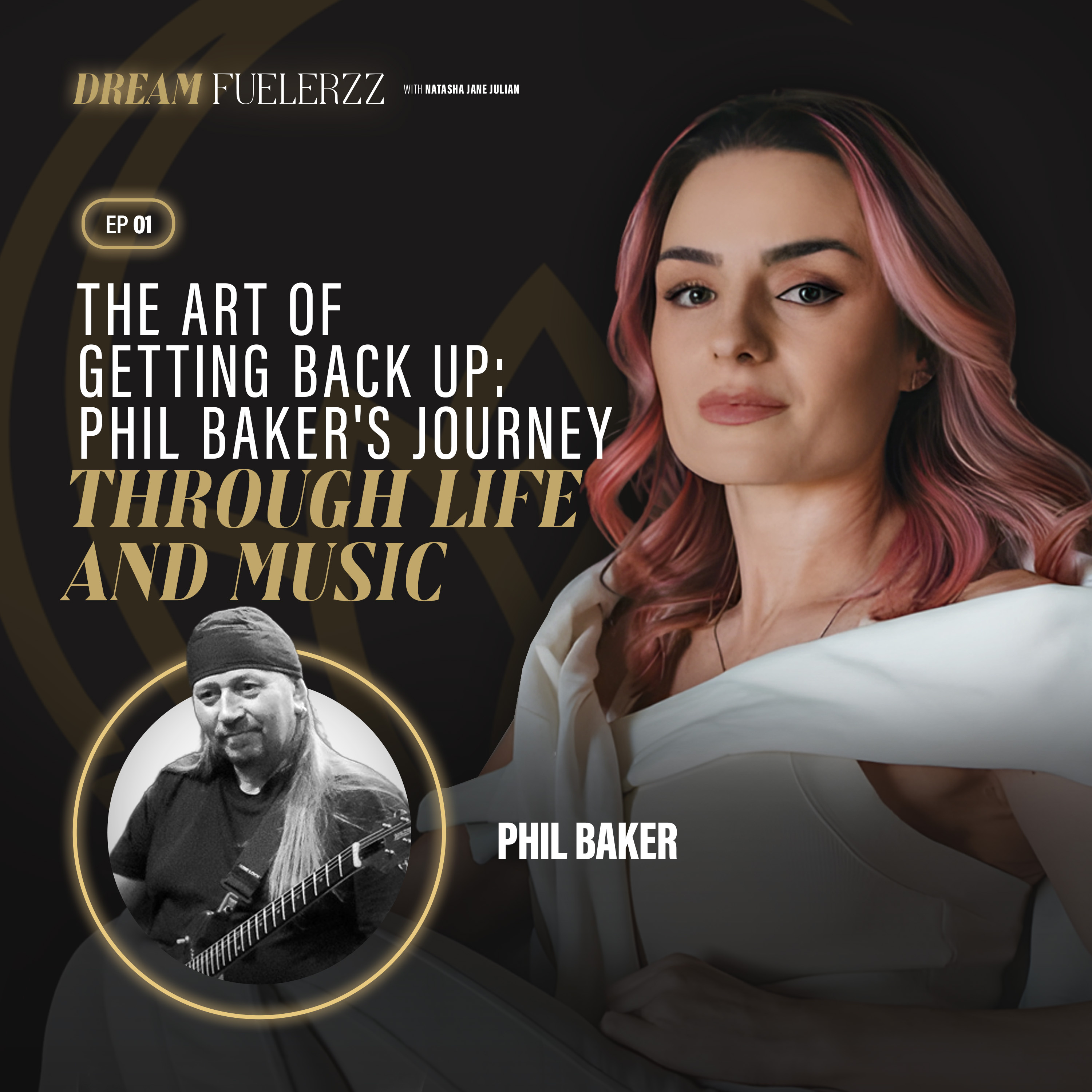
The Art of Getting Back Up: Phil Baker's Journey Through Life and Music
from Dream Fuelerzz - Tools and stories to rewire your mind and reclaim your power
68m 30s
In this episode of Dreamfuelers, host Natasha Jane Julian welcomes Phil Baker, a renowned musician, composer, and author, to discuss his life, music, and new autobiography, "I’ll Be Ten Minutes." Natasha recounts how they met at a Uriah Heep convention in Belgium in 2015, where they bonded and later collaborated on her first EP, including the song "Gemini Twin," which marked a pivotal moment in her musical journey. Phil shares that the book’s title reflects his habit of saying "I’ll be ten minutes" but taking much longer, a humorous trait recognized by friends and colleagues. He reveals that he never intended to write a book; the idea struck him suddenly after a visa interview, leading to a decade-long writing process with editor John Winstownley. The autobiography explores his diverse life experiences, from personal relationships to various jobs, emphasizing resilience and the importance of getting up after being knocked down. Phil discusses a challenging marriage where his wife admitted she married him only to be a good father to her daughter, a revelation that tested him but which he handled better due to past heartbreak. His music career, which began in his youth, faced interruptions from emotional turmoil, but he returned to performing in the late 1980s. He also shares his unique practice of playing guitar in the dark to feel the instrument, enhancing his ability to sing and play simultaneously. Overall, the conversation highlights themes of perseverance, reinvention, and the healing power of music and storytelling.
Welcome to Dreamfuelers. I'm Natasha Jane Julian and I've been through it all. Anxiety, panic attacks, you name it. I'm here to show you that healing is possible. I'll share my journey and chat with other guests who transformed their lives. If you're ready to reclaim your power and chase your dreams, you're in the right place. Let's dive in. Welcome to Dreamfuelers podcast. On today's episode I'm really excited to announce a friend actually who's going to be joining me today. Welcome Phil Baker who is a world renowned musician, composer, and overall really good guy who's had a million jobs in the world and he also just released an autobiography. So welcome Phil Baker. Right, Nat, you okay? Good to see you. Good to see you too. And thank you so much for coming on this show. And it's so great to have you here. I know we haven't spoken a long time. No, we haven't. No, no, it's good to see you. All the way from the UK, it's amazing. All the way from the UK. You know, you know, when I was a part, or at least I was a part, but we're, you know, it's like as if we're starting the next room. Isn't that crazy? I know. So let me just kind of give you a little rundown on Bill's and how we met actually. So I feel like we're really two different worlds apart and how like the universe kind of brought us together and how we met is really strange. But so yeah, I met Phil at a a Uriah heap convention in Belgium around 2015. And he was there playing with another band and doing a bunch of different things. And I was there with my band and we ended up doing some stuff on stage together. And from there, we just really built a really strong friendship and you actually produced and and did a bunch of songs for me, my very first EP. And I first, my very first song, Gemini Twin, and then followed by the EP after that. So I put my Gemini Twin. You just didn't know what was, and I didn't know what was, I was going to arrange it. It just, you know, it just sort of came out. Yes. Over a period of open. Absolutely. Gemini Twin, I can remember the day that I was, I was actually living in Florida at the time. And you had sent me like the first, like, I'm on set, the little first maybe one or two minutes of the songs of the cure, the production for Gemini Twin. And it was like, I remember this moment so strongly. Like, was the very first time that I just felt this aliveness and the fact that this was my song. I never had heard my song produce before, you know, something that I just think, I don't think, I'm going to be on the piano. And then you send fact, it was really exciting and it was really like fulfilling. And that moment I'll never forget. So thank you. It's a great feeling that, but sorry, it's a great feeling that, because I remember when I did my first recording in 1977, there was some called Memories, which was the first song I ever wrote, whatever it was like, 14. I did that at a record studio with Kirby and Liverpool. I did two songs, sorry. I'd sit there with a cassette tape for days, just listening to the two songs thinking, wow, these are actually like songs, you know, but they recorded. And it is, it's an amazing feeling, you know, when you first hear songs, we record it, whether you record it itself or, you know, it would have somewhere else. That is, I would say like, I never expected. I never prepared myself for that feeling. And it's probably kind of why music kind of gets you hoped. I mean, the process from beginning, you know, to ends where you're seeing your song completely done. So you are a huge part in like visualizing that dream, like, and then having that actually done. So it was really exciting. And then so after I met you in Belgium, I was actually in Florida. And a few months later or six months later, something my family actually moved to the South of France to Europe. So you were my, I was one of my only friends, I lived in Europe. And yeah, it was great. So from there, you helped me build my backing band. And I flew back and forth from the UK to France. And we played, we played in in Blackpool, we played well, Stopy plays. We played, we played Blackpool, we played in, we played at Marine Hall in Fleetwood, we played up in Dunn, in Paisley in Scotland. And we were back in the, they meet Wyners to be born as well. That's right. And we played a few places, yeah. It was good. And then we played, we did some acoustic stuff in France as well. That's right, and knee sprints. So, so from my time in Europe, you like, you were a huge part of my life there. And as well, like, the band and you having, like, built me a band and knee having my songs, my originals, and that the band was playing. That was so cool. And so, yeah, that's how me and Filmeh, that was our time that we spent together. And we have some really special moments. So that's why I wanted to have you on this podcast today. And now you just wrote a book in Tato Biography. And I just really think that you're a really interesting person. You have had like a million lives. You've done so much in your life. And you're a true artist. And you're so talented. And you're also a real survivor. You reinvented yourself so many times. You're a tough cookie. And you're just a really true example of the solid human that people can, you know, learn from and see their life to see that you've done so much and how you come out and the other end. And you've always managed to create through all of it. So, I think that's why although it was the main reason of the book, right in the book, but I think that's why the more I sort of started writing the book, the more I realised. And John Winstownley, the editor, who helped me edit the book, I started realising that it was something that people could read, to help people to sort of when you get knocked down, just get up and carry on. I think you get knocked down. How did you get it up again? Yeah, I was just thinking about that song. And so I said it was like, I'm going to go into tune. But yeah, it's, and there's many things, there's many things in the book now that I think about. John and I were spoken about, but they did the editor and he said, you know, it can help other people. You know, sort of read it and sort of like you never know where you're past, going to go through life. That's part of the book as well. When you make a decision, you go down one route, but you could actually come back to the same place, but just down, down a different route. That is so true. And you know, because people always have these brief and seem to know, how their life's going to go. And it's good, cup can. You know, we all have goals and hopes and dreams and plans, but sometimes they make, you know, totally different times. And if you are accepting of that, then you know, and realise that there might be a reason for those recently turned from my eG to something else. When I was reading this book, I must say, because you're a real natural storyteller. I must say, like, hand down. This book is very entertaining. Like, keep you on the edge of your seat. There's so many different stories. And as I was reading this, the stories, I remember when we were hanging out, if you were telling you about this time, this thing happened to you, this girlfriend that you had. I remember a lot of these stories that are in the book. And so they were, it was almost like you, why was reading it, like telling it again in my mind. But I do, so this is the book. It's called "I'll Be Ten Minutes" by Phil Brewer. Yes, thank you very much. And "Auto Bai Avife" into my life as a musician and beyond. I wanted to know, why did you decide, like, how did you come up with the title? And "I'll Be Ten Minutes" is a bit of a, I suppose, a private job between a lot of people, you know, because nine times out of ten, not just to do with the lads who used to work for me when I had the audio, I business just stuff like that. They'd phone me and say, Phil, we've got a problem. And I'd say, right, I'll be ten minutes and they'd put the phone down and say, Phil's got to be an hour. I love that. Unfortunately, unfortunately, there are people in my personal life who seem to think, well, let's say I'll be ten minutes, I'll be an hour. So maybe it's just a trait of. I think we have something
in common for sure. I told you for this interview, like, I'll be five more minutes. It was more like 20 more minutes. Say 30 points. Yeah. Yeah. I'm good. At least you knew. That's a woman's prerogative though. It's not a man's. Right. But I love that. It's just kind of your trait, your character trait. Let's fill it. That's why I wanted to call it. You know, the few people said, "Oh, you can't call it that. It won't be any good with a website because it's got a covering or a circumflexing and it's going to mess it up on the website if you put I'll be 10 minutes in that." And it was like, "But that's what it's called. So that's what it's going to be." But yeah, no, I'm glad. A lot of people have said they think the title's really good. No one actually understands what it means. They just did the title's good. It's interesting for sure. And I remember at some point in the years that you did say that you were writing the book. So here we are, maybe about 10 years later. Passha, why me? Oh, yeah, yeah. About 10 years later, you finally got that book done. I know you've been working really hard for the last beaver is finishing up and busy. Did you always know that you were going to write a book? That you were going to be an author? No. No, I didn't even even five minutes before I decided that I was going to write a book. I didn't think of it. I was never writing a book. It was only a few people that said a few times in the past about me telling stories. But I'm going to like listen to stories, but I'd never thought about the other way. I said, "You should write a book, I'd never really thought about doing that." However, after I'd been to the embassy to get me beaten to go for the interview from a visa that knew I was embossing and with everything that was going on from that, on the way back I was thinking, "Right, I'm going to write a book." So when I got home, I actually wrote everything down and it happens at the embassy, which is in the fall with the book. And then he's been from there, really. Got a lot of it, really locked down, but I still had, I still, after the met John, my family, the editor-in. The last two years I've sort of really kicked in and got it finished and all the editing and back was up all over to everything and then it came out last November. That's such a huge accomplishment. So, congratulations, I know that I, you know, I haven't written book myself, but I know that how much work goes into that and I just want to congratulate you and say not only that you've accomplished so many other things as a musician and father and other areas of your life, which we will go into, but yeah, you're also an author, that's really pool, that's a huge accomplishment. The more I think about it, now that it's done, the more I think about yet it is because I've never ever thought I'd ever had a book in my life, you know, I don't really read that much. I read, I wrote a cycle, mechanic books and maybe, you know, I've read loads of the rings and I read science stuff and I like mythology and all that sort of thing, but I'm not a person to sit down and read loads of books, you know, myself. So, I've never ever thought about doing it, but I was bit sort of not scared, but more easy about whether people would like what I'd done, you know, I just thought it had to be done, but I've had so much good feedback from people, you know, who know me and whatever I've said, this is great and what are you doing in audiobook? Right. There you go, something to think about, but yeah, no, I mean, the story has and the book has all sorts of stories from personal relationships to all the different jobs that you've had and we sure that there's been through some fully big lessons through that. Yeah, yeah. Such a sight. The girl who, the fairy who only married D for because she thought you were going to be a good father to her daughter and the time that your ex-girlfriend attacked your new girlfriend with a breadmife and the kitchen, then light to the police about us. So, those are some of the stories that you were getting to in the book, but let's go back to the the fairy. I think it's so you want to marry a fairy or something like that and the chapter, like, when did she tell you that she only married you because she thought you were going to be a good father? After we got married. Okay, after. How soon after? Oh, literally, I can't remember. I think I put in the book, maybe two or three days, but it might have been a week, but it wasn't more anymore than that. It was just so like it's like, I don't know, maybe I went to give her a kiss or something and she just stay around and said, and so, rushed the way and said, "Oh, the marriage is perfect." Because I said to her, "What's wrong?" or something like that and she just stay around and said, "Well, I actually was only married because she was very good. Father's from the daughter, because she had a middle three-year-old daughter." I think I think she's not my two-way-mife, I spent 18 months or something like that. Well, we got married quite quickly really, but I thought it was the right thing to say. I have my heart and my sleeve sometimes, where my heart was, so it was sort of like, "Oh, yeah, this is it." I mean, mid-twenties, I should be getting married. They're all the usual things, the other society tells you, you should be doing it, you know? And so, it was the right thing to do. Yeah, I did, I loved it, but she didn't love me. She ended up loving me around about nine months later and she told me that, or by then, it was too late really. Gosh, that must have been really difficult. How did that affect you afterwards or did you carry on and did you get moving? We depressed like, how did that affect you after they're always usually? I think because I've had a relationship with someone else, a couple of years before and we'd be together for like five years and we'd spent every day together. We didn't live together, we'd be spent every day together apart from living in our pair of trousers. We spent seven days a week and so up and when we split up, that was, I went off the rails completely off the rails. I was like, it's, you know, I was just drinking and borrowing money and all this sort of thing. I ended up in a real mess. So when it this happened with my wife at the time, I was upset because I loved her daughter. We back out, I was, no, no, adopt her. You know, she's a great kid. You know, we, the two of us bonded and you know, we used to do all things together and put me ex-wife didn't really want to be that interested. She just wanted to watch telly and slow. And there I think because of what had happened with the previous relationship, I'd hardened up a bit. So I was able to cope with it a little bit better than what it would have been if it had just happened. You know, I was still, I was shocked. She was certainly excellent really. But then, you know, once you turn around and said that she was over after nine months, that was, um, by then I'd just lost a lot of respect for her. I didn't, you know, we didn't. There was no violence or anything like that. It was just, I'd just lost respect because of what she'd said. Right. Absolutely. And then she just said that we said, good go on and back up north and start again and then said, okay, if that's after the day is the said to work, okay, that's what you want to do and you'll be happy. Then let's do that. And then see for the moment that I want to do the divorce. Yeah, okay. It all by full, man. Right. So that was just the beginning. That's just that was just the beginning. Yeah. So after on that relationship, you had, um, string of other jobs. So your year 20s, um, tell me also, let's go kind of back up just a little bit from because you started from a young age, um, music and were really good from the young age, um, as a guitar player and you also played piano as well and other instruments. So when did you start playing music and was this all still going by you were having, um, these relationships and all these jobs as well? Well, the, see, the music size, it was really, I was the most better to be on. I would say I was the most better guitarist, but I was 18 than I am now. I was playing.
I was really, really, I played, you know, see where I was at day and I was in the musicals and all this sort of thing. I fell in love before my ex-wife. I mean, I fell in love with this girl, I was 17. Although we met through music, I was up in the street and she was watching me and she didn't realize one of her friends knew me and I ran the look as a blind tank and everything. But it going well forward five years, the music was what split us up because she didn't like me playing in front of people. - Really? - She just wanted, yeah, she was jealous of people watching me play. - Okay. - And so that didn't help the relationship and because of all the women split up and everything, I really, I lost the plot and I stopped playing for a while. Which is a stupid thing to do. But then when you're young, you know, if you have a heartbreak, it's the worst thing in the world even though people tell you it's not. (laughing) - Yeah, a heart, it's been under the world. - Couldn't relate to that, especially if we're in a teenage or early 20s, it's like, oh no, it's like, you know. And you have to be, yeah, that was, and so the music thing died off of it. But I started playing again before I met my ex-wife. - Okay. - I tried to name names. - Okay. - I would still play guitar and stuff, but I wasn't really playing semi-frescial or whatever, which is what I'd been doing. That came back later on in the late 80s, where I was in a pub one night, and I got up singing with some back-and-track stuff and the someone else I was and someone said, when you're playing, next, and I was like, well, what do you mean? They said you must be doing gigs, you're very singing everything. And that's how I ended up starting the solo career in the clubs and the clubs, and that's how it all kicked off. Again, for me. - Amazing. Remember you telling me, we used to like, to learn when we were really young, it was a teenager that was to like, play it with your eyes toe, so you can really learn the, is this right? It's been really learning the chords without having to look. - Yeah, I used to practice in the bedroom and tell all the lights off and, and that was a good learning curve. For learning how to sing and play it at the same time. 'Cause a lot of people can't do that. A lot of people, there's, you know, there's a lot of friends of mine who play in the great musicians and all the great singers. But if you ask me to sing and play it at the same time, some of them find it quite difficult even just doing arm release and stuff, and I've been fortunate that I've sort of learned to do that, but I think I watched a guitarist in a bar in Liverpool in the mid 70s, playing Hendrix, and you were amazing. I watched, there was something not sort of wondering, he was sort of like struggling to find his paint and his role, he gave him his paint, and then his role, he'd take it off, but he'd back and get it, and the guy was blind. And he was, and he was amazing guitarist and he was a culture pianist as well as guy. And I've thought, wow, did you know? How did we, at least, you know, should I have to, I've learned to play, I can't watch what I'm playing, I have to feel it. So I started playing in the dark to feel where you're playing on the guitar, rather than looking at it all the time, you know? - That's beautiful. - And because I'm not looking at the guitar, I can, because I'm not looking at the guitar I'm playing, I can think, because you, you know what I mean, it's like multitasking. That's what I mean. - I should have tried that. I'm not thinking, is it too late to start trying that? That's great advice where somebody learning, just learning, like if you could do that, maybe you'll get the feel of it, whether than trying to focus so much on where your finger's hours. So, yeah, because you watch a lot of people when you're sat there and you're just like that, and they're looking at the chords all the time, and then they're looking at what they're playing, and the thing is because they concentrate on that much on it, sometimes they might even be concentrating on what the rest of the band are doing. - Ah, yeah. - You know? - That is true. - You sort of really need, sort of just be saying, okay, I'm playing the chords, but I'm watching what the bass player is doing, or I'm watching what the fingers are doing, and that, you know, all that helps. - Yeah. Well, we're going to get into some of these stories, real quick, as you know, mine. - Okay. - So, you've had a lot of different jobs, that's what I think is so interesting, and cool and crazy about you. I mean, everything from construction, and the cement jobs, and a radio station, and one time a stripper. (laughs) - Well, it must be twice. - Twice, so, and I love it because you just like, we're always ready to do the next thing, whatever you needed to do to survive, and that you were never shut down something, it just seemed like you're okay, what do we need to do all this to even have a girlfriend that was like house cleaning, and then you did that in some window washing. So, I think it's just so crazy, you know, a true human, a true survivor, I mean, to step in and do what you need to do it, and you give a moment for all the years. So, on page 69, you had a job, a cement job. - Yeah. - And you said that it was one of the hardest jobs you've ever had, but it really toughened you up mentally and physically for what you would go through for the next 30 years. And in the job on page 71, you actually ended up falling in the muddy, murky water. - Yeah. - And then afterwards, end up getting blood infection. So, can you tell us about that day? - I am, yeah, so I won't go into the full thing about cement and everything, but they use their own, it's food, sack of water in a well. And it gets pumped out from the press house at the top, back down into the well, from all the cement mixture before it goes into a kiln. And one of the vows had gone, and then all the, they had a massive link up there, and all the water was pouring down the hill, and all the rest of it. So, we went on to fix it. And the blue circle guys who were working there, had roped a whole area out, where you were supposed to walk, because they had poked their pump and everything out. And I went, we had to get the tools from our up to the stairs, went to the guys and said to them, is there anywhere where we can't walk? And they said, well, you'll see the boats where you can't walk. But unbeknown to me, what I went down to pick up the tools, or the, all the ropes had fallen in the water, and because it was well water, and it had like, or like bits of cement in, and it was gray and everything. You come see the ropes in the water, and I just basically just walked off the side of this, some, because there was no grill on top of it, and just went down, and it was a submersible pulse of the pot, and so I pulled me down. And I got out, I don't remember how I got out, but I got out, and then I did tell stitches in machines, I had a hole in my leg, and all that sort of thing. And then after the couple of days, I got blood poisoning from the actual water as well. I think it was off for about six to eight weeks. - Now. - And then, but we were in unions or in like that. We didn't really get the compensation. They pay me wages for six weeks, but, because you're self-employed. - Right. - And then the union thing with self-employed people was nonexistent really. But it's a lot better in America, but in the UK, it was yourself employed, yourself employed, that's it, you know? - Yeah. - Well done. - You just don't read it anymore. - That was it. - That was it. - But it took from me. - Yeah, so you said that, and that job, like toughened you up, and that just because like, you had to still, these things happened to you and stocked it up the next day. You had to carry on with your life. - Yeah, because that job we were doing, we used to, most of us had been in hospital, once every three or four weeks, with the outpatients, with like either brains or something in your eye, or, you know, or technician Jackson, because you've cut yourself all sort of, it was just, that was just the way it was in the '80s. - Yeah. - You know, that was, the motto of the contractors was just do it. 'Cause if you didn't do it, there was 300 people behind you would take a job. - Right, okay. - And so you couldn't complain about what you were doing, you just did the job.
job and that's what that's what took from me. Yeah, hear you there because it just seems like a lot of young people, young men, especially from the cast generation, older generation. Yeah. Even my mom's husband, it just seemed to have a bit of a tougher, you know, core like to do these things as it may be because of these jobs that they've had that they've found for these experience rather than like the current generation, maybe we have them having jobs that are YouTube or social media. They're missing a little bit of that because they haven't gone through these, you know, tough jobs and had to experience and it is stuff. So I mean, there's some value in that. No, you're right because like I don't know what it's like over in the States with this, but like over here, especially after Brexit because with the European, with believe in the European Union, everything. A lot of the farmers over here are struggling to get people to pick the crops, you know, the strawberries and all that sort of thing. And, you know, the government, the previous government's the stuff I'll be saying, well, the youngsters of great Britain will do that job. They don't want to do it because it's too hard. And years ago, you would like, I had a paper round when it was 11. I'd walk two or three miles to just go and drop a paper into a door and get blocked out by a dog. Right. And then walk three miles back or two miles back or whatever, you know, suddenly just to live in this one paper for me dad, because the other news, he had a paper show. But all the kids, we all used to have little Saturday jobs and everything because that's how you wear it money. Right. No, your parents wouldn't just give you 20 pounds of 30 pounds of week and something going on. And we never had phones or anything like that. And I think these days, I think, yeah, I think it should be, the body a bit too easy lately. Yeah, I think everybody needs at least one hard job as a university. I'm care and take to like waiting. I think I'll do the rest. Well, yeah, I think I think too many people go to university or college now where they should really have apprenticeships. You know, if you could so you're layered on the job when you get in paid at the same time. Wait. Absolutely. That's just the things that happen that much in the UK. Anyone who's going to wear a sweat, or in other countries, well, it's I think it's something that because you know, do your business shifts and everything. It opens you up. Sure does. Yeah. Well, we are going to go into a couple more really quick. We're going to talk about another girlfriend that you had that there was an incident with the bread knife in the kitchen. And her name was Kaz and you said that she kind of looked like a Zina Zina, the warrior princess. So tell us about the night in the kitchen with the bread knife in the police game. Well, and it's in the book, but like Kaz was a hero and I think although I got off her wing two or three times, she ended up going back on it again. And eventually I just couldn't take it anymore. You know, I don't know if I walked out. So when she was, she was, she would not unhair her and met her. She was a heralded or what a mess. She was on methadone, which is when people take methadone, they're just seeing normal. And she didn't say anything about her addiction until four or five months into the relationship. And by then you sort of, well, I'll help you, you know. Yeah. You always were like a caretaker. Like I've seen you in so many. Yeah. Yeah. That's a big problem. That's a problem. That's your one. But all. Like if she told me the, the terrible things that say, but if she told me the day that we'd met, the serious bad owner of it, I would, more than four people, maybe even I would have just walked away. You know. Yeah. But these things happen. So she'd left and gone back to her mums in Sussex. And then I was by myself, while I was in the house. And then I met, met my kids, Mum. And Casas came back to pick some clothes up, which is left at the house, maybe five months before or more. And the dev wasn't the house with me. And I went to get the stuff out, the utility room or something that Casas, when they came back in, Casas was attacking her with a bed knife. Oh wow. Well, I don't know, the jealousy or whatever I don't know, even though we split up like six months before. And I had to try and get the knife off them. Or unfortunately she pulled the bed knife through the fingers and didn't play guitar for 18 months. Straight through. Wait. Oh, we are there. Straight through there. Oh my gosh. 18 months, not being able. A little bit scars, the story. Problem. But it was a straight in the bed knife. So it was serrated. So it was like that head. Yeah, just thinking about it. Oh my gosh. And then, so, and then who called the cops and then the cops came and you called it. Well, I had to pedal to the floor. And I got me hard to throw a police. And then they took her off to do it for a salt and she told the police that allowed her lies. And then I ended up with a load of police rounds, jugged squad and vehicle fraud squad and all this, like, right about three weeks later. And it all got a bit complicated from there, which is too long to explain there. But it didn't work. So the reason why I mentioned with these a few of these stories and these bloodation chips is you've had some relationships over the years and some of them have some really crazy events that happen. Some just some heartbreak. Just looking back, do you feel like you've cut any lessons bound? I have sometimes I think in one or two relationships. I could have helped more. Okay. To help because I see you with, you know, I've I thought I'd relationship with, you know, with X, Y, through love me and everything. There was no way I could really make that any different at all, you know. But I think when possibly the business with that, when I actually met CAD, if I hadn't had that problem, I might have been able to handle the heroin thing better. But it did try to get a off heroin two or three times, which you go off and then and she just went back on it again and they were spates of ads of cable. I think once totally avalaned, I suppose, understand and maybe listen more because sometimes in the past when I was younger I was quite arrogant and I'd just be talking. Okay. That's important, Jose. But listening, yeah, listening, I think listening is a very good thing. Especially if they've got a problem or they want to talk about it. Yeah. Problems sometimes is getting them to actually talk about it. I mean, I think they do. You're really good listener actually. So maybe in a time that I met you, you had learned to become a better a good listener. Did you think that overall that you became a hardened or did you become a little bit softer because you were more understanding afterwards? I think I became more hardened or I'll distort more even though I become hard. And it's difficult to explain. That's okay. No, I understand. You know what I mean? I'd become hardened for my feelings. But trying to be more understanding about the other pairs is really. Yeah. I understand. So I don't end up as a blueberry wreck in the corner. You know, I'd just take it but I try to understand what was happening with the other person. Yeah. I think that's really important and with relationships and
in general, I think that underestimates the power of listening. And that sometimes people don't want advice or don't even want feedback or for you to come up with the solution. Sometimes they just want your presence there for you to just be able to have someone to talk to. - And I've been told in the past, which maybe it's a good thing is that a lot of female friends have said to me back. They can talk to me. If they've got a problem, they can, you're like, blogs talking to blogs start a lot of times. You don't tell them each other problems and stuff, they just spot it all in. - Yeah. - And then, I think about the female talking stuff, but sometimes, and in the past, I've had a few female friends who go, it's really nice, I could sit here and talk to you about things without having to worry about anything, which I thought was a nice thing to say. - Yeah, I do think that you have that quality for sure. You feel, you make people feel very comfortable and you are not non-judgmental. So that's huge. Yeah. You're definitely like an open, comfortable email like somebody that you've known forever. And that's probably why we're being friends past. It is about comfortable. - Yeah, yeah. But I'm gonna ask you about that. On, it goes page 126, "Spin, your buddy was in jam." He had a stripper booked for the night and they weren't gonna miss you, Joeah. And he's like, well, I know you have a Batman costume. Well, you do this for, was it his wife or his girlfriend for like 40 years? - He was his girlfriend. - For his girlfriend, okay. - I didn't even know it. So. - Right, you ran and got your Batman costume. - Yeah, we, yeah, yeah. It's like, I was just up in the pipe and the pulpit and local pulpit. He's, I said, what's up? And he went, "Oh, the stripper grandma's not arrived." He said, "He sat down over there with a mate "and all this and he said them like, you know." And he went, "You've got a Batman outfit, haven't you?" 'Cause the kids, this goes and everything. I said, - Pulpit. - Yeah, he said, "Well, we do it." I went, no, you know, what I'm gonna do, that he went, "I'll give you 40 pounds." I went, okay. (laughing) - Ooh. - And only then five minutes away. So I went back and got it. And I don't know who was more embarrassed me or his girlfriend, 'cause I didn't really know his girlfriend. - Okay. - Then did it and, 'cause I had a cassette player and I could only remember what song it was. (laughing) And then, and then I finished it and this and the guy came up to me and he went, "Can I book you for next week?" (laughing) So I ended up doing an album. - That's awesome. I love that story. - And that, yeah, that was, that was the only two times. I was a bit slimmer than and a bit better looking. (laughing) - I love that because you would never expect that. And like, because you'll see in the book, if you read it, I mean, you'll probably, every job under the van, you'll see. - I think that's a five on one. - Yeah. - Yeah. When I met you, you're like, "Oh, I'd do backing tracks too." You would perfect backing tracks. And you'll have like, as amazing voice. I mean, having even got into that, we're gonna go into your music and that next. But I mean, just, you're, say, your vocal ability. I was on your rock vocal list, but you could really sing any song on your perfect pitch. So it's a little, - I think that was the choir, the choir training. - The choir training, okay. 'Cause it was a, you like, I was like nervous to sing, especially when you first met like, but you, but again, you made me feel so comfortable, but even though like, you're super dope and super talented, you still made me feel comfortable. Like, it's okay. Like, you can make a mistake. It doesn't matter. It's a very uncool, really, really important quality. So. - You know, you're still, you know, people are still, it's like when people are playing guitar and they're learning guitar. It's, you know, you've, you've got to give them a bit of time and patience to get into, you know, what we're doing. - Yeah, and there's a comfort level as well. So I really appreciated that, you know, about me. But let's get into your, your music. So your music, your identity, and other things you've played in, some really big tribute fans, getting the pink boy, both tribute fans. You've also played for the, Mem, the ex-members of your right-hate, were a big part of that group, and you've also done solo stuff, and you really performed around the world. What did, I would say you're performing, give you emotionally. - Like different feelings for different types of gigs, I suppose. So when, when these do the pink toy to be banned, I would be playing a front of, well, two or three thousand people at a gig. That was amazing because, a lot of pink Floyd music, anyway, but everyone's singing along. Do you know what I mean? The whole place could be singing like, wish you were here, or, time, or, do you know what I mean? And then we had really good guys doing light shows and everything, that was like the whole, that was just an amazing experience. When I did the solo stuff in the pubs and the clubs, that was completely different because I used to tell jokes, as well in between songs. - Mm-hmm. - And so, you know, you'd sing a song, then you'd go out into the audience, and, you know, that much that was the world, make a joke and all this sort of thing. And you used to get them singing, you know, like "Wonderful you by Elwoods," or "Oh, there always be all this sort of thing." And it's all, what we've, what we used to call them, the Blue Rinks Brigade, which is all the old days, you know, the social clubs and all the Saturday night play, being there, and all that sort of thing. And you're entertaining them. And that was another different, but that was, that was enjoyable, because you used to, you did it, I did it for like six or seven nights a week, for like, 10 years. And to be honest, it got boring, because it, it's here that we're in some of the job, just the job. But the only reason why I'm not used to it, was joy was watching, all of them, smiling and clapping, and able to freak it back, and go back off then. - Yeah. - So it was a different, different things in different ways. The right legends, well, when I started playing for them. That was a completely different feeling. I was so nervous, every gig, because I was playing with the guys who I used to sit in the repulmpire when I was 13, 14, watching them on stage, and roll on for 14 years later. And I'm actually playing the top of them. And that was really weird. And it used to take two or three songs into each joke for me to actually settle down, because I'm thinking, "Yo, I don't want to make a mistake." (laughing) - I know that that nervous stage right I've experienced it, and a different way. But yeah, I know that two or three songs, like, "Took you just ahead." - Yeah, and until I was able to completely relax, yeah. - But you know, people say, if you just walk on stage and you're relaxed and there isn't a problem, you're most probably gonna make a mistake. - A whole time. - It's the adrenaline and the nervousness. You were saying at a stage, you should always be on your toes a bit. You know, because you could be come to what's the word. From a half day, I don't know whether people will know what that means. - Yeah, maybe somebody just told me this a long time ago. (laughing) That that nervousness is good. - Yeah, nervousness is good. It's good. Or the adrenaline, you know. - I was definitely, I remember hearing when you were saying that you had performed six or seven nights at 8, for like 10 years' strength, how so jealous. (laughing) And then I was like, how do I do that? I remember, and we performed as much as we could for somebody who was living in France and I was flying over for rehearsals and to book a few games here and there, but I remember thinking, wow, that would be so cool. And it's difficult to do that. I mean, unless you're obviously touring it performing for a few months straight. And Los Angeles, they have like a really hard scene to play in because it's not like a pre-repro when you're in a small musician on this not they get. So you end up having, you know, you're out money because you gotta pay the band and you gotta pay the venue because you gotta sell a certain amount of tickets. So I cost you money to pay you.
play out. And I was just thinking one day it would be so cool to try and raise the money and to come up with the venue that musicians can play to actually get paid, get them a hundred couple hundred bucks and they get paid and it doesn't have to be this thing where you have to pay just to perform. Because of first beginning moments and this beginning months that you get practice and you get to, you know, learning your stage and your performance skills and I was loved to find some way to do that one though. But she. I think one of the problems over here is nowadays is and it's to do with the the pub circuit now because it's the pub circuit and so it's collapsing a bit and a lot of youngsters can't go to your venue more because they're Brexit because they have to have a car name but all the equipment's in stopping the costume watch money and they can't go over there and cut the teeth as I say and do all the small gigs and whatever. It's a lot of the places over here now we're paid for play. Oh really? Yeah, yeah, yeah, down. More apparently, I don't know because I wouldn't go into doing it but apparently in South it's a lot. But then a lot of these a lot of these cup of bands who do the pulsing stuff, they're just doing it for, you know, for enjoyment or weekends, you know, and a few of them most of we like the the ego side of it with people watching them play and stop like that and if they're working through the week, they're mostly all right if they pay an extra, you know, pay 50 quid to a pub or something to say, I'll tell you how about a band playing there. It's the people who are writing their own music which is sad because the people who write their own music should be the people who are getting paid to help them promote their own their own stuff, you know, and it doesn't act that way as you know. And as I know, well, I want to ask you a few more questions before we wrap up. But you know, I know that you gone in and out of music throughout the years, even though you had all these up and ups and downs with your fresh my life and what kept you creating, you know, I mean, always coming back to music after heart rates and disappointments or you keep our lump people and nights eight billion years but it's really like running species is what kept you job from losing it. I was playing a little manager junk it, whatever was three, a little manager junk it and once put the stick through the snare, me dad was like, that's it, you're not getting another one, you know, maybe because I was making too much noise as well, bashing away to the beat, all this sort of thing, I don't know. But and then I got a keyboard where it was eight. So the music thing is always being in me from a, for a late. So even when I was going through all this grief and all this sort of stuff, like even when when I was a little bit casus with it, I never said it, I was still after which I still, I had a guitar and stuff, and I was still did the gig in the local pub. Not many, but I still did it a bit, but I think the music has always been there in the background or in the blood. I love that. It's always been there. And I'll always be there, like you know, at the moment, as you know, I've got this workshop with a load of motorbikes and do the job and do the job. You said a workshop with a bunch of motorbikes in there, right? Yeah. Yeah. Yeah. Another thing he does. Yeah. Well, out of bike business in the 90s. So, when I'm always done, but the, I'm not really playing as much as I used to, but I am doing some more gigs with Korki from Elton in September. And I'm actually off to get you to interview for US Reza in two weeks. Because I think Korki is asking me about coming over and doing some pro. Well, gig though, when it's night, right, you're on in the air. So it's all, you know, it's all the music is still there. And I still listen to music. I still sit down with the guitar. I don't practice the motives that should do really. Especially with having the two carpets on the, on the rest of the over the years. I should be playing more. But the music is still in there. And I'm looking at I'm trying to do another second album as well. Which is, no, it's like I'm a global performance. I just need to never stop working. It's a good job of living by myself. The within the busy girls right now. You're a born. I love that. You said music is just in your blood. You're a born creator. You're a born singer musician. You have, when I make me a head songs to the world out. I'm one of your albums that you can find on your website. But you are also working another album right now, which is so cool. What matters most to you now that didn't matter then in area. What's important to you now? To me now, being happy, which is like we get to grow it up. And I'm still working because I'm all of a big pension or anything like that. But I know that I'm in a more chapter place than I was when it needed to go. And I don't think as opposed to that's the main thing. And it's like people, people, people, people, people, people, people, people, I've never seen you. Like grumpy. I might shout a moan a lot. But a lot of people who have never actually seen me go you know, be depressed or those things. I have to agree. And we spent a lot of time together. And I actually, I don't think you've ever seen you like in a bad mood or drumpy. You have maybe said in like some famous filmmaker saying, are like, oh bloody hell. Oh yeah. That's Bullocks. But you know, FF, you know, I'm still well now. Well, you wouldn't be depressed for the day. You wouldn't roam around. So I mean, you always carry on. Ruvon. So that's the, I mean, your story is go ahead. That's something I play over. That's, I suppose that's character building. Using it over there. If something that, that when you get over the years, you sort of, you develop that. Like, you know, you wake up in the morning and think, I wake up some more and go, I can't be asked to get it up. And then it's just like, so yourself outfield, get up. And then you just get out of bed and up. You go, you know, I mean, it's like, that does not very often. It's just sort of, uh, I don't know. You just, I've never been out of work in my life. And if I've been out of a job, lost all of it, something's happened with the job and I've got any money coming in. I'll go sit there and go, we're going to do, you know, it's just like, right, I'm going to find something. And I'll always go out and you just, life is tough. No matter what anyone says, unless you've got a billion pounds in the bank, and even then that won't make you very happy. But life is tough. And, and you have to accept that life is tough. And what you make of life yourself, yeah, is what will make you happy if as long as you do what you, I think that that's, I've waited that right. It's something like that anyway. Yeah, I mean, I love that, like, just wake up. That you wake up and you're, oh, I want to get up now, sort yourself out and get up. Yeah, I just like, you know, all my family are the same. And the kids are really proud of the kids, you know, they just, they've got all the, don't swallow you know, generally, so you've not done it. Yes, I'm not in the cave and they're doing great. So, um, so your story, your, I'd say just your human experience is really one of transformation, surviving chaos, becoming wiser. And using, uh, humor, I would say sometimes, um, for me, it seems like you use humor for, for healing, but it could just maybe be your bodies and resistance, way of pushing through things. I think you have a huge resilience and your story is it really about rebuilding yourself so many times which you have done me can meet in this book. After all, that's happened to you throughout the years. What does peace mean to you now? What does peace mean? What does peace mean to you? I think to be honest, I love peace is the right book. It's nice to know.
that it's been passed away tomorrow. It's nice to know that I've held a lot of people over the years. Okay. Because I've had people like, you know, I had a guy who I will name name for in the lab, but a guy who sort of held him when I did the audio business and the Pink Floyd Jimmy band and everything. And he foaming from the Alawake Festival a few years ago and said, I feel like you're doing, I'm just doing, he was doing a thought about sound for a big band at the corner of everyone. And he said, I just phoned you to say, I'm at the thought about the Alawake doing, whoever. And he said, if it was a few, I wouldn't be here. I'd just like to say thanks to come from them. Now, I've got a few things like that have happened and I've never really drawn out me way to go and doing this to get gratitude or thanks of being. So it's nice to know that although I might have done some bad things in my life and stuff, I've done a lot of stuff to tell to the brink. Yes, you know, I didn't mention this yet. That is me, paint. Back to me, that gets you piece. That's beautiful. I would say that I will second that. I will say that to this day, you are one of the nicest human beings that I have met. And you taught me a lot and you were really, I didn't really realize it that but just seeing you in your day to day and going out on a limb and helping people and offering to do things for them without any expect for any something back. He never expecting something back. He did it because you wanted to, didn't do it within you moans and growlums, you just did it and I was like, wow, okay. This person is, this guy is really nice. It's a really nice guy. Thank you. But I think it happens to look these days. They just expect something in return for all the time. Like, okay, I've written me book and yeah, I've got a lot of blood to my blood to people that write it because, you know, it's allowed me in the pension and stuff, you know, but other things, you know, just helping people out and stuff. I think people are expecting too much these days. They always want recompense for something that they've done. Yeah, that's interesting. And I think it's, I think that's would go down the road, helping you that way. Yeah, that's really interesting. But for sure, it was a huge, I'll say awakened for me, like meeting you and getting to know you, you like our hands down, like opened up a whole new world. And I was really taken back by like, like, there's another way to live. And I've always been like, I consider myself a pretty nice person, but like, no, you were doing things that like you were going out of your way for people. And I just, I just love to lost that. It was so refreshing. But before we go Phil, so this, hold up your book again. Where, can we buy your book? Where can you find your music? How can we support you? Well, the books on Amazon. It's on Kindle as well. Okay. You can buy it in all the bookstores. So I think there's a bookshop to all of you in the States. Okay. I think I've got a website which has got all the different links to like water stones and all the living bookshops and everything. But if you just put in, I'll be 10 minutes for all of that going into Google. I do come up quite a bit. So I'll show you whatever. We see D, you can buy a book that's on Spotify and Apple and all that sort of thing. The only problem with Digit or as you know is that you get run about.01 or a cent. That means I'm played by his CD not just reading it. It's remastered. The Goliath remastered last year. The CD. You know, it's amazing. Oh, yes. Honkster World. Yeah. Goliath remastered from 2013 because I mastered it originally and I wasn't, you know, I'm not a master remasterer. So just me. A master master. But a margin cut from studio in rough grain in Liverpool. Erie Maxas, it's all me and Ali sounds amazing. Ali, I'll have to send you a copy over because I know you've got a copy. The original one. I'll buy it. I don't know when you got a copy of that one. But I do. Well, I should say that. You'll say lots about my music. But some of your music is amazing. That on a mechanical heart. I still say it's most of all the best songs you've ever done, the Dumballi. Thank you. And I know I was on it with a bit of Ebo and some Backing Bones, but mechanical heart is. I still listen to that now. I'll act and listen to that all day. Thank you, Phil. Yeah, that was a great experience too. I didn't even get too bad. But after the first album then I worked with a great producer in a indicate called Dumballi, whose work was being cut. Everybody from. Which Mark Bronson's European sound. Yes, it's a bunch of you. And you wine house stuff and that he even worked in the dough and steam. And he produced my album, my EP. And I went to England, we did that. We worked on that EP and mechanical heart. And I mean, I shot the video. Like you're all alone. You are so great as well. But it's something just about mechanical heart. It's just the white and singing and the feeling that's in the song. So anyone who's listening to this, if you haven't bought it, go out and get that music because she's a great songwriter and there's some really good stuff. Thank you, Phil. Thank you so much for everything that you have done for me. And I'm so excited for that you finally got this book out into the world. And I just have to tell everybody that, you know, this is a story of super, super talented human being, musician, vocalist, composer, multi-instrumentalist. And everything else you've done in your life. And this is a new, you know, story of surviving, reinventing yourself. And I think a lot of people can relate. And also your crazy storyteller as well. So it's super entertaining. So yes. I'll be bringing an audio. I'll be bringing an audio book out too. It is well, so amazing. So go buy us book. I'll be 10 minutes and check out his music and support an artist in their truest form. Thank you so much for coming on the show today, Phil. Cheers, Phil. Well, happy later. Thanks for tuning in to Dreamfuelers. We hope today's episode inspired you on your healing journey. Remember, transformation is possible for everyone. Follow and share with someone who really needs it and we'll see you next time. Keep dreaming big.
Podcast Summary
Key Points:
Natasha Jane Julian hosts the Dreamfuelers podcast, focusing on healing, resilience, and personal transformation.
Phil Baker, a world-renowned musician, composer, and author, joins as a guest; they met at a Uriah Heep convention in Belgium in 2015 and collaborated on music, including Natasha’s first EP.
Phil recently released an autobiography titled "I’ll Be Ten Minutes," which chronicles his life as a musician and beyond, emphasizing resilience and getting back up after setbacks.
The book’s title stems from a personal trait—Phil often says "I’ll be ten minutes" but takes longer, a joke among friends and colleagues.
Phil never planned to write a book; the idea came spontaneously after a visa interview, and he wrote it over about 10 years with editor John Winstownley.
The book includes stories of personal relationships, jobs, and life lessons, such as a marriage where his wife admitted she only wed him to be a good father to her daughter.
Phil’s music career began young; he was a skilled guitarist by 18, but heartbreak led him to stop playing for a while, later returning to solo performances in the late 1980s.
He learned to play guitar in the dark to feel the instrument, improving his ability to sing and play simultaneously.
Summary:
" Natasha recounts how they met at a Uriah Heep convention in Belgium in 2015, where they bonded and later collaborated on her first EP, including the song "Gemini Twin," which marked a pivotal moment in her musical journey. Phil shares that the book’s title reflects his habit of saying "I’ll be ten minutes" but taking much longer, a humorous trait recognized by friends and colleagues. He reveals that he never intended to write a book; the idea struck him suddenly after a visa interview, leading to a decade-long writing process with editor John Winstownley.
The autobiography explores his diverse life experiences, from personal relationships to various jobs, emphasizing resilience and the importance of getting up after being knocked down. Phil discusses a challenging marriage where his wife admitted she married him only to be a good father to her daughter, a revelation that tested him but which he handled better due to past heartbreak. His music career, which began in his youth, faced interruptions from emotional turmoil, but he returned to performing in the late 1980s.
He also shares his unique practice of playing guitar in the dark to feel the instrument, enhancing his ability to sing and play simultaneously. Overall, the conversation highlights themes of perseverance, reinvention, and the healing power of music and storytelling.
FAQs
Phil Baker is a world-renowned musician, composer, and author who recently released an autobiography. He has had many jobs and reinvented himself multiple times throughout his life.
The book is titled 'I'll Be Ten Minutes.' It's a private joke reflecting Phil's tendency to say he'll arrive in ten minutes but actually take much longer, a trait his friends and colleagues often noticed.
They met at a Uriah Heep convention in Belgium around 2015. Phil was playing with another band, and Natasha was there with her band, leading to them performing together on stage and building a strong friendship.
It was Natasha's first song, and hearing Phil's production of it was a pivotal moment for her. She felt a sense of aliveness and fulfillment, as it was the first time she heard her original song fully produced.
Phil was inspired after a trip to the embassy for a visa interview. On the way back, he decided to write a book, and with the help of his editor, John Winstownley, he realized it could help others who face setbacks in life.
Phil's first wife married him because she thought he would be a good father to her daughter, not because she loved him initially. She later fell in love with him around nine months later, but by then, Phil had lost respect for her.
Chat with AI
Loading...
Pro features
Go deeper with this episode
Unlock creator-grade tools that turn any transcript into show notes and subtitle files.
 PodcastTranscript AI