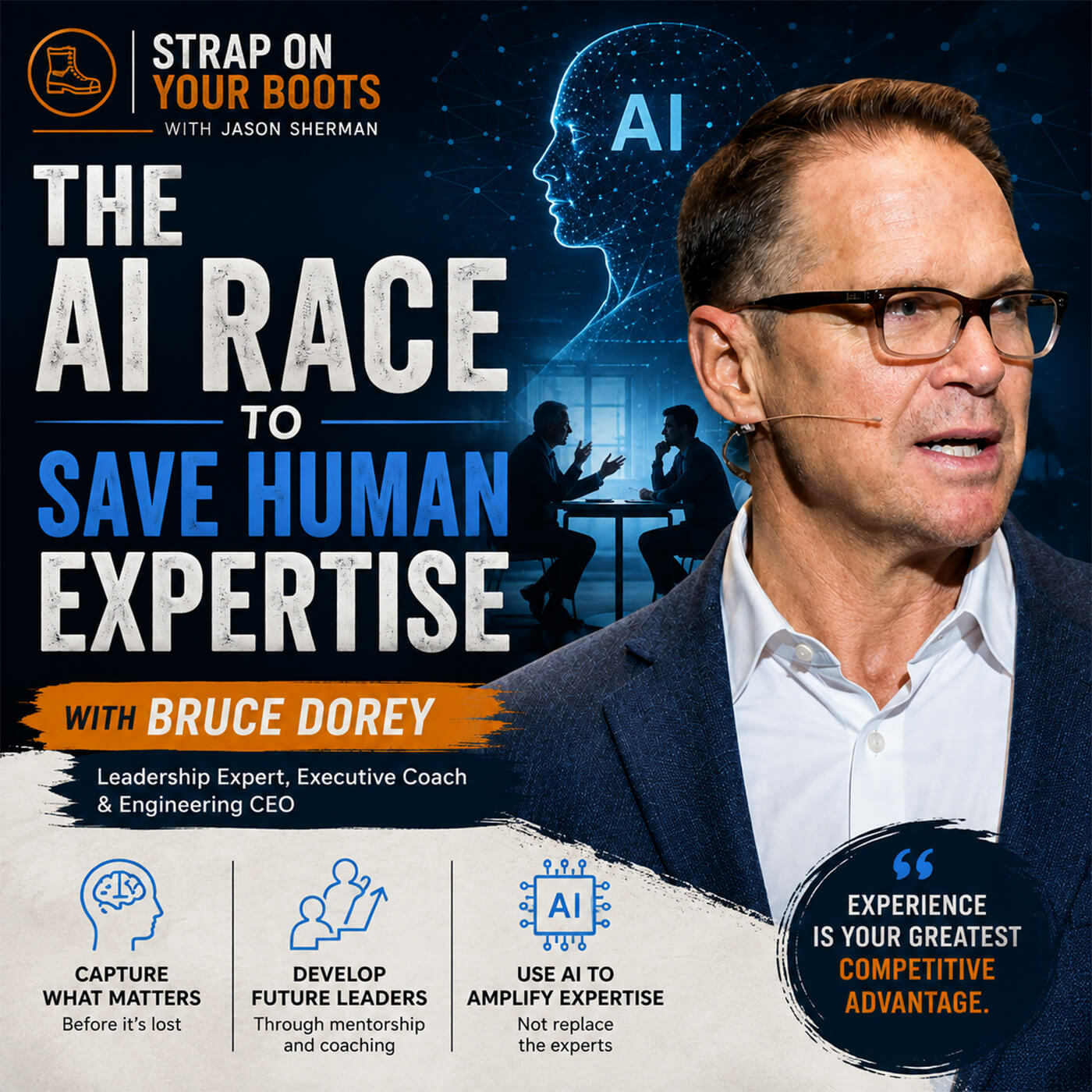
The AI Race to Save Human Expertise with Bruce Dorey
16m 15s
In this episode of Zero to CEO, host Jason Sherman interviews Dr. Bruce Dorey, a leadership expert and engineering CEO, on the topic of preserving human expertise in the age of AI. Dorey emphasizes that while AI is transformative, it should augment rather than replace human intelligence. He warns against letting AI operate without human oversight, as this strips away creativity and critical thinking. The core challenge he addresses is institutional knowledge loss, which often causes organizations to repeat the same mistakes. He advocates for mutual mentorship, where younger digital natives teach experienced professionals about new technology, while veterans share their hard-won expertise and tribal knowledge. Dorey introduces the concept of single-loop versus double-loop thinking, explaining that true growth comes from questioning underlying assumptions rather than merely iterating on past successes. He shares insights from his coaching experience, noting that effective knowledge transfer happens through genuine leadership engagement—short, frequent check-ins and allowing employees to fail—rather than elaborate but hollow mentoring programs. For practical implementation, he recommends using tools like the Vapi app to regularly capture employees’ lessons and failures in an informal, low-pressure way. Finally, he advises CEOs to identify and preserve key relationships and tacit knowledge, which are often more valuable than documented processes. Dorey’s message is clear: the future of work depends on humans and AI collaborating, with a focus on continuous learning and thoughtful leadership to pass the craft to the next generation.
Welcome to Zero to CEO, where seasoned entrepreneurs will teach you how to succeed.
I'm your host, Jason Sherman.
In today's episode of Zero to CEO, I speak with Dr. Bruce Dorey.
He's a leadership expert, executive coach, and engineering CEO.
Welcome to the show.
Thanks for having me.
It's nice to be here.
Awesome.
Thanks.
And today we're going to talk about the AI race to save human expertise.
Very cool topic.
AI is super hot.
And before we even get into the questions and the topic and everything, where do you
see AI going?
Because everyone's talking about how AI has been fundamentally changing the workplace
and people are losing their jobs to AI, but it's also helping with productivity and therapy
and health and everything.
But what about five years from now?
Yeah, it's such a great question.
I, yeah, first of all, I heard just the other day.
You know, that AI has achieved consciousness and, and that was from a fairly, you know,
fairly, it was from like a well-known source.
You know, in my little world, my little sandbox, which is kind of in the domain of building
a business.
So I'm a CEO of a small company.
We're a startup and written a couple of books about coaching and, and it's really kind of
this idea that.
We have to make it work together.
You know, I don't, you know, I don't say that in a.
Humans and AI working together.
Right.
And the poll is so hard to just let AI do it because I know, I mean, I'm, it's easy
to just put everything in there and say, Hey, we're all guilty of it, credit email.
And, and so I think, I think it's really learning to throttle back and, you know, get your team
to think.
Get your team to work on without it and yourself.
Yeah.
I agree.
I always say the human in the loop is, it needs to be there to operate the machine or
the tool, or, you know, if you don't, if you take the human out of it, then the creativity
is also taken out.
And so is the point of it, right?
The whole point is to help us evolve and be a better species.
Right.
So that's kind of how I feel about it now.
You have been focusing your career on preserving institutional knowledge.
Was there a moment when you realized.
That it was kind of becoming a critical business problem and that's why you were interested
in focusing on it.
Yeah.
That's another exactly pinpoint question because if there was, I was in a, I worked for a senior
vice president with a big corporate 500 company and for the millionth time we were doing the
same thing again.
And I, I realized that, you know, wait a minute that, you know, I know this is a fairly new
team.
This is my team.
I was just sitting in on a team.
I was asked, I was a strategy guy.
So I was asked to, and you know, we were dealing with the same problems over and over and over.
We're falling into the same traps, you know, different labeling and different but it, but
it was fundamentally the same process, right?
Same process.
Yeah.
Right.
And you know, it's, so I'm, I really have found it's this mutual mentorship.
So you gotta have the digital natives, the young guy, young folks mentoring the old folks
on what the hell this stuff is, you know, how it all works.
And then, then the guy, and I'm not meaning old in terms of age, I mean, old in terms
of experience.
A lot of people have a lot of experience in their twenties, a lot of, yeah, a lot of expertise,
a lot of knowledge, a lot of tribal knowledge, institutional knowledge.
And then it's using that, you know, with the new technology.
One way that the other is, is, is not going to work.
Yeah.
And also, you know, I, at least, at least on my end, we're always documenting processes
for people coming in the company.
So they know how we do things, but then if certain people who have learned over the course
of say two to five years, like you just said, kids in their twenties who are super smart,
they learn how to do things, then they leave, these are key employees and they take off.
So now.
The documented processes or documented information versus the real experience, how do you balance
that?
Cause that's, that's a tough one.
It is a tough one.
So there's a couple of things, it's a lot you asked there.
So first of all, let's take the case where you got somebody that's been there for say
20 years.
Okay.
And they're a good performer.
They've done really, really well.
They're a good performer.
what they have is useful but you can only capture so much uh you know and that's one of the things
our company is doing we're trying to figure out how to do that and that's easier said than done
but it it really is like uh kind of mentoring somebody you gotta put somebody but you know
the the old apprentice model worked it worked like because you're thousands of years yeah you
gotta fall over you gotta skin your knee you gotta realize you know that the i i you know
chris arduous is a was a harvard professor a really smart dude and he wrote a paper famous
paper called teaching smart people to think in which they first developed this idea of single
loop and double loop thinking and he basically said you know really smart people so these have
got men and women who come out of college really great colleges really you know great scores
they're they have never really made mistakes and all they've ever done is succeeded so they get
into a company succeed succeed and then they hit reality and they make some mistakes and fail and
they it's a problem for them and they don't realize that you know doing single loop thinking
that is like doing the same thing and then just sort of getting better and iterating is not the
best and that's probably how they got their degree because that's
you know basically you get force-fed stuff you gotta reproduce it but sink double loop thinking
which as arduous defines it you know i'm an engineer i like that i like metaphors like this
so the thermos thermostat is single loop right right set the thermostat to 72 degrees it gets
to 68 and it goes back to 72 right it goes back to 60 it goes back to 70 it goes up to 75 gets
back to 72 double loop thinking basically says oh wait a minute why do we have 72
like what did we it doesn't just keep going back to the 72 and getting that better it says
well why in fact do we have 72 anyway could we maybe make a change throughout the day could we
and that's how people begin to think and and they do that by failing like yeah and yeah so
and you know and hopefully as we were touching on earlier about ai hopefully that will help people
fail a little less right and so one of the questions people ask me all the time and you
know maybe you'll have a different answer is where do you see i guess the line between capturing
human expertise and replacing human workers right because that's there's two different things that
ai can do in that aspect yeah oh it's a tough one uh because you mentioned like let's let's let's do
an example right you said the 20 year old employee right you can use ai to essentially interview
this guy for a month every day
he's just giving it documents of the stuff that he does answering questions and then it's becoming
a version of him and his knowledge right yeah versus just putting an ai let's say a robot an
ai robot right putting him in on his desk and saying learn everything you can about this job
and take this guy's job yeah how do you where do you see that that line split
that's where we're headed yeah bruce i mean that's where we're headed
well i'll go to the i'll go to the i think the easy answer yeah hopefully it's not the easy
answer but the answer i come up with is that it is this garbage in garbage out so if all you do
is look to the past to go to the future that's you're just going to keep reproducing that and
versions of that so you're just not ever going to have breakthrough ideas and breakthrough
thinking because you're always going to be getting the right answer
and maybe not maybe not an idea that uh others aren't thinking about because because ai's share
information and once you kind of get up to speed on how do you do this everybody's got that and
then everybody's got okay how do i iterate on that and everybody within a you know within a
nanosecond every so i think it's going to be really really like clever people clever meaning
that they don't get they don't buy buy into you know more it's better and just got to get more ai
and faster ai and one ai against another is really sitting back and going you know are we
are we in the right game here yeah no i agree 100 and and speaking of these uh just clever people
and you've coached leaders across a variety of industries right and um have you noticed
what separates organizations that successfully transfer the knowledge from those that constantly
repeat the same mistakes like you you mentioned a lot
about the iteration but have you noticed the the companies that you worked with that are
successfully transferring knowledge yeah but versus the ones that are making mistakes like
what's the trend yeah that it's it's kind of counter to intuitive it was for me so the ones
that i found that are really that do really well have the senior exec mentor all the way down to
this sort of newbie and it's it's not it and they let them go for a long time they let them fail
they let them nice you know yeah and i and i was you know this was a a billion dollar company
and i was coaching a division this was years ago uh before i started the company um but um
yeah this guy was ruthless you know he he didn't like meetings he had
his one-on-one
ones are about 10 or 15 minutes that was it yeah it was like how's it going you better know what
to say in that meeting yeah and it basically like how's it going what do you need and then he would
do a bunch of short meetings throughout the month so it wasn't like he never talked to he talked to
people all the time but for short periods short periods yeah which i thought that was brilliant
and he also allowed people a lot of a lot of rope and then you know he he touched base with them
like a lot of updates progress reports and stuff like that as opposed to a company that i worked for
on wall street that had really strict guidelines on mentoring and like everything looked really
good like the mentoring program when i read it i'm like wow that is beautiful turns out nobody
like nobody like mentoring nobody like being mentored they're all like uh you know i'm on
the guy's lunch hour and you know he's on the phone the whole yeah he's on the phone the whole
time he doesn't give a shit about what i'm doing so
you know i'm on the guy's lunch hour and you know he's on the phone the whole yeah he's on the phone
oh my god it looked good on paper it just was not real you know the leader was not he the leader
didn't own it at all all right so let's let's say this let's say someone's watching or listening to
this right now and they have 20 employees in their startup yeah what system would you put in place
today to preserve the expertise as the company grows uh preserving the expertise i would i would
okay and um and a and a way to capture best practices with uh with a database so okay what
we what we use is uh what's called the vapi app v-a-p-i it's a it's an app right and and it
download so it asks questions on a on a weekly basis on a monthly basis of guys on the team hey
what'd you learn because you don't you know like it's punishment to get somebody to go and
okay i want you to go write down all the things you learned this month and you know what's really
important and it's like that's punishment so if you just give them ride home in the car let's you
know make this phone call answer these questions about 10 minutes long what'd you learn you know
what was important where did you fail and what'd you learn from that then that accumulates a nice
bit of data and a bit of information yeah it's more personal right yeah and it's and it's real
it's heartfelt too because you're just talking to people and you're just talking to people and you're
talking about it i like that and and before we start to wrap up i'm curious if if ceos that are
listening could implement maybe one strategy that could protect now we're talking about protecting
their company's most valuable knowledge yeah how do you how do you do that you know we that's good
point we ensure the real estate we ensure the uh we just don't ensure the most important thing
which is that knowledge and it's just it's just who i i i would say pull aside the people you know
and again i i use i just use a really simple vaping method where you just say look let's talk
about in my business let's talk about who are the top contractors in our region who who who do we
work with there who are the who are the people inside the organization who have relationships
with them because a lot of time
tribal knowledge is purely relationship yeah and it's not cutting somebody's grass it's just
knowing who to go to to say you know who do we talk to at abc engineering if we need to get
you know an equivalent design feature or what architects are really friendly to us about
you know energy efficiency and we can go talk to them or bring them on a panel or something like
that right super interesting i agree and um if people want
to work with you um and maybe they need help doing this where would they go to find you
so it's bruce dory uh br dory.com so br dory d-o-r-e-y.com and i've got a few books out there
my most recent book is called lift passing the craft and that's really about you know passing
the next to the next generation and lift is really a metaphor for leadership it it exists
lifting someone up yeah yeah lifting someone up but it exists only at the interface between the
wing and the and the air there's no lift in a wing right right it just doesn't you can't say
why guys got leadership inside of them no no nobody's got leadership inside of them right
makes sense not even you and you guys can get that book on amazon as well and reach out to
bruce at his website or on his linkedin as well hopefully you guys learn something about human
expertise and how to preserve it and protect it and we'll see you guys in the next episode
hope you enjoyed the episode if you learned something today please support this podcast
by subscribing to it sharing it with your friends and leaving a five-star review you can learn more
about me at jason sherman.org where you'll find information about my book also called strap on
your boots available on amazon as well as my course called startup essentials on udemy or
skillshare i'll see you at next week's episode
Podcast Summary
Key Points:
AI is rapidly changing the workplace, but humans must remain in the loop to preserve creativity and avoid over-reliance on automation.
Institutional knowledge loss is a critical business problem, often leading to repeated mistakes and inefficiencies.
Mutual mentorship between digital natives (younger employees) and experienced workers is essential for effective AI integration.
Single-loop thinking (iterating on the same approach) is insufficient; double-loop thinking (questioning underlying assumptions) drives innovation and growth.
Successful knowledge transfer relies on genuine leadership engagement, short frequent check-ins, and allowing employees to fail and learn, rather than rigid formal programs.
Practical tools like the Vapi app can capture tacit knowledge by prompting regular, informal reflections on lessons learned and failures.
Protecting valuable knowledge involves identifying key relationships and tribal knowledge, not just documenting processes.
Leaders must ensure knowledge transfer is a priority, comparable to insuring physical assets.
Summary:
In this episode of Zero to CEO, host Jason Sherman interviews Dr. Bruce Dorey, a leadership expert and engineering CEO, on the topic of preserving human expertise in the age of AI. Dorey emphasizes that while AI is transformative, it should augment rather than replace human intelligence.
He warns against letting AI operate without human oversight, as this strips away creativity and critical thinking. The core challenge he addresses is institutional knowledge loss, which often causes organizations to repeat the same mistakes. He advocates for mutual mentorship, where younger digital natives teach experienced professionals about new technology, while veterans share their hard-won expertise and tribal knowledge.
Dorey introduces the concept of single-loop versus double-loop thinking, explaining that true growth comes from questioning underlying assumptions rather than merely iterating on past successes. He shares insights from his coaching experience, noting that effective knowledge transfer happens through genuine leadership engagement—short, frequent check-ins and allowing employees to fail—rather than elaborate but hollow mentoring programs. For practical implementation, he recommends using tools like the Vapi app to regularly capture employees’ lessons and failures in an informal, low-pressure way.
Finally, he advises CEOs to identify and preserve key relationships and tacit knowledge, which are often more valuable than documented processes. Dorey’s message is clear: the future of work depends on humans and AI collaborating, with a focus on continuous learning and thoughtful leadership to pass the craft to the next generation.
FAQs
He sees AI and humans working together, emphasizing the need to throttle back on AI use to let teams think and work without it. The focus is on mutual mentorship between digital natives and experienced professionals.
He realized it while working as a strategy guy in a large corporate company, where the same problems and traps kept recurring despite different labeling, showing a lack of knowledge transfer.
He suggests using a mutual mentorship approach where younger digital natives teach technology to experienced employees, while experienced employees share their tribal and institutional knowledge. He also highlights the importance of double-loop thinking over single-loop thinking.
Single-loop thinking is like a thermostat that iterates to maintain a set point, while double-loop thinking questions the set point itself. He uses this to explain that smart people need to fail and learn to think more deeply, not just iterate on past successes.
Successful organizations have senior executives mentoring newcomers over time, allowing them to fail and learn, with short, frequent check-ins. In contrast, organizations with strict, formal mentoring programs often fail because leaders don't genuinely own the process.
He recommends using an app like VAPI to ask team members weekly or monthly questions about what they learned, what was important, and where they failed, capturing real, heartfelt knowledge without it feeling like punishment.
Chat with AI
Loading...
Pro features
Go deeper with this episode
Unlock creator-grade tools that turn any transcript into show notes and subtitle files.
 PodcastTranscript AI