The discussion centers on the current state of AI as a transformative platform shift, akin to the internet or smartphones. While its significance is clear, the specific products, business models, and winning strategies are still highly uncertain. The industry is moving beyond the initial model-building frenzy to confront strategic questions about product development and practical implementation, especially for companies outside the tech sector. The conversation draws parallels to historical tech cycles, noting that periods like the early internet were marked by confusion, numerous failed experiments, and hype bubbles before dominant applications like Google or YouTube emerged. Currently, a massive investment bubble exists alongside genuine exploration. Many large companies have run multiple AI pilots but now struggle to define a coherent strategy beyond automating discrete tasks. The core challenge is navigating the gap between the technology's vast potential and the present reality where many fundamental questions—from future model capabilities to the role of current tools like ChatGPT—remain unanswered.
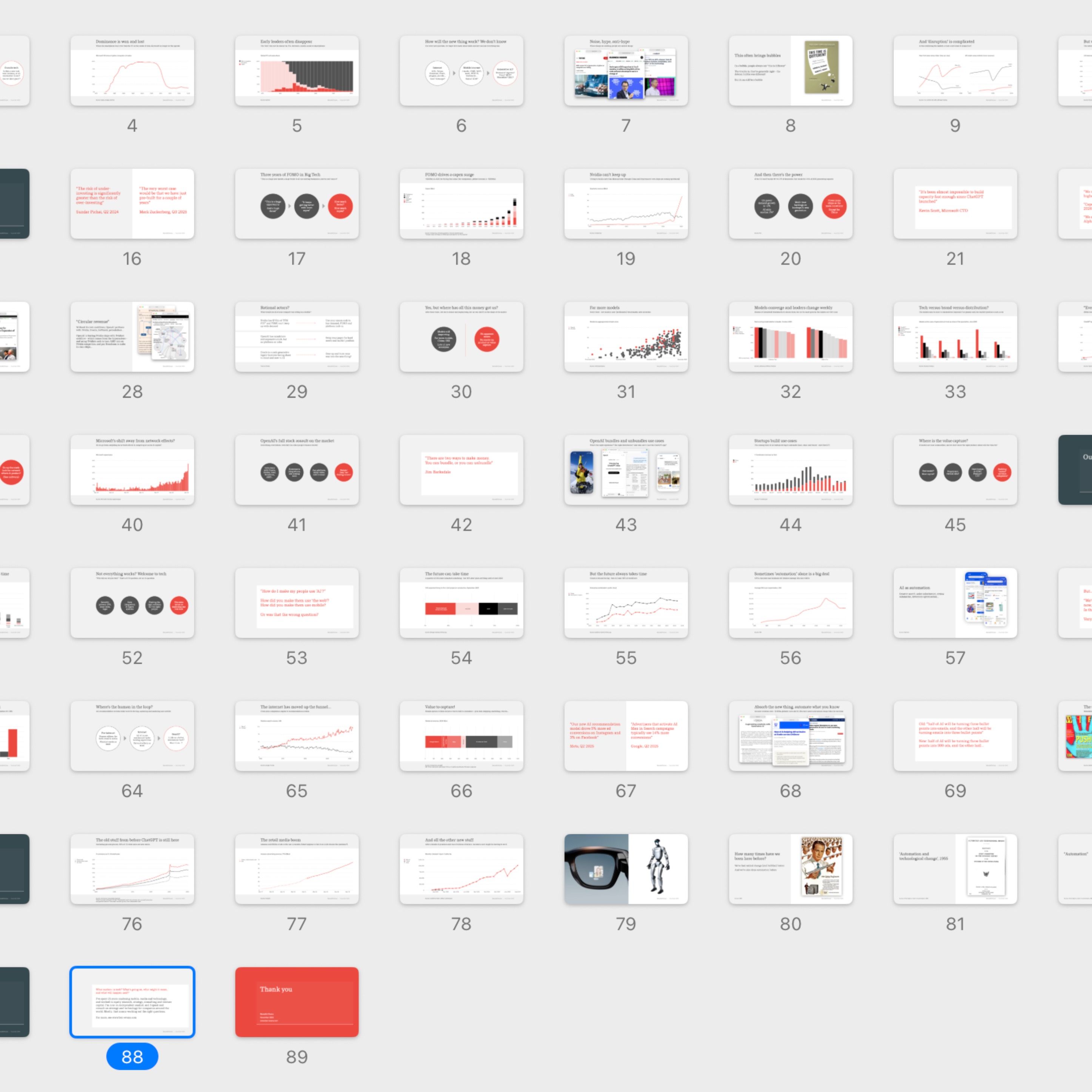
Hi, I'm Tony Karen Brown. And I'm Benedict Evans. It's that time of the year where you've worked on your 100 plus slide deck. I have, yes. Well, I'm not doing it twice a year, so this is the second of the year. I've texted a friend of mine a couple of weeks ago and said, "Can you ask Sam Altman to stop doing stuff so I can finish my slides?" Does he not know that there's someone here in the world trying to finish a slide deck? Yeah, I'm nervous, I'll be rooting. So, yes, I used to do, oh, I do a big present at Macro, Tren, as a presentation, and then I fly around the world giving that to companies in events for money. And I used to do it once a year, and now I've been doing it twice a year because, like, everything's changing so quickly. And of course, it's mostly about AI, although, of course, it's worse remembering that all the stuff we were excited about before AI is still kind of there and still happening. Like e-commerce is still happening. But AI has become the center of the tech industry, the big platform shift, the things that change everything, and that's what makes it more possible to be about. And so, it's that time of year where I've tried to pull everything together into some kind of coherent story of how to understand what's going on and how to think about it. Particularly if you're not deep into the models and don't know how to run your own benchmarks. And also, if you're not an Nvidia shelter and don't necessarily or an investor in startups and don't necessarily want to know all the nitty gritty and the blow by blow, but want to know, well, what does this mean for the rest of us and what's going to happen? What do we need to care about amongst all of this? And so, I've been doing that for various events in the last couple of weeks and I will do it at Flush in Helsinki in two weeks and then publish it. What's the bigger shift that you've seen from this presentation to the one just before it has there been a big big storyline or story arc change? So, I think there's obviously lots happening inside model land all the time. I think the shifting beyond that is much more clarity on what the sort of big strategic questions are for the big tech companies. And more clarity for people outside tech on what are products coming to them? What products might come to them? How might they think about what an AI strategy would even be and how they would answer that? I think we're now at the stage where most big companies that I had this conversation with someone over the summer. Every big company now has had like 10 AI presentations. They've had one Microsoft and Google. They've had the one from their agency. They've had the one from B.C.G.M. McKinsey. They maybe had one from their company. They've had stuff from Accenture. And they probably deployed a bunch of stuff and they've certainly got 10 or 20 pilots going. Some of which work some of which didn't. And they're sitting and thinking, okay, now what? We've automated a few things. We don't really have a good sense of what systemically gets automated with this, but we've automated some stuff. Is that it? How do we think about what this means? And then the second thing that's going on, of course, is the word bubble where these companies will collectively spend something over $400 billion building infrastructure. They have been throwing out announcements of hundreds of billions or trillions of dollars. Somebody at KKR the other day coined the word brag of what instead of gig of what. Because people are kind of bragging about how many gig of what's their building, particularly open AI, obviously. I think we have. And then within that, we've got much more sense of, or what is it that you would try and do with this? If you're Google or Microsoft or indeed, if you're opening I like what are the sort of strategic questions starting to shape out into? And I've kind of struggled to write about this industry of. I've published everything on my website for now six months, which is the first time I've, that's been a very long time because for a long time, the questions were that you could have asked were basically all the questions you've asked in early 2023. And they weren't really any questions. Except would deeply deeply technical questions that aren't very interesting to anybody else. And there wasn't much change in the apparent strategies of these companies other than let's build more models. So it was kind of hard to ask like product and product strategy and company strategy questions. Because the answer was world will build more models. And now you're starting to see that kind of divergence. So you've got these sort of different threads of the explosion in capital funding around that the bubble conversation around that and then sort of the shift towards product and product strategy. Both inside the tech industry, but also for people outside the tech industry, and it becomes there, at least in a further iteration, what you're going to start, what you're starting to think about it. What did you call your presentation? Well, I'm sticking with a running name of a I so well, I used to do it in any presentation called no bullets. Well, obviously it did. It happened. It was no longer something interesting to talk about now it's a I a I it's a world. But then everything within it is new. There's like two new two slides that I've used before. Everything else is new and attempt at rethinking and recapturing what's going on. And as I said, there are different building blocks within that some of that is just to say, look, this is how platformships work. This is how technology gets deployed. This is what tends to happen. And the funny thing about platform shifts in this context is that like this is like sort of 15 years between them. You've got a half of people in the tech industry now who are acting like none of this is this nothing has ever happened before and nothing has ever changed before. And nothing has ever been deployed and nothing has ever failed and it's never been unclear about how stuff will work. And technology has never completely shifted our entire work. There's never been some radically new technology that changed how we look at how this happens time and time again and it is. We don't have to go too far back to see how much tech has changed fundamentally changed the way we work and approach things. And also we can go all the way back and just think about the printing press and how that completely changed everything. It's fascinating. Yeah, I think I think Donald I'm diagnosed had this line that's like anything created before you're about 15 is the way the world has always been and anything created between your age 15 and like 35 is amazing and exciting and you want to career in it. And then anything created after your 35 is a certain civilization. Yes. And the internet, the internet, the internet and the way the world has always been. So I went on this podcast in the summer, but called far from street with a guy called Shane Shane parish, I think. And he put it on YouTube and it's got like 300 comments underneath because the first thing he asked me was, well, what's your most controversial opinion about AI? And I said, well, I think it's like it's as big a deal as mobile smartphones or the internet and not a bigger deal than that. I don't think it's like you know, any electricity or the new fire. I think it's as big a deal as the internet. So there's 300 comments underneath saying, look at this ignorant idiot. He has no idea. He doesn't know idea how big this is. Kind of think the internet was kind of a big deal. What was what kind of a deal and they changed everything. I think what's also interesting about those is we also forget how unclear everything was. So I have a slide early in early in this presentation, which says, I'll share it to you so you can see, which is like. Can you think about the way what was going on in the internet in the early mid late 90s? In the early 90s, it wasn't clear would be the internet at all. There were all these other things. So it was this phrase information super highway, which was sort of implied cable television. And then it was probably clear it was kind of going to be the internet, but it wasn't clear it was going to be the web. So all these other things happening as well. No one remembers go for now or FDP. I think the only case first internet deck had separate lines for web use and email use was going to be bigger than the web. Because he wasn't kind of technically the email isn't the web. It's something else that happens on the internet. And then there was a well and point cast and flash plug ins and portals and net scape. And everything that no one kind of knew what questions to ask on how many of this was going to work and and and and Google was five years away and Facebook was 10 years away longer. And so you can know that this whole thing is is the thing and not know how it's going to work. Same thing with mobile. We got excited about mobile internet in like 99 2000. It took almost a decade for mobile internet to really work outside of so small use cases everyone was very excited about I'm out. I've got a couple of I made phones and a cupboard somewhere that wasn't the future Java wasn't the future. I spent years of my life looking at broadcast mobile video, DVD, TVB, HDB, FH, ISDBT, all sorts of like media flow like all the stuff that was a complete end and never what never happened. And then Nokia and then and all the other. And the whole thing. Like that. Yes. And we're sort of at that. And the same thing with you know if you go back to you know to the 80's you know wasn't really paying attention then but there were a lot of PC companies. There were a lot of people making PCs before I be and produced the PC the IPC. All of which have now been forgotten except by kind of tech historians. I know you remember you were your childhood there was a spectrum in the BBC in the Commodore and there were like 10 others and they were been forgotten. And the same thing now like you know is it is a thing or maybe but is it is is is is is is is actually the new next game is at the right question you know well NCP work. A browser is it browsers is it where I was is it geo like what is it how is any of this going to work in this is exactly what we had in the early 1990 and 1990 so all these cool ideas. So it was obvious that point cast wasn't going to work but might move a motor to buy it for 500 million dollars or something. You also want to buy it you also bought what you did buy my space and that can work. So you've got this whole mode of like and then the same thing when you you ask what is going to mean for anybody else. You'd imagine you sitting in a consultancy and strategy team in like 2006 saying well which industries are going to be affected by the internet. So you could have made some very very high level comments that would have been true. And you could have made some assertions about some industries that would have been right but you know you wouldn't have predicted Uber you wouldn't have predicted Airbnb you wouldn't have predicted that you know over half of all new relationships would start online. There's a sort of a joke that newspaper sort the internet would be great because they say one printing bills. Obviously true. But that also I was going to say that also leads to the bubble point which is people started talking about a bubble in like 97 probably 98 I don't know I was just still at university. It wasn't and people I when I was at Andrews in the Horax we did a big report on is tech a bubble in like 2016. 2017 yeah Morgan Bender who's now gone off to do something else much more successfully than me spent me and months of his life but he'll date it together. Place Morgan. And of course it wasn't a bubble but you know lots of people told this was a you know obviously a bubble in 2007 2017 1617 there's a joke about you know the economists who successfully called five of the last 10 of the last five recessions. And so that's you know yes you know the stuff that looks bubbly the stuff where you can easy easy to say it's not the same as the last bubble but every bubble is different from the last bubble. So there's all this kind of swelling massive uncertainty and pattern recognition and people say no it looks like that. And then you dig right into it and think well great but like we've got some products we can hold in our hands right now and kind of turn them over and say well this is made sense is this going to work what might work. And I think we've gotten less comfortable or actually a better way of asking we've gotten more uncomfortable with the we don't know answer because of the amount of information that is our fingertips today versus maybe when the internet first came around or the mobile internet. And there's a quote I think from I think it's Bowsack who said how luckily you have to have the young because they know everything. Not that not that Vendigran but it's that thing the let the when you when you start discovering something about a topic you think that you know absolutely everything. Yes, it was like the bell can for something yes yes. I don't know some of the you know there's an inverse is this is you get they older you get the more you have to fight to say no this is still really cool and exciting and you rather than saying I saw bullshit. And of course the ratio of real to bullshit probably doesn't change it or any changes with the cycle but it doesn't change very much at the time it's just that you're the one that you're more predisposed to see probably changes as you get older. It's like you know the point about how all the good music was produced between the age of 15 and 25 no matter how old you are. It was yeah you know I don't know it just feels like was so we're desperately trying to find answers to questions that maybe just don't need an answer just yet and we just need to let it play out instead of absolutely needing to find a solution. There's another dog with sadden's line about a character who spends a year dead for tax for the city is kind of a year dead and can't find a happen. I think there's there's you can be very very certain about how this is going to work and you know again I'm firing off quotes that like you know it's a burn sure line that you know whole problem is the world that is that fills a full of certainty and wise men a full doubt. You can it's very very clear that this is a very big deal why too much of a big deal we don't actually have any kind of met a lot of rigorous way of knowing because we don't understand why the words are so well so we don't know how much better the models will get the part that is very clear. It's very clear everyone this is a very transformative technology and you should be thinking about it in terms or incomparable terms to the internet or smartphones or something. You can forget that we wasn't clear how the internet and smartphones are going to work which is what we just kind of briefly talked about. There are people who are and one of the characteristics of a bubble is people kind of want to reject all what does that think that we all that you need to say is this is a very big deal and forget the yes. It can be a very big deal and this company can still be a hundred times the right price. It can be a very big deal and this particular business can be a terrible idea or can just be way way way too early. Remember general magic which basically tried to make an iPhone in 2000 in like 1994 before they were selling it at eight networks or anything else that you would need in order to build that which I think is very much like there's a sort of interesting analog of that I wrote about this weekend looking at this neo human robot. It also reminds me of looking at something like real player. Late 90 maybe better example late 90s real player says hey you could do video over the internet. True and but bandwidth is kind of really slow and limited so we'll have to come up with all these complicated algorithms and we'll build all these algorithms and they'll be able to watch streaming video over the internet and you kind of cook but he was I most people had dial up. It took 10 years before you had enough speed that you could get viable consumer video which is YouTube is forget the dates now YouTube was getting on for a decade later and who launched in whatever it was. If you do an I play a launch in like 2000 for two thousand five to 2010 rate which I think who launched in 2007. So it took a decade before you actually had the technology in place that it would work in the web browser and bandwidth was cheap enough and enough consumers had broadband and PCs could have the theory versus all the tech catching up making it possible. Yes it's the different the difference between being early and being wrong it's the same with all the people who tried to do mobile internet in 2000 2001 2003 I've got a whole box full of internet devices mobile internet devices from that period. Because they all kind of work or child but not enough that anybody actually used them very much. I worked at a hotel I've got all the data no one was using this stuff all of which is to say you know I have a slide that I maybe I should put back into this presentation where I used to say like all AI questions have one of two answers the answer is either no one knows like how much better was a model scared for example. You know what happens to you know just in front just inference costs collapse and we no longer need any more in video chips and these no one knows. The other side of the question is okay it'll work exactly like every other platform should we go with Microsoft or higher extent you to build a custom solution. Well it depends like what are you trying to build how did you answer that question with cloud or mobile or the web should we build our own should we do this how should we identify our first 10 priorities for the machine learning well. How did you find me to AI well how did you machine learning how did you do cloud how did you do mobile in the web and then the other side of this which again is going back to you know there's to be point is I've had like half of the meetings where the companies have said to me company that side tech obviously have said. How do I make that some version of how do I make all my people use AI remember a while ago the CEO Shopify said you know it was like an HR requirement that everyone had to report how much AI they were using. And I think to me this is it's like going to your company in 1997 and saying I'm going to make you all use the web and I'm going to count how many hours you've used on the web this week as like an HR objective. And you know again argue by analogy imagine what's my David Brent or what's the David Brent character in the American version of the office. Imagine the boss comes into the office and Monday morning and says hey guess what guys you don't have SAP anymore you're just going to use chat you be teacher to your work off you go be more productive. That would be an entertaining episode of the TV show but it probably wouldn't be very good for the paper company. And we're sort of at this phase of like each magic make everyone use it everybody should be using it anyone isn't using it is an idiot what's going on like this is the future can't remember who was that I remember reading that. You know in the dot com crash they were so convinced that the internet with the future they just kept buying more internet stock to say when down and he basically this guy like was very rich and the end of it all had no literally nobody. He brought the cat been trying to catch a falling knife and again it's that did not turn in the difference between yes this is amazing and transformative and would be a crucial part of everybody's life also it may be that chat TVT isn't the product at all and it may be that in video isn't the thing at all and it may be that the people needed to be done in a different way for it to be. And then most of them is I'm not going to force that you can't force people to learn how this works you have to go and meet them not the other way around. And all of which kind of gets me to like you know there's a lot of kind of like let me explain how this works you to you young people on the internet which is you know entertaining up to a point but then you would get that as I said only one we've got these kind of basic strategic questions now to be the most interesting one in a sense is is open AI where they gave this stream last year last week. And they said to you interesting things as much interesting for the fact that they said both of them which was firstly they said well we think we're going to have like an AI assistant level and AI researcher at like human assistant level in I forget was it late 26 or really 27 and then 10 minutes later they showed us a diagram of how they get it build like a classic 1990s Microsoft style ecosystem stack where they've got an enabling technology and the other enabling technology and the third parties and chat TVG ones of the models and there's one of many models and many products and there's other products from open AI. And other companies will build products to and you think well pick one either you believe that in two years will have something that's like as good at doing research as a person and in five years will have like super intelligence which is a machine that's as good as any of us are doing anything all you believe that there's going to be 500 individual point solutions and if you want to optimize your reconciliation of your invoices you'll need to use a dedicated piece of software. Which is it because you don't believe that it can be both if I can have a model that's as good as an a IPHD scientist and doing anything what is all the other software for isn't that that what that is. And so you've got this point now where you can see from that which is it's been very clear for like to the last year that these models are commodities outside of specialist use cases and outside of very people who are very very deeply into using them all the time every day unless you're doing it in the same generation or coding or something is different but for like if you just want to go and ask to sing a couple questions every day you could not pause a double blind test and so how do you differentiate do you differentiate. Down the stack in that you can raise more capital and build more infrastructure and blast people out of the water that's kind of and that's an interesting conversation because historically software was asset light and you know Microsoft capital sales was like 1% 2% and they sold you a they sold your $1 CD in a $10 box for $250 and so you couldn't compete on capital you had to compete on the basis of competition turned out be network effects. Whether it's for windows or Facebook. But for capital intensive industries like building alinas or manufacturing semiconductors at a certain point it becomes so expensive and also sort of sufficiently difficult to stay on the cutting edge that you end up with only one or two or three companies. So there are only two companies that make you know long haul alinas scale with any kind of success. DSMC is now the only company that makes data the odd chance and the 20 years ago there were 50 companies now that 25 companies are many others to does it one. So maybe that just the amount of money that it costs to make these things of itself will mean be a forcing function that means you end up with only two or three of the companies open sources of challenge to that again we don't know but that may be what happens. The other side of it is that it may be that you have to create. So if you want to create a new technology layer in that analogy you would say that for Facebook social is a commodity like sharing slugs of text is a commodity making face iPhone apps is a commodity. Now obviously they compete on network effects but they won the network effects with product. And so, it's not not perfect analogy but the point is if you can't be if the models themselves are not going to give you when it takes all effects. Is it is it about once is it further down the stock in the capital and it further up stack in the product and that kind of inevitably takes you to OK well in that case like the next 100 billion dollar company. The enterprise software might be using an open source model from China it might be using 10 models it might be wondering this on Google cloud and that on Amazon. But what it'll be doing is it will found some new thing to do in enterprise software just as you know the world you know the typical big company today uses 4500 sats. Typical large largest US corporations use 4500 sats and all of those are basically database you know on your company you work for when you are still doing enterprise software by the nation building is just a CMS and a database. So why didn't you why didn't your customers just use Oracle well because why do people use workday and not Oracle why do people use Carter and not use a spreadsheet it's just a spreadsheet why you by why you pay all this money for it well because and in that scenario. The differentiation is that there will be 5500 or 1000 or 10000 things running on top of this stuff as opposed to now this is one model and the model is the thing is all deeply inefficient which is also the thing that you and I have had conversations about is that even when you buy all these different sass platform software you're only using 20% of their capability well this is I mean this is you know the only old XK CD. The problem there are 10 standards I'm going to make one standard that unifies all of them problem there are 11 standards. I mean this is a joke that all all all all security software exists to solve problems created by other security software. Exactly that exactly that but but there's always this is this kind of question I mean I've probably said to you before like years ago I spoke to a consultant on Twitter he said that half of his jobs were telling people he used Excel to use database and the other half were telling people he used the database to use Excel. Is it more efficient to do that in Oracle or in Excel or to export the data from Oracle and do it in it in and and process it in Excel or to have a third party staff that and the answer is well it kind of depends what the problem is. You know there was some task where it's going to be better to do it in Excel and somewhere it's you know you reach a point where you want to buy a dedicated sass app and there was somewhere now we want to roll that into Oracle and it depends I saw somebody on social media the other day saying I should sell much that says it depends. But that's kind of the point this fragment into many different use cases and they don't all just kind of fit one model it's just as we don't do everything in Excel. Why are there why are there 400 s apps answer it depends. What's the one biggest takeaway for you from from this presentation having worked on it for the last six months other than that I worked on it six months and I recover. And it depends you can't give me that the presentation that I've done this earlier in one story and this is the constant market is emerging now. There's now 20 different thoughts that emerge out of this mobile ones yes but the AI ones I mean you know two years ago how many different things could you say about AI really. Whereas today okay so let's talk about how platformships work and what tends to happen within them and we're seeing those five or 10 different things happening now. Let's talk about how much money these companies are sending on infrastructure I and let's contrast the fact that. The problem people and the matter are funding it out of cadet as bad out of cash flow met unless so than the others whereas open AI has to do these innovative funding structures because it has no cash flow and Oracle is basically going to borrow 100% of revenue to it. Let me what this the powerful let's talk about the fact that the models are basically appear to be commodities and therefore that poses lots of questions about how you differentiate and build a sustainable business on top of that. If you are a big bank well that's all interesting and I'm glad I know that but how do I deploy this stuff. So let's talk about well what how does that tend to work and what are the obvious early questions and one of the questions that come later and how do I help you think about the difference. So what are the problem with automating problems you have now and discovering new problems and new possibilities and ways that you could completely change your industry. The one of the sort of the framework the sort of sort of imagine if slides so to speak that I was thinking about is to what's other than I talked about a lot in the past is to think about e-commerce. So step one you know step one is automate what you do step two is new things step three has changed the market step one we're seeing very obviously a marketing and advertising which is lots of automation so lots of big consumer brown is now talking about using this to halve their production costs produce much more video produce hundreds of assets instead of a handful of assets. So I'm Amazon so meta and Google talking about this to get uplift in conversion rates for them advertising platforms step two though is what are new things we could do with this that we couldn't have done before. You know what happens if I can just you know point my camera at a poster and it'll tell me you know which before lipstick which lipstick is that is and let me order it off. You know actually change creating stuff that you can have done before and then push a bit further and think well how do you actually might how much you actually redefine the market. I mean that sort of the thought experiment I had is you know you go to Amazon now and you buy packing tape and it'll suggest bubble wrap what it should do is say you're probably moving with you like some smoke alarms and light bulbs. And those are sequel suggestions sequel correlations but what it would might be interesting is to say what if it could suggest home insurance and a mortgage you've already got a mortgage what about home insurance takes on the full journey basically how many can you what is the next question that it couldn't ask what is it what happens now that Amazon and the rule and metal will kind of know what that thing is and why you bought it as opposed to just having it as an asin or a scoop. As it just being a bar code but they didn't really know what it is other than what the manufacturer typed into the metadata field. You know the enterprise example which is that I gave at this presentation a couple of days ago for a big enterprise company in DC was you know I can today the AI assistant every enterprise software company is built means I can go to it and say where is that metric and they'll find me the metric. What you want is to say build me a dashboard for black Friday in this car city and it'll suggest not only will it build the dashboard you want but it'll suggest things into that dashboard that you wouldn't have thought of and then you go a bit further and you say okay what a likely stock out one of the most worst and most likely stock out and what a good substitute for those you push into things that the database couldn't do before as opposed to just making the database a bit better. And right now we're sort of step one of those and maybe step two. But the step threes are the Airbnb's and the Uber's and the tinders and the insta cards and the things that no one is thought of until you showed it to them. There's always that always remember that Steve Jobs line that you know people don't know what they want until you show it to them it's a software code is not the so it's not the consumers job to work out what the 10 or the is for. Generally it takes 10 years of entrepreneurs failing before they work out what the technology is and we're sort of at that stage now I think of well we did a lot of step one stuff some of it works some of it didn't. And if it didn't work it's partly because it's AI but it's mostly because it's just a new thing and like whenever you're trying to deploy a new thing you kind of screwed up hot time. It doesn't work what's an experiment but we're moving quite quickly now towards no we have product here and that's sleeping back to AI you know the so are the app platform the browser. It's quite more than likely that none of those will work. And you know we could sit here and make a list of 10 we could do a whole podcast on you know will the app platform work will the browser work why they doing browsers is that a good idea that could be I'm sure there are many many people have done to our podcasts on. The new browser was. But the real question is well why is there a new browser what are sick as a models of commodities the infrastructure is it no one knows what experiences supposed to be or how you can beat on top of that and we're sort of starting to emerge out into that. And if you're a marketer or a software company you're kind of looking at this and going well we did the early stuff. Yeah yeah I like this idea that we're going into this different phases to this and the phase that we're in is just like answering the questions that we don't know are the right questions to be asking. I think I see it on a day to day also working with whatever it's cloud or chat GPT or whatever it does become interesting when I'm getting fed ideas or suggestions that I'm in for it of myself and I'm like oh this is where I can see the value out here because I'm being it's like having another co-worker next to me that's push that's smarter than me. That's pushing me into spaces that hadn't thought of versus yeah this is a little bit better than a Google search but not that much better and yes I save time versus all the research and reading I might have done but also I still want to do that research and do that reading. Yeah I mean the way I was used to describe that those sorts of use cases are like it gives you infinite in terms. Yeah. I can say and give me 20 ideas for this thing in terms of quite right because I need to know a bit and know a bit more about what you're doing but you know this is what we see on massive scale and marketing now it's make me 200 images here and 50 of them will be useless 50 of them will be not great and 50 of them will be great we can put those right into production and that's a lot better than trying to make 50 images even think of those 50 images let alone make all of them yourself especially when you get in an hour is it going to come up with the brilliant idea that you would never have thought of. No it will come up with the idea that you put on the whiteboard if you just sat in ground grind it away for an hour it won't come up with the complete shift in strategy except by accident because what these things are trying to do is match the average. What yeah out of curiosity what's what's the last slide on your deck how do you close it out my final section is to talk about what well the students talk about as I kind of do my is firstly remember all the stuff that was going on before tattoo beauty is still there like ecommerce is now 30% of you have to retail Amazon is now the third biggest media owner way more is doing close to a million rides a day. And people are excited about robots and AR and stuff but then I have a I have an image of a US government report on something called automation from 1955. And one of the things that they talk about is electronically controlled elevators and my apartment building in Manhattan has a manual elevator the dorm and drive the elevator to streetcar if he was drunk he could kill me you could drive through the roof like but great got Charlie in the talk effect in great way to go to the roof and let me go to a bit. And now that's just the way the world has always been you get into an elevator you press a button you don't think about it as an electronically controlled automatic elevator. And we go through these waves of automation in the way the world has always been and today you know dating in online dating is now like 60% of new relationships and there's a backlash now and it had not to be a great market either. And so it's the actual companies involved but that's just like the way the world is always me and of course everybody has a phone and everybody has a smartphone and every smartphone has a camera. Which is again is one of those things we didn't notice that I was deep in mobile and everyone was starting to try 20 years ago, 20 years ago and everyone was very excited by camera phones and everyone thought it would be about person to person messaging and there was no such thing as a social network. And so it really occurred to anybody that you've given everyone a camera that would change dating let alone you've given everyone a video camera. I don't think anyone's really thought of it as a video camera and yet you know whenever there's a news event there's 10 h the video clips of it because everybody has a video camera now. Those sorts of things and yet we don't think about anymore. There was a moment like 10 years ago, five years ago you started seeing smartphone video on news and it was like a moment now. And so it's part of the way the world has always been and I think that's part of the story here is like if there was one line summary from my presentation, it's like this will change absolutely everything in ways we cannot imagine exactly like all the other times we did that. So we've been here before. We've had totally transformative things that change the entire nature of our lives. Five or 10 or 15 times already. We're very prepared and you think we'd be better prepared we had it was smartphones and with mobile and with the web and with PCs and with computing. Mainframes change the world. And again, we don't like it doesn't occur to us to think about this. What would you say to people who would say, but this is different this time it's different this time feels different. If you think that we are these models are on a track to have you know something that is many orders of magnitude more clever than a more clever than a person, then all bets are off. We don't know that. And we don't have any way to predict that. And everything that we have from people who think this is going to happen and who people who don't is fundamentally sort of vibes based forecasting. We don't have a model that will tell us whether that's going to happen. We don't do vibes forecasting. No, and we have people making these sort of obvious logical fantasies like you don't understand exponential growth. Well, just because the charts going up that doesn't tell you that it's just going to go up indefinitely. We don't draw a line on a chart on a log scale chart and say well if it continues on this track for 10 years then X therefore X is going to happen. Now, it's about your bubble of just like there's so many other parts to it. Well, you saw all of this in the whole crypto nonsense two or three years ago though it's his chart that went massively viral where somebody done a log scale chart of internet adoption and like smartphone adoption and then the number of crypto wallets being used and they drew a straight lines on the chart and said therefore, you know, by 2026. Everybody else will have a crypto wallet. Well, that's not that's not how predictions work. You can't just draw straight lines on log scale charts and say it's going to go there. Okay. But meanwhile, Italy is bigger than there or only as big as computing seemed like enough to be expected about the funny thing is like the people who say like we know that this is going to go to super intelligence or whatever that word and their super intelligence is such a bullshit word. This is going to go like 100 times better. Specifically greater than people we know that that's that's kind of a logical fallacy. The real idiots are the people who are just saying, oh, none of this works and it's all non just a stochastic parrot and it's useless and I don't know what it's for. And this is all like nonsense and this is a rewrite of NFTs because these people are just like ignoring the world around. Why attend people using this every day? Why are you know so many big companies already got 20 or 30 things deployed? Yes, I'm just not going to do it doesn't work yet. Yes, it's super early. Yes, there's a bunch of bullshit. But this is like a really real thing that's really useful. That doesn't go to a place and there we are, which is exactly what people said in every other bubble. Amazing. Good to chat. Good to chat. Great chat.
Podcast Summary
Key Points:
AI represents a major platform shift comparable to the internet or mobile, but its ultimate applications and business models remain uncertain.
The industry is transitioning from a focus on model development to grappling with strategic product questions and practical implementation for businesses.
Historical tech cycles show that early phases involve confusion, failed experiments, and hype bubbles before dominant use cases emerge.
Many companies are now past initial AI pilots and are asking "what's next?" regarding systemic automation and strategy.
There is a tension between recognizing AI's transformative potential and the current lack of clarity on how it will specifically work and create value.
Summary:
The discussion centers on the current state of AI as a transformative platform shift, akin to the internet or smartphones. While its significance is clear, the specific products, business models, and winning strategies are still highly uncertain. The industry is moving beyond the initial model-building frenzy to confront strategic questions about product development and practical implementation, especially for companies outside the tech sector.
The conversation draws parallels to historical tech cycles, noting that periods like the early internet were marked by confusion, numerous failed experiments, and hype bubbles before dominant applications like Google or YouTube emerged. Currently, a massive investment bubble exists alongside genuine exploration. Many large companies have run multiple AI pilots but now struggle to define a coherent strategy beyond automating discrete tasks.
The core challenge is navigating the gap between the technology's vast potential and the present reality where many fundamental questions—from future model capabilities to the role of current tools like ChatGPT—remain unanswered.
FAQs
He updates it twice a year because technology, especially AI, is changing rapidly, requiring frequent revisions to stay current.
The presentations primarily focus on AI as the central platform shift in tech, while also acknowledging ongoing developments in areas like e-commerce and other technologies.
Many large companies have multiple AI initiatives and pilots but struggle to develop a coherent AI strategy, often asking 'now what?' after initial automation efforts.
He compares it to major platform shifts like the internet and mobile, noting similar periods of uncertainty and experimentation before clear winners and applications emerge.
There is significant capital investment, with companies spending hundreds of billions on infrastructure, leading to bubble-like discussions, though every bubble differs from previous ones.
Just as with the early internet or mobile, it's unclear exactly how AI will evolve, what products will succeed, or which industries will be most transformed, requiring time to play out.
Chat with AI
Loading...
Pro features
Go deeper with this episode
Unlock creator-grade tools that turn any transcript into show notes and subtitle files.
 PodcastTranscript AI