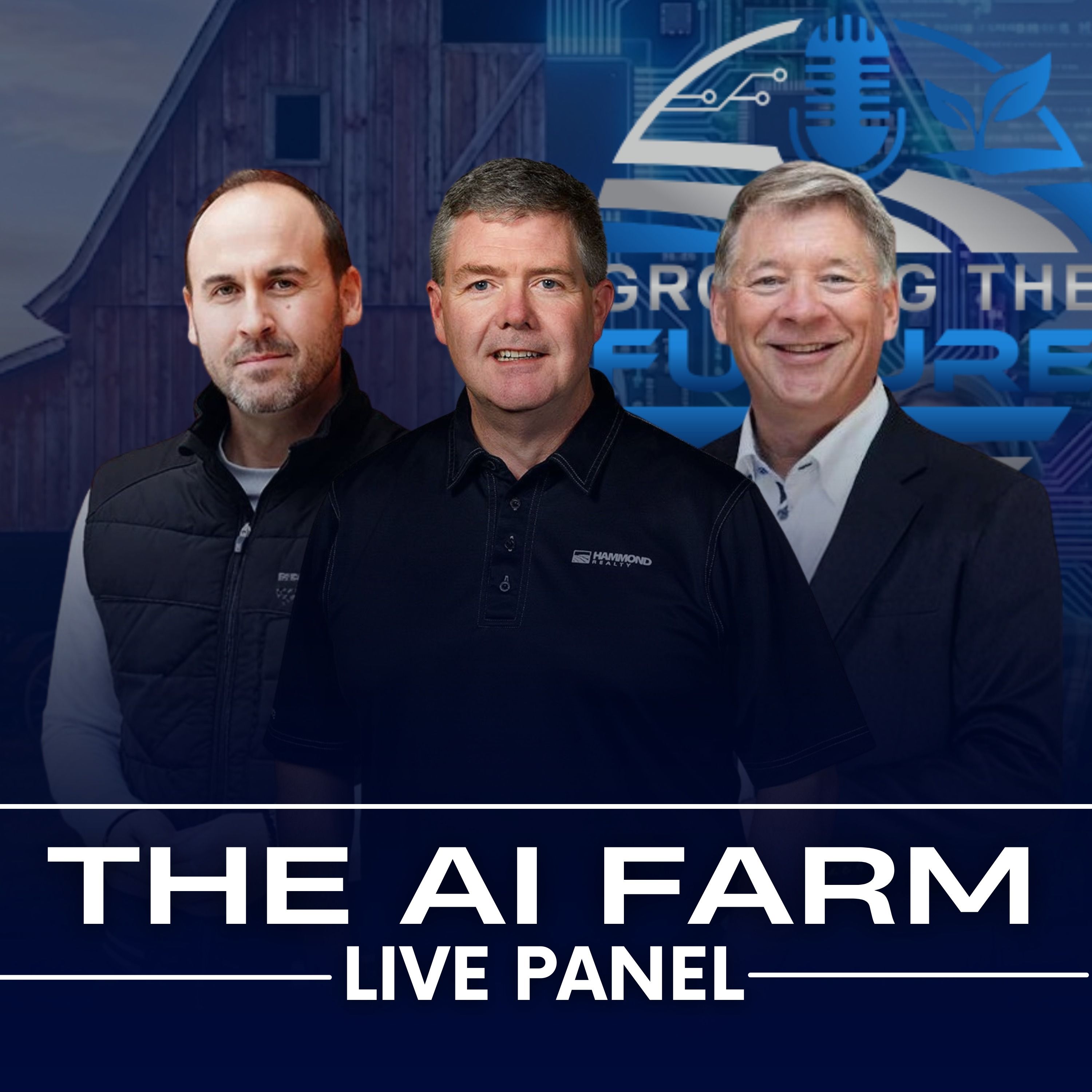
The webinar "The AI Farm" explores how artificial intelligence is transforming agriculture, emphasizing both opportunities and adoption challenges. Host Danny Hart introduces panelists Rob Psych, Tim Hammond, and Damon Johnson, who represent ag-tech innovation, real estate, and insurance sectors. Rob explains that while AI disruption is currently more pronounced in industries like management and finance, agriculture is seeing growth upstream, with robotics and data tools gaining traction. He demonstrates practical AI applications, such as using Perplexity for research and building custom tools for equipment management, recommending starting with accessible platforms. Tim shares his extensive use of AI to enhance productivity, and Damon discusses AI in insurance modeling. A poll reveals that while 27% of participants use AI tools regularly, 19% have not yet engaged with AI, highlighting a significant adoption gap. The session aims to bridge this gap by showcasing actionable ideas, from simple research tools to advanced automation, to help farmers leverage AI for improved decision-making and operational efficiency.
Good morning. I'm just doing an online meeting here. So I'll be back. Well, good morning. Look at this lovely crowd. Hello, hello, hello. Nice to see you all. Thanks for joining. Okay. I'm going to get this single on live on YouTube. If it works last time I tried it didn't work, but I'm going to be back. Second time's a charm. And are we in the money? Are we in the money? There we are. Okay. Can I mute that? And we are going to roll. Three of the sharpest minds in agriculture are sitting at the same table as you to talk about the technology that is transforming how we farm. This is the AI farm. And in the next 60 minutes, you're going to walk away with three amazing ideas, one from each of these power users. And at the end, you get to vote on the one that hits home for you. And it's going to make the most productivity gains in your life. That's very exciting. So stay tuned for that. If you're watching on YouTube right now, do me a favor. Smash that like button to hit subscribe. We do this every every every so often seems like every week now for producers all across North America live on the internet. And we're bringing you value. We've been talking about lots of different topics. Today we're getting into AI. My name is Danny Hart. Welcome to growing the future. And we've had a lot of events lately with people attending live and asking questions. Good morning, Harvey. And my dad's on the show. So he's become maybe my biggest fan. Let's say, hey, hey Rob is dad my biggest fan. Would you say? Harvey is he's he's right on the precipice of leading the technological charge. Harvey is. Yeah, I think he likes be better than Terry now, even though Terry's the farming silly, but I'm going up in the ranks with all these all these events. But anyways, I digress. But it's been fun. We've been covering fertilizer and the weather and succession and capital and farmland and the dream team. And now we're dipping our big toe. So to speak into AI. And here's why this matters right now. Rob say it's going to talk more about this, but the numbers on AI and agriculture are moving fast, roughly 70% of large scale farms and developed countries are already using at least one form of AI on their operation. Where are you? Where are you? The global AI and agriculture market was worth almost 5 billion bucks last year. How much of that did you get? And it is growing it over 26% a year. I think Rob's sake is mentally fact checking me now I'm interested here. What his opinion is on this. But the thing is so 80% of agribusiness to say they understand the potential of AI, but only 20% have actually adopted it. And I would hesitate to say that maybe more than 5% has been highly successful. Really. They're old, pretty principle. It's been hard to really implement in a way for a lot of folks. So we want to we want to bridge that gap today a little bit. And that's what I'm going to be with the school to be talking about here today. So producers are, you know, there's a big gap between who's pulling ahead with this technology and who's just dabbling and Steve jobs said this is a computer was a bicycle for your mind. Well, this is like a jet rocket. Some people are leaning into it. And that's why I brought these folks on the call. So let's talk about what we're going to do in the next 60 minutes. We're going to talk to some incredible folks for the first inaugural episode. There's a reason that these folks are on their heavy power users. They're going to share what they're doing as always. You can put your questions into the chat. The Q&A. I got some great questions in the registration already that I can ask. But let's meet our panelists first up Rob's sake founder and CEO of T1 technology corporation, the company behind egg visor pro and buy by visor pro author of the agricultural manifesto and food 5.0 how we feed the future. That's a good title for today and one of the most respected voices on egg innovation in North America keynote speaker convergence and some fella not a bad golfer rob 15 companies in the last 40 years like what you've been doing my man what you've been doing. Yeah, just bored. That's all just bored. Yes, cannot stop cannot stop till you drop. I love it. Well, you're going to lay down some AI notes upon us today and we're going to be highly educated. So you were the honestly Rob, you're probably the very first person I thought not to take anything away from the other contestants today, but you know, your business is really centered around helping equipment dealerships with AI and I think you're doing great work out there. So next up we have Tim Hammond founder of Hammond real to the team that is move more farm line in western Canada just about anybody guys who knows firsthand where the smart capital is going good morning, Tim. Morning down. Yeah, and we've had a lot of conversations about this AI topic and I'm really excited for what you're going to lay down today and Damon Johnson executive vice president of global ex-risk solutions. The Saskatchewan team that built the whole farm insurance and parametric weather modeling tools. That's a mouthful and you're helping producers across western Canada with their production insurance part of hub insurance now. Good morning, Damon, welcome. Good morning. Thank you for having me. Yeah, it's going to be really good. So I know you're working on some really deep, deep things there with AI. So before we get started, I just want to thank crop aid nutrition for being a platform partner Saskatoon based manufacturer soil health products. I put their links in the chat if you want to make contact with them. Thank you, crop aid for supporting this platform. Of course, Hammond real to Tim and I are having a fantastic time collaborating. I put the link in there. We're having a new event on the landmark. It's split the difference between what premium lands going for and how some average acres are starting to lag. I think you're going to want to check that out next week. So thanks Tim for for supporting the platform and then grip. Hey, this is a farm management software that it's built for real operators. We're using it on the farm. It's QR code base. They'll take a look under the hood at your operation for no charge and tell you what they can improve. So check out that link as well as a special offer. And then we just went live with my buddy store bone trail. I'm going to go to the original's appreciation store. Thank you so much. It's been a long journey getting here. But some beautiful stuff and show your appreciation for someone you love. I mean, talk about moving up on the ladder here. Harvey and Debbie were really impressed with game of Jesus Christel the other day and a little crystal of Harvey right side by side on the shelf. So you saw that. Hey, Robbie saw that in America. I mean, last night at your mom's place, there's, you know, there's a crystal of Jesus and Harvey side by side. So that's pretty amazing. Well, and you've got one on your own mantle of your idea from convergence as a speaker. So, yeah, yeah, drop your questions into the chat. You do 10 minute power rounds for each of these folks and we can chitter chatter as we go. But I want to get out the biggest idea about AI. Well, once you guys have some big takeaways, Rob, say you're up first. You got a little bit of a presentation and some ideas for us. I think I covered everything. Take it away. Let me know. Let me know if my screen's up. Your screen is up. Okay. First thing I want to share with everybody is that there is going to be tremendous dissent immediately Asian with AI and it's not the artificial insemination we grew up with on the farm. But artificial intelligence is going to reshape a lot of industries. The graphic I wanted to start off with is on the screen right now. And you can see there that the red is where the dissent immediately Asian is already happened. This is where job losses are occurring. This is where job shifts are happening. And the blue is the potential total dissent immediately Asian in each sector. You can see that management, business finance, computing, legal arts and media. Those things, office and administration highly disruptive agriculture. You can see where the arrow is is very low on the disruption. Now this is speaking of agriculture at the farm level and there's lots of things that Tim and Damon are going to share with you guys that can be done at farm level. But in terms of disruption at farm level because farming is such a hands on and such a rapidly changing business. Whether and insects and everything impacts and you have to make decisions now decisions are divided into two sides. One is prediction and the other is judgment prediction is where you're pulling together all current information from weather stations, soil, moisture probes, etc. Give me all the data man, the data man, give me some alerts and then I have to make a judgment call us to what I do. So the first thing I wanted to share is that there is lots of opportunity to integrate AI on the farming operation. A lot of the disruption in agriculture will happen upstream like in Tim's realty world, like in Damon's insurance world, like in molecular, molecular extraction for crop inputs. A lot of things will happen above the farm gate, but when you think about robotics and I was CEO of dot working with normal, normal bourgeois, when you think about robotics robotics are going to explode because AI is going to be harness with the robotics. So anyway, that's where I want to start off Dan. I'm going to take you through some exact information.
on my screen, you can see that I have chat GPT, I have vibe, I fives, a proper complexity cloud notebook, LM, Genes Park, and something called Rob psych. I'm going to take you through in 10 minutes to a new view a minute on that Rob. We're getting some comments that it's hard to see. Could you? OK. I'll just try to make it a little bit change my. There we go. This uh shared content only is that where I am. Yeah. All right. So the first thing I wanted to take you guys through is something AI is very good for figuring out how to help you with rep with with tasks that you repeat over and over again. So I built myself something called a dossier builder, which is going to create a background for people that I'm meeting with. So if I was for example, to meet with Tim Hammond of CEO of Realty, Hammond Realty in Saskatoon, I want to know everything I can. About Tim Hammond before I get into the phone call with him. So uh, so this is going to give me a complete background as to Tim Hammond and where I can collaborate with Tim Hammond in my world. And in my world, I have a lot of areas. I've got the power farm group. I've got Agbyser Pro, but it goes through here and it literally will break down. Everything that I want to know about Tim Hammond, it'll pull his, hit a pull his personality profile, how to work with him, practical, ROI's, professional background. This is stuff I do every day when I'm meeting a dis profile, a possible probable Colby of Tim Hammond, a 7632. I think that's probably pretty accurate decision filters, network analysis. Communication style, Tim prefers direct conversation in phone or in person over heavy email exchanges. All right, Tim. That is correct. That is correct. A Thet, uh, he prefers authenticity over polish credibility. Do not over complicate. Do not lead with jargon. Do not push too early. Uh, the capacity alignment scores. These are where my world would align with Tim. T1 technology corporation medium, Agbyser Pro medium to high, Vyzer Pro medium to low power farm high. He don't speak her high. Our factor. This is coach stuff now. DOS dangers, opportunities and strength. This is Chris boss. He's an FBI negotiator. Uh, it tells me how to negotiate with Tim on a tailored basis. Collaboration opportunity. Uh, soil health productivity joint initiatives, uh, authentic cross selling, uh, where I would not talk to Tim about his visor pro because that's for the machinery sector like young's equipment and full line and for mazer group, uh, red flags. Uh, these are red flags positioning. How long will it take for me to work with him? Uh, final insights. So bang. So there. I, if I'm having a meeting with Tim, this is something I do every meeting I do before I meet with somebody and farmers are meeting with people. They're meeting with grain buyers, they're meeting with suppliers. Uh, they're meeting with machinery salespeople. What would happen if a farmer actually knew more about the machinery salesperson than the machinery's houseperson knew about the farmer? So that's where I wanted to start. Uh, real quickly. This is visor pro visor pro is an AI that we built for the heavy equipment sector think construction, rental, agriculture machinery. Uh, I mentioned young's mazer group, Torgesons in Montana. If I was to advise farmers to get started on AI, I would start with perplexity perplexity is it awesome, uh, awesome and simple and reference based tool. What I wanted to highlight here is connectors and these are all the things that I have in my world that are connected to perplexity to allow me to, uh, advance how I'm leveraging AI in my world. Cloud is very, very popular. We're using cloud a lot for heavy, uh, for heavy, uh, AI work and you can see down here that if you go in here, you can choose the type of cloud you want to use and when we're, when we're doing model matching, in other words, matching a massive Ferguson tractor from an OEM manual to a work order. How many different ways can you spell, massive Ferguson? Well, we're using cloud opus 4.6 to help us behind the scenes on doing model matching. If you wanted to bring in, uh, an overview like a video or you wanted to bring in a book or you wanted to bring in a large article, then notebook L. M is a great way to bring in and you can see over here on the right hand side, I'll just make it a little bit bigger that I've got all sorts of reports in here that I'm trying to get information from and on the right hand side, I can turn them into, uh, podcasts, a slide deck, a video overview, flashcards, if I'm speaking. Jen's, Jen spark is another one that I'm using. This is a lot like perplexity and it's got all sorts of AI agents that are attached to it, including a super claw we won't talk about that. But anyways, this got the ability to take you wherever and finally down, I wanted to say it is if you haven't got enough Rob site, Karate, I'm building an avatar right now. And so I've loaded into my avatar. Uh, let's see here is. Yeah, what does that Robert site think about genetic engineering and agriculture? That's the quietest I've ever heard you. Anyway, so that that and then finally, um, if you're in, you know, cope, if you're in a, Microsoft environment, then there's co piloting. If you're in, uh, Google environment, this is, uh, hooking up, uh, all my Google drives and then leveraging Gemini over top of it because half of my life, I spend trying to find things in file folders. So, Rob, I just want to comment here. Uh, do you, do you think you, you could slow it down for the audience and just like pick one, one idea, you know, simple idea that they could implement today? Cause what you're going through is amazing, but it's 20 things for the audience that I think is just sort of a lot of folks. Um, I want to launch this poll. Well, I want to just set it up. Where are you on the AI curve? How would you describe your farm's current use of AI? Have not touched it yet. I have played with chat GPT or similar, but nothing on the operation. I'm using AI tools regularly for at least one part of my business. AI is built into how I run multiple parts of my operation and Rob, you stole my thunder on the artificial insemination. For some folks, artificial insemination may go way back on their farm, but I love it. Yes, a 10 quick start to bring some ideas and you get 30, but what is your work? Cause we got a boat on this. What is your number one simple idea? Take away that people could use today. You know, it's hard to get one right? Yeah, I would, I would start off if I was dabbling and getting involved, I would start off with perplexity. You could start off a perplexity free and perplexity pro, which is where I'm at right now. And I just put I'm a farmer's Saskatchewan looking for values and AF 11 combines what are the ranges and the interesting thing about perplexity that I like is that it always always comes with references. So you can see machine repeat, you can see iron search, you can see team options. You can see in here that there is always the references. And so, and then what happens is you got all the follow up questions that are here. So my takeaway for everybody, and I know I shared a lot of stuff real fast, but my takeaway is, is perplexity is a good place to start. It's a AI aggregator. So inside of perplexity, you have a whole bunch of different models that you can utilize. I should be a perplexity sales guy because I think I sold a lot of this stuff, but it'll do everything. And then if you get more serious than then you got this thing called computer over here. And maybe Damon or Tim will talk upon building AI agents. And if I switch over to computer, then what I can do is I can start to leverage hooking together multiple streams of data and have this thing automatically do things for me. So computer is taking it to another level. The first thing I showed you was Ragn technology, which is search technology. It's much better than Google. And of course, yeah, of course Google is catching up very, very fast, but it's simple. And computer takes a lot of things.
us into that whole area where you can build things for yourself. And I think the day was got an example of that. So yeah. So thank you Rob. That is unbelievably intense overview in 10 minutes of how to I mean, Tim and I were talking about this before we came on. The amount of information now processed in the day is staggering. Is it all good? You know, is it melting air brains? I don't know, I guess the future generations will see, but there's 19% that have not touched it yet. That's pretty significant. One in five. Haven't touched it yet. Wow. Thanks for being honest. I have played with chat, CBT or similar to nothing on the operation is 42% of people. Wow. That's really interesting. And 27% of you are using AI tools regularly. 10% I think are at where these, a lot of the folks on the call would be here. One in 10, you know, AI is helping, you know, it's built into running multiple parts of the operation and Rob, you had an example in your power farm. One of our farmers built a complete marketing. He put in his inventory, put in his contracts and a used cloud. I think he's glad to build a full marketing program for himself. Yeah. Hopefully he's having some bangers there as far as profits go. And then there is 2% that said artificial insemination goes way back on the farm and we salute you. Okay. I'm going to stop sharing. Who wants to go next? Who can, who's going to follow Rob here? Like Tim shaking his head, wishbone, wishbone's going to break here, Damon or Tim, who's feeling like going next year? Tim looks like he's ready to go. Okay, Tim, your person at the same time. Yeah. Very difficult to go after Rob, but very inspired, actually to kind of go after Rob, and so just a little bit of background on how much, like how curious I am about AI. And so I Christmas time, chat GPT said, hey Tim, do you want a summary of kind of our experience over the last year? And I said, sure. Yeah. Why not? Right. And so it said, okay, you're in the top 3% of a doctors of chat GPT, right? You're in the top 3% of there. You are in the top 1% of users. You had 26,500 messages in AI over 800 threads. And I was like, huh, really? I might have an addiction problem. But for me, it just AI has, it has expanded my thinking 10 fold, right? Because now I can ask a question, I get an answer like that, right? I don't have to go searching for it. And Rob, I am low on a fact finder. I'm only a four. I'm not a seven. So I need, I need, I need 70% of the information right away to make a decision or I only need 70%. So, but anyways, so that's kind of what got me into it. I just, I was fascinated with it. What I built it for, what I implant, I've done lots in our business. But one of the things that I did that maybe will roll over into the egg industry is I built a risk model. And really, my risk is in compliance, right? And so we have all these laws, rules, regulations, you know, not only with our regulator, but with our association. And so what I did is I compiled absolutely all the information that I know from these. So I got 400 pages of knowledge from the real estate commission. I got 400 pages of knowledge from the association of Saskatchewan Realtors and also Fintra. So what I did is I combined that into a GPT. That's the knowledge in there. And what I instructed my GPT to do is only interview that knowledge. I do not want you going out into the internet to hallucinate basically, right? And so I want you to focus your answers, your interrogation kind of on this. So and Rob, you'll, you'll, you'll like this. Is like I read a book. It's called the AI Driven Leader by Jeff Woods. I've been taking, I've been taking his course in Austin, Texas. Yeah, I was going to say I'm a student. You're a peer, right? But man, if you read one book about AI, read that book. And when I read it, I read it four times over. I'm an audible guy and I just read it over and over and over and over and it spoke to me. So Jake and so Jeff's premise is, you know, when you use AI, break it down into four things. Provide a context, right? What's going on in here? Give it a role. It can act as an expert or do whatever you want to do, right? And then have it interview you. So have it ask you questions one at a time. And that's where the real goal is because it will bring out your biases, your blind spots, what your assumptions are. That sort of thing. And then give it a task, right? This is the, so it's really an algorithm. It's no different than building a spreadsheet in Excel. It's just AI only is so much more powerful. So AI driven leadership by Jeff Woods, GE, OFF and what you just talked about is crit context role interview task. Yeah. Isn't it intuitive to read a book about AI? No, because it's still that human element, right? And that's the thing that we're never going to lose is that AI is going to free up the human element to achieve more of what they're capable. Is it, oh, Tim, we were talking about this and how we're both like 6 a.m. to 9 p.m. every day. And, you know, I think we need to do another show about, you know, the other side of this. But so Dan to pick up on what Tim said, this is really important for farmers. If you have a grain contract, I hope Damien's going to get into this. But if you have a grain contract, show that grain contract into one of the AIs and haven't analyzed that grain contract for anomalies that you would not want to live with or watch out. And that's a really good way to use AI is to do is to dissect legal documents. Yeah. Love it. Well, so we heard from Rob and his number one pick was use complexity. It's an aggregate perplexity perplexity. Start there perplexity. Start with perplexity. If you're perplexed about AI is a great start. Okay. And then Tim, I love this, how you're offloading. I mean, how fun is compliance? Do you have it? Do you know people that love, you have compliance lovers to people that want to, you know, fun party. We're going to the compliance party by the water cooler. Attention with me, right? We got compliance Tim and then we got business Tim, right? And those don't always make the same decisions together, right? But this compliance GPT that I make always makes the right decision from a compliance basis makes it known that it's not legal advice, right? It cites the sources. Okay. You know, this is how I came to this advice for you. And here's how I supported. So it provides confidence to the user that, yeah, this is actually right. And it also, it's a signal that, okay, I think you need to talk to either Tim about this or the real estate commission or whatever, right? And so I built all of that stuff into it. But what's amazing about this is now I don't have to take those calls all the time. They can get a lot of their answers, right? Right? All the gates and it scales it. So now all my team can do this. And if I expand my team from 10 to 50, they can all use it, right? Did you have a compliance officer before? Yeah, I was Tim. Oh, wow. Yeah. No fair. So you're able to tell the team now, well, you're able to share that GPT then and they can message it on their phone or in their computer and say, am I compliant with the boss? Yeah, the instructions are asked the GPT before you come to me, right? Let me get the answer. And if there's a complication, then give me a shell, right? And then they can actually share that thread with me. So I can see what the questions were that they asked and kind of follow it through. So for me, it is systemizing how we think and make decisions, right? And that is one of the toughest things to do with your team, right? Is to provide that consistency. I've got a few people on my left, her on that program as the computer before you talk to me. Go ahead. Those those those GPT's are like agents. And what Tim did was he instructed the agent what to do every time the one I used on the screen here. That was 4,000 words. So but I never have to do those 4,000 words again. It's done once. Well, and you put whole knowledge banks in there. I mean, you had Chris, the new grocery eater, you had strategic coach, you know, who knows who else is having a party in their Elon Musk? I mean, thinking girl Rich guy Napoleon Hill, who knows Rob taking notes. He's going to put Napoleon Hill in there. Go ahead, Tim. Well, I was just going to say, so that's what I've used that kind of managed my risk in my business. And so I, you know, I could encourage farmers to do the same thing kind of in their business, right? What are the, you know, what are the risks that you see out there, right? And I want to, you know, ask questions about that and set up kind of a framework to do that. my idea for
or four, kind of a farm enterprise, actually comes from the soft side of this, right? And Rob went into it with his GPT, and I'm gonna copy that Rob, 'cause I think it's brilliant. I'm also a student of strategic coach, but it's in how you communicate with people. And so I have profiles on my team that go in there and AI gives me an insight, how to position a message, to position the message differently with each one of them. It's the same message, but they receive information more. They have different fears, different risks, and so I'm using AI to do that. And I think one, I've noticed it over my career is 12,000 acres seems to be a barrier. The farmers who get through 12,000 acres, they have the ability to manage people, to run a human resource department, right? And so I think that if someone is struggling, kind of with that, AI can really help you get over that barrier, and then really it's unlimited, because you can scale it. - Oh, that's amazing. If you can send instructions to your team, about this is how Tim operates, because let's face it, not everybody understands that he might be a 10 quick start and a two follow through, and what that means for them, if they're the opposite, they're a two quick start, and a 10 follow through, Rob, you're indifferent, right? You know all that Colby stuff, you're in different planets. - Yeah, I think, let's just a little context, what we're talking about here is something called Colby Index. And it goes to a fact finder, follow through quick start, and implementer, those are the four areas of an index. And I won't hire anybody unless I'm a 4, 3, 9, 3, go figure. But that's what we're talking about here. But Tim's point is right, if you can understand what the person's modus operandi is, then you can approach them differently based on the conversation. - Yeah, my team in the Philippines does not only a file about how to write like me, but how to work with me, because this is what you should expect. - Colby, K-O-L-B-E, Colby. - Yeah, and there's a free, I think it's like 50 bucks to take that one. - 75 inflation. - 75 inflation, all these wars and everything, it's just things, everything keeps going up. What's holding you back? What is holding you back? Come with us into this AI revolution. The single biggest thing keeping you from going deeper with AI in your farm is, I don't know where it's start. Now, 30, 30 people are saying, I don't know where to start. Hopefully this helped. 17% are saying I don't trust a technology, yet a full 15% said, I am worried about my farm data being used. And 10% said, I do not have to time to learn it. And then nobody, nobody. God bless all the independent thinkers on this call. Nobody said, I don't wear the pens in this relationship. That's good. Just checking in. And then 29% said, a third said, nothing. I am all in. I didn't share the results there. So yeah, that's what things look like there. Well, Tim, thanks so much for sharing what you're doing there. And if we could get rid of some compliance, I'm compliant. I'm fully aligned with you're being compliant on compliance. So hopefully this call is compliant because I'd hate to be out of alignment on the compliance with the compliance boss. But Damon, you got a dear friend, cruel be than the rest of us, because you're been so quiet and just demure. And you're obviously a lot more introverted than the other three of us who are, you know, you're not fighting for airtime. No, cry at the back of the room. So yeah, call me 8-823, disk high C, and Myers-Briggs ISTJ. So take that for a quick one. Happy to be the quiet guy in the back of the room and chime in when the extroverts need some facts to back up their ideas. So happy to be here. But you want me to get into it a bit, Dan? Please take it away, Damon. Yeah, I was really excited about yours too. Yeah, so just a little background myself. So four sessions of mine, create this collision course that I'll talk about a bit where literally obsessive compulsive. So farming, so I come from a farming background still actively involved in an integrated farm here in essential Saskatchewan with my mom and my brothers. But economics background, so I'm obsessed with a modeling and try to predict the bad thing that's going to happen and do something about it. I'm obsessed with data and I'm obsessed with risk and this management and hedging that risk. I don't like bad things happening. If we can control their hedge or transfer it somehow, so hence my involvement in the insurance industry. And then in addition, in my abundance of spare time, I also have a fractional strategic consulting business where I work with a number of farms and agribusiness people. That's kind of funny. We're talking about AI and don't trust the technology and different things. And I forget exactly when it was then, but I say it was about a year ago where the big Microsoft update put co-pilot kind of as an add-on on our look on calendar on email. And the busiest day I've had in probably the last year is the day that happened. And I had probably seven farmers phone and or text me and go, how do I turn this off? I don't like it. It's kind of watching me. So I kind of visit a bit about an indicator that this transitioning to AI especially for agriculture producers to see my no many and long were not ready for this, but there's some benefits to come downstream from this. So that's kind of where I come from from this perspective. So day in and day out in my work, my team and I software engineering and data science were building predictive analytics and synthetic modeling for internally to understand, manage, transfer risk, most appropriately, and kind of create this, I really need ecosystem for that and disrupt it. But I always say, and then you mentioned the part where people just haven't got started or don't know where to start. And I always just say kind of start small and I'll show you an example or talk one example in a second. Where what's the pain pointer, what's the thing that hurts? So what's the thing you see that you like to manage? And when I'm at my farm with my brothers and working on the farm, I'm the guy sitting in the tractor, the spare of the coal mine with, and I always have dry erase markers in my wash kit and I write for those and I have a lot of them. And the windows and I take pictures of them and I would normally send them back to my software team and they would look at them and it was kind of clunky and different things like that. And now those just go straight into a cloud code and we get the JavaScript and the React Script and all the necessary things. So the ability to kind of take pain and idea and move it into action is fairly sweat. So when I think about the center of all this farmers, whether you are a farmer or we work with and advise to farms, there's a really unique opportunity here where, if I think about farmers who are world class, like Bronomy, Rotation Managers, Operators, Production Side, but maybe to where it min and office and the record keeping is less of a strength, depending on your structure and size and all those different things. But the days of the boxes, the shoe boxes overseas going to your bookkeeper, your account and still exist. And that's kind of one of the pain points that he is as I've been working with farmers and some of my side by stuff that you think about all the decisions you have to make in a day planning, logistics, record organization, people accounting, inventory management, grain marketing, agronomy, weather, all these different types of things is, you know, I would say that there's a really unique opportunity in an order to start small and just with one pain point, but moving it and get a bigger and I'll talk about something that I did last night, but you know, I just transitioning years of, I'll just call it messy data, probably 10 years of Excel spreadsheets that don't have great formulas in them or maybe no formulas and it's, that's a common thing. So the level of sophistication at the farm level and this isn't being disparaging. It's just the reality of that Excel week. We all live in die by Excel, you know, even up until now. So the amount of info that we need to consume on a daily basis in terms of organization and understanding to make decisions plus all of the historical stuff that we have, yield directors, or your grown-upy record, spring records, you name it, all exists. So I thought about it in preparation for this, you know, knowing that thinking about cloud, so I, you know, we love to fly here. We use it every single day, where I was, you know, Rob mentioned it. So I took, you know, some brain marketing information, historical field records, legal land descriptions, lat longs, historical rotation, historical yields, historical spray records, and uploaded into, started a cloud project, because that's the place you want to go. So it always remembers the previous input. And I asked it to, I just got some notes here. So I built a custom brain marketing decision agent and input cost in ROI, tracking dashboard, or the weather and spray window detection tool, a seating date, fertility calculator, operations and maintenance logs. So those five or six things. And in a previous life, and people who come from this previous life, and I know that there's some on this call, is that these, you know, kind of, that's what was known as a fully integrated platform. And it took millions of dollars and several years to build that, you know, literally, in this speed to market,
where plot has really become what I call our prototype partner where we always say we want to fail fast So that you don't spend in lunch and spend the time and money getting to a prototype that you can only test to see if it's going to work In some kind of commercial setting and So you'll last night Just I don't have much with social life. So I took the this premise with all this information Created the prompts and upload it into the system. So there's I'm just looking on my screen here. There's six different tabs in a fully digitized react workspace with the Google map and since of all my fields bordered and that took me about 12 minutes to To create and I'm you know, so and then you get a rate of it. So you'll adjust that move the satellite You know, so it's not over top of the zoom window and different things like that But anybody who is pleased to use it knows what I mean, but it's really intuitive and it's kind of like Maybe you do the same thing down. I sit in my office and I kind of talk to myself. Well, they are right notes on whiteboards And it's almost like talking to yourself, but you're just typing it into your plot and it's generating the thing that You're kind of turning into mind and You know, so from that standpoint, you know, again, Rob you talked about the you know upload grain marketing contracts or publications that are 25 pages long and you just need the tenable points or different things like that. So I think from an applicability standpoint it's it's It seems scary and It's certainly not that you use it as well down We use it for everything in our daily life and I usually sit here Starting about 5 a.m. Every morning and it's just instinctual. I probably use it six times today I don't even really realize that I have it's you know, I'll do AI and Prezi and different systems to just It's just helps our life. Oh, so And from the farm perspective Farmers are so Visionary and ideological and intuitive that is just kind of taken what exists in here in terms and putting it Into a GKT to create that thing that they want to see in it's it's you just have to do it once and it's fascinating And I know like Tim and Rob down like it it becomes an obsession almost like an unhealthy one at this point So that's for me to deal with but um It's it's come so far. I was even thinking about a year ago This was even the radar. Yeah, but it's in the business Yeah, and there's going to be other leaps. I love that Finally like we always talked about this moment Rob where we would be standing here and we could take the last decade of data that everybody's been so Studious and collecting and not knowing what we're going to do with it now we can parse it Oh, yeah, I mean agriculture and we collected 20 20 years of data all across western can't on North America and imagine what we could do By layering AI. I have uh Damon uh farmers are very good at sketching out stuff I saw a a diagram the other day farmer was sketching out the value of straw And they were working on the formula and it was just all sketched out on a piece of paper So do this take a picture of your sketch and throw it into AI Take a picture of something that you're doing some Drawing some miscellaneous documentation either writing or a sketch Throw it into AI and have it do something with it So the value of straw was all worked out by Karen. She'd worked out all his values I grabbed it through it in and immediately said to AI build formulas around this so I can use this uh thinking It's the thinking that you need to have and then apply AI to do the work Well Tim I want to get your thoughts on what Damon shared too and we're going to get the questions here very shortly Got about 15 minutes left if we're going to keep it true to the Drop of the hour and respect people's time, but sometimes we go a little bit longer But Tim what do you think in there? I'm putting up another pool and I share it shortly. What do you think in Tim what uh Damon shared there? Oh, well, I mean I just I mean we're hours from the day to play with AI Yeah, I I mean it is just such a tool just such an amazing tool and how You can condense your thinking into into much more productive Kind of blocks so much quicker and model things right it's just uh It's just so amazing and then and then also like the AI is just changing so rapidly too right? So what I knew you know kind of 18 months ago It's different today and and and so and I think that's maybe the part of being in it all the time is if you You know if you go away for a week you're gonna notice that something has changed already right and uh go away for a week Tim You cannot you can't go for a way for a week right? Even if I get on a cruise ship that you can miss something oh yeah Right? As soon as you get on a boat all hell breaks loose yeah But I mean it's it's using it as a part partner right and you know and that that's the thing is sure It'll help you come up with solutions, but you got to direct it right you got to say no these are the parameters and you have to give it context and I actually think like you know You know probably 35 to 60 year olds We're the ones that are really leveraging it because number one we got context we understand what's actually going on and the nuances and number two We're curious we are built to ask questions and AI thrives on that right and so Yeah, those are just a few of my thoughts on it five years from now AI on your farm will be a small helper with a few specific tasks Said 9% a core part of how I make decisions every day Half a folks said that half a folks at a core part. I think that's a big shift Uh running parts of my operation on its own 17% And 4% said hopefully replacing me every way in every way that's my hope And 21% I honestly do not know Lord help us Lord help us all Um And I'm gonna we'll get the questions here, but I'm gonna take the liberty of showing you how I use AI this morning before this call And I want to uh share desktop 3 um and what I did was so I get an email every time somebody registers, right So what I ask Claude as an extension in my gmail is hey, can you help uh scrape all the emails for the webinar registration for the AI farm Creatilist of any questions and who they're from so here they are um This is one of my favorite things to do is just let AI do the hard work in my email So I don't have to look through them and figure them out because we had hundreds of registrations and some people put comments in here And here here they are so um That's that's a lot of fun and I'm using it every day now all the time to help me figure out like what's going on in my email and who said what and how to circle back So if you didn't know you can put AI right into your browser and go to town until the cows come home so um great Great stuff we're gonna vote here very shortly on rob sake said try perplexity. It's an aggregator of Of technology of the AI technology It probably does 80% of the heavy lifting in a lot of these cases Uh, Tim shared how he's staying compliant in the universe by replicating that through a GPT that he can share with his team And Damon built a dashboard in seven minutes. I mean hopefully you have a seated seated heat in the old uh Louvre These days because you can get so much done In the can know on a phone. It's a little scary, but uh Yeah, so it built a whole to the dashboard for the farm, you know from all that aggregated data and it's just Some crazy. So who did you think was the best we'll get to that shortly, but we had some questions here Uh for our expert panel Carl Stroubel is asking can you explain the difference between machine learning and AI? And I wonder if that plays into like what is physical AI and in farming and I don't know um rob did you You're kind of at the cutting edge of all this What's machine learning? Like we sort of yeah, what is that at? I mean, I'll use dot as an example So we were working on dot and back in the day when we were working on dot We did to do a lot of programming so algorithms We had to build a lot of algorithms programs to anticipate what dot might see in the field as it's doing its robotic action today With AI dot wood Not only encounter something unusual, but think through the actions as to How to get around the problem for example if you had a dead moose in the field and you were spraying Dot would normally just stop that's the algorithm at work saying there's an issue with an object Today you could use AI to say hey, there's an object in the field here's what it likely is Back up go around it. That's the difference between AI Damon you might have a real good at explanation because I gather it from your programming background like machine learning Will be leveraged on top or AI will be levers on top of machine learning Yeah, like AI is the you know, it's the thing that's simulating our intelligence is as crazy as that sounds and the machine learning component is Is what trains that model two things like we do or we have and In a technical sensor in our daily work my team and I where It's the better the historical Data to train the model the better the AI is going to begin that's always kind of been the The delta between this is that there's a lot there has been lots of bad data that's going into it and thereby the Recommendations or the AI or the way that it's simulating our thinking will be flawed and I certainly might
taking us off as often. So from a technical standpoint, if you think about building a predictive model in a yield-prediction model agriculture, there's all this remote-sense data from weather, satellite imagery, soils, all these like substance data that we go and get. We extract, transform, and load it. We do exploratory data analysis. We select the features that are most likely to represent. To think like we do and create the ideal outcome with any human intervention, then you train the models based off of that. So it's the input and then output is essentially the or cause and effect. - So dad, if you think back to the clean seeder, the clean seed, the air seed, it could vary six different things per shank. So think about that, right? So it could vary your seed and five different fertilizers per shank. Well, who could program that? Nobody. There's no agronomist on the face of the planet that could program that kind of variation, fertilizer, a variable fertilizer application rates. But if you had a sensor in front of the tractor that could sense what was in the soil, and you could build an algorithm that basically was your recipe, and then you could have AI actually vary six different nutrients per shank every 12 inches across the field. Like it's, it's, it would be impossible without AI. - Okay, we got nine minutes left and we still want to vote. So I want to try and get everybody's questions. So let's keep our answers succinct if we can, gentlemen. Chris Subchuck is asking, speaking of trusting it, how can we verify that the data back is accurate? Tim, you were saying you got to read everything anyways. - Yeah, I do. I mean, you know, when I'm working on something and it's doing 95% of what I needed to, I still need to read it to make sure that it's 100% accurate, right? And actually, when I built this GPT on compliance, when I started playing around with it, I'm like, nope, you're not getting this right. I need to reprogram it, right? And so, you know, Rob, you said your prompt is 4,000 characters, mine is 8,000. And I had to move it from one AI to another. So I used chat GPT to play it off against clot and then I'd rewrite it in clot and put it into it. And so I had to play with it to figure out this is the output that I want. This is the answer that I want. This is the consistency. So it's trial and error. You're not going to get it perfect the first time around, but you train it, right? You train it with your prompts. - Well, now I might be answering this next question from Stefan if I said your name right there, I hope. How do you deal with AI hallucination? You know, well, there are ways to build it into, like the more context you give it to, if you just, I mean, the problem with chat GPT is gonna make up things if it doesn't all the answers. So if you give it context, Rob, I see that you've got some-- - You sure on that? - Well, yeah, just our visor pro that Young's Equipment, Mazer Group, full line are using in Saskatchewan Ag World, it will give you an answer and always the reference. So you need to have a human in the loop to Tim's point, but we've designed it on data that is curated data, so it cannot go externally to hallucinate and you need to have a human in the loop. - Yeah. - Jason LeBlanc is saying all three of these gentlemen have equally great info. You ask us to vote, but it's impossible, so I ask you to get AI to vote. This may provide confidence, yeah. Well, and Jason sent me a comment here that I really liked. AI is the future, some don't believe that, and they thought the TV or the Fax machine where I'm gonna insert my own thing here, probably the steel tractor was a Fad, right? Remember nobody wanted the steel tractor? I didn't get rid of those horses. I worked hard for 36 years as an auctioneer and I got replaced by a button, ha ha. So as fire managers, are you prepared to be replaced by AI? Jason LeBlanc said it, are you, I'm prepared. I mean, as long as, you know, it's gonna give you three squares a day, you know? - Knowing Jason he'll never be replaced. - Well, how can we replace? I mean, no way I could replicate that auctioneer's voice or that, that, that, Southeastern Saskatchewan charm, let's be real. But Ryan Giles from Oxbow Eggland Corporation, Calgary, Alberta, when will drones be able to scout fields and when will they be able to spray large, small grain farms? - Oh, well, this is precision agriculture. I mean, the disruption is $264 billion that Goldman Sachs predicts that precision ag will steal from chemistry, chemicals and fertilizer. I mean, I saw a video yesterday where laser beams are being used in Germany to shoot out weeds. I was in Yuma, Arizona where they were using herbicide to spray out plantain beside a lettuce plant. How many colored batches have you seen on your farm and you don't know how to make sense of it? AI can start to, right, Damon? - Oh, yep. Doug Berry is saying, "How can we use "over the hill farms, Glenboro, Manitoba? "How can we use AI and shop maintenance "in operation work related to potato business?" Oh man, doesn't, I mean. - Start with grip. - That's what I was gonna say. Start with grip, man. Get those QR codes. Link is in the chat or send me a text, but yeah, we're using that on the farm and that's a wonderful thing. Blake Koocher is Star Link and AI with a tractor of viable options such as an air drill with mapping software. Where are we with connectivity in AI? - Well, I, again, I think it's a viable option. They're doing it in Brazil. I mean, John Deere and Case of Sign Deals with Star Link. And if you're following the war in Ukraine, the Ukrainians are using Star Link and everything in the Russians' camp anymore and that's wonderful. And in terms of accuracy, if you spend a little bit of time following what's going on there, the accuracy is out of this world. - How can AI improve marketing of your crop? Well, you just had the example rob of a young fella in the power farm that was using AI. Yeah, I guess that's a great question to ask AI, maybe ask AI. Just like when the internet started, does anybody remember ask Jeaves? That dude, when we were asking Jeaves, now we got the real thing. So I'm gonna go ahead. Go ahead. - I'm gonna say to that question specifically, that was one of the components that built into the dashboard actually. So that, love it. - Club prompt, I'll read it. Just quick, but it's, so I just said, create a green-gum-marking calculator for a 7,000 acre. We can all out barley, farm, and Saskatchewan. I want to input expected deals. Current future prices, storage costs, and the basis levels. It should model three marketing scenarios, solid harvest, stage monthly sales, and price target triggers show me a chart comparing that revenue for each strategy. So you just talk to it, like I just did, you just, but you have to type it. And it does the thing that you just said, it's, it's, it's, it's pulling it. - And my tip is download whisper flow because it allows you to hit the function button on your computer, and it records what you say, and it smooths it out. So I talked to my computer, I don't type, a typing is a little bit of a quaint, quaint thing like a typewriter. Well, final poll. Who's, where's that go now? Who's idea was your favorite? It's all in good fun. We're gonna send them something, probably something from Bone Trail, little monument for being the winner, winner, chicken dinner on the very first episode of the AI Farm. And I just can't wait to do more episodes, talking with friends and neighbors about AI. And I don't know, are we more confused or less confused? More inspired, less inspired, just wanna go in the woods and take a breath, smell nature, whoo, touch grass, touch grass folks. It's okay. Kent Erickson says you say AI and precision egg is gonna take 264 ish billion from chemistry, et cetera. How much of that dollars is from human employment? Is there a downside to human job loss to be factored in? - Yeah. - Will AI be a net job creator or loser? That's a big one. - Hey, some of the numbers in my head, so 264 billion according to Goldman Sachs precision egg because a more precise application of pesticides will steal 66 billion dollars from pesticides, 60 billion dollars from 60 billion dollars from fertilizer. I think the number was 70 billion dollars from labor. So it will impact labor. - But let's put in agriculture then. I'm arguing anybody who's sitting there is clicking on a screen, your days are numbered because. - But this wasn't an AI survey. This was a precision egg survey and I argued that AI is gonna allow farmers to apply precision egg faster better. - Well, there's gonna be jobs for everybody, lots of food and drink, universal income, Elon Musk gonna fix everything, right? Self-driving cars, we'll live like the Jetsons, you do what you want, or what? Or what? Well, drum roll. Oh, this is crazy. Guess who won? - Yeah. - I think Damon, I mean, it's all great ideas, like Jason said, hard to pick one, but you know Damon probably years, maybe inspired people like to build a dashboard with their information. Tim, you probably lost though, 'cause of compliance, you know. - That's right. - That's why I built the GBT.
- Everyone losing is to have compliance. - But no one likes risk, right? - Well, it's, you know, but that's the, maybe the first thing to offload in the unique ability matrix. We've talked about a strategic coach is like, I'm trying to automate everything I don't love. I don't want to get replaced from doing these events 'cause there are a lot of fun, but anyways. And one thing I wanted to do too is, I wanted to share all this in the growing the future mastermind and create some templates and tools out of all these conversations in the future. So I think we're going to, we're gonna do that. We're gonna put that in the mastermind. But final words on AI folks, just to go around the horn, we're almost on the hour here. Who wants to take it away and just give their final synopsis on this AI? What did you think of the AI farm and what do you recommend people get started with, et cetera, et cetera? Maybe we'll let the most introverted fellow go first, Damon, what do you think? You were the winner. By the way, we're gonna send you something from Bone Trail. - Do I get the rest of the day off? Can you text the events in the video? - Well, you've been so productive. Take some time. Take some time. - Yeah, I don't, it's become, it's not, you know, start small. Start with a pain point and just like anything, like when we started using the internet or email or will you start it small and now it, it's like an extension of that. So then try it out and you'll know very quickly if you also hit it. That's the other thing. So, but you don't know until you try. - What about you, Tim? What did you think of the AI farm? What do you recommend to folks? What's your final word? - Yeah, exactly that. It's just, just start playing with it, right? You know, and I think every person uses it a little bit differently and you'll find out where you gravitate to, right? By using it. And also if you're a slow type or just chat to it, that's why they call it chat GPT. You can call it, right? It's in the name, yeah, you can literally talk to it. And Rob, we're giving you the final word. - What do you think, man? - Play. Be a button pusher, play with it. Just, and use it as a thought partner. On the farm, you're off and alone. Just talk, just talk like Tim says, talk to AI about any idea you have and see where it goes. And I think that's the biggest thing. I have to stop myself every day and think about, okay, how can I leverage AI to do this instead of me doing it? And the results are astounding. It helps you, it helps you on block your creativity. - Well, thank all of you for coming on to the very first episode and I was very excited to have this. And hopefully that was somewhat illuminating. Chris Objetka is saying, being able to ask specific and put in good content on what you want will get you good answers, specific questions. And then Darcy Nesbo is saying, go to YouTube, why T, University, YouTube, University, why T? Why T is something different than YouTube? And learn pretty much all that's out there on AI. I mean, it kind of comes down to your passions where you want to spend your time, but I would argue that AI can help you increase your passions, whatever it is. We are in a new age, folks. Everything's changing really fast. We want to keep you up to date here at growing the future. So look forward to more conversations like this. Next week, Tim, we're back. Do you want to give a pitch on that? Yeah, sure. Well, I'm here. Just a little bit. We had a great kind of session about a month ago, just about the farmland market and Saskatchewan and how it's splitting, right? And how there's a different demand for good land and good area than there is for average land in average area. So we're going to drill down more on that, right? And kind of identify what's really driving kind of the, well, the average land, you know, kind of factor in that. We got a couple of egg lenders on there just to tap into their expertise. So yeah, I'm looking forward to it, Dan. Yeah, it's going to be really great. And then Wednesday, for the first time ever, get guess who's coming to the show? Drew Lerner. Drew Lerner. Drew Lerner's coming on Wednesday. So the links in there and we're going to be talking whether that's brought you by Crop A Nutrition. So anyways, it's been fun. Thanks for everybody that attended. We had over 100 on the call at one point there. So thank you very much and great conversation. And we'll do this again. We'll do the wrap around soon and then you, Damon will invent something new in seven minutes. You don't have to come back on the show and Rob will be, he's, we'll have his avatar in actually next time. It won't be the real Rob, but, Arthur and Kirkoff says great combo is and Tim, thanks so much for supporting the channel. Thank you everybody that came and we'll talk to you about growing the future even more soon. Thanks so much. - Thank you guys. - Take care guys, thank you for coming on. Thanks everybody that attended.
Podcast Summary
Key Points:
The webinar "The AI Farm" discusses the adoption and impact of artificial intelligence in agriculture, highlighting a gap between awareness and practical implementation.
Panelists include experts from ag-tech, real estate, and insurance, sharing insights on AI tools like Perplexity, specialized software, and data integration for farm operations.
AI's current disruption in agriculture is more significant upstream (e.g., insurance, real estate) than at the farm level, but tools for prediction, decision-making, and automation are emerging.
Practical AI applications demonstrated include dossier builders for meetings, equipment management systems, and data analysis tools to improve efficiency and decision-making.
Poll results show varying levels of AI adoption among farmers, with many still experimenting or not yet using AI in their operations.
Summary:
The webinar "The AI Farm" explores how artificial intelligence is transforming agriculture, emphasizing both opportunities and adoption challenges. Host Danny Hart introduces panelists Rob Psych, Tim Hammond, and Damon Johnson, who represent ag-tech innovation, real estate, and insurance sectors. Rob explains that while AI disruption is currently more pronounced in industries like management and finance, agriculture is seeing growth upstream, with robotics and data tools gaining traction.
He demonstrates practical AI applications, such as using Perplexity for research and building custom tools for equipment management, recommending starting with accessible platforms. Tim shares his extensive use of AI to enhance productivity, and Damon discusses AI in insurance modeling. A poll reveals that while 27% of participants use AI tools regularly, 19% have not yet engaged with AI, highlighting a significant adoption gap.
The session aims to bridge this gap by showcasing actionable ideas, from simple research tools to advanced automation, to help farmers leverage AI for improved decision-making and operational efficiency.
FAQs
The AI Farm event features discussions with experts on how AI technology is transforming agriculture, offering practical ideas and insights for farmers to enhance productivity.
Approximately 70% of large-scale farms in developed countries use at least one form of AI, but only about 20% of agribusinesses have adopted it, with even fewer achieving high success.
Perplexity is recommended as a user-friendly AI aggregator tool that provides referenced answers, making it a great starting point for those new to AI in farming.
AI can build detailed dossiers on individuals by analyzing their background, personality, and professional details, helping users gather insights before meetings for better collaboration.
AI disruption is significant upstream in areas like realty, insurance, and crop inputs, while on-farm disruption is lower due to the hands-on, variable nature of farming decisions.
Advanced tools include Vyzer Pro for equipment sectors, Cloud for data matching, and platforms like Computer for building custom AI agents to automate tasks.
Chat with AI
Loading...
Pro features
Go deeper with this episode
Unlock creator-grade tools that turn any transcript into show notes and subtitle files.
 PodcastTranscript AI